Get every episode summarized
Each time The Briefing with Albert Mohler publishes, we email you a written briefing from the transcript — the topics, who appeared, and any specific claims, with the ad reads skipped.
Email me new episodesFree for 3 shows. No card needed.
About this episode
Part I (00:13 – 10:03)
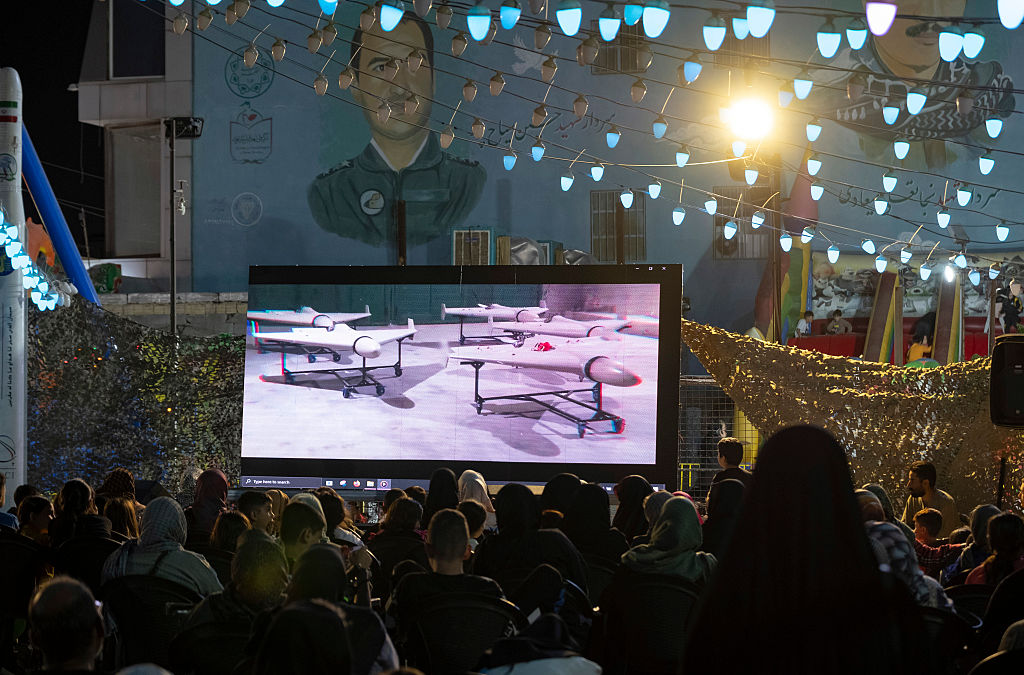
Asymmetrical Warfare in Iran: The Cheap But Highly Effective Drones That are Shaping the War in Iran
- ‘Designed to Wreak Havoc’: The Cheap Drones Shaping the War With Iran by The New York Times (Paul Mozur and Adam Satariano)
ISIS Operatives Attack Near Mayor’s Mansion in NYC: Two Young Men Tried to Carry Out Explosive, Terrorist Attack in NYC – Are Americans Even Paying Attention?
Part III (15:05 – 18:16)
Purim and the War in Iran: Biblical History Collides with Modern History
Part IV (18:16 – 26:46)
Bible Sales in the UK are Soaring: Young People are Dissatisfied in Secularism and Buying Bibles in Record Numbers. What’s Going On?
- Soaring Bible sales prove the young are looking for meaning in our soulless culture by The Telegraph (Bijan Omrani)
Follow Dr. Mohler:
X | Instagram | Facebook | YouTube
For more information on The Southern Baptist Theological Seminary, go to sbts.edu.
For more information on Boyce College, just go to BoyceCollege.com.
To write Dr. Mohler or submit a question for The Mailbox, go here.
Get every episode summarized
Each time The Briefing with Albert Mohler publishes, we email you a written briefing from the transcript — the topics, who appeared, and any specific claims, with the ad reads skipped.
Email me new episodesFree for 3 shows. No card needed.
Hosts & guests

Transcript ready
437 searchable segments. Every word is indexed and playable.
Full transcript
The Briefing with Albert Mohler — Wednesday, March 11, 2026. Machine-transcribed; use the interactive transcript above to jump the player to any line.
It's Wednesday, March 11th, 2026. I'm Albert Moller, and this is The Briefing, a daily analysis of news and events from a Christian worldview. Headlines continue to flow from all over the world, but in particular, of course, a lot of attention right now to military action undertaken by the United States and Israel against Iran. And those headlines are coming to us pretty fast and furiously. The Trump administration and the Netanyahu government in Israel have both indicated that a good many of the aims of the military effort have been met. But still, you're looking at widespread opposition coming from Iran and continued asymmetrical warfare. Asymmetrical warfare means that there is no way that Iran can launch a similar attack to that which is being directed towards it by Israel and the United States. Asymmetrical means there isn't a symmetry. And so this is one of those military terms that entered into our popular conversation
in the last century toward the end of last century. And it shows something that to the Christian worldview is very important. We understand how peace is established among nations. We understand how this is a challenge, but it is also a possibility, at least for some temporary amount of time. Many of the bad actors around the world aren't truly nation-states. And so there are all kinds of terrorist groups, for example, that would represent a direct threat to the United States. But the United States can't fight that group exactly like it would fight a naval or air or ground action against the nation state. When it comes to Iran, here's what things get complicated because Iran is a nation-state. At the same time, it is also involved in all kinds of proxy terrorist activities. There's the asymmetry. But the asymmetry is also present right now in the fact that you don't have a major Iranian air force or army, no major ground forces involved here. And so in the main, the pushback coming from Iran is coming from either proxies, which
means other nations, groups such as Hezbollah and Hamas. But also you have the reality that Israel and the Gulf states are now facing a barrage of attacks from Iran with missiles and drones. And thus you have a situation in which Iran no longer really has an operational air force, and it does have missiles and drones. So long as it has missiles and drones, it still can pack a potent punch. And that has been a great surprise, I think, to many of the nations there, especially in the Gulf region. All right. But embedded in this story is something that's also just really, really interesting. So let's consider the fact that most people operate out of a worldview, especially in the West, Western nations in the modern age. The citizens of those nations generally think of progress as a straight line in one direction. So everything's going toward something of more sophistication, more complexity, more automation, more digital technology. And the ones who have the big money for all those technologies are the ones who are going to win. And this is a part of the conceit of the arrogance of many civilizations, including modern civilizations
like the United States. They believe that because we are in control of all this massive technology, we have the biggest, we have the cutting edge. And by the way, China is openly rivaling the United States, seeking to become a rival force to the United States in those matters. The fact is that on the ground war is always surprising. This is something that Christians should understand. There's an unpredictability in war. As a matter of fact, there have been military maxims just based upon the fact that war is unpredictable. As is often been stated, battle plans make sense until the battle starts. And at that point, you have all kinds of contingencies and unexpected developments. Okay, here is a huge story, and I think there's so many headlines coming out of this particular warfare, military action, that this has been missed by a lot of Americans. Here's the big story. You look at Iranians trying to get American technology, Western technology, in particular, nuclear technology. You look at the United States, which has all of this advanced military technology. And frankly, it is astounding. It is absolutely amazing.
But at the same time, if a weapon kills you, you're dead, regardless of whether it is a primitive weapon or a very advanced weapon. One of the issues of asymmetry that has become very interesting, and especially when you're thinking about not just what's taking place now in Iraq, but even on a larger scale, what has taken place since Russia invaded Ukraine four years ago. Here's a big story. Some of the most unsophisticated weapons have turned out to be some of the most important. Before you might say there's a middle level of sophistication, you're not talking about an F-35 or some kind of modern, you know, third, fourth or fifth generation fighter, you're just talking about a drone. You're just talking about a missile. Drones in particular have been game changers. And so drones are autonomous aircraft. So the difference between a drone and a fighter jet is that there's a human pilot in the fighter jet by definition of drones a drone because there is no human pilot in it. And sometimes once they are in the air, they can actually operate without any continued human contact or guidance that turns out to be important because they also now have
a range that at least in some cases is outside of what would be the operational range for direct human control. So they're pre-targeted. Now, you look at that and you say, okay, the United States should be good at that. Well, the United States is getting better at that. American Armed Forces are getting better than that. Right now, the United States is using very effective drones against Iran, but here's the interesting part of the story. Iran, in one sense, developed those weapons. The United States military years ago captured an Iranian drone in a previous military effort and looked at it and said, you know, we have these incredibly sophisticated multi-million, sometimes almost billion dollar fighters. We have all these things that are available that Iran can never touch, but they're doing a lot of damage with these drones. Well, these drones are cheap. They're certainly inexpensive compared to modern fighter jets, but they can be also very deadly. And so guess what, Americans are verse engineered an Iranian drone. And this has been one of those stories that Americans really hadn't known much about.
The New York Times ran a very interesting investigative report on these drones. The headline was, in a new world of war drones, U.S. builds on Iranian design. And so you have a pair of reporters who are listening to this. Long before Iranian drones rained down on airport skyscrapers and embassies across the Persian Gulf this past week, the United States military was busy trying to find cheap ways to shoot to them down. I go on, quote, in 2024, the military's research and development effort, reverse engineered the Shahed drone, the Iranian drone, to use for target practice aiming to develop new defenses against a weapon that Iran had been sharing with allies, including Russia, Venezuela, and his blow up. So follow the logic here. This is really fascinating. The Americans reverse engineered an Iranian drone in order to find ways more effective at shooting those drones down. But then those involved in that effort thought for just a moment and said, wait just a minute. We don't need to learn just how to shoot Iranian drones down.
We need our own drones. So as the time says, quote, then came an idea. If the Iranian drone was so cheap and effective, why not just copy it? The report then states, quote, thus was born the United States low cost unmanned combat system or LUCAS, Lucas, quote, over the past week American forces used the drone for the first time in combat to hit infrastructure and overwhelm Iranian air defense systems. I find that just amazing. So the Americans faced the threat from Iranians using drones. The Americans captured one of the drones and then they reverse engineered it. In other words, they looked at it, took it apart, figured out all the parts, figured out the technology in order to copy it. They copied it in order to try to defeat it. But then they had the amazing thought, wait just a minute. Don't we need some of these for ourselves? Let me tell you something about the asymmetry of drone warfare. It really becomes very interesting because when you're talking about this kind of asymmetry where you have a one nation, smaller nation without the technology, without the resources,
with drones that can do a lot of damage. This has been a tremendous shock to Russia. Russia, and we have this recently verified in internal documents from Russia, Russia thought its invasion of Ukraine would lead to a Ukrainian surrender within just a matter of days. Russian generals were sent into the battle with their dress uniform so that they could wear the dress uniform in victory parades. They thought what happened in just a matter of days. Four years later, not so fast. And at least a part of how the Ukrainians have been able to fight back so bravely is because they made use of these drones, some missiles, yes, but mostly the kinds of drones. Also, the Ukrainians have been ingenious and coming up with unmanned vehicles, including some on water that have been incredibly effective. Autonomous weapons, basically small boats on the water that can punch, well, they can punch big. And the Russian Navy has learned that. So we are looking at something that I think is very interesting. And I just recall the fact that sometimes we're talking about, say, battle and warfare.
You go back to the Old Testament. You think of David and Goliath. It's a sling and a rock. OK, here's the thing. You look at all kinds of modern weapons that are available. You look at satellite technology. You look at intercontinental ballistic missiles and all the rest. But if you are an individual soldier, if a rock kills you, rather than a missile, you're still just as dead. Of course, that also raises the issue when we speak of asymmetrical threats. What about terrorist threats, even inside Europe and inside the United States, coming from someone else, reverse engineering, some of these drones? And just in case you think this could slip off of our domestic headlines, we have to go to New York City with what happened just days ago, very close to Gracie Mansion, which is the home of the Mayor of New York City. Now the Mayor of New York City, as you know, Zaram Mandani is the first elected Muslim Mayor of a major American city like this and certainly of New York City. And there's been a lot of controversy with this and I've talked a great deal about Mayor Mandani.
He's been most in the headlines because of the leftism of his policies, the kind of undiluted leftism with a smiling face that has led to, of course, a big victory in the New York Mayoralty race. But it's also going to lead to some very interesting developments as we go forward. But nonetheless, you have to follow the headlines because the headlines coming out of the event in terms of the attack, their very near Gracie Mansion. The reports came out with a lot of confusion. Let's look at what happened. The story apart, the reality is that there was an anti-Muslim demonstration very much in the area there near Gracie Mansion, the Mayor's residence. And there was then an attack on the protesters undertaken by two young men, 118 and 119. And the big story here is that both of them have told authorities that they were activated by ISIS, the Islamic State. As the Times reports quote, two young men were charged in federal court on Monday, that's Monday of this week, with attempting to support the Islamic State after a homemade bomb laced
with metal and powerful explosives was thrown at right-wing protesters outside Gracie Mansion over the weekend. Quote, the device did not detonate and no one was injured, but police commissioner Jessica Tish said the attack could have been disastrous. The bomb, one of two devices recovered by the police tested positive for TATP, quote, a highly volatile material used in numerous terrorist attacks over the last decade. So this is a big story here, and it's a big story for numerous reasons. Number one, this was an attack undertaken by two young Muslim men, self-identified, just that way. 118 and 119, they clearly had a deadly intent. They admitted after their arrest that they had a deadly intent. The explosive devices that they made and through included not only this explosive compound, very powerful, very deadly, but they'd also put nuts and bolts inside the canister so that it would explode with all kinds of murderous effect. Now thankfully, the explosives did not go off, and thankfully the plot was discovered,
and these two young men were arrested. But let's just stop for a moment. Just think about this. There were two young men who have now said they were activated by the Islamic State, who tried to carry out a murderous, explosive terrorist attack in New York City just days ago. Yet to wonder if Americans are even paying the attention to what's going on in our own country. Let's just remind ourselves that the Islamic State was a terrorist organization that actually sought to establish a new caliphate that is to say a new Muslim empire under the control of a caliph. The Islamic State really came to public attention in 2006 when it launched military efforts there in Iraq. It then spread to Syria, and especially between 2013 and 2014, ISIS, as it was known or the Islamic State, many Americans were recall using the initials ISIS. The Islamic State was actually controlling a considerable part of territory in Syria and
beyond. They're calling all Muslims to join in a common effort to establish a global caliphate. And so let's just say the group was very open about their aims. And by the way, Orthodox just classical Islam based on Quranic authority divides the world between the world of Islam or submission and the world of war, which is to be brought under submission to the world of Islam. So the global aims are absolutely clear. That is essential to the Quranic tradition, and it's in the text. I just think Americans, including a lot of American Christians, think of all of this is something very remote and very far, but the clash of worldviews, which is a scene here, potentially a very deadly clash of worldviews. It's just closer to us that people think. And many Americans just have no understanding of the nature of Islam, the central teachings of Islam, the political reality of Islam. And this is just another reminder we're going to have to think about this and we're going to have to remind ourselves of what is at stake. And we're going to have to make sure that other Americans, and we should say, especially
American Christians, at least understand the theological challenge, the civilizational challenge, the comprehensive challenge coming to us from Islam. This is something that simply isn't going to stay a challenge in the Middle East or elsewhere in the world. This is just an unavoidable headline telling us graphically, number one, what could have happened? What nearly did happen in New York City? And what is going to be an ongoing challenge for the United States? Anyway, you look at it. Well, alright, something really interesting that I think Christians should pause for a moment and think about. On March the 2nd and March the 3rd of this year, the Jewish people around the world celebrated the holiday known as Purim. Purim in the Hebrew Purim is how it is generally pronounced in terms of the holiday here in the United States and elsewhere. And we need to remind ourselves of the historical background of that holiday. And that historical background has everything to do with the book of Esther in the Old Testament. And you recall that Esther, who was basically among the Jewish exiles, she had been married
to the Persian king. And she confronted the fact that word had come to her that, Heyman, an evil assistant to the king had plotted genocide against the Jewish people was intending to exterminate the Jewish people there within the Persian Empire. And so Esther, representing a model of wonderful biblical courage, goes before the king and pleads the case of the Jewish people. And the king, hearing from his Jewish wife, relents and actually brings his judgment and justice against Heyman rather than against the Jewish people. And the rescue of the Jewish people with Queen Esther right at the center of that story, we can understand it is a story of a Jewish heroine, it's a story of God's protection of his people. And thus we understand why it is a major festival. Okay. So why are we talking about it now? It was March the 2nd and March the 3rd. It's over. Well, it is because I think a lot of us missed at the time a connection that ought to be just jumping out at us.
And this has to do with the Persian Empire, which is to say the territory of modern day Iran. And we're talking about the Jewish people and a struggle against the Persian Empire. All that to say, that for a lot of Jewish people around the world, the military action right now being undertaken by Israel against the threat of Iran to exterminate the Jewish people. Think about that again. Heyman's intention in the book of Esther was to eliminate the Jewish people. One of the aims of the Islamic Republic in Iran is the eradication of Israel and the death of the Jewish people. And so just look at that and recognize Jews around the world paying attention to what's going on around the world had to understand Purim this year in a different light. Rabbi Yusly Levine wrote a very interesting piece for the Wall Street Journal about this unusual juxtaposition. He began his article running Purim was different this year. The holiday arrived with his usual costumes, noise and celebration.
We booed the villain, cheered the heroes, exchanged gifts, and read a biblical story set in the height of the Persian Empire, the book of Esther telling of a vulnerable minority living at the mercy of an imperial power. Later he writes this, this year a tale more than 2,000 years old felt contemporary and all too real. Coming from this rabbi in New York City, I thought that was a very interesting word and it points to something that Christians should have noticed even at the time. Because Esther is after all not just their heroine, but also by ingrafting hours. Very interesting article coming from the telegraph in London, shifting gears here, we're told that there has been an unusual and unexpected spike in Bible sales in Britain. And the big question is why? As Bajan Orani writes for the telegraph, quote, sales of the Bible in the UK have reached a record high. According to a new survey by the Christian publisher SPCK, by the way, historically that was the society for the propagation of Christian knowledge, purchases have increased by 134% since 2019.
Now, that's pretty seismic. 134% is an increase and over that link, the time that tells you something is going on here. Amrani goes on to write, quote, anecdotal evidence from bookseller shows that the greatest interest in the Bible comes from the young. He goes on to say, quote, this parallels data about the recent quiet revival that's put in quotation marks. And investigation by the Bible society has found that church going among 18 to 24 year olds has quadrupled over the same period. Wait, wait just a minute. You see a number like that. You need to step back and say, when in the world's going on here? This is not coming from some kind of peripheral report. So this is a report that's coming with a lot of credibility. And we're being told that church going among 18 to 24 year olds in the UK has quadrupled over the same period. Now, let's just admit something. The numbers were really low to begin with. So you're talking about the quadrupling of a relatively small number given the secularization and the trends there in the United Kingdom. But a quadrupling over that time period that has to tell us something is it a revival?
Well, it certainly is something very encouraging. It points to some great hunger that is becoming very evident among 18 to 24 year olds, young adults in the United Kingdom and in Britain. But let's recognize there's something fundamental here we also need to note. And that is 18 to 24 year olds. Okay. So let's just talk candidly for a moment. When did you really become the adult you speaking to adults? If you're not an adult yet, look forward to this. The assumption of an awful lot of adult understanding and adult self identity comes in these very years between 18 and 24. And so just as an overlay, this has a lot to do with the college experience for an awful lot of young people that they go in as teenagers and they come out as adults. Now we see it as something of a crisis if they don't come out of this period as functional adults. And as Christians, we see this in the larger picture of marriage and church, great commission, children, all the rest. But it also happens to be the time in which we lose a lot of young people when they're
not living in their parents' homes, when they're having to make a lot of decisions on their own. Over the course of the last 50 years, this has been an exit period for a good number of young people. Most studies are pretty clear in demonstrating that a significant number of those who at least in past decades have left during that period come back when they have children. That tells you something about the moral seriousness that comes with having children. But nonetheless, now we're talking about a group at that very age when previous studies talked about how many are leaving. Now this report from London's telling us how many are coming to church and quadrupling is just very significant. And so this particular article in the telegraph is asking about why this would take place. And Omrani writes, quote, many clergy have told me that a major prompt for the young to reconnect with the faith has been the recent collapse of certainties in Western society. Well, that's interesting. A young people searching for certainty. Well, if you're going to search for certainty, where are you going to find it? You're not going to find it in politics.
You're not going to find certainty in popular culture. You're not going to find certainty in Hollywood. Now, if you're looking for certainty, you're only going to find it where there is, well, the one true in living God, the preaching of his word, the proclamation of the gospel. If you're looking for that kind of seriousness, and if you're looking for that kind of experience, that kind of confidence, that kind of certainty, it's going to have to come not only with temporal potential. It's going to have to come with with eternal promise. I do find all of this very interesting. There's another aspect of this article that is something of a tangent, but this also caught my attention. Omrani writing this article tells us that a part of what's changed in Britain is religious education in the schools. He says even church schools, those schools used to, quote, bring children up in the Christian faith. He says, now religions are simply taught as worldviews, rather than gaining any profound knowledge of the Bible or Christian belief children.
He says are hurried through a superficial survey of a number of world religions, secular viewpoints, and philosophy, end quote. All right. So I think that's crucial. I talk a great deal about the Christian worldview, and I think it's just really important when you see how that worldview word is being used here in Great Britain and elsewhere. There's some people who would say, look, it's just about a worldview in the midst of other worldviews, different worldviews, and I think it's just really important. This article coming to the telegraph in London is a great opportunity for us to remember, but we're not staking our lives on a worldview. We're staking our lives on the promise of the gospel, on the reality of the atonement accomplished by the Lord Jesus Christ, in the reality of the one true in living God, in his sovereignty, and in his saving purpose. And as we look at that, we recognize Christianity does not start with a worldview. No, Christianity produces a worldview. It is the truth of the Christian faith, which applied to life, and every dimension of
life, represents that worldview. And so if Christianity is just a worldview, then it's only as useful as something that's just a worldview. But we just need to be very careful. You can't reduce Christianity to a worldview. You can't have faithful Christianity without a Christian worldview. But it has to start with the objective realities of the gospel of Jesus Christ. It has to start with the objective realities of God in Christ, accomplishing all but is necessary for our atonement. It is the promise of eternal life. And of course, it includes the objective indictment of our sin. It is absolutely clear about the hopelessness of our plight. And we are pointed to the salvation that comes only through the atonement accomplished by the Lord Jesus Christ. And by sinners coming to saving faith in the Lord Jesus Christ and being transformed by Christ, by the power of the gospel. And thus, by the saving work of the Father accomplished in the Son, by the power of
the Spirit, Christians living faithfully do learn necessarily how to develop and how to live within a Christian worldview based in Scripture. But it is really interesting. The word worldview is showing up in this article as that to which a lot of modern secularists have just reduced all religious belief systems. They're all just a bunch of worldviews. Consider the worldviews. Study the worldviews. Take a look at them and see which worldview you like. But that is something Christians must not do. We must never do this. We must never reduce Christianity to a mirror worldview set among other worldviews. Even then we would say the Christian worldview would be superior simply because of the virtues and the truths that it proclaims. But that gets to the point, doesn't it? Unless these things are true, eternally true, unchangingly true, the worldviews and illusion. So out of the blue, this comes just as a very clear reminder to all of us that we are
committed to understanding all things through the lens of Scripture and a Christian worldview. But a Christian worldview isn't worth anything. If Jesus Christ is not Lord, but He is. Thanks for listening to The Briefing. For more information, go to my website at albertmoor.com. You can follow me on extra Twitter. We're going to x.com forward slash Albert Moor for information on the Southern Baptist Theological Seminary, go to spts.edu. For information on voice college, just go to voicecolleys.com. I'll meet you again tomorrow for The Briefing.
More episodes
More from The Briefing with Albert Mohler

Tuesday, September 22, 2026
The Briefing with Albert Mohler

Monday, September 21, 2026
The Briefing with Albert Mohler

Friday, September 18, 2026
The Briefing with Albert Mohler

Thursday, September 17, 2026
The Briefing with Albert Mohler