About this episode
What the Stone Did Not Forget
The lineage of the sacred feminine from Neolithic Europe all the way to the Stardust Lineage.
There is an image of a woman small enough to fit in the palm of your hand. She is less than four and a half inches tall, carved from Neolithic limestone over 28,000 years ago near the Danube River in what is now called Austria. She is all curved. A sacred feminine body with a round belly, full breasts, wide hips, a body in its fullness and generative power, honored in the most permanent material available.
She has no face. She does not need one. She is not a portrait of an individual woman. She is every woman. And she is a statement about what the female body means, what it carries, what it represents, and the cosmology of the people who made her. She is, of course, the Venus of Willendorf.
She was once tinted with red ochre, the same iron-rich pigment as human blood, and women’s blood. Even in the act of carving, there was an awareness of the connection between body, earth, and cosmos. The stone itself was not incidental. The stone holds what time cannot otherwise keep. The stone holds the story and remembers.
Across a vast arc of prehistoric Europe and Asia, from France to Siberia, archaeologists have uncovered hundreds of similar figurines spanning thousands of years of human creative life. Each one encoded the same understanding. The female body is sacred. It doesn’t represent the sacred. It is the sacred and created from the sacred. She is the source. She is the organizing principle of human life.
Honoring the feminine because of matriarchy was not something radical, was not feminism. It was not simply embedded into the fabric of early human cultures. It was actually what the fabric was woven from — not just embedded, woven from. It is the very fibers of the tapestry.
And this story lasts for thousands and thousands and thousands of years before the eventual widespread emergence of organized warfare, before the legal and theological structures that would later declare the female body a problem to be managed and named, before the invention of land ownership.
The stone did not forget, even as later cultures obscured, suppressed, and reinterpreted and renamed what these figurines meant. The stone holds the story. The clay holds the imprint.
Marija Gimbutas and the Language of the Sacred Body
Much of what we know about these ancient cultures comes from the work of Marija Gimbutas, the Lithuanian-American archaeologist, Professor Emeritus at UCLA, and one of the most important and most contested scholars in the 20th century. She spent decades excavating what she called Old Europe, the Neolithic cultures of prehistoric Europe that flourished before the arrival of the patriarchal peoples from the Pontic-Caspian steppes beginning around 4000 BCE. In the regions of what is now known as Ukraine, Moldova, and Romania, the Cucuteni-Trypillia era, she documented cultures that developed sophisticated symbolic systems over thousands of years, deeply rooted in agricultural art and the cyclical understandings of life.
In thousands of figurines, burial sites, ceremonial objects, and symbolic markings, she identified a coherent visual language — circles, spirals, triangles, and the female form encoding an entire civilization’s understanding of life, death, the regeneration cycle, and the sacred. This is not primitive decoration. These are not fertility charms made for male desire. These are acts of reverence and collaboration, a co-creative relationship, symbols encoded into stone and clay, telling a story about who we were and perhaps who we could be.
And she found no weapons there until later.
Her interpretation, by the way, has been challenged and debated by subsequent scholars. Her naming, her description of the archaeomythology of the ancient mothers — to this day, archaeologists are trying to disprove her theories and relabel her findings.
And yet the figurines — it’s even hard to call them that. The mother. She just exists. The symbols recur across vast distances and thousands of years with a consistency that really demands no explanation. We honored her and her body. Whatever the precise nature of the social structures that produced them, the female body represented in these artifacts is the power. She is the primary symbol through which a civilization found its meaning.
That understanding did not disappear when the cultures that held it were disrupted. It went underground, literally, and it survived in objects and then modern day practices that the dominant culture wasn’t successful in stamping out.
So much they took from us. So much we remembered. The stone remembers, and the stardust bones remember.
Lenore Thomas Straus — Choosing the Mother
This is how it leads into our Stardust Lineage.
In 1937, sculptor Lenore Thomas Straus received a commission through the Public Works Administration — sometimes called the Works Progress Administration — in Greenbelt, Maryland. This is one of the New Deal communities being built during the Depression, supported by the Roosevelts’ vision for an American public life. Lenore worked on multiple projects connected to this era of public art, and photographs document her alongside Eleanor Roosevelt in a hard hat.
Lenore also made a note that these communities were being built for white people, but by Black people. That is part of the story. The untold story.
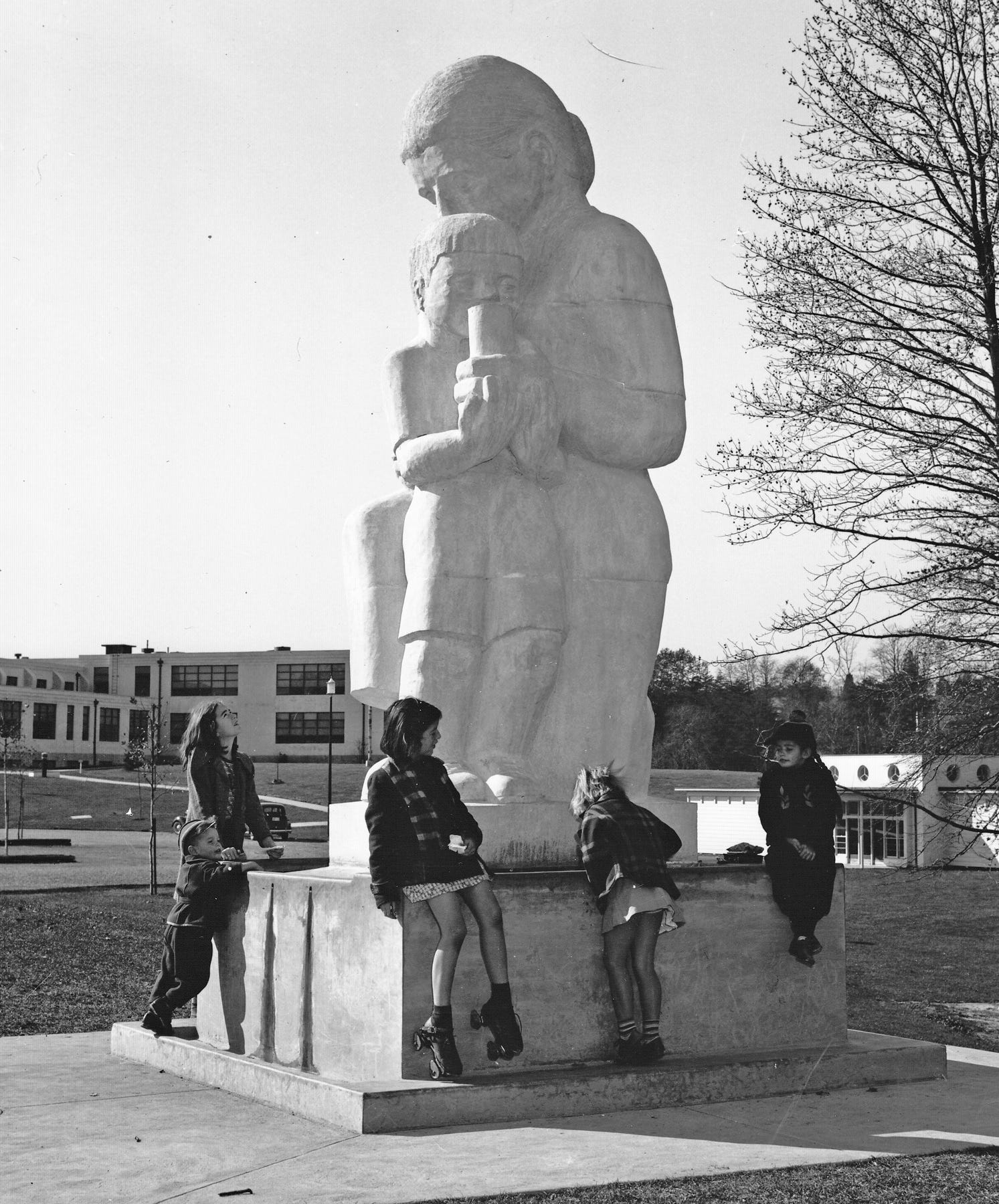
For the Greenbelt commission, Lenore was given latitude to choose her subject. It was going to go in the town square. She chose a mother and child — not a warrior, not a statesman for the area, not an allegory of progress or industry. A mother kneeling, with her child holding a cup with both hands. It is carved across three four-foot limestone blocks from Indiana, twelve feet of stone placed in public space, and functional — a water fountain. Just like a woman, she wanted to make sure it made sense. Utility and reverence made inseparable, the act of offering water given permanent form in stone. The sculpture was commissioned in 1937 and completed in 1939.
This is, of course, a conscious choice. With the full range of American civic iconography available to her, with the imprimatur of federal commission behind her, Lenore Thomas Straus chose to place the sacred feminine body in a public square — a mother and a child.
She also carved in a separate commission the Preamble to the Constitution in stone, also in Maryland.
She knew what she was doing. She was doing what the Neolithic carvers had done across thousands of years — inscribing the female body and the values of a society that honors life in the most permanent material available.
She wrote of her relationship to carving stone as an artist: Quietly, I bow to the stone.
To our community, this summarizes the root system of Intentional Creativity. The sentence holds an entire philosophy. The sculptor does not dominate the material. She listens to it. She honors what it carries. She brings her full devotion to bear before she raises a hand to shape it.
Greenbelt, Maryland is where Lenore Thomas Straus is from — Prince George’s County, Maryland.
Lenore Thomas Straus became the teacher of a young artist named Sue Hoya Sellers. She recognized Sue when Sue was seventeen years old. Sue had ridden seven miles on dirt roads to find her, a portfolio strapped to her bicycle, clothes starched and ironed, two years of preparation. Lenore called her a young artist, and Sue was one.
Among the things Lenore passed to Sue was an understanding that the sacred feminine image belonged in the hands of women — that carving was not decoration, that it was transmission, and honestly, a form of decolonizing the female body.
Sue carried this forward in her own large-scale work, including a monumental pregnant woman carved in wood commissioned for Alice Walker that stands at Stardust Ranch in Sonoma — the sacred feminine body again in the most permanent material available, given to the woman who had sat at the table with Sue, given to the writer who told me that to be happy is one of the most revolutionary acts.
And Sue passed this assignment to me when I was twenty-four. Sue co-mothered me, and this was among the most sacred things she passed forward.
A Cold Day and a Palm-Sized Prayer
I remember the day.
It was cloudy and cold on the mountain. Sue and I, months before, had gone out to dig the very clay from the earth — red clay. She wanted me to understand the whole cycle of making. Finally, the clay was made. It was placed in my hands, and she said: make it fit the palm of your hand. For prayer. Put your intention into it.
I brought the clay into my hands and began to shape it. I didn’t know what it would become, but I knew that I was called to make the Sacred Mother. It was the first thing I ever made out of clay.
Amazingly, years after Sue’s death, Lenore’s daughter Nora sent me a small figurine carved in stone — one of Sue’s earliest works — a goddess figurine, small enough to fit in the palm of your hand. It was only then, holding that piece, understanding what Sue had been handed and what she handed to me, that I received the full weight of the assignment — not as an instruction, as a lineage, as a specific, unbroken transmission of an understanding that Lenore had carried from her own teachers, and they from theirs, all the way back to the women who pressed their hands into cave walls and shaped limestone into figurines small enough to fit in the palm of your hand.
It makes me think of my recent visit to Malta — how the Sleeping Lady of Malta is so tiny she can almost fit in the palm of your hand. But there were also sculptures so huge they were claimed to be made by giantesses. Lenore and Sue did the same thing — made the tiny and the large.
Lenore was a Norwegian woman. She decided to carve an enormous sculpture, a mother and child. She went on to carve the Preamble to the Constitution in stone. She taught Sue and Sue taught me — from hand to hand and really from heart to heart.
And when I think of this teaching and share it with my students today, I feel the throughline of the sacred feminine image always emerging and becoming and arriving in and through our hands. Back at the beginning, right at the time I made that sculpture, I knew I wanted to change the way that women were treated and the way that the face of the feminine was regarded in my lifetime.
Thousands of paintings are part of it. The carrying on of a Stardust Lineage — from Neolithic limestones to these stardust bones.
Us. We.
Footnotes
(1) The Venus of Willendorf is housed in the Naturhistorisches Museum, Vienna, Austria. On the red ochre tinting and its connection to blood symbolism in prehistoric ritual contexts, see: Jill Cook, Ice Age Art: Arrival of the Modern Mind (British Museum Press, 2013); Marija Gimbutas, The Language of the Goddess (HarperCollins, 1989).
(2) On the geographic distribution of similar prehistoric female figurines: Gimbutas, The Language of the Goddess (1989), Introduction; Cook, Ice Age Art (2013).
(3) Marija Gimbutas, The Civilization of the Goddess: The World of Old Europe (HarperCollins, 1991). On the Kurgan hypothesis and the cultural transition beginning around 4000 BCE.
(4) On the Cucuteni-Trypillia culture: Gimbutas, The Language of the Goddess (1989). See also: John Chapman, Fragmentation in Archaeology (Routledge, 2000) for a more recent treatment.
(5) Gimbutas, The Language of the Goddess (1989). On the visual symbolic language of prehistoric European artifacts.
(6) For scholarly critique of Gimbutas’s methodology, see: Lynn Meskell, “Goddesses, Gimbutas and ‘New Age’ Archaeology,” Antiquity 69 (1995): 74–86. For a balanced recent assessment, see: Douglass Bailey, Prehistoric Figurines: Corporeality and Representation in the Neolithic (Routledge, 2005).
(7) Lenore Thomas Straus, Mother and Child, Indiana limestone water fountain, commissioned 1937, completed 1939, Greenbelt Homes Inc., Greenbelt, Maryland. Commissioned through the Public Works Administration / Works Progress Administration Federal Art Project. Photographic documentation of Straus with Eleanor Roosevelt held in the Stardust Lineage archive. For archival verification, consult Greenbelt Museum records.
(8) Lenore Thomas Straus, Preamble to the Constitution, stone, Greenbelt, Maryland. Documented by personal visit. For archival citation, consult Greenbelt Museum records and WPA Federal Art Project documentation.
(9) Lenore Thomas Straus, Stone Dust. Exact page number to be confirmed before publication.
Get full access to Tea with the Muse at teawiththemuse.substack.com/subscribe
Get every episode summarized
Each time Tea with the Muse publishes, we email you a written briefing from the transcript — the topics, who appeared, and any specific claims, with the ad reads skipped.
Email me new episodesFree for 3 shows. No card needed.
Hosts & guests
No transcript yet
This episode has not been transcribed. Request it and it moves to the front of the queue.
More episodes
More from Tea with the Muse
Leave Your Name at the Door 🚪- new poem
Tea with the Muse

The Zen roots of tea with the muse!!
Tea with the Muse
Medicine Woman poem
Tea with the Muse

Inviting the Muse starts with making the ritual of coffee - conscious - like thi...
Tea with the Muse