About this episode
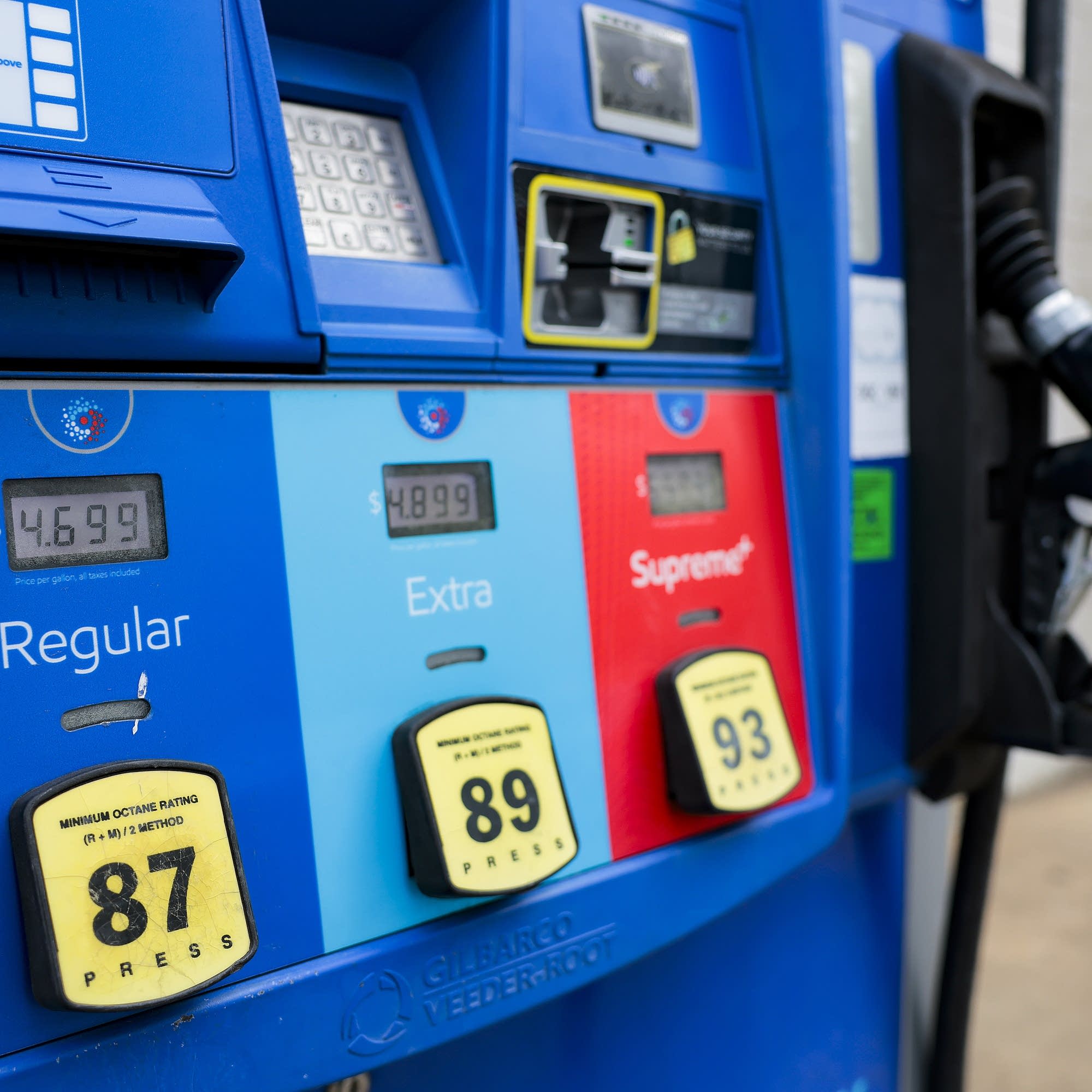
Crude oil prices have risen about $30 a barrel in the three weeks since the U.S. and Israel launched a war in Iran. At some point, U.S. consumers will really feel the war in their wallets. Turns out, it’s hard to say when. Also in this episode, more economic fallout from the war: The Fed and other central banks will likely hold rates steady this week amid global uncertainty, and Texas farmers brace for higher prices while Texas oil stands to rake in profits.
Every story has an economic angle. Want some in your inbox? Subscribe to our daily or weekly newsletter.
Marketplace is more than a radio show. Check out our original reporting and financial literacy content at marketplace.org — and consider making an investment in our future.
Get every episode summarized
Each time Marketplace publishes, we email you a written briefing from the transcript — the topics, who appeared, and any specific claims, with the ad reads skipped.
Email me new episodesFree for 3 shows. No card needed.
Hosts & guests


Transcript ready
259 searchable segments. Every word is indexed and playable.
Full transcript
Marketplace — When will oil be too expensive?. Machine-transcribed; use the interactive transcript above to jump the player to any line.
This Marketplace podcast is supported by Vantage Score. The modern credit score used by nine of the ten largest banks, over 3,700 companies, and now approved by Fannie Mae and Freddie Mac. Vantage Score, trended data, alternative data, reduced risk. The Fed's job was complicated enough before the war from American public media. This is Marketplace. In Denver, I'm Amy Scott in Forkai, Rizdal. It's Monday, March 16th. Good to have you with us. It is Fed week, meaning the committee that guides short-term interest rates in this economy will meet starting tomorrow to discuss the state of that economy. We'll get its decision on the federal funds rate on Wednesday. The last time the Fed changed that rate with a quarter-point cut was December.
Then we got a pause in January and most analysts expect the Fed to hold rates steady this time too. Marketplace's Kristen Schwab looks at why and what officials will be watching for in the months ahead. Between elevated inflation and a shaky job market, the Federal Reserve had already been setting the stage for an interest rate hold. Former Fed Governor Randy Crosner says now with the war, the hold is basically cemented here and around the world. Almost every major central bank is having a meeting this week, and I think almost all of them are going to stay on hold. Uncertainty forces economies to stop, observe, and recalibrate, says former Fed advisor Ellen Mead. If an oil shock or something very similar to it is short-lived, probably the best thing a central bank can do is just wait. Wait to see how long the war lasts and wait to see how deeply oil prices affect other prices because expensive oil. It's a stag flationary shock.
Pricy gas could make consumers pull back on other spending, which would slow down the economy. Pricy gas could also make goods more expensive and push inflation up. Now, usually central bankers write this kind of shock off as a one-time thing, as transitory. You know, that language has sort of been tarred and feathered, I think, by the experience during the pandemic. Back then, the Fed insisted inflation was transitory, but it ended up peaking above 9%, and still hasn't come all the way down to the target rate of two. David Wessel, a senior fellow at the Brookings Institution, says the Fed has to use different messaging this time. They can't count on people being so calm about inflation because we've had inflation in recent memory. If people already believe inflation is likely, it could drive more inflation, and Wessel says that possibility is enough for the Fed to be more hesitant than usual about cutting rates in the coming months. I'm Kristen Schwab for Marketplace.
A surprisingly buoyant day on Wall Street today will have the details when we do the numbers. President Trump continues to pressure U.S. allies to help open the strait of Hormuz, which Iran has effectively closed in response to U.S.-Israeli strikes. About 20% of the world's oil supply typically passes through the shipping channel. The price of Brent Crude closed above $100 a barrel today for the third straight trading session, as the president's war in the Middle East entered its third week. For context, just a few weeks ago, that price was around $70. As Marketplace's Justin Ho reports, drivers are largely taking the
recent spike in stride, but for how much longer? Economist described demand for oil as inelastic. When we say inelastic, what we mean is that demand doesn't change very much in response to price. That's George Perk, Sipa Spoke Investment Group. He says energy is getting more expensive, but people can't really do much about it. What am I going to do instead? Am I going to drive less? Well, most of what I'm doing to drive, I can't really avoid. I can't avoid my commute to work. I can't avoid picking my kids up from school or going to the grocery store. That said, there is a point where the price of oil gets so high that people actually start to pull back, but it's hard to know exactly where that is. Over 120, it really starts to bite. And as we get up to around $140, it would be a steady progression. If you got up to $150, that would really start to squeeze things. The Middle Voice was John Canivan at Oxford Economics, and that last voice was Ben Er, said nationwide. He says up until that point consumers would simply face more inflation,
so they'd have less money to pay for other things, same with businesses. Maybe I just won't make one less higher or it won't expand as much in one capacity, because I have to change around where my costs are. But if oil prices break through that 120, or 40, or $50 threshold, economies around the world might stumble, says John Canivan at Oxford Economics. It'd be more likely to perhaps push the European Union or Japan into a recession. They are more reliant on the oil that is moving through the street of our moves. Canivan says a recession could happen here too, but even at those prices, the US has advantages. For one, we produce plenty of our own oil, and George Perks at the Spoke Investment Group says the economy up until the war was doing okay. The thing about the US economy is that it's very large and has a lot of momentum, and it's really hard to knock it off the trend that it's on, and so you do need a really big shock. Perks says the price of oil might have to hit $200 a barrel to push the US economy into a recession.
I'm Justin Howe from Marketplace. We just heard from Justin about how consumers respond to higher oil prices. Now we turn to Texas, where two critical industries in the state are feeling the impacts of the increased cost of fuel and fertilizer. Marketplace's Elizabeth Troval has that story. In an open field in Brasoria County, south of Houston, near the coast, Farmer Casey Smith shows me around his newly planted rice crop. This is their early stage, right? We're in the first 10 days, two weeks of this crop. It'll get about waist tall by the time we harvest. Today, the rice plants are about three inches high. They look like blades of grass peaking through the dirt, and they're in tidy rows.
My son actually planted this field. My 12-year-old, he planted this. Once this field dries out, Smith will be adding fertilizer. But when you got a quote for the urea fertilizer, he uses the price per ton, jumped about 25 percent since the war started less than three weeks ago. That's definitely gone up. And so I think that's about 30, 40 bucks an acre when you start applying it to the field. So it didn't take very long to add up some some expenses. Add that to the increase in diesel prices, which have gone up by a buck 50 or so, and he's looking at tens of thousands of dollars in additional expenses. These are, I mean, it's a big expense. My farm here, we're typically burning, you know, 20 to 25,000 gallons a fuel a year. Smith loves rice farming, but it's a brutal business. And now, because of the war in the Middle East, which has constrained the flow of global oil, natural gas, and other petroleum products like fertilizer, Smith worries what this means for
his operating costs. This crop will not make enough yield to offset any of those expenses. It's just, it's just going to take off our bottom line, which there is no bottom line. I mean, we're, we're paper thin. As we talk in his rice fields, I can't help but notice the giant industrial buildings with smoke stacks in the distance. Is that a refinery? Yes, ma'am, sure is. That's, there's a, those are oil refineries. Absolutely. A visual reminder of which industry is king in Texas. Here along the Gulf Coast is where refineries are concentrated, but 500 miles northwest of here is the engine of US oil production, the Permian basin in West Texas. You'd think that production would go up with higher prices. There's no drill, baby drill happening because of this. Nikki Morris with Texas Christian University says since for now, this crisis is temporary. High oil prices aren't going to suddenly spur a bunch more drilling. Most of the capex budgets
drill schedules, all of that in particularly Texas, New Mexico are already set. But even without a big increase in production, higher prices still benefit oil companies and oil producing economies, says Carr Ingham with the Texas Alliance of Energy producers. Anytime it goes up, just means more regional crude oil and natural gas income that then gets spent somehow in the economy. He says higher prices lead to increased retail and auto sales and generate more tax revenue. So while gasoline prices may loom large in many US cities, there's a sign downtown in Midland, Texas. It has the price of West Texas intermediate crude oil posted and it's front and center. They know what the price of crude oil is out there. They know what it means when crude oil goes higher in the Permian basin. Then even rice farmer, Casey Smith, who is paying more for diesel and fertilizer,
has a nuanced view of high energy prices because I also work in refineries about 60 days a year. That's how I get health care from my family and that's how we keep the lights on at the house. Smith's job in oil and gas gives him the financial freedom to do what he loves, rice farming. In Berthoria County, Texas, I'm Elizabeth Troval from Marketplace. Hey, so when was the last time you went to see the dentist? Well, there are other reasons people might avoid going. Cost can be one factor. In a humana study, 57% of US adults said they delayed dental treatment to take care of other
expenses. That figure was even higher for parents and other caretakers. But dental patients aren't the only ones facing higher costs all this week. In our series, my economy, we're bringing you stories from inside the world of health care. My name is Catherine Sislow. I am a dentist and owner of Sislow Family Dental and Greenwood Village, Colorado. I graduated dental school in 2019 and then I went on for a residency, which was at a hospital. So I was working in the hospital right as the COVID stuff was hitting. And when I left my residency, there were no jobs done. I couldn't find a single associate ship. I couldn't find anything in public health. There was nothing in academia. I was like, I'll just do your cleaning as I'll be your hygienist and I still could not find a job. I was like six months in and I was like, I need to make money. I'd always assumed I'd own a practice at some point. And so I went out and started looking at practice
brokers and found a practice, bought it, and dental school didn't teach you how to run a practice, how to run a business. So trial by fire. Absolutely. The initial investment front was very, very large. That was probably around my three-year mark where I was like, I was still in the red. I still wasn't making any money at all. And I was like, at what point do I say, this isn't working. I need to go find a job where I can make some money. There's a very, very strong idea that dentists are, you know, they're very, very wealthy. You know, oh, my crown is just paying for your next boat payment, right? And I'm like, you haven't even touched the cost of my rent for this month. But I was very grateful that I stuck it out so that I can treat my patients the way I feel that they should be treated without a quota from a corporate office or private equity saying, I need to push this treatment. I didn't want that.
I had no idea when I went into dentistry how expensive every aspect of dentistry is. We are essentially creating a very small surgical suite inside our office. We have, in choral scanners, that's $15 to $35,000. We have all of our sterilization stuff. That's another $15,000, $20,000. Just the filling materials themselves are each little capsule is $5, $20, $30. So when you look at what just the physical cost of materials is for something as simple as a filling, and then you throw an all the other overhead with it, you look back and you're like, wow, you're barely making, you know, above minimum wage if that filling takes you more than an hour. And you end up working on extremely small margins anyway, because in multiple scenarios, the reimbursement we get from insurance has gone down. And the cost of everything has gone up in 25, 30 years. But what we're getting paid has not. So when they do things like say, we're going to cut your reimbursement, it's not, oh,
I can't afford my boat payment. It's I can't afford to pay my employees. For me, my goal has never been to be the multi-millionaire. I don't want to own 10 practices. I don't want to do that. I would love to just have, you know, small home, have my practice, treat patients the way that I want to. That's all I need. Catherine Cislow, owner and dentist at Cislow, family dental in Greenwood Village, Colorado. We always say it. We can't do this series without you. So let us know what's going on in your economy. Marketplace.org slash my economy. Coming up, the criminal can launch multiple attacks at once.
AI is making scammers harder to beat. But first, let's do the numbers. The Dow Jones Industrial Average added 387 points, 8 tenths of a percent to close at 46,946. The NASDAQ picked up 268 points, 1 and 2 tenths percent to finish at 22,374 and the S&P 500 rose 67 points, 1 percent to end at 66,99. Meta is planning to lay off 20 percent of its 79,000 workers, according to Reuters. That would be more than 15,000 people. This news comes, while the social media company says it's paying the AI cloud firm Nebius, $27 billion over the next five years for infrastructure services. Meta platform skipped up to and 3 tenths percent, Nebius Group's sword 15 percent, bonds rose, the yield on the 10-year Tino fell to 4.22 percent, you're listening to Marketplace. This Marketplace podcast is supported by Vantage Score.
The modern credit score used by nine of the ten largest banks, over 3,700 companies, and now approved by Fannie Mae and Freddie Mac, Vantage Score, trended data, alternative data, reduced risk. This Marketplace podcast is supported by the University of Illinois Geese College of Business. Earn a world-class MBA degree completely online at your own pace. Through their online MBA program, you'll learn from amazing faculty and network with classmates on a global scale without having to put your career on hold. Take your career to the next level by applying what you learn in real time. Get started at onlinemba.illinois.edu. That's onlinemba.illinois.edu. This is Marketplace. I'm Amy Scott. Scanning labels at the supermarket these days, you're more than likely to spot two hyphenated words, plant-based, and not just in the food aisle
between 2012 and 2018. Market Research firm Mintel says, the number of plant-based packaged goods more than quadrupled. But what that term actually means isn't always clear. Adam Clarke Estes looked into it at Vox and joins me now. Adam, welcome to the program. Hey, thanks for having me. Like many good stories, this one seems to have started with your personal experience. Describe what happened. I had a baby. Well, my wife and I had a baby and we were buying all kinds of baby items and not just that, we were getting a lot of ads for baby items. And I just noticed this phrase popping up everywhere, plant-based. And I was used to seeing like plant-based meat in the grocery store and things like that, but not like plant-based diapers or plant-based toys or plant-based wipes, just all kinds of things that were plant-based. I couldn't figure out why they needed to be plant-based or what the benefit of them being plant-based was. So I decided I'm a reporter. I would report it out. If I see a label that says
that something is plant-based, what does that actually mean, though? It probably means that there is something in that product that is derived from plants. And that might be it. The term plant-based is not akin to like certified organic. There is no list of requirements that a company has to meet in order to call their product plant-based. It's totally unregulated. But in general, I think it also really signals that it is not petroleum-based. That doesn't actually mean that there's not a petroleum-based product in it, but they're trying to veer away from petroleum-based plastics and other petroleum-based products. Yeah, and a lot of people would like to have a lighter impact on the planet, whether it's through pollution or, you know, waste or carbon emissions. But if something is plant-based, does that necessarily mean it's better for people or the planet? So if we're talking about food, there's a ton of evidence that plant-based diets are really good for you. But what got me interested in this term was not food. It was all of the other products
and trying to learn if plant-based plastics, there were plant-based legos. Are those really better for the environment? And I hate to say it, but I actually think not really the most popular plant-based plastic in order to compost it. It has to go through a really intense industrial process. And when these biobase plastics or plant-based plastics end up in a landfill, they stick around just as long as the petroleum-based ones do. What about micro-plastics, something people are very concerned about these days? Lately, there's been a little bit of pushback from researchers who say that the freak out over what they're doing to us is sort of, we just haven't researched it enough. But we do know that they're out there and we have no reasons to believe that plant-based products don't create micro-plastics the same way that petroleum-based plastics do. So after doing this reporting, do you have any takeaways, advice for people who want to shop conscientiously? I would recommend that people do their research.
There is actually a trade organization called the Plant-Based Products Council that is working to promote renewable biobased products and knowledge about those products. It's not quite the level of rigor you see from certified organic or fair trade, but it could be moving in that direction. There are other certifications, though, and I'm a fan of certifications because you can see it on a label and kind of know that it's passed some test since there is an organization looking after. For my kids, for instance, I always look for oEco-tex. That's how I say it in my head. It might just be called oEKO-tex. I've never known how to pronounce that, but I know what you're talking about. It's for fabrics, right? It's for fabrics. Yeah, and it's an independent certification, and I think it's increasingly popular. And if I see that a crib sheet or a pair of pajamas has that on it, I know that it is at least passed some tests, and I feel good about that. Adam Clarke Estes is a senior tech correspondent for Vox, where he wrote about plant-based products,
food, and otherwise. Thanks so much. Thank you. A coalition of big tech companies and retailers is coming together to fight online scams at the UN Global Fraud Summit that kicked off in Austria today, brands including Google, Meta, Amazon, OpenAI, and Match Group, the dating app company, signed an industry accord. They promised to share intelligence about threats on their platforms with each other and with law and to step up fraud detection efforts. Financial losses due to scams have exploded in recent years. As AI tools have enabled more sophisticated schemes, Marketplace's Megan McCarty Karino has more
on the new agreement. Consumers and organizations lost $62 billion in financial fraud scams between 2023 and 2025, according to a new report from Nasdaq Verifin. The toll is grown by almost 20 percent, as AI has industrialized scamming, says Verifin Fraud expert Greg Williamson. So we think of the phishing attacks that have been happening for years. Those are becoming cleaner, much more difficult to detect, but also more personalized. No more misspellings and low quality graphics. Erick O'Neill, author of Spies, Lies, and Cybercrime, says any scammer can now run the type of sophisticated long-con that used to require massive time investment and specialized skills. The criminal can launch multiple attacks at once and has a fleet of evil AI agents doing the work for them. Agents that comb through social media to find biographical information about potential victims and create online profiles with convincing AI-generated photos and backstories.
They can create fraudulent websites, chat with victims, or even appear on video. These are sometimes called pig butchering scams, because criminals build up trust over a long period before they strike. Mikey Pruitt at Security Software firm DNS Filter says the contact often starts on dating apps, then moves to social media or messaging platforms. The problem is they each see a segment of the scam. So they're catching one piece and met us catching another, and then Amazon is catching another. Coordination between these various services is crucial to catching these crimes before they happen, says Alice Marwick at Data and Society. Scams are a global problem. They're perpetrated by global criminal organizations and they affect people all over the world. She says this isn't a problem, a single country, or even a single platform is going to be able to fix on its own. I'm Megan McCarty Carino from Marketplace.
This final note on the way out today here in Colorado, thousands of workers walked off the job at one of the country's largest meatpacking plants owned by JBS USA. About 3,800 workers are on strike after their contract expired yesterday. Workers are fighting for higher pay and better health care to compensate for what they say is difficult and dangerous work. Union representatives say it's the first strike in the industry in four decades, and it comes as consumers continue to face higher beef prices that are about 15 percent up from a year ago. Amir Babawi, Caitlin Esch, John Gordon, Noia Carr, and Stephanie Seek are the Marketplace Editing staff. Kelly Sovera is the news director, and I'm Amir Scott. Hope to see you back here tomorrow. This is APM.
You can turn to Marketplace to hear from powerful leaders and everyday people about the economy and their roles in it. And now we hope we can turn to you. Marketplace is facing real threats and challenges as we plan for the future. As a public media program donations from you are a critical part of our budget. So here's one action you can take right now that's going to have a long lasting impact. Start a monthly donation to support our work. Five bucks a month is a great place to start. Head to Marketplace.org slash donate. And thanks.
More episodes


