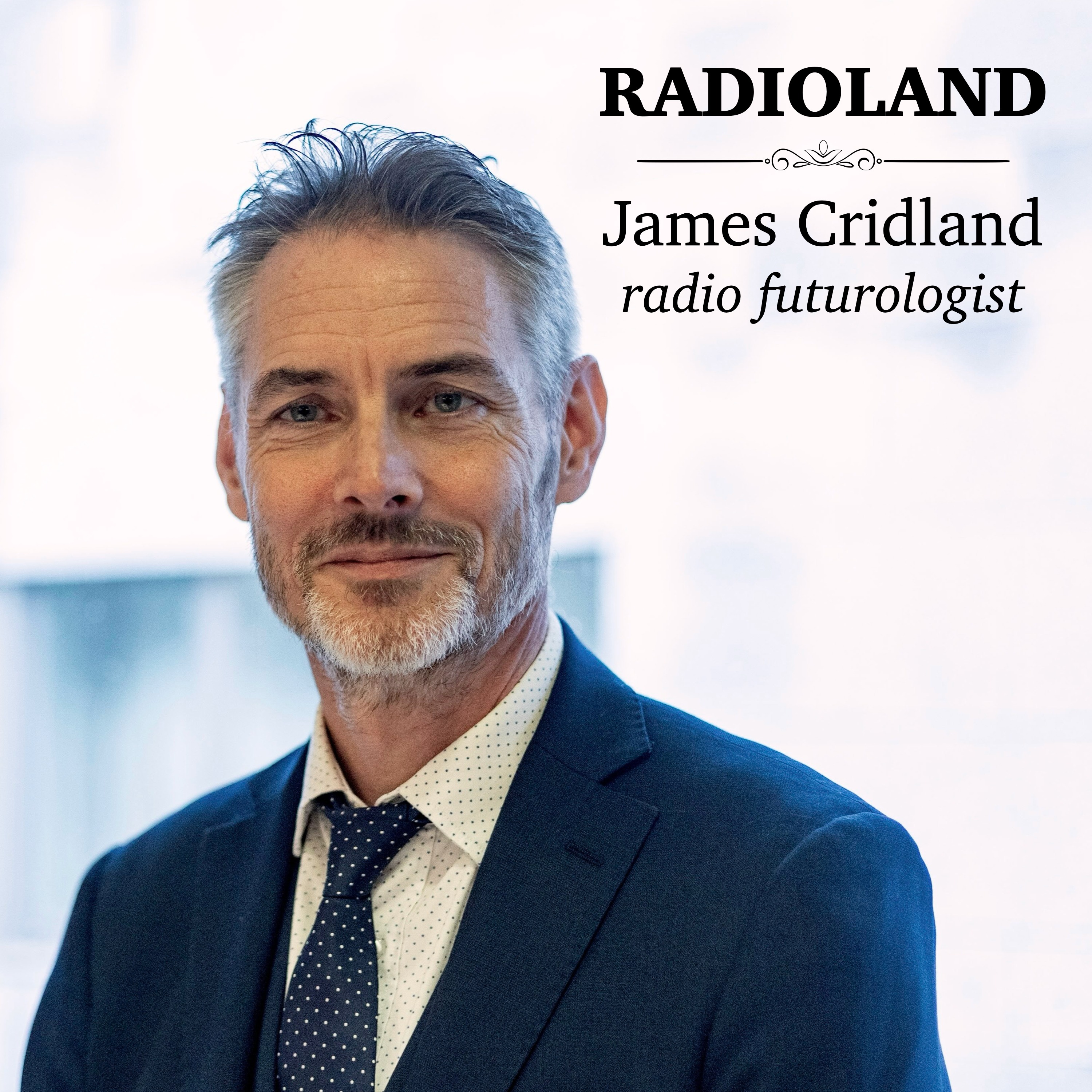
Why TV's decline matters for radio
About this episode
Hey! I'd love to hear your thoughts, send me a voice note.
Read this, see the links and more at https://radioland.email
Get every episode summarized
Each time Radioland, with James Cridland - radio futurologist publishes, we email you a written briefing from the transcript — the topics, who appeared, and any specific claims, with the ad reads skipped.
Email me new episodesFree for 3 shows. No card needed.
Hosts & guests
Transcript ready
131 searchable segments. Every word is indexed and playable.
Full transcript
Radioland, with James Cridland - radio futurologist — Why TV's decline matters for radio. Machine-transcribed; use the interactive transcript above to jump the player to any line.
Hello, I'm James Critt and the radio futureologist and this is Radio Land by Weekly International Radio Trends newsletter. What's the date today? It's February the 16th, 2026 and this podcast is sponsored by RSS.com podcast hosting that's actually free. You can start your podcast for free today with unlimited episodes, automatic distribution to major listening platforms and detailed analytics from day one. You can upgrade anytime as well. RSS.com is where to go for that. Now, I've been watching the troubles of the television industry in A detached sort of way because it's very clear how quickly the business of live television is collapsing before our eyes. It seems every few weeks there's another story about cost-cutting within the TV industry. I can't really remember the last time I watched live television from the antenna. Actually, I can. We turned on the TV on January the 24th to listen to Triple J's hottest 100 on the big speakers in the front room, but that wasn't watching the television
really though, was it? Particularly from an infrastructure point of view, the end of broadcast TV is moving really very quickly. In the UK, there's increasing talk about switching off terrestrial television broadcasting. 2034 is given as a potential switchoff date, given that that's when the contracts are due for renewal with broadcasting infrastructure company Archiva. But that's television, and we don't need to care about television, do we? So I thought, but what I'd not appreciated until now was that of course this means that the costs for maintaining the terrestrial transmission network post 2034 would no longer mostly be paid for by television. That means that radio could end up being charged significantly more according to a story in the eye paper. Radio isn't always co-cited with TV, but clearly maintenance of masks, ground rent, the cost of staff and offices, and many other parts of the broadcast infrastructure world would end up having to be paid for almost entirely by radio broadcasters.
And frankly, there isn't the money to go around there. There's much to think about, I think, while FM and DAB Plus don't require anywhere near the same kind of infrastructure as AM or TV, at high transmission powers, they still do require proper transmission. Meanwhile, the UK government is running a review about the future of FM radio beyond 2030, and DAB is still much, much bigger than online, so there's no suggestion right now that it's the end of terrestrial radio, and those masks will still need to be required. Radio today has reported a Europe-wide piece of work, celebrating listening to radio in the car. And I'm still surprised at the piecemeal approach that the radio industry is taking towards car manufacturers, which means that we get the sort of bad experience that I have in my car right now, in terms of a radio receiver, because nobody is apparently talking to auto manufacturers about how to make it better. And that's not been helped by commercial radio in Australia,
overfilling its multiplexes, which has broken much of the functionality of DAB in my car, which is again something that nobody cares about, either, my goodness, the amount of time that I've spent talking to the CRA about it, and not getting particularly far. The BBC has launched a new tech podcast called The Interface. It's a BBC Studio's audio production for BBC Sounds at the UK and BBC.com internationally. And true to form, it has a bewildering distribution plan. If you're in the UK, you'll be able to listen to it on BBC Sounds, or wherever you get your BBC podcasts. Outside the UK, you can listen to it on BBC.com, or wherever you get your podcasts, or watch it on YouTube. So outside the UK, despite the BBC's website having full video capability, you're not watching it there. No, you only get to watch it on a US website, Google's YouTube, with advertising and tracking. And inside the UK, in spite of the BBC's website having full video capability, and the BBC having this thing
called the iPlayer, which you might have heard of, which has lots of long-form video content, you don't get to watch this thing at all. It's just audio for you and tough. Just bizarre. Really don't understand what the BBC is doing. Now, discovered for pod news, but in radio, we'll find this helpful as well. You probably know about FFMPEG, it's a wonderful command line thing that works command line in Linux, and also in Darwin, which the Mac uses, and all of that. It's very good for audio encoding. It's very good for audio conversion, and all of that. But you might not know that it's also okay, ball of sorting out loves levels. You can add compression with it, you can add EQ with it, you can add all kinds of additional things, just using FFMPEG, which is lovely. So there's a thing called FFAB, Scotty. FFAB, it's a really nice UI for FFMPEG, and it gives you the command line for what it's doing,
so you can add the commands to your workflows. Genuinely amazing what FFMPEG is capable of doing it turns out. And this is really nice UI, which lets you play with the buttons, or foe, faders, and all that kind of stuff to your heart's content. It's very nice. FAB isn't Scotty, is it? FAB is something else, and I'm trying to remember what it is, and I can't remember. Anyway, there we are. I did a web search for Phil Riley trying to remember where I'd read that main story about the cost of radio. And I noticed that he'd blogged at the end of last year about the funding debate for the BBC, and it's effect on radio. Privatizing bits of the BBC would be a calamity for everyone. He argues it's good. There's some good maths in there. It's worth a peek. Now, two pieces of random radio research, which you'll find linked from my newsletter, which you'll find at james.cridland.net, sash block, or indeed at radialand.email. Yes,
can't forget that radialand.email. It's rather easier, isn't it? Anyway, two pieces of random radio research. Firstly, I linked to 2025's radio figures for Finland. Radio reaches 83% of the population there a week, daily listening, two hours, four minutes. Although, if you look at people aged under 24, that two hours, four minutes, drops to just 32 minutes, gosh. There's some nice data in the pack about where they listen and who to. It's a lovely, really clear, really inclusive report, which is really nice. And I also linked to the survey 325 survey for New Zealand. And I might the finish one. It's two sets of tables with a tiny cramped graphic at the bottom of page one. And the figures don't include RNZ, the public service broadcaster, or indeed many of the community stations. I think that radio is much stronger in outer rower than these figures would tell you. And I don't think they tell a very good story
about radio at all, bit of a shame. Now, I'm on ABC television tonight in West Australia during their 7pm news. As I record this, two hours time. Talking about ABC radio perths switch later this month over to 102.5 FM. That's a familiar frequency for me. Anyway, hopefully it'll be almost as good as a very nicely written piece from the ABC on its website, which correctly catches all of my tedious caveats about AM still being very important in regional Australia. But this being a particularly good fix for city broadcasting, which is what ABC radio perth is. Stroke should be all about. Anyway, it's a nice piece which you'll find linked from my newsletter. Tomorrow morning, I'm also on ABC radio perth, if you're up at 615 in the morning perth time. It's 815 in the morning Brisbane time. So I will have had enough time to get into the centre of Brisbane and use something called the TARDIS, which the TARDIS is there.
A little radio studio where you go in and you talk to people at the other end of the line, rather than just being at the end of the phone call, rather nicer. Anyway, there we are. Now, I didn't hear from Peter in Waverly last week. I did hear, though, from another former ABC employee called Ed, who sent me a grumpy email saying, I do carry on so much about AM, adding, I'm just interested in the content. I couldn't really care less about the form of modulation. Well, Ed, I am interested in people actually listening to the content and therein lies the difference. Now, I spoke last week at the Radio Festival in New Delhi, at least I think I did, and you can watch many of the sessions on their website. YouTube's captions are really good at translating the mix of English and Hindi, that the session was all done in. There was a session called Is Radio Dying or Friving, where some radio people genuinely stood there at a radio conference saying that radio was dying, which I thought was a brave career move. Yes, I understand the conversations, but also, wow,
gosh, okay. So the lady from FIVO 104, I thought, yeah, brilliant. I mean, good for you, but wow. So anyway, worth a peek. There's a whole day's worth of coverage there. And thank you to Radio Today in the UK for becoming my latest supporter. As soon as I say that, I start thinking about the little jingle that they used to have with MCASO. Anyway, as long as I've been in Radio, Radio Today has been there, covering the changes in the industry as an excellent resource. And I'm also very excited to see some of Mr. Roy's money. So I will be spending that wisely, quite possibly, in Riga in Latvia, which is where I'm speaking next towards the end of March. My session is called The Future of Audio is People Powered. I've got lots of data, lots of excitement, but also talking really, rather more about the content that we put on our transmitters, not necessarily what those transmitters actually are. And suddenly, I don't think I'll be mentioning AM once,
because it's Europe and Europe has moved on from all of that sort of thing. You should be going to Radio Days Europe as well. It is a marvellous, marvellous event if you're interested in anything to do with Radio. I know it's called Radio Days Europe. There's people from all over the world there. It's a really invigorating couple of days. It's well worth going to. Radio Days Europe.com is where you can buy tickets now. And you should be buying tickets now for it. The tickets will go up and up and up and up and up in terms of costs. And you should be sorting that out right now. So Radio Days Europe.com is where to go for that. I'm also speaking at the podcast show in London. May the 20th to the 21st. I'm actually doing the first speak, the first speak, the first keynote. Yes, anyway, I'll be on it, called a past nine, if you can get in in the first 10 minutes. So that'll be good. And I'll be last on as well, recording a pod news weekly review from something which I can't tell you yet. So there we are. And probably a few other things as
well. The podcast show is very good too. If you subscribe to pod news, then you get some money off as well. podnews.net slash extras. If you do that. And thank you to our many supporters, including Radio today and Gavin Watson, Greg Strassel, Sam Phelps, Richard Hilton, Emma Gibbs, Jocelyn Abbey and James Masterton for being regular supporters. If you would like to support this in any way, then you can buy me a coffee. You can become a member to give regularly. Or just give a one-off coffee or five. That's all good too. Just where'd you go for that? Oh, yes, buy me a coffee.com slash James Criedland. Or indeed, just go to RadioLand.email and find the link there. I'm on mastodon. If you want to follow me on the socials, James at BNE.Social, it's a, a mastodon's good. None of the rest are. So that's basically me. And my website has more details about who I am and what I do and whether or not I can help you further. Thank you to a few
people who have contacted me and said, would you like me to edit this podcast for you? No, no, no. This podcast is literally me opening the microphone, recording it, closing the microphone, and then uploading it. There's no editing on this at all. Can you tell? But until next week, thank you for listening and keep listening.
More episodes
More from Radioland, with James Cridland - radio futurologist
Radiodays Asia, and could TV's switchoff put radio at risk?
Radioland, with James Cridland - radio futurologist
Streaming music overtakes AM/FM radio in the US
Radioland, with James Cridland - radio futurologist
Kyle's first online show 'a disaster'
Radioland, with James Cridland - radio futurologist
The MFWs, a new BBC station, and more from Canada
Radioland, with James Cridland - radio futurologist