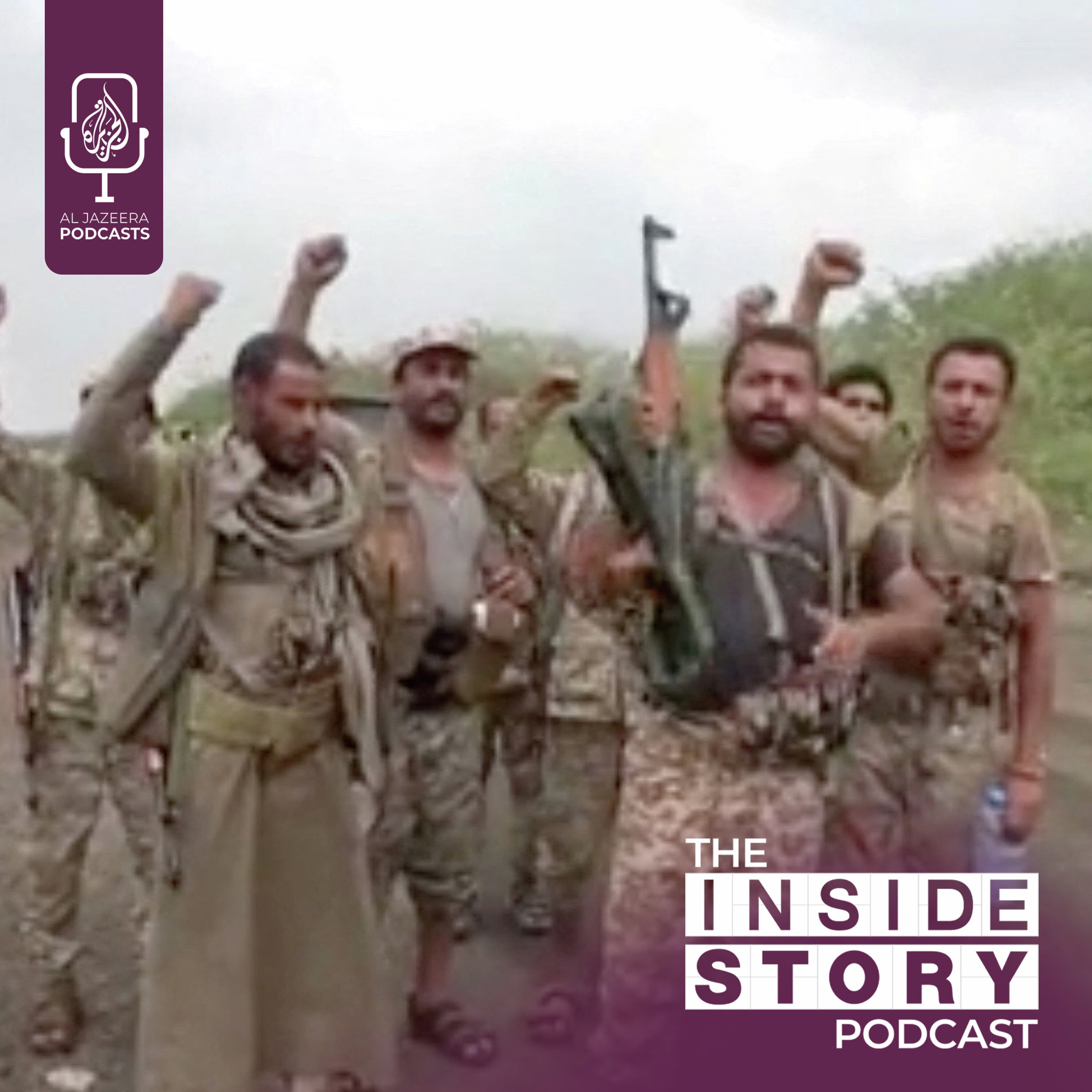
Will the Houthis seizing the Red Sea coast give Iran leverage in the war?
About this episode
The Ansarullah Houthis seize Yemen's Red Sea coast, cementing their hold on the Bab Al Mandab strait. The advance of the Tehran-aligned group threatens an alternative route for energy supplies - with traffic in the Strait of Hormuz already limited. Will it give Iran leverage in its war with the US?
In this episode:
-
Ahmed Al-Ashwal - Military and security researcher, and a former pilot officer with Yemen's armed forces.
-
Jennifer Gavito - Former U.S. Acting Principal Deputy Assistant Secretary of State for the Middle East and a former State Department Official
-
Abas Aslani - Senior Research Fellow at the Center for Middle East Strategic Studies
Host: Neave Barker
Connect with us:
Get every episode summarized
Each time The Inside Story Podcast publishes, we email you a written briefing from the transcript — the topics, who appeared, and any specific claims, with the ad reads skipped.
Email me new episodesFree for 3 shows. No card needed.
Hosts & guests

Transcript ready
312 searchable segments. Every word is indexed and playable.
Full transcript
The Inside Story Podcast — Will the Houthis seizing the Red Sea coast give Iran leverage in the war?. Machine-transcribed; use the interactive transcript above to jump the player to any line.
Al Jazeera, podcasts. The Alps de la Houtie sees Yemen's Red Sea coast, cementing their hold on the Bab al-Mandab straight. The advance of the Taran Al-Alaan group threatens an alternative route for energy supplies, retrafic in the strait of Hamuz already limited. Will it give Iran leverage in its war with the US? I'm Neep Arke. And you're listening to the Inside Story podcast where we dissect, analyze and help define major global stories. Let's bring in our panel of guests in Manchester in the UK. I've met our Uswile, Military and Security researcher, as well as a former pilot officer with the Yemen's armed forces. From Washington, D.C., Jennifer Gavito, former U.S. acting principal deputy assistant secretary of state for the Middle East. Joining us here in the studio, Abasa Slani, a senior research fellow at the Centre for Middle East Strategic Studies. A very, very warm welcome to all three of you starting with the U at Mad.
Because we are looking at a flashpoint that essentially touches everybody right now. The Houties have just pulled off this lightning offensive down Yemen's Red Sea coast taking moccas, seizing islands on the doorstep of the Bab al-Mandab straight. Wishing the frontline we understand a little closer to the seat of government in Aden, all while leaving tens of thousands of people displaced at the same time. Abed, you've spent years of your career studying military aviation and strategy. When you see 90% of Yemen's Red Sea coast captured in this lightning offensive, what does it say to you? Good luck or something else? Good afternoon, everyone. To be honest, what happens the last ten days, it's changed honestly the whole scale of the power in Yemen. As you mentioned, now Houties captured 90% of the coastline in the Red Sea. We are speaking now about 5,400 kilometers, which Houties captured just in four days.
We are speaking about 30,000 military troops from the national resistance, from the Taham resistance or from the giant forces have been pushed out to Ras al-Ara or to Al-Madari Ba'a. So what we can say and what we can explain this, that was an easy offensive. The Houties pushed more than 20,000 troops and they had only one target, how to reach the Babel Mandab and how to get Babel Mandab. They didn't only get Babel Mandab. They got high, they got Khocha, they got Magbina and they got also Al-Mukha. Also now they got all the islands in the Red Sea. We are speaking about Zogar, we are speaking about Honei, small Honei, we are speaking about Breen which is the center point or the most important island in the Babel Mandab.
So when we speak about military things, that was an easy offensive, that was a big loose for the governmental forces. Let's bring in Washington, DC, Jennifer. We are potentially looking at a long-lasting shake-up of the balance of power in Yemen after the past few days or so. You've spent decades working out how the US handles precisely crises like these. We know of course the US has already stretched on now, potentially both sides of the Arabian peninsula, to the Americans then just simply absorb this possible economic shock or do they get more heavily involved, potentially dragged in to a messy second front. Yes, I mean, you've nailed the exact problem that the Trump administration will be addressing today. They essentially have two choices. They can either as you say, absorb yet a further economic shock in addition to of course the disruptions caused by the effective closure of the straight-of-form moves or as Saudi
Arabia has asked to the US can enter the conflict directly and put itself more directly in the line of fire, putting out risk, what are already depleted munitions and bringing in and already stretched US military. So neither of those options are particularly good for the Trump administration. I suspect the president is going to be looking for a third option that at this point seems unfortunately very elusive. But this is a bit of a worst-case scenario I think for Washington. A past turning to you, let's bring Tehran into the picture if we may because the Houthis are essentially saying that Red Sea shipping is fine for everyone but Saudi Arabia at the moment, potentially trying to stave off any quick move by the Americans to sweep in and try and sort this mess out on behalf of Saudi or potentially for themselves if they end up feeding a lot they are targeted. Is Iran a bast pulling the strings here to carve out a new bargaining chip?
I think if it places into context the mining will be much more significant and the timing is quite important. At the time that everybody was looking at Bob Al-Manda as an alternative to the closure of the straight-off hormones and now I think the Yemenis they are seeing that with their control being consolidated over Bob Al-Manda they can have a better leverage to pressure Saudis in order to break the siege. It is not just something related to Iran but they have had their own problems for years sanctions siege. So they think that now is the best time to pressure Saudis in order to break that siege. And in the meantime their interest is somehow overlapping with the ones of Iran which can be somehow used to pressure not just Saudis but to be global. Just simply overlapping. I am very keen to be crystal clear on this. What does Teran's hand in all of this actually look like because there is no doubt that Iran benefits directly from what the hoodies are doing in Yemen right now?
Yes. That is what exactly I was saying that the one that interests are overlapping meaning that any use of Bob Al-Manda as a leverage could somehow benefit the Yemenis themselves as well as Iran. So at the time that we are seeing two chalk points are being pressured, you know, can somehow work against the pressures that is being adopted by Saudi Arabia against Yemen as well as the United States against Iran. And that is the issue of deterrence. The terrorists against any type of let's say bullying any type of pressure against one country. And that is the time somehow to those Yemenis and Iran they have been facing pressure. They have been absorbing it but that doesn't stop it there. They want to externalize that pressure to outside in order to change the cost and benefit calculus. What is the aim? The aim is for Yemenis to break the siege. For Iran also there is naval blockade. Iran wants to break that blockade not just by closing it but using military strategy which
has been updated in doing so. Jennifer, turning to you, would you simply call it overlapping interests between the who feeds and Iran at the moment? Iran always seems to sort of maintain this level of plausible deniability when it comes to how closely aligned or directly ordering of who the activities Iran actually might be. From Washington's perspective do you think that's just a smoke screen? I mean are there rooms full of American intelligence officials looking at this directly as an Iranian orchestrated chokehold on the bubble mandub straight? Increasingly Washington has assessed that daily command and control of the who-these are not necessarily under Iranian control. So I would largely agree that this is a series of events that Iran will have supported certainly through its ongoing support of the who-these but I do think that there is some autonomy and that the who-these in this case are being driven by their own domestic
interests and their own relationship with Saudi Arabia. But there is no doubt that this benefits Iran greatly not just is negotiating leverage by the potential for putting into play economic disruption in the bubble mandub but this really could cause a fissure between the United States and its Gulf allies. If the reports are correct that Saudi Arabia and it certainly seems to be the case that Saudi Arabia has asked for direct U.S. assistance that has not been provided, whatever justification the administration in Washington has for not wanting to get into a second front, that nonetheless is going to bring into question the reliability of the United States as a security partner. So that too will benefit Iran. So all around I think Iran gains at least in the short term from this as the United States tries to figure out what its next best move is. Yeah, we'll get stuck in a little more into U.S. calculations.
But first turning to you, I've met unlike previous years the Saudi-led air support that maybe could have been available sooner simply appears to have vanished on the Western front. It appears as if Saudi is now playing catch-up with air strikes on the strategic port of Mocha there. Meanwhile the government side has been described as a divided puzzle of rival groups. I don't know how fair that is. Why do expensive air campaigns and government ground troops appear to continually fail against the asymmetric kind of warfare wage by the hooties right now? So we have been fighting since 2015. We can say since 2015 until now it's 11 years and most of the air strikes didn't we can say, vanish the hooties and they hurt really the hooties. Last March they used air strikes against hooties. So then after that one that was in July and June July August, Israeli targeted hooties
by some air strikes. We can now see Saudi started now targeting hooties by air strikes. Now we can't even on the air strikes only even if you are drug targeting some important targets or something like that. But because June is something on the ground supported by the air support at least you can make a big change with the hooties. The hooties you can't hurt them, you can't be beaten back by air strikes and we can see the experience from the last 11 years. So we are speaking about 14 countries where they targeted hooties about the allies. We can't speak about the last year about the US. We speak about, we speak about also Israeli air strikes. Yeah, we can say they targeted the government, they killed the prime minister but these are the main players which you can say, oh we finished the hooties or we fought that. So they're able to continually insulate themselves some all the pressure they receive regionally
and regroup. That gives us a bit of a problem, doesn't it Jennifer? Because so we know and you've just touched upon this that the Saudis reportedly look for US help to try and work out how they deal with the slighting offensive. According to some reports, Washington told ReAD that it was not willing to take direct military action for now but it would help with intelligence sharing and targeting. Donald Trump, as you know, is currently an island at the moment. He also said that he doesn't think the hooties want to fight America. So my question to you then Jennifer, America's traditional allies in the Gulf. Are they on their own when the shooting starts? Well, again, this is a really difficult position for the United States to be in. For President Trump, these Gulf partnerships, you know, having a lot of ways been really foundational to the success of his second administration. And if US support in particular for Saudi Arabia is denied in this case, again, it's really
going to bring, I think, into question the reliability of the United States as a credible partner. That being said, the decision not to engage in a second front is certainly from an administration's standpoint, justifiable. As we've already noted, munitions stockpiles have been depleted. We've seen the limitations that we just talked about of air strikes. And so there may not be a great deal of confidence that further US support for those would fund a mentally changed things. And of course, the war in Iran has not yet resolved. And so essentially, you're talking about two fronts operating at the same time for a military that is already under pressure. So yes, this has big implications, I think, for the Gulf relationships with the United States. But there are a lot of other considerations that Washington is having to consider. I mean, Jennifer talks about Gulf capitals potentially realizing the limits of the American security umbrella here.
I mean, from Terran's point of view, that's the good thing, isn't it, to see your enemies potentially losing faith in the one superpower that previously rushed in to sort these kind of situations out. I mean, I'll go states like Saudi Arabia realizing that they have to cut deals with regional allies with Turkey and Pakistan, rather than relying on Washington. Nive, there have been developments in the region and there might be a feature in the getting that the security architecture that was existing in the region might shift and change and a new region, new arrangements are being emerging. You know, the trilateral defense pact between Turkey and Pakistan and Saudi Arabia was an indication that they might be diversifying their source of security. A respect of the efficiency of that pact, I think, that shows us the intention that those countries are seeking alternative sources for their security.
And we are expecting Iran, Iraq and other GCC countries, Persian Gulf countries in order to convene and discuss regional security as well as the negotiations of Iran and Oman that was aimed at formulating new arrangements for the transit and the spread of our hopes. Terran sees an opportunity here to say to these powers, look, that Western orbit that you used to fall into before is unreliable, we're here. We're neighbors. We're potentially friends when all of this is over. Yes. I thought that there needs to be architecture by the region for the region and it cannot be outsourced. And this is also another indication telling us that the perception of peace and security in the region is changing and those countries, foreign ministers, convening at this time, which is significant and this is not out of affection, need, but out of necessity.
At the time that there is escalation, they know that if they live it by itself, it would escalate further, there would be more layers of complexity. What is, the U.S. has no strategy to offer in order to bring in diplomatic offram. So that's why they are filling an urgency to get together and to talk and to build something which can war, you know, based on, let's say, regional conversation and dialogue. And I think this is also very significant. This is a departure from the previous, let's say, the status quo to the new one. Well, all of these regional powers then jostle to find out what they all mean to each other, though. I mean, the global economy, at Med, is at stake here, isn't it? We're talking about infrastructure, not only at sea, going through these choke points and the bubble mandem and trade off of moves being at risk, but also pipelines across Saudi Arabia. We know that the Houthis have been targeting critical arteries across Saudi Arabia's east-west pipeline.
I mean, if we look at the map of the Arabian Peninsula, I've met, I mean, how vulnerable is all of that infrastructure right now? Those supply chains through this double chokehold? If this continues, Saudi Arabia will have to ship its main resource oil north through the Suez Canal, through the Mediterranean, all the way south around the Horn of Africa to reach consumers in East Asia. The entire world is potentially affected here, Ahmed. I think so when Iran started blocking the threat of horror, so the alternative to the Zip-Baiyat to Yamba, so on also they were shipping through Babylon Mandab. So by now, Saudi will find themselves in a big problem now. So they are targeted by missiles. Now the oil can't be going through the Babylon Mandab at the moment at the same time there
are so many targets which Houthis or we can see Iraqi militias at the same time will target. we can say Saudi Arabia will be the main targeted thing from the Houthis and from the Iraqi as well. And that will give the Houthis a big chance to get the big advantage of the peace plan, which they are planning for the future. Or he will be a main player now beside the Saudis in the region and the Middle East. So we cannot see easily anything. We'll go for a solution at the moment because Saudi need to find solutions for themselves. How can they avoid these missiles? Drawers? How can they ship their vessels? Oil vessels? And I think they are now trying to find the, but it's not easy to do it with the Houthis because when you negotiate with Houthis, they started now to raise their conditions. They are starting to get higher and higher when you start negotiation with
them. And this is from the experience of two years dealing with them. Jennifer, you talked about US reticence at the moment as they try and work out. What is the lesser of two evils when it comes to either racing into help Saudi Arabia or holding after see what Saudi can do potentially on its own? We've seen it in the past though. European allies, the United Kingdom, France and others take part and join bombing campaigns on the Houthis. Do you sense there might be a shared reticence from those powers right now as well? Are they stepping back potentially as much as Washington? In spite of everything we've just heard from Ahmed there about this being not just a local regional problem, but potentially a global one too? Absolutely. For all the reasons that we're just cited, this is absolutely a global problem. And so I think that the potential for partners in Europe and elsewhere to engage in constructive discussion about how to address and maintain freedom of navigation through both of these critical waterways that there may be more appetite
for that than there has been previously. Of course, in Europe there was a sense with the Iran War that they were drug into something out of their choosing and have been loathed to participate in discussions until the war comes to a close. But I do think that this introduces a new element, a new risk to global shipping. Of course a lot of it, I think we'll have to do on the next few days. If the Houthis maintain that the blockade is merely against Saudi Arabia, then I think that will reinforce for the United States the danger of inserting themselves into it and broadening the conflict as it were. That may also be the European calculation. So I think it's probably too early to tell if there could be an international response to this, but my sense is that there's more opportunity here just because of what is at stake when you look at this in comparison and in coordination with the straight-of-formers. On that point, turn to you, Abbas. I mean, can Iran really wash its hands of all of this distance itself from all of this?
If global trade grinds to a halt as a result of what the Houthis are doing in the region? What is happening in Yemen is not something local because Ansarullah has been trying to emerge as a regional player. They're adjacent to a chalk point which is of paramount, not just regional, but international significance. So that's why this can work as a good leverage for them. And given that this is happening at a time that Iran is engaged with tensions with the United States, there's closure in the straight-of-formers. The alternative was supposed to be Bob on Mandab. So this is working in a way to create both leverages for Iran and the Yemenis. And we are seeing that at a time that Iran is talking about changing the rules of engagement, meaning that becoming more offensive and trying to target the heart of the American military strategy, which is to adopt
naval blockade to combine economic pressure with the military blockade in order to bring Iran to its knees. We are also seeing that the Yemenis, the Ansarullah is also escalating against Saudi Arabia. And they're also seeing, you know, it seems to be willing to target the heart of Saudi strategy in adopting the blockade against Yemenis. So this is somehow putting us in front of a new, let's say, seen. Very briefly, Jennifer, can Washington afford to look away while the Red Sea remains under threat? We've got about 40 seconds, I'll say. No, I don't think so. I think that, you know, what support looks like remains to be seen. There are already military advisors on the ground. And as you note, providing targeting and intelligence support. So no, the U.S. can't, and I don't think will step away completely, but it will try to enoculate itself from some of the more dire impacts of getting directly involved in any conflict. I think we have to see
what happens over the next few days, though. And something also for all of us to take note, we're talking about 46,000 people at the moment fleeing along coastal roads with nowhere to go, no refugee camps. They, of course, also deeply affected by all of these shifting geopolitics in the region. It's been a pleasure to have all three of you. Many thanks to our guests. I met Al-Ashwah, Jennifer Gavito and Abbas Aslani. This episode was produced by Joseph John, Nargis Mabalechi, Maria Krantischvili and Nikki Duda. Surio Sound was by Nanda Kishore. The program was edited by Viennish Veli Lath, Yasmin El-Tahan and Jodafrius. You can catch every episode on the Inside Story podcast. Don't forget to subscribe and review us on your favorite podcast. Ab, share the episode and leave a comment too. We'll love to hear from you. Thank you for listening and tune in on Sunday for our next edition. Have you ever had the strange feeling we've been here before? I've always resisted this idea that history repeats itself,
but the problem is it does. I think history is like a map. You know, if you don't understand history, you're like someone stuck on a mountain without knowing which way to go. And history allows you to understand where you are and who you are. That's the way we should look at the past. What is the aim, the past that we can pluck out and plant again? I'm Mohammad Hassan and this is Deja Vu, a podcast that connects our turbulent times to history's most pivotal moments. It's a kind of an interesting dance that happens of all of these different figures. This is only a fraction of the great history that we lost but we did not lose anything. Join me for real conversations with historians and public thinkers who unravel the past and challenge what we think we know about today. There is so much from the past that has still the capacity to tell us how to make our way through the modern world and we must not project that knowledge anymore.
More episodes
More from The Inside Story Podcast

How will the far-right AfD's electoral rise impact Germany?
The Inside Story Podcast

What's triggered the latest argument about the Falkland Islands?
The Inside Story Podcast

Can Libya find a way to govern the fractured country?
The Inside Story Podcast

Will Trump's new sanctions against Iran work?
The Inside Story Podcast