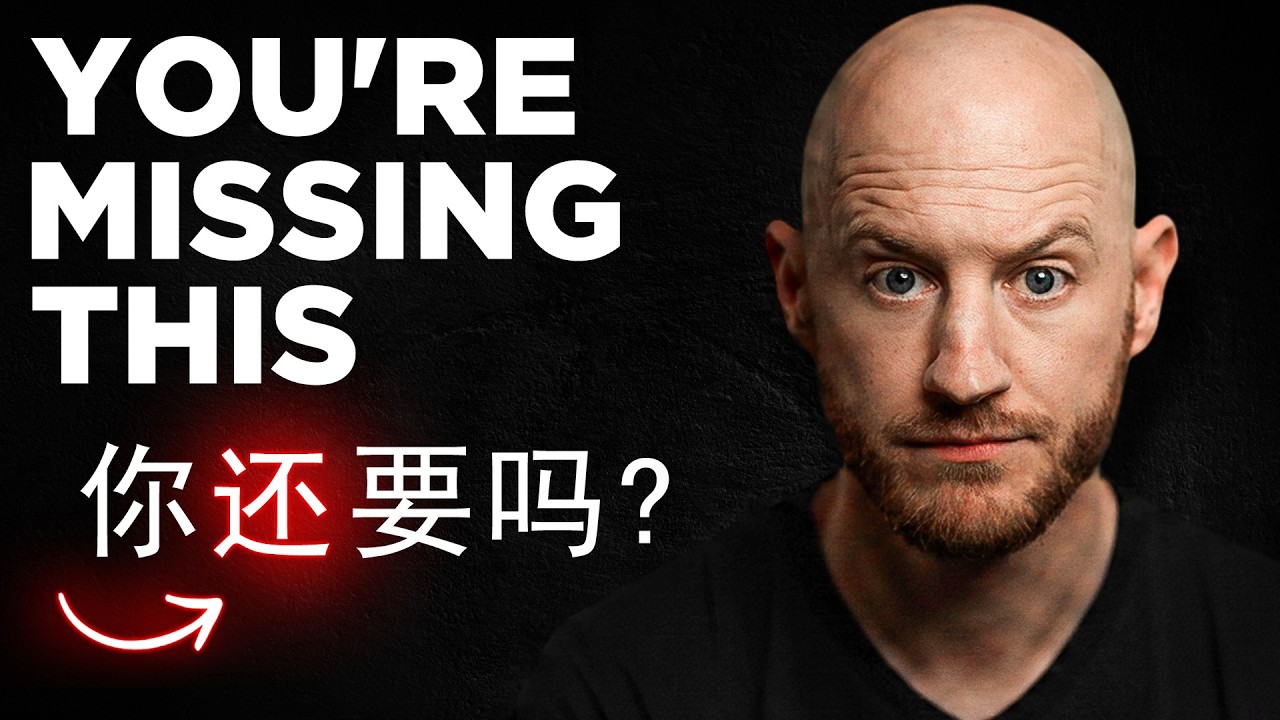
About this episode
Get every episode summarized
Each time Mandarin Blueprint publishes, we email you a written briefing from the transcript — the topics, who appeared, and any specific claims, with the ad reads skipped.
Email me new episodesFree for 3 shows. No card needed.
Hosts & guests
Transcript ready
413 searchable segments. Every word is indexed and playable.
Full transcript
Mandarin Blueprint — You Don’t Actually Know What 还 Means. Machine-transcribed; use the interactive transcript above to jump the player to any line.
There's one character holding your Chinese back, and you've probably been using it wrong since day one. Now after coaching 200 private members one on one and working with over 33,000 learners inside our community, I can tell you with full confidence, the learners who plateau aren't missing vocab. They're missing depth on characters they think they already know. And the character we're looking at today is one of the worst offenders. Most learners pick up meaning of it early and never realize how much more it's actually doing. By the end of this video, you'll understand the full range of what high or when actually does in spoken Chinese. I'm going to give you eight reasons why mastering this one character, high is one of the fastest ways to start sounding less like a textbook and more like someone who actually speaks the language. Doilal, Worsher Filth, Mandarin Lupin, the Liang Huchuang Shire. When you spent over a decade building the most structured path to Chinese fluency and fixing the way learners use high is one of the fastest unlocks we see inside our community.
Would you like to finally make real progress with Chinese? Go to mandarinbloopin.com. You unlock free access to our curriculum, join tens of thousands in our free community, get live Q&As with the co-founders, call recordings, plus a ton of bonus training. Thousands of members have used these materials to finally start reading, understanding, and speaking Mandarin Chinese within weeks, even days. Just head to mandarinbloopin.com and sign up now free. Reason number one to learn high is the frequency unlock. So I'll start with this reason because it hits you the fastest and once you understand it, the rest of the video makes sense automatically. So high is one of the top 50 most frequent characters in spoken Chinese. Top 50 out of roughly 50,000. That means in any random three sentences, a native speaker says to you, this character is showing up at least one of them. And the average learner knows exactly one meaning of it. When you know all the things high actually does, and I'm going to walk you through them today, your comprehension of natural speed Chinese jumps over night. Not because you've learned new vocabulary, because the character you've already seen thousands of times suddenly works
in five different ways instead of one. So this is the fastest way to upgrade your comprehension without learning a single new word. You already know the character, you just have to learn what it's actually doing. So look at this. Well, hi, it's actually a Chinese. In English, that's I'm still learning Chinese. That's still most learners stop there. But watch this. Well, hi, Xiang, hi, coffee. I also want some coffee. Same character, but that's not really still in this context. It's a different meaning. It's also, and this is just two of the five things high is doing in everyday Chinese. So the speed of which you're listening improves when you actually master this one character, it's almost unfair. You're not learning faster. You're just stopping the leak. Now, the second reason that you should learn, hi, is that one character chains into a whole family of connectors. So beyond the frequency unlock, there's something else that happens when you really master high. And this one, the lots of people miss. And it's very easy to overlook. So the connectors that hold spoken Chinese together, hi, hi, shi, hi, hi, hi, me, all of them run straight through this character.
Look at each one or shu yiao jidan, hi, no, no, no. I need eggs and also milk. That's hi, and also the casual way to pile on points in spoken Chinese. Okay, have them this one. Mi huacha, hi, shi, coffee. The English there is do you want tea or hi, shi, coffee? That's hi shi, before that appears in questions. And you'll hear this every single day in China. Ni hi yalma, do you still want it? Do you want more? That's hi yal, still want or also want depending on the contest. Well, hi, me, Trophane. I haven't eaten yet. Well, that's hi, me, haven't yet won most common negative constructions in spoken Chinese. So for high frequency connectors, all built from one character. When you understand the parent, hi, these don't feel like memorization. They kind of feel obvious. They sound natural coming out of your mouth. So this is also the entire reason Chinese is more efficient. Do you give a credit for? The language reuses high frequency characters across a lot of different functions. So if you're learning every compound words, it's a brand new vocab item. You're doing 10 times more worth than you need to.
Character by character is the way to go. Now, the third reason that you should learn the character, hi, is the mild affirmation phrase that will double your native register. So this next one, it might seem small, but it might be one that changes the most about how you sound day today. So it's like the mild affirmation phrase. Think about how often in English, for example, your honest answer to how was your food or how's your day isn't great or isn't terrible. It's somewhere in the middle. Well, that's most of life. And so how do you actually say that in Chinese? Well, almost every natural way to land in the middle runs through high, high-curry. That's like, it's okay, it's fine, high-sheum. It's fine, maybe a little bit better than high-curry. High-but-slaw. Not bad, pretty good. Like it's sort of a way of kind of it's a little bit nicer than the other two. So this is the daily currency in Chinese conversation. It's how people talk about their community, their lunch, their weekend, their boss. It's the everyday register. I've sat in Chinese restaurants in Chengdu and Chongqing in Beijing's, same scene every time. The waiter asks that the food is,
and sure, you'll hear很好 sometimes, but more often locals might say, I can, or high-but-slaw. They're not damning the food. They're just natural conversational register. It's like saying, yeah, not bad in English. Now, if you don't have this in your toolkit, you're stuck either gushing or staying silent or saying it's a terrible. Neither one sounds like a native speaker. So with high-curry, you suddenly have access to the most common register of the entire spoken language. This is one of those things you can learn in 30 seconds and use for the rest of your Chinese speaking life. The leverage is absurd. Now, the fourth region you should learn high is you stop misinterpreting native speakers. There's a flip side doll of this, and it's something most learners don't realize is happening to them in real time. When you only know one meaning of high, you don't just fail to use it correctly. You actually misinterpret what natives are saying, to do you. So picture this, a Chinese person tries something you cooked. They say, Jack, it's high, high-but-slaw. This dish is pretty good. If you only know high is still, your brain tries to parse that as, this dish still isn't bad,
which sounds got a backhanded or hasn't sent in English. So you think they're being looped warm. You think they didn't really like it, but they did. That's a compliment, high-but-slaw. And this context means they actually pretty good. So you would have just rejected your own win because of a translation gap inside your head. Multiply that across every interaction where natives use high and was your textbook didn't prepare you for, and you start to see how many real-eyed moments you've been misreading. Compliments you missed, suggestions you didn't catch, mild disagreements that flew right past you. When you know the full range of this one's character, you stop having those silent moments where you think people are being veered and they're actually being completely normal. You were just hearing them through a broken filter. And once that filter is fixed, conversations get a lot less stressful because you stop second-guessing what people meant. Now, reason number five for learning high is the pronunciation trap that gets you in front of a confused native speaker. So this next one is where things actually start to get awkward in real life, so pay attention. In simplified Chinese characters, high has a second pronunciation, not high, but when, same character, totally different sounds, completely different meaning.
So when high is pronounced when, it means to return or to give back. So something like this, Huanzhu, return a book. Huanzian, pay back money. Gui Huanz to return or to restore. Now, picture this, you walk into a librarian basing, you want to say, I'm here to return my book, you look it up and you say, well, high shu, or it doesn't make sense. It's like, I still book, I also book, which is gibberish, right? So they're going to look that you completely confused and so you point to the book and act it out. Now, this is not hypothetical. Walk into any library to rental shut up and shine up with the wrong pronunciation. And you'll see the same blank look from that staff member. I've watched it happen to learners more times that I can count. Now, one of our coaching members, Nancy, ran into this exact same kind of trap just last week, only with the character, booh, instead of high, she'd been studying for two years and didn't realize that booh, changes its tone depending on what comes after it. Booh man, is it booh, man? It's booh man, second tone, fourth tone, one tone shift, one pronunciation flip,
and suddenly your sentence sounds off enough to slow the whole conversation down. So the same exact pattern can happen with high. It's got a different pronunciation for a different situation. They'll get too concerned about this because at the end of the day, high tends to be used as an adverb or like for still or also in that type of thing, whereas when is a verb? It's return. So you're probably not going to confuse it if you know what the other pronunciation is, but if you only know the one pronunciation of a character, you're going to accidentally say the wrong thing and say confused native speakers. I've seen it happen all the time. The sixth reason you should learn high is the character plateau that can get a lot of learners trapped. So I see this all the time in our coaching calls and it's the reason most learners stop progressing somewhere around the intermediate level. So if you only know one meaning of a character, you hit a wall, hard. Usually around 600 to 1000 characters are marked. The math is brutal. You spend a year, maybe a year and a half learning 800 characters. You feel like you should be able to read at this point.
You sit down with a real Chinese article and you recognize every single character, but the sentence doesn't make sense. And why? Because the characters are doing work, you never learned that they could do. We had a coaching call this past week with one of our members, Nancy. Now she'd been doing flashcards inside our system for two years. She was at level 31. And by any measure, she had a foundation. Big vocabulary, consistent daily reviews. But her conversations always felt like they were getting stuck at a certain point. The flashcards taught her the primary meaning of each character. And real spoken Chinese uses three or four. Sometimes five meanings of the same character. Now you need to learn the most important meaning first. But the gap between her recognition and her actual comprehension was actually that the other meanings she hasn't learned yet had not been applied. So this is why for members stuck at this exact plateau, our coaching teams go to intervention is teaching them to slow down and go deeper. One character mastered in all its uses is where 10 characters skimmed at the surface, always. The members who plateau at level 30 are the ones who keep adding new characters
without ever doubling back on the high frequency ones like high, white, shirt, light, chute. Look, the members who break through and reach real fluency are the ones who treat every common character like a tool with multiple settings. Same effort, but there's a different return because there are many characters where learning the multiple meanings of them gives you much more of a return than even learning only one meaning of a low frequency character. Now, if I'm being honest, it took me years to fully adversity to this one myself. So Chinese is designed around a structural shortcut. The entire language is built on it. And if you don't use it, you're learning Chinese the hard way for no reason. So there are about 400 unique syllables in Mandarin. English has over 10,000. So how does Chinese carry a full language with so few sounds? By having every character do multiple jobs. Characters like high, shirt, white, look, these are the workhorses. They each carry four or five, sometimes six functions. And I'm going to master a handful of these and you've unlocked a structural grammar of the language
without ever opening a grammar book. But if you learn one meaning per character and move on, you're treating Chinese like English a bit where most words do one job. Sure, there are many words in English that have multiple meanings. But Chinese isn't built that way because there's so many fewer syllables. So you're literally fighting the design of the language if you only learn the most important pronunciation and meaning. Now, when I was studying at Sichuan University, my teacher, Yo Laoshi, he was the one who first made this click for me. He pointed at high on the board and basically said, this isn't one word. This is six words sharing one body. Once you see it that way, you stop trying to learn six things. You start learning one thing that does six jobs and that's a completely different cognitive workload. Now, that's the structural shortcut. It's already baking to the language. You just have to pick it up and use it. If you don't, you're choosing to do Chinese on hard mode. There's no other way to put it. I was one more reason I'd have 40 to learn high and honestly, this might be the most important one because everything we've talked about so far is about this one specific character.
But the last reason is what happens when you apply the same thinking to every common character in Chinese. And it's the difference between learners who plateau forever and learners who actually break through to real fluency. The last reason I've got is the one that ties all of this together. So reason number eight, the knockout reason here. You know how I said, high has five distinct uses plus a second pronunciation. Well, now think about this. Every common character in Chinese is doing some kind of similar work. Not every character has a secondary pronunciation, but they almost all have more than one way to use them. Sure, die, look, do, do, do, yeah, wait. Every single one of these is doing multiple jobs. And if you only know them at the surface, you've technically studied Chinese without ever actually learning the language. Now this is the difference between a learner who's stuck at level 30 forever and a learner who breaks through to real fluency. It's not character count so much. It's not even hours log necessarily.
It's not flash cards reviewed. It's depth. We were on a call last week with another member putting in two hours of study every single day. Before he found us, he'd spent over a year on Duolingo and other unstructured apps with basically nothing to show for it. And he told me the motivation kept dying because nothing felt like it was building on anything else. So after about six weeks inside our system, characters taught with memory palaces depth over breadth that motivation problems appeared. Not because he was learning more characters per week because the system finally made the characters click. So saying character count he could have had on Duolingo completely different depth, completely different outcome. This is what fluency actually looks like under the hood. It's not someone with more characters. It's someone with more usage per character. Someone who took the time to figure out everything high actually does and then did the same for sure. And look inside and 20 more. And don't real comprehension from the inside out. If you keep collecting characters at the surface, you'll always feel like Chinese is just out of reach.
Master them deeply, start with high today, and the next one, and the next. And then the gap closes faster than you ever believe is possible. Now to be clear, there's a lot of dimensioning returns. There's a point where you're maybe looking up the seventh archaic meaning of a character that's hasn't been used since ancient Chinese. Okay, you can stop before that. But generally the top 100 to 200 characters, depth is far more important than breadth. And in the case of characters that are beyond like 3,000 in terms of frequency, learning them at all may not be necessary. So essentially what you want to do is look at the frequency of a character like high, top 50. Okay, I really want to get how this character works. It's well worth it. And you'll see what I mean when you get into it. Hey, Luke here, I hope you found that useful. Now if you want to finally have real breakthroughs with Chinese, go to mandarinblueprint.com. You get free access to our curriculum, join tens of thousands in our awesome community, take part in live Q&As with me in Phil, the co-founders, and unlock tons of bonus courses and merch. Thousands have already gone from zero
to reading, understanding, and speaking Chinese within weeks, some in just days. If you'd like to do the same, head to mandarinblueprint.com right now and sign up for free.
More episodes
More from Mandarin Blueprint

The 4-8 Hours of Chinese You’re Already Wasting Every Day
Mandarin Blueprint

This Character Unlocks Chinese Emotion Words
Mandarin Blueprint

Why Chinese Is More Logical Than English
Mandarin Blueprint

What Efficient Chinese Study Looks Like
Mandarin Blueprint