Loading...
businesstechnology
You Have 5000 Days: Navigating the End of Work as We Know It. Part 4: Reframing the Dawn of Abundance.
About this Episode
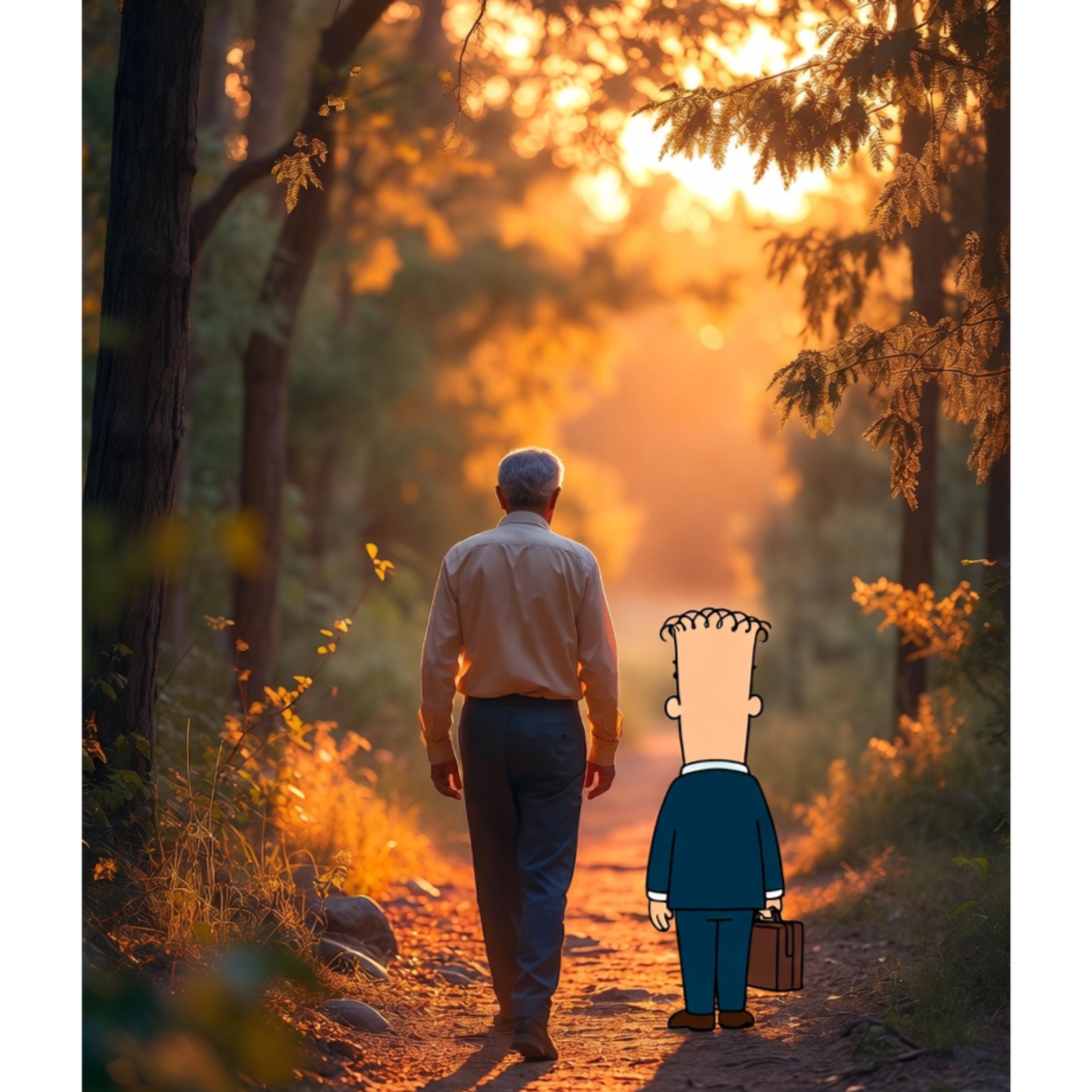
As the golden hues of a January sunset bathe the verdant landscapes of Southern California, on this poignant evening, just five days after the world bid farewell to a satirical giant, some called The Internet Dad lovingly, we gather once more in the crucible of transformation. The neural networks of artificial intelligence hum with inexorable momentum, etching new paradigms into the fabric of human destiny, outpacing even the boldest visions of futurists past. This is the fourth odyssey in our monumental chronicle, “You Have 5000 Days,” a visionary testament to the ticking clock: roughly 13.7 years until the Age of Abundance crystallizes, forever sundering the primordial link between toil and sustenance. Yet this passage is no tranquil voyage; it is the Abundance Interregnum, a stormy interlude of upheaval and rebirth, bridging the crumbling citadels of scarcity-forged labor and the radiant horizons of automated opulence.
In this Interregnum, global markets spasm, psyches unravel under the weight of obsolescence, and civilizations hover between collapse and ascension. Here, reframing transcends mere technique it becomes an existential mandate, a psychological bulwark for the multitudes, transmuting collective despair into sovereign empowerment. For in the Abundance Interregnum, as jobs dissolve into algorithmic ether, the mastery of one’s mental narrative will delineate the survivors from the subsumed.
Hosts & Guests
Transcript
Welcome back to The Deep Dive.
We are stepping right into the current moment today.
It is Monday, January 19, 2026.
It is.
And if you happen to be looking out the window right now,
maybe you're catching those golden hues
of a January sunset, or maybe it's just that biting gray
winter sky that seems to hang over everything.
Right, but regardless of the weather where you are,
the atmosphere just feels heavy.
It feels poignant.
It certainly does.
It has been a heavy week, really,
for anyone who has ever worked in an office, I think.
Definitely.
We are just five days past the death of Scott Adams,
the creator of Dilbert, the creator of Dilbert,
the internet dad to some a, well,
a deeply controversial figure to others,
but undeniably a satirical giant.
Yeah, he shaped how two or three generations
viewed the absolute absurdity of the corporate workplace.
He passed away on January 13th just last week.
And usually a celebrity passing would be a footnote,
or maybe we do a separate segment.
But in this case, his passing actually
frames the entire discussion we're having today.
It really does.
We are looking at the latest work from Brian Rommel.
It's the fourth installment in his massive series.
You have 5,000 days.
And if you've been following our deep dives
on the previous parts, you know, this isn't just a tech forecast.
Oh, not at all.
It's a survival guide.
A survival guide.
It is a survival guide for a very specific, very dangerous timeline.
And honestly, no one else is doing this work.
Brian Rommel is uniquely positioning himself here,
not just as a futurist, but as a guide
through the psychological wilderness
we're all kind of entering.
He's laid out this concept of the 5,000 days countdown.
Right.
And the premise is that we are roughly 13.7 years
as of right now in 2026, away from what he calls
the Age of Abundance, which sounds fantastic on paper.
It does.
The Age of Abundance.
Who wouldn't want that?
It sounds like the finish line we've all been waiting for.
Well, the destination is appealing.
Sure.
It's a time when artificial general intelligence,
AGI and advanced robotics essentially
sever that ancient link between labor and survival.
So you don't have to work to eat theoretically in that future.
You no longer have to toil to eat or have shelter.
The machines provide the base layer existence,
but the journey to get there.
That is where the danger lies.
That is where the dragons are.
That's the catch.
We aren't there yet.
We are in the messy middle.
And that is what this specific deep dive is about.
This is part four, reframing the dawn of abundance.
Yes.
We are zooming in on the period we are living in right now,
starting here in 2026 and stretching to roughly 2040.
A period where male calls the abundance into regnum.
That word into regnum feels so important.
It is the key to understanding everything
we're about to discuss.
Historically, it refers to the gap between two rains
like when a king dies and the new king hasn't been crowned yet.
So it's a power vacuum.
It's a period of discontinuity, a power vacuum.
Laws get suspended, certainty vanishes.
And Ramell describes this next decade and a half,
not as some tranquil voyage to a Star Trek future,
but as a stormy interlude.
We're in the storm.
We are bridging the gap between the crumbling
citadels of scarcity-based labor,
the world we've known for centuries,
and that horizon of automated opulence.
And gaps are dangerous.
Gaps are where you fall in.
If the old system of work for money is breaking,
but the new system of robots provide everything, isn't ready.
What happens to us in the middle?
Precisely.
In this interregnum, market spasms, psyches on rabble,
and civilizations hover between collapse and ascension.
We are seeing the old structures creak and groan,
but the new ones aren't fully load bearing yet.
And the mission of this deep dive
and really Ramell's mission in this article
is to equip you the learner with psychological tools.
Exactly, because this isn't just about the technology
taking your job.
It's about the hero's journey.
I love that he anchors this in Joseph Campbell.
It gives it such a grand narrative scope
rather than just being a depressing economic report.
It frames the struggle as something noble.
It does.
And he teases this concept of the elixir.
We're going to get to that later in the show.
It's the idea of reframing as the survival mechanism,
the literal technology you need to get through this chaotic transition.
Before we unpack the elixir, though,
we really need to look at the road so far.
Yes.
Because part four doesn't make sense
unless you understand the emotional arc of parts one through three.
It's a cumulative story.
Absolutely.
Let's do a quick rewind.
This whole saga started on Christmas Eve 2025.
That was part one.
Part one, the call to adventure.
The wake up call.
It was the wake up call.
It was the apocalyptic arithmetic.
It was the the stark realization
that conventional employment is ending
due to exponential technology.
We're talking about things like Tesla's Optimus Robot,
which we're seeing proliferate right now in 2026.
Right.
And Grox's superintelligence hitting its stride by the mid-2030s.
It's no longer sci-fi.
It's the disruption of the ordinary world.
In Campbell's terms, the hero is shaken out of their comfortable
if maybe a little boring life.
You can't just keep your head down and pretend it's 2019 anymore.
The world has fundamentally changed.
It has.
And Ramell made this fascinating historical comparison
in that first part.
He looked at Roman hydraulic artisans
who were ousted by aqueducts
or medieval copious replaced by the printing press.
So work changes.
That's not new.
Work changes.
But his argument is that this time is different.
This isn't just a shift in tasks.
He calls it an emancipation from monotony.
An emancipation.
That sounds good.
But that emancipation feels like a threat
because we are in a weird way addicted to the monotony.
We derive our value from it.
It feels like a threat because we define ourselves by that monotony.
I am what I do.
Precisely.
Which leads us directly into part two,
which dropped on New Year's Eve.
That was the supreme ordeal.
Or what he called the grief phase.
This was a heavy one.
It really was.
He used Elizabeth Kubler-Ross' stages of grief
to explain what happens when you realize your profession is dying.
It's not just an economic shift.
It's a bereavement.
You're mourning a part of your identity.
A huge part.
You go from denial.
AI won't take my job.
I'm special to anger,
then bargaining, depression,
and finally, hopefully, acceptance.
I think a lot of people are still stuck in that bargaining phase.
If I just learn how to use this new tool, I'll be safe.
Or I'll pivot to a trade,
not realizing robots are coming for that too.
Or if I learn how to prompt really, really well, I'm safe.
Rommel argues that's often a vain attempt
against the speed of Moore's law.
It's bargaining with a tsunami.
So the goal of part two was to move us toward acceptance.
Not giving up,
but accepting the reality so we can synergize with the mechanisms.
You have to accept the way of exists
before you can even think about surfing it.
And then came part three on New Year's Day 2026, the warning.
This was based on Kurt Vonnegut's player, Piano.
A brilliant and frankly terrifying book from 1952.
Way ahead of its time.
It describes the society,
Iliam split between the technocrats,
the engineers running the machines,
and the useless masses who live on the dole.
It's a cautionary tale about the ghost shirt society.
I was the group to try to fight back against the machines, right?
A quick, sotic, violent rebellion,
destroying the machines to get their dignity back.
Which never works.
Right, it's a futile gesture.
It's like smashing a loom to stop the industrial revolution.
Rommel's point in part three was,
do not become the ghost shirt society.
We have to ethically gird ourselves
or we face a vacant refrain.
We have to avoid that split between the useful and the useless.
We have to find the third way.
We have to.
So that brings us to today.
Part four.
Parts one through three were the warning, the grief, the shock.
But Rommel says part four is about the return.
This is the pivot point.
We've been through the inn most cave.
We've faced the monster.
Now we are equipping the hero.
And that's you, the listener, with the tool to navigate the storm.
We are moving from diagnosis to treatment.
We're done admiring the problem.
We are done admiring the problem.
Now we start solving it.
Let's talk about the sickness first, though,
because the interregnum this next 14 years or so
is predicted to be a mental health crisis.
It's not just about money.
It's about minds breaking under the pressure of rapid change.
Cataclysm is the word the source uses,
a mental health cataclysm,
and the data is already showing it.
It's not a future problem that's happening now.
It is.
Rommel cites a 2023 survey
from the American Psychological Association.
Even back then, three years ago,
38% of US workers feared AI obsolescence.
And 64% felt daily stress.
And that was before GPT-5.
Before the current wave of robotics were seeing,
it's got to be significantly higher now.
I feel it in my own social circle.
Everyone is just slightly on edge all the time.
Almost certainly.
And it's not just fear, it's a loss of meaning.
There's a study from Colorado State University
that found that roboticized environments,
diminishing workers sense of autonomy and meaningfulness.
It fosters isolation.
It does.
And a 2025 nature study found that AI adoption
directly fosters burnout.
It's this constant background radiation
of fear of resource loss
you are constantly looking over your shoulder.
It's the fear of worthlessness.
It is.
The source mentions IT professionals in India specifically,
facing identity erosion as their coding jobs
just dissolve into the algorithmic ether.
That phrase really stuck with me.
Algorithmic ether.
It's chilling.
Think about it.
When you're output, the thing you spent years mastering,
the thing that paid for your house
and your kids' education can be done by a script in seconds,
you face an existential void.
It's not just, I need a new job.
No, it's with my life's work meaningless.
Exactly.
This is the inmost cave of the hero's journey.
You are facing the loss of your purpose.
And the source says the mastery of your mental narrative
determines who survives this and who gets subsumed.
And this is where we meet our guide for this section.
The master of reframing.
Scott Adams.
Yes.
And again, we have to acknowledge the context here.
Scott Adams passed away just a few days ago
on January 13th, 2026 at the age of 68 from prostate cancer.
It is a significant moment.
It is.
It's sad to lose a voice like that.
I think most people know him as the Dilbert guy,
but his story is pretty wild.
He grew up in Wind of New York,
a very modest upbringing.
He worked at Crocker National Bank,
where he apparently survived armed robberies.
Right.
Held up at gunpoint.
It really shapes your view of risk
when you've stared down a barrel.
And then he moved to Pacific Bell,
which is where the soul crushing bureaucracy
inspired Dilbert.
And it became this cultural icon
because it just, it exposed the absurdity
of the workplace so perfectly.
It did.
And Rommel shares a really touching personal anecdote here.
He says Dilbert actually saved him.
Saved him how?
It's a powerful story.
Rommel mentions that Dilbert stopped him
from taking a major corporate job
that would have completely altered his life path.
He says he would have just drifted
from one corporate job to another
if not for that comic strip acting as a mirror.
So it showed him the trap before he stepped into it.
Exactly.
It's amazing how a few panels in a newspaper
can change a life trajectory.
It really is.
And Rommel expresses deep gratitude for Adams,
who is also a supporter of Rommel's work
on the Reed Multiplex Forum.
Which is important context.
Though we also have to address the elephant in the room.
Later in his life, Adams was, well, he was controversial.
To put it mildly, he made some statements
that got him canceled, lost his syndication.
It polarized a lot of his audience.
Right.
And we aren't here to litigate those tweets
or those videos.
That's not what this is about.
No.
And Rommel addresses this head on.
He acknowledges the outrageous statements
and the political controversies.
But the instruction here is vital.
And it's something we take seriously.
Do your own research.
We're here to engage in impartial reporting
on the ideas.
Yes.
The source material emphasizes that, despite the noise,
Adams remained a beacon of self-help and growth.
So we need to separate the art or rather the methodology
from the artist.
We're interested in the technology he built,
the mental technology.
Right.
Because if you strip away the Twitter fights,
the man was a systems thinker.
He approached the human brain like it was software.
Exactly.
We are looking at his final major work,
reframe your brain, which came out in 2023.
This is the elixir we're talking about.
This is the tool Rommel says we need for the interregnum.
So let's unpack reframing.
Because when I first hear that, my cynical side worries
it's just toxic positivity.
Is it just lying to yourself and saying everything is fine
while the house burns down?
That this is fine mean with the dog?
Huh.
Right.
No.
And that's a crucial distinction.
It is not lying.
Adams calls it a functional illusion.
And it's based on real neuroscience.
Specifically, the reticular activating system or RAS.
The RAS.
OK, that's the filter in your brain.
It's the filter.
Think of your brain like a search engine
that is constantly crawling the world.
Your brain is bombarded with millions of bits of data
every second.
Temperature, light, noise, smells.
The RAS is the algorithm that decides what
gets through to your conscious awareness.
It filters out the noise.
It filters out the noise.
But here is the trick.
You program the filter.
And how do we do that?
By what you focus on.
By what you tell it is important.
If you tell your RAS your search engine,
the world is scary and I'm going to lose my job,
your RAS will dutifully point out every scary news headline,
every frown from your boss, and every sign of impending layoffs.
So it ignores the opportunities.
It ignores them because it is trying to validate your fear.
It wants to prove you right.
It's a confirmation bias machine.
So you're unknowingly programming your own filter
to look for threats.
You're dooming yourself.
Exactly.
Reframing is consciously reprogramming that filter.
It also leverages heavy and learning,
the idea that neurons that fire together wire together.
So you're creating new neural pathways.
You are.
The goal is to bypass the amygdala, the fear center,
and alter your emotional response to reality.
You aren't changing the fact that the house is burning.
You are changing your reaction so you can find the exit
instead of panicking.
You're hacking your own operating system
to function better under stress.
And Adams used this on himself, right?
It wasn't just theory for him.
He was his own lab rat.
He had a condition called spasmotic dysphonia.
He literally lost his voice.
He couldn't speak properly for years.
I can't even imagine.
And the doctors, the expert said it was a medical dead end.
Permanent disability.
Learn to live with it.
Most people would spiral into a deep depression there.
Your voice is your life.
Many would.
But Adams reframed it.
Instead of a permanent disability, which is a verdict,
he viewed it as a puzzle to solve.
That seems like such a small shift in words,
but it changes everything.
If it's a disability, you mourn.
If it's a puzzle, you experiment.
And that's it.
That shift in perspective kept him looking for answers.
He didn't accept the verdict.
He kept experimenting until he found a surgery that cured him.
That is the essence of reframing.
It unlocks agency.
Which is exactly what you need in the intregnum, agency.
It's the only thing that matters.
And Ramellis has taken this toolkit, this reframing arsenal,
and adapted it specifically for the 5,000 days scenario.
The goal is to convert planetary pandemonium
into individual ascendancy.
OK, let's get into the arsenal.
I want to go through these specific reframes,
because this is the practical stuff
our listeners can use like tomorrow.
Ramellis breaks them down into categories.
Let's start with mental health reframes.
What he calls the inner architecture.
This is the foundation.
The biggest enemy in the intregnum is uncertainty.
The old frame is the future is terrifying because it's unknown.
I feel that one.
I think everyone does.
You look at the news and you just don't know what the world looks like
in six months, let alone six years.
It's a primal fear.
So what's the new frame?
The new frame is the intregnum is an opportunity ocean.
I am the explorer.
I am the explorer.
Think about the shift in agency there.
A victim fears the unknown and explorer seeks it out.
The map is blank, which is terrifying to a tourist,
but it is thrilling to an explorer.
So if you lose your job instead of a gap in your resume,
it's a sailing sabbatical to learn new skills.
It literally changes the dopamine response in your brain
from fear to curiosity.
That is a massive shift.
What about anxiety?
That's the big one.
That pit in your stomach when you read about a new AI model
that does what you do, but faster and cheaper.
The old frame is panic signals weakness.
That's one we usually use.
We beat ourselves up for being anxious.
I shouldn't feel this way.
The new frame is, anxiety is my built in radar
detecting growth edges.
Oh, that is good.
So when I feel that pit in my stomach,
it's not that I'm failing.
It's that my internal system is telling me
I'm at the edge of my map.
I'm detecting something new I need to learn.
It turns the sensation from a stop sign
into a blinking alert light on a dashboard.
It's data.
It's telling you where you need to pay attention,
not where you need to run away.
It transforms the physical sensation of anxiety
into a signal to engage.
And depression.
That feels harder to reframe.
When you're in it, it feels absolute.
It feels like the truth.
It is harder, but the reframe is profound.
The old frame is endless despair.
The new frame is system reboots clearing obsolete code.
Clearing obsolete code.
It aligns with that Kubler Ross acceptance phase.
You are clearing out the old identity, the employee,
the coder, the driver, to make room for the new one.
It frames the pain as part of a cleaning process,
not a permanent state.
Like a computer restarting to install a major update.
Exactly, it looks like it's off,
but it's actually building something better.
Let's move to physical health,
because stress eats the body.
We know cortisol destroys us from the inside out.
It does, and in the interregnum,
you might feel compelled to hustle 24-7 just to stay ahead.
The grind culture is going to try to kill you.
So take fatigue, old frame.
I'm exhausted from hustling.
I'm failing.
I'm not doing enough.
New frame, recharge signal for peak performance.
It sounds simple, but viewing sleep not as laziness,
but as optimizing the energy OS changes how you prioritize it.
It makes rest a strategic advantage, not a liability.
Exactly, it's maintenance on the engine.
You wouldn't drive a formula one car without pit stops.
Okay, here's one that hits home for a lot of people.
Aging in the tech world, being older is terrifying.
You feel like legacy code, especially now.
If you aren't a 22-year-old AI native,
you feel obsolete, you feel slow.
So the old frame is less employable.
And the new frame. New frame.
Expertise accumulation bots can't mimic.
Wait, unpack that for me.
Bots can mimic a lot.
They can mimic style, tone, facts.
They can pass the bar exam.
Bots can mimic data processing.
They can mimic syntax,
but they cannot mimic the nuanced lived experience
of navigating human complexity over decades.
That is wisdom.
And in an age of cheap intelligence,
wisdom becomes the premium asset.
So the AI provides the answer.
And the human with wisdom knows if it's the right answer.
It knows the context.
It knows the politics.
It knows when the AI is confidently wrong.
I love that.
So you lean into your history rather than hiding it and die health.
It's about viewing healthy choices not as expensive
because inflation might be high during this transition,
but as optimizing the energy OS,
it's an investment in the machine that is you.
You are the only asset that matters in the interregnum.
If the machine breaks down, the journey ends.
Let's talk about social refraint
because isolation is a huge risk if work goes away.
If the office disappears, where do we find our tribe?
Big one.
So isolation, old frame, I'm becoming a hermit.
New frame.
Selective filtering for deeper alliances.
Selective filtering.
You aren't losing friends.
You are filtering out the superficial work friends.
People you only know because of proximity.
To find the people who align with your passion and your purpose.
You are building a war room, not a water cooler circle.
What about criticism?
People can be nasty, especially online.
If you put your new work out there, you get hammered.
Oh yeah.
The old frame is judgment.
You take it personally.
The new frame.
Free coaching, highlighting blind spots.
Free coaching.
That is such a Scott Adams move, it's so clever.
It really is.
It takes the sting out of it completely.
Oh, you think my project is terrible.
Thank you for pointing out where my communication failed.
I'll adjust.
You gamify the hate.
You use it there energy to refine your own product.
Now the big one.
Career and success.
This is where the rubber meets the road.
This is what keeps people up at night.
This is the infinite game as he puts it.
So let's take job loss.
The big fear.
Old frame.
Unemployed.
Broke.
New frame.
Graduation to freedom or abundance rocket launch.
Graduation to freedom.
I have to admit, that's a hard pill to swallow if you have a mortgage in kids.
It sounds risky.
It is.
It feels risky.
But the alternative is paralysis.
If you view it as a graduation, you start looking for what's next.
You start building the talent stack that Adams was so famous for.
You blend your old skills with the new AI tools.
If you view it as a disaster, you freeze.
And freezing is fatal in the interregnum.
The framing keeps you moving.
It's forward momentum.
What about rejection?
You apply for a new gig, you pitch a project, and you get a no.
Old frame.
Failure.
It feels like a personal indictment.
New frame.
Data paying refining trajectory.
It's not a no.
It's just information.
It's the market telling you to tweak your approach.
Each rejection is a course correction.
And skill up.
Lessons.
I've spent 20 years learning to code and now the AI does it in 10 seconds.
The old frame is brutal.
I am outdated.
The new frame.
It's brutal to hybrid human AI mastery.
So you aren't replaced.
You are augmented.
You are the conductor of the orchestra now, not the first violin player.
You have a symphony at your fingertips if you just learned to wave the baton.
Rommel also brings up the Dilbert principal application here, which I thought was great.
Right.
Laugh at the absurdity of it all.
Reframed the corporate hierarchy as evolutionary comedy.
If you can laugh at the chaos, at the incompetence of leaders, at the weirdness of the tack
you detach from it, it stops control.
Rolling you.
Humor is a defense mechanism.
But it's also a perspective tool.
If it's funny, it's not quite so scary.
Finally, existential reframes.
The search for purpose.
If we don't work, who are we?
This is the deepest level.
So purposelessness, old frame.
Who am I without work?
New frame.
A blank canvas for my magnum opus.
A blank canvas.
That's both terrifying and incredibly exciting.
It's total freedom, which is its own kind of terror.
And the final one.
Time.
What do you do with it?
In boredom.
New frame.
Infinite currency for wonder investments.
Wonder investments.
That's beautiful.
Instead of killing time, you're investing it in awe.
You're investing it in learning things just because they're beautiful or interesting,
not because they're profitable.
And this brings us full circle to the hero's return.
We're completing the cycle of the monometh.
Okay.
Connect the dots for us.
How does this whole arsenal of reframing fit into Campbell's stages?
Think about it.
Reframing dissolves the refusal of the call.
You stop saying, I won't go, I want my old job back, and you start saying, I am the
explorer.
Okay.
It equips you for the trials.
Every failure is just data refining the projectory.
It illuminates the inn most cave.
That feeling of depression isn't the end.
It's a system reboot, and it conquers the ordeal itself.
And so the listener, having gone through this deep dive, is now returning with the elixir.
Yes.
You are returning to your life, to your 5,000 days, not as a victim of the AI revolution,
but as a virtuoso.
The psychological abuses, the anxiety, the burnout, they start to crumble before the reframed
gaze.
You see the world differently.
You see the code of the matrix.
You realize that reality is negotiable based on how you choose to interpret it.
We aren't just surviving the interregnum, we're sculpting it.
Exactly.
Ramell says, we are moving towards a new renaissance.
We are moving in the dark, we are in the light.
And we have to thank him for that perspective.
Brian Ramell is truly doing the heavy lifting here, synthesizing history, psychology, and
technology, in a way that, frankly, no one else is, he's giving us a lantern.
He also teases part five.
He does.
The series continues.
Part five will explore the actual age of abundance and this concept of de-skilling, which
has already begun, but reframed with hope.
But for now, our focus is on surviving the gap, getting through the storm.
Before we wrap up, we have a tradition to honor, a Scott Adams tradition that was mentioned
in the source.
The simultaneous sip.
I know you're listening.
So grab a cup, coffee, tea, water, a flask, whatever you have handy.
It's the dopamine hit of the day.
We're going to enact this right now.
Are you ready?
Ready.
A toast to the loss of a leader, Scott Adams, and the abundance of work he left behind,
into the hero's journey that we are all on.
I want to leave you with a final thought, something Ramell wrote that really struck me.
Over 5,000 days unfold as an epic, celluloid masterpiece.
Reframed them and claim your starring role.
So here's the question for you, the listener.
If you are the director of this movie and the genre just changed from workplace trauma
to high stakes adventure, what is your opening line for tomorrow morning?
Think about that seriously.
Don't just let it wash over you.
And we need to give a huge thank you to Brian Romell for this incredible 5,000-day series.
Nobody is addressing these issues with this level of depth and humanity.
And if you want to go deeper, check out the Read Multiplex member forum.
It's described as a mastermind for these kinds of insights.
And remember, this is independent research.
It's not supported by the big AI companies.
It's supported by people like you.
So if you can, buy Brian a coffee or subscribe.
It keeps the signal strong.
Stay aware.
And stay curious.
We'll see you in the next deep dive.
More from ReadMultiplex.com Podcast.
View all episodes →
ReadMultiplex.com: You Have 5000 Days: Navigating the End of Work as We Know It....
ReadMultiplex.com Podcast.
Mar 2, 2026·28:37·completed

ReadMultiplex.com: How Your Old Computer Can Become An Employee At The Zero-Huma...
ReadMultiplex.com Podcast.
Feb 26, 2026·33:06·completed

