Loading...
businesstechnology
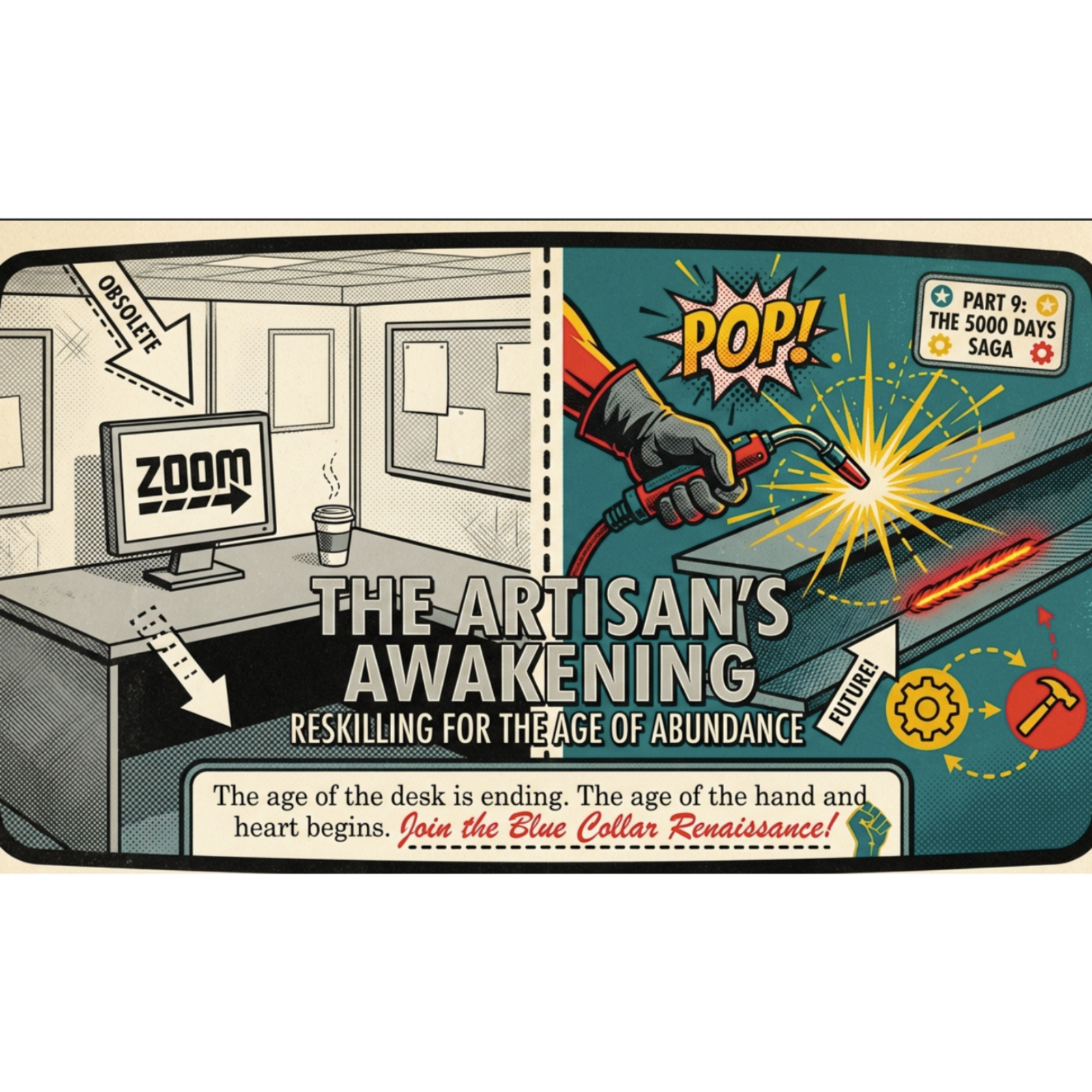
You Have 5000 Days: Navigating the End of Work as We Know It. Part 9: The Artisan's Awakening.
About this Episode
As we forge ahead into this ninth chapter of our epic saga, "You Have 5000 Days," let us first cast our gaze backward, honoring the path we've traversed together through the evolving landscape of human endeavor and technological transformation. This series, born on the eve of profound societal shifts in late 2025, serves as our collective map through the Abundance Interregnum – that fateful 13.7-year odyssey where artificial intelligence and automation sever the ancient chains binding work to survival, birthing a world of unprecedented plenitude, freedom, and creative potential. Each installment has been a beacon, illuminating the shadows of change with stories, strategies, and unyielding optimism, drawing from literature, philosophy, and real-world insights to guide us toward a future where humanity thrives beyond mere labor.
Read it at ReadMultiplex.com
Hosts & Guests
Transcript
Welcome back to The Deep Dive. Today is Monday, February 2nd, 2026, and wow, I mean,
if you've been following the news cycles at all, we're just looking at your own career trajectory
lately. You know exactly why that date matters. It really matters. We are right in the thick of it.
We are. We're living through the timeline. We have been obsessing over on this show for months.
It's not theory anymore. No, not at all. It feels like we've been talking about this transition
forever, doesn't it? But we're really only a few years into the specific timeline that
Read Multiplex laid out. We are deep, deep in what he calls the abundance interregnum.
Exactly. And that brings us to today. We're tackling part nine of the You Have Five Thousand Days
series. The title is The Artisans Awakening. And I have to admit, right off the bat,
when I first saw that title pop up in my feed, I felt a little, I don't know, resistant.
Resistant? That's interesting. Why? What was the pushback for you?
Well, just think about the journey we've been on. Look at the last few deep dives we've
done on this series. We went through the de-skilling. We sat with the dark night of the soul.
Those are headed. They were brutal. We established really painfully that AI is essentially
eating the white collar world alive. It's dissolving the junior analyst, the coder, the marketer.
It's genuinely scary stuff. Yeah. And now suddenly part nine comes along and claims there's a
solution. It felt a bit like a bait and switch. Ah, I see. Like everything is burning down around
you. But hey, look over here. I've got a bucket of water. Yes. Exactly that. I was expecting a high
tech solution to a high tech problem. I thought the source was going to say, okay, the robots are smart.
So you need to become a cyborg. You need to merge with the machine. Get a neural ink. Yeah.
That's the standard advice you hear on every other tech blog. Learn prompt engineering or become
an AI supervisor or pivot into synthetic biology. But this source, this one says the complete opposite.
It says, stop looking at the screen. Look at your hands. Look at your hands. It's such a massive pivot.
It's a survival guide. But it's completely counter-incuitive in today's world.
The source is making this incredible argument that the safest place to be financially,
psychologically, existentially isn't above the API. It's not in the cloud. It's in the mud.
It's in the crawl space. It's in the workshop. We're talking about the traits, actual physical
blue collar traits, plumbing, welding, farming, electrical work. And before anyone listening,
rolls their eyes and thinks, wait, I didn't get a master's degree in economics to go fix toilets.
We have to be super clear. Absolutely. The source isn't framing this as a demotion, not at all.
They're framing it as an ascension. Exactly. This isn't a consolation prize for failing in the digital
economy. It's not, oh, you couldn't hack it as a coder. So go carry some bricks. This is presented
as the elixir. This is the next critical stage of the hero's journey that he's been mapping out.
And to understand why that's not just, you know, poetic language, we have to respect the sheer
boldness of this 5,000 days series. I mean, the author is seeing things that almost no one else is
seeing, especially with this timeline. Let's reestablish that context for a second. Because if
someone's just joining us now, the idea of 5,000 days might sound like a completely random number
he just pulled out of a hat. Right. Like some marketing gimmick. But it's anything but random.
The author has identified a very specific 13.7 year transition period. That is the abundance
into reg them. We are living in the gap. The gap between the old world where you work to survive
and the new world where AI and automation provide unprecedented plentitude and the cost of living
just collapses to near zero. But the key phrase there is near zero. We're not there yet. No. We are
in the turbulence. The messy chaotic, often terrifying middle. And the journey so far has been brutal,
part one was the call to adventure, just waking up to the fact that traditional work is dissolving
underneath our feet. And parts three and five were the heavy hitters, the player Fiano and
diskilling. That was the gut punch. The realization that these AI feedback loops are moving on 19
hour cycles. I still can get my head around that 19 hours. It's impossible for a human to compete.
If you're trying to reskill in the digital realm, you know, you go take a course in the new hot
coding language or some new software. By the time you finish the six week course, the AI has
already mastered it, integrated it and made your new skill obsolete. You can't outrun a 19 hour
feedback loop with a human brain. It's just not possible. Which led us directly to part six,
the dark night of the soul, that deep existential dread. If I don't type into a spreadsheet,
who even am I moment? Yeah, that one hit home for a lot of people. Yeah. And then part eight,
saving your wisdom was about trying to preserve human knowledge in the face of all this.
But part nine, this artisans awakening, it really is the turning point. It is. We are finally moving
from lamenting the loss of the desk job to actively celebrating a reskilling into the physical
world. So we're done mourning the spreadsheet. Is that what you're saying? We are done mourning the
spreadsheet. We are picking up a wrench. Okay, I'm ready. Let's get into section one. The blue collar
renaissance and the hero's departure. The source uses this fantastic metaphor of crossing the
threshold. It's classic Joseph Campbell, the hero's journey. The hero has to leave the ordinary
world to find his power. And in our case, the ordinary world is, well, it's the modern office.
Fluorescent lights, endless zoom calls, slack notifications, pinging you at 10 o'clock at night.
The algorithmic drudgery, which let's be honest, feels less like an ordinary world and more like
a trap these days. It absolutely is a crap because of the villain we identified back in part five,
de-skilling. The source really hammers this home again. AI is systematically destroying the value
of data entry of coding of mid-level analysis. If your job involves sitting at a screen and processing
abstract information, you are in the blast zone. There's no way around it. The algorithms are
eating the cognitive middle class for lunch. So the special world, the place the hero has to go to
find safety, is the world of tangible creation. The world of the trades, the source calls them
fortresses against the machine onslaught. That is such a strong image of fortress. It is, and it's
based on a very practical, very grounded analysis of what robots can and cannot do right now,
and for the foreseeable future. This is the logic of robot resistance. Okay, now, I need you to
steal man this for me, because I open my phone, I go on social media, and I see these videos of
robots from Boston Dynamics folding laundry. I see them doing backflips. I saw the atlas robot
doing parkour. Of course, the viral videos. Right. And if a robot can do a perfect backflip,
why is a plumber safe? A backflip seems way, way harder than me than just tightening a nut on a pipe.
This is such a crucial point, and it's a classic cognitive trap. We anthropomorphize intelligence.
We assume that because we find calculus hard and walking across a room easy, computers must
feel the same way, but they don't. They feel the exact opposite. It's a concept in computer science
called more vex paradox, more vex paradox. Okay, break that down for me. Hans more vex, a brilliant
robot assist pointed this out decades ago. It turns out that high level reasoning, things like
playing chess, writing poetry, diagnosing a rare disease from a text description, calculating
complex stock market trends, that stuff is computationally very cheap. But the smart stuff is actually
easy for them. Incredibly easy. An AI can become a grandmaster at chess in a few hours,
but low level sensorimotor skills. Things our bodies do without thinking. Walking across a cluttered
room without tripping, feeling a bolt to know if it's cross threaded, perceiving the subtle
difference between a shadow and a damp spot on a wall. That's the hard stuff. That requires a
staggering, almost unbelievable amount of computational power. It's the easy stuff for us that's
hard for them. So that back flipping robot. That robot is almost always in a highly controlled
environment. It's a lab. The floor is perfectly flat. The lighting is perfect. The variables are
limited. Now contrast that with the real world environment of, say, a plumber. Okay. A damp,
musty basement in a 1920s Victorian house. Exactly. Let's really visualize that. You, a human plumber,
walk in. It's dark. There are cobwebs everywhere. The pipes aren't standard PVC by at Home Depot.
They're cast iron that has settled and warped over 80 years. They're not where the blueprints say
they should be. The blueprints are a work of fiction at this point. There's a leak, but you can't see
it. You have to smell the dampness or feel the humidity change on your skin as you move around.
You have to move a precarious pile of old boxes. Your client stored down there without knocking
them over. And the robot in that scenario, what does it do? The robot is fighting entropy. The real
world is pure, unadulterated chaos. To a robot, that basement is a data overload of noise.
It tries to grasp a pipe, but the pipe is slippery with slime and condensation. The robot's sensor
slip. It doesn't have that human touch. So it applies too much torque and cracks the brittle
old iron. Game over. Game over. You've just flooded the basement. The messiness of reality is
actually our armor. It's our protection. That's the fortress the source is talking about. The more
chaotic, the more dirty, the more non-standard the environment is, the safer the job is from
automation. Precisely. Robots love order. They love the sterile, predictable world of the factory
floor. They love spreadsheets. They hate rust. They hate mud. They hate what the source calls gravity's
whims. And there's an economic argument here too, right? It's not just can they technically do it.
It's, is it even worth building a robot to do it? Exactly. This is the scaling problem. Could we
with enough money and time build a bespoke robot to go in and fix that one specific Victorian toilet?
Maybe. But it would cost millions of dollars in R&D. And it wouldn't work on the toilet in the
house next door. Because that one has a completely different problem in a slightly different
equally chaotic environment. Scaling specialized robots for every single nook and cranny of society
is just ridiculously prohibitively expensive. So while the white collar world is crumbling because
software scales instantly and for free, the physical world has this built in friction, this
economic and physical barrier that protects us. Correct. And that's why the source argues that
while these white collar domains are crumbling right now as we speak, these trade jobs are safe
for another 10, 20 or even 30 years. 30 years. That is a massive bridge. We're talking about a
5,000 day transition, which is roughly 14 years. A 30 year window is more than enough time to
ride out the entire storm. It is. It buys you safety through the whole interregnum. You don't
just survive. You thrive because you are doing the one thing the machines can't touch. You become
indispensable. Okay, so this isn't just about survival. It's a genuine strategic pivot. Let's talk
about the specific roles. The source curates this amazing list of the top 22 locations. He calls them
the pillars of the Renaissance. And I love that it gives them these incredible, exalted titles. It's
not just plumber. Well, let's go through a few. And I wouldn't really dig into what these jobs
feel like because I think so many of us have lost touch with what it means to work with our hands.
I agree. What's so powerful is that these aren't framed as dirty jobs. They're framed as heroic
archetypes. Let's start with the plumber. The source describes a plumber as a master of fluid dynamics.
Commanding the lifeblood of civilization. That sounds like a superhero, not a guy fixing a clog.
But it's true, though, isn't it? We take it for granted. But clean water flowing in and waste
flowing out is the absolute bedrock of public health. Civilization collapses without it in about three
days. It's that fundamental. But let's get really specific. Why is this job so hard for AI? We
talked about the Victorian basement. But what about the day-to-day thinking involved? It's the
diagnostic intuition. It's a multi-sensory investigation. A good plumber listens to the pipes. They hear
a specific thunk and know that's a water hammer issue in the West Wall. They look at the color of
the water coming out of a tap and know the water heater is starting to rust out from the inside.
They're like a doctor for the house. Exactly. It's Sherlock Holmes with a wrench. It's about
interpreting these tiny subtle clues that a robot sensors would just register as noise.
I love that. Sherlock Holmes with a wrench. Okay, let's move to the electrician.
The weaver of energy. Harnessing lightning to illuminate homes. Now, this one feels different to
me. Plumbing is messy, but electrical work feels dangerous. And that's the crucial differentiator.
The stakes. The consequence of failure. If you make a mistake in a spreadsheet, maybe you lose a
client or some money. If you make mistake wiring a high voltage panel, people die. House is burned
down. So the barrier to entry isn't just skill. It's about liability and trust. Precisely. Insurance
company, regulators, building inspectors, they are not going to sign off on an AI wiring a
hospital's ICU anytime soon. But let's look at the work itself. You open a junction box in an old
building. What do you see? A rat's nest. A total rat's nest. Wires from the 1950s mixed with wires
from the 90s. The color coding is wrong or it's faded. Nothing matches the schematic. The robot
looks at the schematic, the model of the world that was given and the schematic doesn't match reality.
And the robot freezes. It's a fatal error. But the human electrician uses what the source calls
kinesthetic intelligence. They trace the wire with their fingers. They interpret the intent of
the previous electrician from 40 years ago. I think, oh, I see this guy used the green wire for
the hotline because he must have run out of black wire that day. You have to get inside the head
of the person who did the work before you. Exactly. It's anthropology as much as it is engineering.
It's a human to human connection across time. Let's talk about the HVAC technician. The source
calls them the alchemist of comfort. I love that one. Balancing air and heat. Again, it sounds
poetic. But think about the technical complexity. You are managing thermodynamics in real time.
You're up on a scorching hot roof in the middle of July or you're in a freezing cold crawl space
in January. And you're dealing with pressurized refrigerants with airflow dynamics with pressure
differentials. You're trying to figure out why one room in the house is 10 degrees colder than
all the others. It's a puzzle with invisible pieces. And then there's the welder, the forge god.
Fusing metals, creating structures that withstand time and enormous forces. There is a permanence
to welding that you just do not get in the digital world. I feel like welding is the ultimate
example of this kinesthetic intelligence you're talking about. Yeah. You have to control the
puddle of molten metal, the speed of your hand, the angle of the torch, the distance of the arc,
all at the same time. It's a dance. And you're doing it by feel. You feel the heat through your
gloves. You see the subtle color changes in the metal. A robot can be programmed to weld a perfect
straight line on a car chassis and a factory. Sure, over and over. But can it weld a broken railing
on a rusty fire escape hanging off the side of a five-story building, fighting the wind and
awkward angles? No, absolutely not. That requires constant microsecond adjustments based on a
flood of sensory data that we're not even conscious of processing. Now, there's a key dish into
this list that I found really moving. And honestly, it surprised me a little. The source includes
farming and ranching. Yes. This is a vital expansion of what we think of as a trade. Usually when
we hear learn a trade, we think of construction or mechanics. But the sources arguing that the
farmer and the rancher are also a protected class in this age of AI. They're the stewards of the
soil and custodians of herds. But my first thought was, isn't farming already super automated? I see
those giant combines driven by GPS that can harvest a field with inch-perfect precision. That's
industrial model culture. Miles and miles of corn or soybeans. Robots can do that. That's a
predictable factory-like environment. But the source is talking about the artisan farmer.
Regenerative agriculture. Termiculture. Exactly. What's the difference? Technically.
Permaculture is an ecosystem. It's a complex integrated system. You have apple trees next to
berry bushes next to nitrogen-fixing ground cover. You have ducks that are there to eat the slugs.
It's a three-dimensional puzzle of biology. It's chaotic. It is intensely beautifully chaotic.
You can't program a robot for it. You have to observe it. You have to walk the land every day and see,
oh, the aphids are bad on the kale this year. I need to introduce more ladybugs into that patch.
It's a constant complex strategic game played with nature itself. And the rancher.
The custodian of herds. Animals are not machines. They have moods. They get sick.
They have complex social hierarchies. A good rancher can look at a cow from a hundred yards away
and just sense that something is wrong. How though? It's the way it's standing or the look in
its eye or the way its tail is twitching. It's a million tiny data points that a human brain
evolved over millennia to read other living creatures can process instantly. A sensor might
pick up a fever 24 hours later but the rancher knew yesterday. It's empathy. It is empathy as a
technical scale. An algorithm can simulate empathy but it cannot feel the herd. That connection to
life to life cycles is something purely biological. So we have this incredible list of 22
vocations. We have the alchemists, the guardians, the stewards, and the common thread running through
all of them is this kinesthetic intelligence. It's about being in the world, really truly in it.
It's about being corporeal. It's about having a body. We have neglected the body in favor of
the brain for so long in our economy. The artisans awakening is really the body striking back. It's
the body saying, Hey, remember me, I am useful. I can do things the mind alone cannot.
This leads us perfectly into section three, the psychology of craft. Because the source isn't
just saying do this for the money. It's saying do this for your sanity. This is where we connect
all the way back to part six, the dark night of the soul. The crisis so many people are feeling
right now that deep unease is alienation alienation. That's a heavy word, but it feels right.
It is, but it's accurate. In digital work, your output just vanishes into the ether. You spend all
day crafting the perfect email. You hit send and it's gone. You write a brilliant piece of code. It
runs in the background on a server in Virginia that you will never see. You don't see the fruit of
your labor. I feel that so deeply. You close your laptop at the end of the day and nothing in your
physical environment has changed at all. The room looks exactly the same. You're just tired. Yeah.
And empty. Exactly. That profound disconnect between effort and tangible result creates a
nying existential anxiety. The source argues that physical work cures the spread because it offers
tangible proof of existence, tangible proof of existence. I like that. When a welder finishes a
seam, that seam is there. It is solid metal. It will hold weight for 50 years. You can run your
hand over it and feel the texture. When a carpenter builds a table, that table exists in space. It takes
up room. It has weight. The feedback loop is immediate and physical. It's not a like on a post.
It's a thing in the world that says, I was here. I did this. I changed the world even in this one
small way. Exactly. It proves you have agency. It proves you matter. And psychologically,
that kind of visible achievement bolsters mental health in a way that a performance review never,
ever can. And is the mindfulness aspect too? The source talks about
getting into flow states. Yes. Hands on work forces you to be in the present moment. If you are
soldering a copper pipe, you cannot be doom scrolling in your head or worrying about your
mortgage. You have to be right there watching the heat, watching the metal flow. Your entire focus
is on that single point in space and time. If your mind wanders during a zoom call, you miss a slide.
If your mind wanders while you're using a table saw, you lose a thumb. Chuckles. Exactly.
And that danger or at least that requirement for total focus actually quides the noise in your
brain. It's an enforced mindfulness. It stops the anxiety loops. It grounds the worker in physical
reality. It's an active meditation. So in a way, the trade isn't just a job. It's a therapy.
It's a practice like yoga or martial arts. It's a way of being. There's also the social value.
We've talked so much about how lonely an isolating remote work can be. The source describes the
artisan as a community hero. This is such a beautiful and important point. Think about the HVAC
technician who shows up and restores the heat in a family's home on the coldest night of the year.
You are literally saving the day for them. You are. You walk into someone's home. They're in real
distress. Their kids are cold. And you use your skills, your knowledge to fix their immediate
physical problem. The gratitude you receive is real. The connection is face to face. Or the local
farmer at the market who feeds the neighborhood. Right. It creates a powerful sense of belonging.
You are woven into the physical fabric of your community. You aren't some ghost living in the
cloud. You are a neighbor who helps other neighbors. That's a deep human need that has been stripped
away. So we have the financial safety. We have the psychological grounding and we have the community
connection. It sounds perfect. I have to play the skeptic again. Please do. The source is honest.
It doesn't say this fortress lasts forever. We talked about the timeline 30 years maybe.
No. And that's the integrity of the 5,000 days series. It never sugarcoats. It acknowledges
the inevitable. This brings us to section four. The long game. Because eventually the robots
will catch up. Won't they? The source admits eventually. Yes. Sometime in the late 2030s,
we will likely have swarms of dextrous adaptable bots that can master chaos. Material science will
advance. Sensors will get cheaper and better. The Victorian house problem will eventually be solved.
So wait a minute. If I spend the next 10 years becoming a master plumber learning all the nuance
is building a business. And then in 2038, a robot can do my job better and cheaper.
Was it all a waste? Did I just delay my obsolescence by a decade? That is the pivotal question.
And the source gives a resounding emphatic no. Why not? Because of the twist. This isn't a tragedy.
In the hero's journey, this is the return with the elixir. Okay. You have to explain the elixir.
The elixir is the transformation of work into exalted hobby. Exalted hobby. That sounds nice.
But what does that actually mean? Remember, we are moving toward an age of true abundance.
The abundance into regnam ends. We enter a period where we no longer work for survival because the
machines provide the basics for everyone. Energy is nearly free. Food is cheap. Housing is 3D printed.
Exactly. So in that world, we will work for joy, for self-expression, for meaning.
So I'm not plumbing because I need to pay my mortgage. I'm plumbing because I just love pipes.
That feels like a stretch. You're plumbing because it has become an art form.
The source paints these absolutely beautiful visions of the future hobbyist.
Give me the examples because recreational plumbing sounds like a really hard cell.
It does, doesn't it? Yeah.
Listen to how they describe it. Plumbing becomes a aquatic artistry.
You aren't fixing clogs anymore. The nano-bots do the sewage. You are designing beautiful,
sustainable eco-foundons for public parks. You are creating interactive water features for private homes.
You are mastering the flow of water for beauty and tranquility. Okay. I have to admit that's
actually really cool. And electricians become inventors of custom light installations.
They aren't just wiring outlets. They are using their deep knowledge of energy to create art.
They are lading up cities in new ways we can't even imagine. And welders become sculptors.
Making massive, kinetic art. The forge god becomes a true artist. In 2040, a human welder isn't
welding a structural eye beam for a warehouse. A robot does that perfectly every time.
The human welder is creating a gate for a garden that is a masterpiece of intricate design.
And the farmers and ranchers. What happens to them? This is perhaps the most profound transformation
of all. They become regenerative homesteaders. They aren't worried about yield efficiency for the
global market. The giant robot farms handle that. The human farmers are biohackers and artists.
They are experimenting with heirloom crops purely for flavor, not for durability or transportability.
They're growing the tomato that actually tastes like a tomato. Exactly. The one that bruises if
you look at it wrong, but tastes like heaven. That's a human luxury in a world of perfect,
tasteless machine grown food. And ranchers focus on conservation breeding of rare animals
and on animal companionship. So the idea is you learn the trade now to survive the chaotic
transition. But in doing so, you are also saving the human touch for the coming era of machine
perfection. You become the master of two worlds. That's the final stage of the hero's journey.
You have bridged the gap. You survived the chaos of the interregnum and you arrived in the age of
abundance with a rare, valuable skill that allows you to express your humanity. That is a deeply,
deeply hopeful vision. You completely reframe the whole robots are taking our jobs narrative.
It's not that they take our jobs and we all sit around doing nothing. It's that they take
the drudgery and we get to keep the craft. We get to keep the joy of making. Exactly. We keep the
connection to the physical world. I want to pause here for a second because I feel like we
breeze past a few of the other vocations on that list of 22 that I really want to highlight.
We hit the big ones, but there's some deep cuts in there that I think are fascinating and really
illustrate the point. Oh, absolutely. The list is incredibly well thought out. Let's do it.
Okay. For example, the locksmith. Ah, the secret keeper. Yes, the source calls them secret
keepers, unlocking mysteries while fortifying security. Now, why is that resilient to AI? It seems
like it's all about precision, which robots are good at. Think about the integration. A locksmith
today isn't just filing metal keys anymore. They are installing complex smart locks that have
to integrate with home automation systems, but the purely physical act of retrofitting a 50-year-old
worked wooden door to accept a brand new digital lock. Right. It's never a clean fit. It never
is. That requires drilling, shizzling, aligning strike plates on frames that have settled. It's
custom work every single time. A robot might be able to hack the software of the lock, but can it
physically install the hardware without completely ruining the mahogany door? Not easily.
And there's a massive element of trust there too. You're letting someone into your most
secure spaces. A huge element that human factor of trust is very hard to automate.
What about the glazier? That's when you don't hear about every day. The source calls them
the glass visionary. Framing views that connect inside to out. This is a great example of the
intersection of energy efficiency and aesthetics. As we move toward a greener world, which is a huge
part of the background of the 5,000 days series. Retrofitting old buildings with new energy
efficient glass is a massive, massive job. And glass is heavy, awkward, and incredibly fragile.
Extremely. Imagine handling a 10 foot by 6 foot pain of triple glazed glass on a windy construction
site, 30 stories up in a city. That requires a level of tactile feedback and minute team coordination,
literally sensing the wind and the weight shift with your partner that is so far beyond what a
machine can do right now. It's that kinesthetic intelligence again. It just keeps coming back to
the body. It always does. Okay, what about the auto mechanic, the vehicle healer?
Reviving mobility with mechanical empathy. This one is really interesting because of the massive
shift to electric vehicles. You might think, well, EVs have fewer moving parts, so mechanics are
doomed. That's the common wisdom, right? No engine, no transmission, no job.
But the source points out the importance of adaptability. First, there's a huge body of work
in adapting to electric and autonomous vehicles. But even more interesting is maintaining the classic
models for enthusiasts. The classic cars, of course. In the age of abundance, collecting and
driving vintage internal combustion engine cars will be a huge hobby. Keeping those beautiful,
complex machines running requires a very specific, almost lost art of mechanics that robots won't
be programmed for because it's a niche, passion driven market. So you become the specialist who
keeps the 67 Mustang rumbling down the road when everything else is a silent self-driving bot.
Exactly. You are a historian as much as a mechanic. You are preserving the rumble. You're preserving
a piece of culture. It's funny. As we go through these, I realize how much creativity and design
is actually embedded in the so-called blue collar jobs. Our culture has stripped them of that
dignity. We think of them as road labor. That was the fundamental mistake of the industrial age.
We treated humans like machines. We told the plumber to just fix the pipe. We told the welder
to just join the metal. Now that we have actual machines to do the machine work, humans are
finally free to be artisans again. That is the headline right there. Waking up from the nightmare
of being biological robots and returning to being creators. I want to touch on the economic
reality one more time to ground all of this. Because while the exalted hobby future is beautiful,
our listeners have bills to pay today in February 2026. The source talks about salaries.
It does. It notes that median salaries often eclipse 50 to 80 thousand dollars annually.
And that's for journey men. Master tradespeople can earn significantly more.
Which in 2026 dollars is a very solid living. But the entrepreneurship angle is key.
Boundless horizons as the source says. Starting your own contracting firm.
Specializing in high demand areas like eco-friendly installations or smart home integration.
Because when you have a trade, you own your own means of production. You are your own asset.
You have power. You do. Think about it. If you get laid off from a corporate job,
you lose your access to the company's data, their proprietary software, their client lists.
You're left with nothing. If you're a plumber and you get fired, you pick up your tool bag and
you walk down the street to the next house that needs help. You still have your power.
That is true. Anti-fragility. It is. You are robust to shocks. You're not fragile.
And in the abundance in a regnum, shocks are the only guarantee.
Turbulence is the new normal. You want to be a sturdy boat in that storm. Not a delicate house of cards.
So the message of Part 9 is crystal clear. Don't be a house of cards.
Via fortress. Via forge. Via garden. Via artisan.
Okay, let's pull it all together. What does this mean for you, the listener, right now?
Today. Yeah. In 2026.
It means you have a fundamental choice to make. You can cling to the old world of the desk job,
which is actively crumbling. You can keep refreshing your email, hoping the layoffs don't
hit your department next. Or you can accept the call to adventure and get your hands dirty.
The source is telling us in no uncertain terms that craft work is the elixir.
It's the thing that stalls the loss of a job right now. But ultimately,
it's the thing that lets your job become your art.
And you have to remember the timeline. We are living through this specific 13.7-year transition
right now. The clock is ticking on those 5,000 days. This isn't a problem for the next generation.
It's for us. I want to leave everyone with a final, provocative thought,
something to really chew on from all this. We talked about abundance,
about a future where money is no object. Right. The post-scare city world.
So ask yourself this question and be really honest. If money were truly no object,
if you're housing, your food, your healthcare were all guaranteed,
which of these trades would you choose to do purely for the satisfaction of the act itself?
Would you want to work with wood, with metal, with soil, with water,
with energy? That answer. Whatever pops into your head right now,
that might just be your lifeboat today. And your joy tomorrow.
We really want to hear from you on this one. Are you making this shift?
Have you already traded the keyboard for a hammer? Go to the forum at readmultiplex.com
Share your own hero's journey into the trades. We'll be there reading every one of them.
This has been The Deep Tive. Thanks for listening. Keep building.
See you in the future. See you in the future.
More from ReadMultiplex.com Podcast.
View all episodes →
ReadMultiplex.com: You Have 5000 Days: Navigating the End of Work as We Know It....
ReadMultiplex.com Podcast.
Mar 2, 2026·28:37·completed

ReadMultiplex.com: How Your Old Computer Can Become An Employee At The Zero-Huma...
ReadMultiplex.com Podcast.
Feb 26, 2026·33:06·completed

