
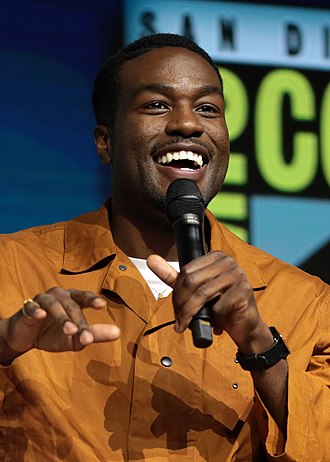
Best Of: ‘Wonder Man’ actor Yahya Abdul-Mateen II / John Coltrane centennial
About this episode
Also, we’ll hear from saxophonist Ravi Coltrane, son of jazz great John Coltrane. This month marks the centennial of his father’s birth. He spoke with Terry Gross about this father's legacy.
Plus, Ken Tucker reviews a new album by the trio The Womack Sisters, granddaughters of Sam Cooke and nieces of Bobby Womack, and an album from Margaret Glaspy.
See pcm.adswizz.com for information about our collection and use of personal data for sponsorship and to manage your podcast sponsorship preferences.
NPR Privacy Policy
Get every episode summarized
Each time Fresh Air publishes, we email you a written briefing from the transcript — the topics, who appeared, and any specific claims, with the ad reads skipped.
Email me new episodesFree for 3 shows. No card needed.
Hosts & guests


Transcript ready
763 searchable segments. Every word is indexed and playable.
Full transcript
Fresh Air — Best Of: ‘Wonder Man’ actor Yahya Abdul-Mateen II / John Coltrane centennial. Machine-transcribed; use the interactive transcript above to jump the player to any line.
This message comes from Capella University. That spark you feel? That's your drive for more. Capella University's Flex Path Learning Format lets you earn your degree at your pace without putting life on pause. Learn more at capella.edu. From WHYY in Philadelphia, this is Fresh Air Weekend, Antonio Moseley. Today, actor Yaya Abdul-Mateen II. He's nominated for an Emmy for his performance in the Marvel series Wonder Man. The two weeks after his nomination, Disney announced the series would not return for a second season. But getting laid off is how he found acting in the first place. I keep on getting laid off and losing it and losing jobs. What up with that? Every time I do, it turns into something better. You know what I mean? So I wonder what this one's going to turn into. Also, we'll hear from saxophonist, Ravi Coltrane, son of jazz musician John Coltrane. He was two when his father died. And growing up, he was just known as Ravi.
The two's I picked up the saxophone suddenly. I was John Coltrane's son. Plus, Ken Tucker reviews a new album by the trio, The Woe Max Sisters, granddaughters of Sam Cook and Mises of Bobby Woe Max. That's coming up on Fresh Air Weekend. This message comes from Sotva. Have a big day coming up? Remember, tomorrow starts tonight, with the restorative sleep you need to perform at your best. The kind every Sotva mattress is designed for. So whether it's the first day of school, a new job, or an important presentation, Sotva helps you be the best version of you. And now save up to $625 on $1,000 or more at Sotva.com slash NPR. That's S-S-D-A-T-V-A.com slash NPR. This message is from Synchrony Bank, who wants to remind you to stay flexible. Not the 10,000 steps before breakfast, yoga bending, circus performing, wish I hadn't done that kind of flexible. It's about staying financially flexible, like with our High Yield Savings account.
You'll learn a great rate without monthly fees or minimums that can slow your progress. Go to Synchrony.com slash NPR. Remember FDIC. This message comes from Jerry. Car insurance gives drivers plenty to be skeptical about. Jerry gives them a way to check. Jerry shops rates from over 100 insurers, so drivers can review their options and switch all in the app. No spam calls, no hidden fees. Jerry has saved drivers over $1 billion on car insurance. It has 4.75 stars on the app store and over 5 million drivers. Still skeptical? There's only one way to find out. Download Jerry today. This is Fresh Air Weekend. I'm Tonya Mosley. And my guest today is Yaya Abdul-Mateen the second. He's nominated for an Emmy for the Marvel series Wonder Man. He plays Simon Williams, a struggling actor with a secret. He has real superpowers. And if anyone finds out, he doesn't just lose his career. He loses his freedom. Abdul-Mateen grew up in both New Orleans and Oakland,
studied architecture at UC Berkeley, and worked as a city planner until a layoff sent him to the Yale School of Drama. He booked his first major role in 2015, nearing 30. And since then, he's performed on Broadway and Top Dog underdog, been cast as Black Manta and Aquaman, Bobby Seal, and the trial of the Chicago Seven, the lead in Candy Man, and won an Emmy for playing Dr. Man Hatton, in HBO's Watchmen. Wonder Man made him the lead in his very own Marvel series. And then two weeks after his Emmy nomination, Disney canceled the show. A few months after a second season had already been announced. And Yaya Abdul-Mateen the second, welcome to Fresh Air. What's up? What's up? What's up? Thank you. I'm happy to be here. Why are you laughing? You know, I don't really reflect back so far, that far. And when he's first, you say him a name, and then you go through and you tell the story. And then, even when you engine off,
he said, and he just lost his job. And now he's sitting in front of me, and he just lost his job. And I just thought that that was so. It's so funny the way that I'm being talked about right now. But you know, I mean, there's so much to talk about. The thing about it is, when Marvel approached you, you said, I only have one Marvel dollar to spend. Yeah, yeah, yeah. You asked yourself whether Wonder Man was the actual role that you were going to spend that dollar. I'm really curious. I thought that was a really interesting way to talk about entering the Marvel universe. And being a part of something that's so big, how are you reflecting on it now that you have spent that dollar and you've gone through this journey on this show that is highly respected? Yeah, so far, dollar world spent, for sure. Look at the experience that I had, you know, and I got to put it out. Now, when I said that, I was talking about fun and longevity.
You know, I was talking specifically against a one off. A role that is going to stand the test of time and not be a one off. And at the same time, something that was worth my time and something that I enjoyed, that's what a dollar world spent would be. Now, when I flashed to present day and I do reflect back, boy, of course, it was a dollar world spent, you know. I got to make a fantastic show. And I got to play a fantastic character who many people related to. Wonder Man is not a typical Marvel story. There's almost no action. It's a comedy. And it's a comedy about auditioning, shot like an indie film. And the hero's battles are with casting directors and in his own head. Your character, Simon Williams, he's a working actor and Los Angeles, years in without a break, when a reclusive director announces a remake
of this cheesy 80 superhero. Have you ever wanted a role as bad as Simon, wanted, Wonder Man? Oh, let me think. There has to be a yes. There has to be a yes in there somewhere. I wanted to play both the characters that are played in the play called Top Dog. Underdog, I've been wanting to do that for 20 years before I got a chance to do it. But I never did pursue it. So I don't know if I've wanted anything. I can't think of anything that I've pursued. In the same way that Simon pursued, Wonder Man. Because he was doing some crazy things for a job. But actors, we do all type of things. I was telling stories. I was lying on my resume to my telling stories. I was lying on my resume back in 2012, talking about all the different skills and accents I could do and things like that. Oh, he first graduated from acting school? No, no, no.
I hadn't gone to school yet. This was when I was just getting little jobs and the Bay Area little acting jobs. And I was over exaggerating. I had maybe played the bone goals two times and said, yeah, I could do that. So I put it on my resume. I may have done an accent in class one time. So I said, you know, that wasn't too hard. I put that on my resume. But that's what you got to do. You got to stack the cards in your favor. What gave you the goal to do it? I didn't know no better. And it was too much empty space on my resume. So I needed to figure out, I needed to find things that I could do so I could write it down. I think it would gave me the goal, the empty space. That's what gave me the goal. Season one ends with us expecting to now see what Simon is going to be like now that he has all the things that he has been fighting and working toward. He is Wonder Man. And they point to a pattern of Marvel involving Black lid projects. There's Wonder Man canceled, despite your nomination
for Emmy, Blade, Dead After Seven Years, Iron Heart, Armor Wars. It's just a whole bunch. And the argument is that Marvel doesn't protect its Black lid projects. You kind of have rejected that. Why do you see it? It's not that I've rejected that. I make the observation based off my experience. When you look at the history of those projects, and when you put them all together, there's no way around it. It does not look good. It does not look like good business. And it looks like it's certainly not favorable to its Black creatives. That's what it looks like. So I'd be ignorant if I didn't, if I'd be willfully blind if I chose not to make that observation. I'm always interested in the truth. And I'm always interested in what is true for me.
And what is true for me is that in the case of Wonder Man, I actually don't know what happened. What did they tell you? I've heard things about viewership. What I would say is that if that is the case, then when it comes to Black-led projects, especially Black-led niche projects, I think they need a little bit more time to cook. Because I think Black audiences usually find out and gravitate to the niche projects a little bit slower. They're a little bit behind because they're not always, that's not what's always marketed to us. And I think that it was one of those projects that needed a bit more time to cook if it was going to depend on the Black audience to also give some buoyancy to the numbers of that show. Nevertheless, I will circle back and always come back to the point that I'm so thankful and blessed to have been able to be a part of something that was special,
that is special. I'm getting so much love out there. And the reason why I think I'm getting so much love is because people are, yes, they do feel for me, but what's actually going on is that they love that show. People really enjoy that show. And I know what it's like to have one of my favorite shows be canceled for it to finally end. You got to find a way to feel that, to feel that slot, to feel that void. So I think it's a sign that our show gave a lot of people, a lot of joy and relief and some distraction in this world. And I do hope that I get another chance to step back into that one-to-may character. You grew up between New Orleans and the Bay. And somehow you went to 13 different schools. I think so. I think it tries like that. Yeah, that's like changing schools every few years. Why did your family move so much? Always looking for a better life. Always looking for a better school.
There was six of us. So a lot of that sometimes was about trying to find whatever was convenient for my parents and the best fit for our education and things like that. Was there ever a moment when you got tired of it? No, I didn't even notice it. You did? No, no, because there was so much love in my home. So whatever now could be perceived as some type of instability or anything like that, we were shielded from that. And my parents did a fantastic job. And like I say, when we went to different schools, we were looking for a better education. How do you think that experience shaped who you are, being the new person all the time? Yeah, I mean, I think that it's made me more observant. I enter into new environment, sort of quiet, looking around and sort of calculating and doing the math on my surroundings.
And then after a little while, I take up a little bit more space. Now when I went to high school, I went to one high school. And so high school was my first time entering into a space with the same students, basically entering into a school, just sort of on the same level as everybody else. So high school was really where I sort of socially blossomed. In the ninth grade, I sort of gained my confidence. But what I did have by the ninth grade was my individuality. I was myself. Which does that mean? I looked at that look like. Well, I wasn't a follower. We had my high school reunion in the Bay. In the Bay of Yeah. In Oakland, I think it was the last year or the year before. And I was at lunch with my best friend from high school.
And then with another one of our friends also from high school. And he said, yeah, yeah, man, he said you was different. I said, what? He said, yeah, man, your dad would drop you off on the motorcycle. And you would just, you were just different. And when I think back, I was like, I think, wow. I guess I was. But I was always myself. You even called yourself the weird one. When did I do that? Yeah, there was an interview where you said, I was a little weird. I was nerdy, but I also played sports. And yeah, yeah, yeah. I mean, I don't know why I used that word. But I was different. But I liked myself. You know what I mean? Whatever it was about me that made me different. I didn't know it. I didn't know that I was different. That's the thing. And I liked myself. Everybody's different. You know, I was confident enough to, like, I didn't have the cool shoes that didn't even
feel like it fit my personality. You know, I remember one time I wore, I got some Jordans. It was the first time I had like the cool shoes and I wore them to school in a friend of mine. Oh, man, he didn't let me rest. Oh, yeah, yeah. You know, point that me because I got the new cool shoes on. And I was a little bit embarrassed, but, you know, but I was always confident in who I was. That's funny to be embarrassed, right? By wearing the latest. Yeah, yeah, yeah, yeah. But because I wasn't that kid. So it's sort of, you know, it was as if I was trying on cool for the first time. People called your family the Black Brady Vines. Yeah, yeah, yeah. You were the youngest, the youngest of the six. I'm the youngest. Yeah, we had a mom, dad, the dogs, the station wagon. And what I like to say is we didn't have the, you know, the white picket fence we had the chain link fence, but, you know, it was ours. You talked about having a stutter.
Yeah, I started growing up. Yeah, even to this day, I started. How into this? It can be intense. If I let myself get comfortable, you know, right now my brain is on. So I'm conscious to take my time and things like that. But if I wasn't worried about taking my time, then you would be able to tell. Oh, he started. Oh, really? Oh, yeah. Yeah. So are there particular words or words sometimes tend to give me, it just depends. But say I have this thing, right? I have two streams of consciousness going on, basically all the time. And I can feel a stutter on its way. And when I know when I'm about to stutter, then I switch over to the second stream of consciousness and I go, I'll go around the stutter and then I keep on going. When I'm at home and I don't feel like doing that, I just stay on my single stream of consciousness and I just stutter. I just let the stutter go and I just get through it. I've always been that way for you. I think so. Mm-hmm. Yeah.
Architecture was your major at UC Berkeley. And you've talked about how you took drama classes to help you overcome your stutter. Yeah. So that you could do your presentations for it. Yeah, that didn't work. It didn't work. I didn't work at all. But I found, you know, acting. And I didn't stutter when I acted. I never stuttered with a script ever. What do you think it is about the drama and the drama class that really allowed you to be in that space? I will rehearse the words. So it's just really all muscle memory. I know you don't know any different, but it sounds like it's a lot of work. It's, is it exhausting? It's exhausting the two. I mean, we all have double consciousness to a certain extent. Is that exhausting? Yeah. It's a little bit of work, but, you know, it helps me to articulate myself better. Yeah. And things like that. One needs to care. You know what I mean? You know, who knows? I do what works for me right now. It helps me to communicate better. You know, I don't want to be on TV and on my interviews just stuttering all over the
place and making a mess, you know? But it's so, it's also kind of amazing because I've heard other actors who have also, I think James Earl Jones has talked about he had a stutter. Yeah, but stuttering is frustrating. For example, if I were to stutter right now, sometimes you just wouldn't be able to hear anything. I just wouldn't be able to say the word. You may have radio silence for about eight seconds. And I'm not even making sounds. But the times I sound like the car engine trying to start and that's when I'm being stubborn and just trying to push it through, you know? And I don't feel like taking my time. I don't feel like going to my alternate words. You know, it's just what I know. Our guest today is actor Yaya Abdul-Mateen II. We'll be right back after a short break. I'm Tonya Moosley and this is Fresh Air Weekend. This message comes from Fisher Investments. Senior Vice President Michael Hosmer explains the importance of providing a comprehensive
approach for clients. The culture at Fisher Investments, it's about helping. It's about improving our clients financial situation, advising not just for now, but all the way through hopefully to their next generation. A well-designed financial plan will cover a number of important topics and many of these topics are connected to each other. Fisher Investments possesses the professional expertise across all these important disciplines from investment management to tax minimization to a state planning you name it. Learn more at Fisherinvestments.com. Investing in securities involves the risk of loss. This message comes from Schwab. At Schwab, you can get everything from self-directed investing to full service wealth management all in one place. No matter your investing goal, life stage, amount to invest or know how, you can invest your way with Schwab. This is Fresh Air Weekend. I'm Tonya Moosley. Let's get back to my interview with actor Yaya Abdul-Mateen II.
He's nominated for an Emmy for his lead role in Wonder Man, a Marvel comedy about a struggling actor who's hiding the secret that he has real superpowers. Abdul-Mateen II grew up between New Orleans and Oakland. The youngest of six studied architecture at UC Berkeley and worked as a city planner in San Francisco until a layoff sent him to the Yale School of Drama. Since then, he starred in several television productions, which include starring as Black Manta and Aquaman and Bobby Seale and the trial of the Chicago Seven. He won an Emmy for playing Dr. Manhattan and HBO's Watchmen and earned a Tony nomination for his Broadway debut and top dog underdog. This year, he also starred in and served as executive producer of Netflix's Man on Fire, stepping into the role of John Creasy, a part Denzel Washington made iconic. Is it true that your dream since you were a child was to be a city planner? Was it an architect?
To be an architect? Yeah, I wanted to be an architect. That's why I went to college to study it. Yeah. Back of your mind during that time period, acting as well? I didn't even know that was possible. I never even thought about that. Somebody, I'll keep your story short, but a teammate of mine dared me to take an acting class. What type of teammate? I was on the track team at Berkeley. Yeah. One day, we were at practice making fun of the coaches and things like that on the team building exercise. I got up in front of everybody and did an impersonation. Everybody was laughing. The next day, they were still talking about it. My teammate, he dared me to take a theater class. I was looking for an easy class to take and auditioned and took the class. Didn't take it seriously. In the sense that I did all the work, but I used to be late to class and things like that. I wasn't the best representation of what a top student should be. But I always knew my lines. I rehearsed for real. I don't know how present I was.
But when it was my turn to work, I always put in the work and always took the work seriously. I didn't take the attendance the most seriously. After that semester, the teacher, she told me, I just ran into her in the building one day and she said, hey, she said you're really good. I hope you take some more classes. I wasn't necessarily intending to. I was like, oh, I didn't know that. Maybe I will. So the next class that I took, I found something that I thought would be a good opportunity to work on my stutter. And then that just brought me deeper into this world. You're deep in this world, but you still, you graduate with an architecture degree and you work for the city of San Francisco as in the city planning department. Yeah. The mayor's office of housing. Yeah. I was a program coordinator for a project called the SF Hope Initiative.
I believe it's been almost 15 years now. You remember it. Yeah, yeah, yeah. The youth SF leadership academy, youth SF leadership academy, I think that's what it was called. But I was a program coordinator. My job was to pair young people with architects and with city planners in six of the housing projects in San Francisco that were undergoing a redevelopment process. And so I was teaching or facilitating a program that taught architecture and city planning, curriculum to the young people so that they could work with the planners to get educated feedback on what they wanted in their neighborhoods. Were you enjoying the job? Absolutely. You got laid off though. Yeah, it was like 11 months. 11 months later, you get laid off. I keep on getting laid off. I'm losing it and losing jobs. What up with that? You know, every time I do it, it turns into something better. You know what I mean? So I wonder what this one's going to turn into. Well, I mean, you got a whole slew of projects. So you get laid off and you give yourself three years to become an actor or you'd go back
to study. Yeah, I was going to go get my masters in planning and probably working politics. You decided to go to grad school for it. You ended up at Yale School of Drama. That is a prestigious acting school. It's one of the best in the world. It's for serious actors. When you went there, did you have a specific dream of the type of actor that you wanted to be? Not necessarily. I just wanted training. I knew that actors from that school were working on Broadway. That was really, because by then all the acting I had done was in theater. So I was like, well, okay, well, how far can you go in theater? Well, you can go to Broadway. So, you know, I was hoping to get enough training to go and do Broadway and then you see what happens next. Yeah. Yeah, yeah. Abdul Mateen the second. This has been such a pleasure. It has been. Thank you very much. Yeah, yeah. Abdul Mateen the second. He's nominated for an Emmy for the Marvel series Wonder Man. And his new film by any means is in theaters now.
The Womack Sisters are a trio with illustrious family ties. Their uncle was R&B great Bobby Womack and their grandfather was Sam Cook. The Sisters have just released an album of tight harmonies. By contrast, Margaret Glassby, who also has a new album, sings starkly about living a solitary life. Rock critic Ken Tucker discusses these contrasting sounds in his review. Let's start with the Womack Sisters. Much of the Womack Sisters' self-titled new album is filled with music that
harks back to the days of classic soul and R&B. It's in their blood. Their parents are Linda and Cecil Womack, who made beautiful rhythm and blues under the name Womack and Womack. Their uncle, Bobby Womack, possessed the gravely voice that powered hits like looking for a love and across a hundred and tenth street. And their grandfather was the gospel and soul great Sam Cook. Now these three Sisters, Beeji, Kucha and Zimani, are looking to shape the kind of music they grew up hearing for a contemporary audience that doesn't know or care about their illustrious roots. The Womack Sisters' self-titled new album is filled with music that harks back to the days of classic soul and R&B.
It's in their blood. Their uncle, Bobby Womack, possessed the gravely voice that powered hits like looking for a love and across a hundred and tenth street. And their grandfather was the gospel and soul great Sam Cook. And their grandfather was the gospel and soul great Sam Cook. And their grandfather was the gospel and soul great Sam Cook. And their grandfather was the gospel and soul great Sam Cook. And their grandfather was the gospel and soul great Sam Cook. And their grandfather was the gospel and soul great Sam Cook. That's a song called Shofur, whose title works as a job description and a metaphor. Apparently, the Womack Sisters took a number of jobs over the years to finance their recording, including doing some Uber driving. The lyric is about taking control of one's career, no longer being a passenger, getting behind the wheel. While this new release is being positioned as the Sisters' debut, I've been aware of various songs and EPs they've released over the past decade.
And what strikes me about this album is that it's got their best songwriting. And for the first time, they transcend nostalgia. Yes, the music is rooted in 1960's soul, but their crisp, tight harmonies possess an urgency and immediacy that speaks to the world we're living in right now. Look into my eyes, boy, don't realize you went away too long, too way for your heartache and almost enough to forget you went away too long, too way for your heartache
and almost enough to forget you. In contrast to the Womack Sisters' impeccable harmonies, I give you Margaret Glassby's voice, ringingly alone, as her piece is interrupted by a former lover who suddenly appears at the end of her driveway. And I'm a city girl, but it's a different world out here in the middle. I'm on solid ground with the friends I found, nobody makes me feel it all. You said you didn't want me.
Then why did you come all this way? You said you didn't need me. You said you didn't need me. Who's standing in whose driveway? That song called Michigan leads off Margaret Glassby's new album called I Am Both. On it, Glassby acts as a chronicler of doubt, hesitation, misgiving of the emotions that can grind a relationship to a halt. She keeps circling back to the word nothing. Doing nothing is something I do too well, she sings on one song. In another, she describes a couple stuck in a rut. James and Marie, they don't want to say the wrong thing, so they say nothing.
The music is mostly Glassby and her acoustic guitar with an occasional puff on a harmonica. Discrete keyboards and drums, slip in here and there. Working with producer Joe Henry, Glassby sounds as though she's walking through the rooms of an empty house, taking in memories good and bad, assigning blame, and taking responsibility. Can't you read my mind? I thought telepathy was a requirement for love. So I rolled my eyes, thinking that you were acquainted with Barty Languages. I didn't know I had to speak up.
That's why I'm folding your long name, that I'm making a meal of it. I'm slamming doors, you leave open, and I'm hoping you're feeling it. I thought we were on the same page, apparently not. I'm in a silent rage. I'm sorry for being so petty. That line, I'm slamming doors, you leave open, and I'm hoping you're feeling it. Oh boy, that really kills me. Both Glassby and the Womac Sisters are women who've been put to the test by men who resist understanding their pain and their power. They know that relationships are a lot more complicated than victim and victimizer, and you use their work to untangle these snarled dynamics to better understand and explain themselves to us.
Kintucker reviewed new music by the Womac Sisters and Margaret Glassby. Coming up, we'll hear from Saxophoneist Ravi Coltrane, son of Jazz Great John Coltrane. This is Fresh Air Weekend. One minute I am a dream to you, and you can't cope with how much I mean to you. And the next you are through me, and you want nothing to do with me. This message comes from Fisher Investments. Senior Vice President Michael Hosmer explains the importance of providing a comprehensive approach for clients. The culture at Fisher Investments, it's about helping. It's about improving our clients' financial situation, advising not just for now, but all the way through hopefully to their next generation. A well-designed financial plan will cover a number of important topics, and many of these topics are connected to each other. Fisher Investments possesses the professional expertise across all these important disciplines,
from investment management to tax minimization to a state planning you name it. Learn more at Fisherinvestments.com. Investing in securities involves the risk of loss. This message comes from Schwab. At Schwab, you can get everything from self-directed investing to full service wealth management all in one place. No matter your investing goal, life stage, amount to invest, or know how, you can invest your way with Schwab. This is Fresh Air Weekend. I'm Tony Mosley. Terry has our next interview. Here she is. The jazz saxophonist and composer John Coltrane was born a hundred years ago. The centennial is September 23rd, and the celebration includes concerts, album reissues, and a new book of Coltrane photos edited by my guest, Ravi Coltrane, the son of John and Alice Coltrane. Ravi is a highly regarded tenor saxophone player and composer who is recorded as a leader and in other bands.
The book is titled Coltrane, the definitive visual celebration of the legend, and it includes an introduction by Ravi and several essays, including one's by Patty Smith, Carla Santana, Carim Abdul Jabar, and Phil Lesh. The Coltrane family is organizing some of the centennial events and overseeing the estates of Ravi's parents, John and Alice Coltrane. John Coltrane is one of the most influential musicians in the history of jazz. He was famous for his early recordings in Miles Davis' band, his transcendent ballads from the Great American Songbook, his modal music, his spiritual music, for popularizing the soprano saxophone and jazz with his recording of my favorite things, and for avant-garde free jazz like no one had heard before. To quote with a late jazz critic, Francis Davis wrote, in The New York Times, full disclosure, Francis was my husband. Coltrane has come to stand for a discipline mindset, a desire for spiritual ecstasy, a vision of music as ritual, and of performance as a holy right. That's R-I-T-E.
Depending on what a listener wants from it, Coltrane's music is a cry for black liberation, the soundtrack of a spiritual quest, a backdrop for tripping, or the next evolutionary step for jazz after bebop. Alice Coltrane, Ravi's mother, was a pianist and harpist who played on John's final albums, recorded many albums, and her own name, turned to Vodonta's spirituality, and founded an ashram in LA. Ravi Coltrane, welcome to Fresh Air. Congratulations on the book. I want to start with something from your father's ballads album, because I just think that album is gorgeous and so beautiful that it sounds a little spiritual to me, because it sounds kind of transcendent. So where do you see this album fitting into your father's body of work before we hear a song from it? Well, first of all, thank you Terry for the invitation, if an honor and pleasure to be speaking with you. It's a pleasure to have you.
And yes, I think that album really displays his tone, his sound, and I think that all of the songs are very beautiful, his interpretation of them sonically. I mean, I think that's really where the record really gets its power from his tone alone. You won't hear a saxophone, a tenor saxophone sound, quite this beautiful and any recording. It's something to marvel at. It has this uplift to it. I don't mean that it's uplifting, but his tone always sounds like it's kind of rising. It carries us. It carries the listener really. So let's hear you don't know what love is from John Coltrane's ballads album.
You You You You You You You You You You You So that was from John Coltrane's ballads album. And when we heard Elvin Jones on drums, McCoy, Tyner, Piano, and Jimmy Garrison bass.
So you just edited a collection of photos of your father and there there were a lot of iconic photos in there. You've looked at photos of him throughout your life. Do you look at his photos in the hopes of finding out more about who he was but also who you are? And do you ever look at his photos and then look at your face in the mirror and see like if you can tell that you're his son. Well, I've been told throughout my life how much I favor my father and you know, at this point I've outlived my father about 20 years. You know, he passed away at 40. I turned 61 this year. And I think with especially with this photo book, you know, it was it was a real opportunity for me to, you know, not only see these icons. I mean, seeing these iconic photographs that we all know but but I mean seeing a brand new photograph for the first time.
It's enlightening and elevating, you know. Some people thought of Coltrane as having of being divine himself. And there was actually I'm not sure if it still exists or not. There was a Coltrane church in San Francisco called St. John's. And St. John's divine. Yeah. And the John was for John Coltrane. And there was even like a painting in the church of Coltrane as if it was like one of those apostles. Yeah. And you know, they played his music during the service. And he was kind of like worshiped. And that's, you know, it's fascinating, a little strange. What's it like for you to have your father literally be worshiped? I mean, like he was your dad. You might not have known him. But, you know, he was, he was like a mortal with an exceptional talent. You put it right there on that he was one of us.
Yes. It's the thing where people want to, well, they, if they, if they don't recognize the fact, you know, they say, Oh, he was from another world, from other planets like now he was from North Carolina. You know, he's, he's as human as all of us. But he represents the highest, the heights and possibilities of human achievement. He's still doing this as a human being. So I want to play another recording by your father. And this record, the album is titled Ascension. And here's my story behind it. So first of all, this is one of the most radical albums in jazz history, a turning point in free jazz. It's also one of the first jazz albums I bought. Wow. Yeah. So I was living in Brooklyn and I was on a summer break from, from out of town college. And I was working on Wall Street as a typist. Well. But I had just started listening to, to jazz. And I wanted to buy jazz albums, but I hardly had any money.
So I was working on Wall Street and it was near JNR Records, which is a great record store. So on launch I sometimes go to the record store and look for like discounted records. And I knew Coltrane's name. I didn't really know his music at the time. And I saw Ascension. So I bought it. It must have been like, on sale, I don't know. But I got home. I put the needle down on the vinyl recording because that's all there was was vinyl. And this is what I heard.
So I have to say the more I listen to that, the more I hear patterns and get a sense of cohesion. But when I first put that on, I thought, what is this? And I didn't know what to make of it were the musicians expressing anger. Was it called Ascension as in Christ ascending or as the souls of the dead ascending? Was it expressing existential pain were the musicians high? Was it a bad trip or a good trip? And I was afraid to listen to it high myself. I thought, who knows what's what. Where you going? Yeah, where you end up.
What did you hear the first time you heard this? Do you remember? Well, yes, I think what you experience, I think is probably what most people experience when they first hear that music. And you know, what is this and what's going on? Maybe the second feeling is like, yeah, it's actually entering my body in some way. I'm reacting to this either positively or negatively. There's something that's stirring there. And it's like diving into cold water. For shockings, it might be initially you get used to it at some point. And as a gateway record, I mean, not a lot of people choose Ascension to start learning about John Coltrane's music. That was quite interesting. No, I just did it because I saw his name. I knew he was important. But one of the things with your father is that, for example, he took really long solos.
And he could pull it off. But he set this kind of new opening for other people to take really long solos who didn't really have much to say musically. And I've sat through like, that's true. I've sat through many jazz concerts where the editor in me kept thinking like, you could cut this down from like 10 minutes to two and it would have been fine. Yes, yes, not everyone can go on that journey and take the audience and listen along with them and continue to explore and expand. But the great, great improvisers, the great solos, the great visionaries in music, could. And John Coltrane clearly was one of those types of creators and improvisers. There's a very famous recording from a club called The Half Note that was on Spring and Brum here in Manhattan from 1965.
John plays a 27 minute saxophone solo. And throughout, he never repeats himself. He's building from one idea to the next and one motive to the next and expanding these motives and ideas. And the most organic way, the ears, the band is following and things continue to build and grow for 28 minutes. That's really something. Most musicians don't have 28 seconds worth of new ideas within a solo. What are your thoughts with your own playing about how long a solo should be either in performance or on record? Yeah, about 28 seconds. I think that's fair. So, Elven Jones, who was in your father's quartet and was a really brilliant drummer, he called you when you were still, I think, still in your teens? No, I was still studying. I was still in school. So I was in my early 20s.
And he suggested that you join him on the road and perform with his band. What was your response to that? I said no. Because? Well, I was not ready. I was still learning. I was still in school. I told him I wasn't ready and then I was, you know, I was still studying. He said, well, I want to help you get ready. So I agreed. Yes, I couldn't say no twice to Elven Jones is offered to bring me on the road and let me play in his band. It was life changing for me. So you didn't feel ready, but when you were playing with him, did you feel like you were holding your own or were you thinking like, I really am not ready? I shouldn't have agreed to do this. Well, that's the thing. You know, it was an experience of a lifetime. I mean, the first tours that I did in Europe, I mean, the first tour I did with Elven Jones was 1991, spring of 1991. It was two months, two months of one nighters.
And that same year we came back in the summer and did another month. I mean, to watch him play every night, to listen to him as a band leader, to see how he conducted himself on the stage and off the stage. It was these are the most powerful lessons that I learned in my my young life as a musician, you know, whether I was ready to be on the stage or not with him. So when you became a jazz musician and you're playing with Elven Jones, who's a legend unto himself and who played with your father and your father's quartet and your father obviously was a legend, did you feel the pressure of being John Coltrane's son? I mean, picking up the saxophone, there's going to be a certain amount of pressure for anyone. If your last name is Coltrane, yeah, I mean, the pressure can be internal or external because I did grow up very much ravi, you know, that was who I was growing up.
But as soon as I picked up the saxophone suddenly, I was John Coltrane's son. So as I kind of was moving through those are better early stage in my my life as a musician, you know, I was very aware that people were aware. Was it hard to figure out who you were as a musician since you had been so steeped in your father's music? Yeah. So like you couldn't really escape it and you didn't you didn't define yourself like an opposition to your father like you weren't playing radically different music. You weren't playing like punk rock or something. You know what I mean that would have been like totally different. For the sake of being different, no, no, I mean, the reason why we plays because we hear something that compels us, it draws us in, you know, and John Coltrane's music drew me in. I mean, I'm not the first to be captivated and and compelled by the sound of his saxophone, you know, by the power of his intention and musical invention, you know, that it's a powerful sound.
Putting on a John Coltrane record, you know, you say, what is that? And then you say, I want to do that. Well, Ravi, good luck with all the Centennial celebrations. I know it's a lot of planning. Good luck with your new book and you know, thank you for coming on fresh air. Thank you, Terry. It was again, an honor and a pleasure to speak with you today. Thank you so much. Ravi Coltrane is a jazz composer and tenor saxophonist and the son of John and Alice Coltrane. He spoke with Terry Gross. Ravi edited the new collection of photos of his late father called Coltrane, the definitive visual celebration of the legend. Fresh air weekend is produced by Teresa Mading. Fresh air executive producer is Sam Brigger. Our technical director and engineer is Audrey Bentham. Our engineer this week is Adam Stanishevsky. Our interviews and reviews are produced and edited by Phyllis Myers, Roberta Shorock, Ann Marie Baldenado, Lauren Crenzel, Monique Nazareth,
Baya Chaliner, Susan Nakundi, Anna Balman, and Nico Gonzales Whistler. Our digital media producer is Molly Cv Nesper. With Terry Gross, I'm Tanya Moosley. This message comes from Workday, the Enterprise AI platform for HR, Finance, and IT. Since 1949, medical technology company Medtronic has set out to provide life saving equipment for patients. Now, their workforce has the ultimate tool, more time to focus on those life saving products. Before, Medtronic recruiters found their days were consumed with managing around 12,000 hires a year. With Workday's AI agents for HR, teams can automate interview scheduling and reduce processes from days to just minutes.
With 80% of their HR processes safely automated, recruiters at Medtronics spend less time on routine tasks and more time making strategic decisions, like hiring the next innovators in healthcare. They do it all through Workday's AI platform, built with a deep understanding of their organization's unique rules and guardrails, ensuring every AI action has the permissions to get work done and get it done right. Learn more at workday.com
More episodes
More from Fresh Air

Best Of: Life in the Mojave Desert / Director of ‘The Uprising’
Fresh Air

Stories of survival & loss at Ground Zero
Fresh Air

How the WNBA became a political prop in the culture wars
Fresh Air

How Sept. 11 changed American life
Fresh Air