Brian Lehrer Weekend: El Niño; NYC Schools & AI; Jeff Spurgeon
About this episode
Three of our favorite segments from the week, in case you missed them.
Extreme Weather and El Niño (First) | Back to School Report (Starts at :30) | Goodbye, WQXR's Jeff Spurgeon (Starts at 1:03)
If you don't subscribe to the Brian Lehrer Show on iTunes, you can do that here.
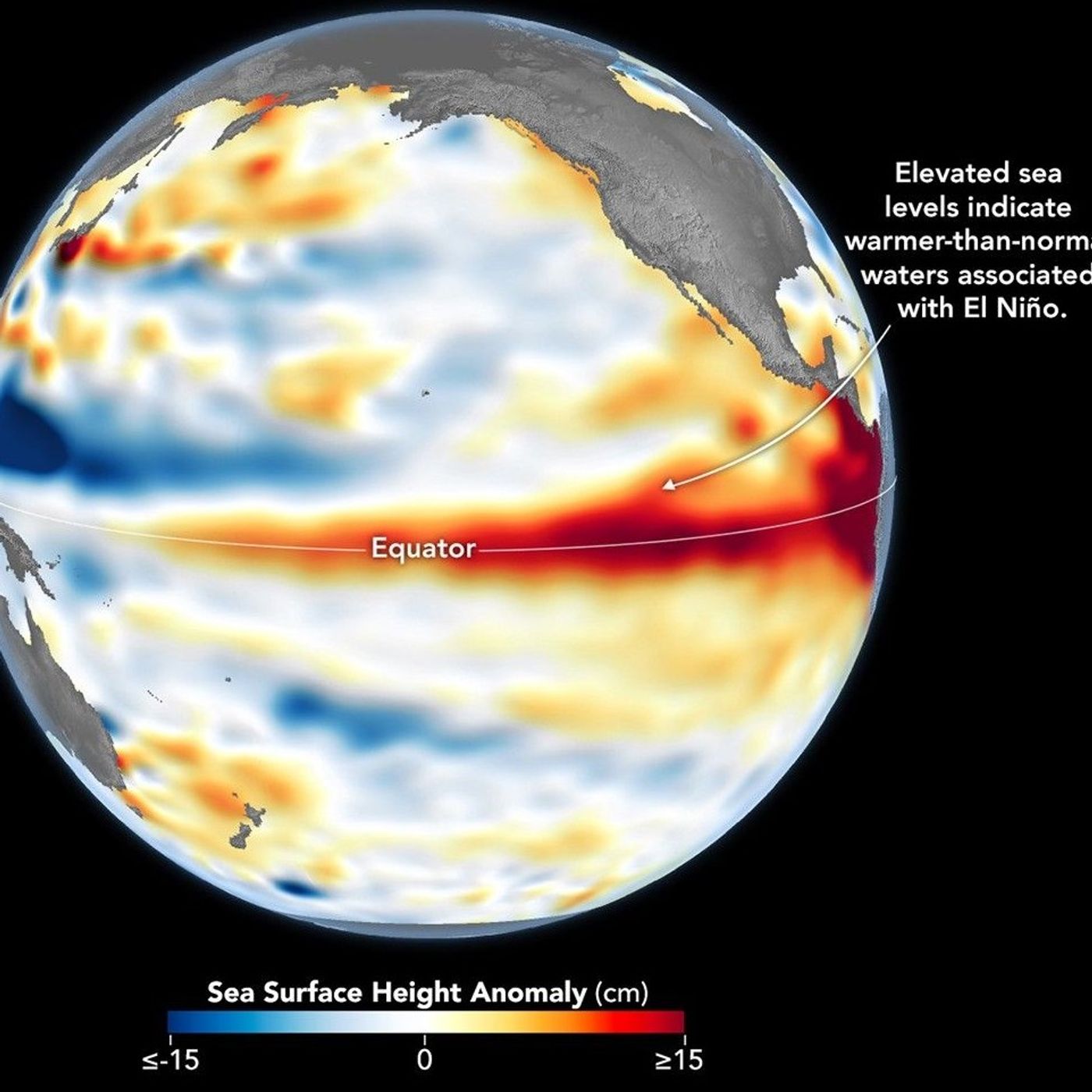
Photo: Higher-than-normal sea surfaces (red) are visible in the central and eastern Pacific on June 8, 2026, a few days before El Niño was declared. (NASA Earth Observatory/Lauren Dauphin, Public domain, via Wikimedia Commons)
Hosted by Simplecast, an AdsWizz company. See pcm.adswizz.com for information about our collection and use of personal data for advertising.
Get every episode summarized
Each time The Brian Lehrer Show publishes, we email you a written briefing from the transcript — the topics, who appeared, and any specific claims, with the ad reads skipped.
Email me new episodesFree for 3 shows. No card needed.
Hosts & guests
Transcript ready
399 searchable segments. Every word is indexed and playable.
Full transcript
The Brian Lehrer Show — Brian Lehrer Weekend: El Niño; NYC Schools & AI; Jeff Spurgeon. Machine-transcribed; use the interactive transcript above to jump the player to any line.
Hi Brian Lehr here. Up next Brian Lehr weekend, three of our favorite segments from the week packaged together for you to listen to on the weekend. So enjoy and I'll see you back on the radio Monday at 10am on WNYC and WNYC.org. It's the Brian Lehr show on WNYC. I'm Kuchen Avidar, filling in for Brian. As some listeners know, when I'm not hosting at WNYC, I host a public radio show called Climate One Solutions and Stories as our environment changes. For health and climate Tuesdays, I thought we should talk about El Nino and quick refresher. El Nino is a climate pattern, the winds that normally blow warm water west from South America to the world. From South America to Asia get weaker. So all that warm water concentrates in the part of the ocean near the equator off South America's coast.
And that has a ripple effect on jet streams and weather patterns. Generally, temperatures spike and some places get drier while others experience more rain and flooding. El Nino is cyclical, it's natural and normally it usually peaks around the end of the year. Now a new cycle is upon us and some of you may have noticed that we're feeling the impact sooner and more intensely, experts from the National Oceanic and Atmospheric Administration. Now put the odds of a very strong El Nino this fall and winter above 90% with a 69% chance. It becomes the strongest event since records began in 1950. Here to walk us through what's different about El Nino this cycle and what to expect and the economic impact of extreme weather generally. I'm joined by David Gellis, a reporter on the New York Times climate team where he leads the Times Climate Forward newsletter and event series and quick plug. They are hosting their live event climate forward on September 23rd, 2026. David, welcome back to WNYC.
Thank you so much for having me. So how would I do at that crash course on El Nino? Is there anything you want to add? You got it. I feel like my work here is done but we forgot plenty to talk about obviously. No, that was a really succinct summation of the actual phenomenon. And I think you raised one of these big important questions which is what is the interplay? What is the dynamic between El Nino this naturally occurring phenomenon and the man made climate change the man weighed global warming that we have all been experiencing so intensely in recent years even before this El Nino kicked in. What is the interplay here? We're going to find out over the next several months. Yes, and I want to dive into that. Let's set context for listeners because you recently wrote a piece in the Times called Early Onset El Nino, which I really enjoyed that headline. What about this year is early onset? Well, I think what we found in talking to experts around the world is that just as you said, we're starting to maybe feel the effects here in New York City.
People all around the world are already seeing the impacts of what seems to be these signature characteristic El Nino phenomenon earlier than expected. And that's because this El Nino, as you said, is expected to be so intense. There is more heat emanating from the Pacific Ocean. It started earlier. It is expected to continue throughout the end of this year, maybe even early into next year. And as a result, all of the effects are just starting to get magnified. So what does that mean? That means in parts of the tropics, it's already incredibly dry and hot, much more so than it would have been at this time of year normally. And so we're seeing terrible wildfires in Indonesia, for example, already in parts of Africa that might still have been expected to be getting some rain. In the late spring, it was starting to dry out. And so there's concerns about drought and famine. And so that early onset quote, which I think delivered to a colleague of mine, Chigoharlin, really tried to convey the sense that, oh, we know that we're going to have a big phenomenon. And it might be here even sooner than we imagined.
Can you point to any examples in the US where we might have felt early onset? Yeah, again, you know, here, I think we just have to have a little humility. It's very hard with any weather event to say that is specifically because of global warming. What we can do with these things called attribution studies, as you know, is say, well, that sort of a storm or that sort of a heat wave was made more likely, much more likely, perhaps, because of something like man-made global warming. I think we need to have some similar humility when it comes to El Nino. It's not going to be the case that we can say that that rain cloud was specifically the result of El Nino. But what we can say is that these phenomenon are becoming much more powerful, much more likely because of El Nino. So in the US, listen, I think we're starting to see I'm here in California right now. And the expectation is that it is going to be an incredibly wet winter here that the sea level is going to be higher than ever.
That's partly because sea levels are rising already, but also because the wind is expected to pick up as some of these intense coastal storms get more intense. And if the rains come, that is going to make California wetter stormier, even then usual. And we're already starting to see that. Listeners, we want to hear from you. How has this summer's heat affected you? And since we're talking about the economic impact in a bit, I'd especially love to hear from any businesses that have had issues or had to change operations as a result of this year's climate or, you know, just the changing climate in general. Give us a call or send us a text at 2124339692. That's 212433WNYC call us or text us. We'd love to hear from you. Okay, so David, I'm really happy that you brought up attribution science. And you mentioned right at the top, super interesting. And I think vital to consider how climate change and this cyclical El Nino pattern might coalesce, might overlap. And maybe how they don't.
If I understand it correctly, El Nino naturally occurs. So is there any part of El Nino that has a human fingerprint on it? And in other words, is there a relationship we can prove between the way this cycle is behaving and the climate change driven by humans releasing greenhouse gas emissions? This is one of the big questions that scientists are trying to figure out right now. And what we can say without equivocation is that man made climate change, the global warming that has already raised average global temperatures, roughly 1.5 degrees above pre-industrial levels. That warming is going to make the effects of this El Nino more intense, which is to say if El Nino already raises some sea levels rate, you know, in California, for example, well, they're going to be that much higher because climate change is already done so. If El Nino makes certain areas of the world drier and hotter, well, that's coming on top of what has already been this additional heat and dryness that has been caused by man made global warming.
So we know that the effects of El Nino are just going to seem more intense because of the existing warming that we've already put into the system. The big question, and this is the one that scientists are really trying to figure out, and there's some initial research coming out that's starting to try to answer this question, is whether man made climate change is actually making the El Nino phenomenon more intense. Now there was a recent study in Science Magazine, Science just published a story about it. Yeah, yeah, I was going to bring that up, I'm so happy you brought that up, I just read it yesterday. Sorry, go ahead. Well, go for it. Maybe you should know you're the guest. Go for it. You got it. Well, what they found again, this is one data point, but what they found researchers found is that temperature swings in the Grapicos Island as recorded in corals looking back a thousand years or something suggested that the El Nino phenomenon, they could see it, but that it has gotten something like 36% stronger.
In the past four decades, way stronger than anything that they saw in all the centuries before that. And why does that matter? Well, because it's only in the last four decades that we can really start to see that human fingerprint of man made activity in the warming record. And so if El Nino is 36% stronger in the past four decades, then it had been in all the thousand years previous. And it's only in the last four decades that the effects of man made climate change at the warming we've actually induced in this planet has been able to be detected. Well, their scientists start to see what is potentially a real causal link. Right. If it looks like a duck and it quacks like a duck, it's probably a duck, like the thing that would I don't know if that's exactly the scientific method. We're getting there. Yeah, right. After when I popped this is on that an interesting thing that I found in that study to was that the lead scientist Julia Cole said about, hey, this could be a causal link. Like you're saying she said, if I get pushback on that, I would like to know what the alternative is, which I think is such a pithy line about what other explainable.
What other explanation could we have besides man made climate change. I'm wondering for you, because in your newsletter, I think it was two weeks ago, you wrote that it wasn't clear whether man made warmies intensifying El Nino. And for listeners, I want to be clear, like that is as far as we have gotten so far, no causal link for sure yet. But does this new study shift how you'd answer the fingerprint question today. I mean, again, I try to operate with a whole lot of humility here. I think this is an important study from the looks of it, but it's one. And as you know from writing about science covering science, talking a lot to scientists, it takes more than one study for at least me to be confident making absolute claims about something as complex and global as El Nino. I'm not going to go much further. I think if I were to rewrite that story today, after I've seen this study, I would certainly include this. I think this is just the kind of data point that starts to help make this a more nuanced conversation and maybe start to add some clues to this fundamental question, which we've been talking about.
Yeah, and it sounds like what we can say confidently, the story here as it affects our lives right now is that regardless of the cause, the El Nino having an impact on what is already an overheated baseline is going to exacerbate an already bad situation. Is that a fair like tagline there? Yeah, without question. And let's just step back and say, listen, even if we weren't experiencing an El Nino right now, climate change is wreaking chaos around the globe. It's costing lives. It's costing dollars. I mean, the glacial flooding in Nepal. Again, hard to draw a direct line at this exact moment, but we know that glaciers around the world are losing mass at unprecedented rates. And that's happening because the world is hotter than it's been in 10,000 years or more. And that's because of manmade climate change.
And so even without El Nino, we are in a moment where we're going to be experiencing more of these disasters, more extreme weather. And that's going to again take a real toll on human lives and economic activity. I imagine since you brought up the global impact. I imagine when you speak to people in the US, it's a lot about spiking temperatures, but it's not just about heat. There's huge implications for rainfall dependent regions and specifically public health, which I think is important to bring up here. During the last very strong El Nino in 2015, the heavy rains in Kirobati led to a rise in mosquito-borne illnesses like dengue fever. Are you watching for that pattern this cycle, too, of extreme rainfall driving disease? Yes, right? This is one of so many things. I think the Kirobati, I'm trying to remember, I believe I spoke with a scientist who was out there in Kirobati just not too long ago. I think that was in that same early onset El Nino piece. And this was really fascinating. She was a woman named Alissa Atwood, I just pulled it up. She was out there and she's a professor at Florida State University.
And she is tracking, sort of doing the same sort of coral analysis that we were just referring to as different scientific team in the science magazine. But what she found is yes, the corals were bleaching. That was unfortunately confirmed her hypothesis, which I think is the scientific method. But what she found when she got to Kirobati, which is this island nation and the central Pacific, was that the effects of El Nino, as you said, were all ready there. Unlike in Indonesia, where there was extreme drought and high temperatures, Kirobati was much wetter than usual. They were just getting swamped with unusual amounts of rain. And that was leading to real tolls on the public infrastructure. The roads were all muddy and rotted out. They were having a hard time getting around the island. And this real spike, as you said, in mosquito-borne illnesses. And so sure, in regions that are going to get unseasonably wet impacts from the Sel Nino, we may see a rise in mosquito-borne illnesses.
But it's going to be very regionally dependent. And I think that's one of the things that makes El Nino so complicated, frankly, is that the effects are simply not the same. You can't say that El Nino just makes the world drier, or makes the world wetter. It scrambles the weather patterns. And so it creates a situation where whatever you think might be typical for a certain area at this time of year, it might be very different because of El Nino. We have Izzy from the Bronx, who I believe is a retired meteorologist. Izzy, is that correct? That is correct. Well, welcome to the show. Go ahead. OK, yeah, I've been trying to follow climate change, even in retirement, reading up as much as I can. I remember that a few years ago, I don't remember exactly how many we had an intense El Nino episode.
And we were expecting a very, very wet west coast. And they were hoping for it because they've been drawing out as you know. And nothing happened. They were dry. The following year, which was not an intense El Nino, but had the remnants of the previous years El Nino, that caused heavy rain. And you know, the what I'm finding is that the climate change is affecting the predictability of the El Nino. What we had expected to happen in previous years when El Nino is around, you know, changes in the months, soon seasons in India and Pakistan. And I'm not being a one cannot really predict anymore because probably because of climate change. I can't say for sure. Is it getting in the way?
Yeah, Izzy will have to leave it there. Thank you so much for that call. And I think it kind of echoes what you were saying, David, right? Like we can't say for sure whether it is being affected by climate change, but one thing we can observe is that the impacts are different. It scrambles everything like you said, right? Absolutely. And I think what one of the things we're trying to do here at the times is get a sense of, all right, what should we expect over the next six months here in the United States? And again, I don't have a crystal ball. I can't tell you exactly what the weather's going to be like in Denver, for example, which is not your scientific method either. I want to point out you don't. But here's what we're expecting broadly. California is probably going to get wetter. A lot of moisture during the Nino's tends to just pound California. That's going to likely be the case once more. That's going to lead to some of that intensive potentially coastal flooding that we've seen over the years. The Northeast, it may be much milder. We obviously in New York, anyone could remember those incredible snow days we had in January and February of this year.
I'd be surprised if we see those again this year. Again, I can't say we won't. But typically, Nino means a slightly milder, less precipitation up in the Northeast. On the other hand, in the southwest, again, if you go back down towards the California region, we may see a lot more precipitation. So if you remember the mountain west, this past ski season, everyone was complaining because there was no snow in the Southern Rockies. Well, that could change. This year, we could see a real accumulation of snowfall if it gets cold enough in that region. And so again, we're just going to see big swings potentially in weather patterns across the country. David, I'd love to turn to the economic impact now because you're also a business reporter and I'd love to lean on your expertise there. Do you have any sense of how this summer's climate, the extreme heat, the drought or the floods depending on your location, how it affects economies?
I've got a story coming out. I don't know if it's published in today or tomorrow, but where I look at a lot of the disparate effects. And what we can say is that this is just a part of our economy now is the cost that is being borne of extreme weather and climate-related disasters and their large and small. As I was doing the reporting for the story, I started looking for sort of unexpected small examples. And what I found was that there were smoke days in Oregon that closed libraries and coffee shops. And so that's small, right? That's not going to register in GDP, but it registers in those communities. There were days around the 4th of July when the air quality was so bad in Cleveland that many restaurants with outdoor dining had to shut down. Again, a very small, regionalized local impact. But boy, I bet it meant a lot to those restaurant owners and to those servers.
And then of course, we're going to see the bigger, much more large scale events, large scale flooding, drought that might affect crop yields. And some of the heat and fires, of course, which can take out, you know, terrible neighborhoods and businesses as well. I've got a piece that I'll publish closer to this event that I'm hosting on September 23rd at the New York Times Center. It's all centered around climate week in the United Nations General Assembly that looks at this network of survivors of extreme weather disasters and how they have been helping one another. And what I found, I'm speaking a little prematurely about this story here, but what we found is that there are people who have suffered from wildfires who are learning from people who have survived hurricanes and those people who have survived hurricanes are getting advice about navigating insurance complexities and FEMA claims from people who dealt with flash flooding.
And it speaks to the fact that again, this is now part of American life. Learning how to navigate extreme weather and the costs associated with climate change is just something that is becoming baked into our economy. Well, here's the question that I was just thinking about with that when you're talking to the businesses for these stories and you hear how they process the risks related to climate change. Are they operating as if they're one off events that they'll address as needed? Like, oh, there's one smoke day we'll deal with it with like risk analysis. Or are they behaving as if they need to fundamentally change some of their business practices? I think for those with the resources and the foresight, many businesses can look into the head and look ahead and make some of those capital investments that hopefully will pay off in the years to come. If you're a small business though and smoke makes it impossible to host outdoor dining, I don't know what you can do about that, right?
Can you buy the next door building and expand maybe, but that's probably a big lift if you're a small business owner. But no, absolutely what we are seeing is for large corporations, especially even if they're not talking about climate change quite so publicly anymore, even if they're not promoting their ESG strategies on their websites quite like they used to be. If you speak with the chief risk analysis at these companies, if you speak with the heads of their real estate portfolios, they are hardening their facilities in anticipation of more extreme weather to come. There's no doubt about that. For listeners, ESG stands for environmental, social and governance standards in which businesses try to look at all of the bottom lines for the way their operations might actually impact their business and the way the world works responsibly. So I got a text here that I want to read out because it touches on what you're saying there, David.
Seaside bars and restaurants are having trouble attracting customers this summer due to bad weather forecasts, which also affects hiring and paying for local bands to supply live music on summer days and nights. The reason I thought this was interesting is that it really touches on what you were talking about with. It's not going to necessarily show up in GDP. These impacts for businesses, but it will be felt at the local level. And I find it very interesting that you're talking about the normal normalcy of this all. Like can you talk quickly just about how people are changing their behaviors in ways that our listeners might resonate with? Another really fascinating series of conversations I had just in the last couple weeks with summer camp directors. And I have children who went to summer camp. And so this is top of mind for me how they were dealing with the heat, how they were dealing with the extreme rainfall events if those came. And what I found was that these summer camps are really an incredible case study to understand.
All right, how do you deal? And what I found was that they were doing literally everything. They had to have adaptation plans for days when it was too smoky. So boy, do they have an enhanced roster of indoor activities? They were having to make capital investments. So there's real capaxes expenditure happening in the form of things like new tents that could survive the higher winds that they were experiencing year after year. They were also having to find alternates for swimming activities when because of algae blooms, the lake was unsafe if it got too warm. So time and again, what I found was that whether it's a summer camp or a big multinational company, we're all having to learn how to adapt. And for someone like a summer camp where this is a every year occurrence and they've got 100 days throughout the summer to fill with a couple of hundred campers, boy, do they need to have their programs pretty dialed in?
Yeah, we just got a text from a listener that touches on this generally about adjusting behavior. It says if you're taking questions for the climate change dude on the Brian Lair show right now, what should long time New Yorkers know and do in response to the shift in New York City's climate? I'm sure you got this asked a lot of dinner parties when you're just out in the world. How do you normally respond to people and they ask you what behaviors they should change to respond? I mean, listen, the truth is in New York City, there's only so much you can do, I guess is my answer, right? I mean, the subways are what they are. And I think anyone who's taken the subway on a really rainy day over the last couple of years knows that sometimes the subways, some of the subways are going to flood. It's also the case that when smoke from Canadian wildfires turns our skies orange, well, there's only so much you can do, but that's sort of being a New Yorker, that's sort of what we learned to do is all get through together.
So it might mean you stay inside. I spoke with someone for this story that's coming out in just a couple of days who said he had a really tough summer because he has some underlying health conditions and he wasn't able to go outside as much this summer because of the heat, because of the humidity, because of the smoke and that had an effect on him personally. But the other great news, I mean, I'm a born and bred New Yorker, I love this city as much as anyone, is we've got incredible facilities. And so, you know, whether you're out in Central Park, enjoying a drink at the boat house or whether you're on reverse side drive and able to soak into West Side Highway, we've also got great places. So, you know, I'm still very happy to be a New Yorker even as the climate changes. Me too. You're hosting an event on September 23rd. Can you tell us a little bit about it? Yeah, delighted to. Thanks for bringing it up. So every year we at the New York Times bring together senior newsmakers during climate week, during the United Nations General Assembly week.
And on Wednesday, September 23rd this year, I'll be hosting this event at the New York Times Center right in Times Square. And I can't tell you everyone who's going to be there, but we've got activists, including Jake Bonn and Aaron Brockch. We've got senior lawmakers from across the political divide. We've had a fantastic scientist named Kate Marvel, who was a government scientist, but ultimately left. Cult of this administration's cuts to science funding. We've got CEOs of nuclear companies, geothermal companies, solar companies, and will be in conversation with all of these newsmakers live on stage at the time center. You can register and apply for tickets to be there in person, and you can also stream online. Wonderful. Well, I wish you a great fortune on that event on September 23rd. It sounds like a really interesting lineup. I'm especially interested in geothermal for what it's worth. I think that talking about that energy source is super not cool because I would be a bad pun, but I think it's going to get really hot.
So I really hope that you have a great event. We'll have to leave it there for today. My guest has been David Gellis, a reporter on the New York Times climate team, where he leads the Times's climate forward newsletter and event series. David, thanks so much for coming on the show. Thanks for having me. Are you hungry for some great investigative journalism that sounds like a music? Then Radio Lab might be the show for you. Radio Lab began over 20 years ago as an exploration of science, philosophy, and ethics. The show is in six-fanded to become a platform for some of the best long-form journalism and storytelling you'll hear today. Join Chad, Lulu Miller, and myself, Flethef Nasser, as we investigate stories that provoke, delight, and ask you to completely change the way you view the world. You can find Radio Lab wherever you get podcasts. We're just one week out from the first day of school and New York City public schools is turning in its biggest assignment right of the buzzer. Yesterday, eight days before students walk in, the city released its long-awaited rules on artificial intelligence in the classroom.
The city is putting a one-year pause on all student use of artificial intelligence through eighth grade. That's about 600,000 kids, two-thirds of the system. High schoolers will be allowed limited use for things like AI literacy and career readiness. There are screen time rules too. Most students from preschool through second grade won't use individual devices in class at all. And there are time limits on laptops from third through eighth grade. Teachers can still use AI for lesson planning and some communication, but they can't use it for grading or for decisions about whether a student moves up. We'll also check in on the rollout of the Mayor's Free 2K program where providers say they're still waiting to get paid. We'll check in on his legal fight with the teachers union over paraprofessional bonuses. And of course, how families are surviving in almost 11 weeks summer. And here to talk to us about all of it is Jessica Gould, Education reporter for WNYC and Gothamist.
Jess, welcome back. Thank you. So let's dive into AI. How was AI being used in classrooms through eighth grade before this policy? Well, one thing that we as education reporters have learned through this process of considering whether there should be AI and how much in schools is that it's a bit of the Wild West, you know, the city when chat GPT came out they under the Adams administration first they banned all use of AI then they allowed it. And then it's been in this gray area for a long time where it wasn't banned and different schools and different teachers had different practices and different ways of using it. In some cases there were the student facing AI and teachers also use it on the back end, which as you said will still be permitted. But there's been a huge ground swell in the past year among parents and some educators and policymakers to pause to have a moratorium to reconsider and think about all the potential downsides there are for children in their exposure to AI on their learning on the environment.
And that ground swell against AI, which we've seen across the country, really hit in your card. And when the schools chancellor first introduced this under Mamdani first introduced an AI playbook in the spring, which allowed more use of AI and kind of left it up to teachers about how students should use AI. There was so much pushback that he said we're going to take it back reconsider and now we have the rules that you just mentioned. Okay, so it's kind of like going from the Wild West to reaching a fever pitch and now they're responding to demands kind of that that movement there. Yeah, but there are of course still a lot of questions about how this is going to be rolled out as you said it's right against the buzzer. This is kind of cramming the night before. And so pulling all this technology back is going to be hard. Yeah, let's go to a clip from Mayor Mamdani. This is at a press conference at Brooklyn steam center on September 2nd. The tech industry wants us to believe that AI in early education is not only inevitable, but that it is necessary. We do not see it that way.
I have yet to see a study showing that AI is beneficial for students and elementary in middle school with the exception of course of research sponsored by the very corporations that stand to profit. So beginning this school year, we will implement a one year moratorium on generative AI for students in 2k through eighth grade. Jess, that's a pretty different tone from March, kind of what you were hinting at when Chancellor Samuels rolled out the traffic light approach and student use Scott like a yellow light. Right. Yeah, you report that policy was criticized as vague. Tell us about the earlier policies and how we got here. Yeah, well, I think you know the yellow light was vague. It was up to teachers to use discretion about when to use AI. And I think a lot of critics felt that that left things far too open. There's a lot of concerns about cognitive offloading, you know, students not learning how to evaluate hard questions, how to write paragraphs and essays.
And so that's the pushback that led to where we are now. I think it's interesting to hear Mayor Mamdani kind of speak out against the tech industry and the tech industries influence within schools. That's a popular more popular sentiment, particularly among progressives right now against ed tech in schools in general. So it's been a real shift in course. Can you tell me more about why you find that positioning interesting? It lays it interesting from a political perspective of like getting people on board with it or something else? Well, I just think that the backlash against the AI industry has been so significant in the past, you know, year. And I think that you're seeing this take place in, you know, schools and classrooms, just as it's taking place, you know, against data centers. So from a, you know, progressive democratic socialist mayor to talk about, you know, pushing back against the tech industry.
It's interesting, especially for one who is so sort of digitally savvy as he is. That's a great point. Yeah, the social media game is high in that, in that office listeners. We want to hear from you teachers, parents who wants to weigh in on the new AI policy. Give us a call, send us a text. We're at 212433 WNYC. That's 2124339692. Or if you want to share how you dealt with child care for this last week before school begins, we're going to talk about that in a moment. Summer was a week longer than usual because of how late labor day is. Give us a call. We're at 2124339692. Are there any paraprofessionals listening who want to talk about the bonuses or did anyone snag a 2K spot for their 2 year old? We're here for all of it. We're at 2124339692. Just so thousands of parents petitioned for the moratorium on AI use. Do you have any sense of how the parents are reacting to what we got?
Well, that coalition had a press call yesterday. And the message was that this is a step in the right direction, but it doesn't go far enough. They're concerned about exceptions and exemptions. So, you know, there are exceptions for students with disabilities who need assistive technology as part of their individual education plans. And also for students learning English for translation. And there's also questions about how much assessments that, you know, use AI or, you know, our digital, like I readies, one of them that's used broadly will still be allowed. Initially, we heard that assessments were also exempt that you would still be taking these tests digitally. And so that's a question. There are questions about these high school pilot programs and career readiness. You know, the activists who wanted a total AI moratorium wanted a total AI moratorium.
And so there are concerns about that. But, you know, Mayor Mamdani and the officials say that it is important to teach students about these tools. And they're going to be giving these AI literacy courses that are new across the system as well. Do you know what age the literacy classes are for? I know it's for high school. High school. Okay. Yeah. And then on the teacher side, there is some use that's allowed to, right? Like in lesson planning, things like that. Lesson planning and, you know, preparatory work, some communications. It all has to follow data privacy laws. You know, some of the activists wonder about how those data privacy laws and, you know, protections are going to be enforced and whether they'll be enforced well enough. There's also ambiguity about, you know, the programs that are already in woven into the, you know, fabric of classrooms. The school's chancellor, Samuel said there's almost 40 that they are planning to pull that they say use AI and 40 programs that were being used on the high school level that they were going to pull.
So first of all, that has to happen fast, you know, within a week. And also the city has not, and, you know, the chancellor and the mayor have not been able to say that they have a full handle on all the programs that are out there and being used. And they say that they're going to be, you know, trying to get that in the weeks and months to come and that anything that doesn't meet their standards will also be pulled. I found it interesting that chancellor, Samuel's told principals to pause software purchases until this came out. So we've got eight days. And I'm sure there's a lot of stuff that needs to get bought. What does that look like to happen but week before school? Yeah, even less than eight days. I was actually talking to a principal about that. And the software purchase has been hard because they do need some of this technology, including stuff that doesn't, you know, have AI, right? That will be allowed. And I asked if it would be enough time. The principal I talked to said, yes, it will still have enough time, but it's really cutting it close. In some ways, this rush on AI on a much smaller scale. And also the 2k payments has reminded me a little bit of the kind of scramble to get things ready in classrooms post COVID.
Since you mentioned 2k, let's go to the younger kids 2k launches next week and providers say they haven't yet been paid on Monday. The mayor called the delays unacceptable and promised $43 million and 200 new hires. You've been talking to providers. Here's here's one clip. I'd like to play Camila Farouki who runs 3k and pre K programs in Manhattan. This year because of the lack of contract registration, those advance payments were did not come through. So we are relying on bridge loans to so that we can use those bridge loans to open the schools and not just that many of the programs have have taken their own loans to to operate for July and August. That's a 3k provider, but you report some 2k centers have the same problem. Will it be fixed by the first day of school?
Yeah, I want to explain kind of what's been happening here because it's been hard to wrap your mind around. And what happened is that all contracts for community-based organizations that provide 3k, 4k and 2k centers and 2k 4k and to some extent 2k, the new 2k program is small just 2,000 spots. But contracts were up, you know, just in the cycle of how contracts operate in June when the city's fiscal year ended. And the city had not processed the paperwork. They had not solicited or in some cases just not processed what they'd already received the paperwork from these providers need to get their contracts in. And as a result, because they don't have contracts, they can't be paid. And so there's no money flowing for the start of school. And we've seen this happen before. We saw this the last time the contract was up. There's something wrong with the way that the paperwork is handled and they can't seem to get it together.
And as a result, you know, preschool providers and childcare providers do have to take out their own loans or their staff, you know, who are already very low pay. Go without, you know, their pay. They need money for rent, for insurance, for snacks, for kids, for paints and pencils, yeah, all these things. And so that money hasn't been flowing. And even when the city said, you know, because we have this law jam with the contracts, we'll get you these loans, these bridge loans from the city. Those didn't come through either. And so that's why a lot of these programs are on the brink and are, you know, clamoring. I have heard in the recent days from a couple of programs who were waiting for money, didn't have any who got their, you know, agreement signed just like yesterday, you know, a couple days after this announcement. So it's possible that things are starting to move. But this is a longstanding problem that needs to be fixed. The mayor says he's going to fix it. But a lot of these providers say that they've been through this before and some of them say that they don't want to work with the city anymore because of this.
We've got some callers about AI it looks like. So if we can, let's just shift gears a little bit back to that since we just touched on it. Let's start with John in Manhattan. Hi, John. Welcome to the show. Hi, thanks for taking my call. I wanted to call and just say that there's a, first of all, that this is absolutely the right move by the city. I work in for a very large tech company and I've been working in big tech for maybe almost 20 years now, I think. And the perception that kids are going to miss out because they don't know these tools is absolutely false. I mean, like absolutely false. There's this like the, I work with these tools very intensely almost every day and they are very dangerous for your mind like the brain drain that happens almost immediately is pretty incredible. And they're also the kind of thing where they can do a lot of stuff, but the reality is that they're just basically an amplifier of what you know and what you don't know.
So if you don't really know anything and you start using them, what you get out is garbage. You have to know a lot in order to use these tools effectively. It's like imagine that it's like there's almost like a magic gun that can shoot like a million bullets all at once in a giant cloud. I mean, it's very powerful, but also like. You know, really, really dangerous. John, I really appreciate that. I want to ask a quick follow up for you as somebody who works in the industry and to be clear, it doesn't sound like you're a child psychologist or in education, but do you in your opinion have a moment or a way or an age where you feel like it is appropriate to start introducing these tools to people. Well, the reality is I mean, I'm maybe I'm a little extreme in this, but like I'm watching like my friends and my colleagues and whatever lose their ability lose their ability to reason. You see what I'm saying? Like these are these are adults who are professional toward using these tools every day and already they can't do these things without the tools. So it's it's just like it's just like the companies AI companies inserting themselves between us and what we know how to do and just sort of rob us of our ability to do stuff.
It makes me furious because like, you know, eventually and that time is going to come soon. These tools will come so prohibitively expensive that no one will be able to actually afford to use them anymore. And at that point these companies will be like, well, we start employees know how to do things and they won't. John, thank you so much for that call. We really appreciate it. Let's move to Mike in Dittmiss Park, who's a high school teacher. Hey, Mike, welcome to the show. Hi, thanks for taking Michael. Sure. Yeah, so I teach I teach high school seniors and I my reaction to the policy is that it's a good start. I don't really understand ending the policy at eighth grade or ninth grade, I guess. I think that high schoolers are sorry are on their devices the most they have the most screen time and I think particularly the limits on screen time in in class like school issued or school devices that kids are using. I feel like they would really benefit for them. Also, I don't totally understand why an eighth grader would benefit from those limits, but a ninth grader would not.
So for you, it sounds like having a pause and figuring it out is the right move for everyone or would you go even further than that, saying I just don't want it in my classroom in any way and you've already landed there. I don't want in my classroom. I don't use it, but I think my understanding of the policy is that there's. That the middle schoolers have much stricter limits on just any any screen time period, not just not just the use of AI technology. Yeah, and I feel like I should would benefit from that. Also, they're on their screens a ton when they're at home and when they're out of school. And I feel like at the very least school should be a place where they don't have to deal with that. They don't have to engage with the technology that's distracting them and they can be in a different mode for you know, six hours of the day. Mike, thanks so much for that call. Really appreciate it. I want to go to one more caller before I turn it back to you, Jess, to kind of put this into context for us. Katie from Queens. Katie, hi. Welcome to the show. Hi, thanks so much for taking my call.
I totally agree with the last few callers and I just wanted to add I'm a doctoral student in education and I study writing and reading comprehension and I, you know, the idea of AI literacy courses being a thing that exists now that they're a best practice behind is just not true. You know, there's not even agreement on what AI literacy means for high school or some people think it means protecting yourself protecting your data, understanding how algorithms work. Other people think of it in a career readiness sense. There's just not even agreement across the board on what we should be amplifying. So I think that to just kind of toss that in for high schoolers. I agree with the last color. I don't fully understand why that was included for high schoolers, honestly. Thanks, Katie. We really appreciate that call. Okay. So Jess, we have three different callers. We had John from the industry. Mike teaches seniors Katie getting her doctorate all kind of seem like they're saying takedown screens pause or don't include AI. Anything you want to point out from those calls?
Yeah, I mean, I wanted to, you know, mention that the screen time, they're not restrictions, they're recommendations, which is already something that some of them more, you know, anti screen activists have said doesn't go far enough that it should be actual restrictions and. But it's, you know, no one to one devices from 2k to 2 and then recommended limits for 3 to 5 and 6 to 8 and then it's true. We don't have the same thing for high school. So it's interesting to hear that groundswell for that as well. Listeners, if you have more opinions on AI or if you want to talk about some of the other topics recovering, which includes the bonuses that paraprofessionals are still waiting for the 2k program, the long summer vacation that has happened this summer for parents out there that are trying to figure out what to do with their kids. Give us a caller send us a text we're at 2124339692 that's 212433WNYC.
It seems like we just got a caller who might be on the opposite side of this. I'd love to bring them down just so we can get a full picture here. Amy from Manhattan. Hi, Amy, welcome to the school. I'm sorry, welcome to the school of thoughts. Go ahead. Hi, how are you today? Thanks for putting me through. I am a local public school teacher. I teach STEM so science, technology, engineering and math. I've been a part of this program for 12 years now. One of my big concerns about this announcement is, again, extremism. Moving from unlimited screen time to now no screen time to second grade. What happened to Barack Obama's initiative of computer science for all? I understand there's plenty of things we can teach kids with computer science that doesn't involve a screen time.
But I agree with limited time, but now we're taking away. So how are we setting our kids up for success? Are we still doing a state test online now? So how are my second graders going to be able to professionally take an exam if we can't teach them how to use a computer? Amy, thank you so much. Where I stand. Yeah, yeah, we really appreciate that. Just this is not a black and white issue here. We hear Amy saying, you know, screen time can play an important role. Go ahead. Yeah, well, one thing that I think is interesting is when we had I was on the show just several weeks ago talking about the decline in reading test scores on the state tests. And one of the issues that came up was that for the youngest kids, it was the first time that the state tests were on computer only. And they have issues with typing. They don't know how to type as well. So, you know, we're getting mixed messages and mixed requirements from different parts of the education system.
Not to mention that there are a lot of teachers out there who've told me that AI2, you know, they say they can do some creative work with it that's thought provoking. I that's something that, you know, I want to drill into more and better understand in in terms of specific examples about that because certainly there's a lot of concern about, you know, shortcuts and not using your brain. But some teachers say that they've found ways to use it to be creative. We want to have AI continue to be part of the conversation here. So keep bringing in your calls. I do want to touch on some other important elements though with the time that we have left. So we'll hop back to AI in a second. But just I want to bring up another mom, Donnie move that we covered on the show, which was the bonuses for paraprofessionals. The mayor's suit to block them. You caught up with Michael Mulgrugh, president of the teachers union, the UFT. Here's what he told you about starting the year in the middle of that fight. But at the same time, we can't be naive. You know, we are going to start school year, short thousands of paraprofessionals, which really adds to the stress and the challenge overall for us through the school year.
So he says thousands of parapositions are vacant going into the year. What's the latest on that lawsuit and what does that shortage look like on the first day of school? Well, the lawsuit is going through the courts and each side is so far sticking to their sides. I think that the shortage is not new. It's been here for years, which is part of why the UFT is pushing for higher wages for paraprofessionals who make between $34,000 a year and $54,000 a year. Often working with a student or students because of often because that students with disabilities to help them in the classroom. And it's often part of a legally binding agreement in their individual education plan. So the fact that there aren't enough paraprofessionals really affects those students and the entire classroom, you know, when those students don't have the support that they need. And it's not consistent with the law. But neither, you know, the city is arguing that neither is raising wages outside of the collective bargaining process.
So does that mean there's no option there? Well, you know, Michael Mulgar, the president of the teachers union says that the way they've written these bonuses with city council is consistent with the law. The city is challenging that. That's the sort of nut of the issue here. But the broader problem is that there's a workforce that is primarily women, primarily black and brown, who make very little money. It's hard to keep people in these jobs. They're really important for students and for schools. And so, you know, the teachers union, I believe the contract is up in 2027. And so the city is arguing that that's when we should be having these conversations about wages. But then that's a year away. Right. And we don't have the staff. But that's been the way that has been for years now. So a kid will get a paraprofessional one day and then go weeks without one. Let's go to Mike in flat push. Hi, Mike. Welcome to the show.
Hi, thanks for taking my call. I know I'm going to sound maybe like Milton Friedman saying this and not what I intended all, but, you know, if the collective bargaining process led us to this point of what uses collective bargaining. It's not on the paraprofessionals to shoulder the load of the sanctity of collective bargaining when they're trying to make ends meet or not or exiting the field altogether. I think that DSA and Mamdani and all the walks advising him are missing a real coffee, you know, table issue or lunch table or whatever you want to call it. And I just think they're missing the forest for the tree. I think that they're completely off $10,000, you know, even before taxes makes a big difference. And I'm not saying I'm on the side of the UFT. I think that they've, you know, really deprioritized powers and it's been a shame. But if this sets a precedent that like destroys the whole system.
I mean, you have to question the entire process. Thank you so much. Thank you so much for calling. So it seems like this is going to be an ongoing deliberation between the schools, between the UFT. And in the meantime, kids are not going to be guaranteed paraprofessionals that they need. Is that fair to say? I think that that will be true for many of them. Many of them will have them and many of them will not. So I'm going to turn back to AI with the time we have left because we have a lot of callers there justifiably. So let's go to Dominic in Van Quortlin Park. Hi, Dominic. Welcome to the show. Hi, thank you for taking my call. So I teach, well, I used to say I helped students learn how to work on their writing. But now I have to teach them how to write with pen and paper. I'm old enough to know life before the internet. And a lot of our students are used to using tablets and using all this AI stuff. It's there everywhere.
And even if they're just sending an email, there's a stupid AI component that suggests phrases and words. So I get all these wonderfully written but now emails that all start with I hope you're doing well because AI fits that in and it sounds right. And what we're doing is we're destroying the human voice and writing. Dominic, are you teaching the way that you grade like? Is it blue books? What are you turning back to? I'm very lazy and the blue books are very bulky. So I just have these sheets of paper with lines on them that I collect. But it's all handwritten. Revision is by hand. And when I have, we all feel like we're ready to start typing and we start typing. But I insist on no technology in the classroom to the best of their ability. We take breaks so they can make sure that the world is still functioning on their phones. And then we go back to the work in class. And there's more conversation now in the classroom and eye contact and all those crazy things that makes us stand out as almost safe and safe.
Dominic, thank you so much for that call and for sharing your experience. I'd love to go to Jane on the upper east side as well. Hi, Jane, welcome to the show. Hi, thank you for taking my call. I'm an AI literacy advocate and work in policy. I'm working in this space for this space for over three and a half years. I think the New York City public schools generate AI policy. This is the mark and two in a few significant ways. One, it doesn't address a positive vision for how we will integrate AI. The fact remains that it is ubiquitous in order for students to be college career and civic ready. They have to be AI literate the world economic forum just released the six hour course. And that's not enough on AI literacy. There are many coasts and there are many organizations that have courses on AI literacy. But regardless. So one, our students need to be AI literate in order to do that. They need to be able to use these tools in safe ethical responsible ways with guidance and with clear policies use policies.
The other area which the so the moratorium to me makes no sense to students are using it. And so wouldn't you rather than use them in five, the classroom and informed safe ethical and pro social ways. Jane, can I ask you as a person who works in policy again, understanding that you are on the policy side, not a child psychologist, child development expert is there an appropriate time in school in terms of age that you think is the right time to introduce AI then. Yeah, I understand age restrictions in early childhood for sure, but I even then not using the tools, but understanding certain AI and media literacy concept can be introduced. I think middle school is again with guard rails with clear policies that students also should be engaging in designing part of the issue is also that our teachers have had insufficient professionals of health.
Pew Brookings I can name so many institutions and have done research on this in terms of the extent of use by students nationally, internationally and teachers without sufficient direction and professional development and guidance. Jane, thank you so much for that call really appreciate it and just I want to turn it back to you because it sounds like on the policy side there is a significant number of people talking about how ubiquitous AI is and how you can't ignore it. So how do you think and I'm asking you to look at a crystal ball, but just how does that play into your reporting as you're thinking about the direction of schools. I think one of the big unanswered questions is how to handle student AI use on homework and assignments. We heard from the teacher who's doing you know, loose leaf paper and writing by hand. Yes, a lot of a lot of teachers have had to completely retool how they assign homework and essays and projects because of this.
And yet I'm also hearing from teachers that it's very hard on written work when it's not done in front of you in class on pen and paper to determine if something is AI the software that is supposed to catch AI gives you a sense, but you can't prove it necessarily and then I've heard from students who say that they've been accused of using AI on their work and then they feel like they have a scarlet letter. That they don't deserve so I think that how to handle the way that the tentacles of this have already gotten into all of you know the schoolwork and homework world for teachers and students and the relationships that are between them and how those have suffered as a result. I think the city we asked the mayor and the chancellor about this yesterday and they said you know they're working on it. It's about having conversations with your kids at home and you know they'll be working with kids in school on how to you know not cheat.
But but these are hard questions. You just mentioned something that perked my ears especially which was the relationships suffering. Can you talk more about that? Yeah I was talking to a bunch of students in the spring who said that you know teachers have accused them of using AI when they haven't and they also said that they know kids who do use AI on their assignments. It's just not them the ones that I was talking to of course. And so they're wrongfully accused and that's hours of the relationship with the teacher and that there's just like mistrust that has become very prevalent between teachers and students because of this. Well we'll have to leave it there. My guest has been Jessica Gould education reporter for WNYC and Gothamist. Jessica thank you so much as always for coming on. It's always such a pleasure to talk to you. Thank you. It's the Brian Lair show. I'm Kusha Navidad. I'm feeling in for Brian today here on WNYC. My next guest is probably a familiar voice to many of you. It's Jeff Spurgeon. The long time morning show host on WQXR New York Public Radio's classical music sister station.
We have the honor of speaking to Jeff now because this coming Friday will be his last day on the air. Yes Jeff Spurgeon beloved host is retiring after 30 years here at QXR and 40 total years on the airwaves in New York. And I feel very lucky that he's here with me right now in the studio to reflect a bit on his time here. Hi Jeff. Hey Kusha thanks for having me. Absolutely. It's a privilege. Jeff when WQXR announced this news a few months ago the comments on the web were they were voluminous and they were passionate. Let me just say listeners are really going to miss you. Do you have any thoughts about I don't know how a radio host can become kind of like a pair of social friend and how you approach that in your years. I think that it happens really just by consistency. So you know I feel like one extra to one extent you know you have that share at home that you've been sitting in for a long time. And if somebody comes in the room who hasn't been there they go what an ugly chair that chair needs to be written could you read a poster the thing maybe.
But if you know it and you've spent time with it it's really comfortable. And so having been there for a while people are people are used to it and accustomed to it. And that's one piece of it one piece of it is consistency. And I think the other is the magic of this medium the medium of audio. It's older people will remember the idea of radio but younger people we just should talk about audio. It is a voice. It's somebody with you. And I think it is one of the most magical things in the world because when you hear a voice in a context such as ours it doesn't take long to decide if you like that person or don't like that person 15 seconds of hearing them and you go. It's kind of a jerk click and you go somewhere else or you may stay around for a while but that connection happens without anybody trying and it activates your imagination without you doing it it happens automatically.
I think that is one of the most magical things about audio a voice on the radio and actually about music itself to which also engages your imagination and your heart without you doing a thing. I love that you took the opportunity to compare yourself to an old chair. I think you can be more generous to yourself than that although old chairs are also very comfortable. I want to turn it back to you as well before we go to the classical music you talk about consistency you are in a studio you don't necessarily get to see all the people that you touch how is that consistency of that parasol relationship influenced you. I think the biggest thing that happened to me a number of years ago actually point wqx are moved from the ownership of the New York Times to New York public radio that was in 2009 and we began also to use the internet more for listener comments and previously I had this sense that I was mostly talking to people who were in their later years classical music radio has an older audience.
That's always been true and so I heard from people in those days it was with postcards ask your parents what a postcard is and then we began to use the internet I began to hear from parents who took their kids to school in the morning in the car. So I had this new sense that we were talking to families and young people in a way that I had not understood the reach of the radio station and the appeal of the music again it's a boutique radio format classical music but I still it was the wow we're talking to families and children so that was a change for me to have that sense. Listeners especially wqx are listeners classical music fans Jeff Spurgeon fans give us a call now if you've always had a question for Jeff but were never able to have him over for dinner here's the number 212433 w NYC that's 2124339692 give us a call send us a text we're at 2124339692.
So Jeff we're going to take this time to do a little classical music 101 with our Brian Lair show listeners so what is classical music you know it's a great question and I don't think it's easy to answer but I think we could say that it is a large collection of music from several hundred years of European culture that is the root of this music is art music from the courts of Europe but collected and refined and refined. Recast by great composers over many centuries what did I say 400 years you could go back 900 if you want to you could go back to great manuscripts of while there's a huge manuscript of several hundred pieces that were collected for King Alfonso the 10th 11th century in Iberia tons and tons of music so it's it's many centuries of art music that has been collected and refined over years reflecting mostly European culture.
Some people say it's intimidating it's hard to get into or there's I don't know foreign names what what do you say to those people I'd say you're right it's hard to get into but guess what so is other music and if you want to go into the depths of rock and roll or of jazz or of hip hop this music has deep roots not as far back in time as classical music but still deep roots in culture the jazz from New Orleans is different from the jazz that rose up in Chicago that's different from what was happening in Kansas City it's a little different from what was happening in New York so you can explore all of these amazing corners and it can be in classical music can be incredibly intimidating but what I say to people is if you find something you love look for more of that to get into it. Let's go to Alana in Bedstuy hi Alana welcome to the show. Hi thank you I grew up listening to you I grew up with my grandma in Brooklyn and she would always put on the classical music station when we were eating together and it's the very fond memories of the music.
I'm so glad I'm so glad we were able to make dinner a little better Alana thank you so much for calling and sharing that let's go to Sally on the Upper West Side Sally go ahead hi. Hi Jeff I will miss your one to three minute summaries of the operas when did you start doing that. That was in 2013 it was the 200th anniversary of the births of Wagner and Verdi two of operas greatest composers and see Kusha how quickly it got intimidating. You did take long did it did it but that was the 200th anniversary year and we were talking about how to celebrate the anniversary of these two great opera composers and I had recalled that the Metropolitan Opera broadcasts one of the longest running radio broadcast series in all of history before every act of the opera they do the synopsis and it takes five or six minutes or seven to tell you the story and it's impossible to keep track of what's going on and I thought is there a way to make that a little more fun and a little quicker and just get to the essence so that you can remember the difference between Il Trova Torre and La Traviata and maybe have a little bit better quicker sense of what was happening.
So that happened in 2013 Sally thank you so much for that call and for and for sharing your thoughts there there's a text that follows up on it says I treasure Jeff's hilarious three minute operas and listen to them often I can't listen or go to an opera without finding his synopsis have a great retirement Jeff that's from Ellen in Park slow. Let's go to Donald and Jersey City hey Donald welcome to the show. Oh thank you Jeff I'm just going to miss you because I just love the mornings with you it's just like it's such a great way to wake up you know and just be and and to hear well and have morning box but also of course as others have just said the the three minutes takes on opera are just breakfast. I've been going I've been listening to the operances of his nine years old and you know and of course back then I had no idea what they were talking about or thinking about it took me until later when I moved to New York and could go to the opera in person and get you know find out what it actually meant.
Donald thank you so much for that call we really appreciate it there's a text that I wanted to follow up with which is Jeff is a staple in my early morning shift at work he has been a warm funny presence in our shop and become a bonding force it's wonderful it reflects kind of what Donald was saying. And and Donald is so right you know opera is this amazing it's the most prodigal art form it's it's theater it's costumes it sets it's a hundred people in the pit who you never see playing the music it's years and years of study to learn the technique of singing and all to present occasionally well often ridiculous stories but powerful emotion expressed in music it really is a rich opera form. There's another art form sorry there's another text here I would like to thank Jeff for the morning of September 12 2001 I woke to the usual radio alarm and Jeff was describing walking to the studio early that morning no subways downtown he described the eerie quiet and then played a piece I will never forget quiet city by Aaron Copeland the most emotional early morning.
Do you have a memory or a moment that sticks out as the most special in your mind I've had so many great memories I think that one of the richest things I've ever seen. The experience at WQXR is being close to the artists talking with with people and and honestly watching them occasionally perform in just a few feet away from you you sort of can't believe that human beings are capable of playing instruments in this way of their hands their breath and making this amazing art we had a week again with opera singers when I got to spend an hour each with Renee Fleming and Susan Graham. And Karita Matila and Barbara Bonnie and Ben Hepner five amazing very distinct really wonderful singers and to share their insights and their art these are magically talented people and they bring us so much emotional richness through years of study and discipline and work and they spring forth out of us all of this connection and emotion.
So to have met and spent time with great artists I can't tell you a single one that stands out but there been so many and and and and 30 years 40 years of feeling and experience in the tapestry we got two questions I want to get to quickly here there is one text to say what's going to happen to the three minutes synopsis can you tell listeners quickly what's going to happen to you usual time. Yes Paul Kabul Conte who's been our weekend morning host and whom you can find on seven or 18 other radio stations around New York City at various times of the day he's going to be the new morning host the three minute operas belong to WQXR so they'll fling them out every once in a while I think according to what they what they want to do and really nothing that we do on the station is going to change it's just going to be a different and really really wonderful voice that's all I wish there were more time to read all these texts I'm going to show them to you is okay. Come in by Jeff I heard you say on New York one that you have an outgoing musical reference I believe it's a contata by Johann Sebastian Bach called in English I have enough why is that your outgoing theme well I chose it because it is it is a church contata by Bach and it's from one point of view and the plaintiffs point of view it's about understanding and approaching death but the German I have a canook I have enough it I feel it in my time at WQXR so I'm going to be a little bit more careful.
WQXR and frankly in my broadcast career which is not quite but close to 50 years long I have been so incredibly fulfilled so incredibly fortunate given so much wonderful opportunity and had so many great experiences so it isn't about it isn't about dying for me it's about being full being fulfilled and having enough and more than enough. There are so many texts and calls coming in we're going to share those with Jeff thank you all so much for sending those messages and Jeff to your point about having enough we're going to go listen to some of that I have enough by Bach right now my guest has been Jeff Spurgeon are outgoing WQXR morning show host who is retiring this week Jeff congratulations best of luck thank you for all of your work and I hope that from now on you are able to sleep past five. Thanks very much Kusha that's it for our show today let's just go out thinking about all the great things that Jeff has given us and listen to some Bach we'll see you here tomorrow.
Thanks for listening to Brian Lairer weekend we're back on the radio Monday morning at 10 am in the meantime follow us on Blue Sky at the Brian Lairer show where there's always a conversation 24 7.
More episodes
More from The Brian Lehrer Show

Tuesday Morning Politics: State of Iran War; Home Stretch to Midterms
The Brian Lehrer Show

The CDC and Measles Deaths
The Brian Lehrer Show

History of the War on Terror
The Brian Lehrer Show

Labor Day: Working Class; White Collar Unions; Supermarkets; Summer Songs
The Brian Lehrer Show