About this episode
Today in Focus is made possible by:
Get every episode summarized
Each time Today in Focus publishes, we email you a written briefing from the transcript — the topics, who appeared, and any specific claims, with the ad reads skipped.
Email me new episodesFree for 3 shows. No card needed.
Hosts & guests

Transcript ready
366 searchable segments. Every word is indexed and playable.
Full transcript
Today in Focus — Gloria Steinem’s revolutionary life. Machine-transcribed; use the interactive transcript above to jump the player to any line.
This is the Guardian. Today, from undercover playboy bunny to feminist icon, the many lives of glorious dynam. Your call has been forwarded to an automatic voice message system. A mist call doesn't feel like anything. No red flag, no notification screaming at you, it just disappears into your call log. And nine times out of ten, that was someone ready to hand you money. That's why today's episode is brought to you by Quo, spelled QUO. The business phone system built so you never miss a call. Here's what I like about it. All your calls, texts, and voice mails live in one place, so anyone on your team can pick up a conversation, see the full history, and respond fast. No more, wait, who talked to this customer last? And if you're worried about after hours lead slipping through, Quo's optional built-in AI agent
can answer questions and even book appointments while your team's offline. It's the number one rated business phone system on G2, and over 90,000 businesses already trust it to stay reachable. Money is on the line. Always say hello with Quo. Try Quo for free. Plus get 20% off your first six months when you go to Quo.com slash tech. That's qu.com slash tech. The following program is brought to you in living color on NBC. This is Lawrence Favak inviting you to meet the press. It's 1972, and the pioneering journalist and feminist activist Glorious Steinem is appearing on Meet the Press, the weekly NBC news show. Ms. Steinem is a writer and the editor of the feminist magazine MS. She's there to talk about reproductive rights, but Spivak has something else he wants to discuss. Ms. Steinem, I asked you a question. You made a speech before the National Press
Club this year, and you said, and I quote, women are not taken seriously. We are undervalued, ridiculed, or ignored. Now watch your explanation for this serious state of affairs and view of the fact that males are at least virtually controlled and dominated by women from birth to puberty and often beyond that. Why haven't you done a better job if you're as smart as you say you are? Well, it's your statement not mine that men are virtually controlled by women from. With her signature oversized glasses and her curtains are long blonde hair, Steinem is unfazed and unsurpriced. But the truth of her situation is that she has no real power over her life outside the home, nor does she have power over. This exchange speaks so much about just what Steinem and the feminist movement were up against. Well, hasn't she an opportunity to brainwash the male during those early formative years? Why doesn't she do it? Well, I think it's
beginning to change not to brainwash, but to be objective for a change and to eliminate the sex and the race stereotypes. By the time she died last week at the age of 92, Gloria Steinem had become almost synonymous with the modern feminist movement in the US. All right, we have got here a revolution. I don't know that I can understate the impact that Gloria Steinem had on popularizing feminism. It is just wild to me to think about how much change occurred in the scope of just one woman's life. Then this is a revolution that cannot fail. It has just begun and we cannot lose. The arc of Steinem's life and activism was a long one. From going undercover as a playboy
bunny before becoming a radical publisher, bringing feminism into the mainstream to a fearless, reproductive rights campaigner. Actually, the only alternative to being a feminist is being a massacre if you're a woman, because either we're full human beings or we're not. But while her legacy as an icon is secure, by the time she died, many of the rights she fought so hard for are under attack. From the Guardian, I'm Annie Kelly to day in focus. After Gloria Steinem, where does feminism go next? Carter Sherman, welcome to today in focus. We're going through the Guardian looking glass a little bit here on we because you're a presenter on our sister podcast in the US, stateside with Kay and Carter. But also a lot of your own reporting has focused on areas that were really fundamental to
Gloria Steinem's work and also to her legacy, which we're going to come to later. But first, I was just wondering if you could give us a sense to American feminist, young and old, what an important figure she was. I think Gloria Steinem was for better and for worse and to some degree of criticism, the personification of American feminism. When you look at her glasses, you just need to see the shape of them to fully see that image of her, right? Becoming a reference is I think a sign that you are now iconic within pop culture. How many other causes have an individual who stood up and stood there for generations and continued to say, this is the cause I'm standing for, this is the cause I'm fighting for. And so, as you said, visibly and stylishly, she was stylish. She was super stylish and she was very unashamedly herself. But I wanted to go back to the beginning of her life. She was born in Ohio in 1934. Can you tell us a little bit about her
childhood? Yeah, I think that a finding moment, it seems, of Gloria Steinem's childhood, was her parents' separation when she was 10. Afterwards, she really saw her mother struggle. And if you think about 1934, I mean, this is actually just a few years after the 19th Amendment was ratified, which means it's just a few years after American women got the constitutional right to vote nationwide. And she really watched her mother struggle to secure economic security, to have mental health. She talked often about how often her mother's concerns around her health were dismissed by medical providers. Her mother was repeatedly institutionalized. Her mother developed an addiction at one point. She was always lying in the couch with her eyes closed, kind of talking to people in another realm. And I think Gloria Steinem really saw in her mom the life of a woman who could not rise above her circumstances because it was so difficult for women to be allowed to achieve anything, to be allowed to be independent. She asked her mom at one point why she didn't leave
before Gloria Steinem was born, why shouldn't leave her marriage. And her mother told her that, well, if I had left, you would never have been born. And Gloria Steinem thought to herself, well, maybe you would have been born though, maybe you would have become a full person. Right. And I think that really formed Gloria Steinem approach the rest of her life. I was really struck as well by her fear of mental illness, after seeing her, mother's struggle so much and that idea of women's voices being shut out of the public health system when her mother wasn't listened to by doctors. And that kind of seemed to inform a lot of her work later on, didn't it? I think Gloria Steinem was constantly concerned about the silencing of women. Actually, the silencing of women is wrong. And the way to put it, I think, is more that women just are being listened to when they speak. I think that's the thing that Gloria Steinem was so worried about throughout her career. So she came from a pretty disadvantaged challenging childhood. And then she moved into journalism. How does she make that leap?
She moved in 1960 to become a journalist in New York. When I first came to New York and tried to get an apartment, I discovered that landlords felt single women were not financially responsible. And if you could earn enough, you must be a hooker. And I think what's really striking is actually that her mom was a journalist. And she even wrote under a pseudonym, a male pseudonym, Duncan McKenzie, which is like, I say this is a person whose name is Carter Sherman, like a very like clearly meant to be male name. Yeah, that's a pretty blokey name, isn't it? Duncan McKenzie. Exactly. Yeah. And I mean, at the time, female reporters weren't really allowed oftentimes to be very hard-hitting. My mother was a pioneer in journalism, but she just couldn't make it all work together, you know, to be the perfect wife and mother and to have a pioneering career at the same time. She had what was then called a nervous breakdown, which made it difficult for her to keep her newspaper job. Often, emblems were relegated to writing about things like housekeeping or how to catch a man
or beauty tips. And so it was very difficult for women to break through and to be taken seriously within the journalistic community. What kind of articles was she concentrating on writing initially? Well, I think the most famous article that she ever wrote was an article that came out in 1963. It was an expose about working at the Playboy Club. Expressing the philosophy of publisher Hugh Hefner, the man who turned the gentle, if prolific rabbit into the sex symbol of the 60s. It seems very madman to me. Women at the Playboy Club were servers and they would wear these incredibly tight liatars with bunny ears and bunny tails. And Gloria Steinem went undercover there, and worked there for a time, and then wrote this expose about her experience there, and talked about, you know, like, losing weight because it was so hard and so degrading to work there. I learned of what it's like to be hung on a meat hook. I mean, that's essentially the emotional experience of walking around in a costume that's so tight it would give a man a cleavage.
She ended up, I think, actually finding herself to be treated as a little bit frivolous after that expose came out. It made her famous, but it also made her look like she wasn't very serious. And then I got less serious assignments and even now sometimes I'm still introduced as a former bunny and I think to myself, well, should I, I don't want to desert the women who were working there who were having a hard time, but should I explain that it was for an expose or should is that a betrayal of them? I must say I didn't find it frivolous. I mean, I actually thought that it was quite groundbreaking at the time, wasn't it, in terms of going in and talking about the physical discomfort and harassment and the pressure that these women were being put under? Oh, for sure. I mean, I remember reading that piece when I was in high school and it actually was very inspiring to me in choosing to become a journalist because I felt that yes, it was hard hitting and it did expose how difficult it was to be a working woman in that time. And also, it did so with like a lot of verb imprenash and the writing is just very good.
Yeah, the writing's great. Yeah, she talks about the boning in the corset. Of the Playboy Bunny costume being so tight that it would make Scarlet O'Hara blanche. And I just, you know, it's such a vivid picture of what that work really looked like. And I think this idea that it was dismissed as frivolous speaks to this idea that was prevalent at the time. And really, it's still prevalent now that whatever concerns women is frivolous, that women's worries are not real, are not serious, that it's men's concerns that are the things that we should all really be thinking about. It was really in her early 20s as well that she had this kind of transformative moment, didn't she? When she had her big feminist awakening, it was something that she called the big click when this all fell into place, what it was that she needs to do with her life. What happened when she was in her early 20s? She decided to break off an engagement and she moved to India for a few years. And on her way to India, she discovered that she was pregnant and she
didn't want to be. And while she was in London, she managed to get an abortion. Because it was for me the first time in my life, I refused to be passive and I took responsibility for my own life. And at the time, it was illegal for doctors in England to perform an abortion for any reason other than for a woman's health. And so this was a dangerous thing for her to do. It was a dangerous thing for the doctor who referred her to do. And the doctor was a very nice man who said, you must promise me two things. You will never tell anyone my name and you will do what you want to do with your life. She didn't quite, I think, put that experience into perspective until much later in the late 1960s. When I believed she was in her mid 30s, she attended an abortion speak out while she was reporting for New York magazine. And I listened to these women testify about all that they had to go through the injury, the danger, the infection, the sexual humiliation, to get an illegal
abortion. And I suddenly realized, why is it a secret? If one in three women has needed an abortion in her lifetime in this country, why is it a secret and why is it criminal and why is it dangerous? And she had, yes, what she called the big click, which is when she finally understood that experience and the context of the systems that oppress women and keep them from being able to live their full lives. And it was after that that she ended up writing her first openly feminist article for New York magazine, which was called After Black Power Women's Liberation. This was really at a time when second wave feminism, which was the feminist movement of the late 1960s, 1970s here in the US, that was really taking off. And so she got in right at that moment and became, it just was on the ground floor of something that ended up transforming American politics in women's rights. We are only 10 years into this wave. It is alive all over the world and we
cannot lose. And could you talk about how reproductive health rights and abortion rights fit into that second wave? So just for a little context for folks who are maybe less familiar with American feminism and our tendency to, for some reason, separate it out into waves. The first wave of feminism occurs in the late 19th century, early 20th century. It is mostly centered around the fight for women's suffrage. I'd had one sentence in my textbook somewhere in the past that women were given the vote. I thought it was all finished, it was all won, and that if I was still having a lot of difficulty, it must be my personal fault. Second wave feminism takes off around the late 1860s, 1970s. Today throughout the land there is a growing demand by some women that society begin to treat them as men, different from men, but equal to them. And it's concerned with a lot of things. It's concerned with women's economic freedom. It's concerned with making marriage
a more equal institution, and a big part of that is expanding access to reproductive rights. In softening the abortion restrictions that had really taken off in this country in the 19th century. And so of course one of the big things that happened in second wave feminism was the deciding of Roby Wade, which legalized abortion nationwide. The decision to end the pregnancy during the first three months belongs to the woman and her doctor, not the government. And Gloria Saynam was very, very much a champion of abortion rights throughout her career. I think it's also you know when she went public with the fact that she herself had an abortion, it was a quite a big thing to go public and talk about having your own abortion at that time. She combined her journalism with talking about her own experiences. How do you think that helped shape the conversation at that time around what the women's rights movement was going to be and what it was going to be fighting for? Well one of the things that she did was she talked openly about having an abortion as part of a
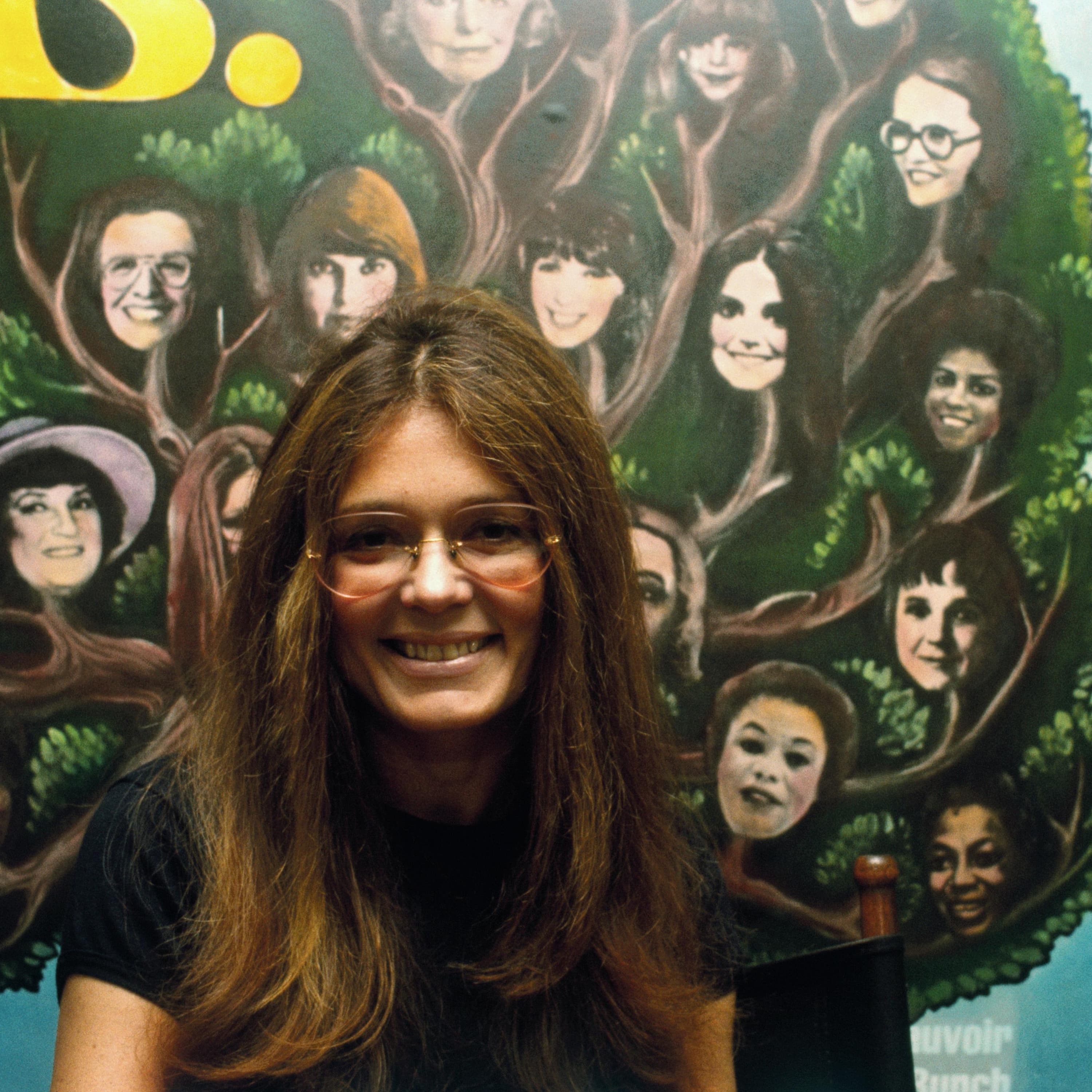
letter. She founded Ms. Magazine. That magazine in the in its very first issue had a letter called We Have Had Abortions and it was signed by more than 50 women, many of whom were famous, including Gloria Saynam, including folks like Susan Sontag and Billie Jean King. And I think this is really a founding tenant of Second Wave Feminism that the personal is political. Yeah. Right. To say, hey guys, that share our experiences and actually what you might think is a personal experience that only you're going through. Maybe I'm going through that too. And maybe the reason you and I are both going through that isn't because of our individual circumstances, but because of mass realities that are pushing us to be, I don't know, housewives who feel like we don't have anything to offer the world other than our uteruses. Yeah. And as you said, a big platform for that was this magazine that she co-founded Ms. Magazine in 1971.
It's just quieting to her, but nonetheless still hard to say whether she's attracted so much attention because of what she's done, what she says, or how she looked. This really was a groundbreaking publication, wasn't it? Can you tell us a bit about that? Oh my gosh. I mean, I have read Ms. Magazine articles from that time and I'm like, these ideas are still groundbreaking. Like they were talking about paying women wages for housework. Like that is still a very radical idea. In those first few issues, they talked about things like body hair and they talked about women who loved women. They even talked at some points about people who we would now recognize as being transgender. The kind of foundation of this magazine and makes it different from others is that it simply considers that women are human beings. That doesn't sound very revolutionary, but it is, because the other magazines are still arguing about it. And the thing was, it sounds like people were extremely hungry for the perspective that Ms. Magazine offered. All 300,000 copies of that first issue sold out with an 80s. It also spawned, I mean, a huge raft of women's magazines and
free sheets, like all across the world. My own mum worked on one that was inspired by Ms. Magazine in the early 1970s and she has always talked about what an exciting time it was to be able to create your own publication that was inspired by what was going on. And I think you will say in turn, as well as Ms. Magazine. Is that right? I did in turn at Ms. Magazine. This was obviously many years later. I did not meet Gloria, stuck in her work with her when I was there, but I still think it felt like at that time there was still such a dedication to the idea that feminist causes need to be championed and supported and the work that was started by the co-founders of Ms. and Claudia Gloria, I know that is not over. And by this time, as you said, she was kind of reaching like icon status with the glasses and with Ms. Magazine and all of the other kind of very provocative journalism she was doing all the way throughout her career. People really focused on her appearance. The hard part for me, I must say the painful part, is I work really hard
and then the result is attributed to looks. And you would think at 76 that would go away, but it's still there sometimes. So how did some in the feminist community feel about the attention or the attention that her looks were receiving? Well, they didn't love it. I think that many people within the feminist movement really felt that Gloria's sign was unfairly elevated because she was so beautiful, because she wore many skirts, because she did really cultivate a particular look. Like she made herself into an icon that's not say that this was something that happened to her on accident. She knew the power of how she looked even though yes, she talked later on about feeling like the emphasis on her appearance really undercut her professionalism and her accolades. The idea that if you were a pretty girl, whatever that meant, that you must be getting assignments for that reason. Betty for Dan, who is the writer of the feminine mystique, which is it's a book about
what's called the problem that has no name. And it's basically about why do housewives feel so bad. And the book is really credited with sparking second wave feminism because it was such a run-away bestseller, but it was also extremely concerned with the issues facing white middle class housewives. And I think that this was also a critique leveled at Gloria Steinem fairly or unfairly that as a white woman in particular, she was taking up a lot of the spotlight. And that was why she was so, so elevated and pedestal by people outside the movement. Coming up, backlash about the Clintons, civil rights and the CIA. This message comes from Jackson. Taxes aren't something you can only think about once a year, with investments planning for tax days year round. Fortunately, Jackson offers tax-efficient products.
Visit Jackson.com for more information on how our products can make your tax bill a little bit less painful. Jackson is short for Jackson Financial Incorporated, Jackson National Life Insurance Company Lansing, Michigan, and Jackson National Life Insurance Company of New York, purchased New York. A mist call doesn't feel like anything. No red flag, no notification screaming at you. It just disappears into your call log. And nine times out of ten, that was someone ready to hand you money. That's why today's episode is brought to you by Quo, spelled Q-U-O. The business phone system built so you never miss a call. Here's what I like about it. All your calls, texts, and voicemails live in one place. So anyone on your team can pick up a conversation, see the full history, and respond fast. No more, wait, who talked to this customer last? And if you're worried about after hours lead slipping through, Quo's optional built-in AI agent can answer questions and even book appointments while your team's offline. It's the number one rated business phone system on G2,
and over 90,000 businesses already trust it to stay reachable. Money is on the line. Always say hello with Quo. Try Quo for free. Plus get 20% off your first six months when you go to Quo.com slash tech. That's q-u-o.com slash tech. She and the feminists move into that time often did face very first criticism for excluding or forgetting women of color. Where did Gloria stack up in terms of her advocacy for black women in particular? This is I think one of the things that is still debated about her. Because there are these real critiques of second wave feminism. I think sometimes she gets lumped in with that, and it's not always recognized how much work she did do with black women and how much credit she extended to them. She worked famously with Florence Kennedy, who was a black civil rights lawyer. She spoke often with Dorothy Pippman Hughes. There was a very famous photo of the two of them both having their fists up in the air. Yeah. She was a fierce advocate for Shirley Chisholm,
who was a black pioneering congresswoman. We're all gods children and the will of each of us is as precious as the will of the most powerful general or corporate millionaire. And she actually ran for president. Gloria's item was a huge advocate for her for that. Gloria's item also talked a lot about how inspired she was by native and indigenous women. And I do think she really tried to talk about how racism and sexism are intertwined and cannot be addressed on their own. That is not to say that she was without fault. In 2008, she supported Hillary Clinton over Barack Obama, which someone is allowed to do that for sure. But she wrote this op-ed in the New York Times that I think came off as a little tone deaf. She spoke about how she felt like Barack Obama was allowed to talk about civil rights clashes within the movement, but Hillary Clinton wasn't allowed to talk about the old boys club. And so sometimes I do think she was not really able to understand and hold intersectionality within her work. She also received quite a lot of
criticism. Didn't she about her support of another Clinton this time Bill? Hillary's husband, yes. So as people might recall, Bill Clinton had some issues in the White House, namely that he had enough air with an intern Monica Lewinsky. News of that broke in 1998 in that year. Gloria's item wrote an op-ed where she backed Bill. She basically said that there is no evidence that Monica Lewinsky didn't want this. That Bill Clinton is not guilty of sexual harassment. And that kind of y'all we should move on. Gloria's item later said, you know, once the MeToo movement broke out, that she would probably address that situation differently now given the power imbalance between the president and a 20-something intern. But I do think one of the things that really strikes me in rereading that op-ed is thinking about how this is a perpetual debate within feminism, which is how do we think about positive and negative rights? Should feminists be prioritizing people's
right to be free from sexual predation? Should feminists be prioritizing people's rights to sexual freedom? And I think in that case, Gloria's item was trying to really emphasize the latter. Did you feel on reading it that the criticisms of her unfair then, or have been blown up proportion? No, no. I mean, I read your page and I was like, oh, God, yeah, it's not, it does not age well. There is no question. I think this is not to defend her words. It is to say, like, just to put it in the context of like, that stuff is really hard. And Monica Lewinsky herself has talked about at the time she felt that this was consensual. Later on, she has developed a different understanding of it. I think we need to contextualize Gloria's item and the things that she said and did within the context of the times that she was living in, and the debate she was trying to have. And I don't think she always came down on the right side of those debates because, yeah, reading the op-ed now, I'm just like, this is a bad take. But it is important to look at her flaws. I mean, including a brief stint that she had before she was a journalist working alongside the CIA,
which is perhaps one of the more random professional choices that she made. Yeah. Can you tell me a bit about that? Sort of a swerve, one could say. I should say, she didn't work directly for the CIA. This was in the late 1950s, early 1960s. She worked for an organization that was CIA financed. And what this organization was doing was running these youth festivals in various parts of the planet. And many of the people who were attending those festivals apparently were interested in communism, were more left-leaning. And so the CIA, I guess, was interested in funneling money towards promoting more expansive view of politics and what they should look like. I think that's really striking about that as glorious. I know, like, really didn't seem to ever apologize for doing that. She said that she was never asked to spy on American nationals, that she was never asked to quote-unquote assess foreign nationals. I had the conventional liberal's view of the CIA as a right wing incendiary group.
And I was amazed to discover that this was far from the case that they were enlightened, liberal, nonpartisan activists of the sort who characterized the Kennedy administration, for instance. Yeah, I think she said she did all again, didn't she? There was absolutely no regrets at all. Yeah, she seemed to indicate, like, that CIA funding had no real impact on their activities, but it is still the CIA girl. I don't know if you can ever get in bed with them and not have it affect something. Did she to come in for quite a bit of criticism for that? Didn't she, when that all kind of came out? I mean, I think when it comes to criticism of glorious item, it's oftentimes hard to separate it from criticism around what is glorious item really the right icon for the feminist movement? Should she really be this much of a spokesperson? And so people pointed to her CIA involvement, if you want to call it that, as evidence that she wasn't really going to be striking against the systems of patriarchy and the governments that enable patriarchy.
And you know, there might be some validity to that. And as an activist, Gloria, it started to never slow down, did she? She was a prolific author. She campaigned against domestic violence and female gentle mutilation, pornography, also the Vietnam and the Gulf Wars. And she was still fighting well into the Trump era because the problem she campaigned over, you know, there's still very much going on. And in some cases, they're getting worse, right? Yeah, I think the feminist movement that she led that she embodied is in retreat at this time. It is striking to me that she died at a time at which I do think a lot of the things she fought for are vanishing. Obviously, Roe v Wade was overturned in 2022. Nearly half of U.S. states have some sort of abortion ban in effect at this time. And Gloria Steinem talked about feeling really angry
that this was still a fight that was going on in her later years. For the first time that we're aware of, there is so much violence against females worldwide, including a preference for sons, including domestic violence in my own country. The result is that there are actually now fewer females on earth than males. On one hand, you know, you can say this is a woman who lived through and fought for so many changes that expanded the aperture of women's lives. On the other hand, she died at a time in which that aperture is, by some measures, shrinking. And do you think, though, at this moment, you could look at yes, her flaws, but all of the things that she fought for and all of the things that she achieved. And kind of in a way like channel a bit of her legacy and her spirit into a positive message for all of us that are looking into the future and trying to think about what it is that we can do. I think regardless of your politics,
regardless of whether or not you agreed with Gloria Steinem, even regardless of whether or not you consider yourself a feminist or think that second wave feminism was a good idea, I think there's no way to look at Gloria Steinem's life and not see a woman who carved her own path, who looked at the options that were available to her and said, this is not enough, I'm going to do more. And I'm not just going to do more for myself, I am going to try to give more women more rights that I believe in. And I think that is extraordinary to do. There is no denying that this is a person who was one of a kind. And talking about her as this icon of the feminist movement, who could be like the next Gloria Steinem, apart from yourself? Oh, yeah, obviously, yeah, that's obviously present. Yeah, yeah, just for the record that is not on my to-do list to become the next Gloria Steinem. But who's some of the women that you feel could be taking feminism into the next phase and be kind of spearheading the fight for
things like reproductive health rights? I mean, there are so many to name and I think that maybe is one of the most important parts of Gloria Steinem's legacy is maybe we don't need a next Gloria Steinem. Maybe there should not be one individual who embodies the 21st century version of feminism because there's no way for one individual to encompass all of the causes and identities and backgrounds that I think feminism is seeking to address. And I think that Gloria Steinem would maybe not even want an ex-Gloria Steinem. I think she would want the rest of us to be our own people. She would want you to be yourself and to fight for yourself and not to fight to take up her mantle. Well, Kasa, thank you so much for talking to the day. It's been a real pleasure. Thank you for having me. That was Kasa Sherman who hosts our sister podcast, Saitside with Kai and Kasa from Guardian US. And her book, The Second Coming, Sex and the Next
Generations Fight over its future is out now. And if you haven't done already, do make sure you check out Saitside with Kai and Kata. New episodes drop every Tuesday and Thursday and you can find it on YouTube or wherever you get your podcasts. And that's it for today. This episode was produced by Saskia Collette and Eli Block and presented by me Annie Kelly. Sound Design was by Rudy Zagadlo and the executive producer was Hummakalele. And if you want to understand more about the news that the far-right AFD Party won an election in a key German state yesterday, do have a listen to last Thursday's Today and Focus episode is all Rick Sigmund's most dangerous man in Germany. And we'll be back later on today with the latest. This is The Guardian.
This message comes from Jackson. Taxes aren't something you can only think about once a year. With investments, planning for tax days year round. Fortunately, Jackson offers tax-efficient products. Visit jackson.com for more information on how our products can make your tax bill a little bit less painful. Jackson is short for Jackson Financial Incorporated, Jackson National Life Insurance Company Lansing Michigan, and Jackson National Life Insurance Company New York. Purchase New York. When you're running a growing business, the right systems can unlock your full sales potential and make fulfilling every order effortless. Switch to ship station before peak season so you're prepped and ready before the rush hits. Ship station connects Shopify, Amazon, TikTok Shop and over 200 more marketplaces with one platform that does it all. You can manage orders, sink inventory, track returns, all automatically. Everything your operation needs, all in one place. Upgrade your shipping operations to stress proof your biggest sales days and capture every bit of potential revenue. Go to shipstation.com and use code audio and get 30 days free. Why can't we get AI to production? Our competitors are already how do we keep data secure? When do we actually see our own?
All this talk about AI, but talk doesn't transform businesses. AWS AI cuts through the noise. Making AI easier to securely deploy and scale with ready to use agents and the broadest set of AI tools and services you can build by or partner your way. Stop overthinking. Start building. AWS AI is how.
More episodes
More from Today in Focus

Is Trump trying to buy votes? – The Latest
Today in Focus

The young and healthy Dutchman who moved into a care home
Today in Focus

Why is Trump silent on UK sanctions against Israeli West Bank settlements? – The...
Today in Focus

Inside Reform UK
Today in Focus