About this episode
Kenneth C. Davis, author of Don't Know Much About History and Don't Know Much About Mythology, quizzes listeners on how well they know their Labor Day history.
Kenneth's blog
Kenneth's YouTube channel
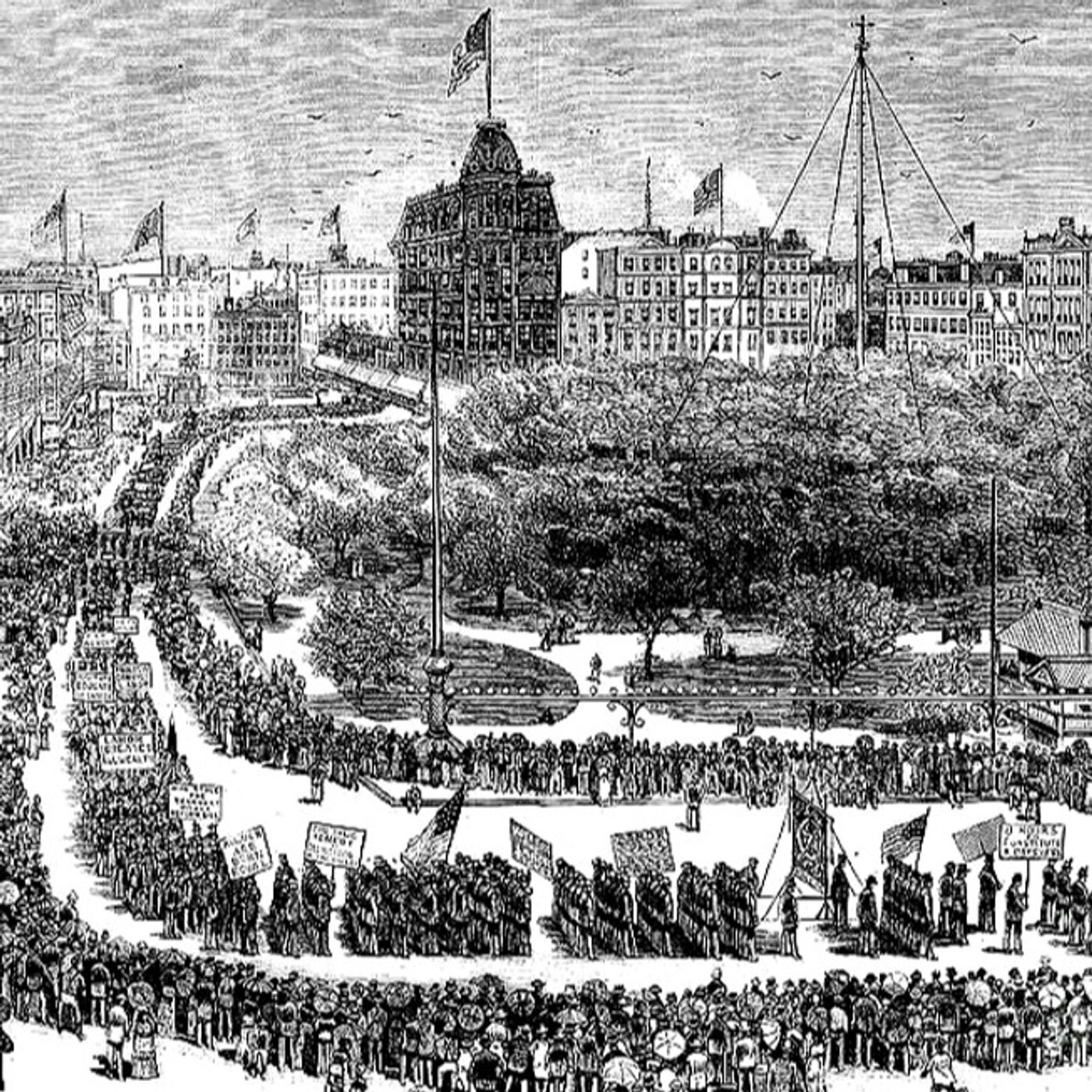
image: Labor Day Parade, Union Square, New York, 1882 (Lithographie), 16 September 1882 (Author not known, but more than 100 years old, Image edited, Public domain, via Wikimedia Commons)
Hosted by Simplecast, an AdsWizz company. See pcm.adswizz.com for information about our collection and use of personal data for advertising.
Get every episode summarized
Each time The Brian Lehrer Show publishes, we email you a written briefing from the transcript — the topics, who appeared, and any specific claims, with the ad reads skipped.
Email me new episodesFree for 3 shows. No card needed.
Hosts & guests
Transcript ready
285 searchable segments. Every word is indexed and playable.
Full transcript
The Brian Lehrer Show — Labor Day History Quiz. Machine-transcribed; use the interactive transcript above to jump the player to any line.
All right. Hey, everyone. It's the Brian Lair show. I'm Kusha Navidad, filling in for Brian today here on WNYC. And to end the show today, let's look ahead to the holiday on Monday and test your knowledge of Labor Day and the history around it. Here's what I want you to do. Call in to play. Give us a call at 2124339692. What do you get if you win? You get one question right. That's all it takes and you'll get a prize, a Brian Lair show baseball hat. And folks, I've seen the hat. I'm looking at one right now. It is blue with red lettering. It is beautiful. It is a wonderful thing to wear. I don't know. Maybe when you're enjoying your Labor Day, give us a call. Send us a... No, don't send us a text. We'll call 2124339692.
That's 212433WNYC. We'll have some callers come in, get the boards filled. And while we're doing that, let me introduce our quiz master and guest. I'm joined for this by a frequent guest, Kenneth C. Davis, the author of the Don't Know Much About History series of books and other things. Welcome back, Ken. You ready to start? Always a great pleasure to be here. And I have my Brian Lair baseball cap with me. It is a beautiful cap. So let's do it. Let's do it. All right. So we have our first guest, Mike and Huntington. Ken, would you like to read this first one and then we can alternate? Yeah, let's do it that way. Okay, so Mike, hey, you with us? Mike, you there? I'm here. Hey, Mike. Okay, Ken, go for it. Okay. So you really get a good chance here. Which US president signed the Labor Day holiday into law? Was it Franklin D. Roosevelt, Richard Nixon or Grover Cleveland?
Cleveland. That is correct. Nice job, Mike. Oh, tell me a little bit about that, Ken. Grover Cleveland, who was the first president to serve non-consecative terms, signed the Bill into law in June of 1894. It was not that he was a great friend of labor by any stretch of the imagination. In fact, he had just sent federal troops in to break a strike, which was called the Pullman Strike, the biggest company in America at the time. Grover Cleveland had sent 12,000 troops to break the strike. He was claiming that the strike was stopping the railroads and the railroads carried the mail, so that's why he could send troops in. More than 30 workers were killed in that strike. And it is, this is part of the story of Labor Day that we don't know how violent this period was that late 19th century in terms of labor organizing and opposition to labor. So Cleveland signed this law into, you know, Bill into law.
It's a bone toss to the workers because none of their other demands was met. They went unheeded for decades. Wow, it took an enormous effort that ended in a lot of bloodshed just to get Labor Day recognized. Absolutely. It was a period when you have the homestead strike, the Pullman Strike, the Haymarket Square affair, wars in the Colorado mining wars in the early 20th century. This was a really violent period. It was another civil war in essence, a period when the businesses were doing everything to prevent labor from organizing and they had the full cooperation of the government at every level. Well, Mike, good job. You're getting a hat. We'll get your information starting off this quiz on a good foot. Let's go to Tess in Astoria. Hey, Tess, welcome to the show. Hi, how are you? Good. Let's do it. I'll read this one to you. Who said labor is the superior of capital and deserves much the higher consideration?
Is it A, Karl Marx, B, Abraham Lincoln, or C, Bernie Sanders? I'm going to go A. Oh, Tess, you want to try one more time, maybe? Of course. I'll go C. Oh, Tess, I'm sorry. We're not doing three strikes here, but really good try. It was actually Ken. Abraham Lincoln in his first message to Congress in 1861, December 1861. It was then a written message to Congress. We call it the state of the union now, but he did write those words that labor is the superior of capital and deserves much the higher consideration. The first Republican president, of course, saying something that no Republican today, I don't think, would remotely consider. It would be blasphemy in the Republican Party today. Absolutely. Yes, thank you so much for playing. Sorry, you didn't get the hat this time, but there's always next time. I still hope you have a great Labor Day.
All right. Next, we have Bill in Bale, New Jersey. Hey, Bill, welcome to the show. Good morning. Good morning. Okay. Ken, go for it. Good morning, Bill. Before there was a Labor Day holiday, the first unofficial Labor Day parade took place in what city, a New York, B Chicago, or C Boston? Chicago. Give it another go. New York. New York is correct. Good job, Bill. Go ahead. For extra credit, you want to guess where it took place? What New York City location had the first Labor Day parade? Union Square. Union Square. Oh, it's in. We're sending you a really good hat, Bill. They're all great, but nice job. Go ahead, Ken. It's interesting. This was 1882, and Labor organizers put together this parade really as a way to give working families a day off, a picnic in the park.
And they also had a political meaning. They wanted to end the child labor, which was widespread at the time. They wanted decent wages. They wanted an eight hour work day and a five day week. They wanted the right to organize. So that's 1882 in New York City. By the way, Union Square has nothing to do with Union, Labor Union. Oh, interesting. I was going to ask you. Or nothing to do with the Union. It was actually named for the Union of what was then two major streets, Broadway, and I think it's fourth street, fourth avenue. Fourth avenue. Okay, cool. Yes, so that's where Union Street comes from. Well, Bill, way to go. Good job. Okay, we're going on to our next question. We're going to talk to Vinnie in Washington Heights. Hey, Vinnie, welcome to the show. Hello, thanks for having me. All right. Oh, this is my turn. I'm really happy I get this question. I'm excited about this one, Vinnie. Here we go. When was the water cooler invented? A, early 1900s, B, the 1920s, or C, the 1950s?
I'm going to guess it's B, is it the 1920s? Oh, Vinnie. Do you want to try again? Oh, guess A, the 1900s. Oh, we got it, Vinnie. Good job. We'll call you a winner. Tell me about the water cooler. The first water coolers were really water fountains and they delivered cold water. Interesting. I remember being a kid and always looking at the fountain in school and it said, Halsey Taylor on it. And I always wondered who's Halsey. Halsey Taylor was an engineer whose father had died of tuberculosis, I think, from or typhoid from drinking contaminated water. So he wanted to come up with a way. But the first, so those were the first water coolers, really fountains. The water cooler, as we know it, came along in the 1950s around the same time as television. So you got to stand around the water cooler and talk about what you want to tell us. What you just want. Oh, that's such an interesting convalescence of social things. Well, Vinnie, great job. Let's get our next caller down there if we could.
We've got Brian in Springfield, New Jersey. Hey, Brian, welcome to the show. Hey, thanks for having me. Absolutely. Excited to have you here. Can go ahead. Okay. And did the federal minimum wage go into effect? Was it A, 1894, B, 1938, or C, 1964? I think that was part of the New Deal. So I'll say 1938. That is correct. Great job, Brian. Sorry, go ahead. Of course, getting decent wages was part of union organizing from the very beginning, but it took until 1938 and Roosevelt in the presidency during the New Deal to come up with the Fair Labor Standards Act, which codified a great many of the things that organized labor had been fighting for since the 19th century. Wonderful. And the minimum wage, what was it? It was 25 cents an hour. Okay, let's go to our next caller, Cecilia in the East Village. Hey, Cecilia, welcome to the show.
Hi, thank you. Absolutely. Excited to have you here. I'll give you the question. What is the current federal minimum wage? Is it A, $15 an hour, B, $20 an hour, or C, $7.25 per hour? I'm going to say C. That's right. You got it right. Great job. Can go ahead. Hard to believe, but it is seven and a quarter. It was last increased in 2009. By the way, in New York City and Long Island, it is $17. So states have higher minimum wages, but at the federal level, it is still stuck at seven and a quarter per hour. And moving from the money we make to how we might spend that money, we've got a question about vacations next, and we're going to give it to Thomas in Summit, New Jersey. Thomas, hi, welcome to the show. Thanks, Zach. Thank you. Wonderful. Let's get the question, Ken.
When did paid vacations become federal law? A, 1938, B, 1968, C, never. C, never. That is correct. Nice job. That one tricked me up. When I first read it, and I was trying to figure out what the answer might be, I didn't consider it never, but it's never become a federal law. The US is one of the few industrialized countries in the world with no federal national requirement to grant vacation time, excluding federal holidays. The eight hour workday became law in 1938 under the Fair Labor Standards Act, the same one we just mentioned. It also established the minimum wage and guaranteed time and a half for overtime. Now we're running short on time, so I think this maybe get one or two more. We're going to go to Roberto in Los Angeles. Hi, Roberto. Welcome to the show. Hi, thank you for having me. Absolutely, lovely to have you here. Okay, here's your question. What percentage of American workers belong to a union?
Is it A, 10%, B, 33%, or C, 5%. Can you repeat those numbers again? Sure, we got 10%, 33%, or 5%. I'll say about 10%. That is correct. Wonderful. Can tell us about it briefly. We're running a bit on that. 2025, it was about 10%, it's about 14 and a half million American workers are in unions. In the 1960s at the peak, it was around a third of workers. Obviously unions have fallen off greatly. Although last year was a year of some increase in union jobs, but once again, we have an administration today that would not be in favor of unions. Going from a union, a president who walked a picket line with the United Auto Workers to a president who just took the right to collective bargaining away from millions of American
federal workers. You can very quickly before I let you go, how are you going to spend your Labor Day? I spend my Labor Day working doing this, ironic talking about labor. It's fun for me and it is one of those holidays we get to enjoy. The last cannonball into the lake, swimsuit sales, but it is no picnic for workers today. And we are so lucky to have you here. That's all the time we have for today for it. So congratulations, all the winners and thank you, Ken Davis, for helping to get us ready for Labor Day. And it's C Davis's author of the Don't Know Much About History series and other books. More at Don't Know Much.com on Labor Day. Alright folks, that's it for the show today. Thanks to the team at the Bryan Lair Show, Lisa Allison, Mary Croke, Amina Serna, Carl Boyzrand and Esperanza Rosenbaum, with help today from Sasha Linden Cohen and Melanie Marich. Juliana Fonda and Milton Ruiz are at the audio controls. I'm Kusha Navidad. It has been such a pleasure hanging out with you this past week.
Thank you for having me. We'll be on tape on Friday and on Monday. Have a wonderful Labor Day. Be safe and stay tuned for all of it.
More episodes
More from The Brian Lehrer Show

Tuesday Morning Politics: State of Iran War; Home Stretch to Midterms
The Brian Lehrer Show

The CDC and Measles Deaths
The Brian Lehrer Show

History of the War on Terror
The Brian Lehrer Show

Labor Day: Working Class; White Collar Unions; Supermarkets; Summer Songs
The Brian Lehrer Show