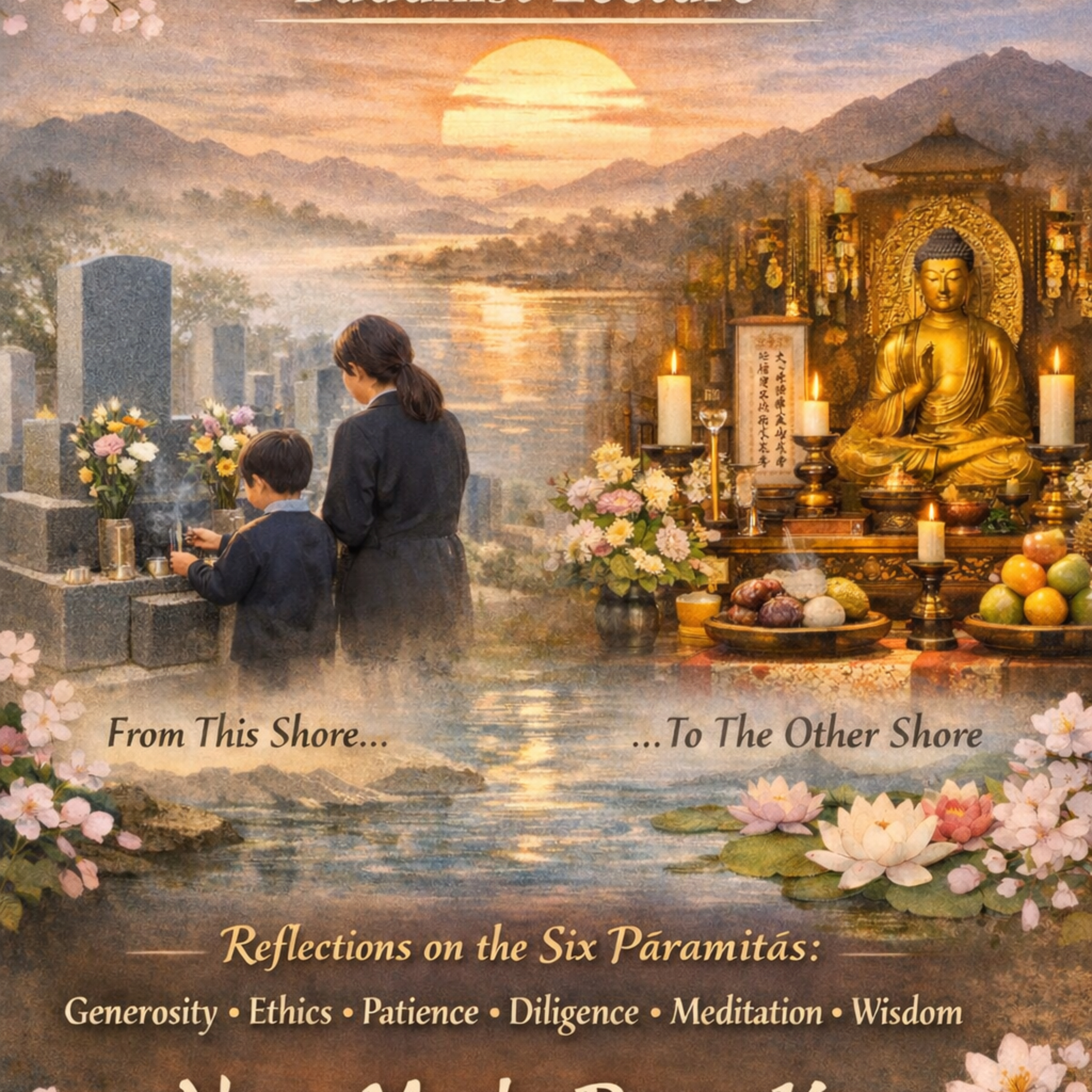
Reaching the "Other Shore" of Enlightenment;O-Higan (お彼岸)
Get every episode summarized
Each time The Rowdy Buddhist Podcast publishes, we email you a written briefing from the transcript — the topics, who appeared, and any specific claims, with the ad reads skipped.
Email me new episodesFree for 3 shows. No card needed.
About this episode
“Thank you very much, everyone, for attending today's service and practice for OHGAN 2026. Today, I would like to give you a lecture concerning what is the meaning of OHGAN.”From the transcript
O-Higan is a Buddhist observance held during the spring and autumn equinox that symbolizes crossing from the “this shore” of suffering to the “other shore” of enlightenment. The practice encourages reflection on the **Six Pāramitās—generosity, ethical conduct, patience, diligence, meditation, and wisdom—as the path that carries us toward awakening. In Nichiren Shu Buddhism, this crossing is realized through faith and practice of the Lotus Sutra, especially through chanting Namu Myōhō Renge Kyō while living with gratitude toward our ancestors and compassion toward all beings.
Get every episode summarized
Each time The Rowdy Buddhist Podcast publishes, we email you a written briefing from the transcript — the topics, who appeared, and any specific claims, with the ad reads skipped.
Email me new episodesFree for 3 shows. No card needed.
Know when Sharon Salzberg turns up
Follow Sharon Salzberg and once a week we email you every new episode they appeared on — including guest spots the show notes never mention, because we read the transcript.
Follow Sharon SalzbergFree. Pick your own day and time.
Hosts & guests

Transcript ready
91 searchable segments. Every word is indexed and playable.
Full transcript
The Rowdy Buddhist Podcast — Reaching the "Other Shore" of Enlightenment;O-Higan (お彼岸). Machine-transcribed; use the interactive transcript above to jump the player to any line.
Thank you very much, everyone, for attending today's service and practice for OHGAN 2026. Today, I would like to give you a lecture concerning what is the meaning of OHGAN. OHGAN is a sacred observance in Japanese Buddhism that occurs during the spring and autumn equinoxes. The word HIGAN literally means the other shore. In Buddhist teachings, this other shore represents enlightenment, awakening, and liberation from suffering. It is contrasted with Shigan, the shore or the world of suffering or confusion, attachment and delusion, in which we normally live.
Thus, OHGAN is not merely a seasonal memorial or cultural custom. It is a profound spiritual reminder that each of us stands on the shore of suffering. Yet, through the Dharma, we may cross to the shore of awakening. The symbolism of the equinox is that OHGAN is observed during the week surrounding the equinox, when day and night are perfectly balanced. In Buddhism, this balance represents harmony and clarity of mind. Just as light and darkness are in equilibrium, so should we, our lives, seek balance between wisdom and compassion. The week of the equinox also was also traditionally seen as the moment when the worlds of the living and the worlds of the ancestors draw close together.
Because of this, families visit cemeteries, clean the graves of the loved ones, offer incense and chant the sutras just as we have done today. But the deeper meaning is not only remembering the deceased, it is remembering our own path or awakening. When we care for the graves of our ancestors, or as we remember them in today's service, we reflect on impermanence, gratitude and the continuity of life. As a really essential aspect for Buddhism, in that we don't become deluded that we have more time to do as we wish. We understand the reality that we must practice and study each day and strive towards that enlightenment that there is no time to waste.
The Six Potomitas are the main practice. This is the way of crossing to the other shore. And during this time of Vohigana, the practice of the Six Potomitas, or as stated also the Six Perfections, are the virtues that carry a practitioner from this shore of delusion to the other shore of enlightenment. These are generosity, dana, giving freely without attachment or the idea of receipt. Ethical conduct, shila, living with integrity and compassion. Patience, shanti, enduring hardship and insult without hatred. Diligence, vire, persistent effort in the practice of the Buddha Dharma, meditation, dhyana, cultivating clarity and calm awareness, wisdom, prajna, seeing the true nature of reality.
These Six Virtues from a form, a spiritual bridge across the ocean of suffering. During the week of Vohigana, practitioners are encouraged to reflect deeply on these qualities in their daily life. At this moment, I would like you to take a moment and ask yourself, where can I practice generosity today? I want you to think in your mind a scenario of where you are able to practice your generosity today, even one thing. An example is that many of you know Lausancy. He sees many opportunities to practice that, such as picking up garbage, offering food to someone, giving someone some support voluntarily, maybe even a dollar, and that's it.
Offering words of encouragement, but doing the good deed, generosity, in that moment. And next, I want you to think, where must I cultivate patience? Where in your life is patience needed? With who is patience needed? And what adversity is patience needed? And even in happiness, when is patience needed? Take a moment and think of that. And then the final question that I wish you to ask yourself is, where do I need wisdom instead of reaction? What situations should we follow wisdom than simply our emotional reaction or default setting? Where do I need wisdom instead of reaction?
I would encourage you to write this down or write down your answers upon thinking about them so that you can come back to them and follow. And in this way, O Higam becomes a living practice, not just the ceremony. In our practice of Nietzsche than Buddhism, O Higam is closely connected with the practice of the world of Sutra. The teaching that reveals the universal potential for enlightenment in all beings. Nietzsche then taught that the path to the other shore is not distant or inaccessible. It is realized through faith in the Buddha Dharma, expressed through chanting, Dhamma-mi-o-ho-den-gay-kyo, devotion to the wonderful Dharma. Nietzsche then wrote, when one chants the O Daimoku, the Buddha nature within one's life emerges.
Through chanting, study, and compassionate action, we as practitioners awaken the Buddha nature already present in our life. Thus crossing to the other shore is not something that happens after death. It is something that can begin this very moment. Remembering ancestors, another important aspect of O Higam, as you many know, because sometimes in some temples the reading can be very long. They keep the ancestors for all anyone to pass away within the last hundred years they will read. Another important aspect as we see in O Higam is the honoring of ancestors. In Japanese temples, memorial services called Higam-e are performed. Families bring flowers in sense and offerings of food, such as potamochi or o Hagi, sweet rice cakes, symbolic of the season.
And in the book that I created, it talks specifically about those items. So if you'd like to create them for O Higam, please do and offer them to your ancestors and enjoy them yourself. These offerings express gratitude to those who came before us. From a Buddhist perspective, honoring ancestors is not only about the past. It is about recognizing that our lives are interconnected with countless others. Our parents, teachers, communities, and even the natural world all contribute to the life we live today. Therefore, this time of O Higam invites us to cultivate gratitude and humility. A metaphor of crossing from this shore to the other shore appears throughout Buddhist literature. But the ocean we cross is now outside of ourselves.
It is the ocean of our own mind, the waves of anger, fear, attachment, and ignorance. When we practice generosity, patience, meditation, and wisdom, we gradually calm these waves, little by little the waters become clear. And when the waters become clear for us, we realize something very profound. The other shore was never separate from this shore. Enlightenment is not somewhere far away. It is awakening of the mind exactly where we stand. We can practice and bring O Higam into our daily life. So I am sometimes asked, so how should we observe O Higam today? Traditionally, practitioners are encouraged during this time to visit the grave of our ancestors or remember loved ones in prayer.
For form acts of generosity and kindness, chant the lotus sutra or the old dimoku. Reflect on the six padamitas. Recomit to the path of compassion and wisdom. Very essential, especially in this time, which is very easy to react and follow other paths that lead us to darkness and suffering. Even simple acts, helping someone, forgiving an enemy, speaking kindly, a ways of crossing to the other shore. Every compassionate action becomes a step across the bridge of the Buddha Dharma. And in closing reflection, like to say that O Higam reminds us that a path to awakening is not distant or abstract. We sometimes become discouraged in thinking, I am not good enough to practice Buddhism.
I am not able to practice it. I am too far gone. I am too angry. I am too sad. Actually, Buddha allows us during this time to see that the path is not far and that each step, each action we take, has considerable power in our lives. It lies in the small, sincere efforts we make each day to embody the Buddha's teaching. When we practice generosity, patience, meditation and wisdom, we begin to cross the great ocean of suffering. Guided by the lotus sutra and the spirit of compassion, we move closer to the shore of enlightenment, not only for ourselves, but for all beings. I see this in my training here. People observe and recognize Buddhist behavior. I am not aware of it, obviously. Sometimes it is hard to see yourself from the outside, but they come up and say, oh, you are very kind or you are very patient or very peaceful.
I don't always feel like that, but maybe in some people's eyes or the world, that is quite different or strange from the usual. Therefore, let us observe or hegan with gratitude, mindfulness and determination. May our practice benefit our ancestors and our communities and all living beings. If you wish, there is a practice study course that you are welcome to send me an email and I will enroll. It is a free course that you can be able to practice each day to have a practice for each of the six potomitas. If you would like to do that, please just send me an email. Again, thank you very much for your time, your practice and your faith. Let us chant the ordai moku three times.
More episodes
More from The Rowdy Buddhist Podcast

Sacred Fire, Sacred Herb: The Hidden Meaning of Hōroku
The Rowdy Buddhist Podcast

Another Candle, Another Awakening: Celebrating Birthdays the Buddhist Way
The Rowdy Buddhist Podcast

The Spirit of Offering: Honoring the Buddha Through Gratitude and Practice
The Rowdy Buddhist Podcast
The Hands of Compassion: Self-Reiki Through the Lens of Maka Shikan
The Rowdy Buddhist Podcast