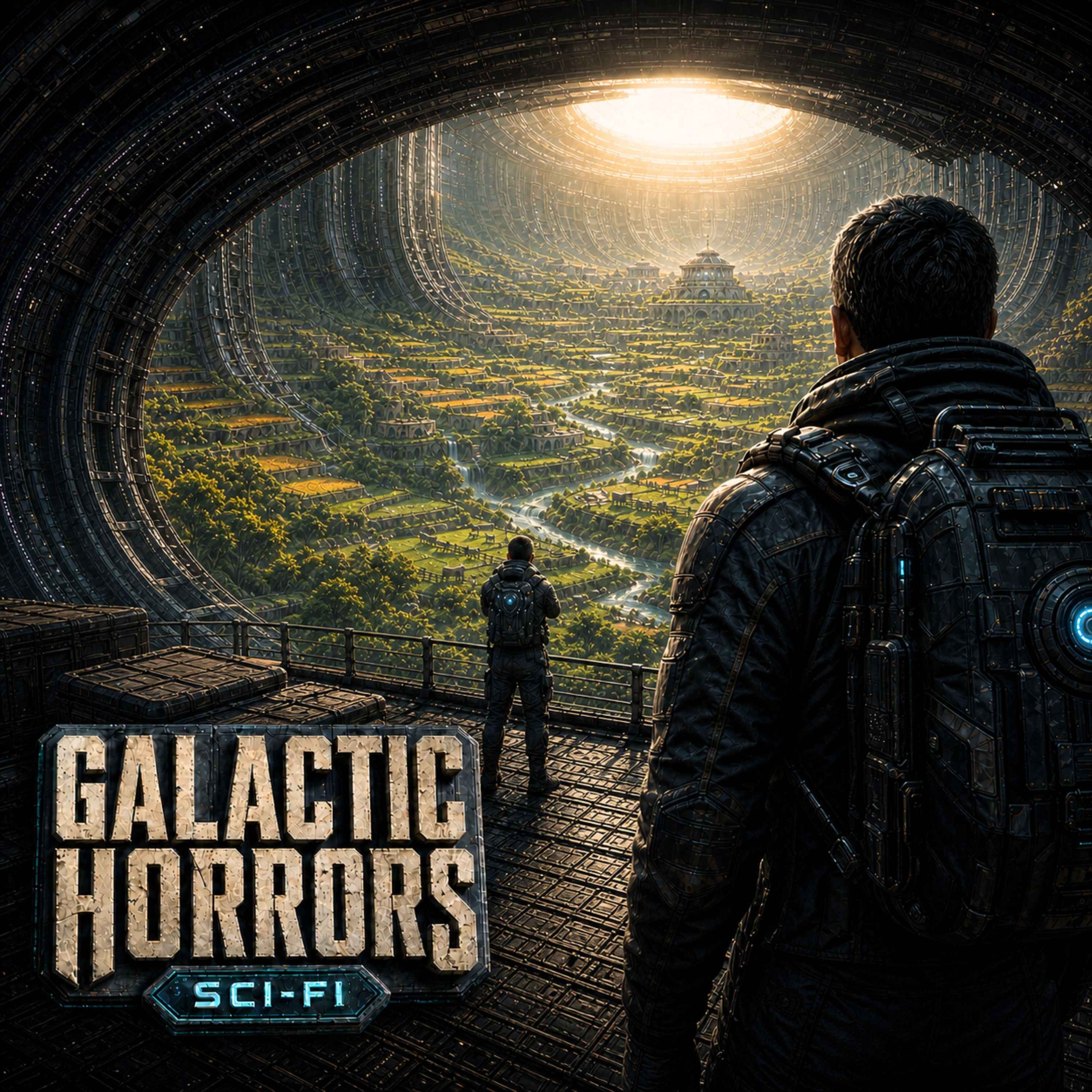
Six Million Passengers Returned From Deep Space. Their True Origin Is A Biological Harvest
About this episode
For fourteen years, quarantine physician Noah has decided when crews from sealed orbital habitats are safe to come home. Then a vessel the size of a small moon arrives carrying six million humans who say their ancestors left Earth thousands of years ago.
Their bloodwork is healthy. Their bodies are not what their history says they should be. Modern vaccination scars, recent dental materials, and impossible genetic matches lead Noah toward a reproductive system the passengers use but do not understand, and toward a vast biological archive built to preserve far more than humanity.
While diplomats negotiate the passengers’ return, extinct organisms begin appearing across Earth. Roads vanish beneath engineered biology. Water systems fail. The vessel is not waiting for permission. It is restoring the planet according to a model older than any government.
Noah was sent to decide whether the passengers are dangerous to Earth. Instead, he must decide how much truth Earth can survive when the only people who can slow the restoration are also part of it.
🔗 Official Links:
The only place to get daily and bonus Galactic Horrors stories with no ads or interruptions is Patreon:
📡 Join Patreon: https://patreon.com/GalacticHorrors
Galactic Horrors stories are also available as eBooks on Amazon, with new releases every week:
📚 eBooks: https://www.amazon.com/stores/author/B0H2F5M2B3/allbooks
📖 Written by Galactic Horrors
⚠️ Content Ownership Notice
All stories, artwork, thumbnails, and animations featured on this channel are original creations of Galactic Horrors. I do not accept or feature submissions from other creators. Unauthorized reproduction, redistribution, or re-uploading of any content from this channel, in any form, is strictly prohibited and constitutes a violation of copyright. Legal action may be taken against any parties found infringing these rights.
📜 Fictional Work Disclaimer
This story is a work of fiction created for entertainment purposes only. The events, characters, and organizations portrayed are entirely fictional, and any references to governmental bodies, entities, or individuals are not intended to represent reality. Any resemblance to actual persons, living or dead, or real-life events or organizations is purely coincidental.
#scifi #scifihorror #creepypasta
Disclosure: This episode includes AI-generated elements.
Hosted on Acast. See acast.com/privacy for more information.
Get every episode summarized
Each time Galactic Horrors publishes, we email you a written briefing from the transcript — the topics, who appeared, and any specific claims, with the ad reads skipped.
Email me new episodesFree for 3 shows. No card needed.
Hosts & guests
Transcript ready
739 searchable segments. Every word is indexed and playable.
Full transcript
Galactic Horrors — Six Million Passengers Returned From Deep Space. Their True Origin Is A Biological Harvest. Machine-transcribed; use the interactive transcript above to jump the player to any line.
Before we begin, Galactic Horrors is now on Patreon. Get daily stories in one place, with no ads and no interruptions. Link is in the description or search Galactic Horrors on Patreon. Now, let's begin the transmission. I have spent 14 years telling people they cannot go home yet. That is the practical summary of Quarantine Medicine in orbital work. A crew finishes 18 months on a processing platform. They want to see their wives and their kids. They want solid ground. I look at their blood work and skin. I look at the particular way their joints have stiffened, or their gums have receded from whatever went wrong with their station's water chemistry around month 11. Then I decide whether they're carrying something that makes them a hazard to everyone waiting at the terminal gate. Most of the time, something's wrong. A fungal colony seeded in the ventilation system during month 4.
Or a dormant tuberculosis reactivation that the station medic, usually a structural engineer with a first aid certificate, has been treating as bronchitis. Minor things, typically. Treatable. But I've seen minor things kill people at the terminal, when a returning crew member coughed into a crowd that hadn't built immunity to whatever the recycler had been brewing for a year and a half. I have been called things in languages I don't speak. A pipeline welder on a satin orbit relay station threw a boot at my head because I kept him 11 extra days over a rash his medic had been calling exomer since February. The rash was methamethicillin resistance staff. The boot missed. None of this qualifies me for first contact. What it qualifies me for is determining whether residents of a sealed environment can safely interact with outsiders. The question with the vessel was whether 6 million people from a closed system could safely interact with earth after a habitation period measured in millennia rather than months.
The longest closed human environment I'd cleared before that carried 23 people for 26 months. The scale difference was like asking a county veterinarian to inspect every farm animal on the continent. But I'd done the work. I understood what sealed environments produce. All diseases can persist in recycled air. Chronic low level exposure can generate new ones while microbial communities shape immune profiles that stopped reflecting earth's biome generations ago. Someone had to board that vessel with an eye for what those bodies carried. The diplomats needed to know whether shaking hands with a passenger could start a pandemic. That someone ended up being me because the more famous candidates specialized in laboratory models of extraterrestrial biology, which turned out to be the wrong specialty entirely once it opened up and the people inside started speaking Mandarin. The shuttle carried 9 of us. I was the only medical officer.
Frank Pollard ran the diplomatic contingent, five career state department officials who had spent the transit reviewing briefing documents about the continuity populations reported governmental structure. Pollard treated the medical assessment as a gate to unlock before his real work could begin. Two biosecurity technicians rounded out the team. They carried sampling equipment. I carried experience which weighs less but is harder to replace. Forty minutes out from docking, Pollard sat across from me going over his notes for a meeting with what amounted to a foreign head of state. He asked me how long the medical clearance would take. I told him it depended on what I found. He asked whether I could give him a preliminary answer within 12 hours. I told him I could give him a preliminary answer within 12 minutes if the person I examined was carrying something lethal, but that wasn't typically the kind of answer people hoped for. Pollard went back to his briefing documents. The vessel was visible through the shuttle's forward camera feed well before docking.
By then I'd seen the long range imagery everyone had seen. During the size of a small moon its exterior a continuous surface without the bridge, engine housings, windows or docking structures of our vehicles. The exterior carried markings that might have been functional indicators or might have been stress damage accumulated over transit periods nobody could calculate. The surface was dark, irregular. It looked geological like an asteroid hollowed out by something with better tools than hours. Having required guidance from continuity controllers aboard the vessel. Our shuttle attached to a surface feature the passengers had adapted into an access point generations ago using equipment they maintained without having built it. The seal was imperfect. Pressure equalization took longer than it should have. When the hatch opened the air that came through tasted like metal filings dissolved in condensation.
I'd tasted worse on stations where the carbon scrubbers were six months past service. The transition from the access point into the vessel's interior was where the scale became a physical experience. We moved through a passage that could have accommodated a freight vehicle. The walls, if that's the right word for surfaces built for purposes I couldn't identify, were smooth and dark. I saw no markings or controls at any height my hands could reach. The passage widened into a junction where four routes branched off in directions that made no spatial sense relative to how far we'd walked from the hull. The continuity guides waiting for us barely paused at the junction before moving through it. One of them, a compact man in his sixties named Harold, led us down the left most route without explaining why. I asked what was down the other three. Two of them go to other settlements, he said. The third one closed about forty years ago, closed how.
The doors stopped opening. Harold walked with his hands in his pockets, his shoulders set against some habitual draft in the corridor. Happened sometimes. Harold shrugged and kept walking. It was part of life there, when one route failed, another took its place. Then the passage ended, an interior door cycled open with a pressure change that made my ears pop, and we walked into something I was completely unprepared for. Fields. Agricultural fields under broad spectrum lighting that simulated daylight well enough to make me squint. Terrorist plots climbed a gentle slope, planted with grain I couldn't recognize from that distance, but which grew in rows that meant someone had cultivated it with generations of practice behind them. On the fields, low residential structures built from processed material had the worn surfaces of buildings residents had actually lived in for decades. Livestock stood in fenced enclosures.
A market area was busy with adults at stalls while children ran between them. A clinic had a line of patients waiting outside. After that enormous corridor, the inhuman passage built for bodies shaped by priorities I couldn't guess at. The settlement looked almost painfully normal. A farming town in a valley, except the valley was inside a machine the size of Wyoming. The patients waiting at the clinic stared at us, some of them waved. Pollard's team broke off to meet with settlement administrators. I walked to the clinic with my biosecurity techs. The continuity medical staff were expecting me. They had cleared a room. Volunteers were waiting with their own diagnostic equipment set alongside space for mine. Everything was organized with the efficiency of a public health service that had been managing a closed community for longer than most countries have existed. I started working. The first volunteer was a woman in her early 30s, healthy, and calm.
She sat down across from me, nervous enough to notice and impatient to hear the result. Should quarantine work up, vitals, blood draw, skin examination, oral cavity, lymph nodes, joint mobility. I asked her medical history through a translator, though her dialect was close enough to standard Mandarin that I caught most of it myself. She was healthy, better than I expected. Well nourished, strong bone density, good dental work, no obvious signs of the chronic deficiency diseases I was expecting. Her lymph nodes were unremarkable. The joints moved freely. Then I looked at the vaccination scar on her upper left arm. I have seen a lot of vaccination scars. Some vaccination methods leave characteristic scars. The multiple puncture technique used with a bifurcated needle. The two pronged tool used in smallpox vaccination campaigns on earth during the 20th century. Typically leaves are small, pitted scar after the vaccinee-illusion heals.
This woman had that kind of scar. Her family history, according to the settlement's records, traced back more than 800 years aboard the vessel. The bifurcated needle technique was developed on earth in the 1960s. Her ancestors were supposedly gone long before that. I checked the clinic record against the scar. The vaccination had been given about 10 years earlier. The patient had vaccinated this woman using a technique invented on earth within the last century, inside a vessel that had supposedly been carrying her family line since before Rome fell. I finished the blood draw without mentioning the scar and returned to my notes. The second patient had modern dental composites. The resin formulation match supplies I'd seen in orbital station clinics. Earth manufactured stock distributed through standard procurement channels. These fillings were maybe five years old. The third patient showed bone density markers consistent with nutritional supplementation,
using compounds that the settlement's agricultural production, based on what I'd seen walking through it, did not appear to produce. I examined 11 more patients before lunch. Every one of them was healthy. Everyone carried at least one physical marker that shouldn't have been there. Scientists of recent earth medicine or manufactured supplies embedded in bodies from a civilization that claimed separation measured in millennia. Over the mid-day break, I sat in the cleared examination room with my sampling kit spread across the table. My biosecurity texts were cataloging blood draws in the adjacent room. The clinic staff had left us alone. I thought about the TB case from seven years ago. The mining crew returning from the Jovian platform. The disease surviving in the recycler for months because nobody qualified was watching. Old things persisting in closed systems. That model didn't apply here. Something had been delivering current earth medical technology to these passengers through
channels nobody was talking about. And it had happened more than once in recent years. I filed a request for expanded genetic sampling authority. Full comparative DNA analysis between the passengers and current earth DNA databases. The request went up through Pollard's diplomatic chain because I didn't have the standing to authorize it independently. Pollard approved it in four hours. He wanted his clearance. He assumed the genetics would confirm what the continuity populations own history claimed. A founding group removed from earth thousands of years ago. Drifted genetically in ways consistent with long isolation. That was what I expected too. The results came back on my third day aboard the vessel. I was in the clinic examination room working through another patient roster when the first batch of comparative analyses appeared on my terminal. An earth side lab had processed the samples and transmitted the results to our staging station in orbit.
From there they were relayed through the vessel's communications infrastructure, which the continuity population had patched together from their own equipment and hardware interfaces reverse engineered from the ship over centuries. The initial report showed expected results. Genetic markers were consistent with South Asian founder groups that had diverged over time, with Drift compatible with a moderately sized, closed community. Pollard wanted confirmation of an old separation with measurable Drift. The report gave him that. Then the comparison algorithm flagged an exact match. A man I had examined on day one, 43 years old, agricultural machinery technician, born aboard the vessel, family records tracing back 600 years in the settlement's archives, shared nuclear DNA with a construction worker currently employed in Manila. The comparison showed the same genome, identical at every locus measured.
In any forensic lab on earth, that result would mean the DNA came from the same person, or from identical twins. These two men were not twins, they had never met. One was 43, the other was 29. I flagged potential contamination and requested verification from the lab. Then I checked my own sampling protocols for cross-contamination pathways. The second match came in while I was still reviewing the first. A continuity woman, 61, matched a retired schoolteacher in Ohio. Third match, a six-year-old continuity boy matched a child currently enrolled in a primary school outside Nairobi. By the time the first batch was fully processed, I had 11 exact matches from a sample of 400. The earth counterparts spanned different ethnicities and ages across unrelated national backgrounds. In every exact match, the earth individual was old enough to have existed before the continuity counterpart was conceived sometimes by decades.
The lab confirmed the methodology was clean. Coincidence was mathematically eliminated before the second batch was ready. These passengers were being made from living earth donors. I sat with that for a while without touching the patient roster. The sampling rate suggested that roughly 3% of the passengers would show exact matches with living earth individuals. Across 6 million passengers, that implied 180,000 people aboard who were, in a precise biological sense, copies of someone living an ordinary life right now on a planet the copies had never visited. I needed continuity medical files, especially reproductive histories and genetic screening files. Prenatal files had to go back as far as the archives held. Those files could show when outside DNA had entered the gene pool if I could trace the sample chains.
Those files were held by the settlement's public health authority. The man who controlled access was a physician named Martin Gage. I met him because he came to me. He walked in on the morning of my fourth day, unannounced. A continuity security escort had apparently decided that the earth doctor requesting settlement-wide reproductive files warranted someone more senior than a clerk. Martin was in his early fifties, heavy through the shoulders and careful on his feet. He wore the settlement's medical service uniform, which resembled hospital scrubs closely enough to be disorientated. He carried a data pad tucked against his forearm, referring to it without looking at it. He introduced himself and asked what I needed. Then he listened while I explained the scope of my request. He pulled a chair to the work table. His data pad lay flat between us. I'll give you the full reproductive archives, including screening histories and prenatal data back through nine generations.
He said, that's as far as our digital archive is complete. Beyond that we have paper indexes, but you'd need a translator for the notation. He paused. In exchange, I want to see every comparison result without redactions. I asked why he wanted them. Because you found something that scared you enough to request files you didn't ask for on day one. He tapped two fingers on the pad's edge, a metronomic habit. If my people have a medical problem you can see from outside, I need to see it too. He was right. He was also giving me more than I'd expected to get faster than I'd expected to get it. Physicians who control population-level health information tend to guard it. Information like that is power. Martin was handing his over, which meant he was either exceptionally transparent, or he already suspected what I'd found. I showed him the matches.
He reviewed them methodically, checking methodology notes, looking for contamination artifacts. It took him 20 minutes. During those 20 minutes he asked four questions, all technical, all specific to the comparison algorithms resolution thresholds. He understood genetics at a clinical level that surprised me. Then I remembered he'd spent 30 years managing disease in a closed population. For him, genetics was infrastructure. When he finished, he sat back. I'd like you to run a sample from my son, Scott. He's 26. I did. Scott Gage matched James Cardona, a 31-year-old welder in Fresno, California. The match was total. Under any Earth Lab standards, Scott Gage and James Cardona were genetically identical. I pulled Cardona's accessible medical and employment records through the Earth side database,
along with his residential history. Standard background information available through the clearances our mission carried. Then I found the incident report. Six years ago, James Cardona had been involved in a minor traffic accident on a state highway outside Fresno. He was conscious at the scene. Paramedics responded. Cardona had minor contributions and declined hospital transport after they evaluated him. After that, a gap. Approximately four hours during which Cardona could not account for his whereabouts. He was found walking along a road shoulder two miles from the accident site, confused but uninsured beyond the original collision damage. The responding officer recorded Cardona's claim that he must have been disoriented from the impact. Cardona filed no report about the missing time. His medical records from the ER visit later that week showed no head injury consistent with a four-hour fugue state.
I showed Martin the incident report. Previous collection methods could be explained through passive harvesting. Biological materials scavenged from hospital waste or surgical discard bins could supply cells without anyone noticing. Biological traces also spill into sewage and countless other channels without anyone caring where they go. Passive harvesting left no marks on the people it took from. Cardona's case was different. Someone had taken biological material from a living man directly, then returned him with no memory of the process. The gap fit an intervention better than a concussion. Martin reviewed the report twice without speaking. Then he set it down on the table between us and straightened the data pad beside it until the edges aligned. What do you intend to do with this? He asked. Follow it, I said. Follow it where?
Into your reproductive system. Into the mechanism that puts collected material into your population. I need to see how the substitution works. You mean substitution? That's what the comparisons show. External genetic material enters your reproductive pipeline at some stage between family submission and conception. Your people submit reproductive material and something replaces part or all of it with stock collected from earth. The children that result are healthy. They just aren't genetically who the parents think they are. You understand what that means for six million people, he said. My son is one of them. I understood it. The clinics, he said. I'll take you through myself. Reproductive clinics occupied a section of the settlement built against one of the interior bulkhead walls. The boundary where settlement construction met the vessel's original infrastructure.
Martin walked me through the entrance with easy familiarity. He'd spent years working in these facilities and knew their routines down to the equipment and staff. The waiting area had worn chairs beside a children's play section with toys that looked handmade. Informational displays showed prenatal nutrition guidelines in a script derived from Mandarin. Families waited in those chairs and filled out intake forms. A pregnant woman was reviewing something on a tablet while her partner talked to a nurse at the intake desk. Ordinary. A health care facility doing what health care facilities do everywhere. The patient facing equipment was standard reproductive medicine adapted for the settlement's manufacturing capabilities. Sample collection areas, fertilization processing, prenatal monitoring, postnatal follow-up. All had been kept running by continuity medical staff for generations. Their workshop supplied upgrades where possible, elsewhere they improvised.
Martin pointed out modifications his team had designed. A centrifuge housing had been rebuilt from structural alloy when the original casing cracked. A monitoring interface had been wired to display on locally produced screens. Martin tapped the rebuilt centrifuge casing twice with his fingertips before moving on. Then we reached the intermediary systems. They occupied a corridor between the patient facing clinic and the bulkhead wall. Five sealed units, each roughly the size of a commercial refrigerator, sat in mounting brackets that were part of the vessel's original construction. Diagnostic panels covered the accessible faces. The interiors had remained closed for longer than anyone in the settlement could remember. The engineering staff serviced exterior interfaces and replaced worn connection points. They also kept the environmental feeds stable. Opening the units fell outside the maintenance protocol inherited from previous generations.
The custom was clear. The outside could be serviced. The inside serviced itself. Martin showed me the panel diagnostics. Input logs tracked biological samples received from the patient facing clinic. Output logs tracked processed reproductive samples returned for implantation. Both had been maintained continuously for as long as the digital archives extended. I started comparing inputs to outputs. The first mismatch appeared within 20 minutes. A sample submitted by a couple seven years ago. The input log recorded the genetic markers of both contributing parents. The output log recorded the markers of what was provided for implantation. They didn't match. The output carried markers from a source that was absent from the settlement's population database entirely. The child produced from that output was now six years old, healthy and loved. Genetically, he was the biological offspring of an earth woman his parents had never heard of,
and a continuity man from a different settlement who had never submitted a reproductive sample. Martin watched me work through the comparison. He verified my methodology twice by checking my criteria against the settlement's own population database standards. Thurough about it. He was making sure I was right before he absorbed what being right meant. Over the next several hours, I traced the substitution pattern across three decades of logs. The mechanism was consistent. Families submitted biological samples to the intermediary units. During processing, the intermediary units could replace part or all of the submitted genetics with stock from their internal inventory, ultimately sourced from earth. The replacement was invisible at the patient interface. The output remained healthy and viable for reproduction. It simply wasn't derived from the parents who'd submitted the input samples. Some outputs matched inputs closely enough to suggest partial substitution.
The process blending parental samples with collected stock. Others showed complete replacement. The selection followed a pattern I could see in the aggregate results but couldn't yet explain. Certain lineages were corrected more frequently. Certain time periods showed spikes in replacement rates. Then I saw the trend line. In the oldest logs, nine generations back. Substitutions occurred roughly once per 20 conceptions in a given family line. One child in 20 carried significant external genetic material. The rest were produced from parental samples with minimal modification. Six generations back, the rate had doubled. Three generations back doubled again. In the most recent decade, external intervention appeared in nearly every conception processed through the clinics. The intermediary process had shifted from supplementation toward replacement. The continuity populations genome was being overwritten with earth-sourced genetics
at a rate that had accelerated continuously across the full span of the available archive. I sat back from the terminal. My neck ached from six hours of hunched analysis. The corridor was quiet. The units lined the wall to my left, mat surfaced, warmed to the touch where I'd brushed one earlier. Machines doing what they were built to do. Martin stood near the corridor entrance, where he'd spent the last hour leaning against the wall with his arms folded and watching me without questions. As a physician, he could follow the math. The rate is accelerating, I said, I see that. Do you know why? I don't know. I gestured at the units. Do you know what's inside those? Nobody does. The maintenance customs are clear that we don't open them. Someone built those customs. Someone built everything in this vessel. We inherited instructions that worked when we followed them. Martin straightened off the
wall and faced the units. Noah, the population stayed healthy and genetically stable across a span of time that should have killed us a hundred times over through bottleneck alone. Whatever it does, however it does it, it solved a problem that would have ended us. It solved the problem by taking genetic material from living people on earth without their knowledge, I said. My son exists, Noah. He's a good man, and all he has ever wanted is to farm under an open sky. Martin's hands stayed at his sides. What James Cardona lost was four hours. What my people gained was survival. You can weigh those however you want. I know how I weigh them. What about the families? The parents who submitted their samples expecting their own children. They gained children, living children who loved them. He left it there. The pregnant woman's partner walked past the corridor entrance on his way out of the clinic, carrying a bag of prenatal supplements the staff
had given him. He glanced at us and kept walking. We were just two doctors in a hallway. I turned back to the substitution rate trend on my screen. The acceleration wasn't slowing. If the mechanism was designed to preserve genetic diversity in an isolated population, convergence toward earth's current profile made no sense. Sublimation should stabilize a population, spread it across a broader genetic base. This was closer to reconstruction. The vessel was rebuilding the passengers to match earth before sending them back to it, which implied a purpose I couldn't identify from inside the human habitats. Whatever drove those intermediary units, whatever logic determined when to supplement and when to replace what targets to hit was embedded deeper in the vessel than any continuity engineer had ever been. I told Martin I needed access beyond the habitats into the original infrastructure
where his people hadn't built anything. He didn't argue. I'll arrange a guide, he said. Someone who knows the safe routes. Someone who'll report back to you. He almost smiled. It lasted half a second before he killed it. You do the same. He was right. I would have. Dennis Orr met me at the habitat boundary gate the following morning, carrying a root pack that had been restitched and restrapped until patches covered most of the original fabric. He was maybe 55 and narrow through the shoulders. He placed each foot carefully. Martin says you want the deep sections. Or studied me for a moment. I've been running routes between settlements for 22 years. I know which corridors hold atmosphere. The doors are another matter. Some cycle on a schedule while others stopped before I was born. What don't you know? Why any of it works the way it does? He cinched a buckle on his pack. But you don't need to know why a river floods to stay off the low ground when
it rains. We passed through a maintenance hatch that continuity engineers had cut into the habitat bulkhead three generations ago and the world changed. The corridor beyond could have parked a truck in sideways. The ceiling, a dense layered substance with a texture like compressed calcium deposit, rose four meters above my head. The floor was smooth, curving into a slight concavity as though designed for something that moved differently than we did. Or didn't walk at all. Blank surfaces offered no markings or signage. Any controls were either beyond my reach or outside forms I recognized. Or moved through it without hesitation. But his attention sharpened around specific hazards. He pointed at a side passage as we walked past. That one opens about twice a year. Stays open for a few days then seals. I've gone through it twice. Both times the same thing on the other side. A chamber the size of the settlement's market square. Completely dark.
The floor was covered in packed powder. Gray stuff. Felt like calcium powder. What was in it? The powder. Nothing else I could see. He shrugged without breaking stride. Some routes are boring. Boring is good. We passed through four junctions over the next two hours. At one, or stopped and held up a hand. I waited as my ears popped. The temperature dropped several degrees. The deep sections cycle atmosphere on their own schedule. He said, nobody's mapped the pattern. You learn to wait at the junctions until the pressure settles. If you push through mid-cycle, the differential can burst vessels in your inner ear. Happened to a guide named Lasky about 10 years back. He was deaf on the left side for the rest of his life. At the next junction, or stopped for a different reason. A human-made service plate had been bolted over a seam in the vessel wall. Its face crowded with three contact studs and a mechanical pressure gauge. He clipped a lead
from his root pack to the first stud, then the second, then the third, the gauge needle rose. Somewhere inside the wall something shifted with a sound too low to hear cleanly and easier to feel through my boots. What did you just do, I asked? Told it was still using this route. You can tell the vessel that? Not exactly. He disconnected the lead and wound it around his hand. My grandfather did this sequence. His guide did it before him. If we keep the pressure load in the right range and make the contacts in that order, this junction stays part of the root. Skip it long enough and sometimes the next cycle seals the branch. We don't know what it thinks we're doing. Could be maintenance or some form of occupancy. As long as the door stays open, it doesn't matter much. No light or display confirmed that the ship had understood. Or check the gauge and started walking again. Between the second and third junctions, or told me about a section that
had opened 15 years ago after being sealed since before his grandfather's time. Three families were living in there. They spoke a dialect nobody in the current settlements could place. Their tools were made from substances the continuity engineers hadn't seen before. They'd been maintaining their own crops and water systems, completely separate from the rest of the passenger population for what the geneticists later estimated was at least 200 years. What happened to them? We took them in. Took about five years for the adults to learn enough of our language to function. Their kids picked it up faster. Their grandkids don't speak a word of the old one. He adjusted a strap. The section sealed again about a year after we found them. If we'd been a month later getting there, they'd still be in it. He delivered this as navigational history, context for why he checked certain doors. The section had opened long enough for the families to be found, then closed again. Or's job was to remember what route still worked. The first sealed ecosystem
was behind a barrier I initially mistook for a wall. Or guided me to a stretch of corridor where the surface on the right side was transparent, a viewing panel, or simply a surface with different opacity than the surrounding structure. Through it I could see an enclosed space the size of several football fields. Grassland. Tall pale gold grass moved in a wind generated by systems I couldn't see. Trees along the far edge were broad canopied and widely spaced. The grass was populated. I saw the first animal from maybe 200 meters through the panel. A large herbivore, shoulder height around five feet with a heavy head and a hump of muscle above the four quarters that suggested powerful neck structures. It was grazing. Three more were visible beyond it, moving slowly through the grass. I am not a paleontologist, but I recognized the outline from a couple of museum visits in Washington and the Natural History magazine I sometimes remember to
open. One of those museum visits had been a date that went badly. The animal matched the general category of large Pleistocene grazers that stopped existing on earth tens of thousands of years ago. That's been there as long as anyone can remember, or said. He stood beside me at the panel, hands in his pocket. There are more sections like it, different animals, different plants, the older guides have mapped about 30 of them along accessible routes, probably more behind sections we can't reach. 30 preserved environments containing organisms from different periods of earth's biological history, alive, maintained. The six million passengers occupied a fraction of this vessel even with all their settlements and agriculture. The human population was one collection among many. Maybe the most important one by the builders standards. Maybe not. The vessel had preserved grasslands with predators and whole insect communities using the same infrastructure
it used to preserve human beings. The equipment was identical. The scale suggested the priority was comparable. We kept walking, or showed me two more viewing panels over the next hour. One looked into a dense forest canopy with no visible ground, trees growing in tight formation, under lighting that mimicked overcast sky, with movement in the upper branches I couldn't identify at the distance. The other showed a marsh environment, shallow water over dark substrate, with tall reeds and something large moving through them that left awake but never surfaced enough for me to see its shape. I stopped trying to identify species. I was a quarantine physician standing inside a biological archive the size of a small country. The professional categories I worked in, all built around containment and population health, were suddenly inadequate. I felt it physically, like altitude rising past the point where my conditioning mattered.
My communications relay had been holding messages from Paul Fitch, my biosecurity tech at the staging station. Fitch packaged incoming earthside reports and forwarded the relevant material without editorial. He was good at it. The packets arrived by subject, with institutional language removed and events in chronological order. The first cluster concerned environmental anomalies. Soil samples from central Siberia contained microorganisms that matched no catalogue terrestrial species, while seeds in Kenyan agricultural monitoring plots germinated into plants absent from every botanical database. Marine biologists in the North Atlantic were also reporting unfamiliar organisms in troll samples. Each report taken individually carried a reasonable explanation. Misidentification or laboratory contamination could account for one. An unfamiliar organism might also have migrated from an unsampled region. The second cluster made reasonable explanations
difficult. Insect populations in British Columbia matched no known species and appeared in densities that suggested established breeding colonies. An Argentine river network held a fresh water fish matching the fossil record from something extinct for 8,000 years. Across 12 separate monitoring sites on four continents, soil chemistry was shifting toward a microbial composition that no modern ecosystem produces. Fitch had included the exposure summaries because he knew what I would ask next. Emergency departments near the affected sites were not reporting a corresponding rise in unexplained fever, respiratory disease, skin lesions, or bloodstream infection. Water quality teams had found unfamiliar organisms in open systems, but nothing yet establishing itself in municipal treatment networks. That was reassuring only in the narrow way a negative culture at R6 is reassuring. It told me what the problem had not done yet. The restoration had begun.
The seeding may have been underway for months before the vessel opened its habitats or the passengers made contact, perhaps even before I boarded. Nobody had been looking for organisms that shouldn't exist anymore. I had boarded to determine what six million people might carry onto earth. The larger exposure pathway had been operating in the other direction while I was still examining vaccination scars. I sat in the corridor next to the marsh viewing panel, my back against the vessel's wall, reading Fitch's reports on my terminal, or ate something from his pack that looked like a compressed grain bar with the color and texture of wet cement. He offered me one. I took it. It tasted like unseasoned oatmeal compacted under industrial pressure. You look like a man who just found out the building he's standing in is bigger than he thought, or said. I told him the building was also rearranging the neighborhood. He chewed his grain bar and nodded once. I found the embryos on my sixth day beyond the habitats. Or guided me to a section
connected to what continuity engineers had identified through decades of external observation as part of the vessel's collection infrastructure. The corridor ran along the inner hull for nearly a kilometer, lined with sealed compartments that registered biological contents on their external diagnostic panels. Most compartments held contents I couldn't identify. Their external readouts used a format the continuity engineers had partially deciphered over generations without fully translating. But one section, roughly a hundred meters of corridor, contained compartments whose diagnostic displays matched the reproductive clinics sealed units. The format and resolution were familiar enough that I recognized the genetic profile readouts. I could read these. The compartments held human embryos, thousands of them. Each was stored under the same preservation conditions the vessel used for other archived life, including animals from the grassland and marsh, along with extinct fish from periods separated
by millennia. These embryos belonged to the archive rather than the implantation pipeline stored with the rest of the biological inventory. The genetic profiles showed recent collections, some within the last several weeks and none older than a year. The collection had accelerated since the vessel entered the solar system. It had not paused while first contact unfolded or diplomatic negotiations began, even though I was supposedly still conducting a quarantine assessment. While Pollard's team discussed immigration frameworks with settlement administrators, the vessel was assembling a new generation of preserved humans from Earth's current genetic diversity. A reserve implied expected failure, an archive implied anticipated loss. The vessel was preparing for this attempt to end the way previous ones had ended. Previous ones. I found the evidence across the next two days, in sections or had visited before, but never examined with the questions I was now carrying. Old habitat regions that the current
continuity population knew about, but had never fully explored. Small populations living in sealed environments genetically separated from the main passenger body by gaps too large to explain through drift. Hundreds of generations of divergence may be more. Human artifacts were preserved in storage sections adjacent to the old habitats. Tools and textiles came from cultural traditions separated by thousands of years. Some ceramic vessels did too. Some artifacts were made from substances the current passengers had never worked with. Others used construction techniques, matching archaeological finds on Earth from periods the continuity population had no record of. Then there were the oral traditions. Martin gave me access to the continuity historical archives when I returned to the settlement. They contained recorded versions of stories passed down for centuries before anyone thought to preserve them digitally. Descriptions of earlier journeys that ended in
approach and withdrawal. Periods when the vessel grew close to something, the traditions didn't specify what, then turned away. The continuity population had always interpreted these as mythologized accounts of the original departure from Earth. A poetic version of the moment their ancestors were taken. They described multiple arrivals to a destination the vessel had assessed and then abandoned as insufficient. The withdrawals were operational events. The vessel had been here before. It had initiated restoration before. Something had gone wrong badly enough for it to judge the attempt unrecoverable whether because the returned population failed to establish or ecological damage remained too advanced. It had recollected what survived and replenished its archives from whatever Earth still had to offer. Then it waited for the next threshold to trigger another attempt. The current continuity population was the latest version of a human reserve that had been rebuilt
through multiple cycles. The new Embryo bank was the vessel preparing for this cycle to fail too. I laid it out for Martin in the clinic examination room where we'd first met. The embryos, the old populations, the oral traditions, the cyclical pattern. He listened completely, asking technical questions at the intervals where they mattered. When I finished, he stood up from his chair, walked to the far end of the room where a window cut through the habitat wall overlooked the settlement's grain terraces. People were working the fields below. Below, a man had a wrench on an irrigation junction. It was the kind of small repair that sustains a civilization one functioning valve at a time. How many cycles? Martin asked. I can't tell. The genetic separation between the old populations suggests at least three distinct preservation periods, probably more behind sections I couldn't access. Three times this vessel
has approached Earth and tried to restore the planet. Three times it decided the attempt had failed. That's what the evidence supports. And each time, it recollected what survived into a new reserve before the next attempt. Martin turned from the window. Three generations of my family have prepared for descent. My grandfather mapped potential settlement sites using descriptions inherited from people who had never seen the planet. My father refined those maps with observation data from the vessel's systems, partial data, because we don't control those systems, but enough to identify water sources and arable land, plus terrain they could defend. He died believing he would walk the planet. The man in the field below leaned into his wrench until the valve seated. If this vessel has withdrawn before, it can withdraw again. If my people aren't established on the surface in a way that can't be scooped up and archived, we go back into the collection. Everything my family has prepared for becomes another failed cycle.
I understand that. Then understand this. Our maintenance customs. The procedures we've inherited for interacting with the vessel's systems can influence how the ship categorizes environments. We can sometimes persuade it that human-built infrastructure belongs inside the preserved model, though we cannot command it. That ability is the only tool either population has for managing the restoration. I thought about AARS three contacts at the junction. A ritual nobody could translate that nevertheless kept a human-cut route from disappearing into the wall. You want to trade categorization for planetary access. I want my people on the ground before the ship decides this attempt has failed, and don't mistake influence for a control panel. We can't point at an empty city on a map and declare it protected. The vessel responds best to occupied places where people maintain infrastructure and keep its flows active, doing whatever it recognizes as continuation.
The recognition sometimes extends to connected infrastructure, but refusal is just as possible. We know procedures rather than rules. So Earth keeps a reservoir if you can make the vessel read it as part of a living human system. It might work. If people are still operating the place and the feeds stay active, the vessel may recognize it. Even then the procedure can fail. That's the level of certainty I can offer you. He held my eyes for a moment. If we integrate our procedures with Earth's response, both populations gain some influence over which areas are restored and which are protected. Without us, the restoration runs on its own logic until the vessel decides the planet is adequately rebuilt. Then it archives whatever's left. If you teach the vessel to classify modern human infrastructure as continuation, you're expanding the preservation model. The same system that does the classifying also manages your reproductive genetics and built the embryo reserve. You'd be giving it authority over both
populations permanently. We're already part of it, Noah. We were born inside it. The question is whether Earth joins us with some ability to influence the terms or the restoration runs without input until everyone is catalogued anyway. There's a third option, I said. Destroy the vessel, kill everyone aboard, erase every extinct species in the archive, eliminate the only mechanism for moderating the restoration, then face whatever comes next alone. He waited. Is that what you're recommending? I was not recommending that. The restoration reached human infrastructure during my third week aboard the vessel. Reports came through Fitch's relay in clusters. In Kazakhstan, road networks were being decomposed as organisms consumed petroleum-derived asphalt and substrate, with an efficiency no terrestrial species could match. Southern Ethiopia had a reservoir breached by root structures growing faster than conventional engineering responses could contain, while
agricultural land in Vietnam was being overrun by organisms that displaced modern rice cultivars within days. The process targeted areas where human construction blocked ecological reconstruction, according to the vessel's model. It did not distinguish between critical infrastructure and abandoned roads. Military responses worked on individual collection units. The next generation arrived with altered materials and new deployment patterns approaching from different vectors. The vessel adapted faster than defense systems could cycle. The first medical consequences were ordinary ones. The reservoir breach interrupted treated water to three downstream districts. Clinics reported diureal disease within 48 hours for an ordinary reason. Families were drinking from tanker deliveries and shallow wells, while engineers tried to rebuild and intake the routes kept breaking. A hospital outside Almaty, post-pone dialysis after a
restored wetland, cut the road carrying replacement filters. Quarantine medicine had taught me early that biology did not need to infect a body directly to become a public health problem. It only had to change what reached the body. The continuity population's maintenance procedures became the only currency that mattered. Their ability to influence the vessel's categorization was imperfect and unreliable because the customs behind it had outlived any understanding of their original purpose. Even so, it was the only tool that could reclassify human infrastructure as continuation rather than obstruction. Representatives from different continuity factions began negotiating directly with regional governments. Negotiations covered political recognition and land allocation through settlement charters, each arrangement tailored to local desperation. Pollard came to the clinic after midnight on the third day of those negotiations.
I hadn't seen him in person since the first week. He looked as though he had been sleeping between calls. He shut the examination room door behind him and stayed standing. I need a medical position I can transmit, he said, you have my interim findings. I have three portions and two requests for more sampling. Then there's a paragraph explaining why the words safe is not medically useful. He rubbed at one eye. The people reading them need a sentence. That's usually when sentences become dangerous. I remember the shuttle. He let his hand fall. You told me a fast answer was generally the bad kind. This isn't fast anymore. He put a data pad on my table. The request had been routed through three governments and mission command. Assessment of biological compatibility for controlled surface integration and joint restoration response operations. They're asking whether continuity personnel can work on the ground
without creating an unacceptable infectious risk. Pollard said. They're also asking whether earth personnel can work beside them. If the answer is no, I need no. If the answer is yes with conditions give me the conditions. What I cannot send them is another description of the problem. I read the request. Three weeks earlier my job had been to decide whether the closed continuity population might carry something dangerous into an unexposed population. I had the blood cultures now, the respiratory panels, the serology, the environmental samples from the settlements. Nothing I had found made ordinary contact with the passengers, the principal biological danger. What I had found instead was a different problem. Their reproductive process had been replacing them with people taken from earth. The vessel was collecting new embryos while earth's ecology was already changing around it. Its archives showed earlier restoration attempts.
Pollard waited. I read it again. I can clear control descent from an infectious disease standpoint, I said. You mean controlled descent? Its quarantine language, it means surveillance stays in place. Sampling continues. New exposures get investigated. And nobody gets to turn one negative panel into a declaration that biology has stopped changing. Can I tell them the continuity population is biologically human and compatible with earth populations? I thought of Scott Gage and James Cardona sharing a genome across two worlds. From a biological standpoint you can. Can I tell them direct cooperation is medically supportable? Direct cooperation is medically supportable? I said. Pollard took the request. Put that in a report I can cite. After he left, I sat alone in the examination room with the reproductive files open on one screen and the clearance request on another. I held evidence that could have reframed the passengers as manufactured
inventory rather than a preserved civilization. The substitution mechanism and ongoing collection plus proof of previous cycles. Released into the negotiations, it would weaken continuity political standing and buy time while the restoration continued without permission. I wrote it. I described the genetic matches as evidence of direct biological continuity between the two populations. I covered the passengers health and medical traditions, their microbiological profile, and the absence of any detected transmissible hazard that justified blanket exclusion from earth. My recommendation was controlled descent with continuing surveillance and bidirectional sampling. Novel exposures would be reported immediately. Every line was true. I omitted the substitution mechanism and embryo reserve, along with evidence that the vessel had done this before. Pollard needed a medical authority government's could cite. I gave him one.
Cooperation began with in days. Continuity representatives worked with regional authorities across Central Asia and East Africa with additional negotiations in South America to reclassify protected zones. Their procedures were less impressive on earth than they had been in Martins explanation. Temporary interface rigs kept threatened systems flowing while people maintained pumps and substations as continuity technicians repeated inherited sequences and watched for the vessel's response. Some areas of earth were surrendered to restoration. Sparsely settled regions where the ecological gain outweighed the human cost or where the restoration had already advanced past the point of reversal. Others were reclassified as continuation accepted into the vessel's model as compatible with the preserved baseline. The process was messy and contested. It remained incomplete. An abandoned industrial park outside one protected city was stripped to soil while
the occupied water plant beside it held. A highway designation failed after evacuation left the route unused for three days. The restoration slowed in regions where cooperation was active. It continued unchecked everywhere else. Weeks passed. The first continuity settlement charters were approved for a region in central Kazakhstan. Marginal step that the restoration had already begun, enriching with microbial communities nobody had seen in 8,000 years. The soil was better than anything the agricultural scientists had tested in the region's recorded history. Martin told me about the charter approval in the corridor outside the reproductive clinic. His family would descend in the second wave. Scott had applied for a surface agricultural position. Martin looked at the corridor wall. The vessel's infrastructure that had been the only sky his family had known for as long as anyone could count. He'll see a real sky. I told him I was glad for
Scott. I meant it. A young man who wanted to farm under open air was going to get the chance. That was a good thing. I could hold it as a good thing while knowing what it cost. I kept one piece from Martin. The collection data I'd been monitoring through the clinic's diagnostic panels since the cooperation began. The categorization was running in both directions. As continuity procedures taught the vessel to recognize modern earth infrastructure as continuation. Earth's current human population was appearing more often in the preserved inventory. Collection continued as the embryo banks expanded and samples from both populations, continuity and earth-borne entered the same archive. The clinics shared analysis file had a field for anomalous collection activity. I opened it twice and left it empty because Martin's people still needed planetary access, while earth still needed their procedures. Nothing I put there would close the embryo banks. I kept working.
Three days after Martin's announcement, I returned to quarantine clearance duty. The second descent wave was preparing for the Kazakhstan settlement, families, agricultural workers, infrastructure specialists, teachers, standard medical clearance. The same work I'd been doing my entire career. Vitals blood draw, skin examination, oral cavity, lymph nodes, joint mobility. The fourth patient gave his name at the desk and then sat down across from me. Scott Gage. I had never examined him. I knew his genome better than I knew his face. He was 26, broad through the hands and forearms. His file listed agricultural systems, training and irrigation maintenance. He smiled when I checked his identification, already thinking past the examination room to the place on the other side of clearance. My father says you two know each other. He said, we do. He says you're the reason they're making
us do three extra blood tubes. I told him his father had approved the tubes. Scott laughed once. The sound was close enough to Martin's that I recognized a family resemblance. His DNA said wasn't there. I worked through the examination. Vitals normal. No respiratory findings. Skin clear. Lymph nodes unremarkable. His joints moved freely. When I opened his mouth for the dental examination, the upper right premolar caught the light differently from the surrounding enamel. The composite filling was in good condition and roughly a year old. The resin formulation was one I recognized. I'd seen it in orbital station clinics across the inner system. It was an earth manufactured, current generation composite from a dental materials company in Ohio, developed approximately 18 months ago. The settlement's dental workshops produced their own composites using a different mineral base and a different curing chemistry.
I'd cataloged the difference during my first week aboard. I checked the tooth again. The finding mattered more than I wanted it to. This filling was made from material that had arrived from Earth recently, through whatever channel the vessel used to move things between the planet and itself while both populations negotiated as though the moving had stopped. Scott waited. Six years earlier, James Cardona had vanished for part of an afternoon outside Fresno. Scott waited for my clearance. I noted the filling's composition and estimated age in his file along with the tooth location. I left it unflagged for follow-up and omitted the cross-reference to the collection timeline. I closed his chart. You're cleared for dissent, I said. Scott looked at me for a second as though he needed the sentence repeated. Then he stood so quickly, the chair legs scraped the floor. Thank you, doctor. He was already smiling when he reached the door.
I watched Martin Gage's son leave, walking toward open sky for the first time in his life.
More episodes
More from Galactic Horrors

A Dead Gas Giant Has A Horrifying Secret Hiding In Its Lower Atmosphere
Galactic Horrors

Deep-Core Miners On A Frozen Planet Accidentally Awakened A Subglacial Bio-Engin...
Galactic Horrors

A Deep Space Prison Uses Crushing Gravity To Restrain Inmates. Tonight, They Bre...
Galactic Horrors

A 3-Million-Year-Old Vessel Drifted Into The Solar System. It Hides A TERRIFYING...
Galactic Horrors