
About this episode
Traceability is quickly becoming one of the defining challenges in the global tea trade.
Consumers want to know where their tea comes from, how it was produced, and whether environmental and labor standards are being met. At the same time, governments are tightening regulations, brands are facing new compliance requirements, and importers are seeking better visibility into sourcing risks. | The Tea Biz State of the Industry 2026 report describes Sustainability Compliance as the transition from voluntary sustainability claims to verifiable supply-chain data. What used to be marketing is now infrastructure. Companies are being asked not simply to say where tea comes from, but to prove it. | BIO: Samuel Lambert is a supply-chain technology entrepreneur and co-founder of ZenGate Global, the builders behind the Palmyra Platform, a digital infrastructure designed to capture and verify agricultural supply-chain data. His work focuses on building traceability systems that integrate farmers, cooperatives, exporters, and brands into a single structured data environment.
Lambert’s projects span multiple commodities—including coffee, cocoa, honey, and tea—and frequently involve mapping farms, verifying production data, and integrating satellite, geospatial, and blockchain technologies into existing trade systems. His work has focused heavily on emerging markets in Africa and Southeast Asia, where fragmented supply chains make reliable data capture difficult but increasingly essential.
Lambert advocates a pragmatic approach to transparency—one that strengthens existing trade architecture while enabling new forms of decision intelligence built on structured supply-chain data. He is a graduate of the Australian National University with degrees in finance, economics and statistics. | Podlink signup: https://pod.link/1549975153
Advertising Inquiries: https://redcircle.com/brands
Privacy & Opt-Out: https://redcircle.com/privacy
Get every episode summarized
Each time Tea Biz publishes, we email you a written briefing from the transcript — the topics, who appeared, and any specific claims, with the ad reads skipped.
Email me new episodesFree for 3 shows. No card needed.
Hosts & guests

No transcript yet
This episode has not been transcribed. Request it and it moves to the front of the queue.
More episodes
More from Tea Biz
Tea Price Report | Week 35 | Ending 28 August 2026
Tea Biz
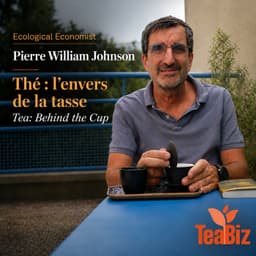
Spotlight | Behind the Cup
Tea Biz

Tea News Recap | Nepal Recovers | India Maps Tea | US Grown Matcha
Tea Biz

Ep 245 | Nepal Tea Recovers | India Maps Tea by Satellite | US-Grown Matcha
Tea Biz