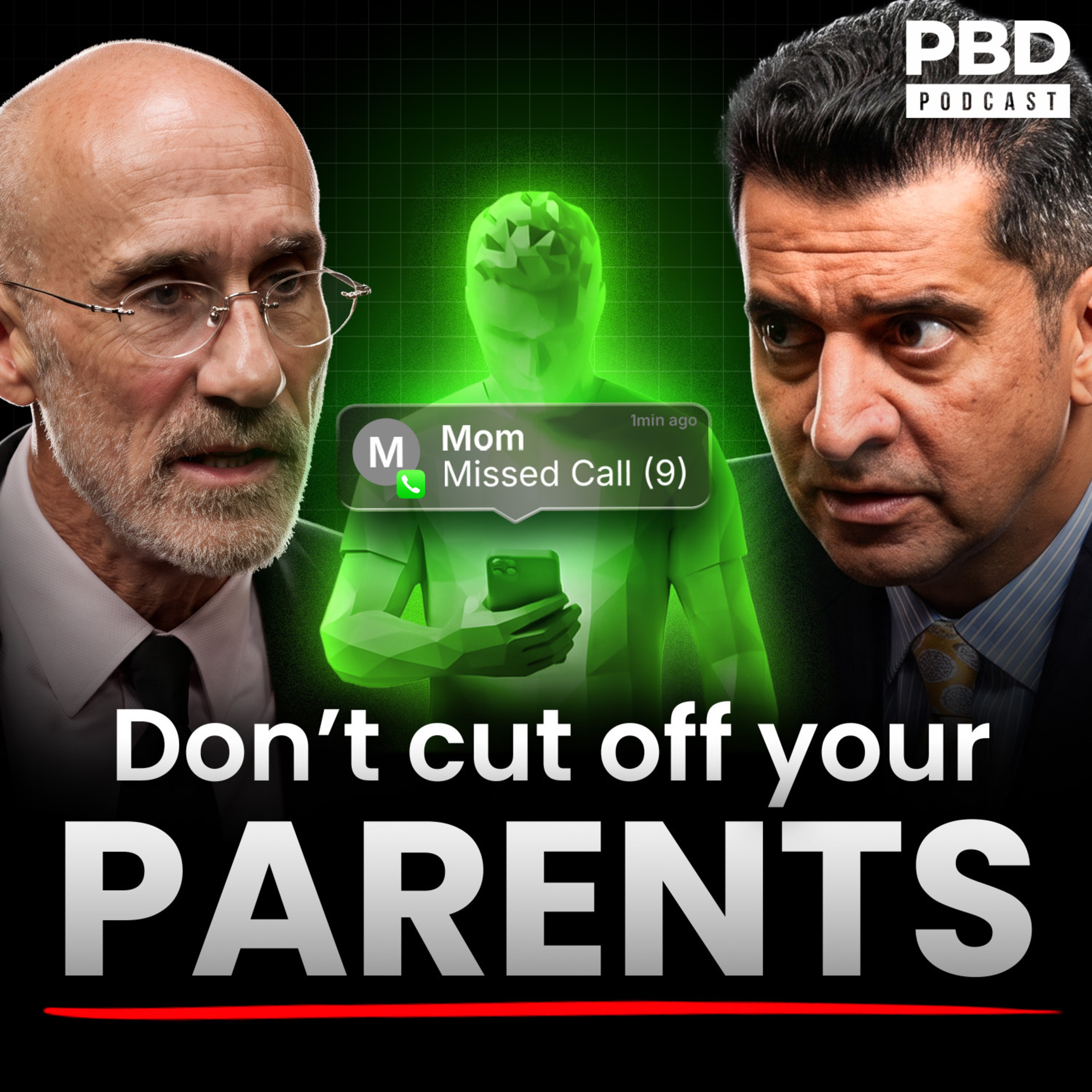
About this episode
Patrick Bet-David sits down with Harvard professor and happiness expert Arthur C. Brooks to unpack why successful people struggle with anxiety, why marriage and family matter, how careers change after 40, the rise of socialism, and why love, faith, meaning, and service ultimately matter most today.
------
👞 Get the NEW Billionaire Suede Loafer: https://bit.ly/4ym5oRA
👞 GET THE FLB1's in Chocolate: https://bit.ly/4mC4uf6
🎟️ BUY YOUR VAULT CONFERENCE 2027 TICKETS: https://bit.ly/4do6rs6
🎥 PURCHASE THE VAULT CONFERENCE 2026 RECORDING: https://bit.ly/4iPHrNX
Ⓜ️ CONNECT ON MINNECT: https://bit.ly/4kSVkso
Ⓜ️ PBD PODCAST CIRCLES: https://bit.ly/4mAWQAP
👔 BET-DAVID CONSULTING: https://bit.ly/4lzQph2
🥃 BOARDROOM CIGAR LOUNGE: https://bit.ly/4pzLEXj
🇰 KALSHI: http://kalshi.com/pbd
SUBSCRIBE TO:
@VALUETAINMENT
@ValuetainmentComedy
ABOUT US:
Patrick Bet-David is the founder and CEO of Valuetainment Media. He is the author of the #1 Wall Street Journal bestseller Your Next Five Moves (Simon & Schuster) and a father of two boys and two girls. He resides in Ft. Lauderdale, Florida.
Get every episode summarized
Each time PBD Podcast publishes, we email you a written briefing from the transcript — the topics, who appeared, and any specific claims, with the ad reads skipped.
Email me new episodesFree for 3 shows. No card needed.
Transcript ready
3,091 searchable segments. Every word is indexed and playable.
Full transcript
PBD Podcast — The Hard Truth About Success, Family & Love | PBD Podcast #853. Machine-transcribed; use the interactive transcript above to jump the player to any line.
Professors are really bad at brainwashing students. Really? Yeah, we're the only parents. Parents who's for a lot of parents are really good at brainwashing their kids. So you don't think professors have as much influence over politics than parents? No, and I got the data on that. I have the data on that. I got a question for you about happiness. Zheng Z. Old philosopher said, happiness is the absence of striving for happiness. You agree with that. Successful people are all anxious. So they all have in common. They're all anxious. Their anxiety junkies, doesn't matter. What is the risk of never getting married, never having kids? Love is entrepreneurship. Ah, right. It's ultimate putting capital at risk. Yeah, risk somebody's money. Boring. Putting your heart at risk. Now we're talking. What are 5, 10 books you recommend somebody to read to get their mind in the right place with their career? He was the one to give me the best advice about how to be a conservative in academia. It need to be twice as productive as the liberals and four times as nice.
And then you'll be fine. What is the greatest how you ever had in your life? You think about that moment. You think about that experience. You're like, I will never forget that. These are these epiphanies. These moments that I don't have to earn love. These are the moments that I realize that I'm on my off. What doesn't matter to you at this phase that mattered at 40? This is why we're the dominant species. We can be retrospective thinking about the past and learning from mistakes. We can be prospective thinking about the future, practicing future scenarios, and working for future success. But we can be mindful right here right now. I have the four protocols that I give couples that have been either newly together or long married that will neurochemically solidify those tendencies. Do you want to know the four protocols? Please. Yeah. So I'm going to ask an indirect way of helping our guys, our production team that works so hard, get erased. Do you want to help them get erased? This is how you can help us out. 49% of you watch our podcast that our editors work so hard,
producers, cutters, all of them, our production team, 32 of them that work here. They work very, very hard to deliver a good quality to you. If you enjoy our show and you want to help this thing get bigger, so we can take our talent that we have in house that support this production all the time and maybe even give them a raise then please subscribe to the channel that allows us to get more viewership. And indirectly, it makes bigger opportunities for our current team that we have. Thank you so much. And to be loved. That's the secret to happiness. That's the secret to happiness. All right. And the best way to do that is to get married and have babies. Well, by the way, just so you guys know, we've been doing a podcast for 10, 15 minutes. We should have recorded the first 15 minutes because that was great. My history with you is I was introduced to a book he wrote many years ago called Roe to Freedom. Reddit gave it to all my guys in my office. I said, you got to read this because you broke down capitalism in a very logical way that wasn't too much and it was common sense. Lot of good stats in there. And then two months ago, I'm going to the UFC fight at the White House, whatever, two or three months ago.
I'm on the flight, Alex Spiron, I have an conversation to get. I don't know if you know Alex is. Yeah. And he says, you know, out of all the books I've read in my life, there's only one book you need to read. I said, Alex, I read a lot. What's this one book? He says at our age, I think he's in his 40s, where he says, you have to read from strength to strength. So I'm on the flight, I order the book, I go through the whole thing, you know, I don't do the audio. You aren't. That's true. Yeah, I do the audio and write, read the whole thing. And I said, let's invite him to the podcast. And then of course, here we are sitting together with you. And I've seen your work for many, many years, you do great stuff. Thank you. Likewise. I mean, it's like you're showing up at everybody's feed for a reason, you know, if you have particular interests. You're interested in ideas, particularly from a business perspective and you admire entrepreneurs, you're showing up, man. Yeah, and you said something, he said when you were in Barcelona doing music, you know, there was a lot of Middle Eastern's, their Persians, I said, you look like you could have a little Persian in you with that perfect, I could never grow beard like that. Even though I'm the Middle Eastern, you're not, I don't have that gift. I, well, you know, I'll take what you've got on the top of the head.
I got on the bottom of the straight. Yeah, that's fair enough. And you're not taking the trade, I know that is fair enough. No, everybody's like, when you go to Turkey, I said, honestly, I've never been to Turkey. No, you went and did that $25,000 surgery. So my hair's been like this. My daughter reminds me that I got a little ball spot here. It's kind of coming a little bit, but we'll see what happens. So Arthur, you know, you go from being a person, French horn, Barcelona music, that was your life. Yeah, and you become a professor, social scientist, study and leadership and happiness at Harvard. There's a lot of direction we're going to sit down here together and you know, you're family wise, you're winning in many aspects of life. What do we get to late in life? It sort of depends on who we are. I mean, people have deficits depending on their background to be sure, but you know, this is like, this is a show for strivers. If you're not serious about life, you don't watch Patrick Schell. So let's just assume everybody watching us as a striver who really wants to get ahead. And let's talk about the biggest mistake that younger versions of you and me would make.
The number one mistake that they make is believing that love is earned. So when you and I were little kids, we were good at stuff. We were hustlers. We were working hard. A lot of people watching us, either they got really good grades or they were really good in sports or they had high initiative and they were starting a paper route and then a business, et cetera. That's what people have in common who are watching us. The problem with that is that you tended to get positive affirmation from adults only when you did something. And your synaptically plastic little brain came to the conclusion that love from the people who you care about the most is earned when you do a special thing. Now I get it. I'm a parent and grandparent. And I know positive affirmation. I know how it works, but it's a dangerous game, especially for strivers, because they'll grow up thinking, okay, I want that feeling of being valued and loved. And so I've got to go do something excellent and they'll chase that feeling through their whole lives. They'll marry people whose love they have to earn. They'll surround themselves with friends, whose love they have to earn.
And those people don't love them. Those are people who are using them. And so the biggest mistake that they make is thinking that love is earned that turns them into workaholics and success addicts and self-objectifiers. And what we have to remember is that love is a free gift freely given. Only hang around with people who love you on your worst day. How do you know the difference? How do you know if somebody truly loves you or not? Yeah, that's the trick because a lot of people walk into relationships that they've earned and then they find out only too late that that's the case. The biggest mistake, of course, is marriage. Is what it comes down to. But the whole point is that you will know when you're in a relationship with a woman or a man. If you're a striver within the first couple of years, I'll find your lowest day on your worst day. She loves you more, not less. That's the thing to keep in mind. That's somebody who sees your human side because you're like your business is going under, right? The creditors are calling. There's a problem. Whatever it happens to be, and you're lonely and depressed. And she loves you even more.
That's the person that you know is a keeper. That's what it comes down to. As opposed to somebody who's like, kick in the knee to the curb on your lowest day. Who wants to only see the win? Yeah. It's funny to say that because right now, a trend that's going on on social media, young men who are on social and they're seeing this, masculinity, all this stuff that you're seeing, the messaging that's coming out that, women just want you for your money, for your status that'll leave you to another rich, better-looking guy one day. And then, so younger guys today, when I talk to them, sometimes I'm worried, is it even worth me getting married? You're seeing the birth rate declining. And guys are like, just live for myself, live for myself is, what is the risk of never getting married? Never having kids. How big of a risk is that that some men are taken today? It's a big risk. Because if you don't do those things, you probably won't be happy. And I've got the data. I've got the data. I mean, the data of the data. And men who never get married and who never have kids are significantly unhappier than men who take those, who take those challenges, who actually make those commitments.
Now, that doesn't mean your marriage is going to be successful. It doesn't mean that it's going to be like a walk in the park every single day. Hurray, it's so wonderful in the country. Look, Patrick, I've been married 35 years. And my wife and I have had 10,000 fights. Part of that's because she's from Barcelona. And they're very, they're very conflicted. You guys met over there, right? No, no, actually I went over there in hot pursuit. I met her in France on a concert tour. She was studying in France and she was from Barcelona. I quit my job in New York. And I moved to Barcelona and took a job in the symphony orchestra because I had his intuition. His girl didn't speak a single word of English. And I didn't speak a single word of Spanish or a cut the line. Was going to be my wife. Or at least I was going to give it a shot. I mean, look, love is entrepreneurship. Ah, ah, ah, ah, ah, ah. Right. It's the ultimate putting capital at risk. It's the capital of your heart at risk. And this is one of the things that I tell young entrepreneurial guys. If you're not putting your heart at risk, you're actually not an entrepreneur. You're lame. If you don't put your heart at risk, love at risk. You're not an entrepreneur. You're not a real entrepreneur. I mean, it's like, yeah, risk somebody's money.
Boring, boring, putting your heart at risk. Now we're talking. Now we're talking. That makes sense. Yeah, yeah, because you know, what entrepreneurs, what do they do? They're willing and able to take risk and manage the risk. Right. That's the skill that I have in pursuit of explosive rewards. Those are the two characteristics of an entrepreneur. I've brought entrepreneurship over the course of my career. I'm a B school professor. So that's the kind of stuff that we do. I've written a textbook on entrepreneurship as a matter of fact. Those are the two characteristics. Willingness and ability to manage high amounts of risk in pursuit of explosive rewards. Now the denomination of rewards depends on you. Once a business, you counted up in green pieces of paper called money and you're trying to get to IPO or whatever. But what is the things that really matter? Then it's love and happiness. And that's a lot more valuable to everybody. And I want to get that. I want to get to the capitalism because at that time when I was reading Road to Freedom, I would say, nobody explains capitalism better than Arthur Seabrook. It was you, Sowell and Milton Friedman.
You explained it in a way. It's a very good company. Well, you are in that company with whether you, I'm sure you know it because of the work you've done. But go back to this marriage thing. So it's scary. You know, both you and I are, I just celebrated 17 years and we got four kids. You got three kids. Thank you. And your kids are doing well. We'll talk about that here in a minute. But going into it. So let's talk about somebody that's single. Not those that are married. We'll talk about how to stay married. But your single, you're looking for spouse. What do I find them? How do I know if I'm ready to get married? How do I filter it out? What are some things I need to do getting into it? Yeah. So number one, getting married earlier is better than waiting longer. This is an important. Now I'm not talking about 16, right? Old school. I'm not talking about getting married when you're in a teenager. I'm talking about getting married in your early to mid, mid 20s is optimal. Not everybody can work that out. I mean, it's just fine if you get married in your 30s that can have really happy relationships too. But the whole point is you want to joint start up with a woman. You don't want a merger if you can avoid it.
Mergers are less successful in startups. I don't know. Like I'm bringing coal to Newcastle by telling you that mergers usually don't work very well. And the same thing is true with mergers inside relationships. Mergers meaning you come with two kids. I come with two kids. And not even that. I mean, it's like you got your career. I got my career. I got my bank account. You've got your bank account. Let's merge. Got it. And that's because we're super independent. And that's basically a hedge against a lack of success. And it's like, I'm going to do everything first. I'm going to finish my PhD and then I'll talk about getting married. That's a merger marriage. OK, it can work. But a startup together. Like my wife and I, we grew up together. I was 24 when I fell in love with her. I've been locked down. As we say in social science, I've been restricted since I was 24 years old. I don't remember what you will be before you were before. No, I mean, I was a musician. So you were around beautiful girls if you were a musician. Yeah, it was classical music. So it's like, OK, slightly different. It's slightly different. But the whole point is I was a pretty serious guy, though. And I had my parents at a very successful marriage.
My dad loved my mom. And that's the most important thing, by the way, that the biggest gift that men can give their sons is that you basically you have one job with your son. If you want to raise a good man, love his mom. That's the one big job. He still loves his mom. And so my dad loved my mom. And that was really, really a big deal for me. Because I knew that that was the source and sort of the source and sum of what it meant to love and be loved. And so I was after that. I mean, it's like I wasn't like when I was 19 years old saying, where's my wife? Where's my wife? I did have, I dated and met different people. And I knew that this wasn't it. And that wasn't it. But we had a strong premonition that this woman was going to be my better half. That this woman was going to complete me based on what? Based, I don't know. I mean, it was a cosmic connection in its own way. And it could have gone well. I wasn't feeling, I think, that people really know because the right hemisphere of our brain, which is where we actually, we have our intuition, where we answer, ask the why questions. That has mystery and meaning is where
we process it in the left hemisphere of our brain. You know when you're with somebody and you have kind of this union where you kind of click, it's because your right hemispheres are actually in sync. And there are people who talk about brain-to-brain coupling using FMRI machines. And that's actually the case. So you can use a dating app to use the left hemisphere, which is analysis and information and all that. And say, oh, yeah, she seems like a good match for me. But when you're with her, and you're like, I don't know what it is, but it seems like this is a person who completes me. That's the phenomenon of two hearts beating as one, which is really two right hemispheres working in sync. And you know. Now, it's still my no-workout. You still got to make sure that you have a period of appropriate courting. But then there are characteristics too. I mean, people are so funny. They say, I want somebody who I respect for sure. But the key thing is when you're for guys, and what percentage of your audiences are men? 85%. 85%. OK. 70% of my audience are women, interestingly,
because of the happiness stuff. But for men, for example, successful relationships have a difference between what men and women are actually give to each other. Respect mutually for sure. That's really, really important. Commitment, absolutely. Lack of commitment is an absolute killer. You should only be going with somebody who can make a commitment to you. Like, no fooling, not talking to others, not posting thirst traps on the internet, none of the nonsense, all of it gone, right? But the whole point is that sheep, it mires you, that men can stay with and fall in love with me, and I'm really happy with women who admire them, and women can stay with and be happy with men who adore them. It's called the adoration admiration dichotomy. And that comes from evolutionary biology. Back in the Pleistocene days, in the middle Pleistocene 250,000 years ago, when our brains were, more or less what they are still today, I mean, we haven't changed that much since that period. We lived in kin-based groups that were related, hunter-gatherers. And women, females, made this huge commitment
of pregnancy and taking care of babies, and you needed somebody who was deeply, deeply and made who was deeply committed to you. And you knew that because of adoration. He's like, I would fight a tiger for you with my bare hands, and you knew it was true. That's adoration. And he needs admiration from you, so that he will continue, always, always have this incentive to drag in that gazelle, daff. And she's going to be like, that is the biggest gazelle anybody's ever brought in. And you know it's true in our marriages, right? Yours and mine. I bet you that your wife really admires you. And she's super impressed by this cool stuff that you're doing, right? I mean, she's mad at you a lot because you're working too much, and you're not paying enough attention. And she's like, I'm over here, right? I mean, of course, because you're a striver. But at the end of the day, she's like, that's my husband. That's my husband, and that's all you want. I'll do a talk for 20,000 people in an arena. I do 150 talks a year. If my wife is out there, that's all I care about. I'm after her and I'm like, how'd it go?
Do you feel yourself doing better if she's in the audience? I find myself more nervous when she's in the audience. I'm never nervous when I speak. Never. When she's there, you get more nervous. I'm completely nervous. You want to perform? I want her to admire me. I want her to truly say that was great. Wow. Truly say that was great. And if she walks into a room, she wants, and it's a crowded room, she wants me to be gone, mm, after 35 years, that's adoration. That's the sign of adoration. How do you maintain that? You may, well, because that's work. Yeah, well, you do it on purpose. Now, there's a lot of other stuff that you can do too. I mean, I have the four protocols that I give couples that have been either newly together or long married that will actually solidify those tendencies that will nerochemically solidify those tendencies. Do you want to know the four protocols? Please. Number one is have more fun. When you're having trouble, all you ever do is rehearse your problems. One of the most important things that you can do is flooding the zone with fun. You like riding your bikes, go ride your bikes.
You like binging a TV show, binge the TV show. Go to the beach. Do the stuff that you actually like together because mutually fun experiences are extremely bonding. I mean, having fun together is extremely bonding. The second thing is reading to each other, which is actually will nerochemically bond you to each other. Reading to each other. Reading to each other. Yeah, like you read your kids, read to each other. And it's especially important. I strongly recommend reading to each other in bed. Don't ever, ever, ever look at your phones when you're in bed. Your phone shouldn't even be with you for the last hour before you go to sleep. So that you're for the architecture of your sleep, for the functioning of your pineal gland, natural melatonin, all that blue screen stuff. We all know that. But the whole point is it'll wreck your relationship to be staring at your phone before you go to bed. It's a sacred time in your marriage, in your relationship. And so I strongly recommend reading to each other in bed before you go to sleep from like a real physical book. Like, so give me an example. Like, last time you did it, what do you, well, every night, you know, literally, I came in last night because we're doing,
we're taping the show in the morning. And so on, on FaceTime, we read to each other at night before we go to sleep. Because I'm on the road 48 weeks. So what do you, whatever book you're reading, you just read the songs. We're in the songs. We're the songs. Yeah, and that's a lot of love. Or how long have you been doing that? Years, as we've been doing that. Yeah. And particularly in the last two, actually we've been doing it more and doing it more consciously. And part of the reason is because I eat my own cooking, I do the research and then I follow my own research. Because if I don't, I mean, shame on me. So reading to each other will just, that will give you a brain to bring, coupling like crazy. And if it's love poetry, all the stronger, the third rule is called the ABT rule. Always be touching. Always be touching. Always be touching. Now that's actually more important for men than it is for women. The guy is watching us are like, yeah, she always wants to be holding her hand. And it actually is you, dude. Non-sexual touch is critically important for the production of the Neuropeptide Vascular Presson. That gives you the feeling of being big and strong.
And so when a couple's walking down the street and she hooks her arm inside his, you know, it makes you feel like you're seven feet tall. That's right. That's because that you get this Vascular Presson boost when you're a wife, when you're a girlfriend, when you're a woman. I'm a protector, I'm a man. Yeah, yeah. So always be touching. So when you're sitting on the couch, when you're lying in the bed, when you're reading to another. Are you saying this to him or to her, both? Both. Always be touching, but I'm especially saying that to her to always be touching him. Interesting. Always be touching him. And the last is eye contact. And that's because of a, even more powerful Neuropeptide called oxytocin. Oxytocin, which functions as a hormone in the brain, is also known as the love molecule. It's a bonding Neuropeptide where we know our kin. And this is especially profound when we have eye contact with a loved one. And so the last thing is you go to sleep after you finish reading and you close the book and you're lying on your pillows looking at each other because your phones are long gone. You stare at each other and talk. Stare at each other, eye contact and talk. That's the big, big, big, big connection.
And that's what will get you back to the adoration, admiration, mutual system that you need to have a long and happy relationship. Very interesting. So in regard to traditions in the family rituals, what traditions and rituals does the Brooks family have? Yeah, so they're actually, they've gotten stronger over the years as it's happened. But we've had a pretty traditional family from the very beginning. So we've been, as I mentioned, married for a long time and we have children and we always had to the extent that we could family dinner together. Eating together is important because this is, when the homo sapiens were in the playsticing, we sit around the campfire, looking into each other's eyes, as we put pieces of the yak meat into our mouths. That's when you get the mutual oxytocin as a family and no phones at the table. That's always been a real rule. So family dinner always and no phones at the table. That's a family thing. We've always prayed together a lot. We pray the rosary together. We're Catholics. We pray the rosary together as a family. We've gone to Mass together every week, every week, every week, every week, which is truly important for us.
To actually practice our religion together. When your kids are little, there's always prayer. It's funny thing that people ask me all the time. What do I do so my kids follow my faith? What do I do? Because so many kids fall away from the faith, right? And the answer number one is have them see you practicing the faith. It doesn't matter what you tell them. You could talk to them. You could talk to your kids in Farsi. And do they speak Farsi? No, English. Let's just mother is American. But you could talk to them in Farsi and they wouldn't understand what you're talking about. But they would observe you and do that. And that's so the number one predictor of kids growing up, especially sons and practicing the faith, is their father practicing the faith. So when I was a kid, I'd psych, my dad was huge and strong. I mean, he was neither huge nor strong. And I thought my dad could lift the corner of the house. He was so strong, he was such a big guy. He was a math professor. He could. And he was proud and never would have like us. He never would have bent the knee to any other man.
But every night he was on his knees next to my bed. And that had a huge influence on the little dude. Because it said that's what it means to be a big strong man is to bow in reverence before the Lord, if you're religious. Not everybody watching us as religious, or at least not religious yet, because people change over the course of lives. And so that was really important to me. And I did that with my kids too. Practice of faith, practice of the ritual of being together, eating together, spending time together, making sure that we each actually could talk to each other. One more thing, which is important in family life, never freak out. Never freak out. Your kids are going to be a crisis. Your kids are going to be, I mean, teenagers are a nightmare, complete nightmare, right? The best ones are a little nightmare, the worst ones are a major nightmare. My brother taught me this, because he had kids younger than me and he's older than me. And I said, give me some advice. He said, never freak out. Because it'll never help. And so never freak out. No matter what, you say there's a solution. What's the craziest thing that happened and you didn't freak out?
Well, so I'm an academic, right? And my middle son, Carlos, college wasn't for him. And it's like, I don't know what I'm going to do. I didn't freak out. No, no, we found him a job on a wheat farm in Idaho. And he, and he, you know, it was a very, very hard job. We didn't freak out. We did something that was good for him. He wanted that job? Yeah, for sure. He wanted to work outside by his hand. How did he find that job in Idaho? He was on Virginia. Yeah, well, I was at the time we were living in Maryland. Actually, and then we moved to Massachusetts. Then we moved to, we moved a lot. We moved 20 times together as a family. And I had a friend who had grown up on a farm in Idaho and his dad needed a man and needed a green horn. And so my son went out to Idaho at 18 and lived in the farmer's basement. How did he know he wanted to do that? So like an intern thing? Yeah, no, no, no, it's an intern thing. No, it was making 11 bucks an hour. He put a, he saved a lot of money because there's nothing to spend money on in Grange, in Idaho.
And he did that for 13, 14 months through two harvests. And it was hard work. And it was 11, 12 hours a day, pulling rocks out of the soil. Then he was ready for the next thing he joined the Marine Corps. And these are very different patterns. These are breaking the patterns in my own particular family. But I never, I didn't get alarmed by it. Everything is an opportunity. I mean, we're entrepreneurs in life is what it comes down to. When he was building his own best life, what I knew was if I freaked out and tried to force him into some ridiculous, useless college experience, that he was probably going to smoke a lot of weed. And he was probably going to party all the time. And he was probably not going to learn anything. And so my freaking out would have made everything worse on the contrary. We treated as an opportunity. And my son is 26, says, two sons happily married. Actually, he's in college now. He's in the dean's list. At 26. 26. So when did he go back to college?
We went back to college last year, started at 25. What did you want to do now? Well, he's studying business. He worked for Clark Construction, which is a very, very fine construction company in the capital region after he got out of the Marine Corps. And he wants to go back. He wants to go back as a senior manager. By the way, I didn't go to college until I was 28. So it's not like I had any ground to stand on. So I had no credibility in trying to force all my kids in the college of 18. No college till 28. Well, I went to one year and then dropped out, kicked out, splitting hairs. I wasn't ready. And then later on when you found out what you wanted to do, then you went to college. I went to college and then graduated a month from my 30th birthday. Now you said you met your wife at 23? I met my wife right after training 24. In France on a concert tour. When did you guys get married? We got married when I was 27. I took me, I moved to Barcelona at 25. And it took me two years to close the deal. Because she wasn't ready to marry me. She wasn't ready? No, no. She's a real European.
I don't believe in marriage. Marriage is restrictive. Just to piece of paper. We can be happy any way. I'm like, well, I'll see. I was determined. Is she also a traditional Catholic at the time? No, she grew up in a hard-read family. They didn't have any faith. The last time she had been in a church was her first community at age eight. No, no, that was a big project. That was a big project. Did her family, was her family involved in the decision? Was she kind of like Austinger family? No, no. Were they upset with a supportive? They were mystified when she wound up with this pretty traditional American guy. I mean, I was a musician and I had hair and long hair at that. So that gave me a little bit of credibility with the hippies. You have a picture of a type in young Arthur C. Brooks. Yeah, that's unfortunate. We're gonna see this. We're gonna shock and set up. I want to see what you look like. Let's take a look. What comes up? Young. That's a, there we go. There we go. First one, second one. That's the first man. Yeah, and so it was,
this is like a once great civilization, Patrick. I mean, that's a long hair right there. But we worked on it. And it was something that we did together to really find her faith path. Tammy G. looking guy right there. Yeah. So what age, you guys got married two years later? So 25, 26. I was 27 when we got married. 20, 70 got married. When did she, when did you have your first kid? So we moved to the States the year after that. We moved, we immigrated the United States in 1992. And our first son was born in 1998. Took us a while, have our first son. Okay. But then we had another two years later and we adopted our third child. Got it. After that. So three total now. Three total. So four grandsons so far. Accounting. That's amazing. They're multiplying quickly. That's amazing. Yeah, I know it's great. Yeah, it's great. So go back to, you know, the idea of, I was, you know, about a year and a half ago, I was having dinner with Tom and his daughter got accepted to rice. It's great. And he's all excited, you know, that's the school
they wanted to go to. She wants to be a GM and baseball. She's a big baseball statistics. Yeah. All this stuff. We go to dinner and this best, this is one of my best friends. If not my best friend in life. And I look at him and she's only been gone for a week. Yeah. And I said, how you doing? And I tell you half a second, he just breaks and starts crying. Yeah. Breaks. So it's his first child. It's the first one leaving. Yeah. The next one's going to, you know, she's very good in school as well. She's getting, they're both academia family. So how do you handle as a parent when the kids get to a point of a leaving? Yeah. So they got to go spread their wings and pursue their dreams. How do you manage those moments? Yeah. So it was hard for me. I told you about my son, Carlos. His brother, who was two years older in Maine, Joaquin, left and went to Princeton, went to really nice college. And I was very proud of that. But it was so hard when he left. Because it felt just feels like something's changing.
And, you know, the glue inside the family is kind of coming apart in the whole thing. But just celebrate the fact that they are becoming the people they're supposed to be. And they're not your kids, they're God's kids. It's like I learned that from my wife, by the way, because she gradually came into a very, very strong sense of who she was. And now she leads me. And I remember one time we were really struggling with Carlos, with our middle son. Because he was unmotivated and things were going well. And he was a very rebellious teenager. And she was praying when I was listening to her praying, when she says, Lord, you have a big problem with Carlos. How can I help? And again, you don't have to be religious to take the idea that they have their own destiny. They have their own journey. And you're a helper along in that journey. And to celebrate that along its way and to look at the good. And it is tricky at the very beginning, for sure. It was maybe even trickier when my last child left. Because that was right after COVID.
And she made a run for the border. She went to college in Spain for her first two years. And that was really, really hard too. But we're mostly all back together in the same area again. They're super traditional. It's funny, because I come from a family that's pretty progressive from Seattle, a group of Seattle, and where everybody's aggressive. You grew up in Seattle. Yeah, yeah. How progressive? Yeah, my dad was a college professor. My mother was an artist in Seattle. What do you think their politics were? And I kind of thought for myself. I remember when I was in my 20s. I was back from the orchestra in Barcelona when I was spending a week or something with my family in Barcelona in Seattle. And I was in the kitchen cooking dinner with my mom. And she's being like really weirdly quiet. I was like, mom, something on your mind. And she said, yes, actually there is. Your father and I are very worried about you. I want to ask you a question. And I want it on his answer. And I want you to know that we'll love you either way.
Have you been voting for Republicans? How would you let this time? I was 28, I guess. OK. Are they seeing patterns where something could be had? I was reading about capitalism. And I was reading. I was studying economics. I had just gone back to college. And I was taking economics courses. Who got a hold of you? What was a tipping point for you to see? I'm going to fight for this more condensed. I was studying by correspondence. I never set foot in the classroom. So there was no brainwashing. And I was simply reading texts. I was reading social science by people that I admired. And people I admired the most were Thomas Sol, Milton Friedman, Hayek, James Q. Wilson, the great political scientist, the conservative political scientist from Harvard. These are the people who really influenced me a lot. James Q. Wilson went on to become my mentor for years and years and years afterward. He sat on my dissertation defense when I got my PhD. He wrote the forward to my first commercial book. He was a huge influence on my life, for sure. And he was the one to give me the best advice
about how to be a conservative in academia. Because I remember I got protested early on, you know, early on, because I was writing for the Wall Street Journal, and you know, capitalism, three years, you know, I got protested at some university. I called him up and I said, Jim, I'm afraid I'm not going to get tenure. What do I do? And he said, oh, don't worry about it. I said, well, what do you mean don't worry about it? He said it's a simple formula. You need to be twice as productive as the liberals and four times as nice. And then you'll be fine. Wow. Twice as productive four times as nice. Yeah. And then hold yourself to a higher standard and you'll be fine. And you know what? He's completely right. He was completely right. Who can give me the biggest confrontation with somebody approaching and said, how could you have these positions? Oh, constantly. It's happened. And again, nobody's ever been. People are very rarely mean to me. During the real height of the woke movement in 2019 and 2020, everybody, there's a huge amount of bitterness and unpleasantness in inside academia. And it wasn't personal. It was just the moment of activism was so sharp edge
that everybody was feeling a whole lot of terrible, terrible, it was disastrous inside academia during those times. There's an article, a cover article in the Atlantic this month from a guy who was teaching at Bates College. We talked about it was so bad that he wanted to just leave academia entirely. And he's a big liberal. He just couldn't handle it anymore. The illiberal environment that was going on there. But the truth is, you know, for, you know, I've had my colleagues have said again and again and again, you know, rolled their eyes. And I've had senior, when I was a junior professor at Syracuse, I had a senior professor who kind of denounced me in print for my retro grade views. And, and the whole point was, twice as productive, or times as nice. Go back to your office and write your articles. Totally. And that's a counsel for life, man. Because if you're going to be successful, number one, you have to think for yourself. I don't have to tell you, I mean, this is the great thing about this is what I told you before. Every time you find something really cool and successful in entrepreneurship in America, there's always a Persian in there sometimes.
All right. You guys are badasses. You guys think for yourselves, right? And, and that's super, super important. But to do that, you've got to have an insurance policy. You can't be mediocre and you can't be a jerk. You have to be good to people. You have to be honest, impeccable with your words, what it comes down to. And then for the most part, you'll be OK. As a professor, how do you do it in here? As a professor, how do you keep the relationships? Yeah. And then, I said, it makes sense. Worked twice as hard before time. Yeah. The other thing to keep in mind is that, I've seen a lot of those debates in academia over the years, because I've spent 30 years in academia, in and out of academia. Of the people who are watching that debate, the ones who felt comfortable cheering were the ones on one side and the ones on the, and there were people on the other side, they were just silent. They were just silent. It's what that comes. And that's bad too. Don't get me wrong. But I spent the last seven years full-time at Harvard. I just moved to Vanderbilt, actually. So I'm a new full-time professor at Vanderbilt University in Nashville, which is really, really exciting. Are you traveling?
Yeah, I commute. And I'm doing a lot of stuff. Vanderbilt right now is like, that's the hot school. Oh my god. Everybody in my community is like, forget about Harvard. You want to go to Vanderbilt? Really? Yeah. I mean, Harvard's awesome. Vanderbilt is just a very new and exciting place. What happened? Why? Well, they have a chancellor, a guy named Daniel Deermeyer. And he's like, he's stellar. And he's like, you know what? We believe in the free expression of ideas, because the competition of ideas is fundamental to a free society. And we actually mean it, which is good. And so the result of it is that a lot of people want to send their kids there. It was the most selective school in America last year. They accepted two- That is 9%. Wow. Yeah, yeah. I mean, they selected 2.9% of undergraduates for admission last year. So it's the hot place right now. But I had a great time at Harvard as well. And the whole point was during that time that it was harder for people with a conservative viewpoint to feel comfortable pressing themselves. And so that was my job. My job was to be open about my views. And I'm not a fire brand. I'm not nuts. I'm not you. You know, I believe that I believe in the American dream.
I believe in opportunity for all. I believe in lifting people out of poverty through opportunity in a hard work and personal responsibility. These are good, old-fashioned American values. I also believe in the American military. I think the United States is a force for good throughout the world. I want families to be able to thrive. It's, you know, I'm old school. It's what it comes down to. Well, I mean, listen, if two of your kids joined the Marines, that tells you what those kids' parents believe in, honor, courage, respect, and you can't judge it in any other way than that when the parents support of that. But, you know, stay on this with me. Because I know you wrote a book with Oprah Winfrey. And it became number one New York Times best Saturday. You guys done a lot of different things together. She's obviously a capitalist. You wouldn't be worth a few billion dollars if you're not a capitalist. But sometimes, you know, she endorsed, you know, hey, being Trump, our friends, and she said many years ago, why don't we run together? You know, that 20 years ago, when they joked about it. And, you know, she endorses Obama or Kamala or all of that. No problem. But she knows where you are. Yeah. And you know where she's at.
How do you make that work? How does that relationship happen? Is that the same thing worked twice as hard? Four times as nice? Well, I try to be. She also works four times as hard. And she's eight times as nice. Oprah Winfrey is one of the most unusual people I've ever met in my life. She's the real deal. And, you know, there are people all over the media that like to trash anybody. Because that's sort of a cottage industry in media. She's highly intelligent, unbelievably entrepreneurial, extremely hardworking, high integrity. And she's a great person. She's the same person. See, it's funny, because you and I have both met a ton of really famous people. All of them on your show. Mostly they're different and public and in private. Because they have to be. I mean, they have to have a public persona, but they have to have a private life. She's the same person. You know, who the person that she appears to be magnanimous, kind, caring about other people. She's exactly the same person where we're having dinner alone just the two of us at her house in Monocedo, California. She's the same person. I've never seen anything like it. And so the result of it is that she's been able to attain
happiness in spite of fame, which very, very rarely happens. She's a fundamentally happy person. And plus hardworking and innovative and intelligent. And the result is that, you know, she and I, we never get to politics when we talk. Because we have so much matter. Well, I mean, it's like we've mentioned things about politics, but we're thinking about other things that are more important. You know, we're thinking about things that actually are more human importance. She ever asks you to say, so Arthur, well, you know, why do you vote the way you vote? Yeah, I mean, we'll talk about things like that. And I'll say it's capitalism is prosperity. It's opportunity. Fundamentally, it's the opportunity society that brought, you know, the bet David's to America. I mean, we lose that. We're just upside down, man. I mean, we're just like another country on the UN roles from Albania to Zimbabwe. And you know, it's like if we can't be a magnet for you, we got nothing. And that means we need to be a capitalist society based on opportunity for all. I love that. And, you know, again, she's won the best stories on capitalism we have in America. And you know, someone to aspire to look at and say,
she can go out there from being who she was to, what she's at today. What walked me through your thought, you're in school, you're around students, you're around kids coming up and you're constantly, they're calling you out debating, hey, you know, Professor Brooks, what about this? And what about that? And what about this? Why do you think socialism is so hot today? You see what's going on with AOC? She is number two on the ballot on a lot of these calcium markets that you look at behind. Nusums dropped off. Socialisms come up. You see Hasan Piker as a voice for a lot of younger kids that are agitated, angry. Why do you think socialisms become and so popular again with these? Yeah. Well, there's two things that are actually going on. Number one is that, you know, there are real trends in the American economy that are problematic that we see. And it actually has nothing to do with capitalism, has to do with capitalism not working. You know, competition requires rules and collaboration and fair play. That's what capitalism actually requires. And what we've got is a lot of cronism. We have wired markets that are not very free. I mean, if you like was ruinously expensive health care
system that we have in this country, where it's like two tears. You and I have great health care. But if you don't have a lot of money, you don't have good health care. You don't even know who your doctor is. You can't even see your doctor for months at a time. Your medicine is unbelievably expensive because these are wired deals in the way that the whole set of markets is regulated. If you're a big company, you have better access to lawmakers than if you're a small company. I mean, the system is kind of wired is the whole point. We've had unbelievably stupid policies that have led to the inflation that we see today. Who does inflation hurt? People who got to buy gas and groceries and were very moderate in common. So they're justifiably angry. You speak right through stupid policies. Stupid policies of, you know, the policies that we had particularly during the Biden administration, but not limited to the Biden administration, where we spend too ruinously on stuff that Americans don't need. So that we have large budget deficits. We borrow tons of money. We pour lots and lots of money through the public sector into the economy. Heated up too much. And the result is that we've had persistent inflation.
And persistent inflation doesn't bother guys like you and me too much because we're high income people. But it really bothers a lot of good, honest, hardworking Americans who are trying to pay the bills and they have to put money in there, have to put gasoline in a pickup trucks to haul their stuff around. And they go to the grocery store and food is 4% or 5% more expensive every single year. And they're justifiably angry about that. And so they say the system, we can talk, talk, talk, talk, talk about capitalism. I don't see it and I don't feel it. And that's legit. The second thing is that we're a long ways away from what you and I saw with socialism, which was gulags and death marches and what was actually going on during the Cold War. You know, that's not what young people have seen today. When they think of a socialist, I think of one of their college professors. He's a guy in a turtle neck and a blazer and got a nice little beard and a guy looks like me. That's a socialist for most of them. And they have kind of good ideas and they say, we'll make groceries less expensive
and healthcare for all. And we can actually afford that and they show them some numbers that appear to make it affordable. And the result is that every generation has to relearn that. And the way that every generation relearns is they try it at fails and they say, oh, that's no good and they start again. So you think that's all it is. You think it's just a pattern. You think the momentum right now is very high because affordability is a real problem that the Republican Party is not really, I don't know if they're taking it that seriously. I think I'm like, oh, it's just fake news. I think affordability is a real thing. It's a real problem. Okay. Which one do you think it is more? I think, well, I think that socialism is a heat. I think it's a fat. I think it is a fat. I think democratic socialism is a fat. This whole thing with the most radical candidates and that's something that we toy with and we generally speaking don't adopt except in certain locations. That's not going to take over the democratic party. The democratic party is not completely insane. Now that's a reaction to a lot of what's actually happened in right wing populism. You know, right wing populism has been, has created a counter reaction.
This is funny. My wife always says that American society is propelled by panics and fads. And this is probably a sympathetic to this idea. It's like panics and fads, all hula hoops and weird diets and whatever new thing that distracts us from general cultural decline. How do you address the affordability to think? Have you thought about, you know, these are three things that we do to address it. If I was an economic advisor to the president or the next president, these are the things that would work on. Yeah. There are a lot of policies that would actually be really helpful. Number one is we need more deregulation. We actually do need more deregulation. And you know, we're deregulation. We're in Florida. There's a reason you have your business in Florida. It wasn't just because, you know, it's kind of, but there's pretty good. It's intentional. It's intentional. It's a good business environment. This is a place that people are moving because they want you to succeed. They celebrate your success. They're not putting up barriers in front of you. And we need more business environments like what's actually going on in Florida. We need more deregulation. Now that's a classic, absolutely, you know,
conservative prescription to what we actually see. And I think that that's critically important that we get back to that. We create more opportunities for people like this. The second thing is we need to be a lot more serious about what we're about the two tier education system that we have in this country. The truth is that if you're poor, you're more likely to get a crummy education than if you're not poor. And that's just not right. Now the solution to that is not just throw, you know, hundreds of more billions of dollars into the traditional education system because that'll just get all gobbled up. And we know that that's not the case. We need more education choice. We need more charter schools. We need more opportunities for highly motivated parents of moderate means to get their kids educated in better ways, which is really important. Expansion of trade and vocational education is another way for us to actually do this to sort of feed the system of people who are better educated, better trained to actually participate in an economy. Because I'm telling you, if you come out of high school and do a year of vocational training in your HVAC, you're gonna make money.
If you know how to actually hook up electricity in some house, you're gonna make money. It's what it comes down to. We need more respect for the vocations, for the trades. And we need more training for that. We need to get more serious about what these things are actually doing. And then the third thing that we need to be thinking about is a, you know, presidents in Congress that care about cronism. You know, it's just not right that if you're powerful and you have good lawyers that you're more wired into a system in the government. You've got more privileges. You're able to block other people out more. We need more of an actual free system that will allow small companies in particular to thrive. And if we did those three things at very least to start, we could reignite the engine of opportunity in this country. Dale Carnegie, he was the master of, you know, what we think of as self-improvement. But it's a handbook on how to live a good life is what it comes down to. He wrote another book called How to Stop Warry and Start Living, How to Master the Auto Publix. I love how to start worrying and stop worrying
and start writing books. I love that book too. I actually read that book. I have it on my iPad and I go back to it. You remember his formula? Do you remember his formula? What it's like? I can't remember the formula. He would say, okay, so you're worried about your mirror. Go to the worst thing that could happen. Get a divorce, humiliated kids. Okay, is it okay? Can you handle the worst case? Not come back up. That's probably not gonna happen. Successful people are all anxious. Oh, I won't talk. So they all have in common. They're all anxious. They're anxiety junkies, this is a matter of fact. And so I'll talk to people who are worrying and I will say, you know, how do you deal with it? And there's something very, very much like that where you do, I used to work at the Rand Corporation, you know, the Think Tank and Santa Monica. I thought it was the Iron Rand, but it's not. No, no, no, no. I don't know. It was a research and development. Right, I looked in the defense department during the Cold War. Right. And it was like a half a billion a year. I looked at the numbers. I'm like, this is a real, I was doing military operations research and I was doing mathematical modeling for the Air Force when I was doing that. I was like, why is it called Rand? It stood for research and development originally. It was just kind of an acronym, but what's the end for us?
It's really kind of research and no development. Yeah, it's just research is what it came up to. Yeah, that's great. I recommend a couple of Eastern classics, as a matter of fact. I recommend a book, anything by the Dalai Lama, you know, I've had the privilege of working with Dalai Lama for the past 13 years. And so I know his work quite intimately at this point, especially for Westerners. But there's a book by a Vietnamese monk named Tick Not Han called Miracle of Mindfulness. That's a strong book that I think that's right. I think it's used the chapter by saying, washing the dishes. Yes. So washing the dishes. Yes. Yeah. Yes. When you're washing the dishes, you should only be washing the dishes because if you're not washing the dishes, you're not fully present. You're not fully alive. You're missing your life. Can you go on the other books that he wrote? Can you go on his right there? If you don't mind. Yeah, look at it. Yeah, look at it. There is another, keep going to the next, so keep going. Yeah, he wrote one book that he says, the key to happiness is the avoidance of stress.
Yeah, that's right. I don't believe it. And I don't get it. OK, thank God. Yeah, I don't believe that when I read that. No, no, no, no. I mean, hope, that's a very, in a way, a very Buddhist thing. So I recommend that all Westerners have some sophistication in Buddhist philosophy. I think it's actually really and really important, including serious Christians like you and me. And part of the reason is because it's a different, it's looking through the prism in a different way of life. So Buddhism is based on four noble truths, the first of which is that life is suffering. Actually, what that, the word in Sanskrit is dukkha. And dukkha really means dissatisfaction. Life is unsatisfying. That's really what that first noble truth of Buddhism is. And it's right. I mean, you and I are like struggling and striving because we're not satisfied yet. That's right. The second noble truth of Buddhism is that the reason for that dissatisfaction is craving, is attachment. The third noble truth is that the secret is detachment. And the fourth noble truth is the eightfold path of Buddhism.
You've got to do all this stuff to be a Buddhist when it comes down to. But understanding attachment is critically important for all of us. So that's one of the reasons that I recommend the miracle of mindfulness by this Buddhist monk to get a little bit more of that. Not to become a Buddhist, the Dalai Lama said, he didn't want me to be a Buddhist. He wanted me to be a better Catholic, right? Because that was my path. And I believe it's true that it is my path to be sure. So I strongly recommend that people do that as well. That people think about that as well. Do you think somebody who doesn't have access to good education, doesn't have access to spend the money to go to college, can have the ability to still be an auto-died act and approach education from a non-traditional university way and still succeed? Yeah, for sure. You did. Lots of people do. Absolutely. That's absolutely the case. What's the right approach to it? Is there a philosophy? Is there a way of doing it that it works for you? So it depends on what the ambition actually is. It's very, very difficult if you want to be a college professor to do it outside the university because you need the union card.
I mean, I wouldn't be a college professor today if I hadn't gotten my PhD. Is there a way? Is there a topic? Is there a method to the madness like go study these topics? Go study these authors. Go take this approach. Hand made in Portugal. The craftsmanship is a way of life. For those who move through life differently, from some that dex to nights that never need an occasion, every detail is considered, every step effortless. Crafted from fine swayed and built with builder technology designed to move with you. Because true luxury isn't about being noticed. It's about how you feel when you arrive. The FLB icon loafer made for the life you've earned. The answer to that is apprenticeship. Is working is learning while you work, which
is critically important. So I recommend is that people actually start. These days, there's so much education online is being acutely aware of what you're deeply interested in and studying it in some way, shape or form, formally or informally. And then setting aside time every day and getting serious about that is say, what am I truly interested in? Am I truly interested in how machines work? Am I interested in philosophy? Am I interested in mathematics? Am I interested in, for me, it's a neuroscience of behavioral science, which are my areas that I teach in. For example, I'm intensely interested in it and to learn, learn, learn, learn. Then the second thing is to work in a particular area. Always be working to create value. Because when you're doing that, you're with masters of the field. You're watching people who are great at it, do it. That's really the secret to get good at something is to work with people who are good at it. So shadowing somebody. Shadowing somebody. And getting into the show. And creating enough value to be paid for it. Like that. Work hard and study what church is today. OK. So let's talk about anxiety and panic.
Do you notice a pattern of individuals that tend to experience more anxiety and panic attacks than those who don't? Yes. So a panic attack is a flooding of the HPA axis, the hypophilomic pituitary axis in the brain. And that's been, it's kind of a new phenomenon. My great-grandfather, Lee Roy Brooks, he never came home and said, my great-grandmother, Mary Ellen Honey, I had a panic attack kind of mule today. No. Why do you think it's a new thing? It's that, well, I think it's a new thing. I know it's a new thing. The reason I think it's a new thing actually has to do with the functioning of the brain. We've broken our brains largely with technology. We've forced ourselves into the left hemisphere of our brains by checking our phones 205 times a day. The small screen has effectively made us all about the how-to and what side of our brains and very, very little about the why side, the mystery side, the meaning side, which is the right hemisphere of our brains. And when our brains are not working, the way that they're supposed to, we're going to have all kinds of weird secondary consequences. And I think the way that we deal with stress and panic
and anxiety is one of the symptoms of that. So that we find that since 2008, clinical depression and generalized anxiety have tripled for depression and doubled for anxiety, especially for native small screen users. People, I mean, you and I remember them before times. People who don't remember them before times. And they're having more and more and more of these weird symptoms you have to connect the two. I think that the circumstantial neuroscientive evidence is overwhelming that this is the case. And that means that we need a better relationship with our devices is what it comes down to. But the truth is that all of us need better ways to deal with our anxiety, to deal with the problems that we face. Once again, especially people watching us, people watching us are, on average, going to be way more anxious than people who are not watching us. In 2013, I used to have a lot of these. What formula do you give them? Where you're having an anxiety attack, you're having a panic attack? What formula is that to lower your nerves?
So there are bad ways and good ways to manage high negative affect, which is how we would think about it, high negative affect. The bad traditional ways are drugs and alcohol, which, by the way, you will cut the connection. If you're really stressed out, that means your amygdala is highly activated. It's a little, it's like bilateral organs, shaped like an almond on either side of your limbic system of your brain. When that's activated, it's fight or flight. That stimulates the pituitary gland, which then goes after going through the hypothalamus, then it stimulates the adrenal glands above your kidneys, and that spits out stress hormones. So it gets you the pity or stomach and that feeling of fight or flight. And then within about 20 minutes, excessive cortisol so that you're highly alert, but not very happy. That feeling, the excessive cortisol you can't sleep at night, you're snapping at your family members, et cetera, et cetera, which is very common for entrepreneurs. It's happening all the time. So the way that you can actually clip that connection is by drinking alcohol. So two alcoholic drinks will cut the connection
between the amygdala and your prefrontal cortex, meaning that you're stressed out, but you don't know it. That's what actually happens, which is horrible for you. Because that way of doing it. That's a very messy way of doing it. It's a very messy drug. Alcohol is a very messy drug for managing anxiety. I strongly recommend that anybody who even worries they might have an alcohol problem, stop drinking now. It's just too dangerous. Drugs, same deal. I mean, cannabis is now the new way for people to manage their stress, horrible way to manage your stress. People will actually use the internet to manage their stress, to pacify themselves. But more time on the internet, you're actually getting more stressed out, but realizing it less. And there's a buildup of that. Pornography is a classic way to manage stress, horrible. Horrible for your brain, horrible for your relationships, bad. What's worse, pornography or alcohol? It's, I don't know. It's a good question, because it's hard to actually compare with respect to the way that you compare them is, which does more damage to your personal life. And you have to kind of decide. What we see is that if you're married man, for example,
pornography is going to screw up your marriage and so will alcohol. And what you find is, by the way, is cross morbidity. People who use the internet inappropriately also use drugs and alcohol. Makes sense. Gambling is another way of doing this. It's really, really problematic. These types of behaviors are not good, you know, is what we do. And that's typically how people will diagnose and treat themselves. The two best ways to deal with anxiety is number one, recognizing I'm an anxious person. And by the way, I'm living in a way that's going to provoke a lot of anxiety. I'm doing a hard thing. And I'm doing it on purpose. Like I have big dreams, baby. Of course I'm anxious. If you're an anxious, it means you're not alive if you're doing hard things, right? The two best ways to deal with it are number one. Is that saying that? Is that the affirmation? That's important that you recognize it. That's why I'm having this. There's nothing wrong with you. Indiorena. It's right with you. You know, it's right with you. It's like after you have a bad breakup and you're really, really sad. There's nothing wrong with you. It's supposed to be sad if you have a breakup after your mom dies.
You're supposed to be sad. That's your brain working the way it was designed to work. And so you say, yeah, I'm trying to start a business. No wonder I freaked out. No wonder I've actually put it all on the line. And I might lose what feels like everything actually isn't. But it feels like I'm going to lose a lot. And I feel humiliated and feel like a loser. And most of the reason people are afraid of failure is they're afraid of their own feelings about themselves if they fail, which is also pretty interesting. But then how do you treat it? There's two good ways to treat it. Number one, pick up heavy things and run around. Go to the gym. I mean, go to the gym. Beat it up. If you're a serious entrepreneur, number one, if the sun is warm when you wake up, you've already lost your first battle. You should be up before the dawn. And the first thing that you should do is be in the gym. You should start your day with hard workout. The second thing is you need to actually be dealing with the transcendent. You need to actually have an agenda of the soul. You need to be doing something with managing your metaphysical life. Maybe that's a meditation practice.
Maybe that is walking in nature before dawn. Maybe that's listening to the fugs of Johann Sebastian Bach. Maybe that's reading the greatest mathematics ever written and diving into the elegance of that. Or maybe that's the faith of your youth. But you need something, man. You need something. Those are the two best ways to deal with anxiety. And those are sustainable and healthy. And by the way, they'll make your relationships better not worse. So today, you'll hear a lot of guys that we had one of my guys here, it's like, Pat, I think I'm having a heart attack. It's probably a panic attack. That's panic attack. How do you know the difference? Well, to begin with, if you're under 30, it's not a heart attack. Yes, if you got some bad genetic. What that means is that there's probably some abnormality with the electrical signal to your heart or something like that. You don't have congenital heart. You don't have some sort of, what if this person's 50? Then you have to be paying attention to that. And you need to go to your cardiologist to make sure that you don't have some sort of weird blockage. You need a CCTA scan to make sure you don't have placking
and soft placking and all the stuff that you and I do. I mean, you're in your 40s. You're a young guy. I'm in my 60s. I'm taking it seriously, right? But you need to be taken care of yourself to make sure. And then when you know that your ticker's great and then you feel like it's stopping, it means you're panicking. You're probably panicking. Yeah. Well, the imagination is both a tool to use to dream about big things as well as an enemy if you don't know how to control it. Absolutely. So how do you control your imagination? To begin with, you don't really have to control your imagination. What you have to do is to recognize that it's pretty normal and then to have a set of techniques to think about it kind of like the best case, worst case, most likely case scenario. The imagination that freaks you out is that you're ruminating on the worst case. Your brain is funny because your brain will ruminate on something without actually making it specific. That's how worrying works as a matter of fact. When you're worrying about something, it's the ghosts in the attic. And you're just kind of trying to work out the problem, work out the problem.
When you make it specific, it's way, way, way less scary. So anxiety is funny because you know, a lot of people think that the way to deal with anxiety is to get rid of anxiety. Actually, anxiety is unfocused fear, that's technically what it is. Fear is an activation of the amygdala, which is fight or flight in response to potentially existential threat. There's a saber-toothed tiger. I hear a twig snap behind me. I don't ask questions I take off running. And maybe if it was my buddy coming up, I'd say, ah, that was funny, but it was better to climb the tree and not climb the tree because that's how your brain works. It's a threat mechanism as the way that that works. The problem with anxiety when it's chronic is that we're treating everything like it's a potential saber-toothed tiger. You open up Twitter, it's a saber-toothed tiger. You get an email from your general counsel, it's a saber-toothed tiger. And so you've got this low-level stress hormone running through your system all day long. The way to deal with it is not to take a benzodiazepine drug, not to take a volume as an anti-anxuolytic
to get rid of it on the contrary, is to turn it into actual fear in the way that you do that is by making it specific. What's the worst case? That's why Andrew Carnegie, they know. Dale Carnegie wrote about it. I love Andrew Carnegie too. He's also awesome. He wrote the Gospel of Wealth, which was one of the first self-help books, as a matter of fact. And that's why he talked about facing the worst case scenario. But that's why he said, okay, put, say what the worst case is, put a probability on it and say the strategy, and then move on with your life, because then you'll look at the terror. Look at the terror. Stop letting it be your crazy ant locked in the attic, knocking around, making weird noises up there. And look, if you can face starting a business, you can face your worth fear. And when you do, your life gets much better. Arthur, what do you do if, you know, you told a story, you had good parents. Yeah. So you guys, so you saw that example, and you kind of passed it down. And you set the good example, 31 years, your kids are kind of duplicating what you guys did. What if you have a different situation?
What if you have a parent that the level of skit, so paranoia, negativity, pessimism, panic, anxiety is so high that anytime you're around that person, they increase your blood pressure. They bring tension to, and this is proven with everybody around them. Sybilings, parents, friends, peers, how do you manage their relationship? So that's one of the big movements that we have today is there's no contact movement you've heard about that. There are actually nonprofits dedicated to helping you go, no contact with your family. With that individual. With anybody in your family. And that's, I think that's mostly a pretty wicked movement. Actually, I think it's a really pretty bad movement because there are a lot of people in the therapy industrial complex that they only hear one side of the story. They have a, you know, a Gen Z or millennial patient who comes in and says, my mom is toxic and they hear all these things. And the suggestion is, so go no contact. So it's like, stop talking to them. It's what it comes down to. And their organization is dedicated to splitting people up from their parents.
That's almost always, sometimes with abuse or abandonment, that's the way it has to be. But that's usually the wrong solution is what it comes down to. That is not to say that your parents are, you know, entirely wholesome characters. I mean, I had conflict with my parents. I was a very rebellious teenager. I was like, my son Carlos is a matter of fact. I have the same appetites and interests as Carlos. You know, it's what it comes down to. It's like driving the family car too fast and, you know, whatever. I started smoking at 13 and it was doing my thing, right? I get it. But the truth is that that conflict is not evidence of toxicity is the way that that works. And so I recommend that you have a normal, normal adult relationship with your parents. You're like, God put you together. You didn't choose this person. And that is not to be your best friend is not what it comes down to. And that means that you can actually work, make it into relationships that, relationship that's, that's congenial and relatively healthy. You don't have to force it into something that you saw on TV, either don't go in a contact,
but also you don't have to turn it into father knows best. You know, everybody's got a different relationship with their parents. The last thing that's worth keeping in mind also is take what you like and leave what you don't from your parents. Is actually think about it a little bit. Like think about the five or 10 characteristics of your parents and make sure that at least half are good and at least half are not good. And say, okay, how am I going to adopt these things I like for my parents and how am I going to avoid the characteristics of my parents that I don't like? One of the biggest reasons that people have a lot of conflict with their parents is because they see themselves kind of becoming their parents and it freaks them out as the way that that works. And then they'll reject their parents' values and that's what creates a schism. Like you can live anyway you want and your parents are pretty much going to accept it. What they won't accept is being told that they're evil and stupid. You know, for some of the parents that are sending their kids to a school that's going to be maybe you know what they're going to go. It's a very different climate today going to school than before. How do you prepare your kids to know they're going to be introduced to certain ideas where you don't lose them?
Yeah. So generally speaking, political conversion and college is not permanent. So I've got the data on that. Professors are really bad at brainwashing students. Really? Yeah, we're the only parents who are very- For a lot of parents. They're really good at brainwashing their kids at the end of the day. Better than professors? Yeah, way better. You think so. Oh yeah, for sure, because of the formative years. Interesting. Yeah, you've got your kids during the formative years. So look, what your kids are doing when they come back from college mad at you, they're experimenting with different ideologies. They might be permanent. They might be permanent. It actually might be, right? I mean, I changed my views. I was going to college my late 20s and just reading economics. So I don't think that was really a kind of ideological experiment. I think it was kind of an awakening in its own way. But I didn't reject my parents' values. I mean, they taught me to be a Christian guy and an ethical person. They were a Christian family. Oh, yeah, yeah, for sure. I was not conservative. No, not conservative, but I was raised in a traditional religious environment. And the things that matter, family values, my relationship with the divine, I didn't change, just like markets. It was purely economical with your parents.
Yeah, it was a pro-life pro-choice. It was more... Jonathan Kennedy was a Democrat. We like him. This is our position. Yeah, I mean, my parents actually, they had more of a political shift to the left as Seattle shifted to the left. When I was a kid, there was like a Republican mayor. Can you believe it? Right? In Seattle, yeah. And Seattle was a very kind of moderate city. And then it became more secular and left wing is the way that it worked. By the way, it's still a beautiful place. Wonderful place. Just love their Microsofts, their Amazon's, their great companies. It's great companies. It's Starbucks there. Yeah, Starbucks is still there. They're opening up a lot more activity in Nashville though. My new academic home, Starbucks is. Yeah, yeah. Nashville's a great market. Nashville's a great market. I'm gonna be there. It's the hot city. Yeah, I'm gonna be there a lot because it's my teaching. Vanderbilt. Yeah, that's right. So it's interesting. But with my parents, it wasn't frated. You know, they thought it was kind of funny. It's like, ah, our son, our son, the Republican. There goes our son, the big Kevin List. Did they ever convert? No.
Never. No, no, no, no. And they just kind of got more and more and more progressive as the years went by. I think even more progressive. Yeah, my dad, I'm pretty sure my dad voted for Nixon. But that was the last Republican you ever voted for. I'm sure. So he was a little bit of a rebel if he voted for Nixon. Well, his parents were staunch Republicans. My grandparents were all staunch Republicans. How did that happen? Well, because my grandparents were old school. I mean, all my grandparents were all missionaries, right? I mean, they were, this is the 50s. I mean, they all voted for Eisenhower and that kind of thing. And so my dad was raised and then my parents were married as good Christian people. And they were Republicans. And then Seattle kind of drifted and they kind of drifted with it. I mean, the tide is the tide. So you don't think professors have as much influence over politics than parents? No. And I got the date on that. I have the date on that. People, generally speaking, by the age of 40, if their parents are Republicans, people who go to college
by age 40 are more likely to be Republicans than Democrats. They're more likely to vote like their parents if their parents are conservative if they went to college. Why? Because they're growing up and paying taxes and starting businesses and doing all the things that are traditionally associated with more conservative politics is what we see. So your friend should basically have some faith that this is not like this. Is it a great guy? This guy's a great guy. And I'm sure his daughter's a great girl. But even if she stays on the politically hard corporate progressive side, she's going to realize her dad's awesome. And she loves her dad. And it's going to be OK. It's really going to be OK. He's going to watch. And not worry about it too much. Not worry about it too much. All right. I got a question for you about happiness. Oh, good. So Zheng Z, which I'm sure you know who it is, old philosopher said, happiness is the absence of striving for happiness. You agree with that? Yes. But with a caveat, if you walk around saying, I'm not happy. Am I happy? Am I happy? I'm not happy.
No problem. And Nathaniel Hawthorne, one time, said happy, or he's purported to a said, he said on the internet, we don't know who said this. But it was a good and a good Hawthorne. He should have said that happiness is like a butterfly. If you sit quietly and might come sit on your shoulder and try to catch it, you never will. So what should you do instead? And the answer is you should actually break it down into its macronutrients and pursue a diet rich in the elements of happiness. The parts of happiness are enjoyment, satisfaction, and meaning. Those are the three macronutrients of happiness. The happiest people enjoy their lives. They take satisfaction in their activities and accomplishments. And they know the why of their lives. And they pursue the why of their lives. Don't pursue happiness. Pursue enjoyment, satisfaction, and meaning. And that's what I teach my graduate students at Harvard. I have a classical leadership in happiness for MBAs. And it's all about how to enjoy your life in career, how to take satisfaction with struggle and hardship and your accomplishments, and how
to find the meaning of your life, including in the suffering in your life. In your book, Strength to Strength, you talk about how we peak a lot younger than people think. And you were given the stats. And you said, this sport is stodied to. This thing was stodied eight. And then I think you said one of the things that you peak at the end, was it Professor or Teacher 72? I don't know what it was, but it was something that you peak later on because historians. Historians is what it was. That you peak later on. They do half of their work after age 65, and it's the better half. That was the craziest thing to think about. So walk me through the understanding of peaking in your career. Yeah. So everybody peaks in their career. And when you peak depends on what you emphasize in your work. Certain careers emphasize what we call fluid intelligence. That's problem solving, that's working memory, that's processing speed, that's like the young lawyer who can solve every case, right? That tends to happen early in your career. That peaks at age 39 then declines. And so if you're all about that fluid intelligence,
that's just like smarts, man. That's like street smarts. That feral intelligence mixed with a good education, that makes you faster and better than everybody else, you're going to peak early. I'm not talking about physical careers, like professional sports. Obviously that peaks early because of the physio. I'm talking about mental careers. And everybody watching us is in a mental career. Or they wouldn't be watching this show, because it's an idea show. Does it naturally go, and you don't even know you're doing that, and you're adjusting naturally, or is it something that you have to be intentional about it? You need to be intentional. Because what will happen is if you're really, really good at something, and then you're on the wrong side of that curve, and then you're just burning out, you're bummed out. That's what happens to a lot of guys. They'll be at some investment bank in New York, and they're working just crazy hours, making a ton of money. And then they notice that they always retire at $49, with $400 million. But right? And the reason that they retired at $49 is what used to be hard became impossible, and what used to be easy became hard. And nobody else noticed it, but them.
And they burned out. Can you be specific? Yeah, well, you can be, so it'll be doing deals that they used to be able to just roll through when they were 35. And when they're 45 or 46, they're like, this is a slog. I can't focus on this. This is less interesting than it used to be. It's less fun than it used to be. It's harder than it. Why is my work getting harder? It doesn't make sense. And so they start looking for an escape route, because they think that's their only job. That's what they're all that, so they retire at $49, with a few hundred million bucks in a plane. And then they dedicate themselves to something stupid, like golf or tennis or yoga, and then pretty soon their marriage meltdown, melts down. They get a good deep tan, but their marriage is melting down and they're spending money and their $400 million becomes $200 million when your wife leaves, right? And they don't know what happened. They go into this big tailspin. And the reason is because they were on the wrong side of their fluid intelligence curve. They didn't jump onto the crystallized intelligence curve. The crystallized intelligence curves when they need to start a business, for example,
where they're scouting talent, or they need to go into management, where they're supervising and teaching younger people. Or by the way, if they're gonna retire, they should go teach at the local business school, teach a class in what they're actually doing, and mentor a couple of young people, and sit on a couple of boards, and do stuff that, or start a podcast for Pete's sake. Do something where they can share knowledge, because they're way better at that, than they would have been when they were. So Elon just became a trillionaire, right? And he is still building all these other weeks. For like two weeks and now he's worth 700 billion, but yesterday or two days ago, they now starling, he's gonna be competing with AT&T Verizon, and he says, Starling's gonna be a trillion dollar, your revenue business. I know, business. What? So that itself could be worth, God knows how much money, with some of these businesses that he's running. How different are the anomalies? And in that moment for you to, do you know, does there become a moment where you're like, because for me, I feel like I'm enjoying what I'm doing. I don't feel like it's like, oh my God, I can't do it, as good as I used to, and I can't do it.
I'm enjoying it, but I'm a builder. I want to be able to build things. If I'm not building things, I'm not having it. If the pressure is all me doing it, I'm not a fan of that, right? I want to be a, so how do you describe, you know, where the person knows, you know? Like I read some of this stuff and I'm like, phenomenal. I can't think of how many people that need to read this book. And in some parts is like, I don't know if I relate yet. How do you tell that apart? So you have extraordinarily high fluid intelligence. And that means that you can be on the wrong side of the curve and still be killing it, right? That's what it comes down to. It's not that you're gonna be in the tank. I'll do you, 47? 47, 47. Yeah. It doesn't mean you're in the tank. I mean, 47 is still really young. And if you have an incredibly high and fluid intelligence curve, even if you're on the wrong side of it, it's still gonna be high and still gonna be exciting and still gonna be good. But you've got to have plans for what the crystallized intelligence curve looks like. And by the way, you're on it right now. This show is a crystallized intelligence show. You're bringing ideas that are very complex. You're unpacking my ideas right now.
You're extraordinarily good at it. You're probing into big ideas for me as a professor. And then you're translating. And when it's not quite clear, you're, I'm sure not, I want to make sure that everybody is watching this notices the skill that you have. You unpack it a little bit more. And then you stop and you say, well, what is that? And you ask me to elucidate it a little bit more. Why? Because you're a teacher. You're being a teacher right now. You're motivating a lot of people. I've met a bunch of your young people before we started today. You're not trying to do every one of their jobs on the contrary. And you're not trying to dominate the technology in ways that they can. That would be a bad use of your time and not the right use of your brain. You're actually literally moving on your crystallized intelligence curve. That's the Patrick crystallized intelligence curve that you're getting on. And it's just going to become more and more and more like that. Not everybody knows what that could be. I mean, you turn it out that you're really good at podcasting. A lot of people working at Golden and Sacks, they don't, I mean, where they wouldn't even know to start on something like that. But there is a crystallized intelligence version of everybody's life.
They just need to start thinking about it. Yeah, that's a good point. Who is the billionaire Rubenstein? What is his name that he started a podcast a few years ago? They're Rubenstein, actually. They're Rubenstein. I'm Bloomberg. Yes, we had him on the podcast. He came down here. We did a great and fantastic together. His genius. And you see here's a guy that's worked a few billion hours. Like, you know what? I want to start a podcast. And he starts doing his podcast. One of my favorite interviews, seen him doing it. And before I was even leaving insurance business, one of my concerns was, what do I do next? So I wasn't going to sell until I knew what I was going to do next. And then one day I got a call from a client that accidentally turned into a consulting engagement. And we did a three hour engagement with this client. And I said, I actually really like this. That's awesome. So fun. I couldn't tell you how excited I'd be sitting down going. I can't see my son. I was at the time when I got the call was six years ago. So I was 41. Yeah, right on time, man. And it was like, I know exactly what I'm
going to do in next. And it was transition going into it. So how would you describe that? If some imagine somebody, let's talk about the person that, you know, I'm at the vault conference. I'm walking around talking to everybody. One of the guys I go to, I said, so hey, you seem like you're a little bit down. What's going on when you're doing this person identity audit? Is this bad? I just saw my business for $400 million. Exit's funny. You're saying $400 million. I saw my business for $400. That's so funny. You said $400 million. You made me think about this guy. He said, I saw my business for $400 million. And you know, my wife and I just got a divorce. I've hooked up with more girls than I can tell you. But dude, I am so empty. I'm trying to figure my next thing out right now. I don't know what the F2 do. This is him telling me this. So he's kind of, so how do you describe it to the person who is going through the face of knowing they're going to have an exit? Transition, whatever you want to call them. I'm about to sell a business for $100 million, $200 million. But I don't know what the hell to do next. Yeah, and they're freaking out about it. They're freaking out.
So what things would you tell me to do to prepare for that? So it's a certain extent, it depends on how old you are. If you're 30 and you're getting that exit because you've been so extraordinarily fortunate and successful in your 20s, then you should be thinking about the next venture. You'll be thinking about the next venture. But if you're in your late 40s or your 50s, for example, and a lot of the people that I talk about who are exceptionally the $400 million guys in their late 40s or 50s, what they're doing, is they should be thinking about what they can actually do to build their crystallized intelligence curve. And it usually is a portfolio that looks more or less like the following. To begin with, they're really lucky. They don't need a wage. I mean, to be financially independent is an incredible blessing. So if they're actually financially independent, the neck, they can build their portfolio in a particular way. It starts off with number one service. Is actually how am I going to help other people? Now, you find that when you are the reason that you love that consulting gig so much is because you were creating value in somebody else's career and life in business. And that was enormously satisfying.
When you see yourself creating value in somebody else's life, it's like, this is one. The angels are saying this is so great. It's like this is what God put me on earth is to actually help these people that I'm successful. That's number one. So get a couple of mentees. That's the first thing. Not 20, not 50. Don't start a company. A couple of people that you really, really believe in. Because people really want successful mentors. If you got $400 million, people would love your advice. And have real mentees, number one. Number two, go teach a class. Go teach a class in what you're good at. There's 4,500 colleges and universities in America. Most of them have business education. And they all need successful people who can turn what they were good at into classes. Just one class. And by the way, that's hard. That's hard. If you've never taught a class before, getting prepared for a class and the materials and describing what you've always done. And the students will light you up like a Christmas tree and the evaluations on the first time. And it's a big new challenge. But you'll find you're better at it than you thought you were.
And most people will be like, this is awesome. I love it. I want to be a professor from now on. It's kind of how they think. The third thing is join one nonprofit board. Not 10, one. A cause you deeply care about. Why? Because they need you. If you're a successful person, nonprofits are a catastrophe when it comes to business like activity. They need your philanthropy. More importantly, they need your expertise. Something you want to give to and something that you want to serve. Four board meetings a year. Just one. So you can really dig in. Not 36, which is what a lot of people do. And everybody will be asking you when you're ready to exit. Come sit on my board. Come sit on my board. And then one for-profit board. So those are the things. Then set up your schedule. Set it up. I'm going to business like way. So it looks like 15 hours a week, which it won't be. It'll be 40. But it won't be 80. The reason I say 15 is so it doesn't turn into 80. So it turns into 40. Why? Because the number one thing that people were exiting, the thing that they hate, the reason they are exiting, by the way, is there's one thing they all hate about their lives,
which is they didn't have time to pee between meetings. They were too busy. They were freaked out about being idle. And so they became too busy. And it was very hard on them cognitively. So actually 15 hours a week means that you can set up your schedule. And if you want to stay at the gym for 90 minutes, instead of 45 minutes, because you're having a really good workout, you can do it. And if you're having lunch with a friend and you want to have a longer lunch, you can do it. And if your wife is like, I want to spend the afternoon with you and you love your wife, you can do it. You can actually do some of those things without sacrificing your business and feeling like you're being irresponsible. That's really, really, really critical. If you do those things, then it will turn into the next thing. But you've designed it in such a way that your life is better, not worse. What doesn't matter to you at this phase that mattered at 40? Yeah. At this phase. Yeah, at this phase in my life? This phase in your life. Yeah, I think you would. 62 and grandkids, you know, what doesn't matter to you at all right now?
Then what's going to happen to me 20 years from now? And when I was 40, I was thinking about 20 years into the future all the time, all the time. Because that's what you do when you're a striver. You live in the future. That's called prospection. Human beings, homo sapiens, have time travel abilities. This is why we're the dominant species. We can be retrospective thinking about the past and learning from mistakes. We can be prospective thinking about the future, practicing future scenarios, and working for future success. Are we going to be mindful right here right now? The reason that we're actually enjoying this conversation is because we're prospective people. I was thinking about the future, but right now we're here, right? CS Lewis, you know, the great theologian and author. He said, you can only love in the present. Can't love in the past. Can't love in the future. You can only love in the present, which is why fellow strivers watching us here, you need to love your wife now. That's why you need to be present with her. And that's why she's bummed out when you're not. It's because you're not actually loving her. And she requires adoration, right?
You're working for admiration, but she requires adoration. Okay, so that's the case. Then then strivers who are mostly prospective people, the average person spends 30 to 50% of their time thinking about the future. That's a lot. The average striver is more like 80% of the time. Uh-huh. Oh, huh. Shit. And what happens when you're 62 is you look at the future and you're like, yeah, I don't think I'm going to be thinking about my career at 82. I need to be here now. So that's the biggest thing that I'm not worried about as much is how it's coming from a man to be. That's right. You're not even thinking 20 years. Yeah, I mean, I think about 20 years. I want to be healthy in 20 years, which is why I keep a very strict diet, you know, I'm paying attention to my relationships and I'm going to the gym every day because I want to be kick him on a 82. Yeah, I saw you were wearing a one of the episodes you were wearing a tight shirt and I said, he's got shoulders. I mean, I obviously work out a lot. I pick up everything and run around. My parents died young. My dad died at 66 and my mom was profoundly
demented by the time she was my age. Does that concern you at all? Does it cross your mind? It does. Today? No, I mean, there's no, I mean, I'm a dad died of cancer. And my mom, I mean, I have the E2E3 genotype, for which is the best predictor of Alzheimer's and various forms of dementia, which is a very favorable genotype for that for sure. But you got to take care of yourself. You know, these are metabolic diseases at this point, you know, dementia is type three diabetes. It's kind of what they're calling it these days. And so the results is, I take care of myself because I want to be bouncing my whatever 23rd grandchild on my knee by the time I'm 82 years old. I want to see my grandchildren get married. I want to meet my great-grandchildren. I mean, that's what I want, you know, if God wills it. Well, I mean, you're on track. Yeah, but I don't need more money. Yeah. Thank God. Thank God, I'm very privileged in this way, you know, and I'm not assuming that,
and it's just things have kind of fallen in the right way in E2, right? So you got to think about where your fortune really lies. And that's in love and faith, Nathan Love. That's where it comes in. So that's what I'm thinking about over the next 20 years. And that's an entirely different ambition and it's a real different kettle of fish. You know, Napoleon, we'll talk about public speaking and death, the two fears, right? The biggest six fears in we'll talk about those two things. Does the idea of you no longer being here, does that mess you up at all? Do you think about it? No, it doesn't mess me up so very much. There's this funny thing that people of, you know, that terror management literature, you know, Ernest Becker, he wrote, you know, they've talked about the fear of death. He's a great social scientist from, you know, way, way back. The reason that we're so afraid of death is actually not that we're afraid to die, is that we can't conceive of not existing. The human brain can't conceive of non-existence. We get you absolutely know your body's going to die. Everybody knows that. Everybody can understand that. Most people are pretty comfortable with it. Only about 20% of people are really afraid of physically dying.
But we can't understand non-existence. So the result of it is that the terror comes from confronting something that we can't comprehend. The incomprehensible is where that comes around. The way that we resolve that, in various ways, among other, among other ways, I should say is religion. You know, we did an invent religion. There's been a never-a-civilization in human history that's not religious, but doesn't have faith. And we have a very, very strong sense that there is some sort of existence beyond the grave. Most people throughout all of human history have believed that. That's evidence. That's it's not ironclad evidence. It's not, you know, proof, but it's evidence that's true. You know, just as water is evidence or thirst is evidence of the existence of water. And sexual desire is evidence of the existence of sex. You know, an appetite for a craving for something is evidence of its object. And my desire for heaven, my desire for the supernatural,
my desire for the metaphysics, my desire for God, is evidence that it actually exists. And I will not cease to exist. And that's what takes away this fundamental fear. Plus, I won't stop existing because I have kids in Grand Ciz. And there's a little bit of me in each one of them, God, love. What is the greatest high you've ever had in your life? The greatest, that's moments, right? There's your moment. It's high where you're like, you go to it and you think about that moment, you think about that experience, you're like, I will never forget that. Yeah, yeah. When I saw my first son being born, right? And I saw that and I said, God, it's good. You know, when I saw, when I met my first grandson for the first time when he was six hours old, the day my wife said, I do, and married me. These are these epiphanies, these moments that I don't have to earn love.
These are the moments that I realized that I'm enough. You know, how about you? Same, man. I mean, it's kids to me, it's something else. You know, kids to me is something else. My, I have two boys, two girls. My son was born, hold them in my arm, and it's just talking to him, you know. We got married, listening to Reggie Calloway sing a song for us at the wedding is January 21st of 04 when I'm at the back of the church at Shepherd of the Hills and I'm giving my life to Christ and I'm carrying all this burden and all of this. I'm like, dude, I can't do this by myself. I will never forget these moments. You know, nothing, cannot forget it. It's amazing, none of it is the exit. None of it is the money hit the bank account. None of it is the big house we bought. None of it is, you know, all these, these are the things. And so the challenge from guys like us, you know, me, you, Galloway, Peterson, you know, we all have a different audience. You're audience because you're talking happiness
is how do we get younger men who are battling. Maybe we're not that cool for them anymore, you know, because they're following somebody who is 22 or, you know, 28 and it's a little bit of a different audience thing. And I don't want to listen to you. Give me a break. You're too old for me. You're too this. Who cares? You're so, how do we get them to continue to realize the greatest joys of life or not how many followers you got how much money you got how much all this. It's about these kids and a family or build. How do we transfer that to them by living according to those values ourselves? You know, people are humans, homo sapiens are mimetic, which means that we mimic each other. Who do we mimic? The alpha, the successful person because we're a hierarchical species, a tropical kin-based hierarchical species that were our brains were accommodated to live in packs, or bands of 30 to 50 individuals, hunter-gatherers, in this middle-placed-acene period.
And what we look to are the people at the apex of our bands. So we shouldn't be looking to be as successful as, you know, tens or hundreds of millions of people on social media. Be people that we find that we really admire. Something that we could aspire to. Somebody who's the man that we want to be, the character of the person that we want to be. And we naturally do that. That's what people do. Men do that. Women do that too, but men especially, they aspire to be a better person. And that's why excellence in behavior, excellence of character, are so win-some when you could be somebody's dad. You know, it's, I've been teaching young people for a really, really long time. And the older I get, the more effective it gets. Not just because I'm on my crystallized intelligence curve, but because they can trust me. And because I live it, I walk it. They know it. You know, they know how the Google machine works. They look at my life and they know that I'm happily married now that I live these particular values. And so this is how we do it. Pat, this is how we do it.
As we live the things that we teach. And that's the most important thing of all. And they can actually see the joy that's in our lives. They can see the fulfillment that comes from it. I mean, you're good. You can say, yeah, when the money hits the bank account, no big deal, and a bunch of guys are out there going, yeah, yeah, yeah, let me try. But they know the truth, which is that that's good. And that's a little bit of reward. That's a little, you know, a little dessert. I recommend it because I think it's good to do it. Like, even your financial free would both finish. I recommend doing that and not looking at it. It's not important. But I can see the joy in your life. The joy in your life is the success that's actually available to every single young man or young woman who's watching us right now. And that's to love and be loved. That's the ultimate success in life. And when they can see that in your life and in my life, and they respect us for the things that we've accomplished on top of those things, that's the best witness. We can actually bring. Last thing I read, you know, I've had Bobby on multiple time, Bobby Kennedy and I've had spent a lot of time with, you know, we had President Bush at one of our events
and talked to some of these guys politics. Yeah, W, he was in my favorite politician. I cannot tell you how amazing he was. I have so much respect for him, as I've gotten to know him over the years. He's, tell me why? Well, so here's how you know, see, people often they trash politicians all the time. Right, but they have really, especially him though. He got, he got a lot of it. I know, but now everybody's like, I got all day, that's right. Yeah. Here's how you know your favorite politician. He's the one where you would have made the same mistakes he made. It's not somebody who made no mistakes. It's funny. If they're in the, if they're in the arena, they're gonna make mistakes. I mean, TR made mistakes. They all made mistakes, right? Speaking of the other. TR's one of the greatest. Yeah, and he's the one who talked to, he wrote that speech, the man in the arena. That's right. And so they all make mistakes. If you can find a politician who may, if you would have made the same mistakes, that's your person. That doesn't mean that they're perfect, or, but you're not perfect either. And the one politician in my lifetime, where I'm sure it would have made the same mistakes
is W. And as I've gotten to know him, I understand why. He's a man of impeccable, sincerity, character, and integrity. He's really a wonderful man. We had him at the event. He says, I wanna see you. I come to the back. We spend an hour together, before the interview, 45 minutes to announce. We come up and he says, you know, one day, I know he's saying the city audience, I'm like 6,000 people in the room. Same event I had Kobe at. So it's the 2019, we're at the Maraj. And he's at it all. Yeah, Kobe was a very different, by the way, at that same event, we had Billy Bean from Moneyball. Is that right? Do you know Billy Bean? I don't know him, I know him. Have you ever seen the movie? I've had him on three times, and I love him. I love Billy Bean. I watched Moneyball last night. And we had Jordan Peterson. That was a line up for this event. And Bush says, you know, one day I wake up, I see all this alcohol that we had. I've missed 10 years of my memories with my kids. I said, what the hell you doing? I took all the alcohol, I went to it about them, poured it as if this is it. Then he went, became governor, and you know, president of the rest of the history.
But what is your position? When you read Kennedys and Bush's family legacy, wondered the things they say is, make the money, protect your, set up your wife, set up your kids, what they need to do. Then go into charity, you know, go into clergy, like church contributing to that, or get into politics. What is your opinion on getting involved in politics later on in life? There's a lot to that. That's certainly the vision of the founders of the United States. These were all men of position, all men of authority and power, and of significant resources. And who felt that there was their goal, that was their obligation and their privilege. Why? To be leaders, because that's what you do. If you believe in your country, you believe in your community, and you've been a good leader in one area, that you should bring that to serve other people, that you can share that. You can share the wealth. And the real wealth that each one of us has is not our money, despite the fact that one of the democratic socialists of America, whatever they're saying this week, that it's all because they're materialists. That's wrong. I mean, the true wealth that we have
is the wealth that we have of expertise, and of magnanimity, and of generosity, and of love. That's real wealth that we actually bring. And so people who have been lucky enough to have a good business, they should actually share what made that business, and share it in different ways. Maybe that's in nonprofit organizations. Maybe that's in their communities. Maybe that's in a very, very extensive family network, or maybe that's in politics. But I agree with the basic sentiment. I think it's a good idea to get into it. To get into something. I mean, basically, when you can, when you've done not to build up storehouses of more and more and more and more and more, because you don't know anything else to do, but rather to help people understand the secrets behind how those storehouses got full in the first place. I mean, that's how America was built. It was built by people who were hard working, who were willing to sacrifice a lot, and to engage in character and personal responsibility, and then later to teach it to other people. Do you see it as a duty? Do you see it as a must? Do you see it as a, like, you know,
do you see it as somebody coming and sitting and saying, like, you've been involved. You've been involved in policies for a long time. You were heavily your career. What, who were you? The American Enterprise Institute. I was the president of the American Enterprise Institute for 11 years. People that know what that is, that's heavy. Who would you say are compared? Claremont Institute maybe. Who was A.E.I. is one of the five big national think tank. It's one of the oldest think tanks in the world. And it's the first free market-oriented, free enterprise-oriented think tank ever. It was created during the Great Depression in 1938, because the people who founded it believed not that there was too much capitalism, but that it wasn't enough. That what we needed to do was to bring more free markets, more free enterprise in the United States, and distribute the benefits of hard work and personal responsibility of capitalism more widely to ordinary people, which is what I still believe. Who was the person that started? Was there a person or was it a group of people? Is it a group of businessmen who actually started it? And what they did was they hired a bunch of economists
from universities who actually, at the time, what everybody knew was that socialism was the future. Eli Lilly. Yeah, Eli Lilly was one of the original funders, was one of the original philanthropists that actually was behind this as a matter of fact. And I joined when I took over as president, when I was 44 years old, and I ran it for 11 years until I was 55. You gotta be kidding me. It was, and we were privileged to be able to bring American values and concepts and ideas to the public policy process. I had some of those brilliant economists and other experts in the world there. Yeah, for me, politics happened purely through capitalism. My mother was a communist, my dad was an imperialist. So kind of like, you know. Your mom was a communist? Oh, they married and divorced each other twice. My mom was a full on, I'm alive. Yeah, she's still alive. They live, my mom's a quarter of a mile from my house and my dad lives with me. And you're close to your, close to both of them still? Could be closer. Very close to that. Very close to that. My mom, her son became what she opposed.
Right. He became a successful capitalist and a staunch, loud supporter of capitalism that is always trying to inject why capitalism's to me is the most honest economical system where you can't lie. I never get out. One of my guys, I love this guy. His name is Len. One day I'm giving him like a $20,000 bonus in the insurance company. And he is not a full on staunch capitalist. He was all about, no, it's not fair, tax diss, tax, I'm like, okay. So one day I'm giving $20,000 bonus. He'll remember this call. He can correct me on the dollar round but it was somewhere around 20 grand. And I said, so I got some good news for you. I got good news and I got more good news. I said, what's that? I said, you're getting the $20,000 bonus. He says, come on Pat, I said, I'm telling you. I said, but I've decided to do something very unique for you. He says, what's that? I said, I know for a fact you know that you didn't do this $20,000 all by yourself. It was you and your agency and your leaders.
So I'm thinking about giving 40 of your guys $500 each and giving you $500 as well because you didn't make this money by yourself. If this was my Obama was saying you didn't build it by it. And he gets furious with me. He's like, how could you do that? That's not fair. I'm the one that earned it and I let him go and chew my ass out. And at the end I said, Len, I agree, you earned it. This is your $20,000. That's capitalism for you. And he says, I see what you did for me. So I learned the concept of capitalism through being in the financial industry and seeing what happened. But to me it's an interesting thing where is it getting involved? Is it not getting involved? Do you get, is it a duty? I love this country, this country changed my life. I'm indebted to the country for the rest of my life. I'm going to do my part. But it's wondering at what point, if it makes sense to do it or not or just avoid it, well, I find a different way to contribute. There's a lot of ways to contribute. A lot of different ways to contribute. Some people, their charisma, their justine
is not doing anything political at all. And there are all kinds of different reasons for that. Look, you're doing a lot, Pat. This show has a lot more impact than most politicians. Let me tell you, most, they're way, way more people who follow you and pay attention to your ideas and subscribe to these ideas than anything you could do if you're elected to Congress. You'd be spending tons of time just beavering away, raising dollars to put TV ads for your next reelection. Not to say that there's something bad about that, but the truth is, I think that this is your calling. I think this is your contribution. Like, you don't have to do this. You could make a lot more money with the next business, whatever it happens to be, than talking to me. But the reason that we're having this conversation is because you want to share these ideas. You want to get these particular ideas out. The bottom line is that I believe that all of us, we don't have an obligation to contribute. We have the privilege of contribution. Because the joy, this is the fruit of success, is what you're actually able to do and have people follow your ideas and care about these particular ideas. I think you're right where you need to be. Would you ever get into it? I mean, if it were the calling and there were the opportunity, I would take the call.
I'm always, my daily prayer is Lord guide my path. Just guide my path. You too, right? And it's funny because when you're 25 and you're a hustler, you're like, no, no, no, God, my path. I know what I'm doing. You know what I'm doing. And by the time you're older, at the time you're in your 40s, let alone your 60s, like me, Lord, guide my path. And I will, follow your will. I will, follow your will. Whether I like it or not, by the way. I would like to see more guys like you in there. Not necessarily. Behind the scenes to give those common sense ideas. Especially nowadays, when some of these younger audiences floating with socialism and hopefully it's right that it's a fad, you know, it's one of those. It's a fad, by like really super good young people are our, our, our experimented with these ideas. So it's not to cast aspersions, not to insult anybody. To say, boom, people are so stupid. I'm a contrary, they're idealistic and they want the best for everybody. And what we need to do is to show them that there actually is a better way
that also works really well. That's what it comes down to. And acknowledge that the system isn't working right for a lot of people. I love it. Really enjoy this conversation. Me too. It's been a long time in common. Really, really enjoy this conversation. And I look forward to a dinner without a camera to just go even deeper in our conversations. I look for, I know you're busy. I'm busy. We'll find a way to do that. But for everybody that's watching, how can they find you? What do you want them to go? Is there any specific place? Yeah, just my website, orthobricks.com. That's got all kinds of surveys that people can take about their own happiness. It's got courses that people can actually take online. It gives people the opportunity to be part of the community and talk to each other. So we have a community of thousands of people around the world that are interested in in becoming sort of happiness teachers in their own way. So there's lots of ways to get involved. And also just kind of read my stuff. It's all up there at the website. 102 books. You have to order. One of them is wrote to freedom. Even though the data, the way you break it down to me was fascinating, as well as from strength to strength.
If you're above 40, you have to read this. If you're above 40. Or if you want to be above 40, it's a point. If you're on a view of 40, you got to go read this book from strength to strength. Arthur, thank you so much for coming out. Thank you. God bless you. Thank you for the work you've done. God bless you as well. Thank you. Handcrafted across five Italian factories with build or technology underfoot, it may be the most comfortable shoe you will ever own. Introducing the all new FLB shoe, finished a new chocolate curates a leather, made to move. Built to endure, designed to impress.
More episodes
More from PBD Podcast

Anthropic Insider Makes Doomsday Warning & Trump Promises $5,000 if Republicans...
PBD Podcast

Lindsey Clancy Mistrial, August Jobs Report & J.D. Vance Defends Tucker | PBD Po...
PBD Podcast

Ted Cruz Reveals What Trump Told Him Behind Closed Doors | PBD Podcast #851
PBD Podcast

Trump vs Canada, Iran Hit with New Sanctions & Florida Cracks Down on SNAP | PBD...
PBD Podcast