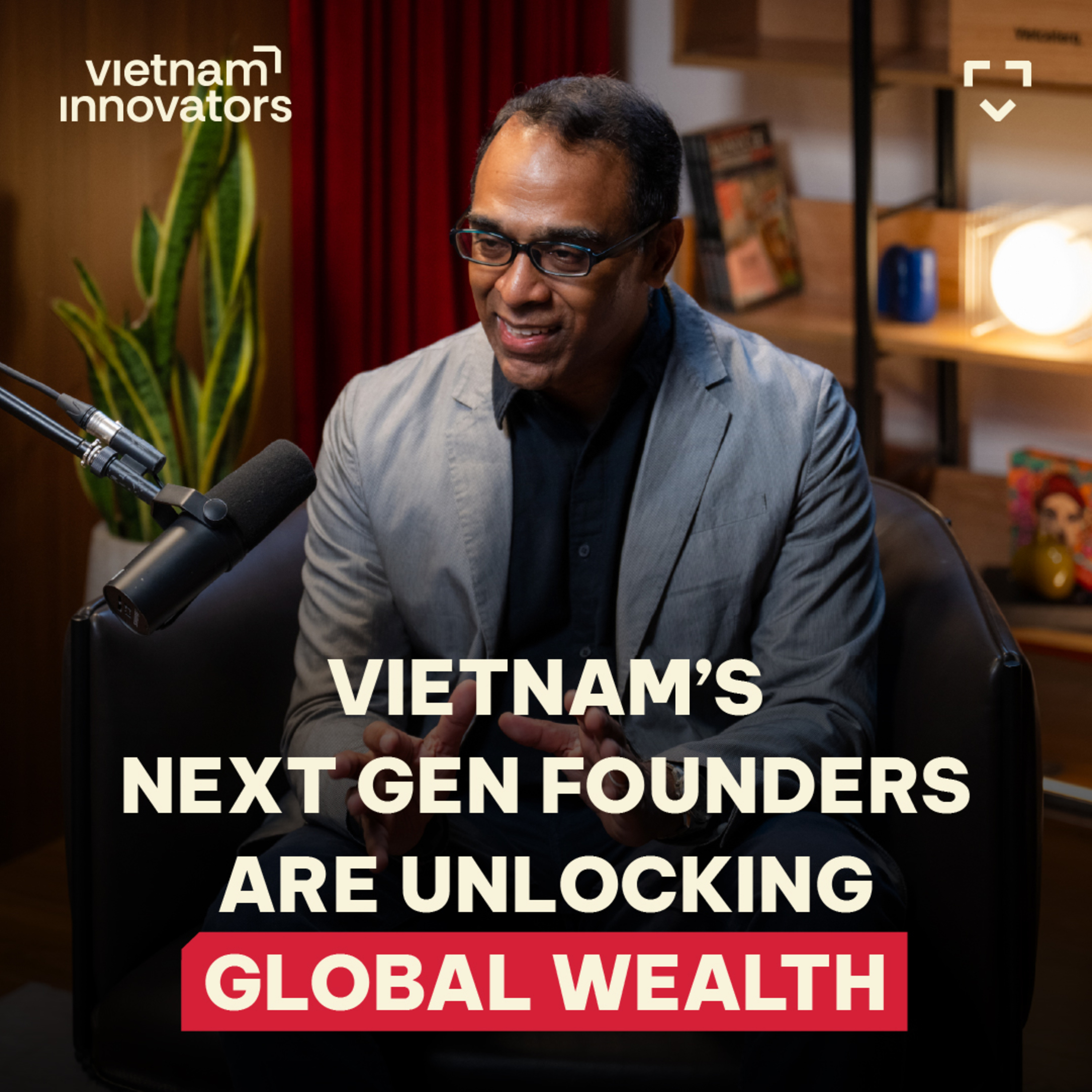
Vietnam’s Next Gen Founders Are Unlocking Global Wealth | Nagesh Devata from Payoneer | EP 407
About this episode
[English below]
Trong bối cảnh các doanh nghiệp Việt Nam đang vươn ra thị trường quốc tế với tốc độ nhanh chưa từng có, sự khác biệt giữa việc bán hàng ra thế giới (selling globally) và thực sự vận hành ở quy mô toàn cầu (operating globally) đang trở thành bài toán chiến lược cho các nhà sáng lập Việt. Rào cản này không chỉ nằm ở sản phẩm hay tiếp thị, mà xuất hiện ngay ở tốc độ xử lý dòng tiền, sự minh bạch về tiền tệ và hiệu quả của hạ tầng vận hành.
Trong tập podcast này, ông Nagesh Devata - Phó Chủ tịch Cấp cao khu vực Châu Á - Thái Bình Dương tại Payoneer, người có 30 năm kinh nghiệm trong lĩnh vực công nghệ, tài chính và thương mại toàn cầu - sẽ chia sẻ những góc nhìn về làn sóng vươn ra thế giới của các doanh nghiệp SMB cùng các nhà sáng lập thế hệ mới tại Việt Nam.
Cuộc trò chuyện tập trung phân tích thực trạng chuyển dịch từ mô hình bán hàng quốc tế đơn thuần sang vận hành toàn cầu toàn diện, thế mạnh nổi bật của Việt Nam trong các mảng Gaming, Phần mềm và B2B, cũng như lý do vì sao hạ tầng tài chính chuẩn mực lại đóng vai trò quyết định trong việc loại bỏ lực cản tăng trưởng và thiết lập niềm tin với đối tác quốc tế. Ngoài ra, những tác động thực tế của AI đối với năng lực vận hành của SMBs và giá trị cốt lõi của sự kết nối con người trong các giao dịch thương mại xuyên biên giới cũng sẽ được thảo luận trong tập podcast này.
-
As Vietnamese businesses expand into international markets faster than ever before, the gap between simply selling globally and truly operating on a global scale has become a defining strategic challenge for founders. This hurdle goes beyond product offerings or marketing strategies, it manifests directly in the speed of cash flow processing, currency transparency, and the efficiency of operational infrastructure.
In this podcast episode, Nagesh Devata - Senior Vice President, GTM APA at Payoneer, bringing 30 years of expertise across technology, finance, and global commerce, shares his perspectives on the international expansion wave among Vietnamese SMBs and next-generation founders.
The conversation explores the shift from basic cross-border selling to comprehensive global operation, Vietnam's key competitive edges in Gaming, Software, and B2B sectors, and why a robust financial infrastructure is critical to eliminating growth friction and building trust with international partners. Additionally, the discussion touches on the practical impact of AI on SMB operational capabilities and the enduring value of human connection in cross-border trade.
-
Listen to this episode on Youtube
And explore many amazing articles about the pioneers at: https://vietcetera.com/vn/bo-suu-tap/vietnam-innovator
-
Feel free to leave any questions or invitations for business cooperation at [email protected]
Get every episode summarized
Each time Vietnam Innovators publishes, we email you a written briefing from the transcript — the topics, who appeared, and any specific claims, with the ad reads skipped.
Email me new episodesFree for 3 shows. No card needed.
Hosts & guests
Transcript ready
276 searchable segments. Every word is indexed and playable.
Full transcript
Vietnam Innovators — Vietnam’s Next Gen Founders Are Unlocking Global Wealth | Nagesh Devata from Payoneer | EP 407. Machine-transcribed; use the interactive transcript above to jump the player to any line.
Vietnam's businesses are going global faster than at any point in our history, but there's a gap between selling globally and actually operating globally. And that gap is measures in slow transfers, in currencies, you can't see clearly, and in money that takes five days to arrive. My guest today has spent nearly 30 years inside that problem, and today he leads Asia Pacific for Pioneer from Singapore. He's watched this play out across continents, and today we are asking him what it looks like inside Vietnam. Nagesh Devara, welcome to the show. Morning, and it's pleasure to be here. Thank you for the time. With Pioneer, it's like having a room bank account in the US, UK, Australia. While you're having your try-in, India. Pioneer. Yes, so you have spent years in the intersection of technology, finance, and global commerce. So what drew you to the challenges faced by the cross-border SMBs?
And why do you believe that this segment actually matter today? Well, what drew me actually, I would say to a certain extent, getting into financial services into Fintech was not my long-term plan. If I go back 20 years ago, it was never my plan. I think over time, and what I've learned with, and I've had the opportunity to work with, merchants of all different types of sizes, right, like from very large to small. What I ultimately found and what really gets me excited is working with, you know, what you would call an SMB, or small businesses, small medium-sized enterprises. And particularly in Asia, I would say for me, Asia is, I love Asia. I love the markets in Asia. And I think it's just the opportunity and the challenges that they have, but also the potential. And I've had the opportunity, I've worked in North America and other markets, but it's exciting. It's so exciting, and I feel privileged to be able to see what's happening in these markets in Asia,
and the opportunity to help them unlock that opportunity. How have you been working in this side of the world? In Asia? In Asia? In this side of the world? It has been 18 years. I've been in Asia for 18 years now. Yeah, so what excites you the most? What excites me is also what challenges me the most is the diversity in Asia, that you have customers of all different types of sizes. You have countries, different languages, different cultures, different ways of operating, and different needs, right? If you think about just take Vietnam as an example, Vietnam's super exciting, super dynamic, but it's also challenging. You can take any other market in Southeast Asia or Asia, same kind of thing, but completely different needs. And it's that excitement that drives me every day to see if I can solve it. You know, I guess, I'm fortunate, I guess, from the perspective of, I get to work in an amazing place, in an amazing region with lots of exciting entrepreneurs and founders
and companies that are doing really great things. And I think we're at a time in Asia where I don't think you could have said this 20 years ago, that the opportunity for these businesses and these entrepreneurs to go and not just operate and say Vietnam or Southeast Asia or Asia, but to go global? I don't think it's never existed, right? So we are at a very unique time. Yeah, I believe so. Based on that's that that I did some sturdy Vietnam's e-commerce market hit about $30 billion US dollars in 2025. That's huge. And then it's growing about 25% year on year. Yes. And then there also the cross-border online trade reached about $4.5 billion US dollars. Now, but growth at the macro level can look very differently or can hire a very different story at the SMB level. Tell me about that. So I think there's lots of examples of where that growth is coming from.
And you know, from more from a personal perspective, when I look at it from a painier perspective and I look at that growth, it is truly, it's coming from not just from e-commerce, it's coming also from business to business, it's coming from industries and verticals like the gaming and the developer side of the business, it's coming from that. So it is very real in terms of that growth and that opportunity, right? So I think it's completely the numbers that you shared are absolutely consistent with what we see. It's the same trend line that we see. And it's really, I think the world has become much more accepting of the Vietnamese entrepreneur, the developers. It's no longer that this only happens in one country somewhere in the world. That's what's changed. The beauty is that people have accepted, people acknowledge that you've got the talent, you've got the smarts, you've got the entrepreneurs here.
And why not? Why not? I think that's where I come from, from a painier perspective is trying to figure out how to help them succeed. But I also wonder from working on the ground, how many of these businesses are actually operating at the global scale, and versus how many of them are actually just selling globally. Like tell me the difference. I think again, we don't have a specific stat to quote in terms of those that are operating globally, versus those that are selling globally. But if I can break it down, I would say the journey is a bit like this. You have a lot of businesses that start, they start by focusing on, I'm going to do something in Vietnam, and I'm going to serve the Vietnamese market. That's the starting point for most companies. But the reality is, they start by seeing their opportunities, there's a much bigger market.
There's a much bigger market out there. Like again, we could talk about it being Southeast Asia or Asia, but the much bigger market is, you know, I see this with Vietnamese companies selling to Latin America, selling to the US, selling across Asia. And as they start to evolve, that is where they're not just selling, they're operating. They're operating globally. And when I say they're operating globally, it's they're thinking about how do they set their businesses up. Maybe I'm going to have tech teams around the world. Maybe I'm going to have developers in Latin America. Maybe I have suppliers, inventors in different countries. And that's where you can think about it as complexity, but at the same time, their business is evolved. So it's not just me operating in Pochumin here and selling something globally. I think again, their businesses are evolving very fast. And there's a lot of reasons why this is also happening. We know the talent is there.
You mentioned, you know, we talk about the gaming vertical. I think Vietnam's number two globally in gaming or the gaming segment. So it's proven itself. And to be able to go and get customers around the world, you can't just operate from your home base here. You now need to start building up your presence in other markets around the world. You might need to put sales teams there. You might need to put people on the ground who are going to go and build and expand your business. So that's sort of the way I would see between just selling internationally versus operating internationally. And then when you start to think about operating internationally, it's thinking about the infrastructure you build. Where do I go and incorporate my business? Which markets do I want to be in? How do I build my sales teams? How do I manage my currencies? How do I manage all the currencies I sell to? All of those things start to come into play. So it's not so simple, but they're really starting to move in a way that's much more complex, but bigger.
Yeah, you just touch something very important. I think that it's true that Vietnam is gaining momentum in gaming and digital services. Yes. Right. And software. Yes. Right. So tell me a little bit more about how significant is that segment to you. Oh, sure. So we talked about gaming being just this is not a pain near point of view. This is just where gaming sits globally. Vietnam's number two, right? We it's a number the number two market globally in terms of the gaming vertical. It is being a vertical that we have focused on at pain here for the last few years. And I'd like to think and we were very early in this journey working with this sector over the last five plus years. It's a really important vertical. And I think the sector itself is growing. So the actual sector independent of pain here is growing in Vietnam.
You know, you're seeing more companies like where we are nearby to this location. There are many, many gaming companies and developers and founders right around us. And it continues to grow. And I think what what tends to happen is that once a founder creates a company, I think they're very good at training the next generation of people on their own teams. Those teams go out and start to build their own programs, platforms, products. So you have a you have an industry that is continuing to grow. And I think also Vietnam's highly competitive, right? So so there are still advantages of building your development centers in Vietnam being a hub for that development. So for us at pain here, it is a very meaningful segment. Again, it's a segment that we really believe we can serve well. And these are these are companies again to your point. And it's it's not just about selling internationally. It's about going global and really and operating globally.
Yeah. And that's something where we feel we're we're really well positioned to be able to support them. Not just with a product with a solution, but with a complete operating model or operating financial model to support them as they go to more and more different countries around the world. And one thing when I have the opportunity to talk to founders, they don't know every single country around the world. Right. Yeah. So so maybe they know the US maybe that's something they understand. But look, think about think about all the markets where where there are opportunities. Do they know Brazil? Do they know India? Do they know Australia? No, right. So so again, we help stitch all of that complexity together and create it under sort of one umbrella, one house. Yeah. Again, you just also touched something very important that growth is very significant right now in gaming and software. But as founders at these Vietnamese founders, where do you think Vietnamese founders or Vietnamese businesses in these sectors need to kind of strengthen their capabilities? That's an interesting point.
And I don't think it's unique to Vietnam. Yeah. So that's the first thing. I don't think it's unique to Vietnam. I think it's unique to most founders. Yes. I see this over and over across my travels and talking to founders across Asia is that like you touched on that like selling globally versus operating globally. I think of what happens is a lot of times founders underestimate first of all, maybe they underestimate how fast they're going to succeed or they're going to grow. But they also tend to try to think about it like like an operating model. Like I'm not going to build like everything that I need. And probably that's the one advice I tend to think about is is try to build that infrastructure, build that infrastructure that allows you to go global. So maybe just like an analogy when you buy a computer, you buy a phone, right. You could buy a basic phone, right. You could buy a pro or even something higher, right. And we all make that decision, right. Like because we're thinking that's good enough.
But if you bought a smarter, better phone, it's going to allow you to do more things. It's going to allow you to do AI. It's going to allow you to do a lot of things, right. And so prepare for that future complexity. And that's the same thing with entrepreneurs and founders. And we see that all the time, right. So build for that infrastructure, build for that operating model, build to have that that to be able to, you know, I think to be able to go global. Right. I think also like when you think about the Vietnamese founder, they're in a very different sort of mindset. And this is something I think once upon a time you would say you have SMEs, right. You're you're you're born a founder. You're born an entrepreneur. But these SMEs and these founders are born to go global now. Right. Like I think it's a different mindset. They're already starting with a very different mindset. If you can give me a couple of just worse or definition about what does it mean or how does it look like as a born global Vietnamese business. I would say a born global Vietnamese business is someone who is from this from the very beginning is not thinking about their market being Vietnam.
That's that's starting point. They would start with an aspiration and an ambition and a belief that their market is the world. That's the starting point, right. That they are solving a problem and addressing a need that supports businesses around the world. It might be that they're really smart about certain regions around the world. That's fine. But they're operating model from from day one is building a global business is is that ambition. Right. They don't wake up saying I'm going to create a business for the next 25 years that only solves Vietnam. I think these are these are what you see. This is the type of profile of entrepreneurs you see in Vietnam that they're starting right off that that's their ambition. That's their goal. That's their vision. And you know, I think it makes tons of sense. I admire them. I really do admire them. And when we talk about being born global, then it's how do you operate globally?
And what do you need to do to succeed? And I would say a lot of times where I see entrepreneurs and founders is that they don't necessarily always think about the financial stack or the financial infrastructure. They're thinking about their product, which makes complete sense. But they or they're trying to solve one problem in their financial needs. Right. How do I get paid? Okay. That's a logical one. But they're not thinking, well, tomorrow I'm going to go to the US. I go to India. I go to Brazil. I go to China. Those are different currencies. Right. Now I have to collect. Right. Like I don't think any of us like if you think about it and you think about we all have wallets at home or we all have that folder at home, which has I have some Vietnamese dong. I have some Singapore dollars. I have Hong Kong dollars. That like you think about that. That's how they have to operate. Right. But they don't want a folder with lots of currencies.
They need to be able to be fast and quick. They have suppliers in China. They have developers in Vietnam. They have customers they're selling to in Brazil. That's their complexity and that's the reality. But they're building it from day one. That's what they need to build from day one. And a lot of times what we see, they're thinking about the product, but they're not thinking about the financial operating infrastructure that they need to go along with them. So in your opinion, what is the most common misconception that Vietnamese SMBs have as they begin expanding globally? I would say I don't know if it's a misconception or if it's a challenge is that it can wait. Is that it can wait? Like I'll get to it. Right. I'll get to it. And I would say that tends to be the biggest challenge. Right. Like because you're running. You're running. Right. Like you're running at building code and developing that next game or building that business. You're running. And then you think, I'll get to it. I'll eventually get to it.
And that's when it becomes more and more complex. Right. Like because you are now selling to all these different types of countries and currencies. And you keep thinking, I'll get to it. But now your complexity is growing and it's getting more and more complex. But you haven't thought about, okay, how do I operate this? The same, I think it goes the same way. Like you think about as a business, they are really good at developing their code and their games and amazing games and focusing on relationships to drive more downloads and get customers. But you often as maybe are not prioritizing, if this was a physical good and maybe if it was a physical good, you're thinking about shipping and logistics. And it's similar to that kind of logic, you need to be thinking about your financial infrastructure. Right. The pipes, the ways you pay somebody, the ways you collect somebody. Just imagine, I always bring it back to the analogy that imagine having 10 wallets to do everything you need to do or 10 bank accounts to do everything you need to do. That's complicated.
That also means as an entrepreneur, I need expertise. I need someone to focus on it. Maybe that means I also need somebody and my team. Now I need another resource. So from an entrepreneur's point of view, I need this to be faster and easier and I need it to work. And I would say things that are going to matter to that entrepreneur or that founder are things like trust, credibility, reputation. So what we see a lot of times is when that founder of business goes abroad, you're selling something. Somebody's going to look ahead and go, you know, your from Asia or your from Vietnam, you want to build that trust. Right. And I'm going to send you money. Okay, I have no, but it's the reality. Right. It's the reality. Right. So how do I, as a business, I need to look legitimate. I need to look like I am operating a good structured business and we have good financial infrastructure between us. And so really that's super critical. So so again, something we do at Pioneers, we operate things effectively like helping our customers with with virtual accounts around the world in different currencies.
So it allows me then to operate in the US and I can exchange and I can operate with US dollars or I can do that. But ultimately what we see with these entrepreneurs and what we really are trying to always do is to help them, you know, be able to bring that those funds back centrally into their business accounts and to be able to operate, you know, for the infrastructure they have in a place like Vietnam. The reality is this is where the talent is this is where the smarts are this is where the coders are this is where they're building the product that goes global. So they need to be able to, you know, manage those expenses pay for those expenses and to be able to support the infrastructure they're building here. Yeah, I have to say I totally agree because for example, I put myself in the situation. My company, less than my company is here and I operate a team here, but then I have a vendor. My vendor is in the US and it will be very simple and it's going to be very fast for them to say like to just be like, Hey, I need to pay you and then I just give them my US holding account.
Yeah, and then they would they would not have like a second thought. I'm like, Oh, and then but then if we have like an account sitting somewhere in Vietnam, for example, the first, the first thing that may come to mind is like, how will my money get to you? How many days will that? Yeah, absolutely. Yeah. And I think this is this is what pay an era is, right? Like is is our ability to provide. We call it a financial stack. You can think of it like as a global operating solution for an SME and you know, it's being able to provide things like virtual accounts, multiple currencies. It's being able to have access to lending in certain markets. A checkout solution to be able to provide all that under, you know, one umbrella, one hood so that it makes it a lot easier. And I think ultimately for SMEs, not just in Vietnam everywhere in the world, they seek simplicity. So I understand that the financial infrastructure is extremely important. But then what if it fails? It fails to keep up with the company's growth, for example. And where do you see it's often breakdown?
So I would say with any SME, this is a real, you know, concern they have to be mindful of is is really thinking about the infrastructure they pick, how they operate it, where they build it. And I think it's really important for any entrepreneur. And maybe this is slightly biased is, you know, the decisions they make and the choices they make and who they work with, I think are super important. Right. The industry that we operate in or that I operate in is one that's built on lots of compliance. It's about knowing who your customer is. It's built on like solid regulatory infrastructure. I mean, we're in the business of money movement. So my advice ultimately to any SMEs when they're thinking about these things, really think about global infrastructure. I think again, really thinking about why there's such, you know, stringent compliance and KYC, you want that. It's the same way when we operate, you know, with traditional banks, you want that. You want to know that your traditional bank is solid, stable, and is going to be there.
And I think that's really what I would say is, you know, the entrepreneurs that we see ultimately that really they're able to put everything under that one umbrella so they can unify things. But, you know, from a pay-in-year perspective, we work with, you know, our financial partners are the best banks in the world around the world. We're licensed in multiple jurisdictions around the world. And I think that's super important. Just just in just to give you some context in Asia, we have licensed across multiple countries, licensed in multiple jurisdictions in North America and Europe and so on. That's really important. And I think ultimately, look, any decision is of course is the SMEs decision. But I think these are all inputs I would tell any SME or any founder to consider to evaluate when they're thinking about what they're doing. And, you know, how to operate the business.
Pair-on-year positions itself as one-stop financial stack. So tell me what does pay-on-year actually do in simple terms. Sure. In the most simplest terms, the way I would describe it, okay, first of all, we focus on cross-border. That is our core proposition. We don't focus on other aspects, right? It's a cross-border. In the most simplest ways, we help a business with their accounts payable. So I need to pay somebody. I need to receive, so that's accounts receivables. I help you manage multiple currencies and complexities. And I help you as an SME be able to get access to other types of products and services. It could be through a mastercard. It could be lending. So I can help provide lending in certain markets to help you with your business. It could be our through our checkout solution. So I need a payment gateway. And in some cases, we also provide a workforce management solution. So if I'm a Vietnamese business and I want to go and, you know, I want to expand to Latin America, I need to hire people, but I don't want to set up there. We can help you provide that. So if you think about it, it starts with the financial sort of pipes, the accounts payable accounts receivables. And then all the other layers that they need to be able to run and operate their business.
So can you walk us through the process of how a Vietnamese SMB, for example, uses, pay on near in practice. Sure. In practice. Yeah. What we typically would see as someone would come to us through any number of channels, sign up for a pay and your account. Typically, the most common use case we start to see is I have a product that I've sold to somebody. I need to get paid. And I want to use pay and year to collect that money. And I have I've sold that product in the US, Canada, Australia, wherever else. And I have multiple currencies. I'm able to now hold all those different earnings in my pay and year account in the currencies that I've earned them in under one umbrella. So that's the first second is I need to pay for supplies. I need to pay for advertising. I need to pay for any number of things to run and operate my business. So that's the accounts payable side.
And I could have a supplier in China as an example. And through my pay and year account, I can pay my supplier. I need to pay for my advertising. Could be a Google or Facebook. I need to pay that. And that's the most basic or starting point of how our customers in Vietnam would probably come to us. And the problems that they're trying to solve or the needs that are trying to address. Vietnam is one of Peonier strategic markets in Southeast Asia. So so far. Well, what is, can you tell me and highlight it achievement of Peonier here in Vietnam? A couple of things without getting into specific numbers. What we what we have seen in some of the most significant trends we have seen is over the last couple of years, we focused on not just e-commerce. E-commerce has always been sort of a historical area we focused on. But was really around business to business.
So if we talk about like what we've been talking about and you know think about these these developers in the gaming vertical. That's kind of like a business to business, you know, need. And we've seen our growth in business to business like, you know, expand in double digits in Vietnam in terms of what we've seen the traction the growth. So we've been able to work with many Vietnamese gaming customers. And we've been able to see how they've gone global. So I personally, I mean, this is an achievement I'm very personally excited about and happy. But I also believe it's it's an area that continues to grow. I also think what's exciting about this segment and why I'm excited is I do think this segment is evolving as well. So while while it's gaming and development, I think you start to see the transition into AI and to sort of other areas that these companies are evolving into. So I have seen where this vertical or this segment of gaming was an idea five years ago. And I think it was just like, hey, there, this is a really interesting thing we should be looking at to where it is today.
It's it's a very meaningful segment. It's a meaningful segment for us. But I think we were right. It is it's not just for us. I think clearly it's it's a global leader. And and you know, I think that's that truly is it's really exciting to say we saw that trend. And I think there's other verticals like that in Vietnam. I mean, we're trying to figure them out. We're trying to discover them. We're trying to learn. But clearly, you know, gaming was one of those. Okay. Then so what is your long term bet on Vietnam? My long term bet is so so a couple of things. I think that excite me about Vietnam and why I think Vietnam stands to benefit a lot. I think as you see, the world is changing in terms of sort of geopolitical trends and shifts. I think just the infrastructure in Vietnam for export is growing very fast. I think it's becoming the world's alternative or the go to potential go to for manufacturing to the rest of the world. It's becoming the world's factory.
So I think at least what we see in Asia, it is really emerging as the world's factory. And when you look at these businesses, when I think about the longer term bet is being able to go talk to these businesses. That's the first thing, right? So I think these are businesses. They themselves are in transition. Often a lot of these businesses I could be a furniture manufacturer in Vietnam. Furniture is one of the biggest and most, you know, I think emerging verticals in Vietnam. But a lot of these are probably still traditional family run businesses. And I think we see this again, not unique to Vietnam as they go through this transition from a family run business that's focused on sort of, you know, their niche to saying, there's a world out there is helping them go through that journey and going and talking to them and approaching them. And a lot of these businesses are probably not sitting right here in this part of the city. They're sitting in industrial zones and manufacturing zones. And we have to go talk to them and help them.
I think personally, you know, any business would be open and excited about the opportunity to take their products and say, well, how do I take my products globally? I think when we have that opportunity to talk to them, they're very excited because they don't often know the markets around the world. And that's something that gets me excited. Like we are white uniquely positioned to be able to say, hey, you've got a great product. You've got a great thing. But maybe you're only selling it to Singapore, Malaysia. Maybe that's all you sell it to because that's that's what you think. But imagine if you could go help them unlock a market like India, Brazil, big massive consumer markets, right? Imagine if you could do that. That is what we help them do. And again, part of that, that's what gives me a lot of excitement about Vietnam. And I keep seeing this. It's an amazingly young, smart, dynamic, innovative community out there. It's just being able to go talk to them. AI is going to change SMBs globally. And that's the consensus. But which part of that do you actually believe in? And which part of that do you think is the hype?
Sure. Interesting question, but tough question. I think we're all learning about AI. I think for all of us, when I think about AI, I think I'll break it down into two parts. I think there's AI as panier and how we're thinking about AI and really using AI to automate our processes, get smarter, serve our customers better, reduce the frictions anywhere we might have, improve our response time. Speech is very important. You can't take away that element. I think you can complement the people that you have, but complement it with AI. And that's very much how we're trying to internalize AI and everything we do. How do I reach out to that customer in the industrial zone, that furniture manufacturer in the industrial zone? Is there a different way to reach out to them? Do I need a physical person or do I need? Could I have someone using an AI agentic AI that could speak into me? These are all the types of use cases we're looking at.
Now from an SME's point of view, what I think AI does for them is speed also and the ability to move faster. I think it's the ability to test. So maybe I don't want to go to Brazil and I'm not quite sure yet. It allows me to go test the market. It allows me to go and localize in the market. I think localization is always a tough one for our customers in Asia. Asia, we operate in multiple languages. Not everyone is going to be fluent in English. Maybe I don't know Spanish. Maybe I don't know Portuguese. Those are all different things. But AI can help me start to look more local and help me to put my product or my offerings in the market or how I advertise or how do I message or all of anything like that. So I think that's like on a very outward perspective. I think AI can furthermore help SMEs. SMEs generally are very lean. They're focused on being efficient, being very optimized.
And I do think there's an opportunity to shift certain workflows into an AI to help them with that. If you think about an SME, just contrast them to a large company. They don't have big marketing teams. They don't have finance teams. They don't have all of those dedicated teams one might have. Like if you and I were to go start a business tomorrow, we probably, it's us. That's it. That's it. And think of it from that lens that AI can help us. It can help us innovate. It can help us drive speed. But at the same time, it can help us complement on certain processes. If AI could help me better manage my finances, better manage my logistics, better drive and develop a product faster. And I think entrepreneurs themselves can see this as an opportunity to be focused on what they do best. If I'm an entrepreneur that focuses on coding, well, okay. I get to be really, really good at that. And maybe I can then use AI to complement my other things. So I like to think AI in a summary can help me just the way we're helping them global.
I think AI can help them really present themselves in a way that I'm not a single entrepreneur, but I am a large, more complex company that presents themselves. Right. But what is the hype? The hype, I think again, it's the is thinking AI can do everything. And in thinking AI can at least my personal view is that it's going to replace all these things. And you know, do it. Do you know, maybe it's someone thinks AI is going to just take over all my customer service. I still think you need to figure out how to compliment both. Like you can't. Like I think if you just force, if you and I were forced into a chatbot and it's an AI chatbot, and I think both of us might not be too happy. Right. We can tell. Yeah. But the human part of it is out the equation out of the conversation. And I feel very uncomfortable.
Absolutely. And I think come bring it back to an SME. An SME has to go build trust. Right. So you think about that as SME that's going somewhere to a market they've never heard of. And if an AI chatbot or an agent is now having that interaction with a potential customer, I'm not sure it'll necessarily resonate because you're building trust. Right. And I think that's human connection. Absolutely. And I still think that handshake is absolutely critical. Right. And that handshake is even more critical when you're doing cross border. Exactly. And when you land in that country, submerge your sound to the culture, figure it out. Maybe I need to tweak a few things here and there in my product. Yeah. Or my payment system. Just because that is my like the consumers behavior locally at that. I think you summarized it really well. I think if someone was to come to Vietnam and said, you know, I want to do business here. And if you're only interacting with some sort of AI agent. Oh, no. I don't think it would fly. No. I don't think it would fly. You know, you want to.
We want to check each other out. We want to know, do I trust you? How do I feel? Are you someone I can do business with? Right. And I think that's it's even more critical for an SME. Right. SMBs really have to do this. If I'm some very large corporation, maybe I can get, you know, reputation is different. When I'm a small entrepreneur going global, yeah. I think trust the handshake knowing who you are. Do I trust you? It's super important. And you know, like we talked about if I have to pay you or you pay me anytime there's money movement, I think trust is absolutely crucial. Yeah. And that's that's where I think you can display your domain knowledge and it's just when I create that trust. For example, I come to you. Like you, parent near come, you come to me. Yeah. And I feel like you are obsessed about me. You want to help me. 100%. Then then I will definitely shake your hands and we are. I like the fact that you I like the way you framed it when you said to be obsessed about you. And I think when it's your customer, you want to be obsessed.
Exactly. And I don't think I can do that. I think it's it's so for me, I view AI and at least this is the way I think is is how can it be complimentary? How can it be complimentary? I really feel like there's parts where you can be smarter and you can optimize. But again, in the cross border space, again, maybe my own bias in Asia, I think culturally all of us are very, you know, we want to know who we're interacting with. So, Nagash, if you could change one thing about how Vietnamese SMB's approach cross border growth, what would that be? For me, everything I like to try to personalize it. And when I when I'm thinking about growth, whether it's cross border, whether it's in the industry of payments or not doesn't matter, is that I would really encourage all sort of Vietnamese SMEs. I think they they have the ambition. I don't think many of them are thinking I am just going to serve the Vietnamese market.
My my advice would be to think about building that infrastructure and thinking about what those options are upfront doesn't mean you have to use it's like we talked about the analogy about the phone, right? Yeah. Having it on your phone is important. You may not use all features, but you have access to the features. And I think that's super critical to have access to those features. As you build and as your business evolves, have it. You want that, right? Like that complexity, you don't want to deal with that complexity. You don't want you don't want that complexity. And as a founder, I really feel like if you can push that noise away and you get to focus on what you're really good at building, you know, the best product to the best tech, this can then be that that operating infrastructure that allows them. So so from a growth perspective, I would say this, like I think maybe another way to frame it. There is a lot of friction that happens. There's a ton of friction. And I would I think there's a lot of money that's left on the table because of this friction. You can you can think about it in terms of checkout or are you know from checkout or payment gateway and I like we actually did this study.
It's a white paper and we talked about the opportunity that's left on the table because of not optimizing your payment gateway or your checkout. It's massive. It's a lot of opportunity. Again, lost sales, lost sales, right? When you are building your business and you're going global lost sales is something you just cannot account for. Like it's not something you should even want to think about. You want to convert every opportunity as much as possible. We kind of bring it back to what we talked about. If I go and sell my product to a new market and I got a customer and I don't have a way for them to pay me. That's that's immediately going to be a lost sale. It's expensive to acquire a customer. Extremely expensive. And if you lose that customer, basically you you need to spend double if not triple correct correct. So you can take it in sort of use cases that way. So so while you may not be thinking. I got to be you know, build this big cross border infrastructure. I would I would ask every SME to think about you know the opportunity cost of not doing something.
If I can't get paid I like you said I did all that effort I flew somewhere I can't convince this person to to work with me and if they can if they can't pay. I want to pay. But they can't pay and then we make it really difficult for them to pay. I'll probably move on right. If it takes weeks for the money to come into my account, they're probably going to think let me go seek another alternative or I move to somebody else. Now you can turn it the other way if I can't pay for my expenses and often as an entrepreneur, you're you're like I got to advertise and you don't know your timings. You just need to know that you can do it. So that that to me is like the biggest thing right like so you can think about maybe even the word growth is not always the right way to frame it. I think it's it just has to work. It just has to work because you've done a lot of effort and a lot of time to go in and and create this opportunity and build this business.
But it has to work and I talked about the payment gateway example and when you sell I think all of us as consumers when we go buy something online we just assume it works. But imagine all the times it doesn't work or you know it's delayed or there's a friction you probably move on you probably move on or you probably say I come back to it. So as an entrepreneur and as an SME you can't afford any of those things so that's why that infrastructure is so critical that it works that any customer I work so hard to get I need to convert them. And to me when we think about growth growth doesn't necessarily have to mean some grand global plan but it needs to work. It needs to give me the foundations that I can scale. Right. Thank you so much for really insightful information about Perineer and I just want to close the show by saying something from my perspective I think as a founder as an operator we need to have that financial infrastructure or the entire infrastructure in the back of our mind because we need to prepare ourselves to expect the unexpected.
Yeah that's a great way of saying it. Yeah in business. Absolutely. So thank you so much for coming to the show I wish you the best and please continue to grow with Vietnamese businesses and founders. Thank you. Thanks for having me. Thank you. Yes.
More episodes
More from Vietnam Innovators

661 Videos Later, Here’s What Khanh Vy Learned | Khanh Vy, Creator & MC | EP 408
Vietnam Innovators

440 Years of British Education Just Landed in Vietnam | Tony Ngo & Kirsty Lowery...
Vietnam Innovators

Can Immigration Save Japan? | Kenji Govaers & Michael Kokalari | EP 405
Vietnam Innovators
Emergency Podcast: When Will Vietnam's Stock Market Go Up? | Michael Kokalari -...
Vietnam Innovators