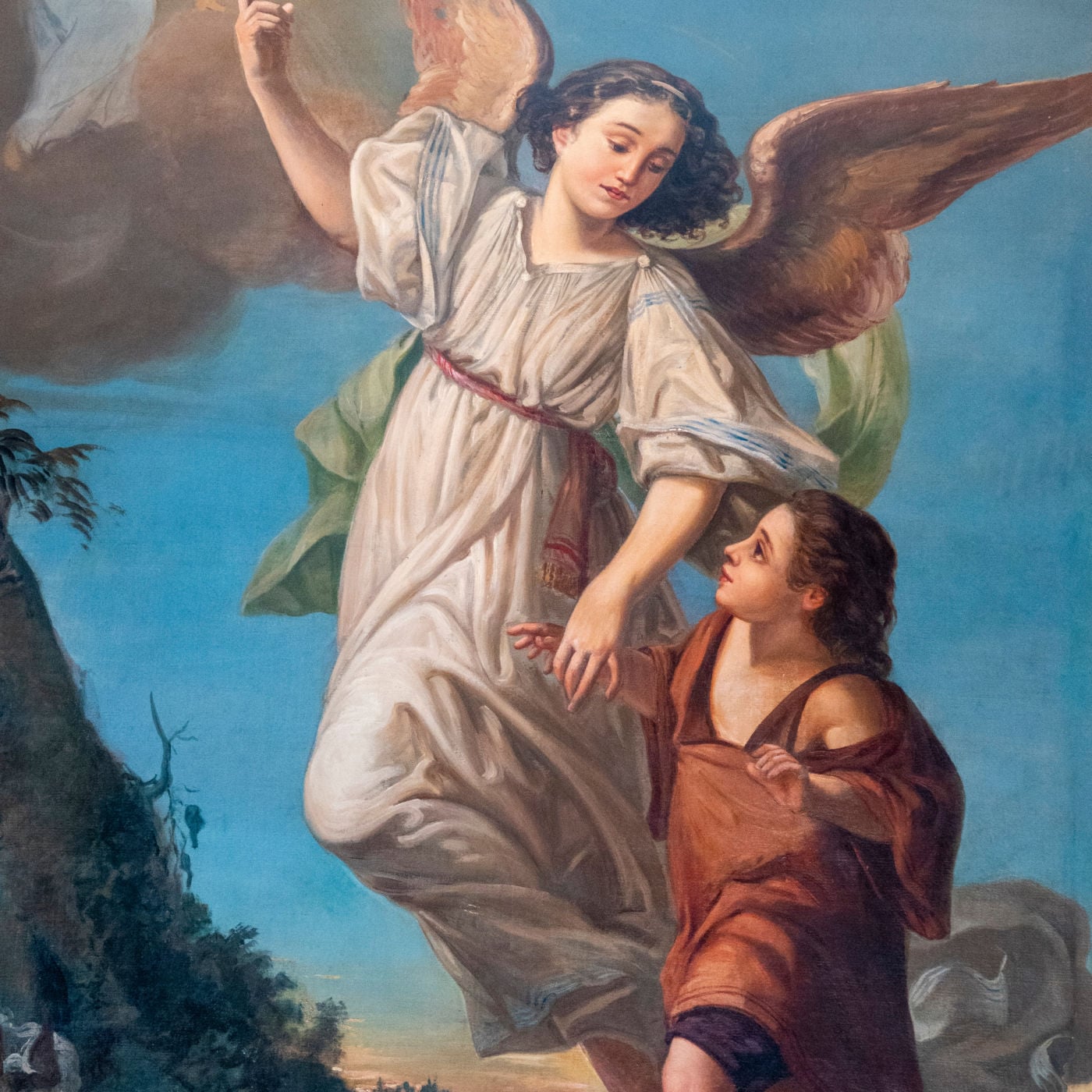
#12905 How Do You Defend Belief in Angels? - Karlo Broussard
Get every episode summarized
Each time Catholic Answers Live publishes, we email you a written briefing from the transcript — the topics, who appeared, and any specific claims, with the ad reads skipped.
Email me new episodesFree for 3 shows. No card needed.
About this episode
Catholic Answers Live is made possible by:
“Buying or selling your home, real estate for life can connect you with a pro-life real estate agent. When real estate for life receives a referral fee, they donate 65% to Catholic answers. Your host very happy to be here on a Wednesday with Dr.”From the transcript
“How do you defend belief in angels?” This question opens a discussion on the intersection of faith and reason, addressing concerns about viewing angels as mere superstition. Other topics include navigating familial opposition to Catholicism, clarifying misconceptions about heresy in the Old Testament, and responding to Protestant views on salvation.
Join the Catholic Answers Live Club Newsletter
Invite our apologists to speak at your parish! Visit Catholicanswersspeakers.com
Questions Covered:
- 04:54 – How do you defend the concept of angels who only see it as superstition? Can you reason your way to understanding or do you have to believe in the bible or have the same kind of faith
- 17:15 – My girlfriend’s family is very close minded about Catholicism and they are not in support of their daughter becoming Catholic. How do I approach them?
- 28:51 – I’m not Catholic and I’m trying to learn more. The OT talks a lot about heresy and the images of ancestors. And Jeremiah talks about people worshiping the queen of heaven. It all looks very similar to what Catholics believe. How is it not the same?
- 41:15 – I’m a revert and my husband is protestant. He always claims “we don’t need that for salvation” when I explain different parts of the faith. How do I respond?
- 50:35 – How do I explain the requirements of receiving the eucharist that looks exclusionary?
Get every episode summarized
Each time Catholic Answers Live publishes, we email you a written briefing from the transcript — the topics, who appeared, and any specific claims, with the ad reads skipped.
Email me new episodesFree for 3 shows. No card needed.
Hosts & guests

Transcript ready
513 searchable segments. Every word is indexed and playable.
Full transcript
Catholic Answers Live — #12905 How Do You Defend Belief in Angels? - Karlo Broussard. Machine-transcribed; use the interactive transcript above to jump the player to any line.
Buying or selling your home, real estate for life can connect you with a pro-life real estate agent. When real estate for life receives a referral fee, they donate 65% to Catholic answers. Learn more at realestateforlife.org Hello and welcome to Catholic Answer's Live. I am Scy Kelly. Your host very happy to be here on a Wednesday with Dr. Carlo. Usually Dr. Carlo Broussard is here with us on a Tuesday, but we got him on a Wednesday this time. And if you've got a question about apologetics, about how do you do it? If you've got an argument you want to test, if you need help making an argument, answering a question, help having apologetics conversations. It's tips for defending the faith this hour.
So maybe you want to to an atheist friend, you want to defend the idea of God. Maybe to a Protestant friend, you want to defend the sacraments or the priesthood or something. If you have an apologetics issue, you would like help with tips for defending the faith, 888-318-7884. And the truth is, you don't have to be Catholic to call because, for example, as I mentioned God, we all need help defending the idea of God. If we're believers of any kind. So maybe if that's you, you are welcome to call and get that help. 888-318-788-4, Dr. Carlo Broussard, Dr. Carlo with a K on YouTube where he's got an increasingly popular podcast that drops each Wednesday. Welcome, Dr. Carlo. Hey, Sy, thanks for having me, but it's great to be on with you again. Yeah, so busy day for you. You dropped a podcast episode. Well, actually, you turn them in,
right? And somebody else posts them on a Wednesday. Is that what works? That is how it works. But today, let's see here, I'm trying to remember what it means. Oh, I was going to give you time. I wasn't going to ask you. You're answering a question. I knew not to ask. I was going to guess. Okay, go ahead. All right. So the title is, you don't believe in purgatory question mark Paul did. And so I spend about 20 minutes, roughly 17 to 20 minutes, articulating and exegiting 1 Corinthians chapter 3, verses 11 through 15, which is the classic text that Catholics have appealed to throughout our tradition as biblical evidence for the reality of purgatory where Paul describes a post-mortem state of purification for somebody who's died in friendship with Christ, but apparently has not, or at least he articulates principles that would allow for someone who dies in friendship with Christ on the day of judgment after death to be purified before entrance into heaven.
And so I articulate those principles. I answer certain questions to try to preempt objections that might be posed to our reading of the text by our Protestant friends and then conclude that Paul indeed was conceiving of a reality that involves all of the essential elements for calling it purgatory. Does it identify specifically sort of the things that are purged in purgatory that we often articulate in our Catholic doctrine? No, but he does describe a final purification, which, as I argue, does have a even punitive dimension to it, suffering on account of wrongdoing that would map on with the dead of temporal punishment due for past forgiven sins, that there is a purification of works and association with the individual going through the fire would map on with the theological understanding of remnants of sin like unhealthy attachments, which are effects of bad works, or guilt of enocin, which is an effect of bad works. So that could be something packed into the purification
that Paul articulates, but insofar as he articulates a post-mortem state of final purification for someone who dies in friendship with Christ before entering into heaven, that's purgatory. Yeah. All right. Check it out. You can get it wherever you get your podcast, the Dr. Carlo podcast. Make sure you spell Carlo with a K, or you can get it on his YouTube channel, the Dr. Carlo YouTube channel. Do look for it. I'm going to open you up with a question here while we get the phone lines ready to go. By the way, there's two lines open, 888-318-788-4, but I want to ask about angels. Okay. And the Christian belief in angels. Is this defensible, or is it understandable by faith alone? A lot of people see our belief in angels as a superstition, or is it something that can be defended by faith, excuse me, by reason, that there's a place for philosophical reasoning in our understanding of angels? Yeah. So it's interesting you phrased the
question like that. Can it be defended by reason? And the answer is simply yes. It can be defended by reason. The more, perhaps the more interesting question is, do we think the existence of angels can be proved by reason? And this is a question that St. Thomas Aquinas takes up, and the first part of his whom at the Eologier question 50 article one. And Aquinas seems, and I underscore seems, to answer yes, that it can be quote unquote demonstrated. He starts off in his answer. There must be some incumporeal substances, and that it's like entities that are purely intellectual and incumporeal by nature. So he seems to be thinking along the lines of something that can be demonstrated, but I will say there is a huge debate among Thomas scholars as to whether he's presenting his argument from reason as a demonstration that angels exist, exist, or is he preventing or is he
presenting an argument from reason to, as you put it, say, defend that which we can only know by divine revelation. You see the distinction between the two. Yeah. Yeah. So if we put that to a side, whether it's going to be a demonstration or an argument from reason to give probable knowledge that they exist, like this is a good argument and defense of what I know by divine revelation. Let's put that aside, and let me just share with you sort of a summary form of the argument he makes in that article. Now I'm not going to do my best to avoid all of the jargon, right? And it's very difficult to read the text of Aquinas himself because you can tell he's just jotting down in summary form and leaving out key premises that would need to be exposed and brought to light and defended within a full defense of the argument. But here's the line of thought. He roots the
the need for angels in the perfection of the universe, say, okay, he says basically the perfection of the universe. And by universe, he means not just the physical cosmos, but the whole order of created being, okay? The perfection of the universe requires, that's his language, which is pretty strong. Basically, all the ways in which creatures as effects can be perfectly assimilated to God as their cause, okay? So the perfection of the universe, this ordered whole, is going to require all the different ways in which a creature can be imaging God, right, in a perfect way. Now he goes on in the next step and saying, okay, well, perfect assimilation of an effect to its cause is imitation of the cause according to how the cause brought the thing about. So heat makes heat, right? Things are real causes within our experience. Like you just caused me to have a certain
kind of concept and thought when you asked the question, okay? I'm hopefully causing you to have knowledge right now, right? Not as much as you could probably guess I would get, but yes, definitely something's happening. Yeah, go ahead. But notice when we do that side, we're being a real cause. We're imitating the ultimate cause, God, by being a real cause of effects within our lives. The sun causes heat. The sun imitates God as cause, right? So perfect assimilation of an effect to the cause is to imitate the cause according to how the cause brought the effect about. Now here's the key move. God, when we think about God, he naturally produces effects by intellect and will naturally without a body. Like he does it without a body or it enthruses some bodily organ or something, right? He does it purely spiritual. Now the only conceived creature, the only kind of creature that could possibly do that to imitate God in that way,
which remember Aquinas says is perfect assimilation. The only conceived creature that can do that naturally is a purely incuporial intellectual substance. Obviously it's in the created order because it's a creature imitating the creator. So we're in the order of creatures right here, right? So the only kind of creature that could possibly imitate God with that perfect assimilation of doing what the cause did to bring about that creature is to produce things by intellect and will without a body naturally speaking. And that's what we call an angel. That's what we call a pure intellectual substance. And so therefore Aquinas basically concludes the perfection of the universe requires that's his language purely intellectual substances. And even if you don't buy this as a demonstration, like angels must exist, according to philosophical demonstration, it at least provides a good reasonable argument to show that the divinely revealed truth that
angels exist can be supported by and defended by reason. A good reasonable argument can be offered and thus provide a reasonable ground for a sentencing to what is divinely revealed that angels exist. Man Aquinas, he's something, isn't he? It just makes you want to know more and more about angels when you start talking about it that way. Yeah, and you know, open up a lot of questions. Indeed it does. And Aquinas writes a great deal about angelology, the study of angels. And one interesting thing is how they communicate. We communicate through speech where we use words and audible sounds to communicate intellectual concepts that we have and ideas and affirmations of reality and what not or denial of things about reality. And he has a whole section of describing how intellectual substances, angels, like these purely intellectual substances, angels communicate with one another. They have an intellectual concept that nobody has access to
unless they will it. And when they will, that intellectual concept be communicated to another angel, the angel knows it. And then he calls that quote unquote speech, although it's not like how we understand speech with verbal words, like mind reading. It's actually distinct from mind reading. Because mind reading would be you sigh. Oh yeah, yeah. Knowing my intellectual concepts without me willing it without me telling you or wanting you to do this like mind project by mind. Correct. So in this case, it's one angel willing that his intellectual knowledge be known by another intellect, by another angel. And then he calls that speech. And then illumination is when there's a proposition that the angel knows to be true, like God created the heavens and the earth. And then he wields that to be known by another angel and Aquinas calls that illumination. And what's really cool is he talks about the hierarchy of angels and how the higher angel is able to know things in a simpler way with less sort of intellectual activity, right?
In the sense of like you don't have to divide it up so much. He just kind of knows it in a simple way and a intuitive way. But that higher angel can communicate that knowledge to lower angels who don't have the high intellectual capacity that the higher one did. And he can like divide up the knowledge in a way that the lower angel can understand it by simply willing it and the angel receives it kind of like for us, you know, you got a really smart person and like you just got to tell him one thing and he boom, he got it and he sees all the implications of that one thing just in an insight. Yeah. But for I don't know about you, but for a good Southern boy from the Southern Louisiana, I do know about me to be down to five. You know what's categorized all they do here. Yeah. And listen, you know, we say this, we say can you break it down for me? Yes, that's right. Lower intellects need knowledge broken down into little smaller pieces. Right, right. Higher intellect. And the angels communicate in the same way like that. So it's fascinating. All right. Just give me a yes or no. Give me a yes or no answer on this because I can't imagine
I'm the only person who's thinking about this from what you just said. Could an angel do that to my mind? If an angel can do it to another angel, could an angel put an insight or a chunk of knowledge into my into my mind? Yeah, that's a great question. So, you know, if an angel was able to wield that knowledge for another angel to know that, that's so that's according to their natural mode of operation. Oh, yeah. And as rational animals, we don't operate naturally in that way. And so I would have to do a little bit more reading of a whine as I'm sure he addresses this. I just haven't done the extensive research on it. But my hunch is that the answer would be no because that would be according to their natural mode of intellectual knowledge. And we just don't have that. Arzostune senses. That is correct. Yeah. So in order for us to receive that kind of knowledge, it would have to be infused within the mind, which is supernatural, which ultimately
God does, right? God infuses knowledge. Now, could God would God utilize a secondary cause to infuse that into our intellect? So I'd have to think about that a little bit more. But that's a very good question. No, I'm not questioning to think about. Dr. Carly Brissard, our guests, tips for defending the faith every single line full. So Jeff, let's make this a very quick break. Make a quick, Jeff. Hang on, Catholic Answers Live will return in a moment. Support for Catholic Answers Live comes from Catholic chemistry, a dating app for Catholics founded by a long time member of the Catholic Answers team Catholicchemistry.com. Are you a coffee drinker? If so, you can now enjoy a coffee roasted to perfection by the Carmelite monks of Wyoming. Delicious, mystic monk coffee is roasted and prepared by monks in a hidden cloistered monastery and is available in over 25 varieties. All mystic monk coffees are works of perfection and labors of love for more information on how to purchase mystic monk coffee visit mysticmoncoffee.com. That's mysticmoncoffee.com.
Proclaiming the faith, changing lives. The year was 1996. The world over, debuts with Raymond Arroyo. Each week, Raymond challenges viewers with the important political and cultural reporting and analysis of a wide variety of topics of interest to Catholics and people of faith. To learn more about Mother Angelica's life and the history of EWTN, visit ewtn.com slash Mother Angelica. Dr. Carla Bussard, our guest, and he's here to give you tips for defending the faith that there's some part of the faith that you would like to defend from the very most basic, like defending the existence of God or to very specific, maybe defending one of the sacraments or something, or if there's a person that you would like some help thinking about how to defend the faith to that person, 888-318-788-4.
We're going to start out right here in San Diego. Nicholas in San Diego. Thank you for calling, Nicholas. Hi, can you hear me? Very well. Hi, so I'm going to give you some context to real fast before my question. My girlfriend's parents, one group, Adventist, one group, Episcopalian, and they're now both non-denominational. So now my girlfriend is starting OCIA after I've introduced her to the faith. She's super exciting for me personally. Yeah, so her parents are very critical and closed-minded about Catholicism, due to their background, and due to just where they are now, and they almost feel upset at their daughter because they feel like, this is how she described it to me, they said they feel like they're losing their daughter. And so the big objection from her mother who grew up Episcopalian was that the math is the same thing as her childhood. She said that it just was, she didn't like it because the music wasn't good as she liked it and it's an non-denominational situation. And then secondly, her father has been getting her info about Catholicism from John McCarthy,
James McCarthy's gospel according to Rome. Yeah. And so my question is, how can my girlfriend and I, easier parents, mind, and allow them to be accepting of the faith? Because ultimately, I'm sure it would take a lot of convincing to make them Catholic, but I really just want them to accept their daughter and be, I feel confident in my ability to explain my beliefs, but I want to know what are some points for things I can mention to them, to allow them to understand what their daughter is getting into and what I believe as a person myself and to make them feel like they're not losing their daughter. Yeah. So the first thought, Nicholas, it comes to mind, to try to ease the con, sort of ease the emotional response of the parents is to present it as, for your girlfriend, to present to them as this is what I have come to conclude as true. And so in order to be consistent with what I think is true, in order to have moral integrity, to pursue that which
I have come to conclude it to be true, I must pursue this. Now, I understand parents, you disagree with me on this conclusion, and we can have a conversation about why you think that, but just so that you know that I am not doing this simply because my boyfriend is Catholic, but I am doing this because I have come to be convinced it is true. And I must follow my conscience because conscience dictates that we pursue what we know to be true. And to go against that would be to go against our conscience and thus to go against this fundamental pursuit of the truth that God has placed within us as part and parcel of just being human. And so if she can present it to them in that light, like this, I've done the research, this is what I've come to the conclusion, I have to follow that. And I trust that you'll be praying for me in my pursuit of truth and wisdom. And I would hope and pray that we can still share the goods that we have in common as Catholics
and non-Catholic Christians and our love for Christ and our love for the Bible, the word of God, and study a scripture, et cetera. And so if she can just share her story and share her testimony, then perhaps the parents will be at least somewhat more disposed to receive the conversion even though they disagree with it. And so they can realize that this is a hard, prudent, thought-out process still disagreeing with her conclusions for whatever reason, but at least seeing that it's rational, and it's not just some emotional response. And hopefully they'll come to accept that they'll see in her her love for Jesus Christ. Like the only reason, Mom and Dad, while I'm becoming Catholic, is because I love Jesus, and according to my research, it seems as if Jesus gave us the Catholic Church. So it's love of Christ. So if anything, Mom and Dad, if I am wrong, and you are right, and the Catholic Church is wrong, I think Jesus is going to have some mercy on me,
because I'm doing this because I love him. I just might be mistaken, but of course he is going to love me for loving him. And so if she can present it like that, then maybe that will quell some of the emotional, negative emotional responses. Now, as far as which points to cover, but Nicholas, that's going to have to come up in conversation to where you might ask the Mom and Dad, or she might ask the Mom and Dad, okay, well, you oppose me becoming Catholic. Would you be interested, and want to extend the invitation? Would you be interested in having a conversation about why you think this is a bad idea? And if they say, sure, well, then, okay, you have that conversation. And then the next question is, okay, well, why do you think this is a bad idea? And then they're going to present their reasons. And you just focus on one, just, okay, let's pick one, you know, and we can get to the other some other time, and you focus on that reason. Okay, this is why you think that's a bad idea. Would you be open to hearing how a Catholic might respond to that? Okay, sure.
Let's say they say, yes, you offered the explanation. And then when you offer that explanation to respond to their problem, to try to solve the problem, then you can simply ask them, and well, what do you think of that? Is there any, what do you, do you think there's something wrong with that reasoning behind, you know, what, what I just said? And then that's kind of how the, the conversation needs to perceive. What do you think of that, Nicholas? Is it helpful? Yeah, I really love everything that you just said. I think that's fantastic. And then if you could touch briefly too on a lot of their objections come from their background. So, mother who was a fifth-capalian, and she said she watched a Catholic mass, and that it's just like the Episcopal mass, and there's no God in there. And then her dad is just, she's just receiving misinformation through no fault of his own. So how could I respond to that? Well, that's a question about like whether good music determines the way Jesus wants us to worship him. Like that's the question you have to pose. Like do you really think that
Jesus would make the authentic and true worship dependent upon the skill of musicians and how they're going to praise him through song? I don't think so to state the question differently. Is it possible that you could have a really good singer and praise and worship in a band and still be wrong about whether or not we supposed to celebrate and worship Jesus in the mass? And hopefully the reason will come to light and be able to see, well, no, good singing, good music, that shouldn't be the determining factor as to how we ought to worship Jesus. So that raises the question, how did Jesus want us to worship him? Is praising him in songs with hands lifted in the air? Good. Yes, that's great. But the real question is, does Jesus want us to worship him with offering his body and his blood in the Eucharist? That's the real question. And if the answer is yes, well then we ought to be attending the mass and worshiping God in that way. And we can worship God with hand
with hands raised and praise and worship and find a good praise and worship band who does praise nights and go and participate. Nothing wrong with that. But if the mass is what we say it is and Jesus intends for us to worship him in that way, then out of love for Christ, we need to be going to mass. And then of course, then the question becomes, you know, as the Catholic Church, the original church established by Jesus to preserve the authenticity of the mass, the validity of the mass, etc. But those would be some strategies that I would say. Hopefully that's helpful for you, my friend. Yeah, that's great. Thank you so much and all I ask for prayers for her. Thank you. Amen. Nicholas, if you'd like, I'll send you a copy of Carla's book, Prepare the Way, Overcoming Obstacles to God, the Gospel, and the Church. There may be some things in there that will be of help to you. And I think you'll enjoy the book in any case. So hang on and we'll send it if you'd like. Dr. Carla Brasard is our guest. Dr. Carlo, to you on the internet anyways, or you can go
to his YouTube channel. You can find his podcast wherever you get good podcasts and his new episode drops each Wednesday. If you'd like some tips for defending the faith because he's been doing it a long time. I was here when I showed up. I don't know how long he was, he was here before that. But when I got into the building about 10 years ago, he was already here. So he'd been doing this a long time. If you'd like some help with your apologetics game, so to speak, if you'd like some help addressing particular questions or addressing people, you know, there's a person who says this or that and you'd like to know how can you respond as a good charitable, clear Catholic, 888-318-784. We hope that one of the things that we communicate here at Catholic Answers Live is that our Catholic faith allows us to be fully serious about all the problems we encounter in the church and in the world. But it also lets us have light hearts and maybe even mix in a bit of fun. And
that is exactly what our good friend Joe Heshmeyer does in his popular podcast, Shameless Popery. You should check it out at ShamelessJo.com. Joe's got a deep grasp of the faith, morals, the teachings of the church, all that. But he's also got a witty conversational style. He entertains and informs, but you will leave equipped to better answer the most common challenges, misconceptions, and questions about the Catholic faith. He's got insightful guests, he does on air debates, and he takes a close look into all the things that you want to know about as a Catholic living today. You'll walk away knowledgeable and filled with joy. Look for Joe on his YouTube channel, check him out at ShamelessJo.com or wherever you get your podcast. And if you like what you hear, become a patron. Your favorite Catholic Answers books are now available, unottable. Whether you're commuting, taking a nice walk, or relaxing at home, you can deepen your faith with audiobooks that will make a real difference in your life. No matter where life
takes you, listen to trusted Catholic Answers authors explain the faith clearly, answer important questions and help you grow in confidence as a Catholic. Visit audible.com today, search for Catholic Answers and let the learning begin. When the resurrected Jesus appeared to disciples on the road to Emmaus, they didn't recognize him until the breaking of the bread. The same is true today. In the Holy Eucharist, we really meet Jesus. In the Eucharist is really Jesus. Author Joe Heshmeyer explains how knowing Jesus in the Eucharist is the key to understanding all of Christian faith. Order your copy of the Eucharist is really Jesus. Today at shop.cafic.com or get it at a good Catholic bookstore.
Yes. Hello. I've been trying to understand how the Catholics view the saints and when I read the Old Testament, I see a lot about the terrafine, which were images of the part of the ancestors. And that seems to be similar. And then also in Jeremiah, we hear about speaking of the Queen of Heaven after they had pled the Egypt. And when I talk to Catholics, they say, well, we just ask them for intercession. Okay. But if I go into a Catholic church, I see images with candles burning in front of them. How is that not an offering? Okay. Yeah. Good question, Joseph. All right. So with regard to departed ancestors, obviously, there is some overlap with our understanding of the King of Saints, referring to the saints who have departed, those who have
gone into the afterlife, the blessed in heaven, they are our departed ancestors, right? Spiritual ancestors, loved ones, members of the mystical body of Christ. So there's going to be some overlap. However, there's difference given the afterlife experience of separated souls in the old covenant before the ascension of Christ into heaven, where the beatific vision is made available for human beings. And of course, in the new covenant, where that beatific vision is had by the blessed in heaven. So there's going to be some similarity in some senses, but there's going to be some differences as well, we're in a new covenant with new revelation and new things being given to the separated souls in heaven. I talk about those things in my book, The Saints Pray For You. If you're interested, stay on the line. I have the conversation. We'll send you a copy of that. Now with regard to your appeal to the quote unquote, Queen of heaven and Jeremiah, the important thing to point out there is that in verses 17 through 25, what is being described or acts of worship, the making of cakes, and
offering them to the quote unquote, Queen of heaven as an act of worship, and pouring out drink libations to actions which have in and of themselves the nature of sacrifice being offered to this pagan deity. And that's what the people, that's what God's people, that's what Jeremiah is pronouncing to be worthy of condemnation, the act of adultery. Now, fair point for you, Joseph, your question is, well, wait a minute, we seemingly see things that might not be offering of cakes and in libation offerings being presented to a statue of Mary, but we do see candles being lit. And so that would seem to be an example of an act of adultery. And hopefully I'm tracking your question correctly there. And that's a fair question. So the question now becomes Joseph or perpetually burning candles
conceived of and thought to be offerings to Mary as a sacrifice. And the answer is just simply no, Joseph, like Catholics do not intend the lighting of a candle to be a sacrificial offering to Mary. Rather, the symbolic value of the lit candle is to be a visible representation of a perpetual request, you brought that up earlier, how we are asking the saints to pray for us, a perpetual request that we are making of Mary. Given the fact, Joseph, that we're corporeal beings, we have to express movements of the heart and the mind in and through the body. You called in and asked a question verbally using your vocal cords and unciating words and sounds to communicate ideas to us because as a human being, you must communicate in and through the body. And that's good. That's a part of our human nature. Similarly, for us to be able to communicate, it is good in fitting
for us to communicate to the blessed in heaven, making our requests known unto them not only just mentally and spiritually, sort of the interior movement of my heart and my mind, but also to visibly manifest that through lit candles. So not only when I go in and I remind it visibly of these perpetual requests being made of Christians in heaven, our fellow members of the mystical body of Christ, but also that I am called to make the requests. I am invited to make the request as well. And I am invited to implore the saints in heaven to remember the requests, to respond to the requests that have been made by of them visibly represented by the lit candle. So rather than the lit candle being a sacrificial offering to Mary, which would be idolatrous, and anybody who's doing that would need to repent, Joseph. The common Catholic understanding and the church is teaching and understanding of this is that these are visible signs of the requests
that Christians make of Mary and all the other saints in heaven. What do you think of that, Joseph? Is that helpful in any way, my friend? I'll have to think about it. The first question that comes to mind is exactly who is it assembled for? Because if it's assembled to other people, then we're not supposed to make our prayers obvious to everybody around us. Well, I mean, I don't know. I don't think it's not an offering to the saints. So let me, let me, let me chat with you a little bit, Joseph, about that premise you had in that argument and that objection. You, you're assuming that we ought not to let other people know what we were praying or asking for? Like, why do you think that, man? Like, where are you getting that from? Not that we shouldn't let anybody know, but that it isn't to be something of show.
Okay, I got you. Okay, I got you. Joseph, I would agree with you. But notice, that's depended upon one's intention. Like, for example, in Romans 1530, Paul asks the Christians in Rome, hey, guys, pray to God on my behalf. And he lists like three different things. My memory is slipping me right now, one of which I think is success in his ministry. So he's, he's asking them to pray for him. He's making that known to all those who read the letter to the Romans. But yet he's not doing it for show. And we know that because Paul is a lover of God, like, he's a humble guy. We can, we can make a reasonable conclusion that he's making those requests known, not for the sake of showing off, which some religious leaders did and still do. Jesus had a few harsh words for those Pharisees who did that. But rather, he's making the requests known because fellow Christians need to know his
needs so that they can implore God to meet those needs. And that's just part and parcel of the Christian life. Brother, I would assume you would agree with me that as Christians, we want as many holy Christians praying for us as possible. And that involves making them know the needs that we have to ask God for. But we do that not out of show and pride and vain glory, which is condemnable. We do it out of love. Like, hey, fellow Christian, member of the mystical body of Christ, God has set it up that we depend upon each other for help. I need your help. Can you help me? That, Joseph, is the spirit with which we visibly manifest the requests that we're making to the saints. Okay. So are you saying it's a combination of reminding ourselves and reminding others of the request or what exactly what are we reminding with the candle? Yeah. That's a great question. I would say both in. It's a room. When I walk into a church and I see the candles lit,
it reminds me of requests generally that people have made of the saints that prompts me to either a make my own request of the saints and establish a relationship with them and communicate in the sense of asking them for prayers and help, but also to implore the saints and say, hey, whoever made the request represented by that candle right there, if it's in front of a statue of Mary, I would say Mary, please help that person out. So it's a reminder of me to prompt me to ask the saints help. It's a reminder of me to ask Mary to help the person who made the request and it could also be a reminder of me to pray for those who made the request that they would have the request granted unto them according to God's will. And then it's a reminder to just the whole congregation, generally speaking, of the theological reality of the communion of saints that Mary is our spiritual mother in heaven whom we implore for help and then we are reminded of the communion of
saints in heaven by the statues of other saints to prompt us to ask for their help as well. Because we believe in 1 Corinthians 12 and Saint Paul's theology of the mystical body of Christ. I'd tell you what I'd like to do if you would like. Joseph, I'll send you a book we have called the saints pray for you. How the Christians in heaven help us here on earth. And it's by our guest, Dr. Carly Rousard. If you'd like a copy of it, just hang on. We'll send it to you for free. We have a very generous donor who makes it possible for us to send books out for free. And we'd love you to have it. That brings us to the break right back with more tips for defending the faith. One line open, 888-318-7884. The Catechism defines evangelization as the proclamation of Christ and his gospel by word and the testimony of life. But what does that look like in real life? It looks like Saint Paul, Street Evangelists, out in the public square, sharing the good news. We're a Catholic non-profit
that starts conversations by handing out free sacramentals. Then we employ our method of listen, befriend, proclaim, and invite. Catholic Answers is supported in part by Saint Paul's Street Evangelization. Visit streetavangelization.com to learn more. Alexian Brothers is a proud sponsor of Catholic Answers Live. For 800 years, these Catholic brothers have offered a prophetic and daring response to the gospel. Serving Christ in the sick, the poor, and the dying. Is God calling you to be a courageous disciple? If you feel called to total self-giving as a religious brother in the mission of Jesus, call our vocations office at 847-264-8703. That's 847-264-8703. AlexianBrothers.org. Hi, this is Father Mike Schmitz. I invite you to listen to Bible Ineer and Catechism Ineer here on EWTN Radio. On Bible Ineer, we're reading all the way from Genesis through Revelation, plus time for explanations and reflections to help us go deeper into God's Word, encounter his
voice, and learn how to live life through the lens of Scripture. Bible Ineer and Catechism Ineer with Father Mike Schmitz tonight at 10 p.m. Eastern 7 p.m. Pacific on EWTN Radio. Welcome back, Captain Gantsons live. Dr. Carlo Bussard, our guest, our phones are persistently full. So I'm going to go straight back to the phones and let Carlo keep talking with folks. And where am I going? I'm going to Medina, Ohio. Melissa in Medina. If it's supposed to be pronounced Medina, I apologize. I never get those right. Yes, it's pronounced Medina. Everywhere I was told in Medina. Yeah, like a normal person, but not a person from Ohio. Okay, go ahead, go ahead, Melissa. Go ahead with your question. I don't want to pick on Ohio. Medina. All right, I'll remember that.
So I'm a reloading Catholic and my husband is a Presbyterian Protestant and I'm trying to bring him gently into the Catholic faith. That's he's a very stubborn man, but I love him still. And it just seems like every question that I bring up, he will have re-bought with like, well, you don't need that for salvation. So I haven't gotten like deep into this conversation of like, well, what do you need for salvation? But the most recent was, as the Mity would want to watch a Bishop Aaron documentary about the beauty of churches. And that was kind of where he was like, well, you don't need a beautiful church to be saved. Well, Melissa on that particular score, we would agree with him. Yeah, we don't need them. Yeah, I mean, like, we, that's why churches are beautiful.
Right. And correct. So if the question is our beautiful churches needed for salvation, obviously, the answer is no. But as you put it, Melissa, I think the more important question is, or a beautiful church is a good that we ought to pursue, right? Like we ought to have. And, and we were to answer yes. And then you can explain to your husband like, well, let's think about some reasons why it would be good to have beautiful churches. Like here's a question, is the majesty of God worth visibly manifesting? Like is it worth giving God our best in adornment of places where we worship? And hopefully your husband would answer that question, well, yeah, God's majestic. He's the most majestic being because he's beyond all other beings like he is God, right? And so it would seem to be fitting to do our best according to the means that we have
to try invisibly express that majesty of God. And that's why we have beautiful things within our sacred spaces where we worship God. And if he has a problem with that, well, then he's going to have to have a problem with the Old Testament because God demanded some pretty ornate things for his temple, for his presence to be dwelling in. And so we're just following that principle revealed to us in sacred scripture. Like God wanted it that way in the Old Covenant. And how much more for his son, Jesus Christ, who came and became man and incarnate and assumed a human nature to himself so that we can order bodily things to God and worship of him. And one of those things or material things that are beautiful. And also to visibly, this gets back to the principle I was talking about in the previous conversation, to visibly manifest what we believe about God's majesty and to visibly manifest Melissa, what we believe about reality and what has been revealed to us through Jesus Christ and his apostles. And so it's not only for the sake of
beauty that we have, ornate things and wonderful things in our sacred spaces, but those things in turn have a pedagogical directionality to them. Like they're for the sake of teaching us about reality that goes beyond the senses. But because we're sensible beings like we're corporeal beings, we need to see things, we need to hear things, we need to smell things in order to constantly remind us of that reality beyond the boundaries of what we can sense, the theological realities reveal to us. And so those would be some possible ways in which you could offer some explanations for why we have the things that we have in the sacred spaces of worship, but also the beautiful things that we have in the sacred spaces of worship. Now with regard to the things about, well first of all, before I move on, Melissa, what do you think of that so far? I do have a few more thoughts to share if you're interested, but I wanted to get your feedback so far. You know, that that answer very, very well about having ornate churches and the reason why we have them. Yeah. Now I suspect that outward,
I guess, manifestation of how we revere God. Yes, yeah. You know, because we're bodily beings, we want to visibly manifest that. And I mean, that's a simple point. He's got to concede. He's your husband. Like the love of you as wife is not just a spiritual intellectual thing. It's a bodily manifestation of love as well. And if you can see that point, which I assume he will, Melissa, well then he ought to concede the bodily part of our worship of God. Now one thought, Melissa, that came to me, you know, he was talking about, we don't need that for salvation. I would suspect, and you can correct me if I'm wrong, that he would apply that logic probably to things that we believe, like Mary's bodily assumption or her immaculate conception. Has he ever applied that logic to those sorts of things beyond just a beautiful church? Yes, he has like one of the things was like, like Jesus' family relationships like James the brother or James the cousin. Yeah. Okay.
All right. So, and I think this is an important conversation to have, Melissa, to try and help him out. If the opportunity ever presents itself, you know, we have to distinguish what we mean by required for salvation. If he means by that, which I suspect he does, like, well, you don't really need to know, Mary was a perpetual virgin or bodily assumed or immaculately conceived to love Jesus and to die in friendship with him. In other words, can somebody be ignorant of those things and still love Jesus, die in friendship with Jesus and go to heaven? Of course they can, right? And so belief in those things is not, quote unquote, required for salvation in that sense. But let's think about another sense of being required for salvation. Suppose somebody comes to know about these truths about Mary and they make a positive act of the will to say, nah, I ain't going to believe that. No,
I reject that, right? And they are culpable for that rejection of these truths. You can ask your husband, like, could they possibly be friends with Jesus if they knowingly reject what Jesus is revealing to us? And I think the obvious answer is no. And so they would be required for salvation in that sense, in the sense that you come to know the truth, but yet you're still willing not to live in a cord with it or you're still willing to reject that truth, even though you have sufficient evidence that it's true. You can't possibly be friends with Jesus. And at the same time, reject the things that Jesus is trying to tell you about his mother. And so belief in these things are required for salvation in the sense that for those to whom it is revealed, they are morally bound to ascent to it. If they come to know to know it, they're morally bound to ascent to it. And in that sense, it's required for salvation. And so hopefully by making that distinction,
by what we mean, quote unquote, required for salvation, then he can possibly be able to see like where his question's coming from and how it doesn't pose a problem for Catholic belief. And then this other part of the question that he's never considered before and that would help him as well. And thinking, oh, yeah, that makes sense. And so the real question is, why don't you think this is true? Husband, I mean, he's going to probably say, well, I just don't see the evidence. Uh-huh. Where that's where the discussion has to go. Let's look at some of that evidence. And that, Melissa, is when you go to Catholic.com and you just type in your questions and you get all the free resources that you can or you go to shop.catholic.com and buy all our books and equip yourself to have those conversations. Oh, I like the second way. Go buy all the books, Melissa. The Amazon wish list of all the books that you guys have. There you go. Yeah, but let's give her one. What do you want to give her, Carla? What would be what pick one of yours? Well, since he's, you know, struggling with Mary and stuff, how about we give him Tim Staples book
behold your mother? Oh, okay. We'll do that. I'm alright. But you know what? If you would, Edgar, also give one of Dr. Carlos books. It's two books for Melissa today because look at how gracious Dr. Carlos. Meeting the Protestant challenge. Okay. How to answer 50 common biblical objections to Catholic beliefs. Okay. Melissa Hang on. We'll send those to you off to Maryland Luke in Maryland. Thank you so much for waiting. Luke, go ahead with your question for Dr. Carlo. No problem. Thanks for taking my question. Just to both know, I'm I'm an Episcopalian. So just to, you know, give that out from the start. I'm curious about defending the requirements around the Eucharist, especially when potentially, but maybe not. It's taken as an exclusivist thing. I'm wondering about it in the long term, you know, kind of conversations we've heard tonight between family members and spouses. But also in the short term, for example, you know, I'm in the Pete Bliss of my cat. We're attending math and
they remind me, oh, yeah, you can't receive the Eucharist, you can receive a blessing. Or at another time when a Catholic priest was trying to give me the host, I'm going XX, no, in our Catholic. Because in those moments, you know, it's kind of hard to elaborate all that. I don't have an ID that's right. You know, so I would love to hear your thoughts on that. Thank you. All right, Luke, it's an excellent question, my friend. And thanks for asking it with such a spirit of inquiry and charity. We really appreciate that. So here's something to consider. And I do not pose this rhetorical question as a gotcha question, but just something to sort of illustrate the principle. And first, good things 11, 27 through 29. Paul says, do not partake of the Eucharist in an unworthy manner. Lest you be guilty of the body and blood of the Lord. And then at verse 29, he says, if you partake of the Eucharist without discerning the body, you eat and drink judgment, the Greek word, Kreme, which suggests damnation upon you. Now, and so I ask the rhetorical question,
should we charge Paul of being an exclusivist there? And I would assume, hopefully you would agree with me, Luke, that the answer is no. He's not being an exclusivist because he's not excluding people from the Eucharist for the sake of exclusion. He's excluding people from partaking of the Eucharist in these unworthy manners because of the spiritual ramifications that it will have on them. So Paul, in this case, has a good reason to exclude people from partaking of the Eucharist without mariting the charge of being exclusionary or an exclusivist. Similarly, Luke, at least from the Catholic perspective, we follow the principle illustrated there by St. Paul in saying, well, there are other cases in which it would be inappropriate for someone to receive Holy Communion because of spiritual ramifications that may come from it. So not only if you're in a state of mortal sin, which is how we Catholics interpret Paul there,
but also, Luke, if you don't believe it's Jesus in the way that we believe as Catholics. And the reason why that would be a reason for being excluded from Holy Communion is because that would bear false witness in the visible gesture of partaking of Holy Communion. Because Holy Communion, Luke, is not simply an expression of what you believe personally, but also an expression to the whole community that you are in communion with the Catholic Church. So number one, if you come up to receive the Eucharist and the minister says the body of Christ and you say, Amen, and you don't believe what we believe about the Eucharist, well, then you would be bearing false witness. You would be participating in an action that visibly manifests a certain particular meaning, namely, believe that this is really Jesus' body blood, so in divinity, and they ain't bread anymore. But yet, if you don't believe that, you would be bearing false witness
for you individually, but then also leading others to think that you believe something that you in fact do not. And so hopefully, Luke, that would be reasonable to you to see at least a rationale as to why someone who doesn't, who is not in full communion with us on this issue, would not be permitted to receive it, unless they bear false witness. I'm sorry, I'm out of time. I'm sorry, too, Luke, but I would like to send you a book. The Eucharist is really Jesus, it seems like the one to send you. That's from our colleague, Joe Hashmire. Hey, if you're on the line, hang on the line. Dr. Carla will be with us for the next hour. And if you haven't called yet, but you'd like tips for defending the faith, some part of the faith that you'd like help explaining, or maybe a particular person you'd like help explaining it to, 888-318-7884.
More episodes
More from Catholic Answers Live

#12920 What Is Clerical Celibacy? Conscientious Objectors and War - Jimmy Akin
Catholic Answers Live

#12919 Can We Pray to Saints? Sola Scriptura and the Incarnation - Jimmy Akin
Catholic Answers Live

#12918 Why God is Against Abortion. Suffering and State Votes - Emily Dinneny
Catholic Answers Live

#12917 Eucharistic Adoration w/Don Johnson - Don Johnson
Catholic Answers Live