Get every episode summarized
Each time Interesting Things with JC publishes, we email you a written briefing from the transcript — the topics, who appeared, and any specific claims, with the ad reads skipped.
Email me new episodesFree for 3 shows. No card needed.
About this episode
“Apolipoprotene E or APOE, it's a gene that comes in several versions. And one of them, APOE4, is the strongest known genetic risk factor for late onset Alzheimer's disease.”From the transcript
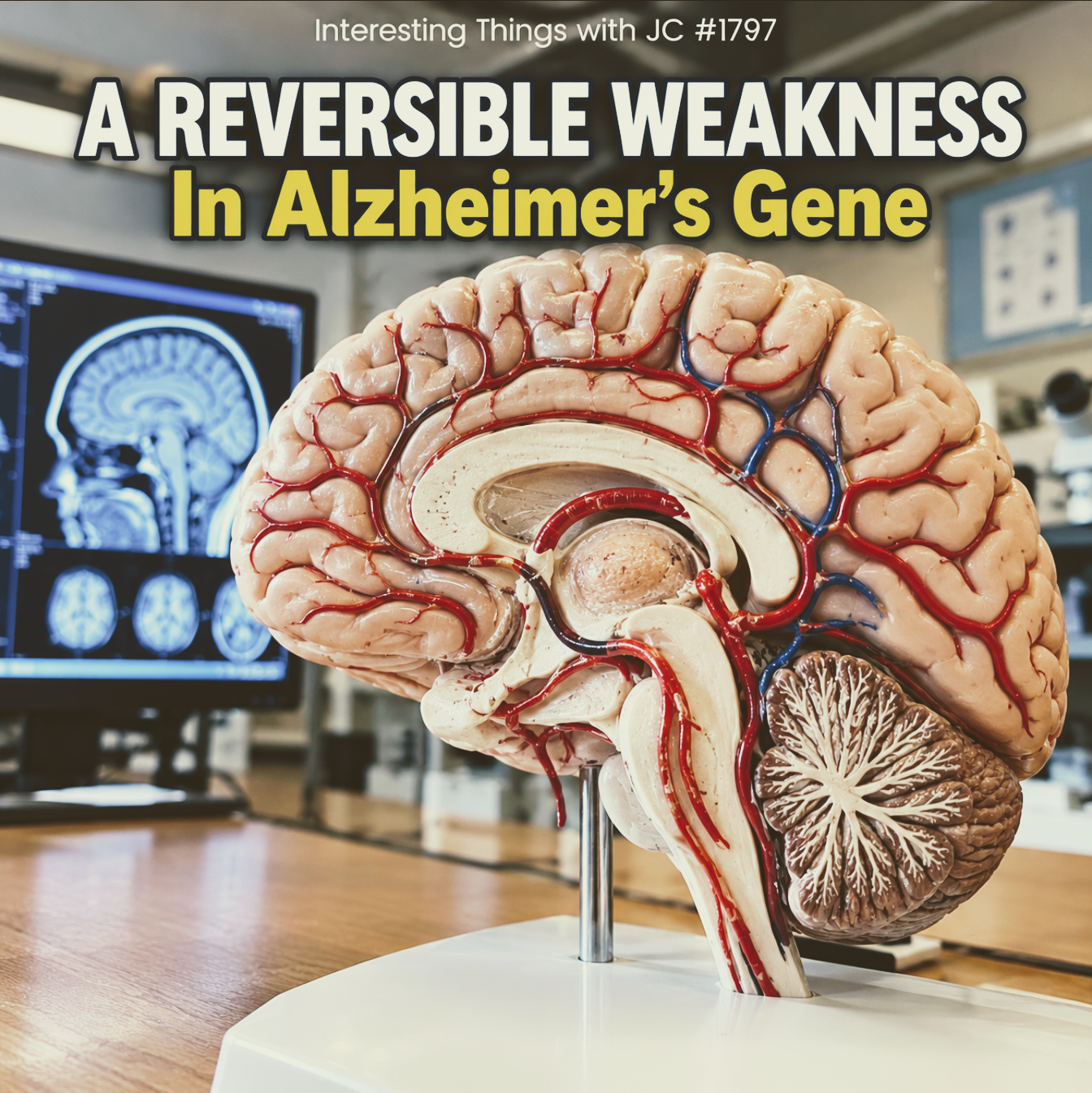
Interesting Things with JC #1797: "A Reversible Weakness in Alzheimer’s Gene" – Scientists found a way to reverse some damage linked to the strongest known genetic risk factor for late-onset Alzheimer’s. Instead of changing the gene, they blocked one of the signals it sets off.
Get every episode summarized
Each time Interesting Things with JC publishes, we email you a written briefing from the transcript — the topics, who appeared, and any specific claims, with the ad reads skipped.
Email me new episodesFree for 3 shows. No card needed.
Hosts & guests
Transcript ready
34 searchable segments. Every word is indexed and playable.
Full transcript
Interesting Things with JC — 1797: "A Reversible Weakness in Alzheimer’s Gene". Machine-transcribed; use the interactive transcript above to jump the player to any line.
Apolipoprotene E or APOE, it's a gene that comes in several versions. And one of them, APOE4, is the strongest known genetic risk factor for late onset Alzheimer's disease. And having it doesn't mean someone will develop Alzheimer's, but scientists have spent decades trying to understand why this particular version raises the risk. Researchers at the ICANN School of Medicine, a Mount Sinai, may have found part of the answer, and it involves the brain's smallest blood vessels. Those vessels do more than carry the blood. They're part of the blood brain barrier, a tightly controlled system that lets oxygen and nutrients reach brain tissue well, keeping many harmful substances far away. Some wrapped around those tiny vessels are support cells called parasites. Think of them as part of the maintenance crew. They help keep the vessel walls stable and the barrier working properly.
The researchers found that APOE4, it can change the behavior of those cells. Some parasites began acting more like cells involved in forming scar tissue. As that happened, there were more fibrosis or thickens scar tissue around the blood vessels, less normal parasite coverage and more amyloid build up along the vessel walls. They then tried interfering with the process. The researchers blocked a cell signaling pathway involving transforming growth factor beta or TGF beta. Those used chemical signals like these to control things such as growth, repair, and scarring. And when researchers turned down this particular signal, some of the damage began to ease. Parapsych coverage improved and fibrosis and vascular amyloid decreased.
They saw similar results in older mice carrying APOE4. They didn't change the gene. They changed what the gene was causing further down the line. This is still laboratory in animal research, not a treatment for Alzheimer's, but researchers now have something more specific than a genetic risk to study. They have a biological process tied to that risk that responded when they interfered with it. APOE4. It may be something a person inherits for life. The damage is set in motion. It may not be as permanent as we once thought. These are interesting things with JC.
More episodes
More from Interesting Things with JC

1796: “Free Fall Kinematics”
Interesting Things with JC

1795: “Do Redheads Have Special Powers for Survival?”
Interesting Things with JC

1794: "Best of Both Worlds - Van Halen - 5150"
Interesting Things with JC

1793: "Velocity & Acceleration vs. Time"
Interesting Things with JC