Get every episode summarized
Each time Heretic Hereafter Podcast publishes, we email you a written briefing from the transcript — the topics, who appeared, and any specific claims, with the ad reads skipped.
Email me new episodesFree for 3 shows. No card needed.
About this episode
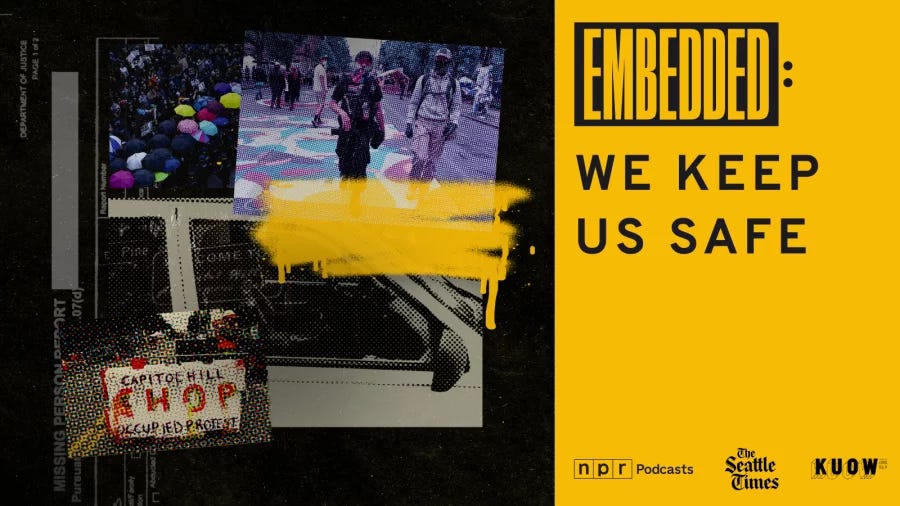
I’ve been following with rapt attention the new NPR/Seattle Times podcast, “We Keep Us Safe” which investigates the murder of 15-year-old Antonio Mays, Jr. at the Capitol Hill Occupied Protest (CHOP) in 2020.
This summer, we’ve been looking at what it takes to make community work. This new investigation of CHOP highlights the challenges of building a society from scratch apart from traditional institutions like the police.
What Was CHOP?
For those of you unfamiliar with CHOP, it was a protestor takeover of Seattle’s Cal Anderson Park and several blocks around it after the Seattle Police Department abandoned its East Precinct station in June of 2020 after several days of protest after the murder of George Floyd.
The media portrayed CHOP, varyingly, as either a Summer-of-Love-type sit-in or a lawless hellscape. Anxious to cut through the hype, I visited CHOP and witnessed both its promise and problems first-hand.
Heretic Hereafter is a reader-supported publication. To receive new posts and support my work, consider becoming a free or paid subscriber.
There were many positive things happening at the park: tables offered free food and water to anyone who wanted them. There were medical personnel on hand and teach-ins using the “human microphone” technique many folks learned during the Occupy Wall Street protests. People were exchanging ideas and vigorously debating how to create the post-racist, just society so many of us were crying out for in those dark days.
But while there were many in the park there to learn and vision together, the vibes weren’t exactly peace and love. Homeless people, some behaving erratically, had also streamed into the encampment. And as my friends and I sat eating tacos on the baseball field, we witnessed a group of masked men surround someone who was recording video. The group began shouting at the videographer, threatening violence. I’d seen enough and decided not to stick around past dark.
Four days after my visit, 15-year-old Antonio Mays, Jr. would be murdered and his friend gravely wounded right in front of the abandoned police station. Questions remained: who killed Mays and why? And how had this protest against racialized violence ended up taking the life of a Black teenager?
The Investigation
In the days after Mays’ murder, rumors swirled: he was a gang member or a troublemaker, there to cause mayhem and possibly harm CHOP protestors. Having witnessed the various groups of people filtering in and out of CHOP, I all too easily accepted this explanation, figuring we’d probably never get the whole story.
But reporters from our local NPR station and The Seattle Times were able to reconstruct a timeline of the murder using hours of security camera and livestream video scraped from social media. This, combined with eye-witness interviews, led to some startling revelations about why Mays was at CHOP and who likely killed him.
The whole podcast is available now; I won’t spoil the conclusions for you because I think it’s worth a listen.
The Aftermath
The podcast begins and ends by interviewing Antonio Mays, Sr. As much as his son’s death has been held up as a symbol for this or that movement, we ought never forget that Mays was a kid. He was a musician, an aspiring BBQ pitmaster, a son, a brother, a classmate, a friend. As a parent, I can’t help but put myself in his family’s shoes. How awful to lose a child, how awful to not know why.
Mays, Sr. wants justice for his son. No one has yet been arrested for the murder. Given the many errors in the criminal investigation, it’s unclear whether his son’s killer will ever face legal consequences.
Here’s the thing I’ve come to understand about the push for police reform: it’s not all or nothing. While political polarization and media sensationalism painted the sides of the debate as either “the police are great, they can do no wrong” or “abolish all police,” many would-be reformers are just regular people like the Mays family who want the police to investigate serious crimes while not abusing their power to harass or harm people of color.
Was Defund the Answer?
I attended multiple Black Lives Matter protests in 2020. We were fed up with biased policing and with the government-sanctioned murder of unarmed civilians. We dreamed of a world where people experiencing mental health crises were met with a helping hand rather than guns drawn. One of our main chants during this time was, “Defund the police, 50% at least!”
During this time, I tried to be careful about what I said in front of my kids, not wanting to overwhelm them. Still, they picked up on more than I realized. My eldest, then 8, saw a newspaper headline about the protests.
He asked, “So they’re going to fire all the racist police and then we’ll have only good police leftover?”
My heart ached at his question; I so wished that we could give him a justice system that was actually just.
While many Seattle City Council members publicly commented in favor of drastically cutting the police budget, in the end, the budget was only cut by 14%, some of that in the form of individual salary cuts, but most coming from moving services like 911 call centers and parking enforcement out of the police department.
Following the debate, the police chief resigned, and police officers left the department at a rate of about 150 per year between 2020-2022. While KIRO news reported this attrition was primarily due to the political climate, their sample size was small (12ish exit interviews out of 400ish departures). Other factors that could’ve influenced this wave of departures include things like poor staffing ratios and mask and vaccine mandates.
Regardless of why police left, many of their positions wouldn’t be filled until years later, leaving Seattle with some of the lowest numbers of police per capita of any large city in America. These staffing drops have often been cited as the cause of increased response times and the feeling that, in Seattle, “the police don’t do anything.”
Looking back on those “defund” demands now, what we were clamoring for was police accountability. Seattle had already gone through a federal consent decree and had an Office for Police Accountability, and yet little seemed to change.
Taxpayers, were, understandably upset, particularly after police overreaction to peaceful protests in 2020, which included a small child being maced. To me, “defund” felt like a last resort, hitting the department where it hurt: its wallet.
And yet, as much as the me of 2020 would’ve liked to chuck out the whole police department and start over from scratch, what happened at CHOP is illustrative of what can happen in the absence of police: namely, untrained vigilantes who self-appoint themselves as “security” creating the violence they’re trying to prevent.
In my opinion, “defund” was too much, too soon. It was (understandably) reactionary, but it made little meaningful progress towards the slow, hard work of reform.
What Would Justice Look Like?
Reforming our institutions often feels impossible. There are entrenched interests heavily invested in preserving the status quo, including groups like police unions. Both communities of color and police often feel under attack, making dialogue difficult.
But there are bright spots amid all this mess, people who are crossing party lines and doing the important, community-building work of accountability and relationship-building.
The first person who gives me hope is Detective Cookie. She’s a South Seattle icon (she even has a park named after her!) a police officer who started an after-school chess club and is a frequent fixture at schools and neighborhood events.
Even as the community has lauded her work to build trust between the police and the community, she’s faced discrimination within the police department and pushback for trying to hold it accountable. I’m so heartened to see the community rally around Detective Cookie; we need more police like her.
The second group who give me hope are the teachers, counselors, and community workers I see engaging in restorative justice, a concept I hope will be more widely rolled out in our community. Groups like Community Passageways mentor at-risk youth, moving people out of the criminal justice system and towards productive employment.
Is this reform work quick and easy? Absolutely not! Our criminal justice system is akin to a container ship that takes miles to come to a stop once the brakes are applied. Turning the ship around is a slow and arduous process.
But, as tempting as it is to give into frustration, to throw up one’s hands and storm out of the city, we must stay patient, we must notice small steps and work towards creating more of them.
If you want to help with police accountability and reform, there are options! You can host a block party or attend a community safety meeting. You can donate to groups in your area that are promoting restorative justice and advocate for it in your schools and institutions.
As much as we grieve the injustice of police violence, we have to remember that this is generational work. As the proverb says, “The best time to plant a tree is thirty years ago. The second best time is now.”
Heretic Hereafter is a reader-supported publication. To receive new posts and support my work, consider becoming a free or paid subscriber.
Get full access to Heretic Hereafter at heretichereafter.substack.com/subscribe
Get every episode summarized
Each time Heretic Hereafter Podcast publishes, we email you a written briefing from the transcript — the topics, who appeared, and any specific claims, with the ad reads skipped.
Email me new episodesFree for 3 shows. No card needed.
Hosts & guests
No transcript yet
This episode has not been transcribed. Request it and it moves to the front of the queue.
More episodes
More from Heretic Hereafter Podcast

Building Boys: Live Chat with Katharine Strange & Jennifer Fink
Heretic Hereafter Podcast

The Secret Lives of Christian Wives
Heretic Hereafter Podcast

I Thought I Had Gender Roles Figured Out. Then I Had a Son.
Heretic Hereafter Podcast

Love in the ER
Heretic Hereafter Podcast