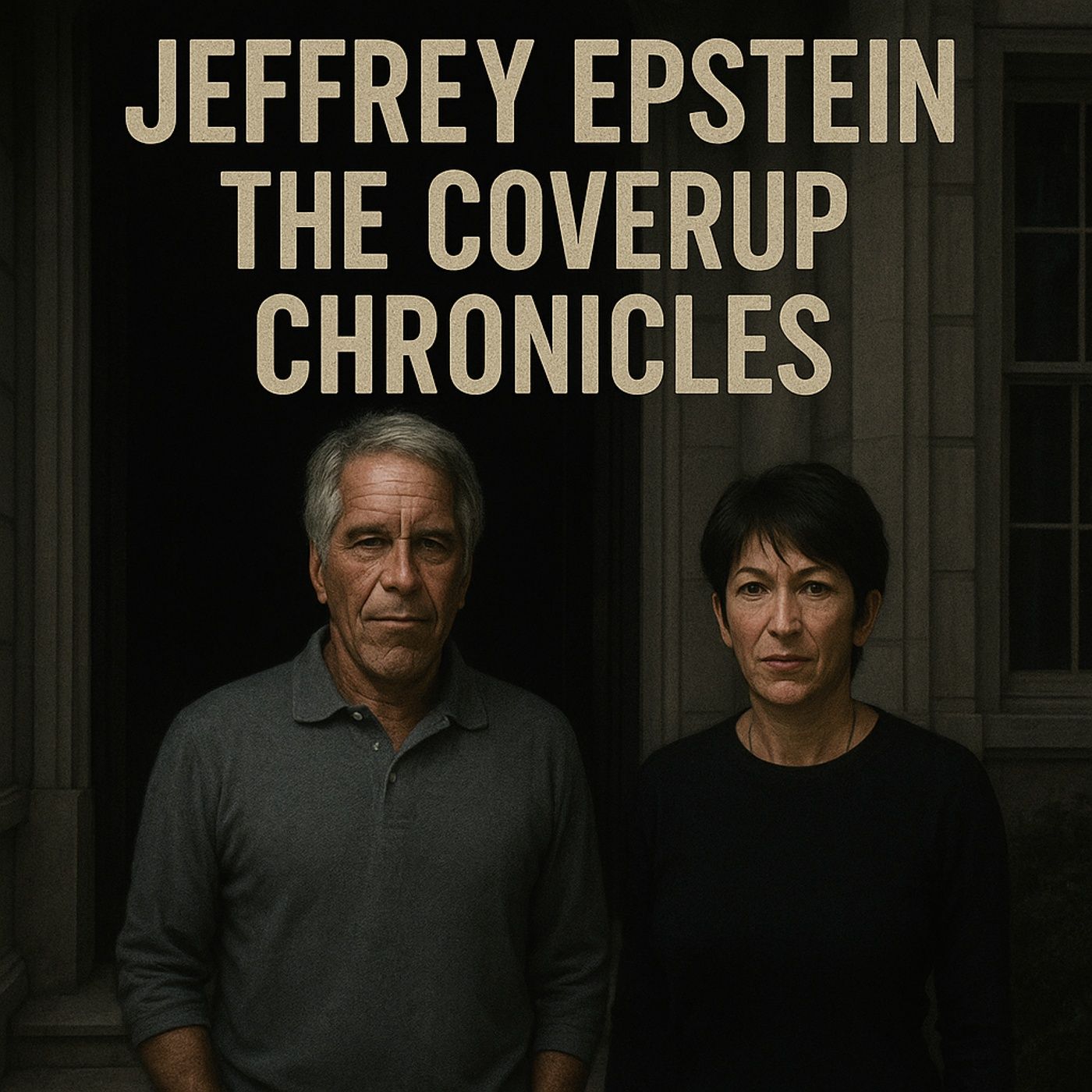
A Sitting President, an Alleged Forgery, and No Investigation
Get every episode summarized
Each time Jeffrey Epstein: The Coverup Chronicles publishes, we email you a written briefing from the transcript — the topics, who appeared, and any specific claims, with the ad reads skipped.
Email me new episodesFree for 3 shows. No card needed.
About this episode
“Ever since the Wall Street Journal reported that Donald Trump sent a birthday greeting to Jeffrey Epstein, Donald Trump has denied that that letter or note was ever sent by him. And if that's true, then where did this letter come from?”From the transcript
This does not prove that Trump wrote the message, but it creates a legitimate credibility problem for his denial. A defamation lawsuit can impose costs, create delays, intimidate further reporting, and keep the dispute framed around media conduct rather than the document’s authenticity. A real forgery investigation would be harder to control and could either vindicate Trump or produce evidence contradicting him. Given Trump’s documented social relationship with Epstein during the relevant period, the existence of a birthday contribution is not inherently implausible. Until the administration demands an independent forensic examination and explains who supposedly forged the message, the suspicion will remain that the lawsuit was intended less to uncover the truth than to slow the release of damaging information and create enough doubt to protect Trump politically.
to contact me:
[email protected]
Get every episode summarized
Each time Jeffrey Epstein: The Coverup Chronicles publishes, we email you a written briefing from the transcript — the topics, who appeared, and any specific claims, with the ad reads skipped.
Email me new episodesFree for 3 shows. No card needed.
Hosts & guests
Transcript ready
111 searchable segments. Every word is indexed and playable.
Full transcript
Jeffrey Epstein: The Coverup Chronicles — A Sitting President, an Alleged Forgery, and No Investigation. Machine-transcribed; use the interactive transcript above to jump the player to any line.
What's up everyone and welcome to another episode of the Epstein Chronicles. Ever since the Wall Street Journal reported that Donald Trump sent a birthday greeting to Jeffrey Epstein, Donald Trump has denied that that letter or note was ever sent by him. And if that's true, then where did this letter come from? And even more importantly, is somebody trying to frame the president? In this episode, we're going to talk a little bit more about the alleged birthday note that Donald Trump sent to Jeffrey Epstein. When we're talking about the birthday message, the central issue is not merely whether that message attributed to Donald Trump is genuine, but whether the administration's response is consistent with its claim that the document was fabricated. The message appeared in a birthday album reportedly assembled for Jeffrey Epstein's 50th birthday in 2003, and later obtained from Epstein's estate by congressional investigators. Trump has denied writing, signing, or drawing the message, and has repeatedly described it as fake.
The White House has likewise treated the document as another political and media attack against the president, yet calling the document fake is not the same thing as demonstrating that it was forged. A forgery of this magnitude would represent far more than an inaccurate newspaper story or an embarrassing political prank. It would mean that somebody manufactured evidence to connect a sitting president to the most notorious ex-trafficking scandal of the modern era. Such conduct could potentially involve fraud, identity theft, obstruction, false statements, evidence tampering, or a coordinated attempt to manipulate Congress and the public. It would also create an urgent national security and law enforcement question about who possessed Epstein's records and who was altering them. The striking fact is that the administration has generated far more noise about the publication of the message than about identifying the person who supposedly forged it. If the document is fraudulent, investigators should begin with the most elementary question, where did it come from?
The reported chain of custody does not begin with an anonymous social media account or an envelope mysteriously delivered to a newsroom. The message was reportedly contained in a bound album assembled decades ago and eventually produced by Epstein's estate. That chain of custody does not automatically prove Trump authored the message, but it makes the forgery theory considerably more complicated. Someone would have needed to create the message, imitate or reproduce Trump's signature, place it among authentic contributions, and ensure that it remained undetected for years. Investigators would therefore need to determine when the page was produced, what materials were used, and whether it was physically incorporated into the original album. They would also need to interview the people who collected the birthday submissions, handled the book, stored Epstein's property, and transferred the material to his estate. Handwriting specialists could compare the signature with authenticated Trump signatures from the same period, rather than relying upon political spokesperson and television surrogates.
Paper, ink, printing methods, metadata, fingerprints, and an archival photograph might further establish whether the page originated in 2003 or was inserted later. None of those investigative measures require speculation about Trump's guilt or innocence because they are precisely how a serious forgery allegation should be tested. And that's why for me, the White House's failure to publicly demand such an inquiry creates a glaring contradiction in its position. Trump's not alleging that a reporter merely misunderstood a conversation or misquoted a confidential source. He is effectively alleging that a physical document bearing his name was manufactured and inserted into the historical record. Presidents have ordered or encouraged investigations over matters carrying far less potential consequences than that. Trump's administration has repeatedly portrayed hostile actions against him as conspiracies, hoaxes, weaponization, or attempts to interfere with the presidency.
In this instance, however, the supposed conspiracy would come with an identifiable piece of evidence, a chain of custody, a limited group of possible custodians, and numerous forensic avenues for examination. This should make the alleged defense unusually attractive to an administration that regularly promises to expose wrongdoing against Trump. Instead, the principal response has been political, denunciation, and civil litigation against the newspaper that reported the document's existence. That choice attacks the messenger while leaving the alleged fabricator untouched. It also permits the White House to repeat the word fake without submitting the underlying claim to the discipline of an independent criminal investigation. The absence of an aggressive forgery inquiry does not prove authenticity, but it unquestionably weakens the administration's performance of certainty. And the lawsuit against the Wall Street Journal must also be understood for what it can and cannot establish. A defamation complaint is not itself proof that the disputed reporting is false.
Lelthian powerful people routinely file lawsuits to challenge damaging stories, control public narratives, impose legal costs, obtain discovery, and discourage further reporting. Trump's original complaint was dismissed after a federal judge concluded that he had not plausibly alleged that the journal published the report with actual malice. The dismissal did not produce a judicial finding that Trump wrote the message, but neither did the lawsuit vindicate his denial. Trump subsequently filed an amended complaint continuing a legal battle that keeps attention focused on the newspapers conduct rather than on a forensic examination of the document. That distinction is critical because defamation litigation asks whether the publisher acted with a legally required degree of fault. It does not automatically resolve who created the page when it was created or how it entered Epstein's birthday album. The journal's report also disclosed Trump's denial, which makes it harder to portray the publication as an in an effort the hideous side of the dispute.
Consequently, the lawsuit may function more effectively as communications and a pressure campaign than a mechanism for determining the document's authorship. There is also a practical reason a political figure might prefer litigation to a government forgery investigation. A lawsuit can be shaped a laid amended narrowed, appealed, publicized, or voluntarily abandoned according to the plaintiff's legal and political calculations. A legitimate criminal investigation is far less controllable once agents begin collecting records, interviewing witnesses, commissioning forensic tests, and documenting their findings. Such an investigation could confirm the president's account, but could also produce evidence, contradicting it. It might reveal that the page is contemporaneous with the album that the signature resembles authenticated examples, or that witnesses remember soliciting or receiving Trump's contribution. It could require testimony from people connected to Epstein Maxwell, Trump, the estate, and the birthday book project.
It could also expose additional communication or social interaction that neither of the White House nor Trump's attorneys want examined publicly. By contrast, a defamation lawsuit permits Trump to present himself as the injured party, while arguing over journalistic standards and legal pleading requirements. That does not establish that the lawsuit was filed solely to suppress her delayed disclosure, but it explains why litigation may be politically safer than forensic scrutiny. The unanswered question is why a president proclaiming total confidence and his innocence would choose the less conclusive path. Trump's known social relationship with Epstein gives a disputed additional context without proving authorship of the message. The two men move within overlapping social circles in New York and Palm Beach, during the period relevant to the birthday album. Trump publicly praised Epstein in 2002, describing him as a long time acquaintance and commenting on his interest in women. Photographs and video footage have also documented the men attending social events together.
None of that proves that Trump participated in Epstein's crimes or composed of disputed birthday greeting. It does, however, make the existence of a birthday contribution less inherently implausible than the White House rhetoric suggests. A forged message normally requires an explanation for why the forger selected a particular person, format, tone, and historical setting. Here, the alleged author was someone who undeniably knew Epstein and had publicly spoken warmly about him near the time the album was created. The administration, therefore, cannot dispose of the document merely by treating any association between Trump and Epstein as an invented political narrative. The historical relationship raises the evidentiary stakes and makes independent authentication more necessary, not less. The forgery theory also suffers from an unresolved problem of motive, who supposedly created the page and what did that person expect to accomplish by placing it in a private birthday album in 2003.
If the document was forged at the time, the forger would have needed to anticipate that Epstein would later become internationally infamous, and that Trump would later return to the White House. If it was forged more recently, the perpetrator would have needed access to the album or the ability to replace, insert, or reproduce a page without detection. Either scenario should leave witnesses, documentary traces, physical inconsistencies, or communications that competent investigators could pursue. The White House is not publicly supplied a coherent narrative, identifying when the forgery occurred, or who had the opportunity to commit it. Instead, the accusation frequently operates as a conclusion that requires no mechanism, culprit, or evidence beyond Trump's denial. Now, that may be sufficient for partisan messaging, but it is inadequate as an investigative explanation. A genuine claim of fabrication should become more detailed as evidence is examined, not remain permanently suspended at the level of accusation.
Until the administration explains the alleged forgeries origin and mechanics, fake remains a political assertion rather than a demonstrated fact. It's therefore reasonable to consider whether Trump knows the message is authentic and is using legal aggression to create doubt, delay, consequence, or intimidate further publication. That remains as an inference rather than an established fact, and I think it's important to label it accordingly. Nevertheless, the inference arises from observable conduct rather than from fantasy. Trump denied the message before the public had access to the entire birthday album, attack the publisher, filed an enormous lawsuit, and continued litigating after the original complaint was dismissed. At the same time, his administration did not announce a comparable effort to identify and prosecute the alleged forgery. This imbalance suggests that controlling the story may have received greater priority than solving the supposed crime. Litigation also produces a familiar political image in which Trump appears combative, persecuted, and unwilling to retreat.
Even an unsuccessful lawsuit can serve that purpose by allowing its supporters to interpret adverse rulings as proof of institutional hostility rather than weakness in the claim. The longer the legal dispute continues, the easier it becomes to tell the public that the matter remains unresolved and should not be judged. That dynamic does not prove the message is genuine, but it makes the lawsuit entirely compatible with the strategy of delay and narrative management. The administration's credibility is further damaged by its selective approach to allegedly fabricate Epstein material. When federal authorities have concluded that other Epstein-related writings were fraudulent, they have been capable of announcing investigative findings, and explaining why the material were considered fake. That demonstrates that the government possesses both the expertise and institutional machinery to examine question documents connected to Epstein. The alleged Trump-Earthay message should therefore be subjected to the same transparent process.
Agents could establish provenance, laboratories could inspect the physical page, and independent specialists could compare the handwriting and signature. The results could then be released with appropriate documentation rather than filtered through political press statements. If the page is fraudulent, such an investigation would provide Trump with far stronger vindication than any social media, denunciation, or civil complaint. If the administration refuses that opportunity, the public is entitled to ask whether officials fear what a genuine examination might uncover. The standard cannot be that Epstein documents are authentic when politically useful and fake whenever they become inconvenient. A government claiming to restore trust must apply consistent evidentiary rules even when the president's reputation is at stake. And when you chop it all up, the administration faces a simple credibility test that no amount of partisan theater can erase. Either the message is a forgery, in which case somebody committed, in an extraordinary act that warrants a full investigation, or the message is authentic.
In which case, Trump's categorical denials are false. There may be intermediate possibilities involving unauthorized assembly, disputed authorship, or uncertainty about particular elements of the page, those possibilities also require evidence rather than slogans. What is not persuasive is the current posture of declaring a historic document fraudulent, while displaying little apparent urgency about discovering who forged it. The person falsely framing a sitting president through Epstein's private records would represent a continuing threat to the integrity of government, Congress, journalism, and the justice system. No responsible administration would treat such a perpetrator as less important than the newspaper that reported the evidence. Trump's decision to pursue the journal while leaving the supposed architect of the forgery unidentified invites the conclusion that the litigation serves as a strategic rather than truth-seeking function. It's possible that the president believes ordinary political combat will create enough confusion that definitive authentication becomes unnecessary.
Until Trump demands the forensic investigation that his own accusation logically requires, suspicion will remain that he is not trying to expose a forgery but trying to outrun a genuine document. All the information that goes with this episode can be found in the description box.
More episodes
More from Jeffrey Epstein: The Coverup Chronicles
Jes Staley And His Unredacted Motion To Exclude JP Morgan's Expert Witness Opini...
Jeffrey Epstein: The Coverup Chronicles
Jes Staley And His Unredacted Motion To Exclude JP Morgan's Expert Witness Opini...
Jeffrey Epstein: The Coverup Chronicles
Virginia Robert's Brother Says Congressman Jeff Crank Ignored Their Epstein Out...
Jeffrey Epstein: The Coverup Chronicles
Todd Blanche Produces Epstein Materials After Judge Sullivan’s Order (10/7/26)
Jeffrey Epstein: The Coverup Chronicles