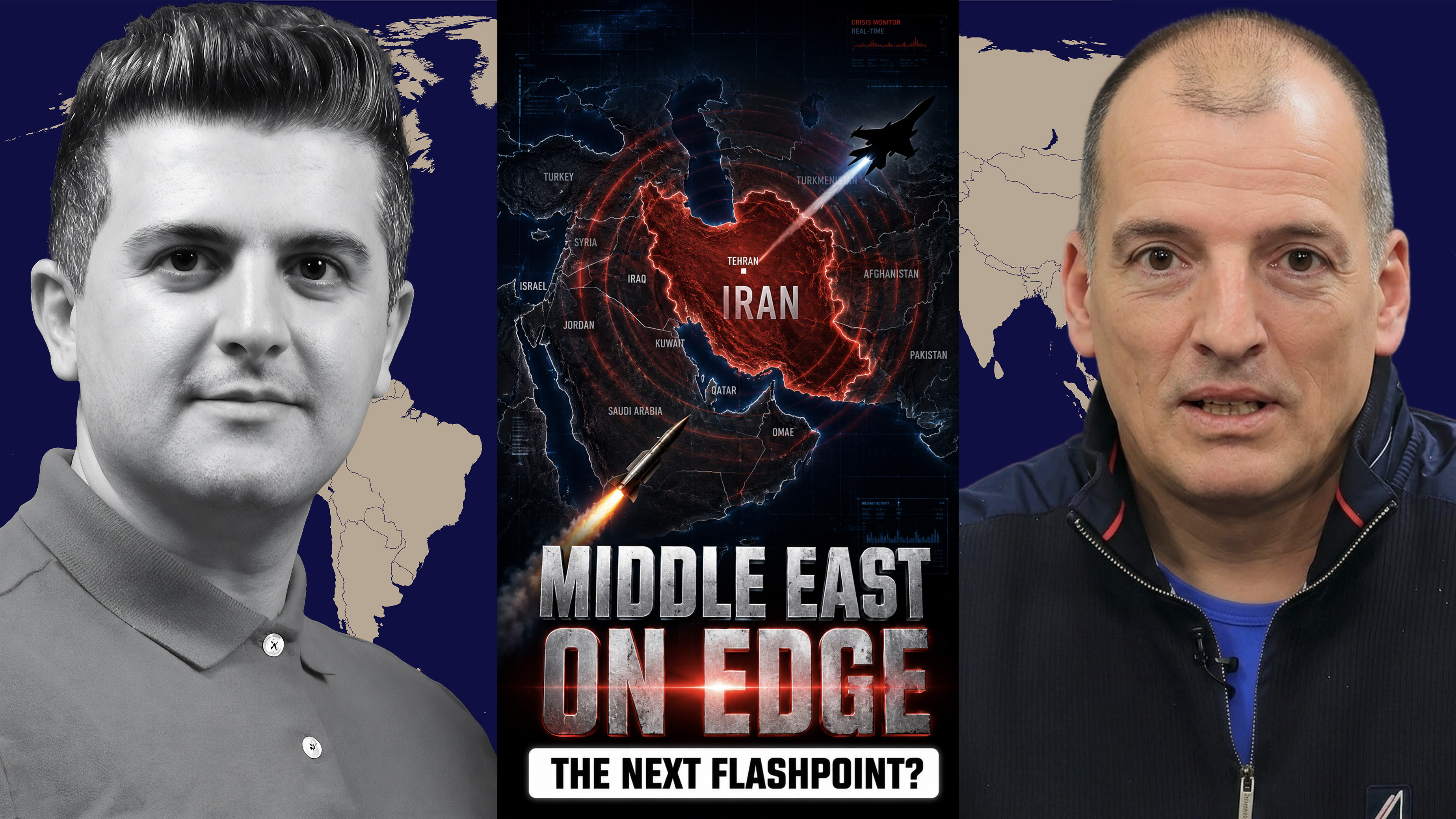
Alex Krainer: The Middle East Just Broke: Here’s What Happens Next
About this episode
Hosted on Acast. See acast.com/privacy for more information.
Get every episode summarized
Each time Dialogue Works publishes, we email you a written briefing from the transcript — the topics, who appeared, and any specific claims, with the ad reads skipped.
Email me new episodesFree for 3 shows. No card needed.
Hosts & guests
Transcript ready
466 searchable segments. Every word is indexed and playable.
Full transcript
Dialogue Works — Alex Krainer: The Middle East Just Broke: Here’s What Happens Next. Machine-transcribed; use the interactive transcript above to jump the player to any line.
Hi everybody, it's Thursday, September, 30, 2026, and our dear friend, our brother, Alex Sashak, is here with us. Welcome, Alex. Thank you for having me, Nima. Good to join you again. And warm greetings from Croatia to everyone listening. It was a great pleasure to have you on Sashak. Let's start with what has happened at the SEO summit, because it was somehow different comparing to before, and this is the first time you see all these countries coming together, can them in the American Israeli attack on Iran, and supporting all those countries who are part of the SEO and are under tremendous sanctions from the United States, naming Iran and Russia. And what is so amazing that none of those news
were, you know, covered in the West. Nobody's talking about the SEO as though nothing has happened. But it was significant. You're taken that. Well, I think it's normal that it's not covered because it's a very serious challenge to the Western global order, to the, you know, rules-based global order. And I think that the American attack on Iran on 28th February of this year was a very, very important signal to everybody that they cannot deal with this rules-based global order. And I also want to underscore that we shouldn't conflate Trump too much with what is happening, because Trump, as much as his part of it,
is merely implementing a continuity of policy that the Western world has pursued for decades now. And we know that since 2003, Iran has been on the kill list, or in the, of the Western powers in the United States. We know that from General Wesley Clark, we know that there has been continued attempts to weaken sanctions, destabilize Iran to collapse its economy and so forth. So Trump just comes as the latest, maybe the most vulgar and dumbest player in this sequence. But it's really the policy of the Western world. And what has changed this time around is that, through their electoral process, the American people have very clearly,
unequivocally, said that they don't want this, that they want peace. Trump won because he was promising no more wars. He was promising that he would not attack Iran. That was quite explicit. He was, he should, many times, he should very strong criticism of his predecessors, because he said they're covering up for their political weakness, for the weakness of their program, for their failure in managing the country's economy by, you know, going to war with Iran as a distraction. So everyone expected that Trump would, you know, given a strong mandate by winning three consecutive elections, right? That he would be able to affect a policy correction, that the course correction, that he would be able to change US policies.
And he even had certain credibility in that sense, because from his first term, we know that he, apparently, wanted to withdraw American troops from Syria and from Iraq, and from Afghanistan. And then that was obstructed, so nothing happened. And he was even talking about pulling the US troops out from Germany. So I think that much of the world had a hope that Trump would change these policies, and, you know, at the beginning of this administration, in the early months, he and the Marco Rubio and other officials were saying, on record, that the existing global order was obsolete, that it was being used against the United States, that it was weaponized against the United States, and that they wished to embrace multiple or integrations.
And so now that Trump simply fell into line with all his predecessors, continued the policies of maintaining hegemony on Eurasian continent, and attacked Iran, beyond it being a betrayal of his voters, I think it was a signal to the whole world that American policies cannot be changed at the ballot box. It doesn't matter what the American people vote for, somebody somehow manages to prevail over elected leaders, whether they bribe them, whether they co-opt them, whether they have compromise on them. However it happens, they end up pursuing the exact same imperial neocolonial policies, as all the other presidents did before them.
So Trump is a figure that's easy to hate, and I see a lot of vitriol directed at Trump, but we have to keep in mind that he didn't invent these policies. That is the policy of the Western world, and we have to be careful to try to identify the incentives that caused those policies to be adopted and implemented. And so I think that the rest of the world finally understood that it doesn't matter what the American people vote for, Western military powers, Western powers, we'll always go back to neocolonialist politics. And that I think gives a very, very strong incentive, a very, very strong impetus to the multipolar emerging world, to move away from that even more quickly.
So what we see now at the SEO summit is very explicit denunciations of this system. A lot more determination, they seem a lot more confident and determined that they have to break the bridges with the system, that they have to start developing their own systems of trade settlement systems, reserve currency systems, gold, commodities, whatever, and that they have to make certain commitments to this. That you can't hope to deal with the United States and NATO countries, hoping that somehow they'll be nice to you, and that you can just continue business as usual and kind of sit on two chairs.
I think that Trump's war against Iran has shown that you really have to choose sides. And I think that this is becoming increasingly clear to the nations of global south to Russia and China and Belarus and Iran and the Arab states and so forth, and that they are acting accordingly. So I think that we will see more of that, and I think that we'll see a much more determined effort to create alternatives, alternative trade routes, alternative payment system, alternative clearing systems, reserve currencies, and definitely new security architecture for the Eurasian continent. That is now definitely coming into shape.
We have something happening in the West Asia, which is out of the devastation, death and destruction in the West Asia. In Iran, you look at the attacks, the devastation of the attacks. You see in the GCC countries, Saudi Arabia was asking for $8 billion in loan from the international banks. This is Saudi Arabia after five months, six months, of the conflict getting to the six months, and UAE and Kuwait running out, or in short, you know, cash, asking the United States to help them. On the other hand, you see Kuwait making a new security agreement or defense agreement with Pakistan, Pakistan coming together with Saudi Arabia and Turkey coming together, that call in Mecca defense alliance, that this is the official name that they gave to this, you know, this new movement in the West Asia.
And we had the foreign minister of Turkey coming out and saying, Benjamin Netanyahu and Israel and the government in Israel. And this is the problem we are seeing in the West Asia all across the West Asia from Syria to Lebanon to Palestine. It's all about Israeli government and its behavior and the way they're trying to expand. Where do you see Alex, this new movement in the West Asia, which was absent, which was there was nothing going on in the West Asia before this attacks happening, before February 28th. There was no problem in the straightover most. None of these countries had the necessity or had in their mind the necessity of having a new defense or military alliance with anybody because they thought the American bases in their countries would protect them, would have some sort of security umbrella. And everything is just, you know, collapsed overnight with the war against Iran.
Where do you see that happening? And where do you see that going in the West Asia? I think that it's definitely going in the direction of elimination, a complete defeat of Israel. Because Israel has been established from the get go from the beginning, from before the beginning, you know, before the Balfour Declaration in 1917, Israel has been conceived as a beachhead for Western colonial powers, i.e. at the time the British Empire, to maintain their hegemony over the Eurasian landmass. Sorry about over the Western Asia. And Israel has fulfilled that role very effectively. And the fulfillment of that role meant keeping the whole region permanently destabilized,
permanently in a crisis, and permanently either at war or on the verge of war, which was very handy for Western colonial powers because, you know, when you are preparing for war or fighting a war, you need a lot of money. So you need credit. And, you know, if you have monopoly and global financial credit, then you're like, okay, so we'll loan you money, and then you loan money to the other side as well. And so you keep everybody in debt. And then if you also have monopoly on, let's say, advanced weapon systems, well, then you're also have a great business because countries that are permanently preparing for war or fighting wars need to buy a lot of weapons. And so you're selling them weapons, you're sending them advisors, you're, you know, infiltrating their political structures, you're shaping the society, and you're shaping it exactly around your requirements.
And those requirements primarily are, well, the technical term is is looting. You know, you're constantly looting those countries of its wealth. And so this is why they were being kept in crisis permanently, because then you send your BP's and exonmobles and KBR's and helicopters to develop those nations' economy. You send your advisors, your engineers, your corporations, and so forth. And so the result of this relationship was that there was like practically a massive wealth transfer conveyor belt going from from Western Asia to Western financial centers. And so that comes to an end. And I think that the key part of it, you know, in geopolitical terms was Israel.
Israel was the essential component of maintaining this order. And I think that it will always remain so for as long as it exists. There's not going to be like a democratic reform in Israel where, you know, Israeli society are going to come to the conclusion, hey, you know, we need to learn how to get along with our neighbors and we have to be fair and equitable with them. That's not going to happen. So I think it's going to, the result will be that Israel will probably be eliminated as a nation, as a state. And that will probably help transform the region's security architecture. And it will help the region evict Western colonial powers from the region.
And then, you know, I think that we have to see what the role of Turkey is going to be. But what we can already see is that Iran will probably play the dominant role. And Iran already has a very strong partnership, if not alliance, strategic alliance with China and with Russia. Turkey will see because there's there's there's there's there's there's there's really is a danger. Maybe it's not immediate immediate, but there is a danger that Turkey will be pushed into into a war against Israel over. Syria. It's not we're not there yet, you know, but they are moving pieces into place. And I think that there's a certain complacency. That the fight won't really happen, you know, there's a lot of talk.
The dogs are barking loudly. But I think that neither Israel nor Turkey really want that war. But you know, like once you start, once the dog start barking and you're starting moving troops and arsenals and you start rigging the region for a fight, a fight could break out, you know, it could get out of control. And then, you know, Israel is already in cahoots with Greece so that if something like that happens, they will they will definitely try to pull Greece into the war. Turkey and Greece are both NATO member countries. So that's going to be a massive identity crisis for NATO, which will probably result in in the in the complete collapse of the of the alliance. If it doesn't collapse even sooner. So I think that there's a lot of complications now that make it very difficult to predict what the role of Turkey will be, even though you know Turkey now has this alliance with Saudi Arabian Pakistan.
So it would appear that, you know, Turkey could end up being the 800 pound gorilla in the region. But I think it's early days, it's hard to say. But I think that Iran definitely is that 800 pound gorilla in the and I think that with each passing day, its positions get stronger and it's becoming more powerful. So we'll see, but I think that what we can predict, if not the time, the timing of it, that Israel will cease to exist and that the new security. Architecture will be defined by Iran in partnership with Russia and China and it's going to be a new Eurasian century or a new Eurasian millennium. I think what's going on in Syria, Alex, to focus a little bit on the details. It's all related how Washington sees Turkey or a country like Qatar, for example, if you hear Nathole Benet every time he's talking about Qatar, the worst enemy of Israel in the West Asia, one of the worst enemies.
You basically mention in how the public opinion in the United States has changed over years because of Qatar, Qatar influence in the United States. This is the perception on the part of Israelis. On the other hand, what's going on, what's boiling up in Syria is so serious, Alex, because Israel wants to stay in Syria. Even the latest yesterday, it was reported that the talks between the government, this al-Jolani government in Syria and Israelis have failed to achieve anything because these people are asking Israel to leave the weather from Syria and Israel is not going to do that. They're serious about it. We're going to make a buffer zone, Israel says. We're going to make a buffer zone in a certain part of Syria. It means that that land is going to be controlled by Israel and you know it starts with buffer zone and later they're going to send the settlers to the land, not to control that.
Yes, I understand that Nima, but I can't tell which part of that story is realistic and which part is delusion. My suspicion is that it's mostly delusion. You know, Israel is already getting their teeth knocked out by Hezbollah, practically on a daily basis. They're trying to get al-Jolani to take care of Lebanon for them. But al-Jolani's government is actually very weak and they're very afraid that if they did that, if they acted like the obedient proxy force of the Western powers, that their government is going to be the end of their government. And they know that from Iraq, there's...
There are proxy... Let's say there are military forces, which some people say that there are Iranian proxy militias, but you have to take that with the qualification. Who have said that, right, if you... If HDS intervenes in Lebanon, we're breaking into Syria. And you know, Syria and Arab Army, when at the end of 2023, or was it 24? Well, whatever, you know, when Bashar al-Assad's government fell, parts of the Syrian Arab Army didn't disband. They crossed the border. So it was November, December 24, right? Yeah. Parts of the Syrian Arab Army crossed the border into Iraq.
And my understanding is that they're still there, and their numbers are not small. It's according to Vanessa Bealey, who is a correspondent from the region and who's usually very reliable, very well informed, there's an estimated at least 70,000 of these troops ready to go back to Syria. And maybe there's even more. Maybe as many as 90,000. Well, that's a very considerable force, given that, you know, HDS, when they took down Bashar al-Assad's government, there was 30,000 of them tops, maybe less. So this is a very serious challenge. So now, who's going to go clean up Lebanon for Israel and for the, you know, Anglo-Sionist Kabbal? Well, nobody. So it's very difficult to predict what's going to happen, but Hasbale is growing stronger.
Israel is growing weaker. Iran is growing stronger, and the axis of resistance is growing stronger as well. We've also seen that Ansarallah has been really, really decimating Saudi forces that have tried to, again, you know, take out Yemen, Ansarallah and Yemen. So I think that all the winds are blowing against the Anglo-Sionist Kabbal and their forces, you know, Israel, UAE, and so forth, and these jihadim militias. So I think in the end, there's going to be a lot of developments that are now next to impossible to predict if a conflict breaks out between Israel and Turkey. I think that it's a long shot. It's not very probable, but it could happen still.
And then, you know, then you're getting into prophecies, you know, where there might be very deep reforms of the Turkish society as well. You know, it might have very, very strong repercussions that I think from today's point of view are next to impossible to predict. But, you know, among other things, the prophecies, which, you know, I used to kind of ignore them, that is, you know, I used to regard them as, you know, something somebody formulated a very, very long time ago that can't possibly be accurate. But a lot of these prophecies have actually come to pass with eerie similarity to modern events. And one of them is that Istanbul is going to go back to being Constantinople, and that, you know, that IAS of Fia is going to become an orthodox church again.
I don't know what that means in terms of everyday geopolitics, but it sounds like a lot of turmoil up ahead. And, and, and by the way, it's not just me saying this, is that a lot of people in high positions of powers seem to be taking these, these, these prophecies very seriously. Alex, what is happening in Syria is that Israel doesn't want any of these governments around Israel. They don't consider, in my opinion, they don't want a government in Syria. In Lebanon, they want to mayor something like a governor in Syria that has no capabilities to have any sort of, to cause any sort of problem with, for Israel. But the policy in Turkey is quite opposite. You see, they're trying to train, they're trying to send weapons inside Syria.
Those weapons, as you mentioned in December, 2024, when they, after the fall of Bashar Assad, Israel basically destroyed everything, Syria had everything. There is nothing there anymore. And that's the difficulty for anybody. That's a soon sooner or later, they're going to have the changes. They're going to have you mentioned the army, you know, but these changes are part of the, you know, plan for Syria in my opinion, when it comes to Israel, it's so important because they're neighboring country. If they're powerful, it means that they're going to have a powerful neighbor, which would benefit, they're going to benefit from that. One of the main reasons that Russia is not destroying all of Ukraine, the western part of Ukraine, why is that? Because they don't want to fail state on the border. They don't want that happening. The same thing has happened in the West Asia for many years in Iraq and Afghanistan.
We've seen the devastation of these wars going to Iran, going to Turkey. And these countries were under tremendous pressure because of these endless wars of Israel in the West Asia. So they know the devastation of, you know, having a failed state on your border. And that's why, but Israel's policy is all about the failed state. Have a failed state in Lebanon, failed state in Syria. That would benefit the Israeli agenda. Well, Nima, I would say that that would benefit the agenda of the western colonialist powers. Israel is getting mangled in the process. You know, the Israeli people, I don't even understand. It's like they're living in an alternative, alternative reality where they think that they can go to war, get to everybody and take a fight everywhere and still be dominant and prevail. So I don't even, you know, what Israelis think and what they want.
It's almost better to ignore because it doesn't make any sense at all. You know, they're saying like, okay, when we're done with Iran, you're not done with Iran. But when we're done with Iran, then we're next we're going to take on Turkey. And then, you know, we're going to go against Pakistan. And it seems that Israeli idea of security is to turn the whole world into Gaza, destroy everything. And as you said, have governors, have mayors and governors who maybe have a lightly armed police force. But definitely nothing that can even slightly be a threat to hyperparanoid Israelis who see a threat in, they see a threat in little toddlers. So they have to kill them because even that is a threat to them. But the colonial powers, they know why they're doing this because if, if all, if this whole resource rich region is constantly in turmoil, they have to get credit from us.
They have to buy weapons from us. And they have, they have to let our corporations develop their economy because theirs is devastated. They, you know, they can't form engineers, they cannot form capital, they cannot form the know how necessary to, you know, build all these industrial facilities everywhere and participating global markets. So they completely depend on us. And the more, the more desperate they are, the more they depend on us. And so we want them to be in constant turmoil, in constant warfare. And the fact that Israel is getting mangled in the process, well, that's what we made Israel for. That's what we created Israel for. And we told the Jews that this is going to be your home country where you're going to be safe. How safe are the Jews in Israel? Well, they're clearly not very safe. But, you know, they've come to, they've come to regard their conditions as something wonderful and glorious.
And they, they passed these photographs of young mothers carrying their babies in their arms and then an automatic rifle on their back. And for some reason, they're proud of this. But this is horrible. I wouldn't want the mother of my child to be walking around the street with an automatic rifle on their back. But, you know, that's the reality that they have created. It seems completely surreal. It seems completely insane. But that's what they've created. And, and the ultimate reason for this reality is because Western financial institutions have a free hand in that region. So, most of the wealth from that region is constantly being sucked out into the West. And so, that's where I think the root of the problem is, and that's where the problem is going to have to be resolved and settled because, for as long as these same occult oligarchies are in power in the West, they will continue to implement this exact same system of governance.
And they will try to keep the whole world at war permanently indefinitely until they are tartan feathered, run out of town on a rail and disenfranchised. And then, you know, we need a completely new model of governance and completely new security architecture. And, you know, this is exactly the question that we started off with. This is why the SEO is now really determined and it means business in order to create this new system of governance and a new security architecture. Alex, we see two different attitudes. One of them is from the United States. Basically, it's all about submission. It's all about forcing zero some game. And the attitude of China, I would say, or the West Asia or the Eurasia or global South, the best term of global majority is that we can, we can call it a compromise and cooperation.
You see that in the SEO, they have their differences that come together, they understand. And but they cooperate after all. And you don't see that happening with the United States. You look at what's happening between the United States and Canada. For example, Canada is the most important, I think, in the northern part of the United States. Basically, they have to have the best friendship. But that's not happening today. You see that happening in Latin America, how the United States in Africa in Venezuela, it just basically, you know, what Donald Trump is doing to Venezuela, I think, one day in the history book, we're going to learn how ugly it is what Donald Trump is doing. You know, it's not about, you know, let's let's talk about 13 billion dollars so far, he sold from Venezuela and oil. But does that really mean that the United States can again something, you know, the picture that they're getting everybody knows in Latin America, they're still in Venezuela. And they're getting everything out of there, they're controlling the government. This is not a good picture for a superpower to be seen.
But on the other hand, you see China is changing its behavior since the war in Ukraine started, in my opinion. And, you know, they were so much, they were, you know, in the initial days of the war in Ukraine, they tried to be, you know, somehow in the middle, then as time went by, you see China coming out and say, we're going to support Russia. It doesn't matter what, whatever would happen because of they have a framework bricks all coming together and working together with the case of Iran, the operation, economic outcast China in the initial hours of the announcement of that, you know, attack on Iran economic attack on China said we're not going to be part of this. Even Pakistan said that Pakistan, you see how dependent Pakistan is on the United States, but they said we basically care about those sanctions by the UN. And we're not going to be part of the operation economic outcast on Iran. This is the new world little by little, the learning from, you know, themselves within the global south.
Where do you see these two different systems, compromise and cooperation and making new partnerships and developing? And the other one is the dominance, zero-sum game. I think that the conflict goes until one system is finally defeated. And I'll try to explain why, because, you know, this is something that has kind of, it has a lot of power. It has been my, the focus on my research to try to understand, because pretty much since the early 1990s when we had wars in former Yugoslavia, because, you know, like we had, we had wars of succession when former Yugoslavia fell apart. And I, I was in my 20s, I was in my early 20s and like many young people, I volunteered to serve in the military because I thought that I would be fighting for my country's freedom.
You know, like many, you know, many Israeli soldiers today might feel that they're fighting for their countries and many Ukrainian soldiers today may feel like they're fighting for their country. That's not what's happening. And what they're fighting for is for one side or the other to have the control, the political control of a nation or a region. The reason why the people who sponsor these wars, the reason why they need political control of Iran, Ukraine, Russia, China, you know, you name it is because that gives them control of the country's collateral. And the control of collateral really is a zero sum game because if you focus on trade and cooperation, let's say, let's say Russia produces oil and Russian oil sells a, let's call it $75 a barrel.
And it costs them, let's say, $50 a barrel to extract it. So that leaves $25 a barrel in profits. So now if it's about trade, then the Russians can say, okay, if you want to be a partner with us, we can split this profits. So expected profits of $25 a barrel, let's say, we take $10 and you get $15 or we get $15 and you get $10. And then, you know, like you negotiate. And somebody gets something. But when you're talking about collateral, then it can be shared. Whether it's mine or somebody else's, if I don't steal it, somebody else will, you know, can basically, if you have control of the collateral, that means that you can issue credit against it.
And so if my bank, if I as a banker, get to control that collateral, I can issue credit against that collateral. And now it has to be mine because if my client can't repay those loans, then I get to foreclose, I get to seize the collateral and now it's mine. And so that's where the, that's, that's the essence of the incentives that create a zero sum approach to policy, which means that the policy is driven by the financial interest. And I'll, I'll give you a very concrete example of former Yugoslavia, because as I told you this, this kind of started pushing me to try to understand since the war is in Yugoslavia. So here's what happened, you know, I remember when the war started in 1991, what I didn't remember is that already in the early 1980s under the Ronald Reagan administration, there was a decision made by the United States, let's say,
national defense establishment, they issued a document called NSSD, which means national strategic NSDD, national strategic decision directive about former Yugoslavia. And they decided that they were going to transform Yugoslavia from a communist government to, from a communist economy to a capitalist economy to open market economy. And that seemed almost reasonable, but what happened is that they started forcing IMF and World Bank structural reforms. So all of a sudden, we, you know, the country was, was forced to do away with subsidies to, to cut back on salaries, unemployment benefits, pension benefits. Health care, you know, health care and education. So it had to cut all of this.
And then they also, you know, in, in former Yugoslavia, we had thing called worker managed enterprises, meaning, you know, these are enterprises that were formally state owned, but they were completely managed by structures, staffed by employees of the company. That was the model. Well, you know, they, they decided that this had to be destroyed and that the Yugoslavia industrial base had to be bankrupted. And so between, let's say in, in, in, in late 1980s, call it 1987, 1988, the NED, National Endowment for Democracy started sending economic advisors. What, what they were doing in practices, they were bribing politicians, media media organizations, journalists, they were creating NGOs. And they started creating pressure for reforms.
And these reforms included completely destroying Yugoslavia's industrial base, meaning that, let's say, between 1988 and 1990, something like 1100 industrial companies in Yugoslavia were destroyed, they were bankrupted. And so you had very rapid rising unemployment and like unemployment showed up to 20% in a very short order and standards of living declined by about 20%. And now you had, you know, as, as NED was bribing media organizations, they started pumping up ethnic tensions to the point where, you know, you have examples where a, a, a newscaster in Belgrade was reading exactly the same speech as a newscaster in Zagreb, Croatia, exactly word for word, except in the Serbian version, Yugoslavia, Croatia was the aggressor and Serbia was the victim. And in the Croatian version, the, the, the Croatia was the victim and Serbia was the aggressor.
So you started creating this polarization and then you started pushing the society towards war. Okay, war started in September in the summer of 1991. Before, before all this started in 1988, the total external debt of former Yugoslavia was something like 13.5 billion dollars. Okay. By 2003, no, by 2010, it was 160 billion dollars. So that's about 14 fold increase. What that means, NEMA, is that Western financial institutions had 14 times the assets based in former Yugoslavia as they had before that war. And the cash flows that had to go from the country, from individual republics that remained, to service those debts increased probably 14 fold, maybe more, who knows.
Which means that, you know, it's a, it's a very complex system of looting again. You know, you, you caused all these republics to go to war against each other. You convinced people that the other one is the enemy and everybody started shooting at each other. You destroyed the country. You came in as the savior. You know, we're going to help you. Here's credit. Here's weapons. You know, go win your war. We're with you and so forth. And then at the end, you know, you're up to your eyeballs in debt and everything you produce, everything you create, you have to pay back to these, to these new friends in the West. And so, you know, that's the model. That's the model. But, you know, as a normal person on the street, you don't see it. And so that's why young men like me, they volunteer for war because they swallow the story about, oh, well, these people are the aggressors and we're the victims. So we have to fight back. We have to defend ourselves. And so they keep doing this.
You know, Ukraine, Russia, Belarus, Iran, Palestine, Lebanon, Sudan, Somalia, Venezuela, Cuba. You know, everywhere, it's always the same thing. But the ultimate objective is looting. The ultimate objective is to create this massive wealth transfer conveyor belts that suck out all the wealth created from these regions into money centers like Paris, city of London, Wall Street. And the same is happening today. And, you know, Trump is just the last in the sequence of their puppets. Same with, you know, Rishi Sunaq and Kirstarmer. And now this burned hand guy who is, they don't even matter. The elections don't matter. We can't change this system through elections. But countries like Russia and China and Iran, they see all this.
And they say, people in the West are lost. They cannot get out of this by elections. We have to create an alternative system. And so that's what they're doing. And we hopefully in the West will be able to sober up and put an end to this because otherwise, you know, what they're doing to Ukrainian boys today, you know, the press gangs that just like push them one after another into the media. And then they say, you know, they're going to be in the other into the meat grinder. Apparently about 30,000 of them a month. The same is going to happen to French men, to Croatian men, to Polish men, German, British guys. It's all coming for us. It's not like they are doing this to Ukrainians, but they wouldn't do it to us. They will do it to us. Believe me, without any second thought, this is the Epstein class. So anyway, you know, that's my long rant, but this is basically what's going on.
And for anybody out there who thinks that if they go to war that they were defender country. That's not what's going on. Alex, I think what you mentioned considering the economy is so important. Look at what has happened in Japan, Europe, the United States. You know, you have the industrial capitalism turning into financial capital, and they produce nothing. And they're not even comparable when it comes to the production. The United States is not even comparable to China today. Because for such a, look at the plaza accord with Japan. What was that all about? The destroyed industrial base. What Japan produces today? What Europe produces today? What the United States produces today? The whole system, Alex, in my opinion, because they thought that the industrial part could be, could be, you know, transferred to those slaves in China. And those slaves today, they're not slaves anymore. They're not producing for the kingdom.
They're producing for themselves, for their own government. This is the problem that the West is so deep, but nobody seems to understand it in the West. That's why they're trying to push more for this financial dominance of the system. Yes, yes, absolutely. Agree with you, Nima. And, you know, the economic collapse of Germany and Europe is not accidental. Because, you know, as I told you in very brief terms, how former Yugoslavia was first destroyed, destroyed economically to create conditions for war. The same is being done now in Germany. It's being destroyed economically because, you know, when you, when you destroy, when you have a prosperous country, where economies doing well, where young men have aspirations for the future, when they, when they expect that they will be able to get good jobs and have good salaries, that they will be able to buy home.
And, you know, when you're able to buy homes and raise families, they're not very interested in war. And if you wave Russia in front of them, they think like, ah, Russia is a very wealthy country. It has like almost 150 million people. Maybe I can go to Russia and sell my products there. That's, you know, that's the thinking. But when you destroy their economy, when you, when you create very high levels of youth unemployment, where young men don't think that they're going to have a bright future, that they will be able to buy a home, raise a family. And, and have a good life. And then you wave Russia in front of them. And they say, you know what? Everything is crap because of Russia. It's the Russians who are doing this to us. So, you know, you have to go to the army and we have to go and kill the Russians. Then, you know, you're going to get a lot of people who are going to go into buy this and he, they're going to think like, well, you know, look at all these historical injustices. And, oh, I, I get to have the privilege of fighting for my country and blah, blah, blah. You know, that's, that's how they mobilized Ukrainian men to go fight, fight Russia, even though there was never any reason for that.
And so, this is being done deliberately. And, you know, as, as they were, as they were prepared to fight Russia to the last Ukrainian, they will be prepared to fight Russia to the last pole and the last suite and the last German and so forth and so forth. So, for as long as this banking oligarchy is in charge in London, in Paris, in New York and elsewhere, they will never, ever give up. They will never relent. They will always look to undermine and destroy Russia, Iran, China. They will always seek to dominate because again, you know, control of the collateral is a zero-sum game. Either it's mine or it's somebody else's, it can be shared. And so, I think that inevitably, the clash of these two systems will end when one system is destroyed.
I think that for the first time in history, this is now apparent and clear to everybody. Well, to everybody, it's, it's clear to me that the Chinese leadership and the Russian leadership and probably Iranian leadership by now as well understand this dynamic and that they understand that the West will not stop at some treaty. You know, that you're going to conclude a treaty and then they're going to say like, well, okay, fine, we're going to be good neighbors now. This will never happen. You know, they made it, they made a commitment to Russia in 1990s, in 1991 that, you know, no, even earlier, late 1980s, that NATO would not move one in cheese toward if the Russians withdraw from Eastern Germany and allow reunification of Germany. So the Russians honored their side, the West never honored their side. And then, you know, we had the Minsk Accords, Minsk 1 and Minsk 2 where, you know, again, they made an agreement, not really with Russia, but Russia was, Russia was part in formulating those agreements and the objective of the agreement is to keep Russia from intervening in Ukraine.
So the Russians agreed. The Lugansk and Donetsk people, peoples republics agreed. The West never had any intention of honoring their side. So it's always the same, you know, they make an agreement just to suit their short-term objectives Same with Iran, right? JCPOA they sign an agreement and then next thing they walk out because they Whatever we don't like it. We want to do something else then they negotiate something else and then they killed the negotiators and they tried to So it's it's always the same a thousand times over We which means that this Western Neocolonialist system of governance will never relent. They will never allow the Russian people Iranian people Venezuelan people to enjoy their resources and to build up their societies and their prosperity and to to live in peace
They will always be creating basically hell on earth So that means that they have to be defeated. They have to be disenfranchised completely Their whole system has to be raised to the ground and Reformed And what what I mean by raised to the ground. I don't I don't mean, you know turning London into Gaza. What I mean is that the This Epstein class that's running the show has to be probably They probably have to be apprehended prosecuted and Put away forever and the the monetary system in the Western world has to be completely overhauled It cannot remain what it is because otherwise it predictably Poisons all relations in society and Creates conditions for forever worse
Good good point to wrap it up Thank you Alex for being with us today Thank you for the name Thank you likewise and until the next time see you soon Alex. Okay. Bye. Bye
More episodes
More from Dialogue Works

Nima R. Alkhorshid: US Navy FLEES After Iran’s Hypersonic Missile Impact – New I...
Dialogue Works

Col. Larry Wilkerson: Missile Over Carrier: Iran's Bold Test Sends US Navy Runni...
Dialogue Works

Paul Craig Roberts: Iran and the U.S. Move Closer to a Major Confrontation
Dialogue Works

Col. Jacques Baud:BREAKING: Houthi Missiles Strike Saudi Aramco – Fire Erupts at...
Dialogue Works