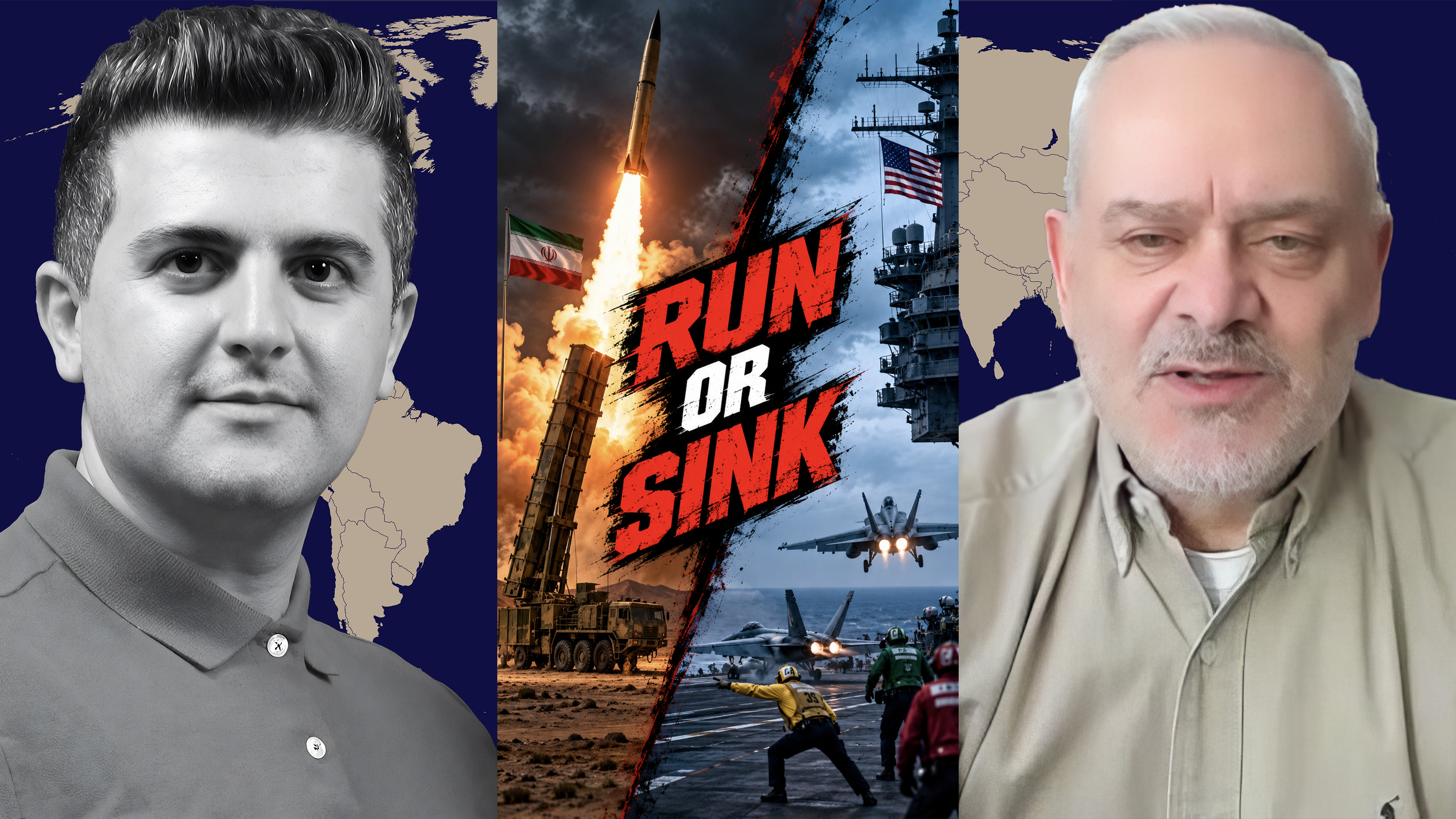
Col. Jacques Baud:BREAKING: Houthi Missiles Strike Saudi Aramco – Fire Erupts at Jizan Facility
About this episode
Why is Western intelligence failing? This analysis explores the fatal flaw of prioritizing tactical counter-terrorism over strategic understanding. While the US and Israel excel at tactical strikes, they consistently underestimate the strategic depth and resilience of adversaries like Iran, the Houthis, and Russia.
Discover how a purely tactical approach—called 'noise before defeat'—leads to disastrous miscalculations in the Middle East and Ukraine. We break down Iran's calculated patience, the shifting global balance of power, and the West's inability to grasp the true operational will of its enemies.
A must-watch for insights into modern military doctrine and geopolitics!
Hosted on Acast. See acast.com/privacy for more information.
Get every episode summarized
Each time Dialogue Works publishes, we email you a written briefing from the transcript — the topics, who appeared, and any specific claims, with the ad reads skipped.
Email me new episodesFree for 3 shows. No card needed.
Hosts & guests
Transcript ready
341 searchable segments. Every word is indexed and playable.
Full transcript
Dialogue Works — Col. Jacques Baud:BREAKING: Houthi Missiles Strike Saudi Aramco – Fire Erupts at Jizan Facility. Machine-transcribed; use the interactive transcript above to jump the player to any line.
Mod.com is changing the way people battle excessive fatigue. Ever hit a wall in the middle of the day and the third coffee just doesn't do it anymore? Here's what's actually happening. Coffee only briefly blocks a denocene, the chemical that tires you out. When it stops working, your system is flooded and you crash. Medaphineal is a prescription treatment that works in a completely different way. Medaphineal works by stimulating multiple receptors in the brain associated with wakefulness, including dopamine, serotonin, noripinephrine, histamine, glutamate, and erexin. It's a more complete solution that gives you 10 to 12 hours of steady focus and energy. To learn more, go to mod.com. Fill out your intake form, meet with a license provider, and if approved, mod alert ships straight to your door. Go to mod.com to get started. That's m-o-d dot com. Who says Halloween only lasts one day?
With Wayfair, one night of Halloween becomes a whole season at home. From larger than life yard decor and moody lighting to festive accents for every room in the house. Wayfair has what you need to make Halloween feel like magic all in one place. Because the best Halloween memories aren't made in just one night. They're made all season long. Shop Halloween decor now at wayfair.com. Wayfair every style every home. Losing way can feel like a roller coaster, full of ups, downs, and being thrown for loops. Like when someone brings donuts into the office, or your kids' dino nuggets start giving you that look again. That's why there's noom. They combine GLP ones to quiet the food noise, with healthy habits that help you keep it quiet, even if you get off the meds. Their program is designed to make weight loss a smooth ride, helping you understand what drives you. So you can build better habits to not just lose weight, but keep it off. Noom. Lose for keeps. Get started at noom.com. Not all customers will clinically qualify for medications.
Individual results may vary. Hi everybody. This Monday, September 7th, 2026, and our dear friend, our brother, Carl. Jacques Will is here with us. Welcome back home. Hi, Nima. Thank you for inviting me again. Happy to be back in your show. Thank you. So happy to have you back home. And let me start with what has happened between Iran and the United States in the Persian Gulf. And we had American attack on three tankers, Iranian tankers in the Persian Gulf. Then Iranian response to the call the US link tankers in that area. And again, Iran attack. Iran used a new muscle. They said that this is the first time they're using that type of muscle. Did you mention what type was that? But it was a ballistic missile. It was for the purpose of hitting aircraft carrier and destroyers.
And it was reported by Iranians as soon as they fired those missiles toward the destroyers and the aircraft carriers. They tried to flee that area. And this is one part of the situation. And the other thing is that the head of Iran and parliament said that the Iranian response is not going to be proportional anymore. It means that if the United States attacks, we're going to attack them in this proportionable. Where do you see the conflict in the West Asia? Are we heading towards some sort of new escalations? Well, I think the idea of escalation is that new. If you look at what happened in the last two months. So you may remember that the after the Israel and US attacked Iran, Iran started its operation to promise to promise for in fact.
True promise is a response to this attack. And true promise was stopped. I think end of June or something like that. I don't have the dates right in my head now. But this operation has stopped and it was replaced by a new operation. And this new operation was defined by horizontal escalation. That means that you respond against the Americans. But by enlarging the circle, if you want. In to some extent, you push the US back to Jordan and Israel and so on and so forth. And you deny the US its logistical base in the region. That was the horizontal escalation and a vertical escalation also by using stronger and more powerful missiles.
So you had both. So this idea of escalation is not new. This is something we have seen during the summertime. And now we are in a new phase. The new phase is in fact. Well, you can say it's an escalation. But the escalation that we had previously was kind of progressive. Iran used a progressive escalation. It intensified the pressure as long as the US. With pressure on Iran, Iran augmented the pressure on its side. Let's put it that way. So a progressive approach to escalation. Now the Iranians say, well, we are not responding as a tit for tat. If you make any kind of attack, we get we keep the rights to answer with everything we have.
I'm not sure. I mean, I understand this. This is a if I to some extent is a kind of deterrent policy within a situation where deterrence is already overcome because we are no longer in it. But that's deterrence within the fight if I can put it that way. This is how we can define what's happening. But this is a risk. And that's a reason why personally, I don't think that Iran would apply this. All or nothing type of doctrine. They will not apply that because they have limited resources as well. And we may have and that's in fact what's got the present. I started to do by engaging economics into the conflict by having this kind of isolation.
This economic outcast, which is essentially an isolation of Iran, which is in essence a kind of a attrition war. The economic attrition linked to some kind of military pressure. I'm not saying not yet military attrition, but this is a little bit what we have. So Iran now that it may be involved in its conflict in the long run. And therefore, it will it has also limited resources. Even if I can imagine that you have a huge amount of missiles towards somewhere in the mountains or in the desert or somewhere in Iran. In any case, regardless of how many missiles they have, those reserves are not unlimited. As a result, they cannot respond with everything they have at the first provocation.
So there will be some kind of escalation, but what they see here, what they say, sorry. And that's the new aspect is that the response will not be proportionate to the attack. That's the message. Meaning that so far you had the Iranians attacking military infrastructures. They didn't, again, I don't know if they had the resource or not to attack, to have a frontal attack against the US Navy. Again, the new missile they mentioned was apparently tested very short time ago. So meaning that apparently it's a very new. So it seems that they hadn't had not this resource before. Meaning that now they can probably afford to say, well, if you attack us, we'll respond in a undispeppersonate way, disproportionate way.
So this is probably what will happen. And. Coral story for interrupting you my understanding since the war started. There was a strategy inside Iran and they were discussing it inside in Persian. You follow the Persian media since the war started. They were asking many military aspects were experts were asking, why are we not using? Why are we not attacking? They said, why are we not attacking American destroyers, warships. And you know, the aircraft carrier we have the capabilities, but the answer from the people in power was that these we have the surprises we're not going to use them right now. We're going to escalate little by little as you mentioned. You know, this is not my understanding that this new missile is not new to the to the stockpile is the first time they're using it. Well, yes, that's the first time they use it, but apparently it was tested or let's say approved.
Very short time ago, meaning that it was probably in production. Probably they had some prototypes, but I'm not sure they had enough, but because once you start with you threaten the US Navy or whoever you need. It's not enough to have just one missile. You need to have many and that's the experience we have seen with other besides the Iranians have so. That's the thing and you have also to understand that when we see pictures of an aircraft carrier and think like that we have this perception that is something that is that doesn't move. Well, in reality, an aircraft carrier does move at a destroyer as well and that's a challenge for ballistic missile. You know, when you have a guided missile, then it's not a problem because you can align the missile on the target.
For instance, if you have anti-tank missiles or anti aircraft missiles, they are used to fight mobile targets. But a ballistic missile by essence is not guided by essence. I'm not saying that it cannot be directed in some way, but essentially it's ballistic. It has a mathematical trajectory and that's it. You may have as the Iranians have shown, we have seen that already by the way last year against Israel. You have ballistic missiles that have the ability to change that slightly that trajectory in the terminal phase in order to avoid anti-missile missiles. You can just slightly move your trajectory and so you avoid the missile.
And we have pictures of that and we know that Iranians have sophisticated ballistic missiles that can, let's say, adjust their trajectory at the very last minute or second, I couldn't even say. But this is a limited because the speed of those missiles such that you can change a trajectory, but you cannot really have a new aim if I can put it that way. As a result, striking a destroyer or an aircraft carrier is not trivial. Regardless of the velocity of the missile, it has a certain time to reach the target. And it has, even if it's a very high velocity, it still has to perform its ballistic curve until it reaches your objective and that takes time.
And during that time, the aircraft carrier moves. So there are, and apparently that's what they worked on to have a missile that can adjust its trajectory soon enough in order to strike with the necessary velocity because the velocity is also the guarantee that you will. It's the target that you will not be stopped by some anti-valistic missiles or a phalanx system or whatever because your velocity is such that you get your unstoppable, but high velocity and keeping high velocity while having the ability to redirect the missile during the terminal phase is a challenge in itself. Especially when it comes to hypersonic, again, I don't know which kind of missile is this one, but have a sonic missile. It's an additional challenge because of the velocity.
It creates at the surface of the, of the, the entry vehicle or reentry vehicle. You have kind of a plasma that is building out of the surface of this reentry vehicle and this plasma prevent any kind of guidance, let's say radio or GPS or whatever, meaning that you need to have something. So it's very challenging in fact to have a ballistic missile that can adjust its trajectory in order to hit a moving target. And well, apparently they have achieved that, which is, which is fine, but I think it's, again, it was probably on the drawing board and in production or pre-production for a long time. Now they have it. And I think it's, it's a definitely, definitely advantage. The, we have seen that now the US Navy has huge problems because of its logistics, because it cannot use the Gulf based logistical base it used to have, meaning that they have to rely on, I mean, the US has to rely on kind of a, I would say, remote logistic base, like,
like Cyprus, for instance, or even France or other countries in the Mediterranean, or even in the Indian Ocean, like Diego Garcia and things like this. So it extends the logistic in a very significant way. It reduces the ability of the US to get closer to the theatre operation. That means that the aircraft has a much longer trajectory to achieve that. And that is a challenge. That means shorter missions, the difficulty to come back or to revisit a target and things like this. Carl, do you think that in the recent days, Israel was intensifying the attacks on Lebanon. And on the other hand, they're talking about if you're on attacks, us, we're going to respond. Do you see the world getting to Israel? Do you see somehow the escalation getting to Israel or you're on the sides of the attack Israel because of Lebanon?
Well, only the Iranians know, but the experience showed that the Iranians have considered Lebanon as part of the overall security of the region. And that was exemplified in the MOU, where Lebanon was definitely a part of this because the Iranians want a global solution for the region. The Iranians have understood that the real problem in the region is the aggressiveness of Israel. And Israel on its side is trying to attack Lebanon in order to provoke Iran. So we see that even if originally Iran and Iran and Lebanon were to distinct battlefields, I mean, originally, let's say, 40 years ago, even if they were contact between the two, but they were distinct battlefields. Today, Iran considers that there is a synergy between those battlefields. And therefore, if you want to have security in the region, it has to be a comprehensive security.
Not just between Israel and Iran, it has to take into account what's going on in Iraq, what's going on in Lebanon, what's going on with the Yemen and things like this. And that's the reason why I think that the reason why Israel is attacking Lebanon constantly, obviously, they also have their own interests in occupying Lebanon. They have said so, and that's no question. But I think a secondary objective of this is also to, I would say, extend the war to some extent. There is a sense of provocation with Israel because there is always this idea that if the war escalates, that would give no chance or no opportunity for the US to avoid this war. That means that the idea is to have the US directly involved in the conflict, and not just by, with the US Navy or things like this, but physically, but puts on the ground and things like this.
And the only way to achieve that is to have an intensification of the war. So there is something perverse in a certain way from the side of Israel to exacerbate the situation in order to provoke a more consistent presence, not just presence, but involvement of the US into the conflict. That's my personal view. So that's why I think that Israel, Iran, has been very cautious not to take the bite too easily. And we have seen that already in the past, when you, if you remember, of the first operation, true promise in 2024. And then in the two, two promise two and three that we had in 2025, Iran had been very cautious in responding to Israel and had even contacts with the US before responding to Israel.
In order to make sure that the US do not misinterpret the intent of Iran. So Iranians have made very clear that they didn't want to destroy Israel and things like this, in order to make sure that the US does not go into a full-fledged involvement in the conflict. I think it's very important. So so far, Iran has not took the bait, but we may have a situation now that it goes even further. We may have that. Israel on its side is making every effort to continue the war. And it's even Israel is probably even accentuating that because they know that the US now becomes more, let's say, reluctant to get involved. So that means that Israel needs to make the steaks higher. And that's probably what we are witnessing with Israel because the logic, I mean our logic, the Western logic, if you wear an Israeli official law, even Israeli authorities, that would be to try to calm things down.
And try to get, to try to have more, let's say, peaceful situation in order to rebuild your country because it has been severely affected, but what's happened in 24, 25 and this year. And therefore you might expect from the Israelis that they put more emphasis in the reconstruction and to redevelop harmonious relations with its neighbors. That would be the Western, my Swiss view, let's put it that way. But it's apparently not the Israeli view. And on the contrary, they try to exacerbate the situation. So it becomes very difficult to understand up to which point Israel is ready to go. And Iran on its side, Iran knows that it's very hard to destroy Iran.
We have discussed that many times. It's very difficult to destroy Iran. It's much easier to destroy Israel. So on the Iranian side, they can afford to take things with more philosophy and more distance and not to take the bite that the bait, sorry, that that Israel is trying to do. So we may have here a kind of a resilient response from Iran, the most immediate threat to Iran or the US and not Israel. But if Israel wants to raise the stake, well, they can probably have an appropriate response. I'm not in the head of the Israelis. They have an extremely, let's say, I would say it's consistent, but it's definitely not what you would do if you had a rational strategic thinking.
If your rational strategic thinking was based on the survival of your own country, if you if survival was your main purpose or your main objective, you would certainly not act as Israel. So that's why the way Israel is waging war defies logic to be honest. It defies, let's say, the Western logic, let's put it that way, because it has it is it plays literally it plays with its own survival. And it thinks that the West might intervene in order to preserve the survival of Israel. And I'm not sure that will happen. We have seen now how many people in the US are criticizing the US involvement against Iran just for the sake of Israel.
In Europe, we don't see that there is barely one country that can provide the necessary support to Israel if Israel would be destroyed or even if it's with missiles. You have no European country that is in a position to counter these missiles. They have this right exactly this problem with Ukraine now. So why would they have the solution for Israel. So here we are with completely irrational decision, at least from our perception, it can be rational from an Israeli perception, but it's definitely not rational from a let's a Swiss perspective. I don't want to talk about the French because they're often very irrational too. In a world where AI is changing every role in every industry, knowing who actually has deep expertise matters more than ever. Upwork connects you with the highly skilled freelance professionals with proven track records so you can hire with confidence.
Upwork gives your business fast access to highly skilled specialists with deep expertise so you can fill critical skill gaps, launch projects faster and scale support up or down without committing to full time headcount. With business plus, you can access the top 1% of talent on Upwork. AI-powered shortlisting delivers a curated shortlist of top freelancers match to your goals in under six hours. No endless searching required. Thousands of growing businesses already trust Upwork to hire highly skilled freelance professionals for everything from one-off projects to ongoing support. It's free to sign up and posting a job is easy. Visit Upwork.com right now and post your job for free. That is Upwork.com to connect with top talent ready to help your business grow. That's UPWORK.com. Upwork.com. Losing weight can feel like a roller coaster, full of ups, downs and being thrown for loops like when someone brings donuts into the office or your kids dino nuggets start giving you that look again. That's why there's noom.
They combine GLP ones to quiet the food noise with healthy habits that help you keep it quiet even if you get off the meds. Their program is designed to make weight loss a smooth ride helping you understand what drives you so you can build better habits to not just lose weight but keep it off. Noom. Lose for keeps. Get started at noom.com. Not all customers will clinically qualify for medications. Individual results may vary. Let me just tell you the breaking news here that the JZN romco facility in Saudi Arabia was struck by Yemeni ballistic missiles and drones just as we talk and it seems that what is happening in the mind of Saudi Arabia fighting Yemen the way that they're fighting Houthis in Yemen. Because on the ground it doesn't seem that they have that much of power to fight Yemen and they know how is the situation with the old oil facilities and how they know the capabilities of Houthis they have drones they have missiles and they can hit and.
As it was reported just two minutes ago that again they attack JZN you know oil facilities and it seems that is a huge sort of explosion happening there. Well I understand you know I think the the Saudis have consistently underestimated the Houthis and the determination of the Houthis. They assume that the Houthis were just some kind of armored movement and we see today that the Houthis are in fact much more sophisticated as we could imagine. We have seen that as soon as October 2023 when the Houthis started to support the Palestinian or let's say not support the Palestinian but supported a negotiation between Israel and the Palestinian.
And therefore they put pressure on Israel to accept the political solutions. I mean indirectly it was definitely to support the Palestinians but essentially the purpose of the Houthis was to press the Israelis into a negotiation process. And we have seen that the Saudi Arabia. No Israel I said between Israel and the Palestinians. Sorry sorry I probably make some but that that was the purpose and we have seen on that occasion that they use a lot of even hypersonic missiles meaning that the Houthis have access to the kind of technology that even Israel is not able to cope with. Now since then of course in 2023 23, 23, 4 and partly in 2025 you had mostly clashes which is where bombing Israel and you had less issue with the Saudis.
The Saudis have reentered the battle if I can put it that way they have never left it as such but let's say they came back trying to launch an offensive against the the Houthis and apparently doesn't go well. And the but again I think the essence of the problem is that they underestimated the abilities of the Houthis and that is that's the real problem. And that's always by the way the same problem we see in a constantly you see that we you have seen that in Afghanistan. I've seen that in Iraq you see that we Iran you see that with the Palestinians you saw that with the Hasbullah you see that all the time we we have those western countries or western aligned countries.
Like Saudi Arabia obviously Israel and who which try to attack their neighbors but they consistently underestimate the abilities and and you know even and the Houthis I mentioned the high tech ability or access to high technology that they have. But this is not the essence of the problem the real essence of the problem or the essence of the Houthis determination is that you have a collective determination they are willing to fight for their independence and that's the that's the same thing with the Palestinians that the same thing with Iran is something a little bit different because there is this determination in addition to that you have some technique technology. Technological and and economic resources that come in support of these deterrentation but the Houthis the Palestinians don't have they say a lot lot of reserve in terms of technology and all that the the essence of their struggle is moved by their determination a little bit like the Taliban in Afghanistan.
And the Taliban one so that means that at the end of the day what counts in a conflict is determination technology helps is a support may provide some let's say tactical advantage or even technical success but essentially what is the defining or determining factor of for victory. Is that you are determined to win and that's exactly what we can feel with the Houthis this kind of collective determination they have and that's very similar to what you have in Palestine by the way even if they suffer a lot of casualties even if they are obviously extremely limited in terms of technological and and armament resources and things like this despite this.
They are able to counter efficiently the the the Israelis the same thing with the has below so this is the essence and we can see the I mean again I don't know and I have I've never worked with the Saudi armed forces but I don't know what is the motivation of the Saudi soldier. You see the the who is no why they fight they know why exactly as a Taliban knew why they fought the Iranians know exactly what they fight for the Palestinians know exactly what they fight for the Hasbola knows exactly what it fights for. I'm not sure the Israelis the Saudis or even the Americans are convinced about the legitimacy of what they fight for. You see and and that's probably the big difference between those armies it's probably more at the determination level the this ability to mobilize not just weapons not just weapons but.
It happens not just resource physical resources but to mobilize also the mindset of people that people are willing to fight willing to win anything like this and my personal view again I'm not I'm not there and I cannot make a definitive judgment because I don't know the I had friends in the Saudi army but but I don't know exactly what is the mindset of the individual soldier my feeling is that it the motivation is not very high you had I read that last yesterday or so but even the Saudis bomb the own troops. You know so they they are tired they wanted to attack the hoodies and by mistake they bomb the own troops you know this kind of thing they affect dramatically the mindset and the willingness to well it shows by the way sorry for it's right it shows the intelligence on the part of so the even they have the people on the ground.
And they don't know who are those people and they're attacking their own forces on the ground. Well maybe a connection with between the military and the intelligence underground in Yemen. Well I mean the mistake in the targeting may not be may not reflect exactly this discrepancy between the intelligence and the command again they may be a simple mistake that that can happen that happens everywhere. I mean the blue on blue fight or shooting you had that in the in Iraq with the you within the US forces as well so it's not new. And you had also that in in Afghanistan by the way the so called blue on blue fight so that that may happen and and that essentially a problem in the command and control but this is not a system you see this is okay the problem here is also when you talk about the intelligence the problem essentially is the whole the tactical intelligence or the intelligence you collect on the field translate at strategic level that's that's the real issue.
The the Israelis are good at tactical intelligence the Americans are good at tactical intelligence to by the way but they're very bad at strategic intelligence. That means assessing the ability of the enemy at the strategic level its ability to wage a war disability to not just waging war but waging a war on the long run for instance to assess the resources to assess. The ability of the military to get or maintain the support from the population or even from the political power and think like this and so on and so forth and that requires it's not just about I did to identifying a target on the field you know identifying and targets and say well I have here group can bomb them and think like this is fine. This is tactical intelligence no problem with that usually with the Western forces and I assume the Saudis are good at that the problem is how do you assess the overall ability of the enemy to sustain the war that's the the most difficult thing and that's exactly where by the way the US and Israeli made a mistake when assessing Iran it's not about that they they failed to assess
the ability of the or see or see or see or see for instance or think like that but it's the ability to have the the popular support that's that's the completely missed the point there. And and that shows you know when we talk about intelligence very often we tend to see intelligence as something which is a concept and period and if you are good at intelligence and no problem it's not exactly so you do have different kind of intelligence you have some different kind of different let's say categories of intelligence if you want to see the right kind of intelligence. If I can summarize like this you know the Israelis are very good in so called security intelligence that means they know exactly who who is who they can identify some people they call terrorists and they can locate them and all that they are very good at this no problem even if those terrorists are probably abroad even if they are in Syria or even in Europe they are probably very good at locating those people.
And probably even very good at neutralizing those people so that's not a problem the real problem is to assess the ability of force and entity let's say has Bala let's say Iran let's say who sees to sustain a war and that is a more complex issue than just locating targets so locating targets is what we have done. For instance in the last 25 years the most armies I mean those armies that were involved in Middle East in particular used to wage tactical wars that means a war when you don't need to have a big imagination in designing operations and things like this because you don't have a moving enemy and things like this you just have your surrounded by a war. And your enemy and your problem is just to shoot before it shoot at you that's can summarize the things.
Therefore that means that the the ability or the requirement for intelligence where no longer at operational and strategic level as we used to have during the cold war because when we were in the cold war where obviously not fighting we were every day trying to assess the operational and strategic capabilities of the Soviets or the Warsaw Pact. So the intelligence were very much focused at the operation and strategic levels. And since the early 2000s the intelligence and even before because you may or may not remember that in the early 90s as the threat of the Warsaw Pact disappeared intelligence tried to find other let's say areas where it could deploy its abilities. And for a while in the early 90s the intelligence in most countries switched from military intelligence to more criminal intelligence or things like that with organized community and you had all these issues especially with the drug cartels and things like this and you had especially in particular in the US but not only.
So that means that just after the cold war intelligence tended to shift towards more tactical intelligence and tend to forget the skills for strategic intelligence and that's something I remember very well that the head of the CIA it was. Oh, I don't have his name it was in the early 90s. I'm sorry I forgot his name but anyway he pointed that out too at that time he said well we have lost the skills of assessing strategic capabilities we've become very good at tactical intelligence and but we are not very good at assessing the mindset of people. And since then with all these wars against terror we have just developed this attack it was William Webster no no no no no Robert Gates it it's probably James James Woolsey no John John doge or George tenet.
Tenet tenet George tenet that was him tenet he made a very famous quote saying that the US intelligence has lost this ability in assessing strategic intelligence and he made obviously this observation regarding the CIA but in fact I noticed that it was a trend all over the intelligence agency. The intelligence agencies across the West and that's that has become our weakness exactly yes that's your Senate and I caught him in several of my books by the way because I think he identified the problem very soon and today we are still in this problem we haven't solved this problem and we are still there and the war against Iran is a case in point. That we were completely unable to assess the overall strategic capabilities of Iran despite all the satellites and and signals intelligence and your name it that we have and and obviously Iran is certainly in one of the focus of the US intelligence but despite this they were not able to assess the real capabilities of Iran and that's what I'm saying.
That's that's a fundamental weakness you see that today you see that in in the in Europe it's very clear that's the reason why they are not able to assess the proper situation that we have in Ukraine this exactly this exactly the same problem we have people who had I mean you see the French or French officers and so they have been involved since 20 25 years and so they have been involved in Afghanistan they have been involved in the United States. They have been involved in North Africa but always in a kind of tactical battle war fighting not operational or even strategic war fighting and that's our weakness and that's by the way if you start to make a comparison you can see that the Iranians and we have mentioned that several times and if you read my book the book I have here which is also in English by the way this is wars against Iran. I also the book behind you go behind me like this one yeah yeah and in this book I tried to make the to explain how the approach to war is fundamentally different the Iranians and they are they have that in common with the Russians to have a strategic operation strategic up understanding of war
while the West and that's how they educated the Ukrainians by the way they have a tactical approach to war and as Sunsu used to say 25 hundred years ago they said tactics without strategy is just the noise before the defeat and that's exactly what we have with tactics without strategy and that's our weakness and that's the exactly how we can explain those all these failures that we have in the West generally speaking because we have an intelligence apparatus that has been that has developed more in the tactical area than in the strategic area and I see that in my own women my former organization is a strategic intelligence service has also exactly has followed exactly the same the same trend as others they have spent more time in focusing on tactical issues rather strategic issue and during the cold war we are very strong in Switzerland especially in strategic assessment and and working at strategic level
today we have lost that and we see that we are much more oriented towards tactical issues and terrorist tracking and this kind of things which may probably that might be done it's not the question that we don't need that but this one is not the substitute for the other and when you have tactical intelligence especially when it comes to counter terrorism and things like this it is a kind of intelligence that is not exclusively but can be shared with police intelligence police intelligence essentially tactical because obviously when you address security issues in in a city or even in a country obviously you are not addressing the big arrows on the map or not that much it's about tactical issue and and very often terrorism is not far away even if my view is that we could address terrorism as strategic level and that's what I explained in a book that is defeating a jihadi terrorism that I explained
how we could address jihadi terrorism in a more strategic way but this is again this is my experience but when it comes to we are when we talk about Iran who is and things like we are in conventional warfare we are no longer in counter terrorism warfare but what we see is that probably the Saudis the Americans the Israelis have lost this ability while on the other hand the Iranians the Russians and probably the Chinese have much more ability to understand your call has been forwarded to an automatic voice message system a missed call doesn't feel like anything no red flag no notification screaming at you it just disappears into your call log and nine times out of ten that was someone ready to hand you money that's why today's episode is brought to you by quote spelled Q U O the business phone system built so you never miss a call here's what I like about it all your calls texts and voice mail
tell us live in one place so anyone on your team can pick up a conversation see the full history and respond fast no more wait who talked to this customer last and if you're worried about after hours leads slipping through quotes optional built in AI agent can answer questions and even book appointments while your teams offline it's the number one rated business phone system on G2 and over 90,000 businesses already trusted to stay reachable money is on the line always say hello with quote try quote for free plus get 20% off your first six months when you go to quote dot com slash tech that's Q U O dot com slash tech in a world where AI is changing every role in every industry knowing who actually has deep expertise matters more than ever upward connects you with the highly skilled freelance professionals with proven track records so you can hire with confidence upward gives your business fast access to highly skilled specialists with deep expertise so you can fill critical skill gaps launch projects faster and scale support up or down without
committing to full time head count with business plus you can access the top 1% of talent on upward AI powered short listing delivers a curated short list of top freelancers match to your goals in under six hours no endless searching required thousands of growing businesses already trust upward to hire highly skilled freelance professionals for everything from one off projects to ongoing support it's free to sign up and posting a job is easy visit upwork dot com right now and post your job for free that is up work dot com to connect with top talent ready to help your business grow that's you P W O R K dot com up work dot com all way of fighting that we are under we can understand their way of fighting therefore they have an edge or and that's exactly what we see with Iran Iran knows better the US than the US knows Iran and that's exactly the same thing we could see with the Palestinians
Palestinians have also developed a more structured intelligence more structured intelligence capabilities and we have seen that they were there of course they are not strong enough to make to exploit tactical success into operational and things like this so they are too weak but if we we dig into the intelligence of the Palestinians we see that they are even better than Israelis in reality because they understand the Israelis better than the Israelis understand the Palestinians and at the end of the day that's exactly what makes a difference between victory or defeat is your ability to understand the enemy and what if you look for instance at what we have the picture we have of the battlefield in Ukraine as an example this I this tendency that we have in the west to portray the Russians as weak all the time
tends to have a disastrous impact on the way you wage war because you have the picture of a weak enemy but it's wrong the enemy is very strong so you don't have the real picture of the enemy and therefore you design your action on the field I don't dare to use the word operations but at least your actions you design your action based on the picture you have of the enemy and that was reflected by some interviews that was collected by the New York Times if I'm not wrong of Ukrainian soldiers or even Ukrainian officers who said well we came on the front line with the bad picture of the enemy we figured out that the enemy was weak they could not manage their weapons or conduct fighting and things like this and in fact what we saw is exactly the opposite
and therefore this was thus created kind of a surprise against that worked against the Ukrainian so weakening or giving a poor image of the enemy is not the best way or the way to win you need to have the right image it must not be a frightening image so you don't have to portray an enemy stronger than it is because otherwise you get frightened and you don't do anything that's wrong but if you have the image of an enemy that is weaker than it is in reality it's equally wrong because then you prepare to fight a weak enemy and you get surprised when you are in front of the enemy because it's stronger so all that is the requires to have the proper picture of the enemy and I think that's the strength of the Iranians and the strength of the Russians if we compare the two theater operations
that both the Russian syrenians have a better operational and strategic intelligence and that I think that explains probably why you have I mean we have mentioned that several times but at least from the outside we have this feeling that Iran is not losing the war again it's probably difficult to say if it wins the war but it certainly doesn't lose the war and if someone is losing the war in the Iranian theater I would say it's rather the US and Israel because so far they haven't reached any of the objectives they defined before so that means that the Iranians have perfectly understood the way the Israelis and the US would act how they would react to the response
and that by the way we have seen that already during the operations through promise 1, 2 and 3 where the Iranians have each time and obviously so they have not only waged those operations but have also gathered the lessons for that while on the other hand sometimes it's it's troke me really in February this year or March this year as the Iranians reacted that you had the I had the feeling that the Israelis had not got any of the lessons of the two promise 1, 2 and 3 you know they repeated exactly the same mistakes exactly the same mistakes meaning that you have this ability in Iran to address the theater operation in a much more I would say even intellectual way than the West
it's less emotional in some way it's much more constructed intellectually solid based on a proper assessment of the enemy not exaggerating the force of the enemy but not undermining the abilities of the enemy as well so that means have the right balanced view of the enemy and that's why they they have this again you may we can argue what is a success what is not victory is always defined or success is defined by the objective you have set and those who are closer to the objectives are definitely the Iranians than the U.S. So meaning that their strategic and operational management of the war is much better than the one of the U.S. and again you can you can compare that with what's happening in Ukraine it's exactly the same thing the Ukrainians have the same drawbacks that we have in the West we tend to have a tactical understanding of the battlefield while the Russians by culture but also by military education
and by the way the conductor will have a more operational strategic understanding of the theater and that gives them the edge that's that's the whole thing. Carol before wrapping up how did you find the SCO summit the SCO summit was different because for the first time you see India condemning the war in the West Asia and the sanctions one of the major issues for the SCO in the joint statement not only condemning these American Israeli war on Iran but also condemning the sanctions on Iran and Russia this is one part and the other thing is the new move on the part of Trump administration sending the White government jack Kushner to Russia to talk with them. Where do you see the combination of both for the case of Ukraine?
Well it's it's it's complex first of all when you talk about SCO we also have to understand that these countries are also part of the bricks and bricks where was designed to escape or to find a bypass to the U.S. sanctions U.S. unilateral sanctions. Therefore no surprise there against that in addition they I think everybody starts to understand that the West tends to solve its problem only through sanctions regardless of the problem. There are a problem with Greenland sanctions. There is no diplomacy anymore the sanction has become the one size fits all for all the problems and and that affects the relationship between the United States.
It doesn't matter if the country is your allies your friend or is your family absolutely yes exactly yes that's exactly the issue I mean the U.S. is is even sanctioning their own allies and think so we see that this has become a mess and this is not just a mess but it doesn't solve problems. We just exacerbate problems you don't solve them you just try to put pressure on the others trying to have your own solution to prevail and that's not the way to solve problems regardless whether you are a big country or small country. If you have an issue this has to be solved at the satisfaction of both that means you need to negotiate you have to discuss the issues in order to find kind of a midway between the two but trying to impose the solution the power of the strongest this is not a solution.
This is not a solution to have a stable world and that's exactly what I think people understand especially in all these countries related to the bridge I mean STO and other all these organizations. So this is I think the so it was not a surprise to have this and at the same time these countries and you mentioned India and so on they also called for peace in Ukraine and think like this. You see so that means that they are they understand that you may have issues and recently you had an issue between India and Pakistan so it's not that you are immune of any military confrontation but it cannot be or it cannot be an alternative to diplomacy and if you want to solve such a conflict you need to have diplomacy.
And sanctions is certainly not the solution of that and if you look at the European Union for instance they have absolutely lost all their let's say I would say power because they the European Union as such has never had a kind of a diplomatic power such but we're diplomacy in your opinion seems to have completely disappeared. They just add sanctions to sanctions that sanction people they use exactly what the US does since about 20 years and today we are becoming coming at the crossroads in the sense that the US in particular is getting weaker and weaker economically but also politically and also diplomatically in the world. People don't trust the US anymore they want to get a read of the dollars in not because they don't like the dollar but because they want to escape the to be trapped by having dollars and therefore they need to get a read of them meaning that the influence of the US is this menacing.
And Europe is on the same path by the way so we have a situation where those areas you know the US and Europe are increasingly using sanction as a substitute for real diplomacy. And while the rest of the world seems to develop much more harmoniously with real diplomacy with a real let's say solution to problems and by avoiding war between themselves. So we and it seems to me that we are approaching the point where Europe will will be totally powerless facing the rest of the world because it will be weak economically weak politically which is already so and we see that internally we see the weaknesses that you have in Germany France and so on with the emergence of new parties because the traditional parties.
So we are so weak so corrupt and so unable to cope with the situation that they are completely distressed by the population. So we see here a very steady decay of Europe and you see the same in the US meaning that we are going into a situation where probably the US and Europe will be obliged to beg to China to have a solution of problem. And that's probably what we are witnessing today when you ask about Jared Kushner and Steve Wittkov going to Moscow and then to Kiev we are probably there because now apparently what happened is that both Kushner and Wittkov went to make kind of a proposal to Russia but Russia said well that's fine but we are not interested to that.
That these are our proposals work on our proposals because now they have in fact they are the ones who can decide what's happening on the battlefield no longer the West and therefore there is here a situation where you have to accept the reality or not and we see that the less we accept the reality the more likely we have a situation where Ukraine will completely disappear. So this is this is a situation so this weakness of the West becomes more and more apparent and this is this is I mean as European I found it sad on the other hand I say well it's it's something we could anticipate because we made poor decisions we knew that the decisions were poor. And therefore if you take a bad decision there is no wonder that you you get a bad answer I mean you and that's exactly what we have.
Yeah. Thank you so much Carl for being with us today great pleasure as always. That was my pleasure to thank you Nima for inviting. Carl your book you mentioned the book behind you. Yes. Let me just bring it here is it in English is it coming out in English I think it is in English it it exists in English and in French if I'm not wrong. Okay. It's it should be available in both English and French on Amazon. Yeah. Thank you thank you Carl. No problem great pleasure as always. Thank you. Thank you.
Because the best Halloween memories aren't made in just one night they're made all season long shop Halloween decor now at Wayfair.com. I'm Jake Stauk co founder and CEO of several we built several to automate the IT work that slows companies down onboarding password resets access to applications my laptop stopped working. While employees wait for help their real work is put on hold IT desperately wants to automate this work and that's why they need serval. You just tell serval what you want to automate in plain English and it's built no drag and drop workflows no expensive consultants employees get unblocked in IT teams go from drowning in tickets to building what actually matters with serval IT becomes the AI engine powering the entire company. This is a new way to run IT we guarantee you'll automate 50% of all tickets and we'll prove it to you in a free four week pilot.
Go to serval dot com slash tickets that's S E R V A L dot com slash tickets. Hi I'm Jack for future Kramer host of the best one yet at T boy we're always talking about small decisions that can have an outsized impact one of the simplest staying hydrated whether I'm traveling getting a workout in or heading into a busy day I keep liquid IV on hand it's clinically demonstrated to hydrate faster than water alone and contains three times the electrolytes of the leading sports drink plus eight vitamins and nutrients it's an easy addition to your daily routine and help support hydration when you need it most shop now at liquid IV dot com liquid IV hydrate. Liquid IV hydration that goes wherever life takes you.
More episodes
More from Dialogue Works

Nima R. Alkhorshid: US Navy FLEES After Iran’s Hypersonic Missile Impact – New I...
Dialogue Works

Col. Larry Wilkerson: Missile Over Carrier: Iran's Bold Test Sends US Navy Runni...
Dialogue Works

Paul Craig Roberts: Iran and the U.S. Move Closer to a Major Confrontation
Dialogue Works

Larry Johnson: U.S. ABANDONS Kurdish Frontline - Troops & Patriots PULLED Before...
Dialogue Works