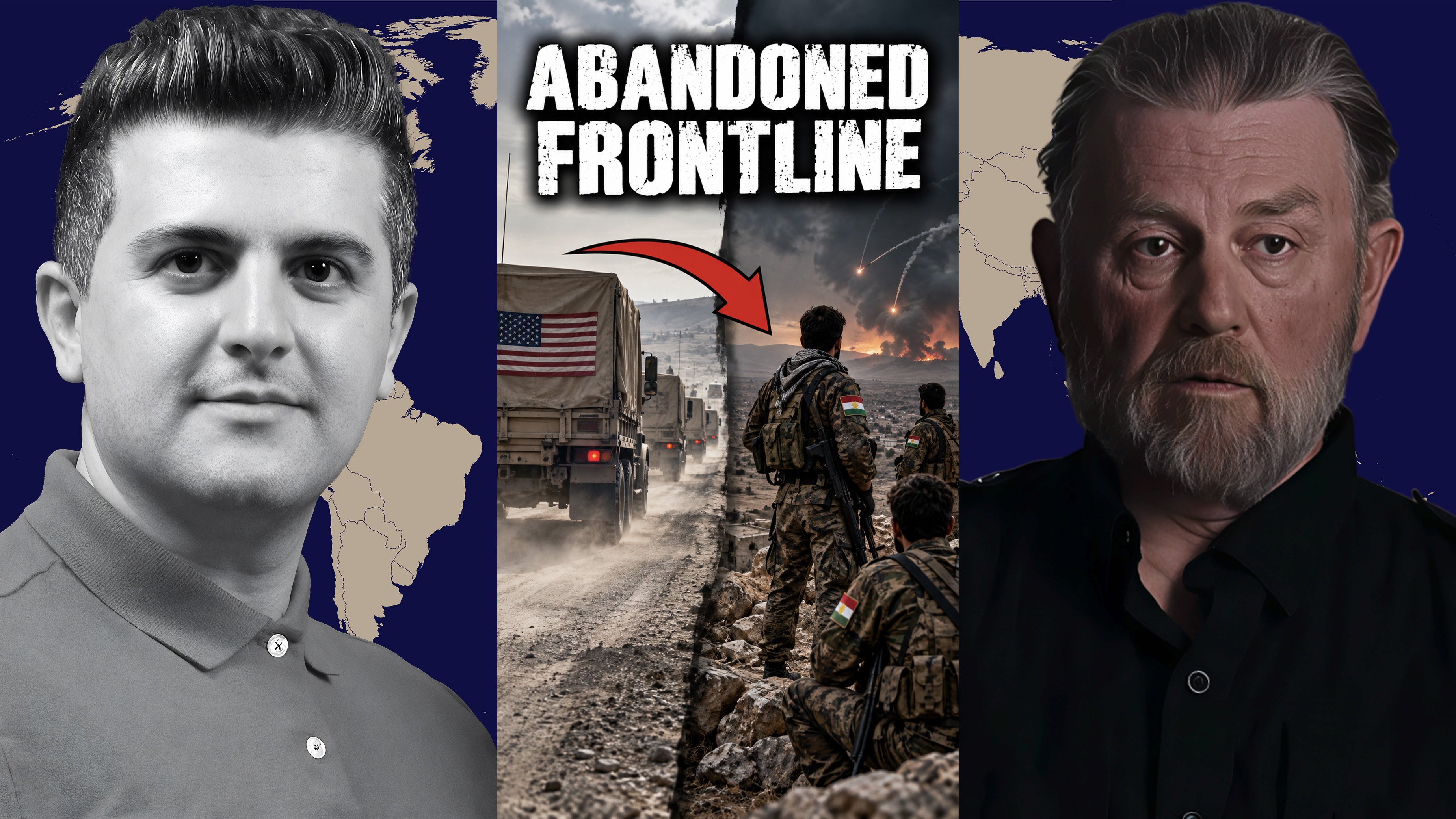
Larry Johnson: U.S. ABANDONS Kurdish Frontline - Troops & Patriots PULLED Before Iran Strike
About this episode
Hosted on Acast. See acast.com/privacy for more information.
Get every episode summarized
Each time Dialogue Works publishes, we email you a written briefing from the transcript — the topics, who appeared, and any specific claims, with the ad reads skipped.
Email me new episodesFree for 3 shows. No card needed.
Hosts & guests
Transcript ready
246 searchable segments. Every word is indexed and playable.
Full transcript
Dialogue Works — Larry Johnson: U.S. ABANDONS Kurdish Frontline - Troops & Patriots PULLED Before Iran Strike. Machine-transcribed; use the interactive transcript above to jump the player to any line.
I have read it today's Sunday September 6, 2026 and our dear friend, Larry Johnson, is here with us. Welcome, Mike Larry. Where are you, Larry? It's still September 26, where I am. I'm in Moscow. Yeah. So, I'm here with Judge Napolitano and John Mirschheimer and Alistair Crook. We're all participating in an active-exeminar. So, I just had a marvelous dinner. Each guy go back, get back to Florida and get back on my diet. You mean, I don't remember any diet on your side.
Oh, yes, yes, yes. I've lost about 24 pounds. Yeah. They're waiting that by bed. Yeah. So, Larry, if you had a busy day, yeah. Yeah. Let me start, Larry, with what has happened in today in Russia. Let's start with that because you're in Russia today. Your favorite figures of the Trump administration yesterday were there talking with Vladimir Putin. Today, they're in Ukraine talking with Zelensky. We had representatives from the United Kingdom from the national security advisors of the United Kingdom, Germany and France being there talking. And Bloomberg reported that Vladimir Putin doesn't want to back down. He wants to cross up there.
He wants to continue the war. I flew into the Nukevo Fort last night. And that was, apparently, what Kof and Kushner had just left about an hour before I arrived. That they didn't stick or say hi to me. We could have chatted and said, hey, guys, what's going on? Yeah. But, you know, I think the over the reaction, you know, talking to some, you know, foreign policy experts on the Russian side, you know, like you've got the, you know, the meetry signs who is an American citizen. He was a naturalized American citizen. But he was forced to flee to Russia for political freedom. I had to flee the United States.
I he was hitting the judge on his. The he's got a he's got a nightly commentary commentary. Called the big game. And so talking to one of the people that's on his show regularly. Yeah, they saw the Whitkopf Christian visit. It's called a performance art. This is all to maybe try to help Trump. But they don't see anything of any substance coming out of it as far as Russia is concerned. Today, Whitkopf said after the meeting he had with Zelensky, he said, we made a lot of progress in Russia and in Ukraine. And as I mentioned, the representative of the United Kingdom, Germany, and France were there as well. Larry is that what does Donald Trump want? He said, I remember
last time he mentioned the case of Ukraine. He said, the war in Ukraine doesn't impact the United States that much. So we're not that much concerned about the case of Ukraine. But today, he sees some sort of necessity, at least to send these to, you know, we had the head of CIA going to Russia. And again, we see see Whitkopf and Jert Kushner going to Russia. What is that necessity for Donald Trump? I missed the last part of what you said. What was that necessity for Donald Trump to send the head of CIA then Jert Kushner and see Whitkopf to Russia to talk with Russians, talk with Ukrainians. Well, I mean, clearly he's trying to find out, but you know, Russia, Russia is not interested in finding a negotiated settlement out of this. They're winning. Ukraine's losing. Now, they don't
want to, Russia would prefer not to escalate. And escalation in this case would mean having to attack Europe, having to attack Germany, the United Kingdom and France. Russia would prefer not to do that, but at those countries keep with their provocation. Now, we need to examine all this in light of what happened tonight at the election in Germany. My understanding, lust I saw was that the opposition political party, AFD, had a had a significant win. I think that they selected more than 50% of the vote, correct? Yeah, exactly. 44%, 46%. So that's the case. That means the voters of Germany have spoken, and you're going to see a lot, a lot more domestic political pressure held up. Germany to stop antagonized Russia and seek a
peaceful agreement. Yeah. It's 44.5% of the votes, and in Sarshan and Alt in that region, but it seems that they're getting the momentum in Germany. It's all, you know, one of the main reasons is the war in Ukraine. Can you hear me, Larry? Can you hear me? No, no, you can hear it. Yeah, you keep breaking off of the world. Sorry, it seems that we have some but beyond my control. No, no problem. Larry, if you hear me, where do you see the escalation in the West Asia between Iran and the United States? In the last, you know, last night,
yesterday, we've seen a new escalation after the attacks on the tankers, the US attacking, you know, onion tankers, you're on attacking US affiliated tankers, as they said, and then Iran in attack on the aircraft carrier together with destroyers. Where does that go? So that again, the new escalation between Iran and the United States, Larry, with the attacks on aircraft carriers, and aircraft carrier and destroyers. Yeah, well, you know, clearly, Iran was testing the new missile, they said, and it doesn't sound like he necessarily intended to hit it. US claim they took the base of action, but I'm pretty confident that the destroyers fired off
severe defense missiles intercept these and bound ones. And if they did, that means the United States is going to more rapidly deplete that missile supply, at which some point the destroyers and the aircraft carrier will have to pull out and go to the agrogarcy in order to arm. They can't rearm it, see. So, you know, Iran, maybe in a position they can keep firing missiles day after day and deplete air defense on these destroyers, which will be, you know, for the side of US weakness, its inability to sustain combat operations. They used the ballistic missiles, Larry, to hit the target instead of using the Navy or the crews, the anti-ship missiles. What was the main reason for that? You mentioned they have used a new missile.
But they said it, they said it was new. No. So, sorry, we're going to finish your question. Yeah, my question is, Iran has Iranians said that Iranians instead of using the anti-ship missile, they use ballistic missiles. And when what is your assessment on the air defense system on these destroyers? It seems that they tried to hit the Washington, George Washington, the aircraft carrier, George Washington, USS, and the destroyers. What is the difference between the air defense systems that they have in Jordan, in Israel, and the air defense systems that they have on these destroyers and the aircraft carrier?
Well, these are what are called vertical launch systems. I forget this particular missile that's on board. It's not the X-3. But it's SM-4, SM-8, something like that. They fired? Yeah, I think SM-4, I think. But the problem is, once they fire it, that it was empty, and they can't just reload it. They literally will have to go back to a port, and it has to be reloaded by a crane. So, to extend Iran can continue to fire missiles like this, at the carrier, force the destroyers to fire their missiles. They can deplete it.
Once they're depleted, those destroyers are going to have to depart to sea. They can't stay there because they won't have anything to fire back at, which means if they leave, the aircraft carrier has to leave, because without those destroyers, the aircraft carrier has no air defense. So, again, it's one of the other vulnerabilities that these carrier task forces carry. That they're not an indefinite period of time, especially if they're facing a steady onslaught of anti-ship missiles. And these were hypersonic, apparently, the problem between 10 and 12 mock. So, clearly, a hypersonic speed, I don't know if they're maneuverable or not. If they're are maneuverable, then that means for air defense systems, the destroyers are shooting, they can't shoot them down. They're ineffective. So, this is nothing the United States could sustain for a long period of time.
Today, General Petrez said that the United States has to change its strategy, basically using the Ukrainian strategy by the use of drones. And what do you see that going? Using the Ukrainian sort of fighting, your method of fighting, the way that they're fighting against Russia, he says that the United States should learn from Ukraine, because everything is so expensive that we have to find some sort of solution to reduce those costs. What kind of drones? I don't know. We've been using MQ-9 reapers and the Iranians have been shooting those down. They've shot down over 45. And those are pretty expensive. They come in about $60 million a piece. So, I'm not sure that's such a good strategy. Yeah, go ahead.
He says that the Ukrainian drones, it means that he wants to produce the same sort of drone that the Ukraine is using on the battlefield with Russia, or they're using the attack Russia. I missed that line. I didn't hear it. Ukrainian drones, they want to produce. He says that we have to produce the cheap drones like Ukrainian drones. Maybe they're asking Ukraine or somehow they're getting the technology and producing somewhere else. Yeah, you don't really get the technology comes from China. You think China's going to sell us those drones? No. So, a little late in the game for that. And again, the notion that the Ukrainian strategy has worked here in Russia, it hasn't.
I drove past 30-some gas stations last night on the way in from the airport. There was an alliance of traffic at any of them. You know, supposedly a great shortage is going on here. Sorry, it's not apparent. Stores of full, restaurants are busy. People are going about this normal business. Nobody looking up in the sky worried about drones at all. You don't hear anything. So, you know, the Western propaganda only works against the West. It doesn't work against Russia. Are you sure that you had your glasses on? Because it keeps freezing. It's like, I speak, it freezes, you speak, it freezes. Yes, sorry about that. I was joking. And, you know, Larry, there was another report and the, you know, the government in Iraq is talking about that the
United States is leaving Iraq. It's leaving Iraq and removing the air defenses from Iraq. Can you hear me, Larry? I'm turning the camera off, hoping that would help. Hope that could help. Yeah. Can you hear me right now? The United States government is what? Yeah. It's removing the air defenses from Iraq. And the Iraqi government said by, you know, the September, September, tell you if they're going to remove troops from Iraq, Iraqi Kurdistan, they're going to remove the air defenses from Iraq. And is it that all about, you know, making some sort of noise or the United States would do that? No, I think it is what you're seeing is the
legitimate withdrawal of US forces from Iraq so that, you know, that represents, you know, if you will, another sort of strategic defeat for the United States, they are getting out of Iraq. The Iraqis don't want us there. And even when we're there, there's not a lot we can do. I think everything is getting Larry in the, at least for the Iranians, the head of the Iranian parliament today said that the Americans must have understood that the era of proportional responses is over. Our strikes on the aggressor bases in recent operations were only the beginning. And they're talking about, you know, this proportional attacks or responses, retaliations for Iran. Do you see in the coming days, the escalation happening in the Persian Gulf confrontation
between Iran and the United States with these new attacks that have happened in the last yesterday, basically? If the US ships stay close, you know, I could see Iran starting to go after them just for the standpoint of, it's okay, if you're going to blockade us, we're going to make you pay a price. And so to the extent that they can, you know, inflict damage on those ships or force those ships to use up their air defense systems and then drive them out, you know, that would be a pretty effective strategy. So clearly, the United States is not in a position where it can do anything militarily to defeat Iran and the fact that Petraeus is calling for a Ukrainian strategy, it gets to Iran. I mean, it's just ridiculous. That doesn't he realize Iran is almost three times larger
than Ukraine? So how is that going to work? That the United States, if you're if you're trying to cover Iran with drones, aka like Russia, I mean, you know, Russia is a big country as well. It's just, it's not an effective strategy, it's just, it's effective only in Western propaganda. Israel said Jerusalem both said that Iran is preparing to attack Israel, not Iran together with Hezbollah and Houthis and the resistance in Iraq, they're all preparing the attack Israel. Do you see do you see that happening or it's they're making their own case?
We've heard about those, they keep warning about these threats all along. So far, they haven't panned out. So we'll see. I think it is, again, Iran, I mean, Israel playing politics using Iran to play politics for the for the own, you know, Bibi Netanyahu's selection campaign. The question of today said that everything is crazy with the case of Israel because of the election. And you know, the election is coming, that's why you don't see that much of, you know, logical or rational behavior on the part of the Israeli government. Do you see any sort of, you know, rational thinking or mindset in Israel that has changed
all of a sudden during the election in Israel? No, no, in fact, if you go back 20 years, you can make the case that there was a saying rational opposition party in Israel that opposition party is now a minority party, very minority party. And the vast vast majority of Israelis, even though they don't support Bibi Netanyahu, they support the general policies that he's advocated, which is about exterminating Palestinians, taking the Palestinian land and seizing it for the benefit of Israeli settlers. That's a mainstream belief in a lot of Israel now. They're bringing today the Foreign Minister of Israel said that we have to get closer to the
Kurdish people in the region because they're the minority, they, you know, they couldn't achieve independence in the region. So we have to make a better relationship with the Kurdish people all across these four countries, you know, Turkey, Iraq, Syria and Iran. What Israel Larry is doing is basically doubling down in making new cycles or new waves of chaos in the West Asia. And I don't know how far is that going to go in the eyes of Washington and how far are they going to support Israel with these sort of mindset? Well, Israel may take the choice out of Washington's hands. If they continue to threaten and then tag in eyes, you know, not just Syria and Hezbollah and Lebanon,
but also Turkey. And then Turkey decides to finally retaliate militarily. Israel is in a lot of trouble because Turkey is in a position of really hurting both in terms of cutting off the supply of oil, which Israel needs, as well as having a substantial military that is capable of inflicting a lot of harm on Israel. So the Israelis need to take a step back and figure out whether they're going to threaten everybody or they're going to sort of wake up to reality and realize they can't live without Turkey and Turkey's support. Larry, where do you see the Russian president today? Do you see? Because let's put it this way, it seems that Donald Trump, again, is asking for some sort of ceasefire between Russia and Ukraine.
Do you see any sort of possibility for that being accepted in Moscow? No, nothing sort of not just to promise, but a firm commitment to hold elections in Ukraine, give rid of Zelensky number one. And then a recognition Crimea is Russian and the territory that has been annexed since September 2023 is or 2022 is Russia except anything less than that. So it's up to the United States and the Ukraine to see if they can be willing to swallow and agree to Russia's terms. How about Ukrainian access to the sea, to the Black Sea?
Ukraine in access to the Black Sea, Larry, can you hear me? I missed the last part, how about Ukrainian access to the Black Sea? Yeah, what Ukrainian access they don't have any and they're not going to get any. I could conceive of Russia making it deal that they could keep some one port in the Black Sea and exchange for intermediates and into the hostilities. But farming that, Ukraine's not getting anything back. So I see, you know, playing hardball with this. Today, Larry, the former head of MI6 said that nothing would happen between Russia and Ukraine.
And you know, this year is talking about next year in 2027, maybe something happens in 2027. And what is that timeline and what is going on? What are the preparing for in Europe together with Ukraine that they want this period of time, you know, then getting to the 2027, maybe in their eyes they're thinking that the position of Ukraine would be true by them. I remember head of MI6, is he even paying attention to what's happening? The Russians are advancing all along the front. The Russians are continuing to bomb and take out key assets, including British assets, forward operating bases and places like Odessa. No, this is not something that Ron can survive for the long term. I think we're looking at, I mean, Ukraine, that Ukraine could be, you know,
real big, big, big trouble by into the year. And when I say big, big trouble, not not able to sustain operations. Yeah. Yeah. Yeah. Iran will be able to sustain operations. Ukraine, not. How about Larry, do you see the possibility of escalation before me term elections between Iran and the United States? No, I think it's highly unlikely. If you, you, I, Iran is going to continue to go after the ships. At some point, yes, it's going to have to withdraw those ships from areas where they can be threatened. And it'll either be sort out of air defense missiles or they've decided it's not worth putting them in harm's way and leaving them vulnerable to that kind of attack. So I don't, I think the polling recognize that if they continue to launch kinetic strikes against
Iran, it's going to have more, more negative blowback and more negative effect on Trump. And he's trying to avoid that. He's trying to clear the decks, hope that the political pressure works on Iran and then somehow be able to declare victory. But Iran, I don't see Iran cooperate and they're going to continue to go after ships that are not abiding by the protocols that Iran has laid out in its memorandum. Is it possible, do you see the possibility of Iran hitting these supply lines to these aircraft carrier and destroyers? Well, yeah, it's, all they have to do is continue to fire missiles. If they fire 10 missiles at each ship, then for each of those missiles, carriers got to launch
two. So let's say they're total of 30 missiles. That's 60 that air defense missiles, the ships out the fire. And at that point, they've only got 20 or 30 left total, where they have to go back to Diego Garcia and reload. So this is a way that, you know, the United States, if wanted to really stress the US capability, that's one way they could do it. Do you think that your connection tomorrow going to get better with the Internet? Or we're going to have the same problem? I don't know, man. I just, I just did one before you, this is fine. So hit miss. Yeah, I don't know what is happening right now. The connection is not good. You have some sort of delay between you and I. Thank you, Larry. I know that you're,
you're tired of, you know, it's been a while. But try, we'll try tomorrow, but it's the else a bit long day, but we'll give it a shot tomorrow too. Yeah, exactly. Okay, see you soon, Larry. Later. I have a good night though. Later. Bye. Bye. Bye. Yeah.
More episodes
More from Dialogue Works

Nima R. Alkhorshid: US Navy FLEES After Iran’s Hypersonic Missile Impact – New I...
Dialogue Works

Col. Larry Wilkerson: Missile Over Carrier: Iran's Bold Test Sends US Navy Runni...
Dialogue Works

Paul Craig Roberts: Iran and the U.S. Move Closer to a Major Confrontation
Dialogue Works

Col. Jacques Baud:BREAKING: Houthi Missiles Strike Saudi Aramco – Fire Erupts at...
Dialogue Works