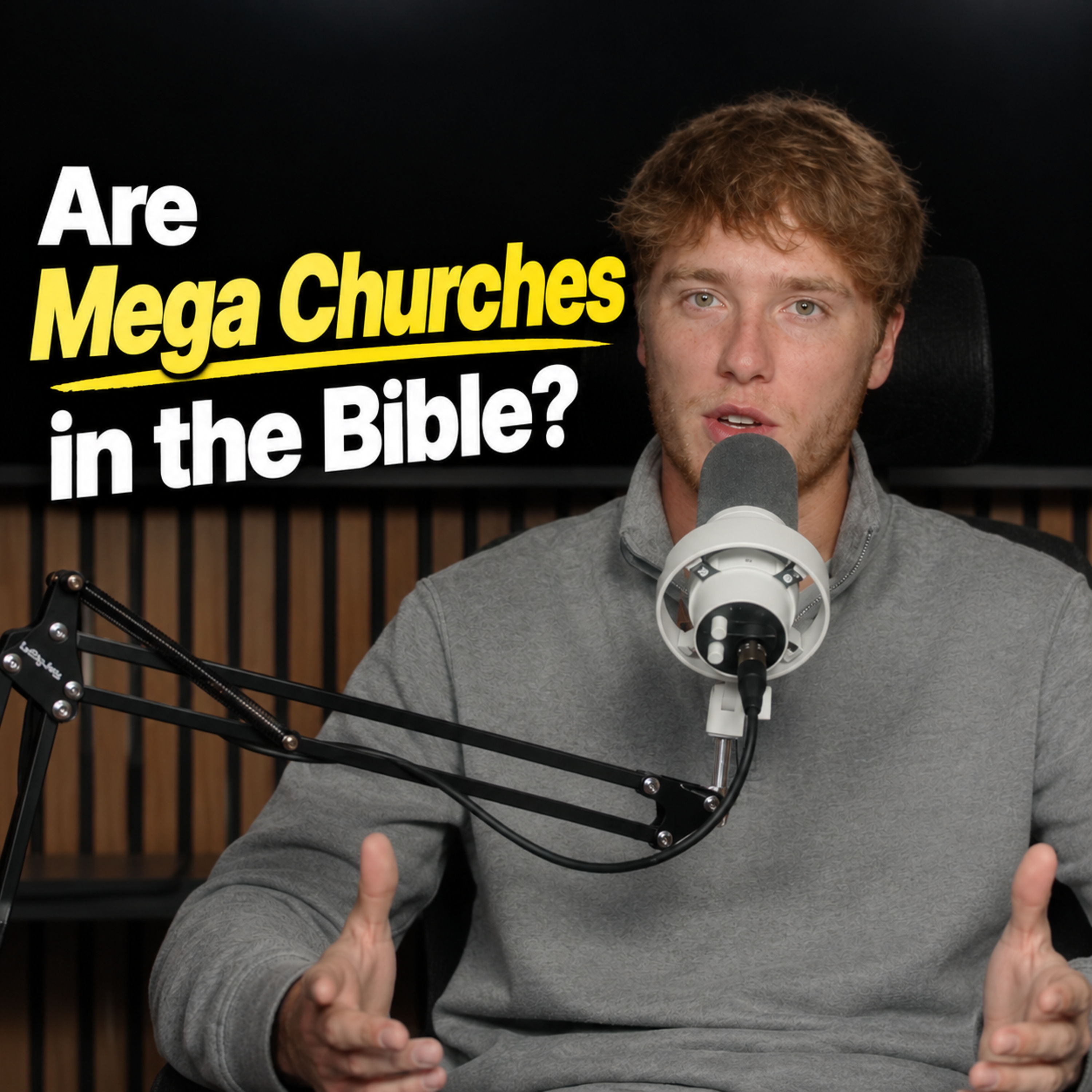
Are Mega Churches In The Bible?
Get every episode summarized
Each time The Straight Fire Podcast: Fresh Perspectives On Timeless Truths publishes, we email you a written briefing from the transcript — the topics, who appeared, and any specific claims, with the ad reads skipped.
Email me new episodesFree for 3 shows. No card needed.
About this episode
“Music Ladies and gentlemen, welcome back into another episode of the Straight Bar podcast. It is a joy to have you wherever you are listening from. Thank you so much for joining us on the journey of season three.”From the transcript
Do numbers really matter when it comes to churches? What about worship specifically? These are important questions to ask, and most importantly, the answers need to come from God's word. Find out in this episode of the Straight Fire Podcast!
instagram - instagram.com/thestraightfirepodcast
youtube - https://www.youtube.com/@TheStraightFirePodcast
email - [email protected]
Get every episode summarized
Each time The Straight Fire Podcast: Fresh Perspectives On Timeless Truths publishes, we email you a written briefing from the transcript — the topics, who appeared, and any specific claims, with the ad reads skipped.
Email me new episodesFree for 3 shows. No card needed.
Hosts & guests

Transcript ready
456 searchable segments. Every word is indexed and playable.
Full transcript
The Straight Fire Podcast: Fresh Perspectives On Timeless Truths — Are Mega Churches In The Bible?. Machine-transcribed; use the interactive transcript above to jump the player to any line.
Music Ladies and gentlemen, welcome back into another episode of the Straight Bar podcast. It is a joy to have you wherever you are listening from. Thank you so much for joining us on the journey of season three. What a journey it will be. I think I remember listening to last episode landed said we're going to put out 150 something podcast episodes. This season? The season. Yeah. Man, this season is going to be like 10 years. I got it. Buckle in for the long haul. That's 2028. 150 episodes. I don't know. I think if you look at our podcast pace per year, I don't. I don't think that's going to be enough. We've been recording for what three years now. Doubtors. Oh, you have little faith. Oh, you have little faith.
That's what we're going to come up with 150 podcast topics, which is why which is a great segue into why you should email us if you have podcast topics at these right for our podcast at gmail.com. Do you have comments? Do you have questions? Do you have a top that you want us to cover? Send us an email. That is the surest way that we will get back to you. Also, if you, you know, you can also comment on the YouTube video, comment on the podcast wherever you can comment us. We're usually pretty. I feel like we're usually pretty good. I really try to read the comments. Yeah. I really do try. We just don't get that many. So, you know, it's just kind of hard. I think we're getting more professional. Look at that. Look at that little segue. Yeah. That was pretty good. I like you don't know what I'm doing. Also, if you want more content like the straight far out podcast, be sure to check out the GB in app. You can download that pretty much anywhere you download. You will download an app, your phone, your iPad, your smart fridge. I don't know about. I don't have a smart fridge. We can be on your smart fridge. I can't voucher. Do you imagine like you're cooking something in the kitchen and like we're just there like in your fridge. Like we're like your friends. Yeah. I think it'll be pretty cool.
Anyway, thank you all so much. Be sure to follow us right for our podcast wherever you can. Instagram, Instagram, YouTube. Hopefully there will be individual, unique stuff coming to each platform. So, it's important to follow us everywhere, everywhere that you can. So, with that being said, I just went and going, jump into today's topic and we're going to be talking. We're going to talk about this question. Are mega churches biblical? And really, I guess it's this idea of how can I be sure, how can I be sure that my church is the church that talked about in the Bible? Because I think when we talk about this issue, that is the most important thing, right? We don't want to follow a church that's made by a man. We want to follow a church that was made, that was made by Christ, right? I think that's what we're trying to, that's what we're trying to identify. Hey, how can I be sure, how can I be sure that I'm in the Lord's body? And we're going to talk a lot more about that as we go throughout, as we go throughout today's podcast. So without further ado, no, we'll you start us off with this question. How can I be sure that my church is the church that's in the Bible? Well, and I think
to start that, I'm going to have to make a statement and that statement could probably be a whole other podcast on its own, but there are lots of resources and I think we have covered this before. But the, the surest way to make sure I, my church practices and is the church that is mentioned in the, in the Bible in the New Testament is to well, is to make sure everything I do comes from the Bible. God has given us his complete word in the Bible. There is nothing past the Bible. There is no future revelations past it. God has given us everything we need to be the faithful church in his word. So if you look at Ephesians, if you look at Ephesians, or sorry, 2 Timothy 3, 16, and 17, it talks about how God has given us all scripture, all scripture is given by God and is profitable for doctrine, for proof, for correction and righteousness that the man of God may be complete, thoroughly equipped for every good work. Right? And I think that applies to the church too. Jew three talks about how the faith was once and for all delivered to the saints, right? And
that's what we have in the word. So we have this, hey, God has given us everything we need. And then we look at some other passages talking about the church. Ephesians 4, 4 says there is one body and one spirit just as you were called in one hope of your calling. Right? So there's one body. Well, what is this body that he's talking about in Ephesians 4? Is he talking about the human body? Well, no, there's, I guess trillions of those if you count up everything that's happened. But he's not talking about, you know, human body or anything like that. He's talking about the church. Ephesians 1, 22 through 23 says Paul's already explained this. He says he put all things under his feet and gave him to be head over all thin and gave him to be head over all things to the church, which is his body, the fullness of him who fills all in all. So there's this idea of, hey, the church is Jesus's body. Ephesians says there's only one body. So there's one church. Acts 20, 28 says, therefore take heed to yourselves and all the flock among the Holy Spirit has made you overseers to shepherd the church of God, which he purchased with his own blood. So how
did God buy the church? Well, he purchased it through the blood of Jesus Christ. So when we look at, hey, why is it important that I'm in the one church and how do I know I'm in the one church? Well, I have to make sure my church is doing what's in the Bible, right? And that church is the, as we like to call it, the sphere of the saved. It just means, hey, God, Jesus died for who? Well, he died for those in the church. The church has been purchased with Christ's blood. So does your church practice what's in the Bible? That would be the number one, the number one factor, the really the only factor that matters when it comes to, hey, am I, am I the church that God talks about? Am I the one body that God talks about? Acts 17, 11 says, therefore these were more fair-minded than those in Thessalonica, and that they received the word with all readiness and searched the scriptures daily to find out whether these things were so. So Paul had come in and he was preaching to them the word and the Thessalonica, sorry, the Bereans were searching the scriptures, right, to find out, hey, is what Paul is telling us? Is that really in God's word? Because they wanted
and they were that one church, right? So that's something we need to do to Matthew 159 says, and in vain they worship me, teaching as doctrine the commandments of men. So if we're taking a man's word for something, then we're not really in the church because that worship is vain, it's empty. And then so can you say for effect? And I think, I know, excuse me, I can, but can every, I think it's important that everyone, no matter where you worship, they need to ask themselves, hey, is everything my church, is everything my church does? Can I find that in the Bible? Yeah. Well, if you can't, then I think you need to, you know, go talk to leadership, go find out, hey, why don't we do this in that? And then if they really are that one church, they're going to open up their Bibles and they're going to explain to you, you know, this, I know we hear at the West Huntsville Church of Christ, it'd be hard to talk about churches and not talk about the church. We go to, but everything we do, whenever our elders tell us why we do something they always use scripture, right? So we can have faith and assurance and the fact that, hey, the church that I'm
a part of, the one church is that church is the church that God talks about in Ephesians, that the Paul talks about in Ephesians, that one body that was purchased with his blood. So for those maybe who are still looking for a church, God lays out a really clear instruction, hey, make sure everything you do is in accordance with my word, because only then can you know that you're in the sphere of the saved. Only then can you know that you've been washed by the blood of Jesus Christ. One more verse, sorry, Galatians 1, 8 through 9, it says, but even if we are an angel of heaven, preach any other gospel to you than what we have preached, let him be accursed. As we have said to you, I've said before, so now I say again, if anyone preaches any other gospel to you than what you have received, let him be accursed. So Paul says, hey, if anyone's teaching anything different from what from the things that we have taught you, the things that you read in the Bible, cut them off, let him be accursed. He doubles down. He says it twice. He doesn't want the Galatians falling for any other kind of doctrine than the doctrine that is being taught in God's one true church.
Yeah, one of the things too that I think, you know, as you're talking about that and as you're going through the scriptures is the is the strength we can draw is the strength we can draw from knowing we're in the same body that those in the first century were. I remember not too long ago, elders did two things. One, which was a hard moment. They had to withdraw a fellowship for someone which we read about in 1 Corinthians 5. That was hard. Then the next, or maybe two or three weeks later, they appointed Deacons, right? Which we read about in 2 Timothy or 1 Timothy, excuse me, 1 Timothy chapter 2. I would check that though. In 1 Timothy, you read about, I think it's 1 Timothy 3 where he goes, he goes first through the qualifications of elders and then to the qualifications of Deacons. And so we had elders qualified by scriptures appoint Deacons who were qualified who were qualified by scripture. And I remember sitting there thinking what, what
a joy it is to practice, to put into practice the same things that the first century church did in our church today. And this idea that we can do the same things, we can do the same things that they did then, right? And obviously our worship is going to, there are different things, right? You know, we have matters of expedience that help us out, right? Like PowerPoint and microphones. You know, just things, things to help aid in worship, not things that add to the worship. Or change the worship. Or change the worship. Yeah. And so just, you know, I remember just thinking, you know, of the joy that it is to practice, to practice in the same way that they would have practiced, you know, 2000 years ago. Yeah, I was thinking too, we, you know, we recently did some podcasts on worship, right? And what true worship looks like according to scripture. I don't encourage anyone to go back and look at those or look at some other resources or go read the Bible. What do those early Christians do when they worship? They came together and what did they do? What did their worship look like? I guess I wanted to stress just a little bit more before we went on to the next question about, hey, this one church that we're not talking, that we're talking
about, it's not all the different denominations who believe in Jesus Christ. I've heard that belief, I'm sure some of you all have to or you all have to about, hey, you know, denominations, they have different beliefs, but really, you know, as long as they all believe that God is God and Jesus Jesus is King, then they're all going to heaven. But the scripture does not hold that because, you know, I want to go back to Matthew 159, anything that is man, that man teaches, that does not come from God's word, well, that's vain. It's empty worship, right? And what are we here to do? Well, we're here to glorify and worship God. So that is what we do is extremely important. So that, that one church, right, that there is that one church that we're talking about, well, some people today would call it the church of Christ, certainly a, certainly a biblical name, but we don't claim to be a denomination. We claim to be that one church, the one body, not because we're so self-righteous and we said, yeah, we're the one church and none of y'all, no one else gets to be. No, simply because we practice what the Bible says and that church has many different names
in the Bible that's just simply the most common name today. But that, that body, that, that one body is whoever is following all the commandments given in the Bible. Well, the thing too about, you know, like, well, you know, why can't all, you know, all the denominations be the one, be the one body? Well, you know, once you start saying, well, yeah, this denomination doesn't have this, right? But they have, you know, they have the rest, right? Well, what, you know, how many things does an denomination have to get, does the denomination have to get wrong before they are excluded from the body? You start going down this slippery slope of allowing one mistake to allowing, I mean, why not, if that's the, if, you know, if one, if there's a nomination that, you know, has one thing wrong and they can go to heaven, then what's to keep, you know, why not? Why can't everyone just be saved? Because, you know, everyone has things, everyone has some things wrong in their life, right? All have said and fallen short, but why can't they be saved just like the others? Do you see what I'm trying to say? I know. God is a, God is a holy God and he demands his people to be holy and to follow the
instructions he has given to approach him. When man starts dictating how they are going to approach God, there are massive problems, which is why again, we always come back to scripture and everything we do is, I don't want to say reinforced because that makes it feel like we're just using scripture to prove our point, but everything that we do is based on scripture and what the only Christians did and we copy the pattern that was, had this been handed down, that form of doctrine as the scripture says, we copy that as it has been handed down. And I think there are some things that we could get into that are a podcast for another time. Obviously, we don't have the church leadership and church traditions. We don't have to, we don't have to be in my mind. We don't have the time to go and tell the nuances of different denominations and what makes different denominations, what they are and why the things they practice, I might be true, some might be false, but I do know this, the one church, God's body, that is who's going to heaven and that is who follows the word that he has given, so they can be washed by Jesus's blood.
Right. So, I guess the next question I have, the next question I have is this, who's allowed to lead, oh, speaking of church leadership, we are going to get into that a little bit, who's allowed to lead to lead the church. Right. There are a lot of different opinions about church leadership, there is a lot of different, there are a lot of different church denominations who claim to have their own church leaders, but who does the Bible say that we need to have as the church's authority? Well, I think one must zoom out and take a bigger view of this before you get specific, because if you're asking this question, what you're really wanting to talk about is, how does the Bible feel about a Pope or a leadership board or these different ideas and different denominations, call them different things, it's a few different ways. You see different words used in scripture, okay, it's the Bible wants to have bishops or elders or what is required. And while important to discuss those things, one should never start there. So, when you go
read through the New Testament, specifically the gospels, which is the accounts of Jesus' life here on earth, he will have a discussion with his disciples and Matthew and he'll say, who do men say that I am? And most probably everyone listening to this podcast is going to go, okay, we know what you're talking about. He's going to say, who do men say that I am? And his disciples that will eventually become apostles, they start answering and they're saying, well, some people think you're Elijah, some people think you're a prophet, some people think you're John the Baptist, and you've came back to life, just weird. And so they're trying to go through the Psalter on the map. Anyway, sorry, I could do anyone. So, they're going through these things of, okay, well, who are you? And then Jesus, you can see all of these crazy ideas, they're obviously not true. And then Jesus looks to his apostles and it gets personal. It's very general. I see, just throw anything out because it's not what I believe. Then he asks, well, who do you think that I am? And so it got very personal because Jesus is about to make a very important point. The point of why he had came. And so he said, well, who do you think that I am?
And Peter, you know, we hate on Peter a lot because a lot of times he'll talk first and he shouldn't have. But this is one of the times that Peter was willing to talk first and he got it right. And so you're the Christ son of the living God. And the Jesus looks to Peter and this is something that you have to pay attention to. He says, you are Peter. So his name is always up to this point been Simon. So Jesus is changing his name. He says, you are Peter. Upon this rock, I will be my church. Someone would like to connect the rock with which the church is being built on being Peter. That's not right. The rock that Jesus's church would be built upon is the statement that Peter made that got him his new name. What was that statement? You are the Christ, the son of the living God. And Jesus said, that statement that I am who I say that I am, I am the Christ, I am the son of God and I am God in the flesh. On that rock, I will build my church. Okay, well, you got to start there. Well, whose church is this? No, I did a great job of talking about
well, how do I know if the the quote unquote church or congregation that I go to, how do I know if that's what's in the Bible? Well, hold up what they do with the scriptures. And if something doesn't line up with what's in the scripture, it's a good chance that's not yet. Well, one of the best things that you can do is look at the leadership for the congregation, the church with which you attend and hold that up to scripture. Who is the authority? If it isn't Jesus, then that's not his body. No, it went into if you want to be saved, you have to be in his body, you have to be in his church. And if you're going somewhere that doesn't even claim to be under the authority of Jesus, I would say that's where you need to start out with hesitation because Jesus said, this is my church. This isn't a man's church. This isn't a board's church. This is my church. And I have all authority, you know, in Matthew chapter 28, when Jesus is giving out that great commission, and verse 18 was to talk about that Jesus had been given all authority. And so with that authority
came his willingness and his ability to say that this is my church. Okay, so you want to say who is supposed to lead my church? It better be Jesus. If Jesus is not the authority for what you believe, what you do, what you practice, if Jesus is not the authority and you know, Jesus does not talk to us today. And so his word is our authority to make that clarification. If what you're finding is not holding up to his word, and that's why I said you hold it up to scripture because this is Jesus's words. This is Jesus's authority. And this is his church. And so you want to talk about who leads who's supposed to lead my church? Well, spiritually speaking, it better be Jesus because it's his church, you know, no, I read a phoenix chapter one verses 22 and 23. Whose body is it? It is. And so when you talk about what we do and we did this in the worship podcast on the aspects of worship and the clarification that we constantly made is there has been some people which have said
that it is unfair for Jesus and the father to restrict so much what worship should be like. Where did that come from? Respectfully, I say that not to be mean. But if it's his worship and it's his church, then he decides what takes place, how it takes place, and when it takes place. You expect that with the family. The parents are going to decide what it should decide what takes place, when it takes place and how it takes place. And the workplace, your boss, he will decide what takes place, where it takes place, and when it takes place and how it takes place. But then we get to the most important thing ever, the church, which Noah said, you want to be saved. You have to be in his church and you go, I get a little bit of saying, I'm going to come on. I'm like, hey, like I'm giving my life to him. I deserve some say. No, you don't. You don't. And that's something that
when Jesus said, I want you to deny yourself and I want you to take up your cross and I want you to follow me. That was part of it. It's then it was an understanding that the moment that I've become a Christian, the moment that I become a part of his body, his church, it's not about me. It's not about me when it comes to worship, it's not about me when it comes to practical living. And it's definitely not about me when it comes to picking who leads my church because it's Jesus. But that's really not what was someone's wanting to know. Because most people come from an understanding of, okay, yeah, this is Jesus's church. Unfortunately, they're not in Jesus's church. And that's why we've done this podcast is because we don't do this out of spite. And Noah did a good job of talking about, we don't do this because we think we're better than you. And we want us, or we want you to be more like us. That's how we're talking about. What we're wanting is to help influence you into going in the right direction, into looking into the true church. And so, you know, when we talked about our podcast on AI, one of the things we talked about for tools and that we were one is that we don't want you to take our word for something,
but rather allow us to help put you in the right direction. That's what this podcast is for. But really, here's the question. Man, because Jesus isn't here today. So physically speaking, who leads my church? Who should? When you look at scripture, you're going to find something incredibly interesting and something that majority of the denominational world does not hold to. Because when you look at what the church is, the church is the spiritual body, but the church meets in many different places. Okay, it's impossible for everyone all around the world to come to one central location and worship. It's impossible. The Jews try to do it in Jerusalem, and they did so, but the population in which there were Jews was much smaller than we were talking about in the realm of Christ. And there are a little questions all over the world. And so, they will meet in different places. And so that's when you come into contact with the idea of congregations, local congregations. And the denominational world understands this just as much as anyone else. Common sense tells you that it's impossible for people to meet at a central location.
And so you have locations in different places and depending on where you're at in the world, there might be more or less. Right. Everyone understands that. And so what you're going to see in the scriptures, the exact same thing. Paul, Barnum, Timothy, these guys would go on missionary trips to spread the gospel. What would they do? There would be congregations in those areas. You would see congregations in Ephesus and Thessalonica and Galatia and all of these different places with which you'd get congregations. But here's what you're going to notice in scripture. And this is what makes what makes the body of Christ so interesting. And you know, when we talk about the church of Christ, people think, oh, it's a nomination. And we're talking about what's in scripture. The church that belongs to Christ, that's what you see in the Bible. So the body of Christ, those congregations are autonomous. That's a big word. I'm getting smarter guys. Look at me go. That is to say that the leadership of that congregation is for that congregation only. Which is to say that the
congregation for to using the New Testament example, the congregation that is in Ephesus, the leadership of that congregation has no authority over the congregation at Galatia. That's how it is. And there was no board which oversalt the elders from each of those congregations. And there was no man that oversalt the board. That's not how it was. What that was was there was going to be a leadership for the local congregation and that was it. Okay, well, what is that? You said, okay, Lannan, you're making a lot of claims. I'm seeing you scripture. Okay, well, here's the scripture for that because I think that's one of the most important things is because you watch podcasts. People tell you a lot of interesting things and back it up to zero percent. Yeah, I see a lot of wild claims that's a podcast. I'm like, man, I need I need the facts. They're approved. Yeah. Well, here's what we start. What did leadership look like in the New Testament? Well, you look at Acts chapter 14 verse 23. You know, I said Paul and Barnum, economists did a lot of traveling as missionaries preaching the gospel and helping start local congregations of the Lord's church. What did they do? The scripture will say that Paul and Barnum
is would appoint elders in every church and then they would lay hands and then pray with them. So what you see is that there was a form of leadership that God expected because Paul was inspired by God. He was an apostle of Jesus Christ. And so what that meant is he had authority that other men did not have as an apostle. And so he is ordaining elders because that's what he knew God wanted. And so you see what is the eldership? What is that rather the leadership look like? Well, it's elders. And okay, what is an elder? I'm not going to get into all that greek and all the things for that because it's important but for this discussion, it does not matter. It is to say that they are an overseer or a shepherd. That is literally to say there are someone who helps guide, lead and protect their shepherd of that congregation. Well, Paul will later write
to his young creditor J in the faith. And this is already been brought up in first Timothy chapter three because this is something you'll write to Titus, another younger man with which he was trying to influence for the better. And to both of these guys he'd write and he would say, they're in different parts of the area, the geographical regions. And in both of them, he's saying, look, as you're going and you're preaching and you're helping these local congregations, this is what I want you to do. I want you to ordain elders. So the same thing that he and Barnum has been doing, he's passing on now and he says, look, these congregations, they need leadership, they need oversight, they need protection because Jesus is the ultimate authority. But Jesus also gave authority to me and to guide and protect. They can't step outside the bounds of what Jesus has written or said in the scripture. But with the authority that God gave them, they're to lead the flock. And in first Timothy, Paul will give an outline of what it looks like. What is an elder? And he'll say that, look, this and you can spend, we can spend hours talking about the qualifications
of what an elder is. Like what does it mean to be an elder? Because it's not just a young man that loves the scripture. It's not just an old man that knows the scripture. And then he says, look, this is what you're going to be. You're going to be the husband of one wife. Notice husband, this is a man. This is a man who has a wife and you know what else you're going to have faithful children. And so an implication there is that he's an older man, not an old man necessarily, but an older man. He's not to be a novice. That is to say that he is not going to be a new Christian. He needs to have an understanding and wisdom of the scriptures. And on and on, he'll go, he'll talk about that he needs to be slow to anger. He needs to be hospitable. And he'll start going through all of these things that you need to look for in a man. But notice you don't see perfect because there is no one perfect. Yeah. Because the authority is ultimately coming from him. But to answer that question, who would he need to hold up to scripture? Well, first off, if Jesus is not the authority, if you are to ask your preacher or pastor, whatever he calls himself, who is the authority for our
congregation or our church? And he says anything other than Jesus, I would hesitate there. But go on farther. If your congregation answers to a board or a man that's in another country or in another state, I would have hesitation because you don't see that in scripture. If you have man that lead your congregation and they don't hold to the qualifications that you see in the New Testament, I would have hesitation there too. But ultimately, what this comes down to, who leads my church? I better be Jesus. But congregationally speaking at a congregation level, who leads my congregation? Go read 1 Timothy 3 and you'll see exactly what kind of person is supposed to lead that congregation. But really the thing that one causes pause to notice is that nowhere in scripture, will you see that your congregation, the leadership of your congregation answers to a board or another group of men or a man in Rome. You won't see that anywhere. You never see qualifications for the Pope and the Bible. You never see, you know, you never see, okay, when all the churches elders
gathered together and meet and they meet with the one leader, this is what needs to happen. You never see anything like that, right? Let every church appoint its own elders and then that they are supposed to be autonomous. I'll play devil's advocate for a second. I knew that was coming. All right. I don't believe it. What? Bidgen be the devil's advocate? So I think the argument that if I was arguing against you is I would present is the, no, it was just turned to face me. I'm very scared. The argument that I would present is, well, in 1 Timothy, in Acts chapter 15, the Jerusalem council wrote and they sent out a letter to like a doctrinal letter to Christians in other areas, counseling them on how to counseling them on how they were supposed to act. You know, and oh, sorry. I was just going to say I love it when Bidgen presents an argument because he's looking at it. It's like seeing how far he can make it before it gets shot down. No, no, that's not true. I look at it. I'll homing you guys. I mean, I believe I know the answers to
this one. Well, let him get to the lineage trip. Yeah. I say, well, we'll let him win the play before you just blow it out. But yeah, so, you know, we see that we have some hope. You know, James, we have James and James writes to the James and the Jerusalem council write to these Christians and they and they tell them how they're supposed to act. So I would say like, well, then could we then take that and why can't we have that today? Like, you know, there's there's a church that can write to other churches and tell them how they're supposed to know something like that. And a church that writes other churches and tell them how they're supposed to act and deal with doctrinal matters and stuff like that. You and me for me first. Okay. I'll go first. I never clean it up. Um, so, you know, that happens. But that happens. This is just that example happens multiple times in scripture. You know, we just talked about Paul writing to Timothy, and you know, John wrote to several different churches, right? Well, he was on the island of Patmos. That letter went to multiple churches. So you could say, well, hey, there's the scriptural authority. We have one man writing to
lots of different churches. But the difference between that time and today is those were apostles, right? Those were people chosen by Jesus to bring about the start of the church. You have Peter in Acts 2, preach the first gospel sermon, right? And they start that church in Jerusalem. And we read in Acts chapter 6, right, where most of the most of the apostles stayed in Jerusalem to, right, to really the only apostles who were traveling abroad preaching the gospel that we really know about is Paul, right? So it's these, it's these men who were chosen by God, who had been given the gift of the Holy Spirit that we read about in Acts chapter 2. And they were the, they didn't have the scripture back then. They were the authority. But what does Paul say in 1 Corinthians chapter 13? He says, Hey, that, that which is imperfect will fade away. And when that which is perfect will come, we don't need these spiritual gifts anymore. Right. So we see the time back then, well,
how are they going to know what to do when these specific scenarios are raised? You read a lot about that. If you really want to know about those, some of those scenarios go read 1 Corinthians, right? Where Paul, Paul has to get on to them pretty, pretty harshly about, but it's these men who were imbued with the Holy Spirit. And then once they, once they died out, the, the spiritual gifts died out as well. So the only way they had to receive instruction back then was through those apostles because they didn't have, they didn't have the word of God yet. So I think that is why you see them have the authority, the apostles have the authority to write to those churches because they were God's chosen messengers. I like what God says about Paul, right? When he's talking to Ananias, he says, Hey, that is my chosen vessel to go preach to, well, what is God's vessel today to talk to us? Well, that's his word, right? That's what God has chosen to speak with Christians today. So that is why we don't, we don't need authority coming from, from anywhere else because God has already given us all the authority we need in his word. So the idea is if there was an inspired
apostle living today, then, you know, no, no, I'm just saying I'm sorry. No, no, I'm not arguing more. I thought he was like, I thought he landed his plane on the runway and he was going for a touch and go when he was going right back off again. No, no, if there's an art apostle today, yeah, what he would say, what he would say would be doctrine because what he said, we could, we could know that what he says comes from God. However, we do not have any inspired apostles today today. What we have, the only thing that we have that we know that we know that we know comes from God is his word. And there's no need, there's no need for further inspiration today because a first Timothy, our second Timothy three says, this has been given so the man of God may be complete and thoroughly equipped for every good work. Then why would we need further revelations if we're already perfect? Yeah. Right. Jude, you know, I like, again, Jude says it was once and for all delivered to the saints, right? First Corinthians 13, that's a pretty deep passage, but it clears it up pretty well, I think, talking about this. I'm sure Lannan is itching to take a stab at it. So,
Lannan? No, I think, I think Noah really covered the idea of what was taking place because one must step into the spiritual climate of the first century to understand what was taking place. One must understand that they didn't have the New Testament at this time. They didn't have elders, man of wisdom to look to for all of these problems. What they did have is men of inspiration. Yeah. You know, you said, let no one be a novice. Well, if you think about it, if the church start, I mean, most of them were going to be novices, everyone had to be novices. Because the church had to do the church had just started, right? And so they didn't have man to go because these were, if you go read what they were struggling with with the Jerusalem, these are some hard problems. For us today, because we studied and we looked at how they answered, we can go, well, these were really not really big problems. Yeah, but they were struggling with Judaism. They were struggling with Judaism, with Judaism, with Judaism, with Judaism, with Judaism, with Judaism, and people that had even became Christians, but wanted to hold to Jewish values. But there were some things that had came with that, that they were struggling with. And so Paul and Barnabas, well, they go and they
ask, okay, look, we need to deal with this. These were men of inspiration, Paul's a man of inspiration. Why did he do that? Because they were taking counsel with one another. The church was new, and they were dealing with a problem. And so why do we not need a counsel today? Because we have the two things that God said, you go to these things now, because the apostles were going to die out, spiritual gifts were going to die out. But two things that were not going to die out, was his church and his word. And so if there are men that are going to hold to his word and lead his church elders, then those are the men that you go to when you have things with which you struggle with. And we do that today. Right. So I guess the, the, the, go ahead. I was, yeah. Oh, I was about to, I'm about to work into the last. Yeah. So the, the last thing, the last thing that we can discuss is this, what, what do I do if I'm at the wrong, if I'm at the, the, the quote unquote, wrong church? And I, I guess I would start by saying this, there is no right or wrong church. I would say there is the church that is the Lord's body. And then there is everyone, there is everyone else. We talked about this a little bit before, you know, there are
denominate, like just because there are denominations and they resemble, they resemble some of the things that we read about that we read about in the Bible that does not make them, that does not make them the church. They're an assembly. Yes. The word church in the Bible is just Eclicy, right? The, the assembly, right? I think believe it might be translated even further as the called out assembly. And so again, it's just, you know, they can, just because worship looks like, it has some aspects, it has some aspects that look like, and we did so well with autonomous, we got cocky. Yeah, that's true. We got a little too, we got a little too overconfident, and we thought we could pull off these big, aspects is not that big of a word though. We're looking at you. Me and no, I've done a lot of, aspects autonomous. Oh, man, let's give no a two-second golf clap for that. We're going to do that for every podcast for now on on YouTube. There's going to be a comment that has the word, the big word we used for the day and the definition. Finish your point
before you forget. You know, different aspects of, different aspects of, you know, worship, just because your church might resemble a few of those, does not make it, does not make it the Lord church. Again, well, it is what we have talked about ultimately, ultimately, it is about how are you following God's word? And I would say, um, where a lot of churches might, where, you know, you might realize, I might not be a member of the churches when it comes to baptism. Right? Baptism is talked about in the New Testament as how you are added to the Lord's, it's when you are saved and it is when you are added to the Lord's body. Right? You can look up and down and you can look all through the Bible. You will never find it as an outward sign of an inward change, right? You will never find that, you will never find the words sinners prayer in the Bible. At least not bad. You, I mean, you'll find the words sinner and prayer, but you won't find them back to back. The point is, the point is that what comes from the Bible is what makes it, is what makes the church the church. And so anything outside of that, anything outside of that is not the church. And so you might realize, well, hey, I'm going to something, then I'm going to
something that's not the church. My church doesn't agree with this scripture and my church doesn't teach these things. My church might not have elders or my, my church might not teach the right thing about, my church might not teach the right thing about baptism. And so what to do is this, you know, I would not first go, well, I would approach the church leadership and be like, hey, here's what I'm reading in the Bible. And I don't think we're following that. And you know, that will take a lot of, that will take a lot of courage, but it will be, it will be worth it. I would say, you know, this is what I'm reading in the Bible. This is why, and you need to listen to them and answer them and hold them closely and hold them closely to the scripture. And if you're saying, hey, this is not aligning with what scripture says, then you're not, and they're not willing to change, then you need to find yourself, you need to find yourself a new church. So a lot of the churches that hold to, not all of them, but a lot of them, that hold to God's word alone as their authority and that have elders and that believe that baptism is the point in which you are added to the body of the saved. A lot of the churches are called the church of Christ. Again, that name
comes from scripture. That's not the only name that can be used. I believe there's the churches of Christ, the churches of God, right? If there's the body, right? You know, just again, so you look for, just look for churches that say, well, our soul authority comes from, comes from the Bible. If you need help finding, if you need help finding a church, email us at the straight far podcast at gmail.com. And we can get in touch with, we can get in touch with some, with some people and we can help you find a church in your area or you can email GBN. I know they do this a lot. Yeah. People watch the authentic Christian podcast. You can email the authentic Christian podcast and they will, they, I know I've heard them talk about them before. They have like, they have people in, you know, who can find churches in pretty much any area. I believe I remember them talking about they found a church for someone in Africa recently. So if you are looking for the church and your church is not willing to change and your congregation is not willing to say that, your congregation is not willing to change, then we can help find you a church and we can help bring you into the Lord's body. Don't go another step, don't go another moment today without
making sure that you are in the sphere of the saved as a Glenn callie is so fond, so fond of calling it. But yeah, with that being said, just remember who the church belongs to and you want to be a part of his church. Colossians 118 and he, that is Jesus, is the head of the body, the church who is the beginning, the first born from the dead, that in all things he may have preeminence. And so, and so we just remember, you know, again, Ephesians 4, Ephesians 4, 4 through 6, there is one body, right? And as we conclude, it's just, it's that idea, there's one body, there's one faith, right? There is no other doctrine. Our only doctrine is the Bible and what a joy it is to have simply one book that we must follow, that we must study and that we must all, you know, and that we all can agree upon and that we all can be members of the same, of the same church. With that being said, we want to thank you all so much for listening to this episode of the Straight Bar podcast. It was a joy to have you. We hope that you support the podcast in any way that you can leave a five-star review if you feel less inclined to leave, you know, maybe a little
less than five-star, so worry about leaving here. You can hold, you can wait and do that another time. But again, thank you all so much for the support you took from the podcast. We hope you all join us for the journey. That is season three. I'm going to see you guys in the next episode.
More episodes
More from The Straight Fire Podcast: Fresh Perspectives On Timeless Truths

Should Christians Use ChatGPT? | S3.EP1
The Straight Fire Podcast: Fresh Perspectives On Timeless Truths

Midweek Motivator | Ep. 10
The Straight Fire Podcast: Fresh Perspectives On Timeless Truths

Midweek Motivator | Episode 9
The Straight Fire Podcast: Fresh Perspectives On Timeless Truths

Midweek Motivator | Ep. 8
The Straight Fire Podcast: Fresh Perspectives On Timeless Truths