Get every episode summarized
Each time CDFAM Computational Design Symposium publishes, we email you a written briefing from the transcript — the topics, who appeared, and any specific claims, with the ad reads skipped.
Email me new episodesFree for 3 shows. No card needed.
About this episode
CDFAM Computational Design Symposium — Washington DC 2026
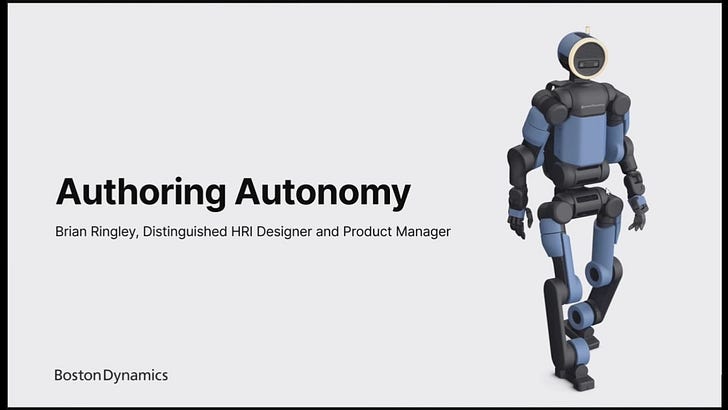
Brian Ringley · Boston Dynamics
Atlas is a general-purpose humanoid aimed squarely at industrial work, and Brian Ringley makes the case that its value is economic rather than technological. Most of the automation gaps on a factory floor could be closed with conventional equipment; what makes that impractical is designing a bespoke solution for each one. A single investment in generalised hardware turns all of those separate problems into one software problem, which is a far cheaper thing to solve.
The talk walks through the industrial design decisions that follow from putting a machine into shared human space. Why the robot has a head and a face that turns: perception needs to sit at eye level, and a gaze tells a person nearby that they have been seen and hints at what the robot will do next. Why it reads as equipment rather than as a person. And why only two actuator types appear across the whole machine, giving a blocky, repetitive design language in exchange for cost, reliability and field-replaceable parts, with continuously rotating joints that let it work in ways a human body cannot.
The second half is about teaching it to do useful work. Ringley lays out the current stack — reinforcement learning for whole-body control, behaviour cloning from VR teleoperation for manipulation, and a vision-language model above both for reasoning and tool calls — and is candid that the hard constraint is data. There is no internet-scale corpus of action data, so it has to be produced: pilots suited up in VR on real plant floors, training in simulation to remove latency, and supervised correction where a human takes control mid-policy to annotate what went wrong. Running underneath is an argument about authorship, that the line between who writes software and who uses it has largely dissolved, and that the world itself is becoming the arena in which this software is trained.
Links
Talk page with full transcript
Search the full text of every recorded CDFAM presentation
This is a public episode. If you would like to discuss this with other subscribers or get access to bonus episodes, visit www.designforam.com
Get every episode summarized
Each time CDFAM Computational Design Symposium publishes, we email you a written briefing from the transcript — the topics, who appeared, and any specific claims, with the ad reads skipped.
Email me new episodesFree for 3 shows. No card needed.
Hosts & guests
No transcript yet
This episode has not been transcribed. Request it and it moves to the front of the queue.
More episodes
More from CDFAM Computational Design Symposium

The Era of Living Machines: How Biology Will Build the Next Generation of Buildi...
CDFAM Computational Design Symposium

From Horns to Armor: Biomimicry, Computational Design, and the Future of Impact...
CDFAM Computational Design Symposium

Before the Model: Aurora as AI-Grounded Climate Intelligence for Early-Stage Des...
CDFAM Computational Design Symposium

Bridging the CAD-to-Simulation Gap: Integrating Meshing-free Isogeometric Analys...
CDFAM Computational Design Symposium