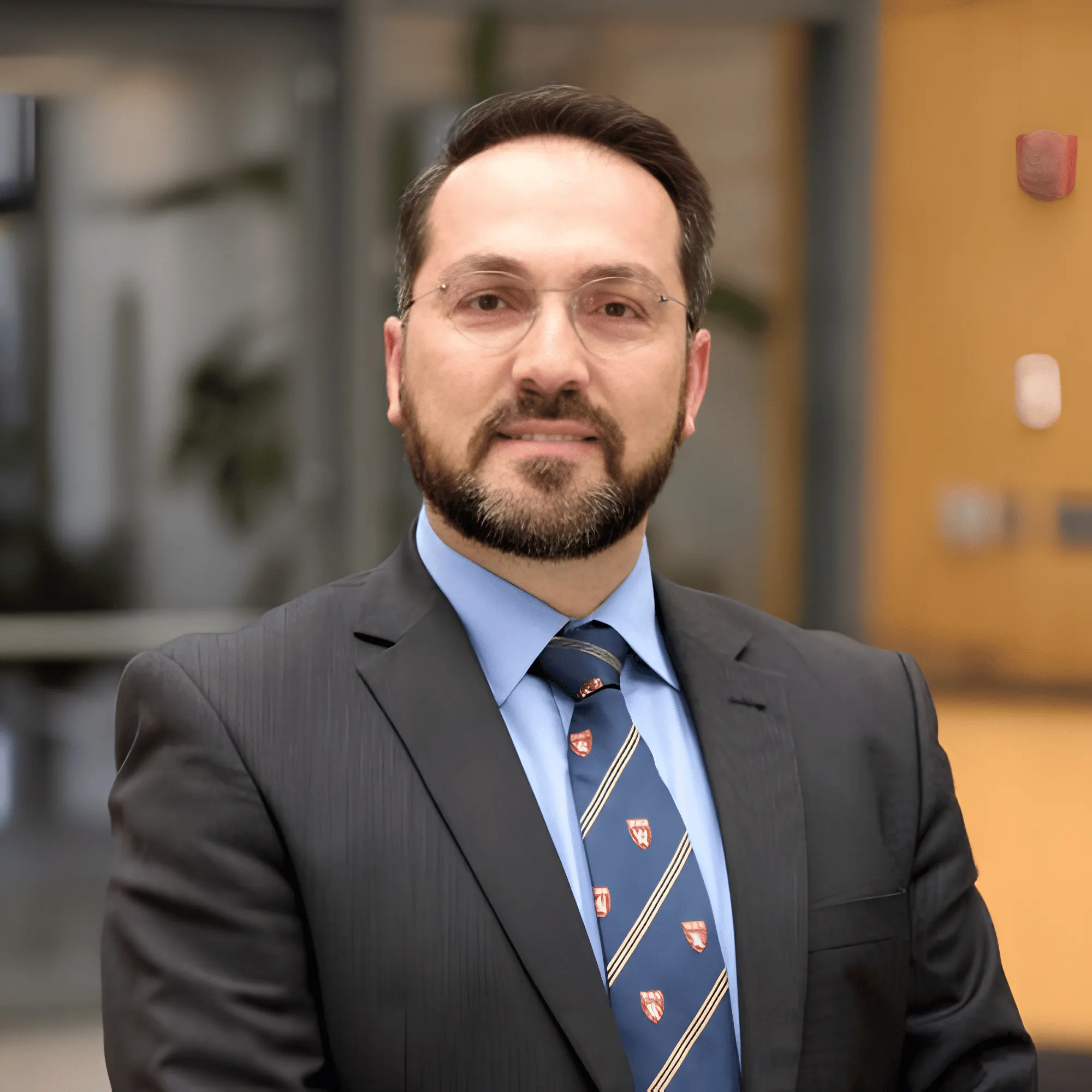
Bioethics, Research, and the Human Questions Behind Innovation
Get every episode summarized
Each time Mission Matters Business Podcast with Adam Torres publishes, we email you a written briefing from the transcript — the topics, who appeared, and any specific claims, with the ad reads skipped.
Email me new episodesFree for 3 shows. No card needed.
About this episode
“All right, so today I have Constantine C. Mopleys on the line and this episode is part of our Better Business Better World Conference series coverage and what we do here is this is going to be at BetterBusinessWorld.com.”From the transcript
Get every episode summarized
Each time Mission Matters Business Podcast with Adam Torres publishes, we email you a written briefing from the transcript — the topics, who appeared, and any specific claims, with the ad reads skipped.
Email me new episodesFree for 3 shows. No card needed.
Know when Constantine Psimopoulos turns up
Follow Constantine Psimopoulos and once a week we email you every new episode they appeared on — including guest spots the show notes never mention, because we read the transcript.
Follow Constantine PsimopoulosFree. Pick your own day and time.
Hosts & guests
Transcript ready
139 searchable segments. Every word is indexed and playable.
Full transcript
Mission Matters Business Podcast with Adam Torres — Bioethics, Research, and the Human Questions Behind Innovation. Machine-transcribed; use the interactive transcript above to jump the player to any line.
Hey, I'd like to welcome you to another episode of Mission Matters. My name is Adam Torres and if you'd like to apply to be a guest in the show, just head on over to MissionMatters.com and click on be our guest to apply. All right, so today I have Constantine C. Mopleys on the line and this episode is part of our Better Business Better World Conference series coverage and what we do here is this is going to be at BetterBusinessWorld.com. We're got myself Constantine. We're both going to be at the conference. Constantine is going to be speaking as well and we'll talk about that in a moment or two, but it's going to be an Orlando, Florida again, that's December 18th to 20th. Go to BetterBusinessWorld.com to grab some tickets and Constantine is a bioessis and academic researcher over at Harvard University and also University of Chicago. So Constantine, welcome to the show. Thank you so much Adam and so happy to be here with you. All right, so we got last talk about here today. Overall, angle, spirituality and well-being for
human flourishing. What a great topic. I'm excited to get into this, but before we do, I know you're going to be as I mentioned at the conference, BetterBusinessBetter World. I know you're going to be one of the speakers and possibly doing some other work there too as well. So talk, talk, I know it's in December, so we've got a little bit of time and things can change, but what are some of the ideas you plan to propose? Thank you. I'm really looking forward to going to Orlando, Florida and be with you and some other amazing speakers that are lined up. Hopefully there will be a lot of attention and people who travel there will be able to get something really, really inviable in terms of how in our case, how we see human flourishing, which is a concept that is so significant these days, looking into puppet health and well-being and medicine and how medicine and puppet health should be even more enhanced so that people can really live productive and meaningful lives.
So I'm going to try to illustrate what the works from the human clergy program at Harvard, or have been doing research with my colleagues for the past four years, is really trying to develop the pathways and has already created the domains to study how do humans flourish? So that's what I'm hoping to bring with stress perspectives from those Harvard and the University of Chicago, or I'm currently doing my research and then give that to the people who will be attending. How did you first get, you mentioned you've been doing this for 40 years, I think I heard correct, how do you get interested in this field in general, in like kind of this path? I started in the field of gene theology, which is a study of the human body motion, or also known as exercise science, exercise physiology, and that's under the umbrella of health education and specifically sport medicine. And I was always impressed by how, in my perspective,
I was on an Olympic level endurance athlete, a cyclist, how could the human body exceed in terms of human performance, any kind of goals that we had set or we imagined we could reach? And so that led into this field of research from an early age, wireless, competing and training further in the games. And then later on, I went into Harvard Medical School where I studied biomedical ethics, and I was also introduced to how the specific study, the evident, Bay Trigoros scientific research on how do humans not only are happy or can have this sense of well-being as we call it, but even beyond that, the many dimensions of well-being, not only for example health or mental health, but also social and spiritual well-being, how does that help
people and society communities at large achieve this human flarison, which we define in our program as the relative state in which all aspects of an individual slice are good, including the communities in which and the context in which people live. In all of those, okay, so first off, you said a couple of things here and I want to circle back too, because you said it like it was no big deal, like just matter of fact. So you were at a Olympic level endurance athlete, what was that like? That was a big part of my earlier life. I started competitive cycling when I was, I didn't even know where this could lead, but I went to a local race. I was born in U.F. It is in my parent lived in New Jersey for many years and then I went back to Greece where we are originally from hence my accent as well and I competed at a local race in the northern part of Greece or South Eastern Europe and that race was the first one that I won at age of 12 and then the team
saw that I had the potential to do big things and lovely hall fast forward even from that early age. I started winning races one after the other and that was mountain biking in particular, although I did the tools, so the equivalent to people know the two differents that do italia but not that big of her interest in the beginning and I also raved the velodroms, I did peed and track and all of that with our team and I won my first national tangents at the early age in Greece when I was 15 and then I was recruited to the national team and at the time in 96 we had the first version of mountain biking as a discipline in the Olympic Games and that was in Natrana in the Atlanta game and that's when I coincided with me winning my first national championship which of course meant that hey maybe I will be able to make it to the next Olympic Games which was coming up in Sydney. So that's how I started with all of this and I reached the high level with a lot of training, it was a big part of
my life. I was a good student in high school but I managed to also put in a 3, 4, 5, hours of training every day and then go to races all over Europe in the weekend. So that was how my life was like for many years leading up to my college years and then we didn't make it to the Sydney Games, some of my colleagues did but then we continued on for the next Olympics in essence 2004. Wow, what an amazing story, that's so great, I love bringing that one. So circling back to your work, what is it even, I'm trying to wrap my head around this, what does it even look like to study human flourishing? What does that even entail? It entails what we call residence-based research, so the scientific approach where we try to look into how population health works. So we're not just looking into certain individuals like small samples as we send
research but we try to do either longitudinal research, for example, research that laps for many years and we're tracking thousands and thousands of individuals using a survey essential where we collect the evidence and pyrrical research as we call it, we have a lot of evidence and data from the people who are participating. And to give you an example, we just completed a big longitudinal study for six years, that was the first phase that started in 2019 looking into 23 countries from around the world with a total number of participants exceeding 200,000. And that was what we call a very representative sample of people with different demographics from different cultures from around the world, including the United States, of course. And we were trying to answer different questions that are correlated to pathways.
On how do people, he flourishing as we defied it with regard to those domains and the first domain is happiness and life-static faction. And we're asking people essentially to tell us how happy or satisfied are you currently wherever you live with your life? We're asking them how meaningful is your life currently? How do you feel that you grow or have grown in virtue or character? And what do social relationships mean to you and how do they manifest? So we're asking those questions that they've developed in our human flourishing index as they correlate to our five domain that are all end in themselves as we say, philosophically speaking. They're not mean to other end that they're good because they have inherent words like I have purpose in my life or this gives me purpose. So that's how we're trying to make sure that what we're investigating
essentially is really based on the best science, the best methodology and the most reliable data from the people themselves. Give me a feeling of maybe how all of this stuff can connect whether it's spirituality, medicine, public health, like I see overlap in all these things, like how do these things kind of connect? Absolutely, yes. And they do connect with, essentially publish the paper, one of the best scientific journals in the world, definitely the best in the United States, what, a top three, it's called JAMA, the Journal of the American Medical Association, where we did a meta-analytic, as it is called, looking into 521,720, some more than half a million for Tichipan, in all combined research that systematically, they're called systematic reviews, systematically, they're looked into this correlation between spirituality and wellbeing,
or also specifically flourishing. And we saw how this actually helps not only when people are ill or have disease that they're living with, but even when they are then in their lives having better productivity, even when in any kind of situation, spirituality, someone who is spiritual and not just religious or necessarily religious, we call it SNR, spiritual not religious, can benefit from something that is beyond our scope of understanding or our scope of the mundane and the very day-to-day pursuit in life. And we've found this effect that we call it scientifically rooted, that there is a very significant effect that people who tend to, for example,
participate in some religious activity, at least one two weeks, based on our study that I mentioned, that was published this past February, have up to an protective effect of up to 18%, which is almost 70% very, very significant, of lower risk of engaging in alcohol or other drug use, which for us it's very significant and for society at large, which then tells us that if we focus a little bit more on our social and spiritual well-being, then overall our flourishing we increase in life, even though we might have some difficulties, either some health concerns or maybe we're striving for a purpose, but we're also not making it exactly as we hope, but as long as we're on track to flourish and this is for our lifetime, then we can show that this is
something important for everyone to consider and we can thank it in our lifetime. So how does, give me a little, and I know there's only so much we can cover in a 15 minute podcast interview, but maybe just one tip of possibly application from the study or something like that, on how people can improve their lives or well-being or otherwise, for the audience maybe something small that's tangible. Something very small and tangible is a project that we have and we've been emphasizing some of my colleagues, led by Dr. Richard Cowding, have been looking into forgiveness and how that works as a catalyst for flourishing and forgiveness is something that you practice when or usually when your religious or spiritual because you believe that this is also spiritually beneficial for you personally, but we see how it works as a catalyst when we forgive someone else's action, usually negative towards us, then not only is it better for the other person
because they feel forgiven and they have a less of a burden that they carry, but it is even more important that we feel less of a burden of things that we hold again someone else. And when we try to practice that in an everyday life, starting with the nucleus of a family or close friends and colleagues, we see that there is a tremendous effect for overall flourishing again and it is very simple, so it's not something that we do again for some other end, so it's not a mean thing, but it's good and herringy for it is own sake and we know that it can help if we do this little, little, little every day. Another way, of course, we know from life-pedal medicine to have a balance between being physically active, eating well and keeping well so that we can then be at the higher capacity to either forgive or look into our own well-being
again, holistically. So every little thing helps, but something like forgiveness, forgiving others is work systemically for the entire community. Well, Constantine, it's been an absolute pleasure having you on today and learning more about your work for a realistic thing. If you want to hear more from Constantine, remember, he's going to be a better business, better world, the conference in Orlando, Florida, that's December 18 through 20th. I'll be there as well. Come meet us in person and then to get tickets, it's betterbusinessworld.com and Constantine, been an absolute pleasure. Thanks again for coming on the show. Look forward to meeting person. Thank you so much for having me and I likewise, I look forward to meeting you as well.
More episodes
More from Mission Matters Business Podcast with Adam Torres

Fighting Cancer Drug Resistance Through Innovation
Mission Matters Business Podcast with Adam Torres

Building the Next Generation of Podcasting With AI
Mission Matters Business Podcast with Adam Torres

How AI Is Transforming Modern Cybersecurity
Mission Matters Business Podcast with Adam Torres

What Mountaineering Teaches Us About Life: Alan V. Goldman on Mission Matters
Mission Matters Business Podcast with Adam Torres