Get every episode summarized
Each time Science Friday publishes, we email you a written briefing from the transcript — the topics, who appeared, and any specific claims, with the ad reads skipped.
Email me new episodesFree for 3 shows. No card needed.
About this episode
“To ghost haunt houses because they have unfinished business, or because you have unfinished races, Mmm. It's further evidence that everything happens for a recess. Your skin, your organs, goo inside of you, but a lot of our high tech world is rigid and hard.”From the transcript
A lot of things in life are squishy, including your skin, your organs, and all the goo inside you. But technology tends to be rigid and hard. Figuring out how to get those two worlds to work together can be challenging. How do you connect an electronic sensor to a soft, beating heart?
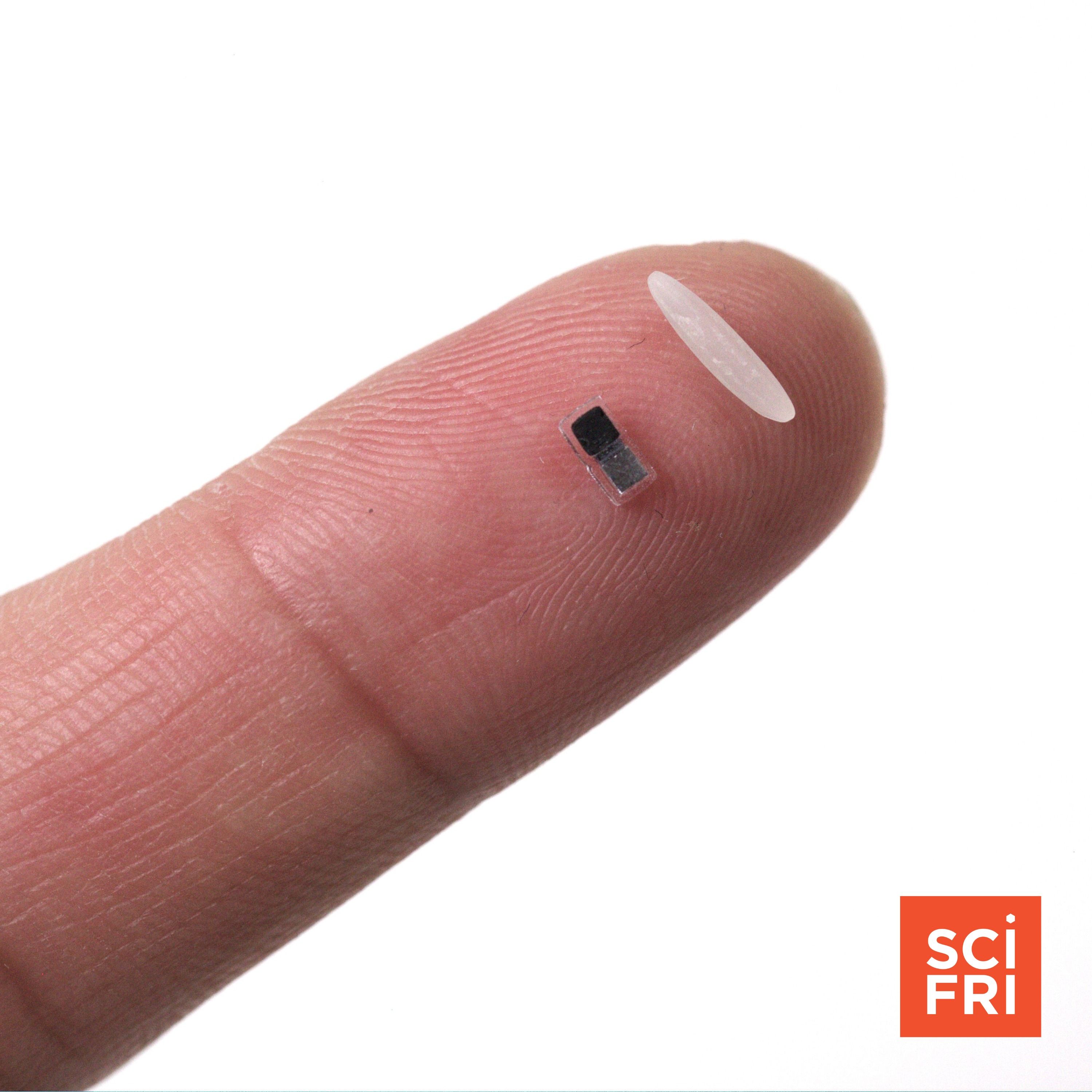
As an inventor of biocompatible electronic devices, John A. Rogers has designed things like flexible probes, a pacemaker smaller than a grain of rice, and wireless sensors that stick to skin like a temporary tattoo. He joins Host Flora Lichtman to talk about the challenges of meshing the natural and artificial worlds, and his approach to science and technology development.
Guest:
Dr. John A. Rogers is a professor and director of the Querrey-Simpson Institute of Bioelectronics at Northwestern University.
Transcripts for each episode are available within 1-3 days at sciencefriday.com.
Subscribe to this podcast. Follow our show on Instagram, TikTok, Facebook, and Bluesky @scifri and sign up for our newsletters. Got a science question that’s keeping you up at night? Call us: 877-472-4374
Hosted by Simplecast, an AdsWizz company. See pcm.adswizz.com for information about our collection and use of personal data for advertising.
Get every episode summarized
Each time Science Friday publishes, we email you a written briefing from the transcript — the topics, who appeared, and any specific claims, with the ad reads skipped.
Email me new episodesFree for 3 shows. No card needed.
Hosts & guests

Transcript ready
297 searchable segments. Every word is indexed and playable.
Full transcript
Science Friday — Bringing hard electronics into soft and squishy bodies. Machine-transcribed; use the interactive transcript above to jump the player to any line.
Mmm. To ghost haunt houses because they have unfinished business, or because you have unfinished races, Mmm. There they are. It's further evidence that everything happens for a recess. Hey, it's Flora, and you're listening to Science Friday. A lot of things in life are squishy. Your skin, your organs, goo inside of you, but a lot of our high tech world is rigid and hard. Figuring out how to get those two worlds to work together is something that my next guest has thought a lot about, as the inventor of bio-compatible electronic devices. He's designed things like flexible probes, a pacemaker smaller than a grain of rice, wireless sensors that stick to you like a temporary tattoo and monitor your body in real time. And that is just to name a few. John A. Rogers is a prolific inventor
with more than 100 patents. He's also a professor at Northwestern University. John, welcome to Science Friday. Yeah, thanks for having me. Thanks for being here. When you started out, what did people think about this idea of squishy electronics? Well, I guess mixed feelings in a way. We got interested in this area shortly after I started my independent career at Bell Laboratories. So the place where the transistor was invented, fiber optic communications, information theory, and so on. We were working on flexible electronics. And we were thinking about applications like paper-like displays or ultra low cost product level electronic tags, things of that sort. When I moved to University of Illinois, there was a lot of interest from DARPA, sort of the military, you know, R&D division in that area and thinking about these flexible electronics systems as kind of field deployable communication networks and so on.
And we didn't really start getting into this notion of electronics in bio-compatible form. So thinking about not only flexible devices, but ones are sort of soft and squishy, as you mentioned. Until I gave a talk at University of Pennsylvania in electrical engineering, and it just so happened, a few of the neurosurgeons saw the title of my talk, I'd interested, came over, listened to the talk, and asked whether I've ever thought about taking those flexible electronic devices and putting them on a brain. A very squishy organ. Yeah, and that was kind of the starting point, you know, for us in thinking about electronics that look a lot more like biology to allow for that kind of intimate level of integration. I mean, biosensors, bio-compatible electronics feels so hot right now. But what are the big problems that you need to overcome to make them? Well, a lot of things, I would say, there's a set of challenges kind of in an engineering domain, and then there's a corresponding set of challenges kind of in the realm of fundamental science. At the engineering level, the real challenge is how do we convert conventional sort of
silicon integrated circuit technology, currently built on silicon wafers, which are planar, rigid, brittle. How do you transform that kind of function into a platform that would allow for, you know, soft, curvilinear integration with the textured surface of the brain? Or how would you develop a class of electronics that would allow you to gently wrap it around the surface of the heart, where you have not only a complex geometry, but also a time dynamic motion associated with cycles of, you know, the cardiac rhythm and so on. And that's opening up a whole set of topics that turn out to be really interesting from an academic sort of engineering science standpoint. But then you have to also grapple with what happens when you put a man-made system into contact with a living, keeling, dynamic, biological environment. Then you have to think about the interface and how do you exchange information at that interface where the lines of communication are fundamentally different. You think about electronics as operating on the basis of electronics and photons.
You think about biology. Now you're thinking about flux of ions and biochemical species and just fundamentally different kind of language. And how do you do the translation? So tremendous set of interesting topics for research, but where successful outcomes we believe will really transform the way that we think about basic understanding of living systems and also technologies to aid in the way we care for patients. You have this background in physics and chemistry, obviously engineering. Did you also have to, like, almost go back to medical school to do this work? Well, a little bit. You know, we're extremely collaborative. So if you take a look at the papers that we publish, they almost always involve multiple senior investigators and their students. So I think it creates a tremendously rich learning environment for the students and that's kind of my main priority as an educator, as a faculty member. We want to do the research, but we also want to train the next generation. And so we try to learn, but we don't strive to become experts outside of our domain.
You know, we have things that we do pretty well. We want to focus on those and then leverage that set of expertise against complementary, you know, knowledge and expertise from collaborators. And we've been able to make that work at a very high level. Do you know when you don't know enough? Usually I don't know enough. I would say, you know, we kind of have like, I would say a T-shaped kind of expertise profile. We're pretty good at material science, electronic devices, semiconductor physics. And that's the, you know, the pointy part of the T. And then the top of the T, I think it allows us to effectively communicate and engage with people who have expertise outside of our domain. And so the top of that T is very broad. Yeah. And the shaft is very narrow, but very deep. And that's, that's worked pretty well for us. I'm so interested in your process. Do you start with an idea for something you want to build and work towards it?
Or do you start with the materials and the chemistry and say, oh, what could I do with all this? Well, I think it's a blend, you know, I'm fortunate to run a fairly large research group. So we have a variety of activities. I would say in one space, we, you know, are interested in sort of blue sky kind of undirected research, discovery oriented where we, you know, think we have kind of an interesting material. When we investigate that or we want to develop something that we think could have promise in the future, not crystal clear where that's going to go. I think it's important that certain fraction of our programs are kind of in that sort of space. But a lot of our projects come to us from the clinical community for the neuroscience community, where they are aware of some of the unique capabilities that we have. And they have a challenge and care for their patients or they have a challenge and the kind of studies that they're doing on a brain organoid, for example, where they think technology might provide a solution and then they come to us and say, hey, you know, it'd be really great if you could do X, Y, and Z.
So pretty much a blend, I would say across that entire spectrum. And then a few things kind of in between those two limiting cases. When you start a project, do you get obsessed like are you the kind of person that sleeps in the office? Pretty much. Yeah, I would say, you know, I think there are a lot of smart people out there for sure. But I think there's a smaller subset of those folks who can become single-minded and like persistent at a scary level and probably I'm kind of in that domain for better or worse. And so obsession is a very key part of it. Give me an example of a project that was really difficult, like maybe unexpectedly difficult. Give me the case study and how you sort of worked around the problems. Well, I would say like almost everything we try to do is difficult. Like if it's easy, then probably somebody else could take that on or it's probably going to happen anyway. But I give you one example. So we were approached by cardiac surgeons and they were interested in developing a new kind of temporary pacemaker.
And so I didn't know anything about this, but evidently if you go in and you have a structural failure or valve failure in a heart, and that requires an invasive surgery, there's a critical risk period following that surgery as the patient is recovering. And so as a consequence of that, these surgeons in many cases will leave a temporary pacing lead in the patient, interface to the heart, passing transcutaneously to an external box of electronics to deliver the stimulating pulses with heart to pace it as necessary during that recovery period. It sounds a little clunky. Yeah, yeah. So that was the problem. Two problems. One is it tethers the patient to that box of electronics. And then the other problem is that it ultimately requires extraction. And the problem with pulling it out is by the time that it's ready for removal. In many cases, there's a fibiotic capsule that's developed around that pacing lead. And so when you pull it out, you tear that scar tissue, but that tearing can also lead to damage to the healthy cardiac tissue,
leading to an internal bleed, and that could lead to death of the patient. So they came to us and they said, hey, we're aware of this class of bioelectronics that you guys have been working on that have this unique defining characteristic that it's water soluble. So they ask, can you take that base of capability and develop it into a wirelessly powered, fully implantable temporary pacemaker that would just dissolve away after it's no longer needed? We don't have to do the surgical extraction. We don't have the tether to the external electronics is fully implantable. Can you guys go off and do that? So let me just make sure I understand this is like disappearing ink for a sensor. Like you put it in, it's completely wireless. It does all of this monitoring that you need. And then when you don't want it, it just poof degrades away. Yeah, yeah, sort of crazy, but you can do that. And so we can build radios and sensors and, you know, a2d converges amplifiers, whatever you want. It seems like spy craft to me, but okay, keep going.
Yeah, it's sort of weird. But just to rewind, we actually got our start in that class of technology again through funding from DARPA. They were interested in electronics to be deployed in the field and then disappear to eliminate the risk associated with unwanted recovery of that sensitive electronics by an adversary. Okay, so it literally is spy craft. Yeah, yeah, back to your question. Yeah, pretty much. But, but then we thought, you know, okay, military, that's important. Probably somebody should work on that. But my students were a lot more interested in how this could be leveraged to improve human health. And so that's kind of the centroid of our activity around this technology. But anyway, we developed this. It worked. And that was fine. But then they came back and said, well, this looks pretty good. But in most cases, we're using this temporary pacing lead for pediatric patients. And that device is too big for an infant. And we're like, geez, that's unfortunate. So we got to go back to the drawing board and try to create something that is dramatically smaller, but offering the same functionality.
And so I think in the intro, you mentioned the super tiny pacemakers. That's what led to the development of these, you know, millimeter scale. It's about the size of a sesame seed, actually. So it provides all the same function. It's a different kind of operating principle. And then just to cap off this story, then the next challenge was, oh, you can do it with the infants. Can you do it with the fetus? And so evidently there are, well, and we actually work with fetus, scopic surgeon. I didn't know thinking about this either. But, you know, the medical community, you know, doing all kinds of stuff. The fetus, scopic surgeon at Lori Children's Hospital approaches is, hey, you have this temporary pacemaker for infants and adults. Can you develop it for use with a fetus? And then that places even more stringent requirements on how the device operates, how it needs to be implanted, what the sizes are. So we haven't published that yet, but we've figured that out as well. So anyway, there are multiple challenges, but it's a really stimulating, great kind of research. You know, I think for me and the students get pretty jazzed about it also.
We have to take a quick break, but when we come back, I want to ask you about how you pick your problems. You know, how you pick the problems you know you can solve. Are you up for that? Sure. Science Friday is supported by Planet Visionaries, the podcast created in partnership with the Rolex Perpetual Planet Initiative. Stay tuned for a trailer and subscribe wherever you get your podcasts. Do you want to hear about visionaries creating a better world? People working in conservation, exploration, science and tech. Alongside storytellers imagining and creating a better future, I'm Alex Honel. Professional rock climber and founder of the Honel Foundation bring you season six of Planet Visionaries. This season, I speak to guests like National Geographic, photographer Tom Peshach and Anna Rathman, executive director of the Jane Goodall Institute, USA. In partnership with the Rolex Perpetual Planet Initiative, watch Planet Visionaries on YouTube or wherever you get your podcasts. You're never just one thing. You're the boss. Hey Google, when's my next meeting?
The athlete. A class wrecks me. And their mommy. Everyone in? The Mazda CX-5. More to move every side of you. Learn more at MazdaUSA.com. Google is a trademark of Google LLC. Sequence is shortened and simulated. Support for Science Friday comes from the Burrows Welcome Fund. Dedicated to improving human health by powering education and scientific discovery. More at www.fund.org. Johnny, you have a ton of patents. And the thing that's so striking is that many of them are in use commercially right now. So a lot of successes. But I'm guessing that people must come to you with directed problems that you're like. I actually know. I can't do this. How do you know when to pass? That's a great question. So I think a lot of our collaborations are kind of in, you know, as I mentioned before, that medical domain. So clinicians are really interesting people in the sense that they're similar to the engineers because they are oriented around solving problems.
And that's what, you know, engineers like myself are interested in doing. But they have a different language. They have a different knowledge base and different set of perspectives. So we get inquiries. They fall into three buckets. So the first one would be a problem that one could probably solve in one's garage with a saw and a drill, you know, and a hammer. That type of thing. Those aren't problems for us. Somebody should solve them. And in me cases, those solutions could really, you know, benefit patients. But somebody else can probably take that on. So that's one extreme. The other extreme would be a request for a technology that would require us to break multiple laws of thermodynamics and physics. One law is okay, but multiple snow. Yeah, well, yeah, one or more typically. So anyway, that's kind of in a Star Trek realm. And those conversations sometimes lead to something that's sort of actionable. But I would say, you know, there is, you know, a set set that kind of fall in that space.
And we're looking for something in between. Something where there's some level of innovation or some level of uniqueness or some degree of alignment with, you know, our particular approaches and material sets and fabrication schemes and so on. So that's kind of how we, we think about project selection and prioritization, kind of it at a rough level. Is it a gut feeling? Is it a matrix you can solve? Like, do you feel like you need to develop an intuition for this? Yeah, I've been doing it for a long time. So I think over the years, you kind of develop a sense of what's likely to work, what's not going to work. But I would say still, you know, there are a lot of failures. I mean, it's just failures. You're swimming and failures most of the time. And you're just like scramming around trying to find something that works. So it's not like you ever kind of figure it out. And I think if you figured it out, then the uncertainty goes away. And then, you know, maybe that's not even research anymore. So I would say say that, you know, a lot of times, however, we can see a way to sort of modify or adapt or combine several technologies that we're already pretty comfortable with.
To create something new. And so those instances, you know, the risk is the lowest. But you're still doing something that's differentiated, you know, and kind of distinct from things that we or others have done in the past. It doesn't feel great to swim and failure. In my experience, anyway, how do you cope? You really have to savor the successes, I guess. I think more than anything, you know, at my stage in my career, I think that's the most important thing to do. I think that's the most important thing to do in my career. I kind of live for the students more than anything. And I want to see them succeed. So I would say the greatest level of satisfaction for me is seeing a student develop and then go off and develop like a super successful career of their own. And sometimes that's an academics or industrial lab. And that's kind of what I do it for at this point. 2001, no, not really, but my students need to publish. So I got to kind of work with them to make that happen.
There can be this cultural divide between, quote, pure science and the applied world. How do you feel about that? I like both. You know, I think the Bell Labs environment was a fantastic place for me to kind of experience. It was a little bit kind of at the tail end of the golden age of the labs, but nevertheless incredible level of talent. I was in the physics lab. I was hired by horse stormer who won the Nobel Prize in physics the next year. And I think it represents the perfect blend of fundamental science, but in the service of technology that could be broadly beneficial to people. I was trying to do something that can benefit humanity. I guess maybe it's a lofty goal. But anyway, we want to get things out of the lab. I think that's the point. I think for me, a role model is John Bardeen, who is a theoretical physicist focused on semiconductor charge transport and working with Britann and Chalkley.
They invented the transistor when the Nobel Prize changed the world. If you can aspire to that level of science and technology, I think that's a model that we like to like to think about. So put another way. We'd like to generate knowledge for the ages, but technology for today. I mean, we'd like to be able to do both of those things if we can. I think that's the perfect place to leave it. John A. Rogers is a professor at Northwestern University and director of the Query Simpson Institute of Bioelectronics there. Thank you for joining me today. This is a pleasure. Yeah, thank you. This episode was produced by Charles Berquist. If science Friday is your source of knowledge for the ages, consider telling the world about it. You can leave us a review on your favorite podcast app of choice, or even just tell your friends to listen. That helps too. We'll see you next time. Thank you for listening. I'm Flore Lickteman.
We'll see you next time. See you next time. Bye.
More episodes
More from Science Friday

The tilcayo is the new wild cat on the block
Science Friday

Are natural history museums going extinct?
Science Friday

Examining a new lunar crater + searching for signs of alien technology
Science Friday

Did the COVID pandemic stunt kids’ development?
Science Friday