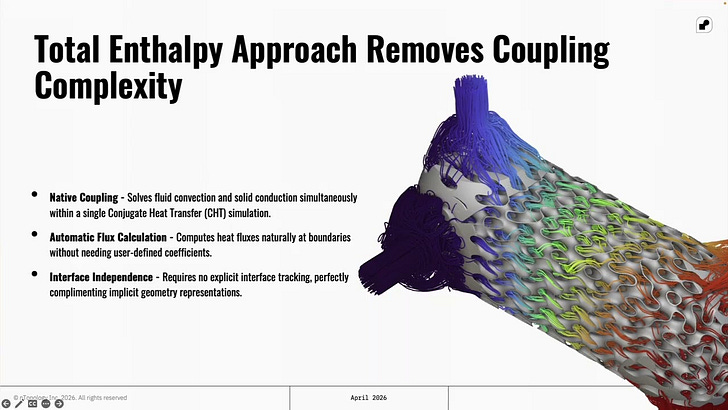
Conjugate Heat Transfer Optimization for Turbine Blade Thermal Performance Using Field-Driven Design
Get every episode summarized
Each time CDFAM Computational Design Symposium publishes, we email you a written briefing from the transcript — the topics, who appeared, and any specific claims, with the ad reads skipped.
Email me new episodesFree for 3 shows. No card needed.
About this episode
CDFAM Computational Design Symposium — Barcelona 2026
Max Gaedtke, Markus Lempke · nTop, Siemens Energy
Turbine blade thermal management demands tight coupling between design exploration and high-fidelity simulation—yet traditional workflows separate these domains, limiting the design space that can be practically explored.
We present an integrated parametric optimization framework enabled by nTop’s robust implicit geometry engine. Field-driven design representation eliminates mesh regeneration between design variants, while a Lattice Boltzmann Method formulation for conjugate heat transfer removes the need for explicit fluid-solid interface handling. This architectural unity—implicit geometry paired with interface-agnostic thermal transport—permits fully automated design-simulate-optimize loops on complex internal cooling geometries.
The GPU-native solver has been validated against finite-volume baselines on canonical heat sink geometries, demonstrating peak temperature agreement within 0.5% while achieving approximately 200x reduction in time-to-solution on consumer-grade hardware. These evaluation times make high-fidelity CHT practical as an inner-loop optimization objective rather than a final verification step.
We demonstrate the workflow on turbine blade internal cooling channels, where parametric control over fin positioning drives systematic exploration of the thermal-structural design space. Results show automated identification of Pareto-optimal configurations balancing thermal performance, pressure drop, and additive manufacturing constraints.
This collaboration between nTop and Siemens Energy bridges computational design research with industrial turbomachinery requirements.
Links
Talk page with full transcript
Search the full text of every recorded CDFAM presentation
This is a public episode. If you would like to discuss this with other subscribers or get access to bonus episodes, visit www.designforam.com
Get every episode summarized
Each time CDFAM Computational Design Symposium publishes, we email you a written briefing from the transcript — the topics, who appeared, and any specific claims, with the ad reads skipped.
Email me new episodesFree for 3 shows. No card needed.
Know when Markus Lempke turns up
Follow Markus Lempke and once a week we email you every new episode they appeared on — including guest spots the show notes never mention, because we read the transcript.
Follow Markus LempkeFree. Pick your own day and time.
Hosts & guests
No transcript yet
This episode has not been transcribed. Request it and it moves to the front of the queue.
More episodes
More from CDFAM Computational Design Symposium

The Era of Living Machines: How Biology Will Build the Next Generation of Buildi...
CDFAM Computational Design Symposium

From Horns to Armor: Biomimicry, Computational Design, and the Future of Impact...
CDFAM Computational Design Symposium

Before the Model: Aurora as AI-Grounded Climate Intelligence for Early-Stage Des...
CDFAM Computational Design Symposium

Bridging the CAD-to-Simulation Gap: Integrating Meshing-free Isogeometric Analys...
CDFAM Computational Design Symposium