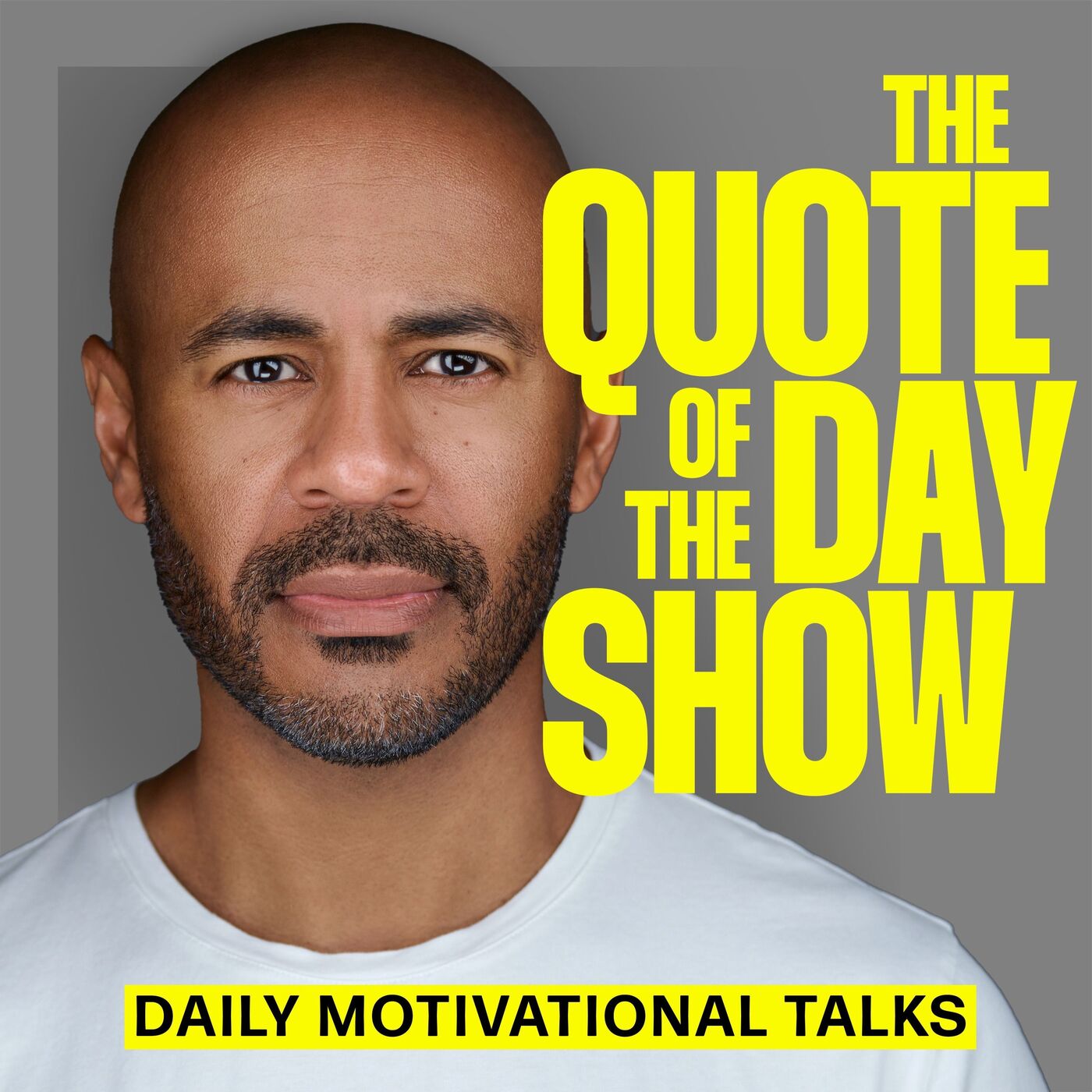
Dr. Joe Dispenza: "We Can't Lose Our Connection to One Another."
About this episode
The Quote of the Day Show | Daily Motivational Talks is made possible by:
Dr. Joe Dispenza answers a question about cell phones, dopamine, and what constant stimulation does to the brain. He explains what happened when researchers offered kids money to put a video game down, why overstimulation can leave people unable to feel pleasure at all, and what he does with his own phone at home. This episode will challenge you to make technology a tool again.
Source: Dr. Joe Q&A - Cell phones and dopamine
Hosted by Sean Croxton
Follow me on Instagram
See Privacy Policy at https://art19.com/privacy and California Privacy Notice at https://art19.com/privacy#do-not-sell-my-info.
Get every episode summarized
Each time The Quote of the Day Show | Daily Motivational Talks publishes, we email you a written briefing from the transcript — the topics, who appeared, and any specific claims, with the ad reads skipped.
Email me new episodesFree for 3 shows. No card needed.
Hosts & guests
Transcript ready
345 searchable segments. Every word is indexed and playable.
Full transcript
The Quote of the Day Show | Daily Motivational Talks — Dr. Joe Dispenza: "We Can't Lose Our Connection to One Another.". Machine-transcribed; use the interactive transcript above to jump the player to any line.
I have a confession. Believe it or not, sometimes I feel like I'm not growing. I'm doing the same things over and over again. I mean, things are good, but good can still feel like a rut. The other day I heard Martha Stewart say, her favorite place to go is where she hasn't been, which is how she's built a billion dollar business over five decades, beginning in a world that doesn't exist anymore. No internet, no social media. She didn't survive all that. She went out and she learned it. Martha doesn't do ruts. She's constantly challenging herself, doing things she hasn't done before. That's how you stay relevant for 50 years. Now, how do I know this? I watched her two-part class on Masterclass. And it was excellent. One of the most inspiring things I've watched in a long time. And there are 200 plus more classes, including FBI Negotiator, Chris Voss, on negotiating your next race, Cal Newport on reclaiming your focus
and Carol Dweck on developing a growth mindset. $10 a month, build annually. Right now, as a listener of this show, you get at least 15% off any annual membership at masterclass.com slash quote. That's 15% off at masterclass.com slash quote. Head to masterclass.com slash quote to see the latest offer. So I just have certain things that I do now, like I don't take myself on the dinner, or very rarely take my cell phone to dinner. I just don't want to disrespect anybody at the table. That's me. I want to connect. That's why I can connect any other time instead of the table. I want to connect with you. You're right there. I wish you could connect with you now with somebody else. U marks, welcome back to the quote of the day. Show, I am your host, Shawn Croxton, of Sean Croxton dot com,
we got doctor Joe. Dio disp there back on the shoulder up up the week. Our QODs this. We can't lose our connection to one another. Dr. Joe's gonna talk about smartphones, what they may be doing to our brains, and our ability to connect with each other. A couple of weeks ago I did something that I thought was really cool. You're probably not gonna think it's cool though. I took my phone, powered that baby down, and put it in a drawer. And I left it there from Tuesday morning until Friday afternoon, and it was wonderful. I'm gonna do it again. And I know not everybody can do it y'all got kids and you got real jobs, but give it a shot like on a Sunday. Because let me tell you, my brain was like, ah, thank you so much. Thank you for giving me a break. I just needed a time out. During that four days, I was able to attend
to what's in front of me in a way that I hadn't before. And what I mean by that is if I'm working on something, I'm just working on it. If I'm talking to somebody, I'm just talking to them. If I'm reading something, I'm just reading without the potential of a ring or a ping or a notification or some impulsive out of nowhere desire to pick up my phone and start scrolling on Instagram for 20 minutes, right? All of that was gone, and I can just be here in the present moment. I think a lot of us don't even know what that feels like anymore. And again, I recommend trying it out. It was great. Just try it for a day. And so Dr. Joe is going to talk about that and how even while we have all this technology, we got to be more mindful of connecting with each other. Like in person or just calling somebody, like we hardly call anybody anymore. And I think it's having a lot of ill effects on our mental health.
And I know that there are a lot of us who feel like something just isn't right with the way that we live. And what he's going to talk about is what a lot of it has to do with. Dr. Dispensis coming up. The question was to repeat it. I want to know the effects of cell phones on our brains and how it affects our dopamine levels. And I raised three kids in kids use technology. And I was saying this when I was talking to some of you this morning over a cup of coffee, that if your children are using cell phones for information, and basically we are information, that's all we are. And they're accessing information the way they do and they're using their cell phones on all kinds of ways for stimulation. There should be a period of time where they were able to set it down just like for you. And if you can't break your romance with your cell phone,
then it owns you. Would you agree? Because that's what keeps you connected to networks socially, that kind of social consciousness is maintained through networks. And it feeds us because we love tribe, we love culture, we love connection. But it's got to be done with discernment. So what happens for people is if they hand break from it and go from a narrow focus to a broad focus, like get out in nature, go hike, go get on a boat, open your focus and look at the sunset. You don't think that creates alpha in your brain. It does. Nature does that. The resonance of the humans constant is the exact 7.8 frequency of alpha brainwaves and training us to connection. So when they've done the research on cell phones, the video gaming to start with,
they sent to these kids, hey listen, here's how it's gonna go. You guys wanna make some money? What do you think the kids said? Yeah, let's make some money. They said, okay, we're gonna get you involved in a video game and then we're gonna ring a bell and you have five seconds to stop. If you stop in five seconds, we'll give you a dollar. And we're just gonna go as long as you, very hard, long I went. Do you know that none of the children, none of them were able to stop? That's how addictive it is. So the research shows then that when you begin you begin to blow somebody up or you shoot someone or you get a text, you know, that's important text to you. There's a release of dopamine in your brain, the pleasure chemical, the reward chemical is released. But if you're overdoing it and you're playing a lot of video gaming and you're blowing something up or blowing someone up or breaking through some level or doing something, the reward systems
are being activated in your brain and you start releasing too much dopamine all at once. And that burst of dopamine into the brain is more than the receptor sites have to handle it. You understand what I'm saying? Come on. So then the over amount of dopamine is not being absorbed by those receptors, the receptors close down, it's too much. They become desensitized. It's like living with the spouse that always yells at you. They gotta yell a little louder. You get your attention the next time you need a little bit more now to turn it on the next time. Does that make sense? So then the pleasure centers start recalibrating to a higher and higher level. It takes more now to turn the money and do a bigger burst to get them stimulated. Are you with me still? So the pleasure centers start recalibrating to such a high level that now the person needs the game, needs the phone to feel something
to make that feeling because in the absence of any stimulation, they experience a loss of pleasure. You understand what I'm saying? They become desensitized to pleasure. So I walk with your dog, go tell a kid to go see their grandmother, watch a sunset, just way too slow. They're overstimulated. Are you with me still? And that's called adidonia. You can't find pleasure from anything. Adidonia. Does that make sense? Now, what happens is this is the scary part, is that learning should be a reward by itself. Yes or no? But if you just blew up a nation and you're going to school and your brain is shut down as can't get stimulated by information, there's only one way you're gonna stimulate it and that's gonna arouse it. How do you arouse it? Can trouble? Act out. Do something dumb. Get some attention.
Just so you can arouse the brain. The child doesn't know they're doing releasing epinephrine and neurobeinephrine just for an arousal. But they're doing it and when they do that, they're actually shutting blood flow further down in the form of brain. Now, here's the problem. When that child gets older, and they face challenging situations in their life, they're gonna look for something else to make the feeling go away and it's gonna be something bigger. Do you understand what I mean? They're not gonna wanna realize they can do it themselves. They're just gonna go to another chemical, something bigger. So then that dependency that's created from technology has to be inhibited at certain times. I just have certain things that I do now. Like I don't take my cell phone to dinner, I very rarely take my cell phone to dinner. I just don't wanna disrespect anybody at the table. That's me. I wanna connect. That's why I can connect any other time. I said to the table, I wanna connect with you.
You're right there. I wish I could connect with you and I was somebody else. And now in my home after a certain time, I put my phone in my bedroom. This is mean, if I wanna use my phone, I'm gonna leave the rest of the house and go to my bedroom after a certain time because I've been making thousands of decisions every day. I just wanna be able to disconnect from technology. Are you with me still? And so then if you keep shifting your attention from one text to another text to another text, to another email to another Facebook, what are you practicing? You're actually practicing a short attention span. And the rush of the dopamine combined with a short attention span becomes a very short attention span. Are you with me still? And now the person doesn't wanna learn. They do wanna be stimulated. So the solution of course, is exactly what you're doing in this work. I joke around all the time and I draw a picture
and it says, where you place your attention is where you place your energy, out of world of physical reality, inner world of thoughts and feelings. And then I draw a line where your attention goes every day, your cell phone, your WhatsApp, your LinkedIn, your Instagram, your Facebook, your pictures that you put on Facebook, your email, your computer, your other email, your job, your coworkers, your boss, your enemies, your ex, your husband, your wife, your kids, all your face, your pain, your disease, your diet, this is where all the people's attention is. Now, none of those things are bad. But there's a neurological network assigned every one of them. And when you learn how to disconnect from your cell phone, now you're saying that it no longer owns you, you use it as a tool instead of as something that stimulates you. How many people understand that? So it takes practice. I mean, you have to be able to navigate in the world of technology. I mean, we have so much technology in my company now
and I mean, I'm always learning about it and it's faster than me. It's a big deal. But we can't lose our connection to the earth. We can't lose our connection to one another when we're sitting in the presence. I mean, I don't know about you, but in the United States sometimes, I can't believe I'm sitting in a restaurant and there's four people sitting at a table and all four of them are on their phones. And they're having dinner together. I'm thinking, wow, that must be a really deep conversation you guys are having over there. Are you texting one another? What are you doing? Send each other links. I mean, connection is so important. In physical connection is important. So we have to balance it out and you can recalibrate those pleasure centers by finding pleasure and other things like what you're doing. And there's nothing wrong with dopamine. It's just that you can't overdo it because you'll get kidnapped. You literally get kidnapped by technology.
And remember that book called Future Shock? I don't know, and there was a movie that Orson Wells did. And he was young, I don't know, this was in the 70s or something. Anyway, I had to read it when I was in college or high school or something. And the author reached out to me and said, hey, I'm doing a thing called After Shock. And I've been familiar with your work. Well, you are, you won't write an essay. And I wrote an essay about just what we talked about. And he said, I love this. This is because we're victims. To the very technology we created, isn't that crazy? It is crazy if you think about it. So you got to be able to use it, but you got to be able from disconnect to it and in staying balance. That was Dr. Joe Dispenser. His website is DrJodaspenser.com. You can watch today's entire talk on YouTube. It's called Dr. Joe Q&A Cellphones and Dopamine. Hey, if you've been wondering about the money mind challenge
that I talked about a few weeks ago, it's still going down. It was just really awkward timing. I didn't want to do it right before Labor Day. And I didn't want to do it right after Labor Day because it would have been like Tuesday through Friday, which just felt a little awkward. And so I pushed it back a couple of weeks and we added a fifth day so we do it the right way. So I got to have to write that fifth day and get everything together and do a little rearranging. And so that will be going down a week from next Monday. So we go five days. It's totally free right here on the podcast. And I also tell you all about money mind academy, which is opening up for enrollment for the first time in like five years. And this new version of money mind academy is insane. Like it's insane. So I can't wait to tell you about that. And enjoy your weekend. I will see you on Monday. I am out. Peace.
More episodes
More from The Quote of the Day Show | Daily Motivational Talks

Dr. Wayne Dyer: "Your Subconscious Mind Rules Your Life."
The Quote of the Day Show | Daily Motivational Talks
Shad Helmstetter: "The Strongest Program Always Wins."
The Quote of the Day Show | Daily Motivational Talks
Caroline Myss: "Transformation is So Bloody Hard."
The Quote of the Day Show | Daily Motivational Talks
Steve Harvey: "I Knew That I Could Not Remain the Same and Change."
The Quote of the Day Show | Daily Motivational Talks