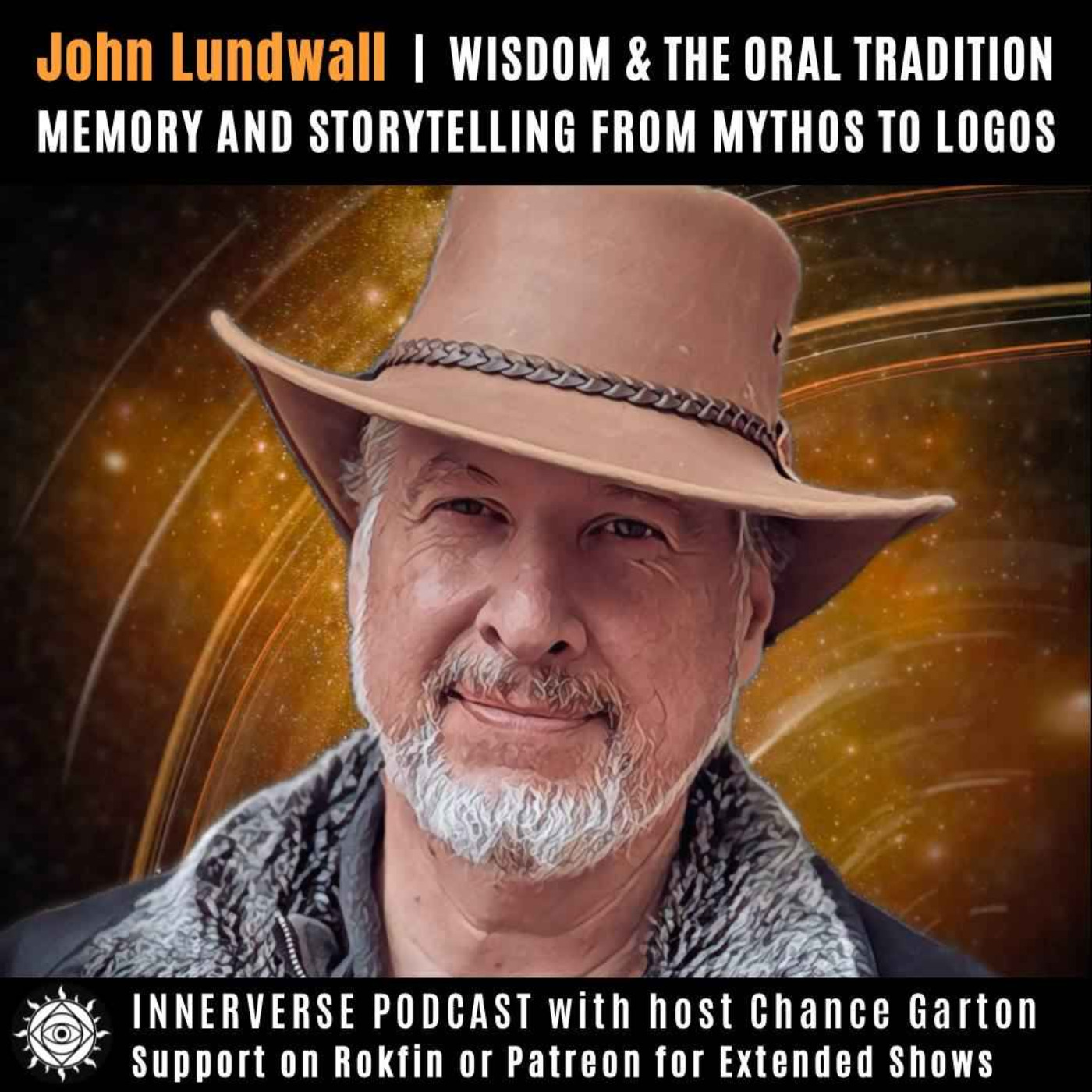
Dr. John Knight Lundwall | Wisdom & The Oral Tradition: Memory and Storytelling From Mythos to Logos
Get every episode summarized
Each time InnerVerse publishes, we email you a written briefing from the transcript — the topics, who appeared, and any specific claims, with the ad reads skipped.
Email me new episodesFree for 3 shows. No card needed.
About this episode
Dr. John Knight Lundwall joins InnerVerse to discuss his groundbreaking book, Mythos and Cosmos: Mind and Meaning in the Oral Age. Picking up the torch where hundreds of years of academia missed the mark, Dr. Lundwall guides our understanding of mythology as a technical language akin to scientific jargon, exposes the epistemological wall between literacy and orality, explains the analogical aspect of oral myth via the example of human sacrifices, and ponders why oral cultures did not keep histories as we know them.
In the Plus+ Extension we turn our discussion towards the category error of modernity to consider oral rites and stories as religion, question just what religion is through the example of the cult of state mandated "public health," the Renaissance prodigy Camillo and what his memory theater informs us of our own potential to recall complex ideas, the relationship between light pollution and literacy, and what it means to marry the best of both the oral and literary mind.
Support InnerVerse Rokfin and Patreon for extended episodes!
EPISODE LINKS
- Video Episode - https://youtu.be/upy-K1Xnwc4
- Read Mythos and Cosmos - https://www.amazon.com/dp/B017L4S5BI
- Outro Music by VOLO - https://www.volovibes.com
- https://www.innerversepodcast.com/season-10/john-lundwall-myth-cosmos
TELEGRAM LINKS
GET TUNED
SUPPORT INNERVERSE
- InnerVerse Merch - https://www.innerversemerch.com
- Tippecanoe Herbs - Use INNERVERSE code at checkout - https://tippecanoeherbs.com/
- Check out the Spirit Whirled series, narrated by Chance - https://www.innerversepodcast.com/audiobooks
- Donate on CashApp at $ChanceGarton
- Buy from Clive de Carle with this link to support InnerVerse with your purchase - https://clivedecarle.ositracker.com/197164/11489
- The Aquacure AC50 (Use "innerverse" as a coupon code for a discount) - https://eagle-research.com/product/ac50TT
InnerVerse intro theme by Conspiracy Music Guru - https://www.conspiracymusicguru.com
Hosted on Acast. See acast.com/privacy for more information.
Get every episode summarized
Each time InnerVerse publishes, we email you a written briefing from the transcript — the topics, who appeared, and any specific claims, with the ad reads skipped.
Email me new episodesFree for 3 shows. No card needed.
Hosts & guests
No transcript yet
This episode has not been transcribed. Request it and it moves to the front of the queue.
More episodes
More from InnerVerse

What Connects Christianity, Tarot & the Stars? Astrotheology 101 with Chance Gar...
InnerVerse

Virgo Season Herbs: Gentle Plant Medicine for Digestion, Nerves & Calm | Astro H...
InnerVerse

The Hidden Science of Tarot | Marty Leeds & Mario Garza
InnerVerse

Tartaria Exposed: Sacred Cows & the Psychology of Conspiracy | Chance Garton on...
InnerVerse