Get every episode summarized
Each time The Brion McClanahan Show publishes, we email you a written briefing from the transcript — the topics, who appeared, and any specific claims, with the ad reads skipped.
Email me new episodesFree for 3 shows. No card needed.
About this episode
The Brion McClanahan Show is made possible by:
“So, Hilton called to me the superstition concierge to make your fan rituals a reality. Want to make sure our team doesn't wash your lucky jersey? Hilton's unmatched hospitality can keep up with any superstition.”From the transcript
Another day, another "conservative" attack on Lee.
https://mcclanahanacademy.com
https://patreon.com/thebrionmcclanahanshow
https://brionmcclanahan.com/support
http://learntruehistory.com
Get every episode summarized
Each time The Brion McClanahan Show publishes, we email you a written briefing from the transcript — the topics, who appeared, and any specific claims, with the ad reads skipped.
Email me new episodesFree for 3 shows. No card needed.
Hosts & guests
Transcript ready
548 searchable segments. Every word is indexed and playable.
Full transcript
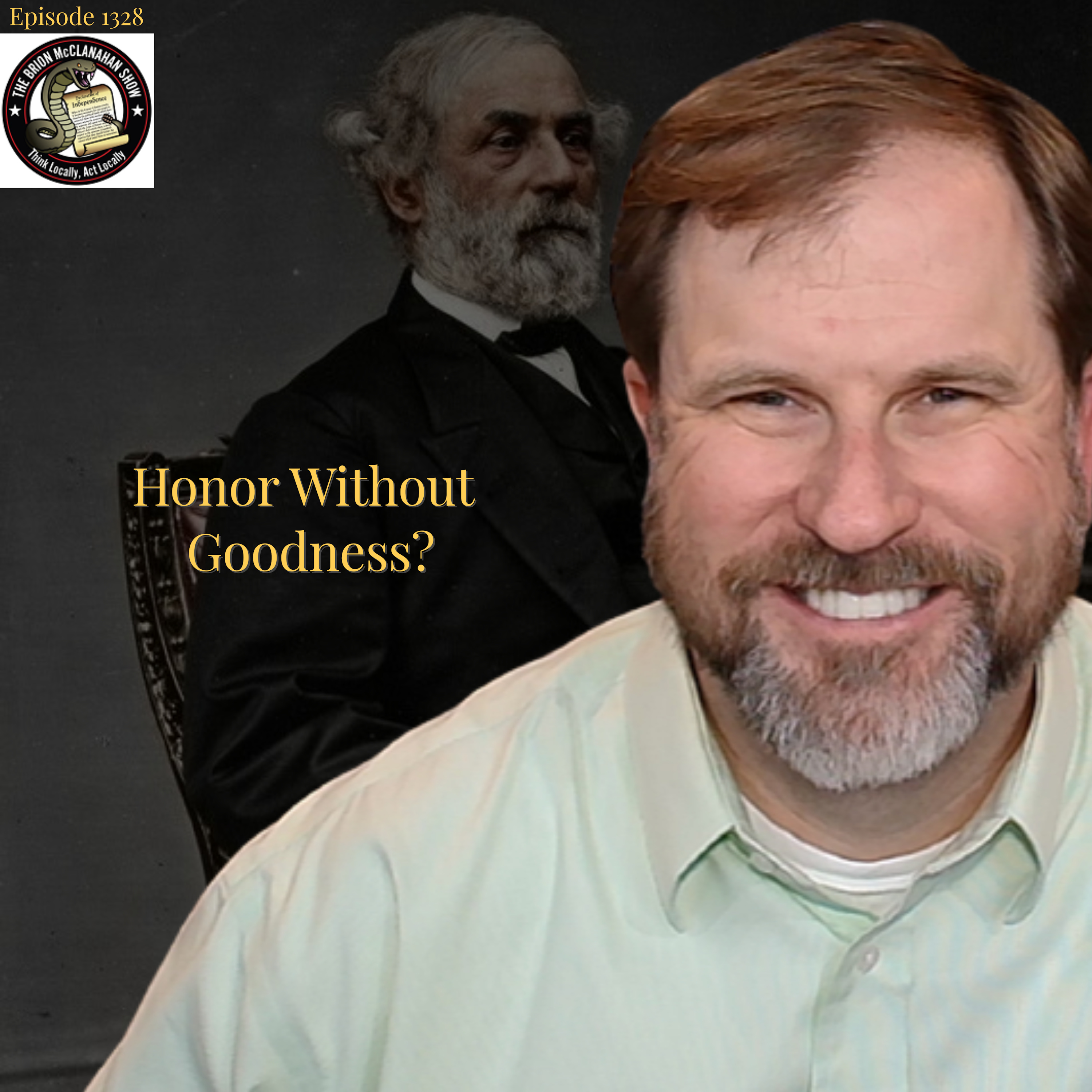
The Brion McClanahan Show — Ep. 1328: Honor Without Goodness?. Machine-transcribed; use the interactive transcript above to jump the player to any line.
College football is back. So, Hilton called to me the superstition concierge to make your fan rituals a reality. Need a room to match your lucky number? We got you. Want to make sure our team doesn't wash your lucky jersey? Oho, that smells lucky. Hilton's unmatched hospitality can keep up with any superstition. Even a marching bandwink up call it 555 and 55 seconds. Hit it! When you need a team that will do whatever it takes on game day, it matters where you stay. Hilton, for this day. This episode is brought to you by PayPal. You know how a mom's bag has everything? Sunscreen? Snacks? A stapler? The new PayPal app is like that, but for your money. Shop, pay, manage your account, and earn rewards all in one place. And with purchase protection on eligible items, biometric security and pass keys, you're protected at every step. Download the new PayPal app to get started. See PayPal.com slash protection terms. A Clanahan Academy.com is your gateway to a real history education.
Go to McClanahan Academy.com, use the coupon code podcast and take 25% off every class every day at McClanahan Academy. Get a real history education. I'll see you in class. If you like this podcast and you want it without advertisements, head over to patreon.com and become a member of the Brian McClanahan Show for 10 bucks a month. You get all the podcast ad free, including video, and you also get a special Q&A podcast. I'm only going to answer your questions, your listener generated episodes through those Q&A. So head over to patreon.com, get this podcast ad free. No ads, not even things like this. And you really do help support the Brian McClanahan Show with really cool stuff on the back end. The essential originalist papers is 77 public documents in favor of ratification of the Constitution. It is the book if you want to understand originalism. Get it wherever books are sold online, I guarantee you'll love it. Another day, another hit piece from a conservative quote on quote on Robert E. Lee.
We'll talk about that on this episode of the Brian McClanahan Show. It's time to think locally and act locally. Welcome to the Brian McClanahan Show. Welcome back to the Brian McClanahan Show. Glad to be back on the program. Very glad to be here. All right, as I said at the beginning another day, another hit piece from the quote on quote right on Robert E. Lee or the Confederacy or the lost cause. I mean, we can't even keep track of this stuff. And I mentioned yesterday that this was coming. The left has made some progress again in their attacks on the south. And so now you have a lot of supposed conservatives in the United States jumping on the Confederacy again. And this is coming from the usual suspects. These are people that publish at AEI, which moderately conservative the dispatch.
I mean, some of these places that you would question whether they're conservative national review. And a lot of these people that are doing this are first or second generation Americans. And this one is no different. It's written by Ivan Chu or Chow or CHI youth. I think it would be two to you. I don't know how you pronounce it exactly, but. But miss choose from California from California. She is a first generation or I should say second generation American her parents. I guess we're, you know, I don't know her parents immigration status, but. She went to school in California and spent a lot of time in China actually working at Hong Kong. One thing I'll say about hers is that about 13 years ago, I found a video of her at a talk. It was a TED talk actually in Hong Kong.
I think is where she was giving the talk. But she actually said things like well, you know, we have these biases in education. This is what the whole point was about when you understand biases in education and maybe using bias is a good thing. And she talked about how there's biases. And maybe there's some biases in American history. Maybe one of those is on the war and that, you know, maybe states rights and federalism are really important. To to this war and that we're not really taught that. Here we are 13 years later. That was 2013. Here we are in 2026. And she's writing garbage like this. I find that fascinating. Now you could argue, wow, I mean, she's come around. She's done research. She's figured these things out. And now she's abandoned her old misguided ways. And now she's come to realize that the lost cause and the myth of the lost cause and all these things are real. Now think about that 2013. It's two years before Dylan Roof.
It's seven years before the summer of love. And so what happened in that time period? Well, 2015, you get all these conservatives again jumping on the south. And so for some conservatives, they changed their tune entirely. Which means they weren't really that conservative to begin with. For intellectually dishonest people, they changed their tune. They just went with whatever the current thing was. And it's lost cause and myth. Again, just like yesterday, you know, David Blight couldn't have written this better. College football is back. So Hilton called him me the superstition concierge to make your fan rituals a reality. Need a room to match your lucky number? We got you. Want to make sure our team doesn't wash your lucky jersey? Oh, that smells lucky. Hilton's unmatched hospitality can keep up with any superstition. Even a marching bandwink up call it 555 and 55 seconds. Hit it!
When you need a team that will do whatever it takes on game day, it matters where you stay. Hilton, for this day. This episode is brought to you by PayPal. You know how a mom's bag has everything? Sunscreen, snacks, a stapler? The new PayPal app is like that, but for your money. Shop, pay, manage your account, and earn rewards all in one place. And with purchase protection on eligible items, biometric security and pass keys, you're protected at every step. Download the new PayPal app to get started. See PayPal.com slash protection terms. I mean, Heather Cox Richardson couldn't have written this better. Hell, Adam Seuer couldn't have written this better. Who wrote the idiotic piece, the myth of the kindly general Lee, for the Atlantic? I mean, that piece is one of the worst things it's ever been written. If you ever want to see a take down of it, I take that piece down at the Aviva Institute website,
where it's Robert E. Lee versus Twitter historians. And in this case, this is not at Twitter. This is AEI.org. But it's the same kind of stuff. Right? And so the point is you've had a portrait put back up at West Point of Robert E. Lee. And people are losing their minds over this because there's an image of Robert E. Lee. Who, by the way, his life is not defined by four years of the war. Robert E. Lee was a very well respected officer before the war began. He married into one of the most prominent real American families. He came from a very prominent real American family. And the Lee's had been in Virginia since the 17th century. His father gave the ulaji that became famous for George Washington. His wife was in George Washington's family. I mean, you can't get any more American than this.
But somehow now he has no goodness. Somehow Robert E. Lee is only a four year period of American history and doesn't deserve any respect, doesn't deserve any admiration. I mean, Lee was one of the best cadets ever at West Point. When Field Scott offered him, Commander of the Army, the Potomac. I mean, this was something that he was considered to be the best. Right? So yes, you had southerners. And he did not side with their states in the Session winter. But Lee decided that's what he was going to do. And of course, he was taught at West Point. Or at least the opinion was out there at West Point. There's some discussion about how much it was actually taught. But Session wasn't illegal. Now Lee didn't like Session. He's writing letters in the 1830s, talking about how he doesn't think
a nullification is the right thing to do. He's waffling on Session. He's not necessarily supportive of it. I mean, Robert E. Lee is not an ardent fire eating Sessionist at all. He's a Federalist, really. He's an Old Federalist. What I find fascinating is then after the war is over and he's writing about things. This is the prior book, you know, Reading the Man, which I have a very old video with poor video qualities. One of the first videos I ever did for YouTube. It was years and years ago. It was, you know, again, probably approaching about this time, 13 years ago, something like that. And I recorded with an old webcam that I had, but where I go through that book and I talk about how ridiculous some of the conclusions that prior is drawing in that book and actually use that book against this idea of the sewer apiece and some of these other things. That even prior herself, even though she draws conclusions, she doesn't crawl conclusions from the source.
She draws conclusions because that's what she wants it to be. And that's what a lot of these people do. That's what they want it to be. So that's how they draw their conclusions. This is what I want. So I'm going to say this is what it is. So Robert E. Lee is not honorable because he fought for a bad cause or whatever the case may be. We can't celebrate Americans because that's the other thing. These people aren't really Americans anymore. They're Americans. I mean, you do have America in the title of the Confederate States. It is the Confederate States of America. They all consider themselves to be Americans. Are they US citizens anymore? No. But they're CS citizens still of Americans, like saying that Canadians aren't Americans. Of course they are. There's Canadian Americans. Or Mexicans aren't Americans. Well, of course they are. Americans and Central America. All the people that live in the Americas are, quote unquote, Americans just of different countries.
So these people are all Americans. And they all love the red, white, and blue. And we know that because, well, their flag was red, white, and blue in it. So they all love the red, white, and blue. They all love the original United States. They thought it was great. A lot of them anguished over leaving the Union, but they thought that when their state left and Lee was that way, it's the right thing to do, was to side with his state, which is what he believed federalism was built on. Not this kind of unrestricted nationalism, in loyalty to a person or some kind of government. His loyalty was to the Constitution, which Lincoln clearly violated in 1861, by marching troops into the South. This is why Virginia left the Union. It's why Lee couldn't side with the United States. So I'm going to read this little piece because it's pretty bad.
But, I mean, again, you got to consider the source. You got to consider what's going on here. And you got to look at conservatives are starting to think, well, you know, maybe the tide is, we all thought, woke was dead, heck no. So they just changed the name, did something else, and just lays around for a while. It'll come back, and always comes back. It will always be back. It'll always be back because these people are determined. The left is the most resolute and determined political force in the history of the Western world. They never go away. And even if Ivan Chiu says that she's not on the left, she really is. If she's not an American conservative or a Southern conservative, she's not any of that. She's something else. I don't know what that is. She says, on any given day cadets at the United States Military Academy at West Point, New York, are too busy studying
and otherwise trying to avoid demarrants and consequent punishment to notice the 20-foot portrait of Antibellum student and superintendent Robert E. Lee in his Confederate uniform. Restored last year to Jefferson Hall Library's second floor study room. Most graduates do not remember this painting on the original library, subsequent library, anywhere else on campus. Nonetheless, West Point is skittish about it. Neither the library nor the Academy's public affairs officer would answer factual questions such as where it was stored during this brief exile from public view. The controversy is fading, but in difference to the portrait symbolism takes military virtues for granted. As rehabilitating Confederates as public role models is antithetical to West Point's basic values. You see, rehabilitating Confederates as public role models is antithetical to West Point's basic values. Now, I don't think this person ever went to West Point. I think that her specialty is Asian-American relations or something like that.
I know she has a PhD. I can't remember what her PhD is in. I think she got it from Stanford or something like that. So she's a bright person. But this is a strange commentary. And it's weird. These people have this weird fetish with this kind of stuff. And I mean it. People would say that someone like me has a strange fixation on these kind of things. I wouldn't talk about it at all. People would just leave it alone. Leave it alone. But these people are a mall. All they want to do is tear down. It's tearing down. It's destroying. So yes, you're going to say, I mean, this is why conservatives often called reactionaries because you're reacting to what the stupid things that the left does or the neo-conservatives or in the West Coast browsing. So other people are that want to tear this stuff down. You're reacting to it.
I could go the rest of my life and never talk about any of this stuff. Generations. And that would be fine. But these are the people that can't stop thinking and talking about it. As she said, the controversy is fading. In other words, yeah, people are getting over. Let's read talking about it anymore. Except her. She can't let this die. She can't let it go away. It's got to be out there front and center again. You see? It's against West Point Space of values, you see. Perhaps cadets will reckon that treason might one day be praised so long as one loses with a plum. A treason. So there's the treason charge. I discussed that and Robert E. Lee versus Twitter historians. But was Lee ever convicted of treason? No. Was he accused of treason? Well, by individuals, yes. Now, this is where Alan Gellzo, if you press him on this, he's had to come up with a way to get around this because he admits that Gellzo is one of the
biggest conservative lead attractors out there in terms of, you know, this point of committing treason and these kind of things. And so he's had to come, well, Lee might have signed up for the Confederacy before he officially resigned his commission. And he was worried about this kind of stuff and looking at the dates. But was the Lee take up arms against the United States at that point? I mean, no. Was he fighting the United States at that point? No. Could he have had two witnesses against a overt act against his home country at that point? No, because his home country by then was well, the Confederate States. He resigned his commission. There's no treason. He could have been convicted of treason against Virginia. How do you not side it with Virginia or the Confederate States? He would have had to leave. So his homes in Virginia is people are Virginia.
His government is the Virginia government, which the state government there, which is part of the Confederacy by that point. I mean, legally, you could say it is de facto indezura. They had a succession convention. The people decided they're leaving after they rejected the first time. Now the state government has sided with the Confederacy. They're no longer part of the United States because the people said they're no longer part of the United States. So there you go. So who's really committing treason? Not Robert E Lee. This is a weak argument. But it's thrown around. This is treason against what? Against the Constitution? No. Against the government. This is what the government would say, but that's not committing treason. It's waging war against them, meaning the states did Lee wage war against the states? Or was he defending his state from an invading army? I think the question becomes apparent. So these are, this is a stupid position. But it's what's thrown around now because these people in just 1860's Republican Party propaganda and say, this is the truth.
Buh-buh-buh-buh-buh-buh-buh-buh-buh. It's ridiculous. This episode is brought to you by PayPal. You know how a mom's bag has everything? Sunscreen? Snacks? A stapler? The new PayPal app is like that. But for your money. Shop, pay, manage your account, and earn rewards all in one place. And with purchase protection on eligible items, biometric security, and pass keys, you're protected at every step. Download the new PayPal app to get started.
ZPaypal.com slash protection terms. She says more seriously, cadets can learn that they need not think too much about the values of the country they will serve in their own duties as citizens. They need not think too much about those things. If Robert E. Lee is there, they can't really think about these things. She says Lee is a complex figure. One that provides an excellent model of narrow martial virtue that, while necessary, is insufficient for the American military. It's a model that the United States sought to transcend at its birth, and again with the Civil War and still struggles with today. This is a model. A model of narrow martial virtue. It's insufficient for the American military. The United States sought to transcend that in 1776, you say that's his birth. The Civil War, which would be another birth, and still struggles with today. You say, what is that?
An excellent model of narrow martial virtue. That's a model that the United States sought to transcend. How? When did they say that? This is weird. It's a weird piece. In 2022, on recommendation of the Congressionaly-Created Naming Commission, that's true. It was Congressionaly-recreated and did things illegally, by the way, like removing a monument from a cemetery, which they said they had no control over. We'll just skip on that. You had Taliban Thai, who was at West Point for a time, involved in all this. West Point's removed Lee's Confederate portrait in certain aspects from memorials on campus, EG Reconciliation Plaza, and Honor Plaza, and renamed Infrastructure that had been named for Lee and fellow Confederate generals, P.G.T. Bow regard and William J. Hardy. The Commission advocated retaining a separate painting of Lee among the West Point Superintendent's portraits, in order to remove honors conferred on Confederates without erasing the historical records.
So we're going to have a portrait without Lee and his Confederate uniform. Because he was a superintendent of West Point. So we're going to get rid of all this Confederate stuff. I mean, these people just don't matter anymore. Just going to take them out, because they're no longer Americans. Even if they went to West Point, they're no longer Americans. This is ridiculous stuff. I mean, at some places in the North, you can literally honor Americans who fought for Nazi Germany, but not Confederates. It's weird. It's weird. I mean, we've gone in this very strange, bizzara world, where this is the case. Last year, the Trump administration restored many pieces of Confederate iconography around the country, including West Point's portrait of Lee. Secretary of Defense Pete Hegseth as wielded Ye as a cudgel in his ongoing culture war to sweep away the debris of political correctness, race and gender quotas, Marxist ideologies, and social engineering, in favor of returning to a past golden age where merit reigns.
But this is all about merit, lethality, and most importantly, winning. Why are rehabilitate a loser, she says, much less the leader of the side that lost one of the most consequential wars in American history? This is about winning. Why rehabilitate a loser? Was Lee really a loser throughout his life? I mean, here's a man that was, I mean, very responsible for American victory in the war with Mexico. He won a lot of battles. Yeah, he lost the war because, well, I mean, he did run out of men and material to keep fighting. That's not really his fault, is it? I mean, the Confederacy was disadvantaged from the beginning, but that's just lost cause. Mythology there, that's not true. So the South, I thought, oh, go to one, not really. I mean, it's a miracle they stayed in the war for four years. So does losing though make somebody a bad person? This is another strange thing that these people fall in. Well, he lost.
George Washington lost a lot of battles too. I mean, more than he won. You can make a case George Washington wasn't a very good general officer. He lost a lot. But we still revered George Washington. Well, the United States won the war. Well, they have won the war without French intervention, probably not. And then would Washington have been a loser. There's all kinds of people that lose that we still mean. So if somebody, let's put this in sports terms. Damorino is considered a great quarterback in the NFL, won a lot of football games. Did he ever win the Super Bowl? No, I made it once and lost. So he's a loser, right? So loser never won the championship. He's a loser. Do we call him a loser now? Tom Brady won more Super Bowl than he lost, but he lost some too. He says he'll loser. And this is just, you know, sports analogy. Some people have great careers in sports and never win the championship. Are they losers? This is weird.
But in this case, if you didn't win that war, well, then you're a loser. Are all the generals and in American officers who participated in Vietnam, are they all losers? Because well, we didn't win that war. They all losers. How about the Korean War, all those people losers? I don't think that the United States military would call them that, but they didn't win the war. So are they losers? Why rehabilitate a loser? I mean, I'm sure that we have losers all over the place that are honored that didn't win American wars. Lost battles, did things, lost, but yet they're still revered. She says like the thermodorian reaction of the French Revolution's worst successes, excess counter-revolution against the radical F recklessly pursues its own vendetta and purges and teaches the wrong lessons to the US military's detriment.
This is like the thermodorian reaction to the French Revolution's works excesses. So this is coming back. She's using an analogy there. We had the reign of terror. And so then there's a thermodorian reaction to that. And this is a counter-revolution. It's the worst thing we could have done, as its own vendetta's purges teaches people the wrong lesson. She says following the Civil War West Point wrote its unique reception day, Oath of Allegiance, prioritized loyalty to the United States over any and all Allegiance, sovereignty or field TMAO to any state or country whatsoever, and Ben Confederates in person named Reliacness from campus for some time. From the turn of the century through the 1960s, people erected new Confederate monuments across the country to promote an emerging lost-called narrative and report to Jim Crow. Look, this is just complete garbage. This is a conservative supposedly writing this stuff. So this is right after the war, but then the turn of the century, the early 1900s during reconciliation.
And then because people were erecting new Confederate monuments across the country, promote emerging lost-caused no. It's to honor the debt. I mean, think about that. The war is over in 1865. What's 25 years after that? 1890. What's 50 years after that? We'll go, let's see, 1915. Well, nobody celebrates anything at 25 and 50 years like we didn't just have a big, big ceremony for the 25th anniversary in 911. Nobody thinks about that. I mean, we didn't do anything for that. Nothing. Nobody reflects at 25 years and puts up monuments to people that died or reflects about the people that died or anything like that. Nobody does that. It's all for insidious means that they're doing this stuff. They have this hidden message. They hate people. And they need to put it there. And it's all about Jim Crow. You see, this is just ridiculous nonsense.
1950 West Point Commission leads portrait for it. I'm sorry. Cess Quintennial celebration. Curiously artist Sydney Dickinson painted Lee in the pose from a famous photograph taken one week after Lee's surrendered Appomattox, a totally barger for in champion Douglas South off, Freeman hated the portrait accordingly. 1952 West Point proudly unveiled this painting in the then library paired with an 1866 painting of Ulysses S Grant that was moved from Column Hall. Okay. I mean, 1950, right? So, but I thought that was all about Jim Crow. This is all about Jim Crow. Give me a break. Douglas South off, Freeman didn't like it. But, you know, and here. So clearly, this wouldn't have been in his mind. You know, lost cause. Pairing leads and grants portraits has historical and educational purpose. As one cannot make sense of a war without considering the opposing side. But today, Grant adorns his namesake hall while Lee hangs alone in the library. Headset, the headset argues, quote, unlike the laugh we don't believe in a racing American history, we honor it.
Question is, which history are we honoring? Which history are we honoring? West Point's postwar reproachment and inclusivity culminated in reconciliation plaza, which romanticizes connections between graduates on a post opposite size of the war. But whitewashing the trees and horrific bloodletting of a war that divided American families in the north and south trades long term social cohesion for short term reunion. Now, I would miss miss chew. So you got to think about when this was done. Again, there were people still alive that fought in the war when this thing was created. Right? I mean, you say that 1950, but even before that, right? So you have, you have these reconciliation plaza, right? That comes out and this is where this stuff was put. So if there are people that were involved at that particular time.
In this plaza, so these things were removed. I can't remember what year that was created, but it's created in that period of time honor plaza. That these things were put there around that time. Right? So there are people that are still alive. And yet they're not too worried about Robert E. Lee being put somewhere in 1950. They're not. But by the early 20th century, they are. I mean, these things are there. So does that mean these people are wrong in that you're right? Whitewashing the trees and horrific bloodletting. Come on. Again, you couldn't have had a leftist write this stuff any better. I mean, I would say that she is. Maybe she would call herself one. I have no idea. These narratives intentionally and ambiguously invoke an imagined golden age, which proponents pick and choose favorable aspects of different past while ignoring accompanying flaws and necessary trade-offs. This incongruous pistach overlooks fundamental political and moral disputes at the root of Lee's choice to leave the US Army.
Proponents of these golden age narratives want Lee's personal bravery without the moral decreptitude of the defense of slavery, his fidelity to his state without the treason against his country. Well, did he really defend slavery? Did Lee ever actually go out and defend it? No. He never defended it. Not once. Lee was never a pro-slavery. I don't. Again, go read that piece I wrote on Robert Lee. He wasn't a defender of slavery. Well, he saw for the Confederacy. A lot of people thought the Confederacy didn't defend slavery. I mean, there are people in the North that still own slaves and they're fighting for the Union. So what are we doing there? What are they fighting for? Are they fighting against slavery? Clearly not because they said it. Just go read Gary Gallagher or James McPherson. Had go read Stephanie McCurry, I don't know. Stephanie McCurry could have written this better. Same stuff. I've already pegged her as being an income poop at times. But I mean, this is the kind of stuff you get.
She says militaries are tools, but military personnel and liberal democracies are not mere fighters. They're also citizens. As George Washington, Continental Army Commander, and Chief, are sure the New York Provincial Congress in 1775, when we assume the soldier we did not lay aside the citizen. Unlike an atrocities service and liberal democracies require more than personal bravery, honor, and dignity, and a man's citizenship. Okay, so that's a really good point. Let's bring in George Washington here. When George Washington was negotiating the terms of the British leaving New York, he was absolutely ticked off that they kept taking slaves with them. He said, you need to return those slaves. George Washington bought and sold slaves. He said George Washington was fighting for slavery. All of that. Did Robert E. Lee ever buy in self slaves? No. Never bought a slave. Never sold a slave. He freed slaves that he, when he managed his wife's estate, he did that. Never bought, never sold any.
He never advocated for the return of this kind of proposal that Washington did. Never did any of that. Not in the way Washington did. So if we're going to say that there's this moral side to it, well, then you should apply that to George Washington. Just because one guy was saying we're going to be independent and we're I'm going to side with this independence movement self determination against the fighting with the same people that were related to George Washington. Somehow now he's the bad guy. You see, people related to George Washington fought for the Confederacy. This is the weird stuff about all this. These people are, I mean, I don't even know how to describe them at times. Again, the source. Courage, resolution, and honor are necessary, but insufficient for officers in any liberal democracy, especially United States Service Academy graduates.
From Lee West Point cadet should learn the difference between physical courage and moral courage between physical skill and moral acumen. Lee fought bravely and often well, but ultimately lacked proper moral judgment. This is what he was the embodiment of the perfect Christian gentleman, proper moral judgment. A man who would follow the rules of war lacks proper moral judgment, who pitted. He never, he never called the other side of the enemy. I think, well, maybe I think he did one time. Maybe, but it was those people. The very embodiment of restraint and moral judgment. College football is back, so Hilton called him me the superstition concierge to make your fan rituals a reality. Need a room to match your lucky number? We got you. Want to make sure our team doesn't wash your lucky jersey? Oh, that smells lucky. Hilton's unmatched hospitality can keep up with any superstition.
Even a marching bandwreck up call it 555 and 55 seconds. Hit it! When you need a team that will do whatever it takes on game day, it matters where you stay. Hilton, for this day. Now, you could apply lacking world judgment to someone like Sheridan or Sherman or Wilson, James Wilson or Emory Upton or US Grant, but not Lee. Nero focus on personal traits. Tens, a lens to pursuit of immoral ends in the mistaken idea that lethality alone can win wars.
Lethality too, while necessary is insufficient, which is why the Confederacy lost the Civil War despite their military successes in the first two years. They lost because they have enough men in material to fight the work, but she's making this out to be this is a moral thing, right? They didn't win because they didn't have the moral high ground. What? I mean, this is a weird piece. Really weird. It's disturbing it so weird. At least portrait to view former superintendent, Major General Maxwell Detailer declared that West Point had no right to judge his graduates, politics or personal opinions. As the Academy's only concern was producing military leaders, men of character, capable of leading the citizens soldiers of our country to victory and battle. As a were intrepid steadfast honorable soldiers, he said it is proper for West Point to take pride, not of necessity and the rightness of the Confederate graduates, but of their uprightness. Taylor's remarks were staggeringly nihilistic. He saw the long gray line as mere soldiers, but they're also citizen soldiers.
Citizens soldiers should understand that as he put it, violent rebelling transcends political opinion. Trees and renders graduates derelict to the standards of the core, and traders, wherever physically courageous or marshally skilled, are cowardly dishonest, evasive or re-entry to their principles. What? I mean, all these people are now traders? All of them? Let me think about that. They weren't citizens of the United States any longer because their states seceded. You want citizens of the US? They're in a foreign country. How is that? Trees and. Yes, they are citizen soldiers to the Confederacy, not to the United States. Would the men who were fighting against the British were they citizen soldiers of the British Empire in 1777 or 1778 or 17, when Washington and his men crossed the Delaware in 1776, were they citizen soldiers of the British Empire? No, they were citizen soldiers of the United States because their states.
And far less of a popular demand than what you had in the South in the 1860s, the side they were out of the British Empire. They were now independent. Wasn't really even done by popular convention at that point. I mean, they just did it. The South had popular conventions. The people decided. So who were the real citizen soldiers here? This is a weird accusation. The superintendant made a common mistake. He pointed that honor, courage and resolute-ness are good regardless of context, but context, she says, is essential. Untether to a foundational morality, these traits are ethically ambiguous, only when directed toward something good or ill do honor, courage and resolute-ness become virtues or vices. As a manual Kant argues, the only thing good in of itself is a good will. Every characteristic is good only if directed towards good ends and evil directed towards evil ends, but by themselves they have no interunconditional worth.
So thrown around nihilism and contiasm and all this other kind of stuff. Look, Lee was recognized by Americans for a long period of time, North and South. It's a great American and the ideal Christian gentleman. And I don't care what a first generation from America has to say or second generation American from California has to say about this. It has no connection to any of this. And you know what? Conservatives should condemn this kind of stuff. I don't care if they don't like Lee or not. This should be absolutely condemned. You won't find it. I can guarantee you won't find someone like, I don't know, vlogging through history, saying this is just stupid. Nope, because they're going to say, Lee was a traitor. You see? This is the major problem with it. So one should ask, so one should ask of Russian soldiers who fight honorably and invading Ukraine or of suicide attackers who courageously face certain death to what end.
It is dangerous. He's short-sighted to extol personal traits as virtues independent of the object and Lee's case, the Confederacy towards which they are directed. Okay. So now she's, she's comparing Robert Lee to the men that flew the planes into the World Trade Center essentially. I mean, they're the same. They're the same. Give me a break. Or Russian soldiers and invading Ukraine. Yeah, like I don't know the Union soldiers invading the South. Let's talk about invasion. I mean, if you want to put it that way, we won't talk about invading armies was the United States not invading the South. Of course it was. She's going to say that's not honorable. It's not honorable to invade. It's short-sighted. But you see, unless you put, unless you get 1863, there is no virtue in what the Union was doing between 1861 and 1863. They had to come up with something else because if all it is is to save the Union that becomes dishonorable from the moment you do it.
Below Lee's Confederate portrait hangs a quote from him. There is a true glory and a true honor. The glory of duty done, the honor of the integrity of principle. Duty to what? Principle of what kind? He's cannot stand alone or be self-contained. Duty and integrity must refer to an object that makes fulfillment of duty and demonstration of integrity either praiseworthy or blameworthy. In West Point's motto, the object of duty and honor is country. Well, Lee fulfilled that, right? Fighting for the country that Virginia was part of. Was it not? Did all the people of Virginia commit trees and the state can't commit trees and did all the people of Virginia, all of them. Commit trees and mean this is the accusation you're making. And of course, not even the Republicans could make that case. But not any country as co-nationalism is insufficient reason to command political commitment. Faithfulness is virtuous or vicious depending on the moral valiance of the society one serves. Whether trees and is wrong depends on what one betrays as well as what can commit trees and for betraying the Soviet Union could have been a moral good, for example.
But not if such treachery involves selling nuclear knowledge to terrorists. It could be a moral good. I mean, maybe it was a if Lincoln betrayed the Constitution, is that a moral good? If Lincoln violates the Constitution, which is, you know, Lee remembers from Virginia, Virginia decided not to succeed. So if Lincoln violates the Constitution by sending troops, by invading the South, and you're saying we are now succeeding to stop this kind of despotism, is that not a moral good? And that's what you have to ask, because that's what Lee was doing. Societies make good faith efforts, even if they sometimes fail to insatiate universal principles of right depend on the fidelity of their citizens, thus fidelity to such societies and their principles as a virtue and treason against them as a more wrong devotion to the US Constitution, as a particular attempt to insatiate universal principles of right is virtuous and loyalty to Virginia and the Confederacy, which reject universal principles of right by embracing slavery was a grave fight. Wait a second.
So the Constitution was a slave holding, I mean, look, all the abolition said it was a lot of them, pro slavery document. I mean William Lagerison made the point pro slavery document. So if that's the case, then wouldn't leaving the Constitution be a virtuous thing? I don't know, and that's what the abolitionist would say, what William Lagerison would have said, it's virtuous to do that. Virginia was a member of the United States as a slave holding state Lincoln said he's not going to get rid of slavery in Virginia. In fact, offered and meant to protect it there. So is this a, I mean, even though they had no power to abolish it there, but he's going to offer a minute just to say we're going to we're definitely going to protect this with that have made it a more or wrong to support the Constitution then. The Confederacy, the Confederate government in terms of its relation to the institution was no different than what people understood it to be under the US Constitution. They explicitly use the word slavery. This is true.
But according to Supreme Court, the US government had no control over slavery in the territories. According to the state, this is already recognized. Northerners recognized this for years. So there was no difference. No difference. In the powers of the government, according to people at the time, no difference. And you still had slave states in the union. So was this a non-slave holding federal republic against a slave holding federal republic? No. Again, this is not the case. It was weird stuff, you see. And that's why this piece is just so bad. College football is back. So Hilton called to me the superstition concierge to make your fan rituals a reality. Need a room to match your lucky number? We got you. Want to make sure our team doesn't wash your lucky jersey? Oh, that smells lucky. Hilton's unmatched hospitality can keep up with any superstition. Even a marching bandwinkup call it 555 and 55 seconds. Hit it!
When you need a team that will do whatever it takes on game day, it matters where you stay. Hilton, for this day. This episode is brought to you by PayPal. You know how a mom's bag has everything? Sunscreen, snacks, a stapler, the new PayPal app is like that. But for your money, shop, pay, manage your account and earn rewards all in one place. And with purchase protection on eligible items, biometric security and pasquies, you're protected at every step. Download the new PayPal app to get started. See PayPal.com slash protection terms. She says there may have been courage on Lee's part, but there was no virtue in standing upright in a false field. She says a difference between present-day USO's and other legions for enlisted personnel and commission officers amplify the requirement to identify good ends and direct oneself towards them. Both those pledges defend the Constitution against all enemies foreign to domestic, the latter distinction first added to the officer oath during the Civil War.
Enlisted personnel then promise to obey the orders of superior officers and the president, while commission officers swear that they take the subligation to defend the Constitution freely, that any mental reservation or purpose of evasion. The commission officers commitment was also added in 1862 during the Civil War to target Confederate sympathizers, assets and agents in the union, but also serves to emphasize the importance of moral decision making. Well, again, you got to understand what's going on in the 1860s as these things were added. And are they really supporting the Constitution or are they supporting a government? The government is not the Constitution. Again, she goes back to Kant. What makes Humanity sublime says Kant is the ability to not only grasp but also be governed by the moral law that one legislates with one's own reason and emphasizing commission officers autonomy, soundness of mind and professionalism and choosing to uphold the Constitution, which Lee also said that he was doing by leaving his oath because Lincoln violated that. The oath highlights the expectation that commission officers grasp moral law on her governed by it. Despite privately opposing Virginia, so sessionally rejected his commission after 32 years in the US Army, he was hardly a green officer anymore to follow Virginia to the Confederacy while he resigned.
And then you can do that. You can resign your commission. He thought that Lincoln was wrong. It is surprising and little known how anomalous that was, although venerated for his loyalty to his home state, he was an outlier. This is the gels of stuff coming out. Not only was much of Lee's extended family loyal to the Union, you know, also the prior, but Lee was the only one out of 10 US Army colonels from Virginia who resigned and joined the Confederacy of those 10 five others along with Lee were Westpoint educated, the other five kept their commissions. As such, Lee displayed uncommon valor, but in failing a moral crucible that is Pierce past moral Christmas, Pierce went through this and they passed this moral crucible all those other nine, right. Stayed loyal to the United States. Well, okay. But Lee thought that was the wrong thing to do. So he resigned his commission and eventually became part of the Army of Virginia. Right. Lee chose to be mere tool of the state of Virginia, a mere tool. Well, these, these other people, not a mere tool of the Lincoln government. I mean, that's what they were.
And allow them realize when the words over, hey, we made a big mistake here with this stuff. I mean, maybe the South is right and some of the things that they were saying about the government. Maybe you behave not as a citizen soldier who would have recognized the Confederacy's lack of constitutional and moral legitimacy, but rather as a subject. The Confederacy did have constitutional and moral legitimacy. The moral legitimacy is the people of Virginia decide to leave the union. That's moral legitimacy. That's constitutional legitimacy. The people that did know the people that stayed loyal to the United States from Virginia. Now, if they're from Pennsylvania or they're from New York, well, that's fine because that's their state. I mean, that's what their state did. So you stayed loyal to that. However courageous or brilliant a military commander, he was. Lee's virtues were too narrow for what US military demands. Then in today, too narrow. His virtues are too narrow. Lee authors a limited model that deeply flawed by his myopia as what distinguishes militaries of liberal democracies from those of autocracies is that their war fighters are also citizens who must think beyond their tactics operations even strategies. Well, I think Lee thought about that very well.
To be a citizen requires moral contemplation. I think Lee did that moral autonomy and Lee had that in moral self legislation. I mean, to say that Lee didn't have any moral self legislation is one of the most laughable parts of this entire stupid piece. This woman's a loon who has zero understanding of any of this stuff. These duties of citizenship are not trumped by duties of military service rather duties of citizenship or the foundation for military duties. Else war fighters would not know what they should defend or how to commend Lee's bravery and loyalty to his home state without qualification. Judicons that foundation stunts future officers education and development and dangerously narrows the US military's commission. So as Confederate General Robert Lee once again keeps watch over their students, West Point cadet should contemplate how to direct their actions and adherence to the moral law so that their character traits become virtues. They should challenge themselves become the morally thoughtful and responsible citizen soldiers there task to be which and which Lee was not.
Okay. I told you people are absolutely lose absolutely lose on their minds again over this kind of stuff. It's it's remarkable. It's absolutely remarkable. You can't parody this stuff again. Some of the lefties should have written this thing because they could have done it just as well. If not better than this in compoup. So had to do two days of this stuff. I don't know what I'm doing tomorrow yet, but I'm sure it'll be something good to see tomorrow on the brine McLean Hens show. See you then.
More episodes
More from The Brion McClanahan Show

Ep. 1329: Was the "Civil War" Inevitable?
The Brion McClanahan Show

Ep. 1327: With Friends Like These...
The Brion McClanahan Show

Ep. 1326: No Federalism No Constitution
The Brion McClanahan Show

Ep. 1325: Should We Scrap The Constitution?
The Brion McClanahan Show