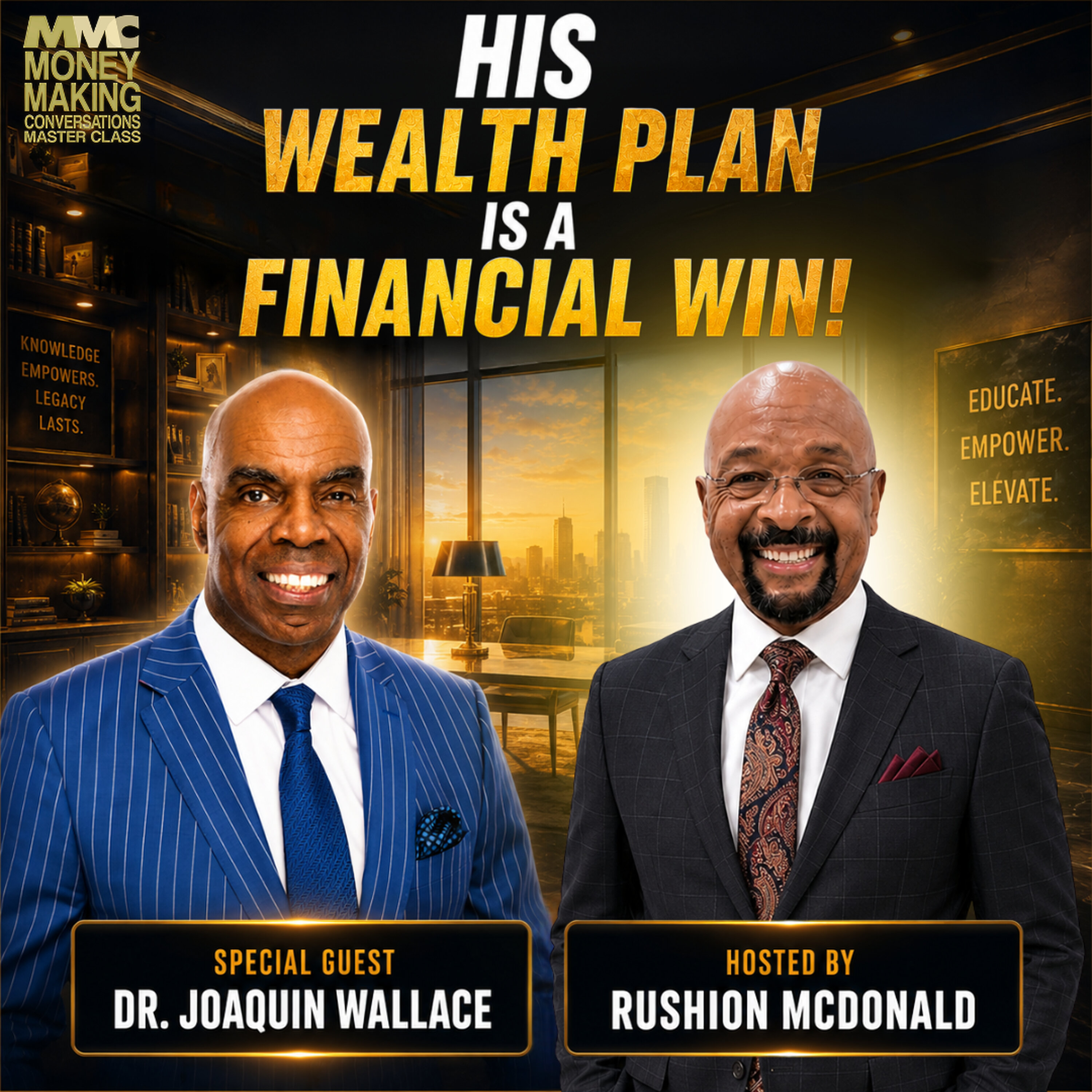
Financial Advice: Dr. Wallace empowers communities with tools for financial literacy and long-term wealth building.
Get every episode summarized
Each time Money Making Conversations Master Class publishes, we email you a written briefing from the transcript — the topics, who appeared, and any specific claims, with the ad reads skipped.
Email me new episodesFree for 3 shows. No card needed.
About this episode
“Guaranteed Human Guaranteed Work on Your Most Ambitious Ideas and Projects. Guest started at chatgpt.com by selecting Work Mode, available on Plus and Pro Plans.”From the transcript
Listen and subscribe to Money Making Conversations on iHeartRadio, Apple Podcasts, Spotify, www.moneymakingconversations.com/subscribe/ or wherever you listen to podcasts. New Money Making Conversations episodes drop daily. I want to alert you, so you don’t miss out on expert analysis and insider perspectives from my guests who provide tips that can help you uplift the community, improve your financial planning, motivation, or advice on how to be a successful entrepreneur. Keep winning!
Two-time Emmy and Three-time NAACP Image Award-winning, television Executive Producer Rushion McDonald interviewed Dr. Joaquin Wallace.
🎯 Purpose of the Interview
To explore Dr. Wallace’s groundbreaking work in financial literacy, particularly his concept of the “financial genetic code”, and to promote his book Generational Wealth Begins with Generational Knowledge. The interview aims to empower marginalized communities with tools for financial healing, literacy, and long-term wealth building.
🗝️ Key Takeaways 1. Background & Recognition
- Dr. Wallace is a recipient of the Wells Fargo Living History Makers Award.
- Featured in the Contemporary Black Biography series.
- Former college basketball coach and educator with a strong focus on discipline and mentorship.
2. Seven-Stage Generational Wealth Model
Outlined in his book, the model includes:
- Internal/External Ecosystem – influences from family, community, and environment.
- Financial Genetic Code – inherited financial narratives and behaviors.
- Financial Healing – reprogramming harmful financial habits.
- Financial Edification – literacy and inclusion.
- Financial Well-being – stability and health.
- Generational Knowledge – estate planning, insurance, long-term care.
- Generational Wealth – successful transfer of assets.
“Without financial well-being, there is no generational wealth.”
3. Financial Genetic Code
- A trademarked concept by Dr. Wallace.
- Unlike DNA, it can be rewritten through education and therapy.
- Influenced by early experiences, family habits, and community norms.
- Examples include “scar tissue narratives” (trauma from past financial events).
4. Credit & Financial Literacy
- Credit score is critical but misunderstood.
- Utilization rate should be under 30%.
- Payment history and inquiries significantly affect scores.
- Many people are unaware of the difference between consumer scores and business scores.
5. Barriers to Financial Growth
- Lack of trust in financial systems due to past trauma.
- Misinformation passed down from family and community.
- Zip codes and overleveraging can impact loan approvals.
- Financial professionals may unknowingly transfer their own biases to clients.
6. Role of Financial Professionals
Dr. Wallace identifies five key roles:
- Financial Educator
- Financial Counselor
- Financial Therapist
- Financial Advisor
- Financial Planner
He emphasizes matching individuals with the right professional based on their needs and emotional readiness.
7. Book Insights
- Generational Wealth Begins with Generational Knowledge is an Amazon bestseller.
- Includes self-assessments after each chapter.
- Designed for both professionals and everyday readers.
- Encourages readers to identify their financial stage and take actionable steps.
💬 Notable Quotes
- “You are your credit score.”
- “Inherited financial narratives create encoded financial behaviors.”
- “Any answer sounds correct if you don’t ask the right question.”
- “Consistency creates consistent outcomes.”
- “Financial literacy is not the end-all—it’s just one piece of the puzzle.”
- “We do what we know. If we don’t know, we just continue to do.”
📌 Final Thoughts
Dr. Joaquin Wallace offers a transformative framework for understanding and improving financial behavior, especially in underserved communities. His concept of the financial genetic code bridges psychology, education, and economics, making financial wellness more accessible and actionable.
#SHMS #STRAW #BEST
Money Making Conversations Master Class with Rushion McDonald is America's premier entrepreneurship, business leadership, financial literacy, and wealth-building podcast featuring successful entrepreneurs, executives, founders, celebrities, and industry experts sharing actionable insights for professional and financial success.
Business Podcast
Entrepreneurship
Small Business
Business Growth
Financial Literacy
Wealth Building
Black Entrepreneurs
Minority Business
Leadership
Executive Leadership
Business Funding
Marketing Strategies
Personal Development
Startup Advice
Sales Training
CEO Interviews
Founder Stories
Professional Development
Economic Empowerment
Business Success
Networking
Brand Building
Innovation
How to start a business
Small business funding
Entrepreneur success stories
Business leadership podcast
Wealth building strategies
Black entrepreneur podcast
Minority business development
Marketing for small businesses
Business growth strategies
Startup funding opportunities
Executive leadership training
Financial literacy education
Success mindset podcast
See omnystudio.com/listener for privacy information.
Get every episode summarized
Each time Money Making Conversations Master Class publishes, we email you a written briefing from the transcript — the topics, who appeared, and any specific claims, with the ad reads skipped.
Email me new episodesFree for 3 shows. No card needed.
Hosts & guests
Transcript ready
488 searchable segments. Every word is indexed and playable.
Full transcript
Money Making Conversations Master Class — Financial Advice: Dr. Wallace empowers communities with tools for financial literacy and long-term wealth building.. Machine-transcribed; use the interactive transcript above to jump the player to any line.
This is an I Heart Podcast. Guaranteed Human Guaranteed Work on Your Most Ambitious Ideas and Projects. Guest started at chatgpt.com by selecting Work Mode, available on Plus and Pro Plans. It's not just Electric, it's Toyota Electric, and during Toyota's Easy Choice Sales Event, going Electric is easier than ever. Right now, save instantly on a new Toyota EV with special incentive programs for first-time EV buyers and prior EV owners. Choose the sleek, busy, adventurous, busy, woodland, or the sporty CHR.
But don't wait! These special savings won't last. We make it easy. Toyota, let's go places. Welcome to my show. I'm Richa McDonald, the host of Money Making Conversations Masterclass. When we encourage people to stop reading other people's success stories and start planning your own. Now, you don't want to miss an episode, so please take a moment right now to follow or subscribe to Money Making Conversations Masterclass. It's free. You can follow me on iHeartRadio app, Spotify, Apple Podcast, or wherever you listen to your podcast. New Money Making Conversations Masterclass episodes drop daily. I want to keep you on alert, because my guests provide tips on how you can uplift your community, improve your financial planning, motivation, or advice on how to be a successful entrepreneur. Now, let's get this podcast started. My guest is honored with the world's Fargo Living History Makers Award. Dr. Wallace is also recognized in the contemporary Black Barography series, which he documents the lives of African Americans who are reshaping economic,
cultural, and social narratives. Please welcome the Money Making Conversations Masterclass, Dr. Joaquin E. Wallace. How you doing, sir? I'm doing great. Thanks for having me on. I got acknowledged that he's a divine, not-me-or-powerful brother. I live this whole life on the West Coast. I don't know why he ain't moved or traveled. I'm down in Atlanta. I've been in New York. I've been in Chicago. I've been in Lesley, and Boen and Houston. But you still out there, new. What's going on with Cap Abyssal? Where's your coach? He's holding down the fort over the West Coast? Listen, I'm trying to hold down the fort. But listen, I've been out the country several times, though. So you know, you can't limit, you can't limit tape me like that. You know what I'm saying? Don't try to hold me in. You know, tell me. I love it. You know, because in the world we live in, experiences is the key, Dr. Wallace. And I know in our community, and that's what the interview was about. You know, it's like, probably about 6% of all of this African American, 20% is white,
and the West breaks down in the Asian and Latino. But as an African American, there are so many of us who want to achieve success, but can't achieve it. Why is that? Well, I think it's a combination of a couple of things. What helped me was, I have an athletic background. So I play sports in college, I coach college basketball as well as a head coach. So I understand discipline. You know, one of the things that we have a hard time with is discipline, discipline to do something. And oftentimes we have unrealistic expectations. We place on ourselves as well. So if we're not able to achieve those, we quickly quit. We don't see things through. So it's important, you know, that you give yourself, provide yourself some realistic expectations. But most importantly, I do believe that you have to find those individuals that you resonate with, that you can touch, that you can actually communicate with, talk to on the phone, that you can identify with, that looks like you talk like you,
talk like you, talk like you act like you. But at the same time, can carry themselves in a professional manner. And I feel when you're able, when you're able to do that, especially from marginalized communities, people look like you and I, it makes a huge difference if you're able to say, hey, you know, this is the person that I recognize, but then when I speak to them, they make me feel, they don't, you know, they make me feel comfortable in my own skin. But most importantly, they encourage me at the same time. And that encouragement is important, especially when it comes to the young age, because that's where we can be shut down. Now you are motivated, you articulate, you're a coach. So you are a builder and a leader of young men to men. Talk about that journey and the important role that you play. And also a role that I can play and making young men to be better prepared. You know, it's a great question. So I always say, I'm going to go back to the educational aspect of it all. You know, it's three levels of education. I think that we have responsibility for. Your first level is your bachelor's degree.
And that degree is for your parents. Your second level, that's your master's degree. And that degree is for you because you decide to say, hey, listen, I've enjoyed my bachelor's degree, but I found something I'm really passionate about. So I'm now a pursue my master's degree. But when you get to the terminal degree, the PhDs, the the the the the the doctorials, the JDs, I think MDs, things that nature, your job at that point, I firmly believe is to change generations. You know, it's my opportunity now to say, listen, I'm transferring knowledge. I'm transferring information because you, as you know, within the African American community itself, it's only four, I think it's 4.2% of all PhDs who are African American men. And so oftentimes and not, we don't believe that that's something that we can aspire to. And the ones that do have those degrees, in some cases, may not relate to the common person. So you have to make sure that you're able to relate to the common person as well.
I always say, I don't wear my degree on my sleeves. Unless you ask me or you reference me as Dr. Wallace, it's something that I don't really talk about and kind of, you know, put before myself. Now education is key, but money is the winner. Now, when you talk about why financial healing is essential before financial growth can occur? Well, you said financial healing, what do you reference? Well, in my book that I have this generation of well begins a generation of knowledge, you know, I firmly believe that within my seven stage generation of wealth model, we often don't look at our internal external ecosystem. And so we have the right. So we have these internal inherited financial narratives and encoder financial behaviors, which creates your financial genetic code. Your financial genetic code is something that you can reshape that code itself, but for the most part, we need healing. And if we don't have the healing, when we don't have the healing becomes a challenge to actually get to stage five model,
which is financial well being, but most importantly, to move forward stage four, which is financial education, which is literacy and inclusion. So I firmly believe that we have to first acknowledge that we do carry inherited financial narratives, which creates our encoder financial behaviors. So you have the inherited financial narrative, which is the why. The encoder financial behaviors is the action, which creates your financial genetic code. And everyone has a unique financial genetic code that first they have to recognize that they even have. Another minute, because when I start thinking about my genetic code, I look at my score, you know, I try to keep my score above 700, because at least that allows people to acknowledge that I am very good, creditworthy status. Now, in the financial world, is that score as important? What are the things in the financial world? I just mentioned the score that will enable a person to consistently be able to compete in the financial space.
Well, I'm talking about buying a car. I'm talking about buying a home. I'm talking about living the lives that are getting the right apartment. That's the financial space I'm talking about. Yeah, well, first and foremost, you have to have a very competitive credit score. I mean, it is what it is because you are your credit score, right? So when people see your credit score, they have an assumption and we know what they say about assumption, but they do have a picture, a snapshot of who you are. What they see. Now, that may not be who you are, but those may be decisions, irrational decisions that you've made throughout your lives, because let's face it, many of this information we don't know. We don't understand the power of credit. We don't understand how mispayments can affect your credit reports, so to speak. So with that being said, again, it goes back to, when I talk about, in terms of my book, it talks about, you know, here to financial narratives, those are things that we just don't recognize that we carry, because many of our, our first financial fiduciaries were our parents, cousins, uncles, friends, family, neighbors, so to speak,
and they provided us information or education in regards to money, unsolicited information, and oftentimes and not without our permission. And we carry that on for years and for generations. So when you're looking at credit or things of that nature, which is stage four of my model, which is financial edification, financial literacy and financial inclusion, oftentimes and not, we're not prepared to participate, because we just don't know exactly what to do in the ramifications if we're not able to do it in the correct manner. Now, it's important that people understand what's going on here. There's a path to success, and it doesn't start in one day. In other words, you can't get good credit overnight. You see those commercials, ooh, my credit score went up to 40 points. Well, you probably was at such a low state with your credit score, it would go up that quick. When you start getting it to the 700 to 800, you in, I like to say, in gold medal country right up there.
But again, like you just said, such as my score would go down, Dr. Wallace, and they'll say something like, well, you're not spinning enough, or your credit, your count, you need to spend more on your count, or you close the account. That's what you were talking about, is the confusing point. You don't even understand how you keep your score up some time. It'll go down, and you think you're doing all the right things, correct? Yeah, absolutely. And there's two ways you want to look at in terms of credit itself. You have the credit that is, when they run your credit report, which is not the, like mortgages, things that nature, which is, it doesn't hit your account. So you have those credit applications, credit apps, so to speak that you can look at, what is it, credit sesame, right, experience, all those that are not the ones that actually businesses actually use. And so it's always going to be a difference in terms of score as well too.
So when I used to work with a lot of my clients, they would say, well, I was trying to apply for this car, this car loan, so to speak, my credit was $6.45. Right. But on experience on my consumer app, it was $700. And I would say, well, that's a big difference because they do more of a more in-depth look at your credit, so to speak. You have consumer, which is totally different. But the biggest thing that you want to do in regards to credit is to make sure that you're at 30%. Don't go anywhere. We will be right back with more insights from money making conversations master class. Welcome back to money making conversation master class hosted by me, Rashad McDonald. Let's get back into it. Yeah, 30% turns of utilization rate. That's important. So again, I you mentioned earlier, oftentimes and not. Hello, Dr. Wallace. You're professional line. I'm just a regular every day dude. They're actually 30% of utilization rate. Now, help a common thinking guy like me and my listeners.
What does that mean? 30% utilization rate. So, so look at this way. If you have a credit card of $1,000, that's your right. You want to be somewhere in the neighborhood of $300 and below in regards to utilization rate. But if you look at your entire portfolio, that's what the entire portfolio looks like. So if you have a $40,000 portfolio in terms of credit, you need to be a 30% of that. Because that's pretty much driving your credit report that in 35% is your your length of time you've had your credit, your payments being on time and things that nature. All of those things do really affect what you have in terms of your credit. So 65% is between making timely payments, right? 35% and 30% of utilization utilization rate. And that's where we kind of miss the boat in regards to payment. Now, there's ways to get around it as hacks, so to speak. But the bottom line is that you want to make sure that you're paying timely.
That's important paying timely. And making sure that your credit utilization rate is under 30% and reducing the amount of inquiries on your credit report. Because those can last two years on your credit report as well. And it can impact you immediately. Now, if you do get the credit card itself, then it will eventually increase your credit score. But let's say hypothetically that you do not get approved for that credit card. Well, now you're taking the hit as well for one. And it's going to be on. We don't know the length of time it's on, but we know it's going to make it a direct impact on your credit report immediately. As soon as you that you actually apply for that ticket towards the credit card and or I don't know. Now, Dr. Dr. Dr. Joaquin Wallace, he's been honored with the Wells Fargo Living History Makers Award. He's also been recognized in the Contemporary Black Biography Series with documents, the lives of African Americans who are reshaping economic, cultural and social narratives.
Dr. Wallace, I'm a black man. I got money in the bank. I got to I like to believe in the excellent score. I pay stuff all the time and it's like I do the trick of always allowing my automatic payment to the minimum of being paid. That where I won't miss anything. I'm never late. But I got to tell you, sometimes I get I feel I'm being rejected because of the color of my skin. Is that a false statement or I'm just or I'm just selling myself short or just to say that because my wife she gets mad. She was sure I don't know we got money in the bank. We got all this. Why are they telling us if we need more? Why do I feel that way, Dr. Wallace? Well, I mean, I'm not going to say that's not true. We don't know that. There's really no. Come on. I'm saying that. Does that make it come with a mask? I feel that way. That can have zip codes can play a factor in that as well. Okay, cool. That's good. Okay. I just said zip code. What can pay play a factor in those rejections because I feel I hit all the marks, money in the bank, been at the bank a long time, ten years,
credit score over 800. And then when I try to get along, then they want to equity. What you going to put up against that loan? I'm going like, where's where in the game, Dr. Wallace does all this hard work. And I just can't get along based on my hard work. Why is it I always feel like I got to put something up for you to hold so I can get some money? Well, sometimes you have to collateralize some things as well. Okay. And the point I don't like. Right. So it might be, it may be zip codes. And maybe you may be over leveraged. I mean, that may be something as well too. I mean, if you're doing everything correctly, like you say you're making your payments in a timely manner, that may be the case. That part, I don't know why, but there is some history. But there is some history that does suggest that does happen in particular with the zip codes, kind of like redlining is same thing. So zip codes can play a part possibly in you being rejected. And you may be over leveraged as well too.
But that's something that that's some the metrics that they that those financial institutions use. That's something I'm not really too aware of, but I've heard of that before. Because this is on my shoulder day. That was the first time I heard about there is a business score and there's a consumer school. And so I didn't even, I'd never heard that before in my life. So what exactly is your role in the financial literacy community, Dr. Wallace? That's a great question. So again, as I stated earlier, I created a book, a rotor book, a generational wealth begins with generational knowledge. It's an Amazon bestseller within 30 days. Why did you do that book? First of all, we're going to take our time on this book. Why did you feel the need to do this book? You articulate, you smart. I'm sure you do a lot of speaking engagements. Was it frustration or people just didn't understand how to be successful? Well, I wrote the book. It was a self inventory of myself for one. Okay. Because, you know, although I was in the business, again, as I mentioned earlier, you know, we have these,
this relationship with money and we don't know why we have it. And so based upon that, I created a model, which is the seven stage generational wealth model. Stage one of the model is our internal and external ecosystem walls and walls out, which creates our inherited financial narratives and encoded financial behaviors. Stage two is our financial genetic code, which focuses on financial trauma and anxiety, which is a byproduct of stage one. Stage three is financial healing, reprogramming our financial genetic code, stages two and one. Stage four is financial edification, which focuses on financial literacy and inclusion. Stage five is financial well being financial health is financial wealth. This is where our soft landing is. Stage six is generational knowledge. This is where we create our financial footprints to reach stage seven. The model is broken into three stages, stages one and two is the past three and four is the present five, six and seven is the future.
However, it's where you're at at that moment, where your feet are at at that particular time. You may be in financial well being, but things can happen that can take you back to stages one and two. Because again, many of these traumas and anxieties that we inherited that we have is unbeknownst to us. So a lot of our decisions that we make in terms of credit and things of that nature, we just don't know, but a lot of it is based upon what we've seen in our home, which are called walls and walls out. So I felt it was very important for us to first identify these inherited financial narratives for us to right forward because in our community, especially marginalized communities, we just don't know. While we make these decisions and remember our inherited financial narratives and encoder financial behaviors have been given to us without our prescription, but it's been decades and decades and decades. So we may have learned, we've learned how to deal with money or not how to deal with money, right, is based upon our internal external ecosystem, which is extremely important because each of us has our own unique financial genetic code, which is important because when you're talking about marriage or partnership with.
And in the visual, each of us have a unique financial genetic code for one, which we know that we don't know the exact number, but we do know that money can ruin marriages and friendships simply because of our financial genetic code. So it's important, it was important for me to first identify that because many of the clients that I was working with, thousands of years, billionaires, billionaires, hundred of years, no errors, a lot of them basically were dealing with a lot of inherited financial narratives that they didn't know that they were dealing with. Therefore, they had analysis by paralysis, not being able to move forward and take advantage of the vehicles that were out there to get to stage five, which was financial wellbeing. Please don't go anywhere. We'll be right back with more money making conversations masterclass. Now I need for you to do me a favor. Right now, follow or subscribe to money making conversation. It's free. And you can find it on the iHart Radio app, Spotify, Apple podcasts or wherever you get your podcasts.
Please do me that favor. Follow or subscribe money making. Chad GPT can do more than answer questions. It can help you get real work done. Chad GPT work is built for bigger projects with multiple steps. You bring the goal along with the information it needs, like notes, files, customer feedback, calendars, project plans or data. Then Chad GPT can help turn that into a useful work. A marketing grief, a sales tracker, an investment update, a deck outline and analysis, even a workflow your team can use. It can also work with approved apps and connected tools to help move the project forward. And you stay in control the whole time. You give directions, review the work, approve any access and decide what the final result should be. So instead of spending all your time figuring out where to start, you can start making progress. Put Chad GPT to work on your most ambitious ideas and projects. Get started at ChadGPT.com by selecting Work Mode available on plus and pro plans.
Versace. Welcome back to money making conversation masterclass hosted by me, Rishan McDonald. Money making conversation masterclass continues online at moneymakingconversations.com and follow money making conversation masterclass on Facebook, X and Instagram. Why seven stages? Well, because when you look at the model itself, it is broken down in seven stages. So again, stage one is internal external ecosystem stage two is your financial genetic code, which is the past stage three is financial healing, which now we have the reprogram stages two and one stage four financial edification literacy and inclusion stage five is financial well being soft landing financial health stage six is generational knowledge, which is important because 10% of the money that you've amassed over time will be left for your grandchildren based on the numbers 30% will be left for your your immediate children. Well, why is that because of generational knowledge?
We put so much focus on generational wealth, but we put less folks on generational knowledge. It should be life insurance, which could be a state plan, which would be long term care, all of the things that we need to successfully transfer our assets, we just don't do. And in particular within the African American community, we have a low rate of a state plan and things that nature insurance long term care things that nature. So oftentimes, not we're not able to transfer assets and we see it a lot with a lot of our celebrities that pass away. We didn't have things in place. So although they had the assets, the knowledge wasn't there to successfully transfer. So that's why I firm, that's my argument is that we're focusing on the wrong thing. We need to focus on more of a holistic approach. Therefore, we can actually get to generational wealth, but for you and I, we are trying to get to financial well being because without a without financial well being, there is no generational wealth. Right, well, you really look at it right, right? Right, right. That's important because you mentioned financial genetic code, which is which stage two, I believe correct stage two.
Yeah. And what exactly is that is in your book and I want to drive people to read your book and gain all his knowledge, but why does, why is that so important? Because when you say the word genetic code, it feels like there's something that's inherited and not learned. Talk to us about that. Absolutely. I'm glad you asked that question. So I trademarked the phrase, financial genetic code simply because I firmly believe that that's language that hasn't been used before. And a code is something that you can rewrite versus DNA that you can. So you can rewrite the code and inherited financial narratives. As you mentioned, that's your why and then the action is encoded financial behaviors. In my book, I table 20 and essential inherited financial narratives, but there are more than that. But for, for instance, you have the scar tissue narrative, where scar tissue narratives basically suggest that something may have happened financially during your lifetime that you've seen or witnessed.
Therefore, you are now not apt to trust the system, so to speak. And so if you're not able to trust the system, what do you do? You don't do anything at all. And it may be in a situation that you've seen in your home. So those are kind of narratives that we that has been again, given to us without our permission, unsolicited, so to speak, and then maybe train. That's been trained. No money in the mattress. Exactly. Your grandma money in a bra. Exactly. Money on loan trees. Right. So that means you the money you get you hold it. Absolutely. And so the distributed for opportunities that you don't understand like the market and best. So this is great. I understand this. This is like a green light. I know for me, because I understand where you're going now, because we in the financial world, we do what we know.
Absolutely. We do exactly what we know. And we do. And that's the thing. If we don't know, we're just going to continue to do, right? I mean, it is what it is. And so that's why the book is so important. You know, what I'm really excited about is that I look at the comments, so the testimonials and the reviews on the book itself. And everything is positive. Some saying is one of the best books that have been written. I wrote the book for two specific markets. One was the financial professionals and the regular person like you and I. And the financial professionals, there are five of them. You have the financial educator, the counselor, the therapist, the advisor, and the planner. I firmly believe that oftentimes and not we transfer our own financial genetic code to our clients without knowing subconsciously. So understand that. So whatever my financial genetic code is, I'm transferring that to you. And oftentimes and not that's why you have a lot of individuals who don't trust financial planners, advisors, the things that nature, because they're transferring their own inherited financial narratives and financial
to you as the client. That's where the trust comes into play. Right. And that's where, you know, wow, this is really interesting because of the fact that, you know, as you go through life, you know, when I came up, you know, the goal was to go to college. Now, people just comfortable getting certificates and becoming certified. And they're making salaries that I didn't make when I came out of college for a four year degree. Now with that new knowledge with the websites, the YouTube and all that, when you see that, how people are gaining financial knowledge, what do you say to that? Mr. Financial genetic code. Well, I think that the information one thing is we're talking about it. Right. I mean, now we're talking about it, which is good. That was years ago, we never talked about it. Because it's not like the research. Right. So we're doing more research. We're becoming more educated, so to speak. But, but again, I do believe that each person needs to understand where they fit on the in terms of the five financial professionals.
Because thinking of this way, you may come to me and say, Hey, I want you to provide me a financial plan. But you have so many inherited financial narratives. You have so much trauma and anxiety that whatever I say or do, you're not going to do it anyway is analysis by paralysis. So what you may need initially is a financial therapist to flush all of that out first or just in terms of education. Oftentimes, we're we're we don't know what we're talking about because we're not educated enough. We don't know the difference between long term care, disability insurance, life insurance. There's several life insurance that are out there for one case, 403 B's, 457's, qualified non-qualified, raw, traditional, iris. We don't know what they are. Therefore, if I meet with someone who is a financial advisor or a planner, I can't ask the most educated questions. So what happens oftentimes, that's when they get burned or they're not getting the expectations. And that's where the frustration comes in.
I'm actually just question, Dr. Wallace. I'm talking Dr. Wallace, the inspiration behind the book, the creation of the seven state generational wealth model is a book I came out in the 2025 and June. Now financial literacy person. Are you a financial therapist? For me personally, what I am, I'm a therapist, I'm a planner advisor, I'm an educator as well, I'm literacy. So I pretty much can do all five. I have a certification to do all five as well. I have all my license to do that. Yes, I am. But for the most part, what I try to do is align an individual with the right person, so to speak. Am I a therapist? Yes, to some degree, but I will refer you to someone who is a financial therapist. I try to stay in my lane because that's the best way to be effective. I don't want to be all, you know, jack of all trades master of none. So I try to concentrate on what I specifically do because that brings more credibility.
Do I do a state planning? I can give you some information about state planning. But I refer you to in a state planner because that's the most effective way of doing it. We can talk about taxes. Yes, but I'm a refer you to a CPA, someone that can best handle you a business tax strategist and specialists because that's my job. I'm a conduit. But for the most part, I'm more into the educational piece of it now as ever before. And that's why the book was written because I want to make sure that I'm providing the tools for everyone to reach actually right stage five. Which is financial well being, but for the most part, give you the tools that you can understand, recognize, identify. This is where I'm at on the model. Therefore, I can make changes and or I can go out and seek the right person to best assist me going forward. Because for the first time I saw the value of a financial therapist and your journey in the conversation because I never thought from a standpoint of your financial genetic code is that you are as to natural education, you know, if you educated, you learn how to read, you learn how to write, you know how to talk.
Same thing with finances. If you know, at the earliest, my mom got me a savings bond. Didn't know what that meant. Okay. And stuck it in the drawer. And I was supposed to get it a certain age. But that was, but that's not how you went. You went through consistent training and in order to go through the training process, like you said, you have to trust, but you also have to educate yourself through the process of what you're trusting. So you want to appear in an episode agreed. Being scammed. Talk about this. Well, that's again, that's why when you when you look at it from that perspective, it's so important because you have to know, you have to ask the right questions first and foremost, right without asking the right questions. Any answer sounds correct. And I like how you talk about consistency in the book. I say if you consistently consistent, your outcome will consistently be consistent. All the time, we're consistently inconsistent. Therefore our outcome is inconsistent consistently, right? So from that perspective, no, it's for a while. You used to coach. I used to tell my athletes that for the most part, you have to be consistent or whatever you do. So education is important.
You can't believe everything you hear, read, but you can you can do the due diligence to find out the due diligence to find out what's comfortable to you. For that reason, yes, YouTube is there. You have a lot of individuals doing Instagram. And one thing that you want to think about is that this genre is becoming oversaturated and it's a fragmented market. The barriers to entry are low. So if you look at the product lifecycle, we're now at the maturity stage, maybe going to the declination, you have to do something to extend the product, so to speak. So you have a lot of people in this market now saying and doing the same thing. And so what I made sure that I did in regards to my book, I made sure I use no language that is that this trendy language. So the language that you read is totally my language. For instance, the financial genetic code, that's totally my language. That's why we trademark the phrase because now I will be synonymous with that throughout. And it's a purpose because many people don't look at and think about what, you know, what is my financial genetic code?
What's great is when I talk to people say, you know, my financial genetic code is X. Well, that's something they never thought about. They never heard of it. But when you really look at and break it down, look under the hood, so to speak, it does make sense because you're inherited financial narratives and you're encoded financial behaviors that creates who you are. But unlike a DNA, like I said earlier, you have the ability to rewrite that and rewriting that is having therapy, talking it out, understanding what your triggers are, what your flash, your flash parency is, right? Knowing what that looks like, now I can make decisions because you may be at stage five in financial well being, but something that can happen that can trigger you back to stage one and two. We hear you see it all the time. Then you go back, but now you have the tools to say, okay, here are some things that I can do after each chapter in the book. We have self assessments. So you go through the self assessments and you answer questions and what people are saying to me that's read the book anyway, they're using it as opportunity as a work in progress consistently.
So it's not a one time read. You can read and come back to it over and over again. Hey, I'm going to go back to step one. Look at this. Okay, why is this happening again? And it's really good with families as well to have these conversations with their kids. You know, one of the questions maybe what's your first. When you're, what's your first idea of money asking that to your teenager? Well, it's interesting to hear what they have to say, you know, having these conversations, talking them through it because in the book, we talk about financial passengers, which is important in the financial drivers. But the financial passenger is someone that's been in the as a passenger while you're driving the car for for their lives, right? For a long period of time. Eventually you give them the keys to the car. When you give them the keys to the car, they're going to drive really well or really bad. What's the same thing about finances as well because they're watching you. And when you give them when they on their own, well, they watch what you've been able to do and they're kind of mimicking that can mimic that and or they may not based on your head of financial narratives.
They're going to say, well, I'm not going to do things the same way in my parents did things, but they, but they wasn't educated again, right? Not only what credit looks like not no investments looking like understanding what a state planning on. Like, you know, my daughter, she's 30 years of age and the person that refer my clients to her to state planning, she having a state plan at 30 years of age. He was like, this is the youngest person ever written in a state plan for. I had a firefighter 31 32. He has in a state plan because it's great to start early as well too because it's important. But we know in our community that we don't do a state plans, right? We're both our trust, we're both what trust things that nature power attorneys. We don't do those things. So at the end of the day, you hear stories within our community. The 1% who actually have made it. Had a heart what does not actually do not do a good job of transferring to assets. That's the 1% what about the other 99% the neighbor, the cousin that lives around the corner that we hear about relatives that lost properties.
So to speak to have in fighting within the families. All of those things do occur because of the scarcity of resources. What they encountered during their lifetimes and we know that many of those individuals who have ascertained lots of money from inheritors or windfalls have lost a lot of it as well. Simply because their financial genetic code and they really didn't have a true understanding of their inherited financial narratives in encoded financial behaviors. So the next one is the creative the 7 states generational wealth model. The core message the core message of generational wealth begins with generational knowledge and wise more than a financial guide. Dr. Joaquin E. Wallace my brother. New cap after side divine nine. Man, this is outstanding man. I was standing, you know, we're going to talk again and you're going to get your picture on this wall. I promise you. This wall used to be celebrity with is several ever I just want to fill it with people who are changing everyday people lives to financial education.
Small business knowledge, our nonprofit influences because that's what we need. We need people within the community that can change our financial genetic code. I hope I hope you realize I got the message and you educated me on my own show brother. There it is. There's a shirt right now. We got this is basically yeah, we got the shirts going on everything. We're going to start selling those we have the death. What's your website? Dr. J Wallace dot com drj Wallace dot com. You can hit me on Instagram as well. Dr. J Wallace and LinkedIn. Dr. Joaquin Wallace. But most importantly, you know, buy the book. But when you purchase the book, make sure that you get a paper back and or a hard copy, not to kindle because there again, you can do the exercise on the back. What is paramount is that you leave a review that's so important because that gets to the eyes of other individuals.
And that's the one thing that I would say to anyone who purchased the book, refer the book. Make sure you read it for one, obviously. But then make sure that you leave a nice review because that's what drives the algorithms in the Amazon. I heard that again, thank you. Dr. Wallace is coming on my show, brother. You are special and do my favor. Send us a JPEG so we can promote it on my platforms. That's what I, you know, that's what I do. I'm here to promote people who are changing people's lives and the information that you have conveyed to me on this show. You are definitely changing people's lives. You open my eyes to make me realize that I am who I am because that's how I was raised. My parents gave me this sense of financial education and it took me years to kind of trust the process. But when the process was never shown to me as a kid, I didn't have any foundation. Right. And now you know your financial genetic code. We're going to look at it, right? Yeah. Thank you brother. Appreciate you, man. Appreciate you. Thanks a lot.
Thank you for listening to this episode. Now I need for you to do me a favor. Right now you'll follow or subscribe to money making conversation. Keep it free. And you can find it on the iHard Radio app, Spotify, Apple Podcast or wherever you get your podcast. Please do me that favor. Follow or subscribe money making conversations. Keep winning.
More episodes
More from Money Making Conversations Master Class

Business Advice: Damon explains why the beauty-supply industry needs Black owner...
Money Making Conversations Master Class

Financial Talk: LaVaisha Davis focuses on helping first-generation wealth builde...
Money Making Conversations Master Class

Financial Advice: Ashley's fintech platform is focused on making wealth‑building...
Money Making Conversations Master Class

Money Advice: Dr. Nicole Roberts Jones’ work helping entrepreneurs and professio...
Money Making Conversations Master Class