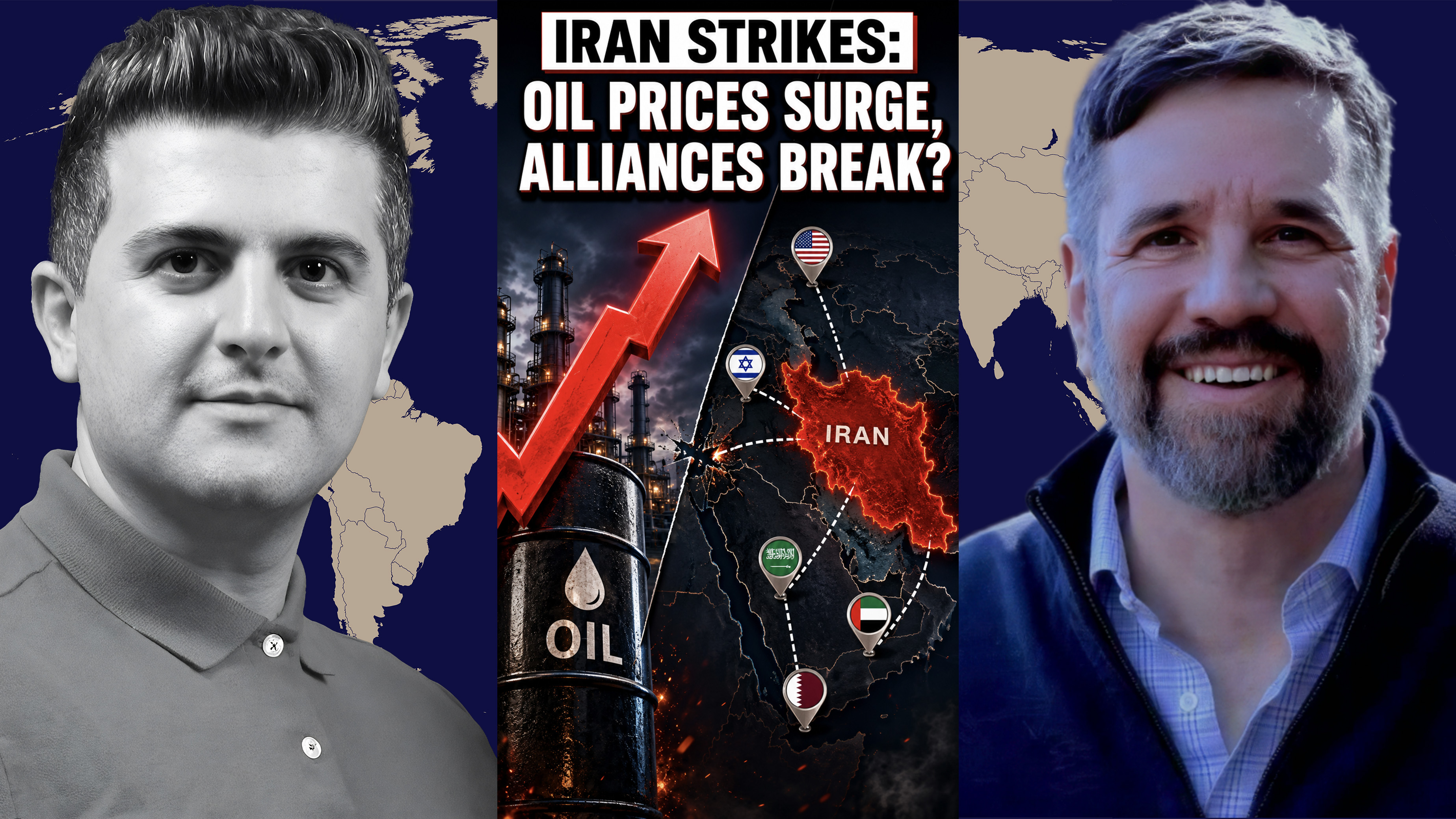
Fmr. Marine Matthew Hoh: Oil Prices, Allies, and War: What Iran’s Retaliation Means Now
About this episode
Hosted on Acast. See acast.com/privacy for more information.
Get every episode summarized
Each time Dialogue Works publishes, we email you a written briefing from the transcript — the topics, who appeared, and any specific claims, with the ad reads skipped.
Email me new episodesFree for 3 shows. No card needed.
Hosts & guests
Transcript ready
551 searchable segments. Every word is indexed and playable.
Full transcript
Dialogue Works — Fmr. Marine Matthew Hoh: Oil Prices, Allies, and War: What Iran’s Retaliation Means Now. Machine-transcribed; use the interactive transcript above to jump the player to any line.
Hi, already today's Wednesday, September 2nd, 2026, and our dear friend, our brother Matt O is here with us. Welcome, Mike Matt. Hi, name a good to see you. Great to have you, Mike Matt. Let me start with what Donald Trump said about the Iranian attack on Jordan. Here is what he said, Matt. We took it out. We took out some other things, and then we hit him last night because they took a shot at us in Jordan at our base in Jordan. We knocked all of them down. There were, I guess, eight missiles that we shot. They were all knocked down. When we let go, because it was so inaccurate, it landed in the middle of the desert, so I'm fling it. Sometimes we let them go. They're not aimed correctly. It's an amazing science. What they can do is absolutely incredible. We had a case where 111 were shot at a certain shot. No.
It's Matt. The case of the war is somehow, how do you feel the war? The way it started, it was so strange because they were saying that Iran is put in mind and again back to the straightover. Most of which, we knew that the minds are there and knew that they removed those minds. Did they start it? The two attacks on Iran and respond to them? Where are we right now in Iraq? We're stuck in this status quo, I think, that we're going to see for, I think, years. I was hopeful that I don't know why, from a romantic, I'm optimistic, I'm an idiot, whatever you want to describe it. I was hopeful that Donald Trump would take the MOU and make that his legacy as the man who changed the Middle East. That would be his pathway to the Nobel Peace Prize, this MOU that restructured the Middle Eastern Order, etc. Obviously, that's not happening. I think that estimate is out.
I think the other side now is that we're essentially looking at this war lasting through Donald Trump's presidency, unless there is some type of action, some type of black swan event or something, um, foreseen that changes things until we have some type of political change and political direction in either Washington, DC, Tel Aviv or in Iran, this war continues. And I don't see that happening in Iran or Tel Aviv, no matter who wins the elections in Israel at the end of October. And I think that political change has to come from Donald Trump. Now it's possible he might get bored with it. It's possible he might have a, a, a, a, a, a, some degree of, of clarity on this and say this is ruinous. This is a mistake. This is going, everything is going wrong. This is only hurting us in multiple ways, including, uh, hurting our economy and risking a recession, maybe even a depression if this thing gets out of hand.
Um, so, you know, maybe there's that chance because John, Donald Trump is mccurial. He isn't anchored to anything, whether it be ideology or institutions, only to his self interest. So maybe he would change, but unless he does, I think this is what we see the last several months is the pattern for the next couple of years. Uh, this idea of on again, off again, warfare, on again, off again, diplomacy, a lot of posturing, uh, both sides trying to show that they're the ones in control playing to their constituencies. Uh, I think that's essentially what we're going to have for again, the next, next two years or so. Actually, they started asking, uh, with the case of the price of oil, here is what CNN was asking Speaker Johnson about that. Repeatedly that this war was going to be over soon. You said that this would be a temporary blip on short term, on gas prices. It is similar than six months. People are getting hurt still at the pump.
Should the American people not also judge you on your projections here that were clearly off base? Manu, that is one of the stupidest questions you've ever had. Why? I have nothing to do with the prosecution of the war across the globe. I am. You are responsible. You are, you are selling this to the American public. Are you not? So should the House Speaker be held responsible for their duration of a military conflict around the globe? You answer that question. I mean, you call this a short term scrimmage. It is costing billions of dollars. Wow. I don't know if I've ever seen anything so cravingly, cowardly, coming from a House Speaker. And I've seen a lot of cravings and cowardly House speakers in my life. I can't imagine a Tom Delay or even a Nancy Pelosi giving away the power of that speaker ship in such a way that you see Johnson do there. You say, I can't do it like a child. It's not my fault, not my responsibility.
And so you see that abdication as evidence that there is simply dysfunction chaos in aptitude and Washington DC. And it will be based upon Donald Trump deciding to do something because I have a feeling that he came Jeffries is not cut from any firm or stock. The Mike Johnson is. And I think that Jeffries will put himself in that same position. I mean, so I will say though that, nevermind, let's go. Yeah, that's not important. But the problem, Matt, is do you think that Donald Trump is considering? He's today, he said that the war is soon is going to be over. The war with Iran today, he said that just moments ago. But they don't see that happening anytime soon. No, and I, you know, I think we've talked about before even going back months now that this is essentially plan C. Plan A was the regime change, trying to get what you did in Venezuela.
And certainly we just saw with this Venezuela oil deal, this is what the Americans were expecting in Iran. The Americans were expecting a quick and easy cheap regime change. They get some Iranian, a deli Rodriguez in power there. And then in six months, eight months, however long you'd have these oil deals. And I think that was motivating a lot of the American desire for this war. Not taking anything away from the role of the Israelis in this, not taking anything away from the imperial inertia of the United States or the goals of the military industrial complex. You know, we can't dismiss various industries in the US. That would have benefited greatly from a successful Iran war. So that plan A was the regime change plan B. Excuse me, was going to be this idea that while we'll get the Iranians to fight among themselves, there'll be some type of civil war. There'll be mass instability. Terran will effectively be removed from the chessboard of the Middle East,
because they'll be so busy about trying to keep themselves empowered, fighting their own people. That plan B didn't work either. And so, plan C, I think, has always been the 1991 to 2003 Iraq model, where we're going to sanction them, blockade them, and carry out continuous air strikes to try and degrade them. And even when I saw a press release the other day, yesterday or two days ago, from Senkham, essentially, I think it was from Senkham, but somebody, the Department of Defense, whoever. Essentially, saying the idea was that these strikes are, I think they used the phrase, mowing the lawn. You know, this idea that we will mow the lawn with regards to Iran to keep them from controlling the street or high mous. So very similar to what you saw on Iraq from 91 to 2003, where the United States was carrying out, I think, I think, I just,
8,000 sorties a year over Iraq during those 12 years. I mean, as well in the air strikes was every third day or something from, over those 12-year period, the United States was dropping bombs on Iraq. And, you know, I mean, that, I think, was the model that was in their minds. And that makes perfect sense, because the Americans are a 20th century empire. Their thinking is 20th century. If you look at how this war is being fought for the Americans, it has much, many more similarities to the 1991 First Iraq War, the Persian Gulf War, then it does to say any modern war, right? There's more similar areas, I believe, the way United States is carrying out this war to the wars of the late 20th century or the 2003 invasion of Iraq, then certainly to say like the Russia-Ukraine War, or even the Armenia Azerbaijan War in 2020. You know, I mean, so I think this idea of what we're just going to do plan C, and we'll just keep, you know,
mowing the lawn, which is a phrase that goes back decades now. I mean, in my time, this is referred to what we're going to do in Western Pakistan. We're going to just mow the lawn there and keep them down by continually droning them over and over again. And, you know, that type of view, that doctrine, that belief by American military leadership is still present. And why shouldn't it be? Because the generals and generals who were in charge of this war, that's what they grew up through. Matt, there were reports from two US officials reporting that the former IDF volunteer and the president Brian Masth is on the short list to become the next US Secretary of Army following the Dan Driscoll's resignation. When it comes to the resignation of Driscoll, what is your understanding of that? Because more than 20 generals and officers have been resigned, will force out of under the control of
PTAX at the Secretary of War. And today, you know, Dan Driscoll's resignation is the latest one, but replacing him with Brian Masth, and it's going to be, what is your understanding of what's going on with PTAX? It's actually more than that, according to the New York Times story today, or yesterday, I can't remember which, by the New York Times count, 80 generals and admirals have either been fired by PTAX or been denied promotion, which is essentially, you know, firing them before they can even get in the post. And we've seen that most of that has been without cause, without reason. No explanations, including for the, I don't know, 10 or 12 or so forced, three and four stars who've been denied promotion might or not be not a hybrid motion, but who've been basically fired, it made me more than that at this point. We saw no explanation for the relief of the chief of staff of the Army, Randy George. We saw no explanation for the relief of General Donahue,
who was the US commandering Europe, I mean, so as well as, too, we had that issue about a year ago when the Admiral and charge of Southern command was relieved or resigned. I don't even think we still have a real explanation for it. So we've seen this happen continually, essentially anyone that Pete Higgseth, or anyone that disagrees with Pete Higgseth, Pete Higgseth can't have them around him. He's such an insecure, immature, clownish amateur that he can't do anything with anybody who may disagree with him. I think with this Driscoll issue, you've seen this contention, this tension between Driscoll and Higgseth for the last 18 months or so. I mean, from the get-go, these two couldn't be in the same room together, it seemed like. And I would have feeling that it's a lot of it probably has to do with the reality for these men and women in the Pentagon,
having to serve, having to work for somebody like Pete Higgseth. I mean, just the revulsion of having to work for somebody like that guy. Not just because of his behavior, not just because of his character, but because he's also an ennuramous. I mean, you hear from Republican members of Congress that when they talk to Higgseth, he doesn't know anything. All he can do is speak the talking points. All he can do is essentially repeat what he says before the cameras. And when they ask him for further information or for details or if he has any thoughts on this, nothing. So I mean, I think unfortunately, though, with the Driscoll firing or resignation, and don't forget that the Secretary of the Navy had also resigned, slashed, been fired back in April. So two of the three service secretaries out within months of each other. Unfortunately, though, it is applies as well to all these generals and admirals who were being fired. We're not seeing any of them speak out.
You know, we're not seeing any of them prefer reform as Joe Kent has been performing, right? And Joe Kent, to his great credit, resigned in protest over the Iran War as the national, as a director of the National Counterterrorism Center. And he went public and he has been talking nonstop since his resignation. And it's terrific. It's great. I can understand maybe some of these admirals and generals. They're still on active duty technically so they can't speak out. But we know some of them have fully retired. Like, and I'm sorry, I'm blanking on his name, the admiral who resigned, slashed, got fired from Southcom last year. We know he retired from active duty. How come he hasn't sped it, said anything? If he really did resign because he believed that these attacks on these boats throughout the Caribbean and Eastern Pacific are murder, which they are, why isn't he saying something a year later? So I think with with with with risk goal with Fitzgerald, the deputy
undersecretary army who is also resigning, you know, I don't think we're going to see them on your show, right? Or on with Danny Davis or with Judge Napolitano or anybody like that, because I think their differences have been primarily personal or they've been internal to their understanding of how the Pentagon should work. So one of the things you see that if you divorce the way the personality and the character issues here, which is very hard to do because it's very dominant, but you do see that with risk goal and and and George Fitzgerald, this belief that the reason why the United States can't win wars is because the United States is is states is stuck in the 20th century. I mean essentially just we were saying a few moments ago. And so the idea to the United States military has to modernize. Meanwhile, Peg Seth and his people, including a guy like Brian Notnast, will say that's the reason why the United States can't win wars is because we're too woke because of DEI, you know, if it wasn't for diversity, we would have won the wars in
Iraq and Afghanistan or some other complete absolute nonsense. So there is this split, but even in terms of ideology or what they believe should happen, but even then it's a split that doesn't address the policies here, including these ruinous, unwindable wars. Matt, do you where do you see the way that the United States is SEO summit, for example? Because no one is basically talking about SEO summit. What does that mean for the United States? What does that mean for the region? And because since the Secretary treasury secretary Scott Besend announced the sanctions, the operation, economic outcasts, you see Pakistan coming out saying that we're not going to be part of that. China says that China at G20, they mentioned, you know, they had a paragraph
mentioning the safe and free passage through the straightover. Most China rejected that paragraph in G20. You don't see that much of cooperation with the United States when it comes to the sanctions on Iran. And today militarily, economically, they may feel the pressure from the sanctions, but it's not that much different from what it was before the war started. But they really believe that today we had Scott Besend talking about the sanctions. He said that we basically were not seeking to collapse the Iranian government, but that may come. Here is what he said. There isn't necessarily to collapse the regime could happen. Maybe the people will, they rise up 100% inflation, lines, the military not being paid. The central banker was in panic last week.
But as President Trump said, he believes the reason the MOU failed, the Iranians were not ready to make a deal. So we're going to make sure that they want to make a deal. I talk with my friends who are in Iran. I talk with many people in Iran. I said, is there any sort of line when it comes to nothing of line is happening? I don't know where do they get this sort of information and the false information? Is that the rather they're making by themselves or they're getting false intelligence from the region? I think it's a mixture of both of all of it. I think it is there as my friend Rich likes to say they're high on their own gaslighting. They can't see straight. They can't think clearly. Everything in this is just not this administration, but previous American administrations. The narrative is what's important. So you end up structuring policies to reinforce the existing narrative, rather than changing the narrative to accommodate or to
entertain or to accept reality. These people stick with the narrative regardless of whatever is occurring. And the Sankami said for the Biden administration, for the Obama administration, for the Bush administration, whether you want to talk about say, are Ukraine, Afghanistan, Iraq, etc. And of course, I know somebody in the comments right now is making like a Baghdad reference, right? If you remember the spokesperson for the Bath Party for the Iraqi government in 2003, you know, on the streets of Baghdad, loudly proclaiming there are no Americans in Baghdad, as literally an American tank is driving behind him. You know what I mean? So that type of this honesty, but also to crack pot realism, right? That they believe the way they see the world is the correct way, even though it is cracked. I mean, so, when Besson talks about the inevitability
of the Iranian government collapsing, the reality that all these other nations will line up with them because obviously you're either with them or with us, right? I mean, it just, this is how their world works. And they live in such bubbles. They are surrounded by sycophants who tell them no differently. They understand that their power is based upon keeping Donald Trump happy, right? So the whole thing is corrupted. The whole thing is rotten. And it is just, again, this bubble that is held up internally by a structure of lies, by a great web of lies. You know, and so I think that's how you get these statements, you get this rhetoric, you get these assertions that just don't match up with reality or what history may explain to us as possible, or what, you know, anyone who has the good sense to double check and see what other people are saying. I mean, so, you know, you asked about the SCO and, you know, the idea that is gone unnoticed in the United
States. And I mean, I don't, I don't read the American media, I mean, I don't do media analysis. Thank God. I would have a worse mental health problem than I do now if I did that. I had to read American media all the time. You know, so I see it as it comes American media. But so I'm not checking CNN at the times every day or the post every day. Did they talk about the SCO meeting in Bishek. And, you know, so I don't know if they did or didn't. But, you know, I could tell generally though that for the most part, it has gone unnoticed or remarked of in general commentary in the US, or it's a passing glance, or it's a hysterical thing, or it is on the other side where it is hysterical that these barbarians are ganging up on us, right, that we have to this is this is why we really need to double down and spend a trillion and a half dollars because, you know, these asiatic races, right, are threatening Western civilization,
you know, and that's the, that's the line you see through. There's commentary on it. That's the line. It's in there. And there is, I think maybe a thread that they should actually be concerned about because you do have, you know, with the SCO closing, this statement affirming support for Iran, basically affirming a united front against the United States, a commitment not to go along with these sanctions. And these are not small countries. You're talking about China, Russia, India, Pakistan, the entirety of the former Soviet republics, I believe, in central Asia. And then of course, Iran as well. I mean, so this is a very strong block of countries that have a committed relationship to one another. And they are saying to the United States and to the world enough, we're not going to go along with this. Now, no one should expect the SCO is going to launch a fleet and it's going to sail into the Arabian Sea or the Gulf of Amman and defeat the American Navy like a 21st century battle of Midway. But the reality that just,
is a two, when, when I'm sent to do his whole economic deed day, was that two weeks ago? You know, that's less than two, six and two weeks. It didn't even make it two weeks, you know? I mean, like the Americans after deed day, we made it to Kalei in about two weeks, you know? We wouldn't when it didn't in terms of that scale, we didn't even make it to Kalei. So they didn't had to throw it out. And remember last week, the conversation was like, now United States is not going to be attacking Iran anymore because the economic warfare is really going to hit them so hard. We don't have to do this. And then of course, now this week, we're attacking Iran again because it was clear that this economic deed day, economic operation, economic outcast was going to be underwhelming. It was always going to be underwhelming, right? It always was. And you can imagine the working groups that say the SCO, these guys all comparing notes on how best to avoid or subvert or confuse or to get around American sanctions. I mean, so yeah, there's a commitment coming out of these countries that has
already destroyed the great economic deed day operation, economic outcast that the United States bragged about not even two weeks ago. I think that of course, that trend, and that of course, then has repercussions in the future, right? We could then extrapolate to say, what does that mean for American power going forward? What does that mean for American influence going forward? And if you are nations that are not aligned or you're on the cusp, or maybe you've had pressure put on you and you think that maybe not being a part of the American empire is a good way to go in the future, I think what we've seen in like, say, the last couple days is a great reason to go someplace other than the American empire. Do you think Matt, let's put it this way, when you compare the way that the United States is trying to force Canada. And instead of, you know, you would say, who's the closest friend of the United States today? Friend, I'm not talking about those countries
who've been, you know, the Argentinelling. I'm not talking about these countries. I'm talking about friends. Like if we had a, if we had a, if we had a pack up and move, which country would come help us move our stuff? Exactly. Right? Canada would kind of think. Canada. Canada could go and but you see, even with Canada, they don't want to talk. They want to force them. They want to you know, it's so strange with the Trump administration. I assume we know that Biden administration was the zazzars many ways, but I don't see even under Biden, you would see such a behavior toward Canada. Do you think that's a bipartisan sort of attitude or it's particularly dependent on the United, on Donald Trump and his administration? I think this is dependent upon Trump because this hurts communities across the U.S. including in red states or in parts of states along our border, that are Republican. You get up on those border areas and I'm pretty certain they all vote
Republican up there, you know, through Michigan, Wisconsin, you know, into the Dakotas, Montana, Idaho, you know, certainly Eastern Washington state. I mean, you're talking about very real Republican communities that are going to be hurt very badly by this war. You know, that press conference, I heard that press conference about from an hour ago. I'm really impressed in the email quickly, you're gonna clip all that because that was about an hour ago with Donald Trump was saying all those things. And you know, some of the things that he was going on about with Canada, I mean, it's just absolutely raving, you know, like, like, you're senile aunt or uncle or something, you know, just going on and on about how the Gulf Stream jets are the best in the world and would take nine years. I mean, like, and no one believes this, no one, no one, you know, I mean, I can imagine people who out there who know about people didn't see that press conference Donald Trump went on for, I don't know, it felt like 10 minutes about Gulf
Stream private jets and bombardier and how he was going to tariff Canada because Canada is being unfair to Gulf Stream and they won't allow Gulf Stream, they won't allow Canadians to buy Gulf Streams or something or other, you know, and just no one believes him outside of his circle and his basis of poor and even among his basis of poor, that's fracturing people are unbelieving and it's now become a shrug of, well, they're all like that. Well, look at Biden, you couldn't believe anything Biden had to say, right? So it becomes that defensive, you know, they're all like that type of rationale or excuse to continue to support this guy. But yeah, I don't understand it. I mean, you have a look, you go back to Audubon Bismarck and one of his, he's, the Bismarck had a lot of great sayings. One of those sayings was that, you know, the United States is blessed with, you know, weak neighbors, were gentle neighbors to the north and the south and fish to the east and the west, right? I mean, it's understanding that the United States is in a position. There's also
another quote from Bismarck, although it's not, it's more of a rumor quote or apocryphal, where Bismarck supposedly said, God has a special providence for drunks, fools, and the United States. And you look at the good thing the United States was handed that it's position is geography, its resources and the fact that we do have neighbors that are friendly neighbors, that aren't neighbors that we make deals with all the time. And now Donald Trump wants to ruin this for what purpose, particularly in the, again, the impact it will have on those communities throughout the northern part of the US. It's going to be devastating something like this. You know, a pick a fight with France or Italy or Switzerland or somebody, you know, pick a fight with an ally or friend and pick one who's not going to have that type of direct impact on your own people. You know, he shouldn't be picking those fights anyway, but at least be smart about it. And so you see here, he's got this obsession with it. And, you know, where this goes,
I mean, again, I think the Canadians are just going to have to wait this out, be patient, stand up to bullies like you're supposed to. But, you know, I think the damage is going to be done to both countries through this deal, unless there is some way to work, you know, unless there is some way for the cadeties to find some bone that Trump will be happy with. You know, I think, again, this is something that I was going to deal with because he came out of the gate in his term banging on about Canada. And then overall, you know, then that kind of went away. And then now we've seen over the last months, he's focused back on Canada again. And I think that's the center of the pattern that we're going to see for all these issues, including Cuba, including Greenland, you know, eventually he'll get upset about Russia. I think he's kind of ready is getting upset about that. But, yeah, I think this is just a curial rollercoaster ride that we are on with Donald Trump until he leaves office. I think don't, we don't have to underestimate Donald
Trump and his capacity to make Canada the enemy. The guy's so amazing is, you know, it's actually really is. And one thing if you want to remember, he is pushing with Mexico too when he seems to have dropped that a bit. And he was getting other concerns, been going back a year so we were seriously concerned about seeing him launch military operations in the Mexico. And that's something that can come back. I mean, I wouldn't be surprised if, you know, he's treating out, tweeting out on true social right now about Mexico and the cartels and, you know, the fact that their government has corrupted and blah, blah, blah, military action. Yeah, I mean, we could see that happening as well. But do you think that Donald Trump is somehow, he invited Russia to G20. And on the other hand, you see in Europe, they're somehow doubling down because the new attacks on life's thick in Germany, they say that we, they investigated the case, they
believed that Russia was behind it. You know, after how many years did it take for them and so far, they didn't come with a investigation about the North St. Paipli. Right. Right. Literally in two days and four days, they found that Russia was behind that drone, which hit nothing in Germany. That drone hit nothing, basically in Germany. But there's so much, and there's so much angry about what has happened. What, where do you see Donald Trump in with the case of the war in Ukraine? You know, that's a good question. And he is. He's so unattached or unanchored to things. He can, you know, be moved in other way. I heard during that press conference today, someone asked him if he had seen videos of the Ukrainian press gangs, you know, dragging men into service. And he said he'd heard about them, but not seen them, and please send it to me because I'll send them around. So I mean, he certainly, I think, is willing to,
to be open to changing his mind on these things as we've seen. But I mean, I think, generally, though, his trend is moving towards hostility with Russia. I think he is being told over and over again that Russia is the reason why Iran is still surviving that the reason why Iran fights so well, their missiles and drones work so well is because of Russia, that if it wasn't because of Russia, Iran would be out of this war, as well as, too. I think he feels upset. He's disappointed. He is embarrassed that he didn't end the Ukraine war on the first day, like in an office like he said he would. I think he feels rebuffed. Certainly those around him are neo-concertivatives. They're hawks. They want to be on Ukraine side for the most part. And I think that with a particularly, if the Democrats get control of the Congress, there's a very real chance that we'll see a spending package
or a funding package for Ukraine in the next couple years that might have a veto-proof majority in both the Senate and the House, and the Senate, almost especially, particularly with Trump as a lame duck, I totally could see the Senate having a veto-proof majority on that. And it's very possible in the House because you have essentially all the Democratic caucus and probably in roughly half of the Republican caucus in favor of sending money to Ukraine again. So what would Donald Trump do then at that point when he'd go along with it or would he veto it? And who knows, who knows where his head's going to be on this? I think, though, that the trend I feel I have seen over the last year is a hostility towards Russia and a disappointment and anger at Russia, Anchorage produced nothing, the summit last year, Anchorage produced nothing. A lot of that was simply because Donald Trump couldn't deliver on why he supposedly promised the Russians. And so, of course, Donald Trump is the type of person that that failure in his part is going to
be projected onto somebody else. And so I think you will gradually see the Americans coming back into the war. Certainly, the United States didn't leave the war in many ways, including providing intelligence and targeting support to the Ukrainians. But in terms of actually fighting direct funding, I think it's very possible we see the United States return to that in the next year or two. And then certainly, if you have a rubio as president in 29 or any of the Democrats, then you'll definitely see that occur. Here is what Donald Trump said about Ukraine and Russia. Hey, some of them would be thought of as much tougher to stop than this. And I got to stop. But this tremendous animosity between the two presidents, tremendous animosity. But I think it's going to be pretty close. It's going to be time. They seem to have a new burst of energy. But I think they're going to be, I'm dealing with both of them and I think they're going to stop it.
But when he was elected, I can bring a footage of him saying the same thing. Exactly. Right. Yeah. Exactly. I mean, it is. It's the same. We've heard it before. And this is what we hear continuously. I mean, whatever the topic is, whatever the issue is, you know, that we're going to, according to him and his Treasury Secretary passing $40 trillion in debt, no big deal. We're going to grow our way out of it. That's what they've been saying for years. That's what he said in his first term. We're going to grow our way out of this debt. We're going to have no debt because the economy is going to go and we're going to have so much revenue coming in that the debt's going to go away. I mean, this is the same thing. They say the same things over again. And get back to what we were talking earlier about about the narrative, about the bubble that they're in, about their crackpot views of the world. And so, yeah, I think that's the case. But I just, have a feeling that his trending, he is trending more towards going back to supporting Ukraine.
And certainly, there's been things that have occurred over the last year or so. That makes the Russians feel that way as well. But yeah, I mean, I think the Europeans and the Ukrainians both see the light at the end of the tunnel here with regards to the Americans. This bridge that the Ukrainians and the Europeans had to get across in terms of funding the war in terms of having the money to keep the Ukraine government solvent to keep the economy from crashing as well as just to fund the war in general. They've mostly gotten over that bridge. They have some problems now that it, Zelensky saying they've got a $30 billion whole in their budget and the Ukrainian Europeans who people remember about a year ago, you had that whole drama with the Europeans whether they're going to steal the Russian frozen assets and give that to Ukraine or whether they're going to provide a loan to Ukraine to decide to the pod providing that loan. And that loan was 90 billion
euros for two years. And they're burning through a lot of that. And they're probably going to use, have to use much of the second year's tranche of that loan to help Ukraine get through this year. And it's still probably not enough. So that then sets it up, of course, for particularly if you have a Democratic control congress in the US to have to come to the rescue next year and provide $25, 30, 40, 50 billion dollars in American money to keep Ukraine solvent to keep it from going bankrupt. And you know, this is, I've said this a thousand times in your program. I've always felt this is the way that the war ends in terms of Ukrainian collapse is not a military collapse, but a financial collapse and economic collapse, particularly if the money stops coming in, Ukraine is a state entirely dependent upon foreign assistance. It's also an incredibly corrupt state, it's a giant patronage network. And once that money stops coming in, that patronage network gets very scared and people start to panic and the money doesn't continue to flow down as it needs to and then
everything just falls apart. And that's what happened, right? And Afghanistan, and that's what happened in South Vietnam. And so I thought that would be, I still think that could be the way that this war ends or at least this phase of it ends with a collapse of the Ukrainian government that way. And so obviously you can make that argument to Washington DC, particularly if the Democrats are in power, and then you could see that type of spending coming back to support Ukraine. You know, I mean, but just like this war with Iran, it may shift to something different. I think that's what you have with Ukraine. Although I think I think overall, I think the Ukraine Russia war again without some type of black swan event or some type of unforeseen occurrence, I think it continues the way we see it occurring, the way it's being carried out now and how it's been carried out for years. I think that continues now for several more years at least. Matt, they're talking about the Patriot system that
talking about Patriot licenses to Ukraine. He said that it's been negotiated. Mark Rubio said, here is what Mark Rubio said. The licenses to make their own. Well, that's being negotiated as we speak. And as I said again, but that is not an immediate solution. I mean, ramping up production, even if you have a license to something that takes multiple years to build these factories, I mean, you're highly sophisticated weaponry. So that's being negotiated now that may come to fruition, but it really won't solve the short-term challenge that they're pointing to. Ukraine wants to help us with their joint. Yeah. Yeah. Well, what do they want from Ukraine? Let's assume that they're producing patriots. How is that going to help Ukraine? How is that going to change the situation for Ukraine? It just allows the war to continue. I mean, what they want from Ukraine is they want the war to continue. They want Ukraine to continue sending its men. And now we hear about this idea of conscripting
women as well. They want to send its people into this furnace, right? They want this war to be fueled by Ukraine through its people, through its land, through its infrastructure, the idea of destroying Ukraine in this attempt or this hope to destroy Russia. That's the plan. That's why I'm not too worried about a war. Certainly, it's a risk and we can talk about it. But when I talk through it and come to the end, I'm not overly concerned about a war between NATO and Russia. Again, the risk is there, but the idea being that the Europeans don't want war with Russia. What they want is Ukraine to fight a war with Russia. They want a weekend and eventually destroy Russia through this war that's going to suck and weaken and destabilize Russia. And that's how that the Russians will collapse as the Soviet Union collapsed, following the Afghan.
They're Afghan war, right? That's the thinking in Berlin and Paris and London and Brussels, right? And so that's what they want. They want the war to continue. And so this idea, the patriots, yeah, it certainly sounds good. It's assembled. It has shown to me of, again, what we're saying before, an example of why I think Donald Trump is moving back towards supporting Ukraine and making Russia an enemy. And you could see where he came across that threshold where that's how he starts referring to Russia, even as many of his cabinet people do. Certainly his CIA director sees it that way, his secretary of state sees it that way, right? Secretary of State slash now security adviser sees it that way. So I think, you know, but this patriot, you know, the funny thing too, is there was a story when this was first announced, or not first announced, but a little bit after it was announced one of the reasons why Lockheed who makes the patriot missiles is so, where's Eratian?
The camera, which whoever makes the patriot, they're very concerned about it. If I'm not mistaken, patriot, or what Lockheed Martin? Lockheed makes, okay, yeah, so their concern is that if the Ukrainians are allowed to build their own patriots, they will build them cheaper, faster and more efficiently than Lockheed builds them here, right? I mean, and that's like one of the main reasons why Lockheed are dragging their feet. So, you know, but the reality is it'll take years to build them, and then it won't really matter, because the Russians will have the advantage with their ballistic missiles over any defensive missiles. That's the way it works. The offense, particularly, with that type of technology, seems to all of them. Actually, sorry for interrupting you, a combination of Eratian together with Lockheed Martin. It's that primary manufactured by Patriot, you know, Eratian, and then the major components and interceptors built by Lockheed Martin. Okay, so both of them
are up to the concern that, you know, on the Ukraine. And, you know, and that's the reality of it. The Russians will continue to produce ballistic missiles that are more capable than the defensive missiles that can shoot them down. It's also, too, what variant of the Patriot are they going to be given? Now, certainly, maybe these Patriots will help shoot down those jet-powered garage drones that the Russians are using to great effect. So, but how many Patriots are they going to be able to produce? And now you're just in a war here where the Russians can produce more than the Ukrainians can, as well as the fact that, you know, wherever they build this Patriot factory, it's going to have to be underground, unobserved, just like the Ukrainians have done with man, their drone factories, right, hidden them, sometimes effectively, sometimes not effectively. But, you know, certainly the Russians will make a Patriot factory, one of their top priorities for their
commanders, probably offer a bounties for it or something like that, just like they did when the Americans gave the Patriots in the first place, just like they did when the Americans gave the Abrams tanks, you know, they put bounties on these things to incentivize their commanders to find them and destroy them. So, but it is, all it does though is continue the war. Best case, it certainly doesn't win the war, it doesn't give the Ukrainians any advantage, and it does nothing to disturb the reality of the battlefront, right? It does nothing to stop that slow gradual advancement of the Russians' westward. Now, it may take, God knows how long for the Russians to get the rest of the Dombas, or if they decide to move further west, it would take even longer, but there's nothing stopping that, right? That inertia is there and it's unstoppable, and so you could give the Ukrainians right now every Patriot that's available in the world and it won't make a difference. It would make a difference in terms of maybe protecting some
of Ukraine's critical energy structure, but even then, I mean, this stuff we've been reading over the years, the effectiveness of the Patriot, you know, we've seen that maybe only 20% effective against the Russian ballistic missiles, you know, against the, you know, against their zircons, are there escondors, or, you know, I don't think anything's effective against say they're a Russian, but you know, Scott Ritter is the guy to talk about this, he knows this much better than anybody, him or Ted Postal, right? You know, but yeah, this idea that's not very effective at all, and what we've seen even with the Americans in this war of the Iran is that this idea that you fire two Patriots for every missile you want to intercept, that that's, no, that that that might be what's in the the the the the teaching the classrooms, but that's not the way it works in practice that they're firing three or four. I've seen reference to possibly the Americans firing has made eight Patriots. At one missile to try and shoot it down. So if you do have the case where say the Patriot is only
20% effective against Russian ballistic missiles, that means you have to fire five Patriots against every incoming Russian ballistic missile, and then you have on top of that, then all the advancements, not just with the Russian ballistic missiles, which will continue the advance, but again with their drones, you know, you have this very real issue with these garons, these jet-powered drones that fly much higher and much faster than anything that was available in Ukraine two years ago say, and that causes real problems for the Ukrainians. So, you know, I'm not sure what Ukraine is going to do here, they don't have the ability to surrender to give up, right, they're not going to capitulate, and so they're going to continue to be destroyed as a nation. I mean, when we see the Russians just in the last few weeks, destroyed like 90% of Ukraine's commercial and retail warehouses, I mean, like in a span of weeks, they just destroyed everything, and now Ukrainians, among all the
other things they have to deal with, have empty stores at the shopping or stores that are going empty, I should say, but yeah, I mean, so I mean, but again, you have the political will there in Kiev, whether it's Zelensky or someone from the right wing who will happily hang him from retreat and replace him and keep this war going, and then you have all the backing from the West, right, so MI6, a CIA, they're never going to give up on this war, and then the political leadership, whether it's a, you know, maybe this is I think where there maybe is some hope, Nima, is, because and God helped me for the day, and it's because I don't want to see a Le Pen come to power in France, I don't want to see Alice Widel come to power in Germany, you know, but this idea that that might be the way that some of that support for Ukraine starts to falter and weaken is through European elections, you know, with the American elections. No, unless you got possibly JD Veyens,
who, but I don't trust or believe anything, Vance has to say, Rubio, we know where he's going to be on this war, and of course, the Democrats in the US are all aligned in favor of it. If people aren't sure about that, I would say go back to the Munich Security Summit, you know, six months ago or seven months ago, where you had all these potential Democratic hopefuls, Richard Whitmer, Gavin Newsom, Alexandria, Acacia, Cortez, and they all just paraded, right? The Joe Biden talking points on Ukraine. So yeah, I mean, I think maybe then the hope for this thing ending is a split within the EU because of right wing victories and elections that bring other problems, but maybe that's what causes that support that keeps us we're going to Ukraine to fracture. Yeah. Before wrapping up, let me bring this up to change the atmosphere here. Donald Trump.
Now we have we have it under USA control. Should we change the name of her? Hormuz straight to Trump's straight like America itself, it would be hotter than ever before. Thanks for your attention to this matter, Donald J. Trump. I believe. I feel bad for like these people who are, you know, cartographers or whatever they do at like, you know, NGIS, which are the federal government's map makers, you know, and you know, are people who work in the park system or, you know, just just people who are doing their jobs, doing their careers, you imagine me like a park ranger up on Lake Ontario and now you have to refer to it as like Lake America and you know everything about it, you know, that name predates, you know, Canada's probably, I mean, all this stuff, right? You know the whole history of it and,
you know, you have to say that, you know, and all you are, you're just a good guy or gal doing your job as a park ranger, you got to go along with this bullshit. Oh, I feel bad for those people. Thank you. Thank you so much, Matt, for being with us today. Great pleasure as always. All right. Thank you, Nima.
More episodes
More from Dialogue Works

Nima R. Alkhorshid: US Navy FLEES After Iran’s Hypersonic Missile Impact – New I...
Dialogue Works

Col. Larry Wilkerson: Missile Over Carrier: Iran's Bold Test Sends US Navy Runni...
Dialogue Works

Paul Craig Roberts: Iran and the U.S. Move Closer to a Major Confrontation
Dialogue Works

Col. Jacques Baud:BREAKING: Houthi Missiles Strike Saudi Aramco – Fire Erupts at...
Dialogue Works