Get every episode summarized
Each time EU-Startups Podcast publishes, we email you a written briefing from the transcript — the topics, who appeared, and any specific claims, with the ad reads skipped.
Email me new episodesFree for 3 shows. No card needed.
About this episode
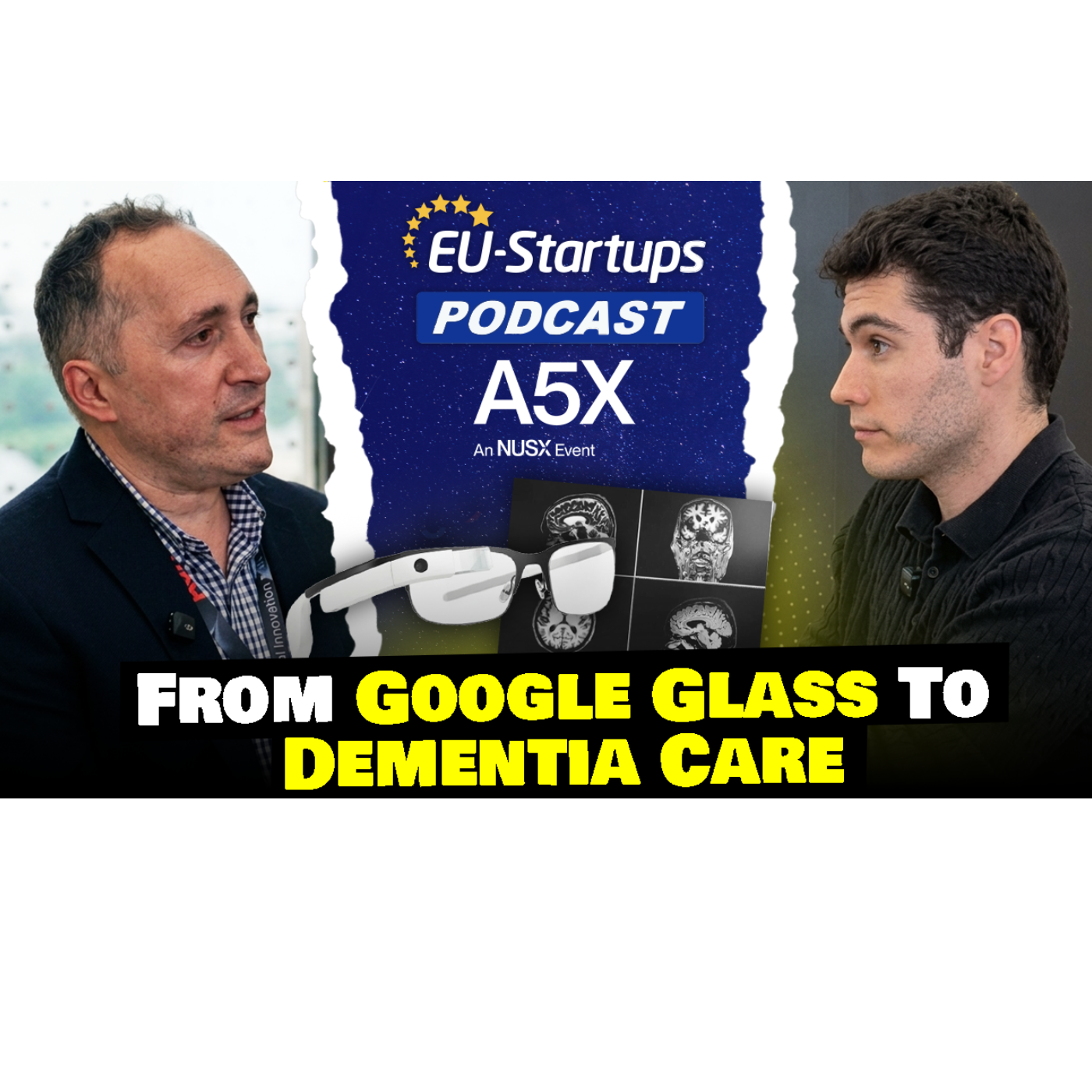
“You are now listening to the EU Start-ups Podcast. We're here at the A5X conference in Singapore by Mutation, the National University of Singapore.”From the transcript
Get every episode summarized
Each time EU-Startups Podcast publishes, we email you a written briefing from the transcript — the topics, who appeared, and any specific claims, with the ad reads skipped.
Email me new episodesFree for 3 shows. No card needed.
Hosts & guests
Transcript ready
363 searchable segments. Every word is indexed and playable.
Full transcript
EU-Startups Podcast — From Google Glass to Dementia Care. Machine-transcribed; use the interactive transcript above to jump the player to any line.
You are now listening to the EU Start-ups Podcast. Hello and welcome to the special episode of the EU Start-ups Podcast. We're here at the A5X conference in Singapore by Mutation, the National University of Singapore. Throughout this next few days we're going to be chatting about innovation, funding, and the developing bridge between Southeast Asia and Europe. Not to mention, they sing in port defense tech hackathon, whose winner is going to show up at our very end of the series in a special episode. So I hope you're looking forward to hear us talking about the challenges, the innovation, and how we're all comparing when it comes to localized markets such as Asia, Southeast Asia, and Europe, and even the global challenges. Not to mention, the lessons we can learn from each other. Well, thank you, Babak, for joining us here at the EU Start-ups Podcast. It's a pleasure to have you on.
Yeah, my pleasure. Thank you very much for the time. It's good to see you. Of course, I'm very much looking forward to our conversation here. You have such a varied background and the way it all descends up time with each other. It's very interesting. But before we get into it, I think it's a good idea for you to maybe give us a little bit of background as to who you are, what you've done, and why you're here. Absolutely. So at the moment, the founder and CEO of New Days, this is an artificial intelligence company that is aiming to help people that struggle with their cognition. So this is really the use of artificial intelligence to help people with their natural intelligence. There is a lot of people out there that have either dementia or the stages before that they struggle with their cognition. You know, the scope is quite large. The number of people suffering from this is very large. And pharmaceutical interventions are unfortunately not available. So our hope is to help people with that and push back the symptoms of the disease for
them. So this is what we do is an application of artificial intelligence that was really not feasible to build even three years ago. So this is basically very recently that has become available. And if time allows them happy to tell you before this, what I was up to. I think it actually is relevant because it will tie to my very first question about it's kind of where you come from when you've done. So from this level. Sure. So I'm happy to tell you about this. And how we ended up with this particular domain. We write the four of this. And with some overlap, I was an venture capitalist, basically. I was a venture partner at the firm called Madonna. I was investing mostly in artificial intelligence, healthcare and deep tech. Before that, I was for a number of years, a vice president at Amazon. I ran an independent organization that was chartered with identifying and then making operational, substantial new domains for the company. So I was there for a number of years during that time, it became a trillion dollar company. So it was very interesting to see the growth and be part of that scaling.
And one of the things I did was to lead the company into healthcare. And in the process of actually doing this, this issue of cognition really showed up on our radar as this big red blinking dots that it's large. Many people are impacted by it. And it's an unmet need. Solutions are unavailable. So this is partly where the idea of a new company has come about. Me and my co-founder also both unfortunately have a family history with these things. So both of our fathers have suffered either from Alzheimer's or dementia. Prior to Amazon, I was at Google for quite a few years. In this part of Google, that's called Google X. I was doing so the crazier things at Google. And I did some things in computing, some things at the interface between also healthcare and tech at that time. And one of the things I did there, which I really liked, was building a device that was called
Google Glass. This was the first modern device that started the wave of current XR and AR and VR that we see in the market. Yeah, in fact, I had a conversation just last week for another episode where Google last came up. It was a company that was developing this kind of headset for visually impaired people. And they talked about the inspiration of Google Glass on these things. But you have such a varied background. And in fact, you already kind of referenced this of how you ended up in dimension. You got a addressing these problems. And he's spoken about family history and all that. So I'm not going to go too much on that, Rox. I think you've already touched it. But that does make me wonder because varied history. You've been in venture capital, Amazon, Google. Do you see this as kind of what your experience has led to? Or do you see this as a stepping stone onto something greater somewhere in the future? We're really highly dedicated to make a difference in this particular situation.
I'll just give you some of the numbers and tell you why. Besides our family connections to this disease. If you look at people over the age of 65, 11% of them have dementia. And on top of that, 22% of them have mild cognitive impairment, which is really euphemism because the person could be so impaired that they may no longer be able to pay their bills. So there's actually a medical diagnosis if someone has MCI. So one third of people over the age of 65 require treatment for their cognition. It's not normal aging. So the number is very large. And these conditions not only emotionally, very impactful on people. They impact how people live their lives. They impact how they socialize with the loved ones. And they're the rest of their social network. It impacts how they live, where they live. It impacts their financials and impacts the rest of their health care. So these are not simple diseases. They're all encompassing very broadly impacting diseases.
So we have lots of people that have these situations. The impact is very large. And you also notice that at the moment, we don't have any pharmaceutical intervention that can cure these diseases or stop these diseases. Yeah. And the last number I'll tell you is the cost of these diseases. That if you compare sort of people that are otherwise medically the same, but one has MCI one doesn't, the cost to the US health care system for that person is $18,000 more. And if they have dementia, that extra cost could be $30,000 per person per year. So if we don't attend to these diseases, these diseases alone can actually bankrupt the US health care system. And the rest of the world is actually following because pretty much most of the world is aging, which means that in absolute numbers, the number of people facing these conditions is going to increase in the next few decades every year actually.
It's going to increase, but tremendously till 2050. And just think about the extra cost of the health care system to take care of these people. So obviously we care about the patient and they will be in first and foremost, but even financially these are urgent issues that we cannot wait. We have to deal with them now. And what's the public application been like then? Do you have relationships with health care organizations? Is it fully somebody signs up on their own volition? What does that look like? Yeah, so we do have actually a number of partnerships. So there are some neurologists that for example, when they diagnosed the person, they were sent to us for treatment. We have partnerships with caregiving organizations. We have partnerships with senior living companies. Yeah, so we have a number of partnerships to make our treatment as accessible as possible. We operate in a highly regulated space. So as a result, we're going state by state in the United States. So we're not at the moment available outside of the US.
We plan to be. But in the US, we're available in six states at the moment, which covers a little bit more than a third of the US population. Okay. And you mentioned at the very beginning there that five years ago, this kind of idea wouldn't be possible because of the advancements in AI. Right? So I can't want to hear a little bit more about how AI has kind of changed your approach to being an entrepreneur and how you see it developing within MedTech and HealthTech in general. Yeah, the impact has been tremendous. And you know, because we have a pretty short time, just focus on what we did. So when we started, we looked at all randomized controlled trials, clinical trials that demonstrated benefit to patients. So an RCT or randomized controlled trial is the gold standard of medicine. So this is how drugs are approved, for example, by the FDA. We found a number of interventions that really impacted patients positively, changed how they experienced the symptoms of the disease.
And they all turn out to be very labor intensive. So none of them were scalable. So it was an interesting situation where you had a big problem. You even had a solution for this problem, which was proven to our randomized clinical trials, the best standard that we have in science. But these solutions were never scaled because they are so labor intensive. Some of these treatments can take years. Some of them might require a trained person to sit with a patient one on one, in a highly personalized way multiple times a week. So that's why they never scaled. I mean, we realized that what the new Gerative AI technology allows us to do is to offload some of the work to be done by AI, and still keep it under the supervision of a human commission, expert commission. So we can democratize access to these treatments. So that's what we do. Basically, we take something that's proven, there's highly manual, unscathedable, and move a lot of the work, we're at the more repetitive part of the work, to be done by AI. But we don't let AI operate fully, autonomously on its own.
We put it under the guidance and control of an expert human clinician, who also sees the patient. So the combination of the two is what allows us to scale these treatments and get them to many people, and we absolutely could not do this three years ago, because the technology wasn't there. And it also makes us operate safely and with confidence. Do you see that relationship, how do you see that relationship advancing? Right, because we've had such a large jump, right, just in five years, how everything, Gen AI and everything's progressing. Do you see that relationship between the kind of human controller and the AI advancing in any way, or do you feel like we've got the relationship set, and now it's just making sure there's a market fit? I think we are one of the pioneers of actually deploying this for real. Our point of view is all of medicine will be practicing this form in the coming years. So the traditional medicine has mostly a human expert,
the doctor, interact with the patient. So the patient comes and the doctor, she would say, okay, probably this is your diagnosis, this is what you should do, come back in two months, I'll see you again, but it's a very human-to-human relationship, which is important. So our point of view is that in the coming years, that would fundamentally change, and it would be this third entity, which is the AI, that would also, in quotation, see the patient, but not fully autonomously. It would be actually an assistant to the human clinician, to the human provider, who is really in charge, and also eventually will be accountable for the outcome. So you see that human element is still essential to what you do. Yeah, so we really have no plan of actually ever cycling out to human. Okay. Well, and I want to circle back a little bit to something you mentioned previously, which is that you're currently active in the US, and you're kind of rolling out in the States.
Question then, because, you know, and I want to draw the big connection here with Europe, Asian, the US. And the idea is that, from what I understand, aging population is really a larger problem in Europe and even Asia than it is in the US. So has there been thoughts of using that as kind of, it seems to me that that's a more natural place to begin an application of this technology in the States? Am I wrong? You're right in a sense that there's tremendous need in various Asian countries and European countries, and we hope to get there as soon as possible. It does because our intervention is highly personalized, then it does require long-form conversations. So one of the things, it's a neuropsychological intervention. So sometimes RIA needs to sit with the patient and talk for half an hour or 45 minutes. It does require actually a decent amount of tuning, both cultural and otherwise. There's not just pure language translation.
Sure. And the next step, very, very deploying the technology. But it is a hope then to at least be expanding the future. Absolutely, absolutely. That you hope to do that. Because they need this very large. We get definitely approached by people outside the US that want this solution from Latin America to Europe to Asia. What have you found then from kind of being a startup and being a smaller organization and how you approach this medical question? Because you've worked a huge Amazon, Google is a huge company. Do you feel that there is elements that you can approach easier as a startup than with a big tech company? You definitely have compared to I've also been a university professor. I'm still a field head professor. So if I compared the resources, for example, is going to place like Google or Amazon or a young company like ours, there's really no comparison between the between these.
Obviously, a large company has a lot more resources. They have a lot more reach. And because of their financial resources, also they can hire really good people. So these are all the advantages of a large company. I think for a younger company, really, it borders down to a velocity of execution. So either a younger company can execute fast. And that's really what they have. If not, they would definitely lose to the larger companies. And this is our attempt to execute as fast as possible and be very focused also on one specific problem that we're trying to solve. So if you're in a large platform company, there are many products and many different groups. So in a sense, some of the very large companies are not as focused on one thing that makes it a bracket. For the people that are in the company, for a young company like ours, there's only one thing that we do. And our job is to do that really well, and be really focused on that and execute as fast as possible.
Well, this fast execution, I think, that's a natural bridge into another point that I want to talk about, is that, and you actually mentioned this, that you work in a sector that's so heavily regulated. And you say that from the US, which I think some Europeans might find that funny, because the comparison between European regulation and US regulations is usually seen as the US is much lighter. So do you feel that that is a crutch at all to kind of making initial advancements? Of course, having a complete agreement that MedTech Health Tech should be well regulated when it gets to the user and to the patient or whatever it's affecting? But should there be more of a relaxed path to get to that point so that innovation and execution can be done faster? Yeah, I mean, I think there's some regulations that actually benefit patients. I really need to keep them, and maybe in some instances, even make them stronger, so whether this is in Europe or the US. There are some regulations that clearly have no benefit for the patient,
and we should remove them. But good example is medical licensing in the US. This is the same for practicing medicine or neuropsychology. If you're licensed in the state of California, you cannot practice in the state of Oregon. That really makes no sense at all. This is still one country, and I can't think of any reason that would have someone be qualified to see patients in California, but be unqualified to see patients in Oregon. But the regulatory burden of actually executing that and getting your clinician's license in every single state, you have 50 of them, you can imagine what's the burden of that. Sure. That has zero benefit to the patients. It has a lot of extra burden to people that want to build new things and innovate. So those types of regulations we can finish should get rid of. We have quite a few of them in the US. You'll be surprised. So that is interesting. A lot of European founders and entrepreneurs and investors I talked to
mentioned that exact problem on the European side. You know what they have an issue with scaling when it comes to different countries because of the different regulations and the different laws per country and all that. So it's interesting to hear that the US isn't kind of this mecca without these issues as well that also has these regulation blocks. That kind of need to be addressed. This depends on the sector. But definitely in healthcare, there are certain regulatory requirements that make no sense at all because they don't benefit patients in any form. Okay. Well, then to wrap up because we're going to the end here. I think I want to just, I think the final logical question really to this whole conversation is where you see dementia treatment going forward. I mean, is there, can it be cured? Is there an end game insight to all of this? Are we right now just trying to find the best ways of addressing it? I think the need for it is immediate. So we can not, we don't have right now a drug that can cure Alzheimer's and a lot of dementia comes from Alzheimer's.
We don't have one that can stop it at the moment. Doesn't mean that we have to give up though. So we absolutely have to continue biological research to really understand the disease and eventually hopefully stop and cure the disease. So it can't happen. It's within the realm of possibility that this could be. I don't see anyone, anything that tells me it's impossible. So hopefully, let's say it's possible. But until we get there, there's going to be millions and millions of people that cannot wait for the hypothetical cure that may come the years to decades from now, they need help today. So we have to figure out how to help them. No. So we were focused on that. And I would say if I compare the state of, you know, where we are in understanding the brain and these cognitive diseases versus the, versus oncology, what's happening with cancer. I think there's been tremendous amount of progress in cancer. Many of them are nearly curable right now.
And the reason is we really understand the molecular mechanisms of cancer a lot more. Sometimes we don't know actually what causes it, but we have many tools because we know how it evolves and produces symptoms. We can intervene. And the most blunt intervention is that you open the person, you take a tool out and sometimes they're cured, right? But we have many tools in our disposal, even when we don't know what causes the cancer to intervene, to prevent it from progressing, to address the symptoms and to cure it. Because the molecular understanding and the biological understanding is quite advanced. That is really not the case actually for many of cognitive diseases. Our understanding is quite actually further back behind cancer. So my guess is that it's going to take us some time before we develop the proper biological knowledge. And after that we can actually produce interventions that scientifically can address the symptoms. So it may take some time. But I'm optimistic that eventually we'll get there. Well, I look forward to it.
Thank you very much. Yeah, my pleasure. And absolutely pleasure to have you. Thank you. Wonderful.
More episodes
More from EU-Startups Podcast

Inside the New DefenceTech Race
EU-Startups Podcast

What Europe Can Learn from Asia
EU-Startups Podcast

Turning Research Into Billion-Dollar Startups
EU-Startups Podcast

How to Win the Global AI Race
EU-Startups Podcast