Get every episode summarized
Each time Fun Facts Daily publishes, we email you a written briefing from the transcript — the topics, who appeared, and any specific claims, with the ad reads skipped.
Email me new episodesFree for 3 shows. No card needed.
About this episode
“Back to school mornings can feel like a group project you somehow got assigned by yourself.”From the transcript
Get every episode summarized
Each time Fun Facts Daily publishes, we email you a written briefing from the transcript — the topics, who appeared, and any specific claims, with the ad reads skipped.
Email me new episodesFree for 3 shows. No card needed.
Hosts & guests
Transcript ready
174 searchable segments. Every word is indexed and playable.
Full transcript
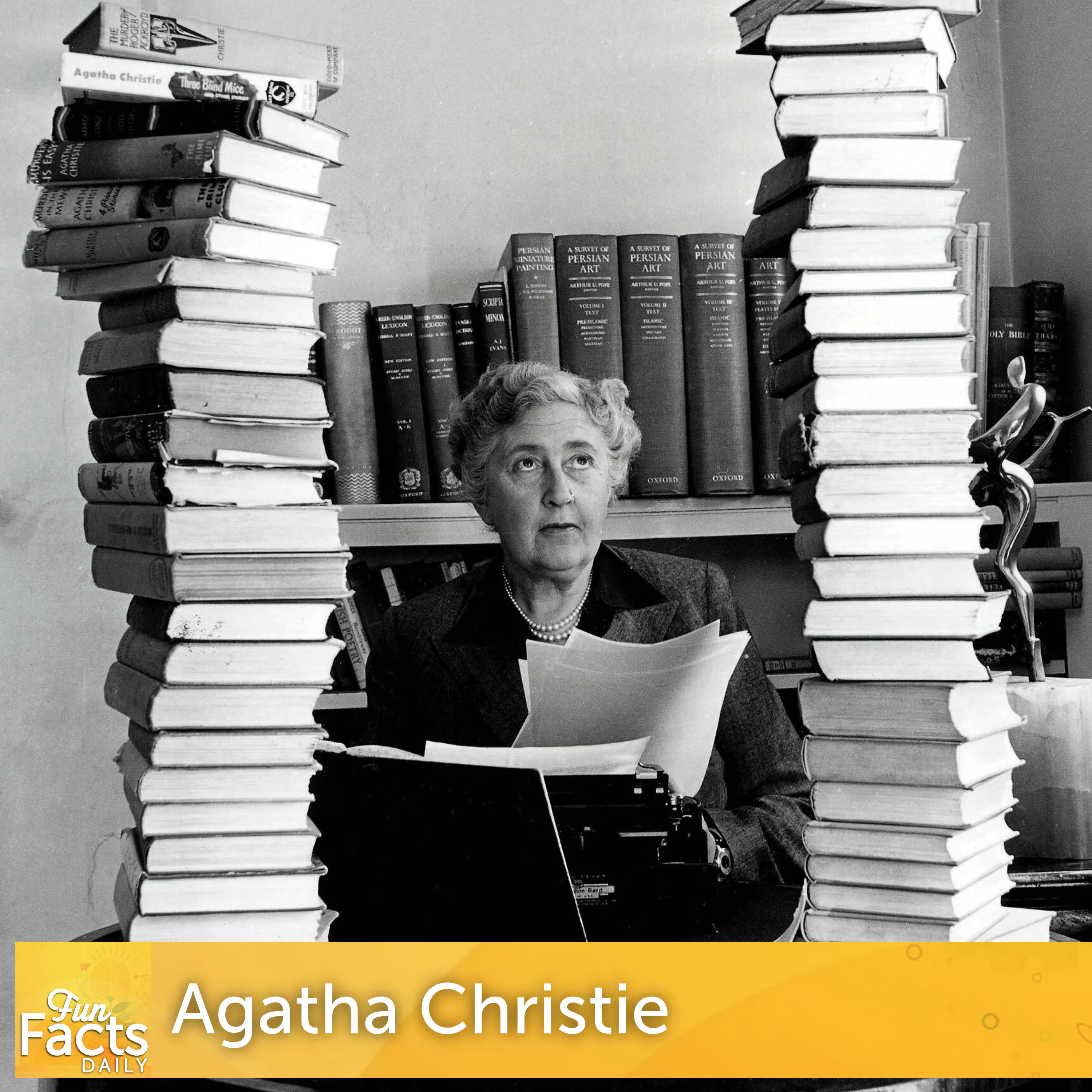
Fun Facts Daily — Fun Facts About Agatha Christie. Machine-transcribed; use the interactive transcript above to jump the player to any line.
Back to school mornings can feel like a group project you somehow got assigned by yourself. Smarty Pants Vitamins is one easy win. While you're finding shoes, packing lunches, trying to remember if today is the day they need that poster board, Smarty Pants Kids plus multi-anomagus supports brain health and delivers 33% more nutrients than the next leading product. No wonder it's the number one best-selling kids gummy multivitamin. Shop Smarty Pants Vitamins at Amazon Target or Walmart. Finding unlocks some pretty impressive skills, like carrying grocery bags, a soccer ball, and a sleepy kid all at once. Good thing the newly designed Chrysler Pacifica has a few tricks of its own, hands-free power sliding doors and lift gate, rear seat entertainment, and still-en-go seating and storage that adapts faster than your family's weekend plans. Visit Chrysler.com to learn more. Chrysler is a registered trademark of FCAUS LLC. Welcome to Fun Facts Daily, your source for just the good stuff.
Monday through Friday, we're bringing fun facts and news you can use all carefully curated to uplift and inform. So give yourself a break, relax, and learn something awesome in just a few minutes every day. Hi everyone, I'm Kyle Wood and today we're going to be learning all about Agatha Christie. One of the most famous writers of detective novels in history. But before we get into the facts, let's warm up our brains with a little challenge to see if you can tell fact from fiction. Consider this. In 1926, at the height of her literary success, Agatha Christie vanished without a trace for 11 days. Her car was found abandoned near a quarry with the headlights still on and her belongings inside, but she was nowhere to be found. The disappearance triggered a nationwide manhunt involving over a thousand police officers searching and even airplanes flying overhead to look for her.
The fellow mystery author, Sir Arthur Conan Doyle, took Christie's gloves to a psychic medium in the hopes of finding her. It all seems like something straight from a mystery novel, but in real life. When she was finally found staying in a spa hotel under an alias, many people, including members of the press, thought she was just staging an elaborate publicity stunt to boost novel sales. What do you think? Did Agatha Christie actually stage a real-life drama and mystery to gain publicity and sell some more books? We'll find out at the end of the episode. Now for your word of the day. Our word for today is Who Done It That's WHO-DUN-IT. A Who Done It is a complex plot-driven variety of detective fiction where the puzzle regarding
Who Committed the Crime is the central focus. The narrative typically provides the audience with equal access to the clues alongside the investigator, allowing the reader to deduce the culprit before the official revelation at the climax. The term is a colloquial contraction of the phrase Who Done It or Who Did It. It came into print in America in the 1930s in issues of variety to classify murder mysteries in literature, film, and theater. So it's kind of a slang term from the golden age of detective fiction that made its way into print and since then it's gotten formal recognition from dictionaries and other prominent sources. Donald Gordon, a book reviewer for the American News of Books, used the phrase in print in 1930, as soon after head line writers adopted the compound word because it fit compactly into printed newspaper pages. While Agatha Christie didn't invent the term or the genre, her work really set the
structure and the rules that defined the genre for generations of writers that followed. Time for your daily high five are top five fun facts about Agatha Christie. Number one, Agatha Christie is officially recognized by Guinness World Records as the best-selling fiction author of all time. For her career, Agatha Christie wrote 66 detective novels and 14 short story collections. UNESCO indexes indicate that her stories have been translated into more than 100 languages which would indicate a wider distribution than almost any other individual author in history. It's estimated that her books have sold more than 2 billion copies worldwide. But the numbers keep growing. Royalty records indicate that her state still sells millions of copies annually, despite
her having passed away decades ago in 1976. Her novel and then there were none, has sold over 100 million copies alone, making it one of the top-selling single title books in history. Really, there aren't that many books other than the Bible that have sold more printed copies than Agatha Christie's collected works. Number two, Agatha Christie's The Mouse Trap has the record for the longest continuous theatrical run in the world. The stage production opened at the Ambassador's Theatre in London's West End on November 25, 1952, starring Richard Attenborough and Sheila Sim. The play transferred to St. Martin's Theatre Next Door in 1974 without missing a performance, continuing its schedule for decades. In November 2022, the production officially celebrated its 70th anniversary on the British stage.
The show has completed well over 29,000 live performances to date. The production has cycled through countless cast rotations, thousands of costumes, and who knows how many proper placements, but the show always found a way to go on continuously for nearly 70 years. Aside from just the temporary closure during the 2020 pandemic lockdowns, it has captivated audiences for generations. And even though it's an old show, nobody likes to have a mystery spoiled, so traditions still dictates that as the audience exits, they agree to not reveal the killer's identity. Number 3. A Christy learned quite a bit about toxins and pharmacology because she served as a hospital dispenser during both world wars. During World War I, Agatha Christy volunteered as a nurse in the voluntary aid detachment before training as an apothecary's assistant in the Red Cross Hospital dispensary.
She studied chemistry and pharmacology under the guidance of commercial pharmacists. In 1917, she passed her exams from the Society of Apothecaries in London, qualifying her to mix and prepare medical prescriptions. This hands-on laboratory experience gave her a deep understanding of lethal doses, incubation periods, and the symptoms that would be associated with various chemical toxins. Over half of the murders in her stories involve poison, far more than guns, knives, or bloodshed. And just an amazing little factoid about how deep her knowledge was about these different compounds. In 1977, British doctors were able to diagnose a case of thalium poisoning in an infant because a nurse recognized the symptoms as described in Christy's 1961 novel The Pale Horse. Agatha Christy was among the first Western women to learn to surf standing up.
In 1922, Christy and her husband Archie went on an eight-month promotional trip to organize the British Empire Exhibition. While staying in South Africa, the couple bought some wooden planks and practiced belly-boarding in the waves near Cape Town. But later that year, when they reached Honolulu, Hawaii, the locals there introduced them to full-sized wooden surfboards. Christy actually documented her learning process and her letters, describing how she got a tailored swimsuit and practiced balancing on waves until she could paddle, catch ocean breaks, and stand upright unassisted. Her writing indicates that she had a lot of fun surfing, but in the 1920s, there weren't a lot of other women out there doing it. And our fifth and final fun fact for today, Agatha Christy wrote six non-crime romance novels under a pseudonym Mary West Macat.
In 1930, Agatha Christy published the novel Giant Speared under the name Mary West Macat to explore emotional, introspective themes without the constraints of the detective formula she was so well known for. The West Macat books focused on relationships, family dynamics, and artistic ambitions instead of murder investigations. She came up with her pseudonym combining Mary, which was her middle name, with West Macat, which was the surname of some relatives. It wasn't until 1949 that an observant reviewer in the British paper The Sunday Times noticed recurring stylistic habits and narrative motifs in her writing. A Christie continued to publish under the pen name, even after the reveal, issuing her final West Macat book The Bird In in 1956. Now for some news you can use.
Agatha Christy famously wrote brilliant detective novels that had shocking twist endings, but those twists didn't really come out of nowhere. She believed in a rule of fair play where the reader has a chance to be able to solve the mystery before the big reveal in the end, so she always laid the groundwork throughout the novel. Now, here's a little tip if you want to sharpen your focus and solve mysteries before reaching the final chapter of any detective novel. As you're reading, try keeping a small index card tucked into the book. Split the card into three vertical columns, suspect, motive, and timeline alibi. Every time an investigator discovers a hard clue, like a train ticket, a dropped key, or a discrepancy in a watch's time, write down which suspect has no verifiable alibi for that specific minute. Treat statements given by characters as unreliable until physical objects in the text confirm them.
This systematic note-taking will work because writers from the Golden Age of Detective Fiction adhered to the fair play rule, and many writers today still follow that same idea. Authors are kind of obligated to give the reader a chance to solve the mystery before the fictional detective, so they'll show every clue to the audience at the same time the detective in the book observes it. By taking your own notes and keeping all the facts organized on paper, rather than just following the narrator's assumptions, you can see through the red herrings and the author's misdirection and solve the puzzle through logic. Finally, the moment you've been waiting for. At the beginning of the episode, I asked if Agatha Christie's disappearance in 1926 was all just an elaborate publicity stunt. This one's a fallacy.
Historical evidence, medical assessments, and personal records all indicate the event was a genuine personal crisis, not some marketing scheme. In 1926, Christie suffered the death of her mother and discovered that her husband Archie was pursuing a relationship with another woman. Medical professionals who examined her determined that she had experienced a fugue state, a form of temporary amnesia introduced by trauma and stress. There's really no need for her to carry out any sort of publicity stunt. Her novel sales were already secure. And really, all the public scrutiny just caused her a lot of lasting distress. Now I hope you enjoyed learning a bit about Agatha Christie with me today, and be sure to tune in every weekday for even more fun facts. Funfax Daily is an airwave media podcast. It was written, recorded, mixed, and edited by me, Kyle Wood. Thanks for sharing a part of your day with me.
Be sure to follow Funfax Daily on your favorite podcast app so you can keep the good stuff coming your way every day. And if you like the show, please do me a favor and leave a kind rating review or just tell your friends about it.
More episodes


