How to Evaluate STT for Voice Agents in Production
Get every episode summarized
Each time The Good Tech Companies publishes, we email you a written briefing from the transcript — the topics, who appeared, and any specific claims, with the ad reads skipped.
Email me new episodesFree for 3 shows. No card needed.
About this episode
This story was originally published on HackerNoon at: https://hackernoon.com/how-to-evaluate-stt-for-voice-agents-in-production.
Most STT benchmarks measure the wrong thing. Here's how to evaluate speech-to-text for voice agents using the metrics that actually drive production performance
Check more stories related to tech-stories at: https://hackernoon.com/c/tech-stories.
You can also check exclusive content about #ai-voice-agent, #voice-agent-stt, #pipecat, #voice-ai, #conversational-ai, #ai-voice-agent-benchmarking, #stt-evaluation-metrics, #good-company, and more.
This story was written by: @speechmatics. Learn more about this writer by checking @speechmatics's about page,
and for more stories, please visit hackernoon.com.
Voice agent developers are optimising for TTFB — time to first byte — but it's one of the least useful metrics in production.
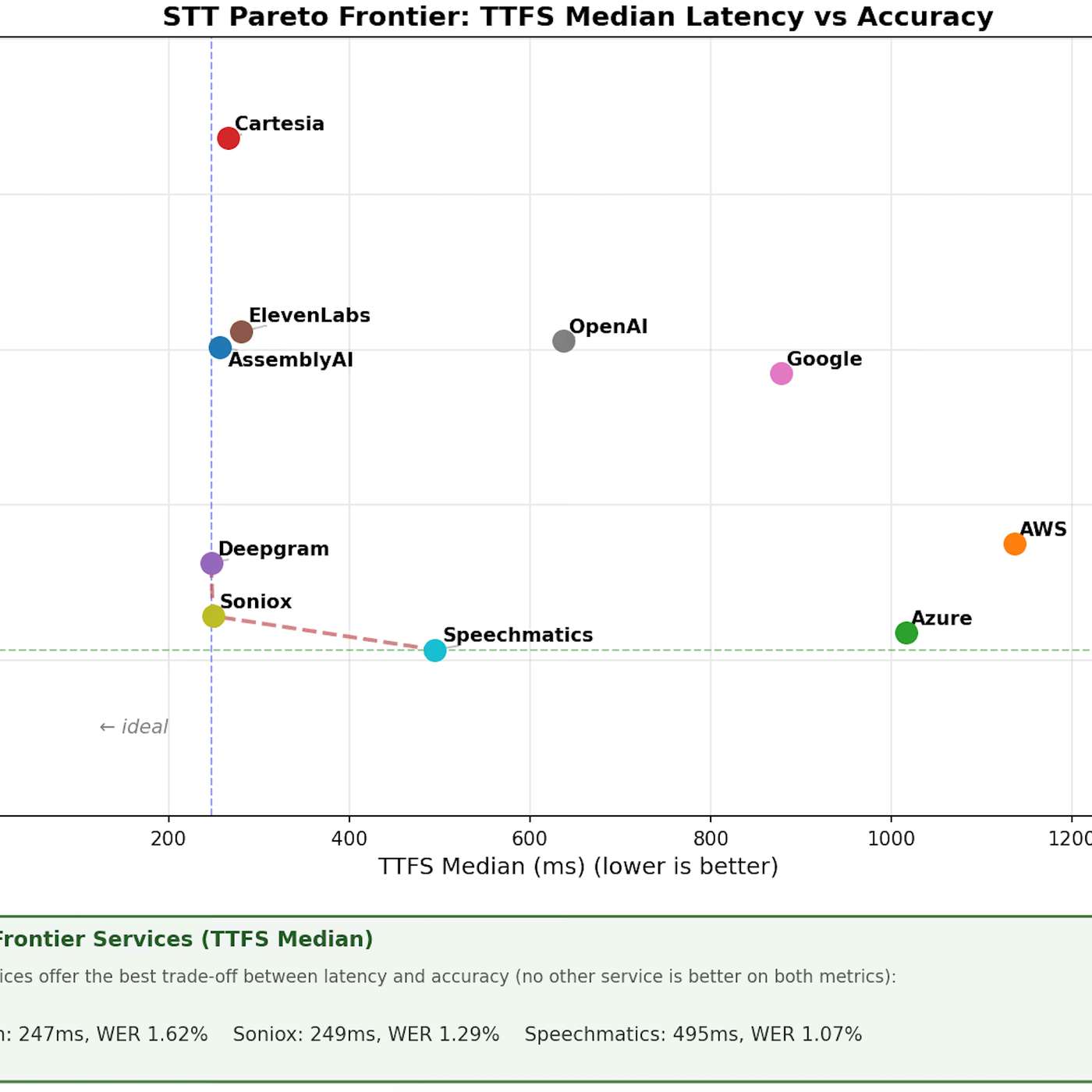
What actually determines how fast and reliable your agent feels is TTFS (time to final segment): the gap between a user finishing speech and a stable transcript landing in your LLM.
This piece breaks down the Pipecat benchmark — currently the most credible public eval for STT in voice agents — explains semantic WER and why it beats standard word error rate for this use case, and makes the case that accuracy and latency are inseparable. A faster wrong answer is still a wrong answer.
Get every episode summarized
Each time The Good Tech Companies publishes, we email you a written briefing from the transcript — the topics, who appeared, and any specific claims, with the ad reads skipped.
Email me new episodesFree for 3 shows. No card needed.
Hosts & guests
No transcript yet
This episode has not been transcribed. Request it and it moves to the front of the queue.
More episodes
More from The Good Tech Companies

Protection Funds, Insurance and FDIC/SIPC: What Actually Covers What
The Good Tech Companies

Credible Captain Launches Independent Consumer Review Platform Focused on Transp...
The Good Tech Companies

4 Ways to Win a Hackathon (None of Them Is Writing Code)
The Good Tech Companies

Tokenized Stocks vs Real Stocks vs Stock Futures: Wall Street Without Walls and...
The Good Tech Companies