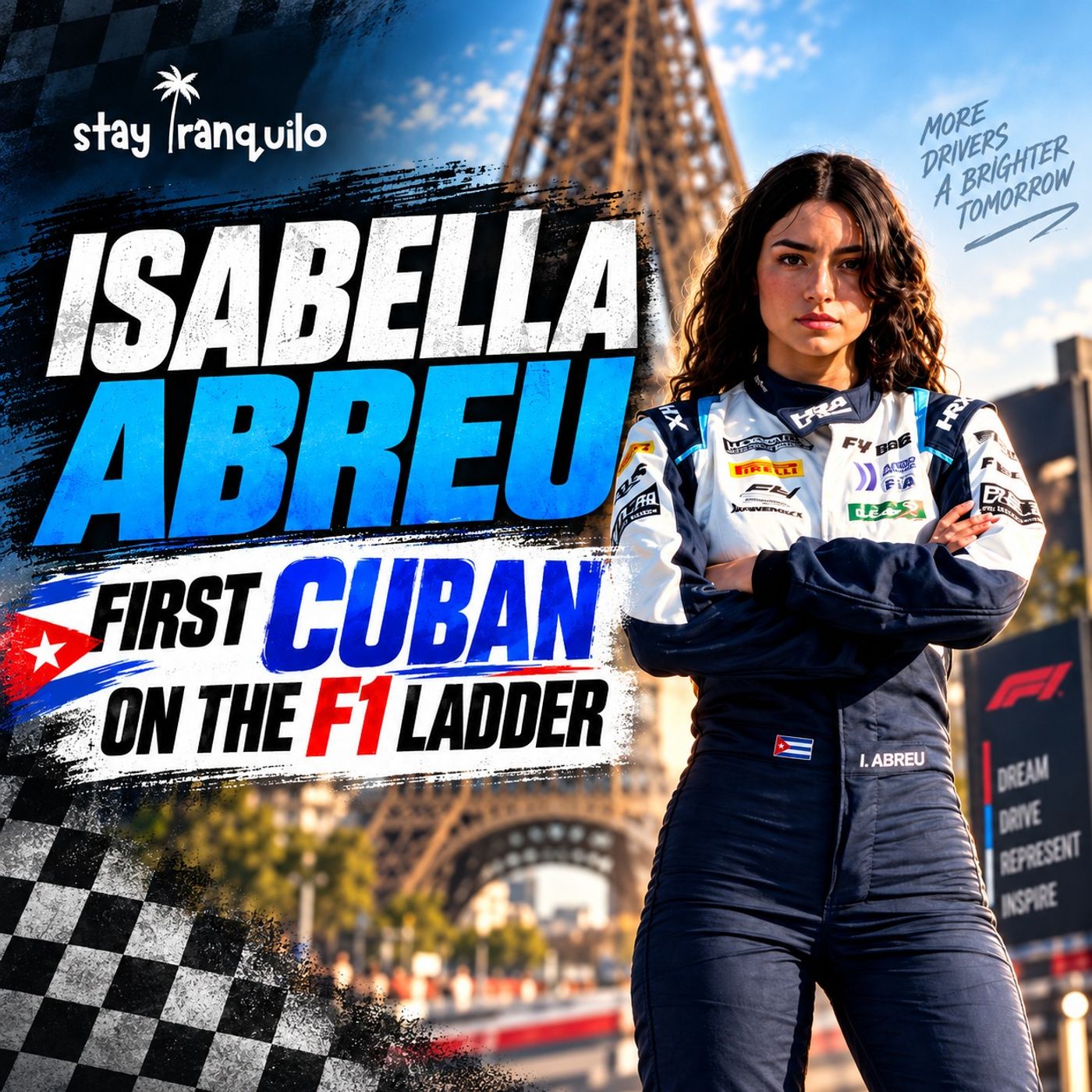
Isabella Abreu: The First Cuban Driver on the Formula 1 Ladder 🇨🇺🏎️ | Stay Tranquilo
Get every episode summarized
Each time Stay Tranquilo publishes, we email you a written briefing from the transcript — the topics, who appeared, and any specific claims, with the ad reads skipped.
Email me new episodesFree for 3 shows. No card needed.
About this episode
“Yeah, we had 1957, we had Formula One in Malagona, La Lana. That's where the champion of that year was kidnapped by Fidel Castro. Yeah, I'm doing a clothing brand about it by the way. I was doing a lot of research recently because I'm designing shirts for it.”From the transcript
Isabella shares her journey from being born in Cuba, moving through Spain and eventually settling in Miami, to discovering her passion for racing and competing internationally in France.
We dive into what it really takes to pursue a career in motorsports — from six-figure racing budgets and finding sponsors to building a personal brand, training mentally and physically, and refusing to quit when the odds are stacked against you.
We also talk about Cuba’s forgotten motorsports history, the importance of representing Cuban culture on an international stage, Isabella’s goals for the next generation of Cuban drivers, and a major next step in her racing career that she’s getting ready to announce.
In this episode:
🏎️ Becoming the first Cuban driver on the Formula 1 ladder
🇨🇺 Growing up between Cuba, Spain & Miami
🏁 Racing internationally in France
💰 The business and sponsorship side of motorsports
🧠 Mindset, persistence & overcoming adversity
📱 Why social media has become essential for modern athletes
🔥 What’s next for Isabella’s racing career
🌴 What it means to Stay Tranquilo
Follow Stay Tranquilo for more conversations with athletes, entrepreneurs, creators and people chasing something bigger.
0:00 The Forgotten History of F1 in Cuba
0:57 Meet the First Cuban-American F1 Driver
2:08 The Unspoken Truth About Success
5:42 From Havana to Miami: A Journey of Resilience
12:28 Born with a Passion for Speed
19:01 The Brutal Reality of Racing Economics
28:03 The Power of Personal Branding for Athletes
42:02 Inspiring the Next Generation of Cuban Drivers
#StayTranquilo #IsabellaAbreu #Formula1 #F1 #Motorsports #CubanAmerican #Racing
Hosted by Simplecast, an AdsWizz company. See pcm.adswizz.com for information about our collection and use of personal data for advertising.
Get every episode summarized
Each time Stay Tranquilo publishes, we email you a written briefing from the transcript — the topics, who appeared, and any specific claims, with the ad reads skipped.
Email me new episodesFree for 3 shows. No card needed.
Transcript ready
1,438 searchable segments. Every word is indexed and playable.
Full transcript
Stay Tranquilo — Isabella Abreu: The First Cuban Driver on the Formula 1 Ladder 🇨🇺🏎️ | Stay Tranquilo. Machine-transcribed; use the interactive transcript above to jump the player to any line.
We actually had Formula One in Cuba. No way. Yeah, we had 1957, we had Formula One in Malagona, La Lana. Wow. And then we also had 1958. That's where the champion of that year was kidnapped by Fidel Castro. Yeah, I'm doing a clothing brand about it by the way. Oh, that's so cool. That's what I was telling you. I was doing a lot of research recently because I'm designing shirts for it. Okay. And it was an actual Malagona, La Lana. There was like 150,000 spectators. That year Fidel Castro kidnapped the champion, the Formula One champion of that year. He's Argentinian. Okay. And he to make a statement, right? And then the next year he cancelled motor sports forever in the in the island. Until now, I mean, until I'm like over here. Of course. Get back into the house. All right. Welcome back to another episode of State Tranquilo.
Today we have a very, very special guest Isabella Abrejo, one of the, I think the only Cuban American F1, right? Yeah, I became the first to see her yet. That's, I mean, that in itself is impressive, you know, representing those Guanos out there. And we were talking about a offline before we were recording, right? Like that we're proud to be, you know, Cuban and well, Cuban American, right? You were born in Cuba. I was born here in America, but my grandparents are Cuban. So I am more of like Cuban. You're a true Guano or Guano. Kind of half and half half and half. Half and half like the cuff. Yeah, exactly, exactly. But I'm really excited to one, obviously, share your story today. I think it's one of inspiration, you know, for a lot of young female latinas and in specific, but for anybody, right? You really have pursued a dream. And I think that's always something that being an entrepreneur, I genuinely, really, really appreciate because it is a grind, right?
And no one really sees the behind the scenes. So I'm excited to like hear your story and get deep into it. You just hit my heart, man. Yeah, I mean, it takes a lot and it's more about persistence and not giving up than anything else. You could be very dedicated, but there's people that quit in the middle. So it's just about not quitting and continuing even though everything's falling apart around you. 100%. It's funny. Like I've listened to a lot of podcasts myself. It's a big reason why I ended up starting one a couple of years ago. But one thing that I've always found as like a common denominator amongst successful people, it doesn't matter what space they're in. It could be sports, business, entertainment, anything, right? A career, that path that they've pursued. The one common denominator they always go to is they just never quit. Yeah. Because everybody hit some sort of level at adversity at some point. Some challenge, something, right? Something along the way where they had doubt on sanity as to like, why am I even doing this? Like what is the reason behind?
And that's what most people quit, right? Exactly. And that's where you have to tell yourself. And it's really difficult because it's, you know, you're doing psychology on yourself. You're basically like don't quit, don't quit, don't quit. Or it's stop thinking negatively. Just go. Everything's going to be okay. Yeah. That's where most people quit. And then you just have to get past that space. 100%. Where you're trying to just let go of it. Because it's easier to get a custom to normal, right? And what you're striving for most times is bigger than normal. Absolutely. And that's what what I have in my head every time I'm trying and working towards, you know, racing, you know, it's a really big thing to have on my shoulders to have become the first Cuban driver to get to the Formula One ladder. And representing an entire country. It's like you have to get away from that and focus solely on just continuing. 100%. Yeah. I mean, your identity is your identity and that goes with you no matter what you do, right?
And you wear it proud and you wear it loud and as anybody should, right? But at the end of the day, like, your craft is what's most important. Yeah. And being able to be the best version of yourself at whatever your craft is. And putting the time, effort and energy into being the best at what you do. 1000% and if you don't work on yourself too, you're not going to be able to hold through the success part, right? And you're going to go back to the normal. So I've also like, I don't know if it's happened to you, but it's kind of how life works where it teaches you like, absolutely. Like don't do this or you have to work on yourself. Go to the gym. Do this mentally so you can withhold what you are actually wanting to strive for, right? Absolutely. I don't know if you understand that. No, no, I'm never saying I'm with you. I'm with you. I completely agree. And I think, like you said, I think that's why you've been successful in a still young career for yourself, right? But you, that's what's, you're building the foundation, right? You don't have the foundation built early on.
You can get the success, but it can crumble just as fast as the way, right? And I think that's what some people don't realize is that instant gratification and you know, you see people get from here to here. Yeah, that's why. But they don't understand what happened like in between. And that is really building the foundation to be able to sustain. So like Scarface style, right? I love that. He worked all his life to become this big guy and then everything fell apart because he couldn't sustain that, right? And yeah, I mean, it takes a lot. Absolutely, absolutely. And I want to get more into, you know, mindset, everything that goes into it. But I want to share your story. Tell us, you know, born in Cuba, right? You move to Spain at a young age and then move to Miami. So talk to me about that whole journey. How much you remember, obviously? I, people ask me and my mom's like, how do you remember some things? Because I remember everything. I don't know why. I remember living in Cuba when I was little. I was like six. I was like five. I don't know. But I do. I mean, I remember almost everything. And then that big change, I spent most of my childhood trying to get to the US.
We went to Spain and we realized it wasn't for us. My dad did. So he's like, okay, the next step is going to the US. We traveled all around Europe getting our papers, right? We went to Paris. We went to Brussels. We went to, and then we went to Canada. And we crossed the border. Holy cow. And we got to the US. And when you moved into the US straight to Miami? Straight to Miami. That's where we had family. So and then slowly but surely I became Miami in his health. What from your, I know you were young, but when you were in Cuba, like, what do you remember about Cuba at that time? Well, right at that time, I wasn't as bad as now. Of course. Yeah. I mean, it's obviously progressively, you know, from like that to the Grand Parenthood sort. You know, there to the time, obviously, that you left. There was already a ton of change at that point. Right. I mean, this is 2009ish. So an eightish. It wasn't, I mean, as difficult. It was right after, like a lot of years after a pretty special. So we had food. We had everything.
I just remember having a lot of fun. That's awesome. I mean, we went to have Anna and there was El Goni Island, which is an entire, it's like universal, but Cuban. Okay. That sounds interesting. And it's no longer there. It's stuff that it's slowly decline, stuff that I mean, I saw when I was a baby, a little girl and I loved and I want to go back to and I can't. But I mean, yeah, I just remember my family most. Right. And foremost, which I mean, that that's like the thing everybody. But I was sent every single year after that for the summer break. I was, I went to school in Miami. I would say I went to Slovenia Heights. That's where people went to. No way. Yeah. That's got to happen. And then I went to Carver, then Mast. But yeah, I went to. I was saying no, my cousin went to Mast actually. You look like a Columbus guy for some reason. Wow, nailed it. What is this? Holy crap. Damn. I didn't know we had to. It's the flow. It's hilarious. Yeah. Oh, no.
Every time I say that, it's supposed to be an insult, but there's time I nailed it. But that's what I was like. I know that's not a compliment. But no, I was sent to Cuba every single summer. And I would see progressively how difficult it would get to be there. At first, it was like, okay, we got AC. We have everything. We would go to the beach. We would go to hotels. And then next thing you know, no light, no this, no that. So it's been a couple of years since I've gone. Yeah. I really want to go once it's gotten better. Because I do have family that I wouldn't really see. But yeah. It's obviously it's a tough spot. It's terrible. Kind of like the fall of Cuba. Very progressively and been bad for a while. But it just somehow continues to get worse. You mentioned the no electricity, food shortages, all these different things. But I remember my grandma when, obviously she was already here. And she was alive. And you know, we talked to her about Cuba. What, what time frame is this? So she was there like, my mom was born 68.
Okay. So you're almost probably like 50. She was four. Yeah, she was there like in the 50s. I mean, she was born in 1936. Okay. So she was there from 36. In the good. Yeah. Yeah. When we were exactly thriving. I mean, she was wealthy. Coca-Cola was there. I mean, it was Las Vegas, but in the Caribbean. Exactly. Exactly. No, I mean, she said it. Cuba was beautiful. You know, the best beaches, very vibrant. Ton of energy. She had, she was wealthy. Right? Like she had a great life in Cuba. And then obviously towards a lot of half of her life in Cuba, that's where, you know, Fadal was coming into power. And ultimately, that's what got her out. And when we were talking offline, she was able to get a visa. So she flew into New York. And that's where they had the immigration going on over there at the time. So she went over there. My grandfather, who they were not together at the time. But. Oh, I thought, when you told me, I'm like, she didn't help. But they knew each other. Okay. Like they were, you know, friends of the neighborhood were like somewhat kind of close, but not super tight.
But they knew each other. Okay. But my grandfather and his two brothers did the whole escaping and took a raft and made it to the OG. Yeah. Getting here to Miami. Exactly. And then they rekindled in New York. Oh, and then that's where they met and they got married. That's such a nice thing. You probably have the picture. Yes. Oh my God. I maybe we could pull it up for the video. There's a picture in my house of them on their honeymoon. And it's like a little cottage that they're in. And it's like my grandfather with his arm around my grandmother. Where did they have them honeymoon? I don't know. I'm thinking like Cuba. They went back to reimagined. Or maybe it wasn't their honeymoon. Because it feels like the picture was in Cuba. Actually? I think about it. So I got to, I got to, you're going to start to fall up your mom. I got to call my mom, or my uncle, one of the two. Someone will know the answer to that. But there's a nice picture of them together. And I got to figure out the math of like when that was. But all that being said, like their migration story was like the start of obviously the downfall of Cuba.
Right. And then that's why I asked you the timeframe. Because the downfall of Cuba was also the downfall of motorsports in Cuba. We actually had Formula One in Cuba. No way. Yeah. We had 1957. We had Formula One in Malagonda, La Lana. Wow. And then we also had 1958. That's where the champion of that year was kidnapped by Fidel Castro. Yeah. I'm doing a clothing brand of out-of-life. Oh, that's so silly. I was doing a lot of research recently because I'm designing shirts for it. OK. And it was an actual Malagonda La Lana. There was like 150,000 spectators that year Fidel Castro kidnapped the champion, the Formula One champion of that year. He's Argentinian. OK. And he to make a statement, right? And then the next year, he cancelled motorsports forever in the island. Wow. Until now. I mean, until I'm like over here trying to get back into it. Yeah. Wow. Dude, that's a pretty insane story. And like obviously, like, you're ties to Cuba.
Yeah. Like, that's cool. That's really cool. So you talk about motorsports, right? Yes. Let's get into that. OK. So you come into the states, right? Yeah. At that time, were you already intrigued by cars and racing? I've always been in love with cars. And this is something my dad can tell you better because it has been, when I was little, I would tell my mom to let me drive. I was like seven, going to school. And I made a, like, out of paper, like a steer wheel out of paper and would mimic how she would drive. Like, it's an ongoing obsession because my dad in Cuba had a packer of the 50s. OK. And he would bring me into the shop every time he would work on it. And I would look under, look at the mechanics of the car. And I'm being like, wow. Like, this is something that, I don't know what, I was born with. Right. I guess, who the fuck are you? But I mean, listen, like what's meant to be is meant to be the other day. So like the fact that you were around it and you naturally enjoyed it tells you something.
Yeah. And it's not usual when girls gravitate towards mechanics and cars and speed. And my dad was like over the moon. He's like, oh my gosh, because he's always wanted a boy. And I'm like, I'm a girl, but I love cars. He got best of both worlds. Yeah, exactly. That's incredible. When we came to the US migrating here, we're not starting with any money. We're starting from scratch. So I couldn't really go and be able to race or drive anything. So I would do that. I would look at my car. My dad, the mechanic says he's always loved that. And would get the steering wheel and slowly but surely, when I was 14, I started saving up from my first car. I started getting jobs. I got BMW Z4. Oh, yeah. And that's where I was like, holy crap. So you're getting speeding tickets for no 15. And that's when my dad's like, listen, so I have something for you. Let's go to the track. That's amazing. Yeah. And I was like, oh, yeah.
Oh, my God. And that's where everything started. It's been now. It's been short lifts. I mean, it's been a short amount of time where I've been racing. But it's like, I started late. But I've caught up to everybody starting when they were four. And that's why all the four years, old is when people are starting. Yeah, carading starts when you were four. You're lying. Formula one driver start when they're four. What? Yes, or five? Yeah, little kick-carts. I can't even picture myself at four years old. You have to go to the go-cart track and see. Yeah, that's incredible. It may look like bubble heads. It's super cute. I know. That's really adorable. The big helmet. Yeah. That's insane. Yeah, I started racing. And then I progressed. I'm going to race with Mazda. Then I did Formula. And now next year, I'm going to do something really cool. I was like, you know, nobody knows. Wow. Wow, wow, wow. It's funny. We were talking. Your dad introduces you to cars. You get your first car. You have this innate feeling within you to drive fast.
And you love the mechanical side of cars. And how you don't really know it in that moment, but you now looking back at that little girl then and being like, shit, this is what I was going to be doing. Obviously, it was going to turn into every single picture you see of me when I was in a car. I don't know how. It's always me in a steering wheel. It's always me trying to, oh my gosh, I would, my grandpa gave me roller blades to just, you know, and I would go so fast that I would rip off like the leaves of my mom's garden and stuff. And she would get super mad. And yeah, I mean, I've always loved speed, I don't know. So obviously your day job is racing. But like on the day to day driving a car, like what? I always get this question. How do you have? And do you want to drive faster? It's like that your moment to like, you know, be a little more tranquilo behind the wheel. I like what you did there.
I always get this question. When I get off the track and I'm racing here in Miami, for example, I get right off the track, get in the car. I have a BMW Z4. OK. The same car that I had since the beginning, I love that car. I get in the car and I feel like I'm like a tortoise when I'm going in like 80 miles an hour, right? But on the every day when that adrenaline goes down, I drive like you. Or La vieja, la la la, it's fine. But I do have more reaction time. So I avoid a lot of the bad Miami drives. Miami, yeah, the pomero. But no, I don't want to drive fast because that's all in the past. That's when I have like five six meeting tickets. I don't want that anymore. One of my first cars was a Camaro. And I just wanted to go. I wanted to fly all the time. And it's like, it's so effortless, right? And then I remember I'm like, you know what? Speed's not a good thing for me because I just want to go fast. Maybe not like race car drive fast. But like I just like I know exactly what you mean, because street racing.
I mean, that's why I had to take it. It's insane. I remember like 2 a.m. Highways wide open. And you let me see what I could do here. And then it was like, oh my god, I hit a hundred. All right. Let me let me let me scale back. And then the next time I was like 110. And then it was 120. Yeah, you find that limit. Yeah, the fastest I ever won, I think was like, sorry, mom. But it was like 128, 132, I think. OK. In the Camaro, was it an SS? Yes. OK, my dad had an SS. Before I had my car. And it was, I don't know if you know about anything about suspension, but probably not enough. OK, it was twisted. So the steering wheel goes there like this. So me a hundred miles an hour. I'm really good. But yeah, you just feel like you lack control, obviously. So it's like one mistake or one thing. It was like, I touched it and I immediately. That's why you see a NASCAR. I mean, I have nothing to do with NASCAR. I don't treat NASCAR or anything. But in NASCAR, they're going really fast in a straight line.
Right. And then you make sudden move. Everybody in back of you is going to go into the court. I mean, into the, yeah, wall. Yeah. It's speeds, speeds is different. And like, you have to respect it. Oh, 1,000, 1,000%. So talk to me about competitive racing, right? OK. When did competitions start for you? Obviously, you started getting into driving, you said you race with Mazda, you race with. But to now get into kind of like the Formula One world, right? What was the progression into that stage? It was a lot of work. Yeah. Like, how does one even get there? Yeah, it's, yeah, it's difficult. Most people stay in carting. OK. Yes. So I go carts like the professional carting. I got my first podium six months in. So that's when we realized, it's not just a hobby. Any more, it's more so like we kind of got to get a career out of this. And we had to, I mean, my dad and I worked our butts off to get the money. I mean, it's six figures a year for me though. But that's why we progress more into the Mazda's.
That's cheaper and it's more grassroot racing, where you learn the basics of actual speed. And I was driving manual, he'll tell you know what he'll tell. Not even a clue. It's when you're breaking. And you have to match the engine revs to the down shift. Got you. OK. So now that we got that down, exactly. I'm learning all of this when I had to even have a license yet. And yeah, I mean, I had to learn. I had to go to race. You didn't have a driver's license? No, not yet. Wow. And yeah, I got my red driver's license. I started getting speeding tickets, all that stuff while I was in carting, right? And then when I went to Mazda, it got better. I was doing very good. And that's when I started doing what you're doing now, where it's sponsorship acquisition. Right. Yeah, the business side of it. Because before I would depend on my dad, that was funding. And then I saw that it's gotten very expensive. And I don't want him to go bankrupt.
Yeah, yeah. So I started, you know, he's investing in you at the end of the day. At the end of the day, I mean, yesterday I was talking to him. And he's like, if it hadn't been for all the strength that it got to, and all the money, you wouldn't be there. And I'm like, I know about that. Yeah, yeah. I know. I just went back to how Marcelo says, if it hadn't been for me, I'd be coming to. Yeah. I mean, there is definitely truth to that. 100%. 100%. But it's like my entire life. 1,000%. But, you know, think, put yourself in the shoes of your parents. Right. You know, like when you're that moment, when you're in that moment, and you have a kid, and you're like, you know what? I'm going to do everything and anything for my child, right? To follow their passion, pursue their dreams, and do it well and right. And you have obviously proven to your parents as well that you deserve a chance, obviously. Like you work hard, you're talented, like you check the boxes. But at the end of the day, like now this is your opportunity
to give back to them. To give back to them. And that's where I am right now. I mean, I'm 22. So that's where I am working my butt off, not just to fund my racing career, obviously, but just to give a little bit back to them and make them not so much work. Because I mean, escaping communism, coming here, migrating, living all that plus, you know, starting from scratch in a brand new country, when you don't know the language, that's respectable. And yeah, I know I have to 100% give back to them and you work now for them. 100%. And so your was your dad the one that taught you how to like drive with the intention of racing, or like who taught you how to race? Or you just you figured it out. I should talk to me. He took me to the race track. And I, a little passion grew in me, right? Where I couldn't leave the race track. And it's, I can say like over, how am I supposed to say? Like it's very intricate what I do. But learning the side of the data analysis,
why the car does this, why am I not going faster in that corner? So you like nerd it out about it a little bit. I nerd it out about it. Like I wasn't called it, while I was racing Mazda. And I was like on the weekends just like learning about you know the statistics of Daytona for example, like how I was racing the Daytona at that moment. And I was like how does this happen? Like the gravel, the this and this is that? No, the gravel cement. Yeah, I got what you were saying. The the tire wear, it's, it's very intricate. And that's what I fell in love with. But then the speed aspect after I was going to tell you, drivers don't really see the speed. Like we can be 200 miles an hour and we don't feel it. Right. Because we're so focused on the corner, like the slow part of it to maximize it that we have no clue how fast we're going. That's correct. Like it's just you the track and then everything else is like, forget. You almost like black out a little bit. No, 100%. It's called tunnel vision. Yeah, we we black out. We don't think about anything. Because once you think you start overthinking it,
you start over driving. Mm-hmm. And that's where your competitors will like blast through you. Yeah, 100%. Yeah. You know, you recently raced in France? Yes. Part of the formula series? Yes. Talk to me about like that experience. And what, like what does that race like mean to you? It was the first time that I was racing internationally. It was the first time a Cuban was racing in formula. Wow. It was the first time, and I was alone. My dad and I. And you had to qualify for that? I had to. Yeah, I mean, they scout you and stuff. Gotcha. But yeah, exactly. It was difficult. But when, when I was there, I was in school, an FFSA, which is the school there. I mean, I don't know if you know anything about Formula One, but Isaac Hadjar, the current Formula One driver, it was in FFSA. All the French people, all the French drivers go through FFSA. And it was really nice because we got to learn everything that I nerdied out about on the low, actually, in the classroom.
Exactly. I mean, we were there since 7 a.m. to 7 p.m. And I was there alone. I was in the Mon. And I was there by myself. Then we had the first race also there by myself. I didn't have the budget to have my dad there, which was really difficult, because he usually is every single race where I'm at. And he always, like, ties my helmet. And that's, like, the safety net. I have the time I don't know. I'm at it's fine. Yeah. But, no, yeah, I was traveling from Paris to Le Mans to Luce to Dijon. Like, it was eight hours. I spent there, like, two months. For my first race, preparing. And for some reason out of this world, it was where I started getting noticed. I mean, I was putting all this work behind the scenes. No followers. Yeah. I was just grinding away. And then that's when everybody started realizing, oh, my God, we have a Cuban in Formula 1 here. Yeah. I mean, it's incredible. It's like, how the hell did that happen? Well, I'm over there, like, trying my best. And it was really nice because I was, I mean,
I'm 22 at the time of 21, very alone, working my butt off. Like, it was a lot. And then going back to my phone and seeing, like, an entire community of Cuban Americans or Cubans in and out of the islands just saying, just keep going. It was, like, hard-worming. And it helped me continue a lot more than, yeah. And so that now, that was, was that the last, like, Formula race that you've done? I did. The last Formula race was in Ju, my mate. OK. May, may, may. It was recent. And so just so, like, educate the listeners and the viewers and myself, honestly, too. So what do those races do for you, right? Like, are they qualifier races? Like, if you finish a certain place in that race, it allows you to get into another race. Like, how does that work? It was for a championship that I did not continue that championship because that's not my goal. OK. But it does qualify for my license. So my FIA license, you know? OK.
You need a certain amount of points. Oh, OK. You need to have, like, their silver bronze and all that gold. Yeah, that's kind of where I'm striving for it to come back to the US and race again. Right now, I am currently racing, not racing. I'm currently training to race in the US in one of the biggest series, there is, like NFL style, but racing. And I can't say it yet. It's all October. But it's been more difficult than the formula we'll ever be. Wow. So you've been training for that? Yeah, yeah. I mean, my team's here in Miami, actually, in Miami Garden. So I wake up, go straight there, trained till 6 p.m. At the rock? Right next to the hard rock. OK. You're giving away stuff. No, I'm just kidding. I'm like, where the hell is there a track? It's not a track. It's not a simulator with a trainer. OK. OK. OK. Yeah. Got you. Understood. Well, I mean, I mean, go into the track, usually, it's like 20k, just to race, to train.
So that's why we have simulator. Gotcha. Yeah, no, 100%. I was like, yeah, we're going to do this a couple of times a week. You're going to be down 100k before the year. 100%. Yeah. Yeah. So right now I'm building sponsorships, building myself. That's why it's all mental right now. Yeah. I mean, training, doing all this stuff mentally, I have to prepare myself because it's harder than anything I've done in my entire life. Right. And which because I'm curious, right? You talked about the sponsorship side of things, right? Obviously, the racing component is the sport, right? But with every sport, there's a business side to it, right? So you are the brand, per se, obviously, you have similar to any athlete, right? You have a platform. Exactly. Just like an NFL athlete has the NFL as its platform, but they are their own brand in themselves, but the NFL amplifies them. Very similar for you. So what does the business side for you look like? Obviously, there's like, local placements on cars, you're a level of talent in this social media world as well, right? Yeah.
And again, that's just part of the personal brand, exciting. Right. I think people look at it as like taboo, but you have a platform, right? And you should be able to leverage that platform for your own personal gain as well. It's a same thing like we saw with college football, right? Exactly. Where collegiate athletes that are students and full-time athletes, like they did both. And they do the business too. Well, because they have to sign, they have to have an agency, all this stuff now. But remember, before they couldn't do that, right? It was just like, you go to school, find me, and go to school, and you practice, and you play your games. And I was all you were allowed to do. I was really wish. I was like that. Well, yeah, and I'm not part of that. I don't want to have that. Yes, I would say yes and no, though, right? Yes, because like, yes, you don't have anything to worry about on like the business side. But someone's making money off of your name, image, and likeness. It's like if you couldn't monetize your platform right now, because you know, F1 or whatever series you're a part of is like owning you and the monetization only could come to us.
You guys cannot benefit from your name, image, and likeness. That was what was happening in college football. They changed the rules. I think now it's been like four or five years now where they started what they call NIL. Right. And NIL allows. I just explained that to me. Yes. When I was looking over like sports and all of a sudden I always see NIL. Yes. What does that name, image, and likeness? That's what it stands for. So college athletes couldn't benefit from their name, image, and likeness. So I was the number one recruit in college football, right? And there's a ton of hype around me, huh? Were you? No, I wish. I wouldn't be here right now. I mean, I'd probably be here, but in a later part of my life. I'd be on the training somewhere. But that example, right? Number one recruit. There's a ton of hype. I'm going to a big football program or a big baseball program, whatever. The school is going to benefit because now they're selling more tickets. They're selling merchandise.
The events when I show up, people are going to want to show up because they want to meet me. And are you gaining an idea of how to pay $0? I have a full ride to school. I don't pay for my books and all those things. I don't pay for my meals. I don't want to go to school. But exactly. At the end of the day, I need a car. I need to go eat and have a weekend and hang out with my friends. And while you guys are all benefiting off of me, so eventually they change the rule. And now athletes can basically sign sponsorship deals. So through the university, the university is still attached to it, right? So the university still can benefit off of it as well. But it's a mutual benefit. So for example, Ohio State's football team this year is spending $40 million. Just on the football team alone. That doesn't include any other sport. And that goes to an array of athletes that like let's say Coca-Cola wants to partner with Ohio State. They now have access to their athletes and their athletes depending the way of their pool of like the number one guy is obviously going to get paid the most.
And then other guys will maybe spread the pie amongst other people. But they're now able to get paid. The highest paid college football athlete right now, I believe is making $8 million. All right. Just sponsor should belong. Sponsorship the year exactly. Yeah, we don't have structure and racing. Right. Yeah, like I wish we had that type of structure of college football, for example, or any other sport. Right. But this sport is so different. Because you don't have a team. We have a team. You do have a team. But we pay the team. Yeah. As drivers, we pay the team to race. Really? And to manage like the entries, the car, everything, everything's ran through. So what does the team do for you? They manage everything for like the logistics. Okay. Right. I'm not trying to like knock the team. I'm just like. Oh my god. I have to stop with the. They haven't hold on. Yeah, we don't we we pay them. We're kind of like we we we we we we we're thrown into this.
Wow. And we get to a state where we're we're just you in this vicious cycle of looking for sponsors and not being able to live and then just like spending everything on the on the racing. And it's very, very it's nothing to do with with. Interesting. Well, yeah, reverse model. It's a reverse. Yeah, we're thrown into the wolves and then figured out. And then you're responsible for monetizing for everything. And that's why you see a lot of race car. But if you make money, you don't have to pay like let's say you close a deal with, I don't know, I'm just going to use Coca-Cola again, right? And with Coca-Cola. Yeah. Do you have to pay anything to the team for that deal that you know, okay? You only pay for the season. Got you. Right. But it's, you know, it's so difficult to get to Coca-Cola, for example, because for example, NFL people represent NFL, right? We represent the series that we race for. Right. But we're individual individual drivers, right? We're not in a team. The team has different drivers, but we're not with them.
Right. Right. We're individual. This is an individual sport. Yeah. So it's kind of harder for brands. That's the thing I never really understood about F1, right? Because like I've what when I watch the races, right? I could see guys are on the same team, but they're competing against each other. So they're competing against each other. So because the team is just the manufacturer. The drivers are in a team. They're racing the same car supposedly. Oh, so the manufacturers just like we just got multiple heads out there that are benefiting us. Yeah. Yeah. Same thing with other types of series this. But yeah, I mean, it's kind of a money sport. Oh, 1000%. A thousand percent for millionaires. Mm-hmm. And I came from not being a millionaire. Of course. Yeah. So it got very difficult at one point where I was like, I'm probably not going to be able to race. And then I then again, I was like, that's not a factor for me. I'm going to continue. And that's what we were talking about in the beginning. Skipping on going just like remando, remando, remando until, you know, I got to a point where I was able to race again and all that stuff.
But you can have the talent of your life. Like you can have a be very talented, very fast. You could be a really good driver and not have the backing because you're not very good at the business side of things. Yes. And that's why it's so important right now with having a following on Instagram. Exactly. You see all these athletes now trying to get a following, getting more into social media. Social media right now is really big. Yes. More for monetization and all that stuff for us athletes to be able to eat. Absolutely. Absolutely. I mean, I advocated to everybody, like the importance of building a online personal brand. Right. Because it is, it's a weird world. I get it right. Like you're putting yourself out there, you're publicizing. And I, I'm not saying everybody has to do this. Right. Is there an advantage to doing this? 1000%. And even more, even more. Because then you're kind of left behind the curve. There's money on the table that you're leaving out by not using it. You're not leveraging the platform that already exists.
Yeah. Like amplifying you. Because you know, I use myself as an example. I'm building the platform. Right. And then I hope that like my platform can amplify other people as part of it. Right. But I don't have, you know, the NFL providing me a platform or, you know, or another media company providing me the platform. Right. But that's where collaboration comes into play. Right. So you could collaborate with people that have audience and reach. And then you can use that to kind of funnel. And that's why I think it's important because I give you leverage. It's called networking and social media. Yeah. Pretty much. Yeah. But you got to create some sort of leverage on yourself. So like, what's the value that I can bring to the table and what's the value that you can bring to the table for me? And how can it mutually benefit us? Yeah. It's the same thing when you're trying to close a sponsorship deal. Just the same thing when you're trying to maybe bring in talent into your network. In our instance, you're trying to expand your business. Who are the people that you can bring in resource wise. Right. It's important that you find people. And it's funny, right.
We started the conversation about how it's, you know, it's, it's almost lonely. Right. And you're, you, you have to be like your biggest supporter and your biggest advocate. While all that is true, it's also important to surround yourself with people that are also going to maybe help you in places that you struggle. Right. The business side. Right. You're a great racer. But maybe you need someone that's going to help kind of help bring more business deals to you. And it's funny you say that because in this world that I'm in, I'm mostly surrounded by very old people. Which is not a bad thing. They're successful business. Exactly. Or business women that have helped me, you know, close deals or teach me that it's not this way. It's this way. Like stuff that you don't learn by yourself or tragedy, but he doesn't teach you. No, absolutely. Like, yeah, you have to call this person if not, they're not going to help you or, you know, things that most people don't know. But you have to just surround yourself with people that already made it or are going to or in your same mindset to be able to get to where you want to go.
Right. Because you're not going to build by yourself. I mean, yeah, there's the saying definitely probably butchering it. But yeah, basically don't be the smartest person in the room. Right. Yeah. Don't pretend you know everything. Yeah. Basically. That. But you know, if you're the smartest person in the room, you're not surrounded by the right people. Yeah. Like that's, that's just the reality of the truth. Like, there's got to be a level of humility in every single phase of your life to realize like, hey, I. Yeah, I might know something, right? And I might be smart and I might, you know, be a level of success. But guess what? There's somebody out there that knows more than you about whatever it is that you're trying to tap into, right? Or they may know about an issue that you're trying to figure out. And they've already gone through that similar problem as you and they could provide advice and recommendations on how to handle that situation. Or even, you know, other types of like professionals. I mean, I'm surrounded by lawyers. Of course. Entrepreneurs, all this stuff that I mean, they inspire the hell out of me because it's like they've also gone through a hell of a long process to be able to get there.
I'm 22. I want to be where they're at. How do I get? How can I get there? So I ask a bunch of questions and I mean, it's very important. Again, what you said to surround yourself with people you admire. Yes. 100%. And that's why when I find, for example, a fast driver, I'm going to be friends with them. Because I really want to get back. How can I be as fast as you? Yeah. But yeah, no going back to social media stuff. It sucks, but it's really good at the same time. Because I really just want to be an athlete and you know, perfect my craft. But at the end of the day, I have to become an influencer, which I'm not. But somehow I have. It's like learning. It's the nature of these. Yeah. Yeah. You have to do it because it's just part of the game. But at the end of the day, social media is a tool. It's a tool. Right. So I, you know, sometimes I struggle with it and I'm like, what do I really want to do with this? But I'm like, you know what? It's not you're overthinking it. Like it's one platform to be yourself.
Right. Communicate something that you may have on your mind. That's providing positivity in a world that probably needs it more. Right. And that was really like the mantra of state, the on Gilo at the end of the day. And I just want people to like relax, you know, like it's taking easy, you know. And like there's a sign right here like that don't worry. Be happy. Like there was like, you know, Bob Marley inspiration because the world can be chaotic around this at times. But we need to find like that that equilibrium. And I was like, you know what? Social media is the tool to be able to put that message out there, right? Through the form of podcasting through the form of going on Instagram and posting something that aligns with the brand. And if you look at it from that lens and you realize like, shoot, I have a platform that can help people. Then you're doing something right. And I can help can come in a variety of different ways, right? Could be providing advice. Could provide entertainment, right? A guy like Marcelo Hernandez. Funny as heck, right? Yeah. And because he was active on social media and he did all his little stand up and then he partnered with only a day which give him a platform.
Right. And then the rest was history. Right. And then the, you know, on top of the world, like SNL movies, you name it extremely well deserved, right? Because talk about a guy like we were talking about early that hustled and grinded soccer player, quit playing soccer, D1 soccer player, quit playing soccer to pursue stand up comedy. And then was like, you know what? I think I should do this. And that's really hard to get to that state where you want to like quit the normal scene and go pursue something that's abnormally. It takes them honestly. But, uh, yeah, no 100%. Yeah. Well, look, that's three Cubans right there. And plus Fernando Mendoza. Plus Fernando. Number one overall traffic. Cubans are up. Let's go. And so before we can. Before we kind of wrap up here, what's the, you talked about obviously like new racing series that you're going to be a part of, but what's like your, your goals over the next couple of years?
To progress and become kind of a little bit more known and kind of get the Cuban American side out there because what I've learned. And this is going to be probably long if I make it long, but I'm very passionate about this. What I've learned is a lot of people know our history. Yes. I was very true. Being an advocate, you know, and for example, in Europe, when I was racing over there, no, but people thought I was Puerto Rican, right? I was asked like, where is that? Yeah. I got this German girl was like, where is that Asia? No. Like that. So it's kind of important to have representation and represent where we have been before, right? And kind of getting the word out there. And I mean, bad bunnies out there. Of course. It's for Puerto Rico. There's a lot of talent. But for sports, Cubans have been always very good at baseball, boxing, but we've never been erasing, right?
No. I want to be that person. I mean, you are that person. I mean, I want to be the best. Exactly. Yeah. And helping. I've helped a bunch of drivers that are Cuban now get to carding. You know, there's this little kid in Cuba right now that's in carding. And helping him get a platform so he can find sponsors to leave and be able to race in Europe. And just helping out the next generation also would be awesome. Once I, you know, structured myself. There was a, he's a, I think he's a senior at Columbus right now. Okay. Yeah, he's racing in the next. Okay. Yeah. Okay. Yeah. I saw that he like won a race and the next day he went to school. Yeah. That's basically what we were doing. I just assumed, I guess because he wants to Columbus. Because he's not everybody from Columbus is too. But I would say that having my joy is. I still can't believe I nailed it. Yeah. You know, many times I've gotten that though.
Are you serious? Oh, yeah. I don't even know what that means. You radiate like private school Columbus guy. I hadn't bad history with Columbus kid. Most people have. I mean, you have a bad reputation. Listen, I don't know how to tell you. I mean, we're good guys. You know, we're good guys. Successful, right, hard working. I'm not lying. All right, I guess. But there's probably an anomalies out there. The majority of the. Oh, man, hey, Columbus what we got about that about. But look, I think at the end of the day, you nailed it, right? It's inspiring the next generation utilizing your platform for something that's good and really using that as part of your brand, right? Because when you talk about sponsorships and things like that, people want to work with the person, right? Obviously, like you reach and your visibility, all those things are extremely important, right?
You need to have people seeing what you're talking about and what you represent. But you could be someone that is like not talking about positivity and getting views and everything for all the wrong reasons. It could be millions of views, but if a brand doesn't align with your view, then it's worthless at the end of the day. So I think it's really about being authentic, you know, organic, have some sort of level of positivity attached to yourself. And again, like in a way that's like true to you. And honestly, like the rest will take care of itself, right? Because people are going to gravitate to working with the people that they align with. And that's why I love brands. I don't know if you've gotten this, but they actually want to meet you and be your friend first and then work with you. 100%. Because then you actually get to know the brand itself. 100%. And they get to know you. Yes. And it's actually more so just being true to yourself. And again, the same thing you just said, just putting a little bit of positivity out there because how many times a day can you communicate positivity to so many people, right?
Or inspire people to do something. I mean, I do me, I train, I do, I do a crap ton of stuff, but I somehow get messages of, oh my gosh, you inspired me to continue what I'm doing. What should I do in this situation? Because it takes a lot. It takes a village where it takes a lot. For sure. For sure. But you're young and there's still a ton of good to come your way and you're obviously doing everything right and you've had a level of success up to this point. And I know the sky's the limit for you. And you know that too, right? I always. You have to believe it at the end of the day. If you don't believe it, then you're not even giving yourself a chance. I believe it. It's gotten hard to believe it, but I mean, I don't really see it until I get there. For sure. And I don't get there because the sky's a limit. I mean, I've never been like, oh my gosh, I'm successful because success for me is like for you. Yes. I'm with you 100%. But you got to appreciate the journey and like, look, how far you've come, right?
Because I fall victim to this all the time. I'm like, looking back. I'm not where I want to be. Like, I know there's so much more out there, but that's what keeps you motivated. But then again, where did you start? I mean, that's where you have to look at. It's crazy, you know. But it is important, right? So like acknowledge where you are because like it's like the pad in the back, but it's not having like a level of comfort or complacency and saying like, you made it. You never made it. I always say that's good and bad. That could work like the double and the angel because it's like, yes, you're not complacent because you want to strive for more, but also you're not complacent. You have to be grateful for where you are, what you have accomplished. It's kind of like a double-sided silver. Yeah, no, 100% nailed it. All right, so we're going to, oh, we always end at the end with a couple rapid fire questions. I think crazy. I love these fun questions. You know, pretty traditional. Okay. The first one I'm going to ask you, what's your favorite, favorite racing moment?
What? Winning. Yeah, but like, like talk to me about it. Like in general? Yeah. Winning. Like your moment. Oh, my moment. Yeah, yeah. No, not in general. You're racing is very broad. No, no, your favorite racing moment. My race, oh, my gosh. Hey, it's kind of funny because it was one of my crashes. I was like, it was one of my best weekends in Formula. I was going to second place. This kid crashed into me and I was so happy for some reason because I was like, it took so, it was so hard to get to second place. I mean, I was so fast, I was really happy with the car. I got to the car. It was total, but I mean, I was really happy that we were fast, you know? And that's where I decided to start looking at bigger stuff. And that's where I am now because of that moment. Wow. I like that. Hey, your favorite Cuban dish? Probably have a little bit of lamb.
That was fast. I ate it the other day. That was easy, easy answer for you. Are you like a pastelito with guayava person or like a pastelito con carne? This is such a controversial thing. I hate guayava. You hate guayava? I'm not a huge fan of it. I like it. Don't give me wrongs. I like those intolerance. I can't eat guayava with cheese. I love them though. Yeah, yeah. I'm a more carnitas. They're delicious. Don't give me wrongs. But they're not like when I go to the bakery. They're not guayava. I'm maybe getting one or two versus getting like four carne, you know, sacroquette. Exactly. Yeah, I'm getting a little bit of an assortment. And guava is always the one that I get the fewest of. It's always the one that gets left behind too. Yeah. Like when I bring it to the family and all that. Yeah. It's always there's someone by the top of it. It's sweet. Oh my gosh. It's sweet. All right. Last question is what does it mean to stay tranquilo? For me is exactly what the entire podcast is.
Exactly. It's just who, you know, lay low for a little bit and focus and realize where you are. And kind of stay tranquilo. Just stay back, relax. It doesn't have to be this hard. You're where you need to be. Just stay tranquilo. Absolutely. It feels like for us Latinos, it's tough to stay tranquilo. It is very tough. Even more when you have a Cuban dad, Cuban mom, you're never tranquilo in the household. It's funny. As my grandmother got older, she was like the tranquilo in the house. She was always like, I, it's not a big deal. You're worried. And honestly, that was like a huge inspiration behind the brand. Because, you know, she was like, she's like, yeah, you know, viejita has seen life. Every facet of it. And she's like, guys, like just relax. Take it easy. Volotab being like everything's fine. I know this is all K.O. That's better.
Like we're good. And that's why I always are good. I have Juan gave me from Johnny Cuba. They gave me a little Stanley Cup that has Johnny Cuba's. They tranquilo every single day in the morning. I go to the gym. I look at them. I relax. Take it easy. Love that. Love that. Honestly, I really do. That was, that was like, that's the goal, right? That's the main goal. That's the main goal. It's like, I want you to see that and just be like, okay. Yes. Exactly. Cluck it. Yes. And yes, shout out Johnny Cuba. Great set of Esa. You know, especially on a hot summer day here. And their hot sauce and the hot sauce. And the hot sauce. Of course. So the, the, the old reason with Johnny Cuba is like the, it says, stay tranquilo on all the cans. Uh-huh. Uh-huh. Uh-huh. Uh-huh. Uh-huh. Uh-huh. Uh-huh. Uh-huh. Uh-huh. Uh-huh. Uh-huh. Uh-huh. Uh-huh. Uh-huh. Uh-huh. Uh-huh. Uh-huh. Uh-huh. Uh-huh.
Uh-huh. Uh-huh. Uh-huh. Um-hm. Um-hm. Uh-huh. Uh-huh. Uh-huh. like you can barely see them. They're there though. They're there. They're a slow reminder. That X maybe a little bit of stress and yeah just cups. It's wisdom. It's wisdom. I'm gonna start saying that. It's wisdom. For every grade that you get, you just got wiser. It's a learning factor. Yeah. Yeah. Well, ESA, thank you so much for being here and taking the time. Ton of fun and a lot of good conversations and obviously we're rooting for you. Thank you. The community is rooting for you and excited to see what comes next for you. Very thankful. Thank you. Thank you. Thank you guys for tuning in as always and tune in for the next
episode. We will be doing an episode with Ron McGill from the zoo Miami. Yeah that's interesting. So tune in for that. As always, thank you and stay tranquila. We'll see you on the next one. Don't you wish everything was more rewarding? With Rakuten almost everything is. You can earn cash back on those new shoes you've been wanting. You can save on the next trip you book. You can cash in on groceries. Just join shop your favorite brands and save target Instacart Expedia. Macy Sephora CBS. The list is long save online in store and at over 22,000 restaurants and when it's time to redeem those rewards get your money exactly how you want it. Choose PayPal check, built points or cash out with gift
cards. Eligible American Express card members can choose to earn membership rewards points instead of cash back terms and conditions apply. So go ahead take a trip, fill a cart order dessert. Rakuten is a world of rewards. Join today for free. Go to Rakuten.com or get the app. That's RAK UTEN.
More episodes
More from Stay Tranquilo

Luis Hernandez: The Journey From Miami-Dade Deputy to the UFC | Stay Tranquilo
Stay Tranquilo

Ron Magill: Wildlife, Zoo Miami & Why the Flamingo Should Be Florida’s State Bir...
Stay Tranquilo

Fighting Childhood Cancer Through Research & Collaboration | Chris Hagemeyer, Li...
Stay Tranquilo

The Story Behind Diplomatico Rum and How it Became a Global Brand 🥃
Stay Tranquilo