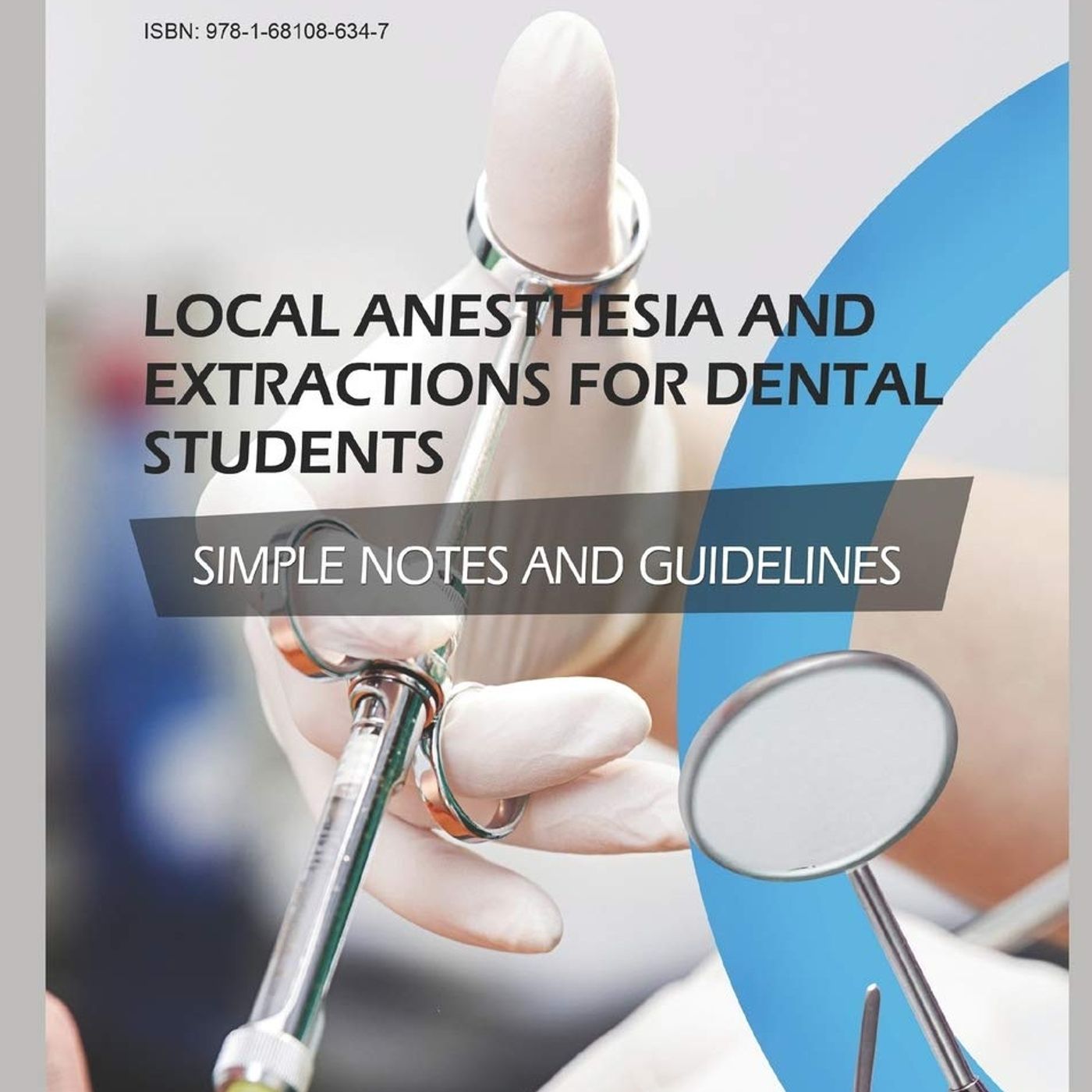
Local Anesthesia and Extractions for Dental Students: Simple Notes and Guidelines
Get every episode summarized
Each time Dentistry Made Simple publishes, we email you a written briefing from the transcript — the topics, who appeared, and any specific claims, with the ad reads skipped.
Email me new episodesFree for 3 shows. No card needed.
About this episode
“So when it comes to fast internet, I know what I'm talking about. That's why I recommend Optimum Fiverr-powered internet. It has fast and reliable internet speeds, starting at only $30 a month with a five-year price lock.”From the transcript
Get the Book now from Amazon:
https://www.amazon.com/Local-Anesthesia-Extractions-Dental-Students/dp/1681086344?&linkCode=ll2&tag=cvthunderx-20&linkId=7f656d84de51aa262f96fe8bdd571bfc&language=en_US&gaOptInStatus=true&ref_=as_li_ss_tl
You can listen and download our episodes for free on more than 10 different platforms:
https://linktr.ee/dentistry_made_simple
Produced by:
https://www.podcaistudio.com/
Get every episode summarized
Each time Dentistry Made Simple publishes, we email you a written briefing from the transcript — the topics, who appeared, and any specific claims, with the ad reads skipped.
Email me new episodesFree for 3 shows. No card needed.
Hosts & guests
Transcript ready
693 searchable segments. Every word is indexed and playable.
Full transcript
Dentistry Made Simple — Local Anesthesia and Extractions for Dental Students: Simple Notes and Guidelines. Machine-transcribed; use the interactive transcript above to jump the player to any line.
Hi, I'm Gus. I'm a dog and an expert in speed. So when it comes to fast internet, I know what I'm talking about. That's why I recommend Optimum Fiverr-powered internet. It has fast and reliable internet speeds, starting at only $30 a month with a five-year price lock. So how can you fetch such an amazing deal by calling 8669 Optimum or visiting optimum.com to switch? That's 8669 Optimum. Speaking of fetch, that's my cue. Terms apply, seeoptimum.com for details. Right now at Subway, try the 499 Sub of the day. Get a different 6-inch sub every day for just 499 each, like Meatball Marinera on Mondays, tuna on Tuesdays, and the BMT on Saturdays. It's a different 6-inch sub every day, packed with protein and your choice of chopped veggies for just 499 each, or make it a meal with chips and a drink for just $2 more. But hurry, it's only for a limited time, and only at Subway. At participating restaurants, price is higher in Washington, Alaska, and Hawaii, and on third party delivery. At uns taxes and fees for delivery additional.
When people outside of the dental profession picture a toothpick extraction, they usually imagine this incredibly barbaric scene. Oh totally, it's all brute force in their minds. Right, someone pulling with all their might, they're trying to start a stubborn lawnmower or something. Yeah, there's definitely this persistent illusion that exodontia is purely a test of physical strength. But the reality of clinical practice is, well, it's entirely different. It's this highly choreographed interaction of physics, anatomy, and pharmacology. And that contrast between the illusion of brute force and the actual reality of delicate medical science is exactly what we are getting into today. It really is a fascinating shift in perspective. Absolutely. So whether you are a dental student currently cramming for boards, a young professional prepping for tomorrow's clinic, or even just a self-learner endlessly fascinated by the hidden mechanics of the human body,
this one is for you. We've got a lot of ground to cover. We really do. We are pulling directly from the clinical guidelines in local anesthesia and extractions for dental students. The authors are Esom Amaz Omar, Fadi Jarab, and Wamyk Masha'i Farid. And the mission for this deep dive is to unpack the exact molecular mechanics of how to successfully block pain, the actual physical physics of navigating an extraction, and the reality of managing complex medically compromised patients. It's a remarkable progression to study, honestly, because you absolutely cannot jump into the physics of an extraction without first mastering the physiology of pain. Right, you have to shut off the alarm system first. Exactly. The nerve has to be entirely silenced. And to do that, we rely on local anesthesia, which is, I mean, it's a lot more complex than just numbing an area. So much more complex. Yeah, there are actually five distinct scientific theories for how local anesthesia achieves this blockade at the cellular level. Let's lay those out, because it really sets the stage for everything that follows.
Okay, so you have the acetylcholine theory, the calcium displacement theory, the membrane expansion theory, and the specific receptor theory. Okay, that's four. Right, and the fifth, which is the most critical one for our understanding, and the one that provides the clearest mechanical picture, is the surface charge theory. So if I'm zooming into the microscopic level right at the nerve membrane, what is the surface charge theory actually describing? Like, what's happening? It describes an electrical takeover, basically. The drug molecules in our local anesthetics are chasionic, which means they have a positive charge. Exactly. They are positively charged ions, chemically represented as R and H plus work. And according to this theory, these positively charged molecules essentially swarm and line up right at the nerves where it's membrane exchange interface. Okay, see. By packing that space with positive charges, they make the action potential of the neuron significantly more positive at the surface. This dramatically decreases the nerves' excitability,
and artificially expands its threshold potential. So if I'm picturing this right, it's almost like a chemical bouncer at a nightclub door. A bouncer, I like that. Yeah. The chasonic LA molecules are physically holding the line, right? Blocking the entrance to the sodium channels. The pain signal, the unwanted guest, is trying to get in to trigger the alarm, but the bouncer's just won't let it pass. That is exactly how it works. The pain impulse simply cannot propagate to the brain. But delivering those chemical bouncer's safely to the nerve requires absolute precision with the armamentarium. The tools of the trade. Right. Let's look at the cartridge itself, because it is not just filled with a single anesthetic agent. It's a highly calibrated chemical cocktail. Right. There's so much going on inside that little glass carburel. Beyond the anesthetic drug and the vasopressor, you've got sodium chloride to act as a buffer and distilled water as the carrying agent. Standard ingredients, yeah. But the one that really stands out is sodium metaphy sulfite. Why is that specific chemical necessary?
So sodium metaphy sulfite acts as an antioxidant, and its sole purpose is to protect the vasopressor. Which is typically adrenaline. Exactly. Adrenaline is incredibly unstable. It's highly prone to oxidation. If it oxidizes, it becomes useless, meaning you lose the localized vasoconstriction that keeps the anesthesia profound and long lasting. Oh, so it just washes away too fast without it. Right. The sodium metaphy sulfite preserves it. But because of this delicate chemical balance, the handling rules for these cartridges are incredibly strict in a clinical setting. You definitely cannot just toss them in an autoclave to sterilize them. Oh, absolutely not. The heat would instantly destroy the compounds. You also have to keep them out of direct sunlight. Because that accelerates the oxidation. Precisely. And crucially, you must never soak these cartridges in alcohol or cold sterile solutions. Because of the semi-permeable diaphragm at the end of the carburetor. Yes. Those sterilizing fluids will slowly seep through the rubber diaphragm through osmosis and actually contaminate the anesthetic solution.
Which sounds dangerous. Extremely. If you inject a tissue with local anesthetic contaminated by rubbing alcohol, the resulting tissue necrosis and chemical burn to the patient is severe. Yikes. Okay. And moving from the cartridge to the delivery system, the syringe and the needle, the guidelines hammer home the absolute necessity of aspiration before depositing any fluid. Yes. That is a golden rule. The needle tip comprises the bevel, the shank, and the hub. Before you inject, you must pull back slightly on the thumb ring to apply negative pressure. To see if you're in a blood vessel. Exactly. If you're sitting inside a vessel, that negative pro-year will pull a visible plume of blood right into the glass cartridge. That is a positive aspiration. And if you see that, you stop immediately. You have to. Injecting a full cartridge of local anesthetic with epinephrine directly into the systemic bloodstream can cause immediate, severe cardiovascular toxicity. So you reposition, re-aspirate, and verify you're in the surrounding tissue planes,
not the vascular highway. Exactly. Which perfectly leads to one of the golden rules of the injection technique itself. I thought this was such an elegant clinical pearl. The text says you should deposit a few drops of anesthetic before the needle even touches the bone. It is an essential step for patient comfort. The curiosity, which is that dense, fibrous sheath in the bone, is incredibly rich in nerve endings. Super sensitive. Hyper sensitive. If you drive your needle tip straight through the mucosa and slam it into the periosteum, the patient is going to feel a very sharp, completely preventable jolt of pain. But by depositing those few drops just ahead of your needle's advancement, you're essentially like paving the road with anesthesia before you drive on it. That's a great way to put it. You numb the path. It guarantees an atraumatic contact when you finally reach the bony landmarks necessary for, say, an inferior L-vular or in-forbidal nerve block. And once you're perfectly positioned, you have a negative aspiration. You are resting gently on the bone.
Well, then comes the 1,000,000 liter per 60-second rule. Ah, yes. The test of patients. Seriously. Meaning a standard 1.8-milliliter cartridge should take nearly two solid minutes to administer. Two minutes feels like an absolute eternity when you're holding a sharp instrument inside a nervous patient's mouth. It does require immense patience. But injecting slowly isn't just about systemic safety and preventing a rapid spike in blood serum levels. It is fundamentally a tissue issue. Because of the hydrostatic pressure. Exactly. If you slam the plunger down rapidly, the sheer volume and fluid pressure physically tear the delicate, facial planes and tissues. Oh, yeah. That rapid expansion forces the tissue apart violently. It causes immediate stinging for the patient in the chair. But worse, it leads to prolonged, severe post-operative soreness that lasts for days after the anesthetic wears off. Just from injecting too fast. Right. A slow, methodical deposition allows the fluid to diffuse naturally and gently along those tissue planes.
Okay. So let's talk about the scenario every clinician dreads. You do everything right. You follow the 60-second rule. You get a negative aspiration. Your anatomical landmarks are textbook perfect. The perfect injection. Right. But the moment you go to test the tooth, the patient flinches. They still feel pain. If the technique was flawless, what is happening biologically? Well, human anatomy is highly variable. And you have to be prepared for accessory nerve supplies. Like weird anatomical quirks. Exactly. For example, say you're working on the maxillary molar teeth. You give a perfect posterior superior alveolar block. But the tooth is still hot. Those specific teeth may actually be receiving a secondary popol nerve supply from the greater palatine nerve. Which usually only innervates the palatal tissue, right? Normally, yes. But sometimes it branches out. So the main highway is blocked, but the pain signal is taking a hidden back road. Precisely. You have to anticipate those back roads and administer supplemental anesthesia to that specific accessory nerve
to achieve total profound numbness. So the bouncers are finally holding every single line. The nerve is silenced. The patient is comfortable. But profound numbness doesn't mean we just start blindly pulling. No, absolutely not. The success of the actual extraction relies heavily on physical ergonomics. Organomics dictate your biomechanical advantage. If your chair positioning is wrong, the extraction becomes infinitely harder and you risk long-term musculoskeletal injury to yourself. Let's look at the upper jaw, the maxillary teeth. Okay. For maxillary teeth, the dental chair should recline to approximately 120 degree angle. So the clinician isn't hunched over? Right. And the patient's maxillin needs to be situated exactly at the height of the dentist's shoulder. Okay. When the patient opens their mouth, the occlusal surface, the biting surface of those upper teeth, should angle at about 45 degrees to the floor. This allows for direct vision and proper leverage. But for the mandibular teeth, the lower jaw, that entirely changes. It drops significantly. The chair should be adjusted to 110 degree angle.
And crucially, when the mouth is open, the occlusal surface of the mandibular teeth must be perfectly parallel to the floor. Why parallel? This posture allows you to keep your arms tucked closer to your body. You utilize your deep core and shoulder strength rather than blowing out your wrists supplying downward force. Which brings us to the instruments actually translating that physical force. We have retractors like the Minnesota and the Whiter to protect the tongue and the fragile Buckel-Mikosa. Essential for soctusia protection. Right. But the real heavy lifting starts with elevators. Elevators are the unsung heroes of exodontia. They are critical for luxation. Which is the process of loosening the tooth. Exactly. Loosing the tooth and severing the periodontal ligament before a pair of four seps is ever even picked up. And the specific anatomy of the elevator dictates its function. Right. You have the straight bean elevator acting almost like a simple wedge. Yes, driving it peepically into the periodontal space to expand the socket. Then you have the white elevator
with its slightly curved blade. Which is for the posterior roots. Right. It adapts beautifully to their convexity. You also have the angled seldom elevators which utilize the wheel and axle principle to lift mandibular roots. And the fine warwick James elevators for more delicate root tip luxation. Okay. And once the tooth is highly mobile, we finally introduce the four seps. The guidelines lay down a universal, unbreakable rule here. Yes, the four seps must be applied as apically as possible. Meaning as far down the root as you can go. You have to drive the beaks way down past the cemento-nemo junction. The CEJ and the long axis of the blades must perfectly align with the long axis of the tooth. But wait, that doesn't make intuitive sense to a beginner. If my ultimate goal is to pull the tooth out of the head, why on earth is my very first move to apply strong apical pressure? Like, I'm literally pushing the tooth deeper into the socket. It seems completely backward I know, but it is the defining secret to a successful extraction. When you apply firm apical pressure,
you are accomplishing two essential biomechanical tasks. First, the beaks act as a wedge to aggressively expand the crestlebone. Which is the tightest, densest collar of bone holding that tooth in place? Exactly. In the second tip. You're displacing the center of rotation. Think of the root like a seesaw. Okay, a seesaw. If you just grab the clinical crown and start wiggling side to side, the fulcrum, the center of rotation is way up near the gum line. That means the apical tip of the root is swinging wildly back and forth inside the bone. Oh, and because the root acts like a massive lever, that thin, delicate root tip will almost certainly snap off. Ah, so by pushing apically, you slide that fulcrum further down the root. Exactly. You shrink the lever arm. The apical tip moves significantly less, drastically reducing the risk of a root fracture. That is brilliant. It's just applied physics. Pure physics. And speaking of physics, the anatomical shape of the root strictly dictates the movement you're allowed to use. Let's compare an upper central incisor to an upper first molar.
Well, an upper central incisor is highly forgiving. It has a single, straight, conical root. It is perfectly round. So it's easier to manipulate. Right. Once you apply that apical force, you can use labial palatal luxation gentle pressure toward the lip than toward the palate. And because it is a single cone, you can safely introduce a rotational movement to twist it free from the socket. But if you try that twisting rotational force on an upper first molar, you will fracture the roots instantaneously. Wow, instantaneously. Yes. An upper first molar has three distinct divergent roots locking it into the alveolar bone like a tripod. If you twist that, the divergent roots brace against the bone and snap. So what do you do instead? For those teeth, you apply apical force. And then you must use strict, buccalical movement, pushing toward the cheek, then toward the palate. The anatomy absolutely forbids rotation. A mechanically perfect extraction is a beautiful thing to conceptualize. But you know, all that pristine physics just goes right out the window
if you ignore the biological engine driving the patient. The whole human being attached to the tooth. Right. The guidelines are very clear. You are not just treating a tooth. You are treating a complex systemic patient. That is where technical skill gives way to clinical judgment. Even assessing the tooth's preoperative history is a systemic assessment. Take endodontically treated teeth teeth that have had a root canal. They're automatically categorized as complex exodontia, right? Yes, because they are notoriously brittle. There are two main theories for why a root canal turns a tooth to glass, I believe. Correct. The first is biological. By removing the living pulp all tissue, you permanently halt the circulation of dental fluid through the microscopic tubules. And that fluid acts as like a shock absorber. Exactly. It's theorized to give the tooth its natural resiliency. Without it, the dentin effectively dries out and shatters under the compressive load of the forceps. And the second theory is purely structural. Right.
To perform a root canal, you have to use a burr to create a massive access cavity. You are removing so much of the tooth's internal architectural mass that you essentially hollow it out. So much as caves in. When you squeeze the crown with metal forceps, the hollow shell simply collapses. Which means you basically approach it expecting it to fracture. But zooming out from the tooth to the vascular system, managing medically compromised individuals is a massive focus here. Let's look at the stress reduction protocol. Stress triggers an immense physiological cascade. For highly anxious patients, or those with a history of angina or myocardial infarction, the protocol dictates scheduling them for early warning appointments. Because they're most rested. Right. You want them well rested. You keep the appointment short. You minimize their time sitting in the waiting room anticipating the procedure. And you actively reassure them. The goal is to keep their endogenous adrenaline levels, their fight or flight response, as low as possible. And for patients with a history of heart issues, having prophylactic sublingual nitroglycerin on the tray
and actively monitoring their blood oxygen saturation throughout the surgery is just non-negotiable. Absolutely. What about bleeding disorders? Like patients with hemophilia or those on heavy daily anticoagulants? That requires rigorous interdisciplinary coordination. You cannot touch them without a hematologist's consult to check and adjust their INR. Which is their international normalized ratio tracking blood clotting time? Exactly. And from a scheduling perspective, you always perform these surgeries early in the week and early in the morning. Never on a Friday afternoon. Never. Because if a patient on heavy anticoagulants goes home on a Friday afternoon and their initial clot breaks down on Saturday morning, the fiber matrix fails to stabilize. And they'll just keep bleeding. They will slowly bleed continuously over the weekend. If they face a bleeding emergency on a Sunday, outpatient clinics are closed and hospital staffing is at its lowest. That's a nightmare scenario. It is. You do it on a Monday morning. So you have the entire work week to monitor their hemostasis and apply local interventions,
like packing the socket with a vibrant sealant. Let's tackle a very common misconception that trips up a lot of young clinicians. Say a patient presents with severe hypertension, extremely high blood pressure. Wouldn't the safest route be to use a local anesthetic without a vasoconstrictor? It sounds incredibly logical, doesn't it? Yeah. Since up an effort naturally raises heart rate, shouldn't we protect their cardiovascular system by just leaving it out of the injection entirely? It is a highly dangerous misconception, actually. If you use a plain anesthetic without a vasoconstrictor like up an effort, the numbing effect will not be profound and it will wash out of the tissue very quickly. Because the local blood vessels remain dilated and just carry the anesthetic away. Exactly. So right in the middle of the extraction, the patient will experience sudden, severe acute pain. Oh no! In response to that intense pain and terror, the patient's sympathetic nervous system kicks into overdrive. Their adrenal glands will dump massive,
uncontrolled volumes of endogenous adrenaline directly into their bloodstream. Which spikes their blood pressure infinitely higher than the tiny amount of epinephrine in the syringe ever could? Exactly. The physiological cascade of severe pain is wildly unpredictable and incredibly dangerous for a hypertensive heart. Wow, that makes so much sense. The tiny, localized, controlled dose of epinephrine in an anesthetic cartridge, usually one part per 100,000, keeps the patient completely out of pain, which keeps their endogenous adrenaline totally flat. Profound pain control is unequivocally the best way to protect a compromised heart. So even if you have an incredibly healthy patient with perfect blood pressure and no bleeding disorders, you can still run headfirst into an anatomical nightmare. Oh, definitely. The ultimate frontier of exodonja impacted wisdom to you. Evaluating third molars requires you to look past the visible tissue and measure the bone density. The guidelines introduce this brilliant metric called house red line.
House red line, okay? It's an imaginary line drawn on the radiograph, starting from the exact point where you intend to apply your elevator's full perm, straight down the root axis. It measures the depth of the tooth in case entirely in solid bone. And there is a very strict threshold with how is red line right now. There is. If the depth in the bone measures five millimeters or more, the guideline strongly advise against a simple clinical extraction. What do they recommend instead? They recommend endotracheal anesthesia or deep sedation. Because here is the critical clinical reality. For every single millimeter of bone beyond that five millimeter mark, the extraction becomes three times more difficult. Three times, so it's not linear, it's exponential. Exactly. It's almost like the event horizon of a black hole. Once you cross that five millimeter threshold, the gravitational pull of the bone and the surgical difficulty multiplies so rapidly that standard physics just can't save you. You need surgical sectioning, heavy bone removal, and a deeply sedated patient to safely escape it. That is very accurate way to visualize it.
Right. Because the surgical hazards lurking around impacted maxillary third molars are devastating. If you apply too much distal force, you risk fracturing the entire maxillary tuberosity. The foundational ridge of bone holding the back of the dental arch together. Right. Or because the roots of those upper wisdom teeth often sit right up against the delicate floor of the maxillary sinus, improper force can easily push a fractured root tip directly up into the sinus cavity. Which creates a permanent oral antrophysicular. A terrible complication to deal with. And speaking of horrifying complications, we have to talk about surgical and physema. This is a direct result of using the wrong equipment in the surgical site, correct? Yes. It is a severe complication born from using air-driven, high-speed hand pieces to cut bone or sectionitude. High-speed hand pieces exhaust high-pressure air. Okay. If you are working deep in a surgical site, that pressurized air can be forced down beneath the soft tissue flap and dissect its way through the facial planes of the neck and midface. It is literally pumping air into spaces
that should be completely sealed. Yes. The resulting facial swelling is typically immediate. But it isn't painful, surprisingly. However, it is characterized by crepidus. Crepidus. Right. When you palpate the patient's swollen cheek or neck, it feels and sounds exactly like crushing bubble wrap under the skin. Bubble wrap under the skin. That is a visceral, unforgettable image. It's definitely something you don't want to feel. And even in standard extractions, there are local complications that demand immediate management, like a hematoma. A hematoma occurs when you sever a blood vessel and blood begins to pool uncontrollably into the surrounding tissue spaces. And what's the protocol? The immediate clinical response is to apply direct, firm, sustained pressure to manually occlude the vessel until hemostasis is achieved. And you also see cases of paresthesia, which is that prolonged tingling or complete numbness that lingers for weeks or months after the anesthetic should be long gone. Paresthesia is typically the result of direct physical trauma.
The needle tip may have physically pierced the nerve bundle during the injection, or an intranural hematoma may have formed, bleeding inside the nerve sheath and compressing the delicate nerve fibers from the inside out. And we can't forget trismis, which is profound jaw stiffness, and L-vular osteitis, commonly known as dry socket. Both are very common SQL A when an extraction is prolonged, highly traumatic, and leaves the surrounding bone battered. Which is why mastering the physics we discussed earlier is so critical. You want to minimize tissue trauma at all costs. But, you know, all of this technical mastery leads to a truly fascinating philosophical shift presented near the end of these guidelines. It really does force you to reframe the entire goal of exodontia. Yeah, because we usually think of extracting a tooth because that specific tooth is decayed, diseased, or completely beyond repair. But the authors point out that sometimes an impacted wisdom tooth, even if it is perfectly disease-free, is extracted prophylactically. Right. It is removed to treat or prevent
periodontal bone loss on the distal surface of the adjacent highly critical second molar. That completely flips the script. You aren't just removing a bad tooth. You are strategically performing a surgical amputation of a perfectly healthy structure, entirely to preserve the biological integrity and the bone height of the remaining dental arch. It elevates dentistry from just fixing holes to a practice of holistic architectural preservation. It is a beautiful sentiment. It perfectly encapsulates the dual nature of exodontia. It's simultaneously a demanding mechanical art and a deeply biological science. Absolutely. Before you head into clinics from our morning, or, you know, back to your textbooks, test yourself on today's deep dive. Here is your clinical exercise for the day. You have a patient requiring an extraction of an uppercainine and a lower first molar. Mentally picture your exact chair angles for both procedures. Remember the ergonomics. Right. Now, based on the specific root anatomy, we discussed, which tooth allows for rotational forceps movement
and which one strictly requires Buculincle Force to avoid snapping the roots? Think about the physics, the leverage, and the anatomy. Keep mastering those invisible mechanics and we will see you on the next deep dive.
More episodes
More from Dentistry Made Simple

Periodontal Disease and Overall Health: A Clinician's Guide
Dentistry Made Simple

Perio-Quest: MCQS and Self-assessment Pictorial Tests in Periodontics
Dentistry Made Simple

Oral Cancer: Diagnosis, Management, and Rehabilitation
Dentistry Made Simple

Oral Complications of Cancer and its Management
Dentistry Made Simple