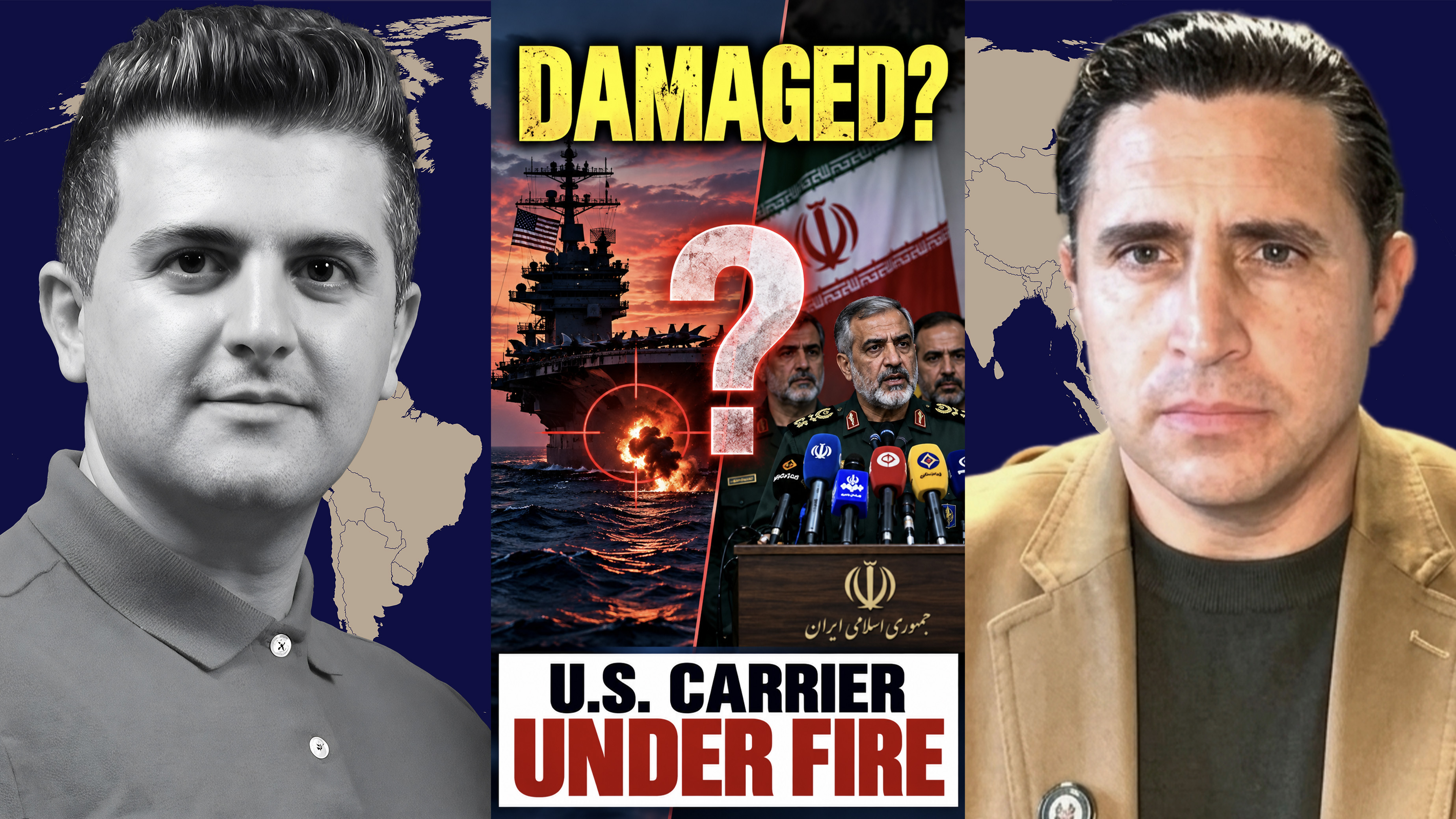
Lt. Col. Anthony Aguilar: Iran Says It DAMAGED a U.S. Aircraft Carrier
About this episode
In this critical analysis, we break down the intensifying military confrontation between the US and Iran near the Strait of Hormuz. Discover how asymmetric warfare, drone tactics, and supply line disruptions are shifting the balance of power, making prolonged US naval blockades logistically unsustainable.
We also explore the alarming rise in civilian casualties, Israel’s vulnerability to a coordinated multi-front war involving Hezbollah, the Houthis, and Iran, and Tel Aviv’s controversial attempts to leverage Kurdish populations across the region. Find out why current US military strategies are failing and what this unrestricted warfare means for global stability.
Hosted on Acast. See acast.com/privacy for more information.
Get every episode summarized
Each time Dialogue Works publishes, we email you a written briefing from the transcript — the topics, who appeared, and any specific claims, with the ad reads skipped.
Email me new episodesFree for 3 shows. No card needed.
Hosts & guests
Transcript ready
848 searchable segments. Every word is indexed and playable.
Full transcript
Dialogue Works — Lt. Col. Anthony Aguilar: Iran Says It DAMAGED a U.S. Aircraft Carrier. Machine-transcribed; use the interactive transcript above to jump the player to any line.
Mod.com is changing the way people battle excessive fatigue. Ever hit a wall in the middle of the day and the third coffee just doesn't do it anymore? Here's what's actually happening. Coffee only briefly blocks a denocene, the chemical that tires you out. When it stops working, your system is flooded and you crash. Medaphineal is a prescription treatment that works in a completely different way. Medaphineal works by stimulating multiple receptors in the brain associated with wakefulness, including dopamine, serotonin, noripinephrine, histamine, glutamate, and erexin. It's a more complete solution that gives you 10 to 12 hours of steady focus and energy. To learn more, go to mod.com. Fill out your intake form, meet with a license provider, and if approved, mod alert ships straight to your door. Go to mod.com to get started. That's m-o-d dot com. Losing wake can feel like a roller coaster, full of ups, downs, and being thrown for loops,
like when someone brings donuts into the office, or your kids' dino nuggets start giving you that look again. That's why there's noom. They combine GLP ones to quiet the food noise, with healthy habits that help you keep it quiet, even if you get off the meds. Their program is designed to make weight loss a smooth ride, helping you understand what drives you. So you can build better habits to not just lose weight, but keep it off. Noom. Lose for keeps. Get started at noom.com. Not all customers will clinically qualify for medications. Individual results may vary. Hi, I'm Jack Ravic, your Kramer host of the best one yet. At T-boy, we're always talking about small decisions that can have an outsized impact. One of the simplest is staying hydrated. Whether I'm traveling, getting a workout in, or heading into a busy day, I keep LiquidIV on hand. It's clinically demonstrated to hydrate faster than water alone, and contains three times the electrolytes of the leading sports drink, plus eight vitamins and nutrients. It's an easy addition to your daily routine and helps support hydration when you need it most.
Shop now at liquidiv.com. LiquidIV hydration that goes wherever life takes you. I am ready today Sunday September 6, 2026, and our dear friend, let them curl Anthony, I agree with us. Welcome back Tony. Thank you, Neema. Appreciate it. Let me start Tony with what has happened last yesterday, and we've learned from the Iranian side after the attacks, American attack on three tankers in the industrial for most indepersion Gulf, we're close to the Persian Gulf. Then you had the Iranian response on the quality US-ling tankers, three US-ling tankers in the Persian Gulf. And then later on, they said that it answered that it targeted the US aircraft carrier and destroyer with several ballistic missiles after the warship harassed your enemy.
And the warship harassed Iranian vessels and participated in the naval blockade. It says both warships were struck and forced to withdraw from the area. Where do you see Tony, the situation that is getting worse and it seems that the escalation is coming in the coming days and the coming hours. We had refueling tankers in the region. We don't know what would be the admission. Maybe the United States is using for those fighter jets in the southern part of the, you know, the straight. But what is your assessment of what's going on right now? Well, as we approach the 27th week of this war, we're at day 190. Just over the last 48 hours, we can see the escalation has ventured into new territory in terms of the, the responses from Iran, the actions that the United States is taking.
What I see happening with, especially with the movement of tankers, US warships maneuvering closer towards the straight up from us in the area of the Gulf of Oman, closer to the straight up from us is, is that the United States is attempting to prepare for or conducting the initial phases of naval operations to try to push into the straight up from us. And that's exactly what Iran would want in terms of a military confrontation because it on controls the straights. As we saw that I think the, some of the indications or reports from what we have initially is that some of these strikes from Iran were against potentially the USS Washington, which is the aircraft carrier that just got into the area of the South. And into the area of operations it replaced the Lincoln.
And in addition to that, the warships that came with it, the lateral combat ships, the guided missile cruisers, and the strikes that the US is taking and the response that Iran is then taking to those strikes. Direct confrontation is at a point to where we're going to see something in the next 24 to 48 hours that is that escalates this even further. I don't see this cooling down in the next few days. I see this heating up. And if you look at the rhetoric domestically, Donald Trump is more and more talking about a strike on pickaxe mountain just yesterday. He said again, that there will be a strike on pickaxe mountain in the coming days. Well, depending on whatever the war plans are to execute such operation, is that going to be through strikes? Is that going to be through air strikes is going to be through ballistic missile strikes? Is it going to be through a combination of strikes and then some type of special operation?
Delta Rangers to go in and and seize a certain amount to show that there's something to show for this. Again, but I also think that that's just bluster because the nuclear material question is no longer a salient point in this conflict considering that Russia and Iran have now entered a 25 billion dollar nuclear plant deal to generate nuclear capability with Iran. So it's clearly Donald Trump is grasped with straws and I think that Donald Trump is clearly seeking a way out of this. However, he's not going to get that in order to seek in order to seek any token accomplishment for Donald Trump to then walk away.
There will have to be military action to present some auspice of success. And that's going to be costly. We're going to continue to see this escalation near the street of Hamos, but also strikes against US bases can will continue. Kuwait Jordan and I think that Iran is also poised to attack to launch attacks against Israel. In any opinion, when it comes to the attacks on aircraft carriers and destroyers, what are the threat? Is that going to be somehow it was some sort of warning did it on want to really attacking hitting the targets? What is the, you know, the mindset in your opinion on the part of Iranians? Well, I think it was a both could be true in terms of a warning and an attempt at an actual strike.
The, the Iranians obviously possess ballistic missile capability still regardless that the US Secretary of War and Donald Trump have both said that their ballistic missile capability has been depleted nearly destroyed. They can't, they can't do anything anymore. That's obviously not true. So the, what, what I think we're seeing all the way back to the, you know, last, last Saturday Sunday when we spoke. We've, we've spoken in between there, but when we did speak last Sunday when we were talking particularly about Iraq Island and the strikes at the United States took on the rock island against these mine launchers. My, my analysis of that was that it was a, it was a way for Iran to bait a US response to bait a US strike to then determine where is the United States now having to strike from if it's by aircraft, where they flying from now.
If it's by ship, which ships are in position to make that, to make that strike because you, you have to contend with distance when you're considering strikes and the United States no longer has the, the ballistic missile capability, at least not very, very many to conduct precision strikes from beyond the 2000 kilometer range. So within that 2000 kilometer bubble, where would the US strike by air, by sea, by land, and where would that be? And that is, that is an Iranian approach to honing in what the United States can and will do with the strikes that we saw on the rock island. The, the Iranians now have an idea of, okay, they, these are the aircraft they're sending out of Jordan, we're going to hit that hard and they did. Here's the potentiality for maybe ground launching Kuwait, we're going to hit that hard and they did the na, the, the naval ships and remember the, the US Navy, since the implementation of this distant blockade and this naval operation by the US fifth fleet.
Has not been operating in the street of Pramoush or in the Persian Gulf, they've been in the central to northern part of the Gulf of Vomon. So, Iran has to understand that distance, will the US come closer, if the US is not going to come closer with their ships, what in the, in the, in the, I, the, the thoughts of the, the Iranian joint staff, the Iranian planners. How can you draw US ships nearer to then strike and strike hard or if they're not going to come closer, what missiles do you then have to hone in to strike from a distance. So, I think that's what Iran is, is continuing to do and what we saw over the last 24 hours, that is US ships are still there in that area, but moving potentially closer, what's that range that Iran is going to have to strike and what assets will they have to put against it. To score a strike a successful, undeniably successful strike on a US ship.
We, we heard the reports from Iran that US ships were struck. Of course, US central command is outright denying that. The truth is always somewhere in the middle. So, I think that we're, we're going to see continued confrontation and continued strikes by Iran in a more aggressive manner. And in fact, Iran's response to this latest round of, of strikes back and forth was, I think it was a, a, um, gollyboth that said that the, the strikes will become faster and more devastating. And I think Iran will hold true to that. We're going to see escalation continue. I think what he, Tony, what he mentioned today said that, the tax can is not going to be any more proportional to what's going on, and it means that, Iran going to, Iran response going to be different. And we've seen that. We've seen that the latest attack Iran,
at least three times Iran attack Jordan and GCC countries. And there was no response from the United States. And with the new attacks on the tankers, you see not only attacking the tankers, they attacked the aircraft carrier together with destroyers. And this is what Iran is talking about. Where does that go in your opinion? Well, as you had mentioned, yes, I believe Gali Bob's words will become more painful, more painful for the United States in terms of the response. So what this looks like is, and we've now clearly entered this aspect of unrestricted warfare to where the United States is striking not only military targets, but non-military targets. We're seeing both sides doing this, especially when it comes to the Strait of Firmus,
Iran doing it to enforce its control of the strait, the United States doing it to try to contend that control of the strait or to place more pressure economically on Iran in terms of Iranian oil tankers. What I clearly see from this is that this is now gotten to a point of escalation to where it's no longer what we saw in the previous 26 weeks of this tit for tat. But now, Iran is going to strike and strike hard offensively. So now the response calculus has been changed that equation, if you think about in chemistry, you have to balance that equation. Well, the balance of that equation has now gone to where the momentum of which is in Iran's court because now it's not the United States striking and embracing for Iranian response. An Iranian attack could come at any time.
So now the United States is on the back foot. I think leading up to this, the United States was already wobbling in terms of how do we respond? Can we respond reduction of prison strike munitions? But now the United States in terms of military is on the back foot politically, diplomatically. The United States is up on the ropes, so to speak. When you look at the relations that Iran is now building, I mean, there was recently with Xi Jinping's visit to Egypt, I can only imagine that this war was the topic du jour during that meeting. Yeah. Tony, the other thing that it was mentioned by Iranians, it was this, let me bring that further here. They say that they intercepted IRGC set, that they intercepted the on-man surface vessel,
USV as they call it. And it seems that the United States is somehow trying to use a combination of this new weapons, if we can call them weapons, but USV together with the fighter jets, refueling tankers are there. They have helicopters. And it seems that all of these basically coming from the aircraft carrier. And where do you see the new weapons that the United States is using? And the other point, Tony, together with us, what we have, there was an interview with General Petraeus, he said that the United States needs to change its strategy using the Ukrainian strategy. Here is what he said. Dr. Drone Warfare, cheaper ballistic missile defense.
We've used perhaps half of our missile interceptors in this particular conflict. Of course, we've provided a number of them to Ukraine prior to this as well. Those are $2 to $3 million a copy. And it takes years to make those not months. We've used a very substantial proportion of our most exquisite submarine and ship launched and air launched cruise missiles. So again, we need to learn from the Ukrainians who are using 10,000 cheap, a tritable drones per day. And the exchange that they're getting for those is absolutely massive. Our exchange when we shoot an expensive missile interceptor to take down a $50,000 Iranian drone is obviously not one that is sustainable. And again, we... Yeah. Yeah, it's very clear in terms of the calculus of this conflict and logic that to continue to use million dollar interceptors
and precision strike missiles against the pace, the momentum and the tempo of hundreds, if not thousands of drones, in addition to Iran's ballistic missile capability, is simply not sustainable. It is not a sustainable calculation. So as we look at that, yes, the United States must adapt if there's any hopes of countering or measuring the response or what the United States can do in terms of military action. The... Even the image that you showed there, that was the... Trying to think, remember the name of it, I think it was the... You asked me if they called it USV. Yes, it was the unmanned vessel, but it's got a... That one was a very specific one. The... It's basically, essentially, it's an unmanned
speedboat prototype that the United States began using during this conflict. Its first combat use was in July, and we're now seeing sent comm use them more, meaning that they've been in development for a while, and now sent comm has their hands on a number of them and is now using them. So these... This Corsair unmanned speedboat can be used for different applications. It can be used as a... It seems that they called them rampage, if I'm not mistaken. Rampage? Yeah. Yeah, so the... Essentially, these unmanned speedboats can be used in different variants and configurations. You can mount it with a... They can be used simply as reconnaissance and patrolling. You could have a light machine gun on it. You can use it as a one-way attack maritime drone. You can use it in different capacities.
Allegedly, allegedly, the United States said that when we had a helicopter that was shot down over the straight-of-from-use, and the pilot was rescued in the Persian Gulf by one of these unmanned speedboats. So we've been using them, but when you go back to that, okay, we now have a new capability about it, but they're very, very, very expensive. They're incredibly expensive when you consider in comparison to what Iran has been using in the area. And so when you look at each of these... For lack of better terms, each of these new toys that the United States is bringing brought to you by the United States military-industrial complex, that they come with extraordinary cost,
and that is not sustainable. That is one aspect, one strategy that I'm sure Iran is considering and has considered is how do we just continue to drag this on and milk the U.S. dry of its spending ability to continue to fund this conflict. For example, it comes at a dollar sign cost, but then it comes in a time of a cost of time. The latest that we've heard from some of the big producers in the military-industrial complex, Lockheed Martin, Raytheon, et cetera, is that they'll make modifications to generate more, but we're not going to see that production until 28, 28, August of 2028. That's a long time away. So when you consider that in terms of cost, time,
resources, the advantage of this is on Iran side when it comes to that asymmetric advantage. Tony, the war is somehow continuing in the region. It's not only between Iran and the United States, you see the war in the southern part of Lebanon as well, but the picture that Israelis are painting for us is drawing for us is that they're basically thinking that today, again, Benjamin Netna, who said if Iran attacks us, we're going to respond. It's going to be our response, it's going to be devastating to Iranians. And where do you see the situation in Lebanon? Because Israel was trying so hard to get that Ali Atahir rage in the southern Lebanon. In the north of the Latani river,
it's not in the south, in the northern part of the Latani river. And today in Nabatia, they use a bunker buster in Nabatia. And this situation is growing more fragile and is getting more critical. And do you think that, do you see the possibility of Iran attacking Israel or has more like getting back to war? Yes, so that the Al-Tahir facility is north of, so as you said, here's the Latani river. That lower black dot, that is where Buford Castle, where Israeli IDF forces attacked months ago. And the Al-Tahir Ridge or the Hilltop facility is just north of that. So you see they're operating north of the Latani river. This is not down near the border. And Israel, the IDF still have positions all throughout here.
Dotted positions where they've moved into locations north of the area along the border. But then this is north of Latani. So I think that we're going to see both an increase in an increase in Hezbollah activity, an increase in Hezbollah military operations against the IDF directly. But I very much so think that Iran has strikes against Israel already planned. It's a matter of the timing and the maximum effect of those strikes. The maximum effect not only in causing destruction and cost, but also the maximum effect politically to show that to weaken Netanyahu's position in Israel. But then to also demonstrate that Iran maintains
the ability to strike at will, that Iran doesn't have to wait for a strike to respond. And that, you know, so I think that Iran has plans to strike Israel in the coming days. And I think that Israel knows that. And I think we're going to see an Israeli attack or an attempt of an Israeli attack against Iran in the coming days as well, which is going to further exacerbate the entire situation because we have war raging in southern Lebanon. The conflict in Yemen is growing more intense by the day. We're seeing the strikes, the military action against Iran and the United States also exponentially getting hotter by the day, you know, each of these little salience of conflict that we saw from the beginning of this war have all gotten to a boiling point. Tony, there is a, since you've mentioned the case of Yemen,
there is a footage came out of Yemen and they were mentioning, they're showing how they're targeting the prosody forces in Yemen. And here is the footage. You look at these vehicles here. AI is transforming sales, support, and every customer interaction in between. But too often, you're sold a different AI agent for every job. That changes with Finn. Finn is a single customer agent that works across the entire customer journey. From qualifying sales leads to resolving support issues, Finn works across teams, carrying context from one conversation to the next. Meet the agent making perfect customer experiences possible at Finn.ai. Mod.com is changing the way people battle excessive fatigue. Ever hit a wall in the middle of the day and the third coffee just doesn't do it anymore?
Here's what's actually happening. Coffee only briefly blocks a denocene, the chemical that tires you out. When it stops working, your system is flooded and you crash. Medaphineel is a prescription treatment that works in a completely different way. Medaphineel works by stimulating multiple receptors in the brain associated with wakefulness, including dopamine, serotonin, noripinephrine, histamine, glutamate, and erexin. It's a more complete solution that gives you 10 to 12 hours of steady focus and energy. To learn more, go to mod.com. Fill out your intake form, meet with a licensed provider. And if approved, modeler ships straight to your door. Go to mod.com to get started. That's m-o-d dot com. They have a drone in that area just filming and here the missile goes to that location.
And here you see, yeah, it's getting to the target. To be honest, I haven't seen the United States or Iran to be that accurate to publish the videos this way. Yeah, when you think of that strike, that was not a large building or a compound. That was three vehicles sitting at an intersection, struck with extreme precision. And when you look at that in terms of understanding what the Houthis are capable of, the Houthis are very capable in terms of their munitions, in terms of their tactics, in terms of their operational capability to observe the target with the drone. I mean, that's similar to what the United States would do. But you saw the clarity and the timing and the precision
and then the speed, if you will, of getting that footage out then to show, look how precise we are. I tell you, a strike like that, I guarantee you that every Saudi backed or you know, Yemeni government, military individual, soldier has that now burned into their mind that they're not safe, no matter where they are, with precision strikes like that. That was a, you know, that was dropped right on target, right on the pin, right on the head of the pin, very precise. Tony, there is a gap between what Iran is doing and the United States is doing in terms of the targets. Look at the casualties on the two sides, you see the significance of what I'm talking about. The precision of these missiles and you see Iranian attacks on GCC countries together
with Jordan together with Israel, you have all of them together. You don't see that much of casualties when it comes to civilians. But the American attacks, since the war started, you see the number of casualties, civilian casualties is growing. And what is your understanding of the way? Is that the problem within, I don't know, they're using AI, the range of missiles, they have some sort of problem to getting closer to the Iranian borders. What is that? What is that the precision, the problem they have with the precision, is that the communication they have with the radars, what is that? It's not precision, nor is it a problem with the intel of the targetry. It is intentional. On the United States in this conflict has departed from international law, Geneva Convention, morality,
from the very beginning, the strike on the Manab school that we saw on February 28th in the March 1st. That was intentional. The strike, the grid, the target, the knowledge of what it was. Now there's argument as to whether or not there was intelligence that led the United States to believe that striking an elementary school on a school day, fully, with a full complement of students of young Iranian school girls, whether or not the intelligence led the United States to believe that the collateral damage assessment gave the commander authority to do it based on, this military target is so valuable that we are going to strike knowing what it is. But there was no accident, there was no unknown,
there was no, we didn't know it was a school, we thought it was this, none of that is true. That strike was intentional. The strike that we saw days ago where the United States struck a wedding. That was intentional. Just as you saw that strike that you just showed, where you saw the drone watching those vehicles, and then the strike, that's the same clarity that the United States has. And in some cases, even better, with observing a target before it struck. So the clarity of that video that we just saw, the clarity of that video, you could see the, you could almost see the exhaust coming out of the back of those vehicles. You could see all the detail in that. The United States in observing a target like that, how could you then say we didn't know it was a wedding? How could you say we didn't know it was an elementary school? How could you say you didn't know it was X, Y, or Z? Of course, it's known. And it's deliberate that the United States is taking strikes
on targets such as that. And it's an attempt to break the morale of Iran to make the cost so devastating to foment internal resistance against the war to, because the United States is desperate. But the United States has been striking civilian targets, civilian locations, bridges, power plants, schools, hospitals. I think since the beginning of the first hostilities of 28 February, I think the United States has struck over 25, close to 25, maybe even more hospitals, schools, bridges, civilian infrastructure that is not legitimate military targets. And that's because of the US leadership. That's because of Pete Hegg's set. That's because of Donald Trump basically giving, or not giving, but ordering the military
to do that. So when you look at how this is happening, it's clear that the United States has departed from morality in the strikes against Iran and that thinking that anything goes. That's a tactic that Israel uses in Gaza and Lebanon. So when we see these, the obvious parallels, it's not lost on me that the United States is being driven by a lot of Israeli influence in what targets we're striking in this conflict. Tony, there is a concept of based on the US blockade and the Iranian blockade, they're talking about somehow cutting these aircraft carriers and aircraft carrier together with destroyers from the supply line.
You know, hitting the supply line instead of hitting the target, hitting the aircraft carrier destroyers, just strangling the situation they're in right now. Do you think that's gonna come? And Iran would go instead of attacking the aircraft carrier, which could be devastating for the whole concept or the escalation, doing something else to put pressure on these people on these forces? Well, I think that we're going, that's, that is the approach that Iran is taking. I think we're going to continue to see that targeted approach and attempts to sever the sea lines of communication, the SLOX to strangle these ships logistically, to then force, to force the decisions upon the sent-com commander to where to station, where to stage vessels, what the solution to that will be,
will it be, okay, we cannot resupply by sea, are we going to have to then start doing more by air? Well, you'll have to do that through helicopters, helicopters are slower moving, you could shoot those down, then you start incurring more US loss, then that forces sent-com to make decisions as to where to station ships closer to the shore or closer to resources, or out of the area altogether, either one of those calculations that incurs decision cost, and I think we're going to see, and I'm doing that, with obviously the, the, the notion of, opportunity to strike a high-value target like a, like a, a missile destroyer, a cruiser, a lateral combat ship, or even an aircraft carrier. And, you know, it's, you know, if you go, you know, sometimes when you go, when you go fishing, and you want to catch a, you want to catch a really big fish, you got to have the right bait. So you, you, you, you take your small bait, you catch a larger bait fish,
you then take that larger bait fish, to then go catch the big fish. But while you're out there trying to catch the larger bait fish, if you end up catching the big fish, well, opportunity came and you took it. So that's what Iran, I think, is, is, is, going to continue to do, is to isolate the fleet, isolate the fifth fleet, but, you know, they, they obviously, they, they have destroyed the, the fifth fleet headquarters in Bahrain, that's gone. So you've now forced the US Navy, the fifth fleet, which is the naval component under US Central Command, to make decisions, not at their will, but in response to. Force decisions like that, create error, create gaps, create unforeseen blind spots, and Iran is looking for that. Where to strike, what to strike, and incurring costs. And that, that is a tactic, that, that's not it,
that is a very logical tactic, that is, that is a very sound tactic in terms of, when you are fighting an enemy, that, that won't come close to you, or fighting an enemy that obviously has more of a naval capacity, in terms of big ships, and you want to draw them closer, it's a very sound strategy. There are general patriots who's talking about the use of drones. But when it comes to the drones, the region is, the problem is the logistics. And we're, how, in your opinion, let's assume they're going to continue. And the mindset is that, at least from what we've heard, we've seen so far, down from wants to continue this blockade, and Iran wants to remove that. But how about the sustainability of the blockade? Where do you see that, and how is that going to evolve
as time goes by? Is, is that going to get better? Are they going to find some sort of supply line closer to maybe, I don't know, Bulgaria, Bulgaria in Europe? They're going to bring something, or Diego Garcia, or maybe from Israel. And what are the danger, you know, what are the consequences of using any of these locations to go? And how is that influence? Each and every one of these options can influence the sustainability of what's going on with the blockade? Well, what we're seeing is a classic case of when supply lines become too long, they're easily then attacked and cutting off the main force from its supply, from its logistics. So the United States will have to adapt in terms of other staging bases, or simply pull out of the blockade. This distant blockade is, I think, was foolish from the beginning
in terms of its ability to impact or affect any leverage or change in the straight up from us. But the United States has been at it now for months. So the matter of bringing supply bases, or you're staging of supplies, your hubs closer to the region, that's one aspect of it. The other aspect in that is that from getting it to the ships where it's coming from. And that's what creates the great dilemma for US ships in the Indian Ocean, the Arabian Sea, and the Gulf of Oman, is that one, the tyranny of distance, two, the ability to move supplies in that region when you are contending with the Houthi threat, one C feature away in the straight up Obama and Dab.
And the ability for the US to continue to supply these ships in this blockade, it's not sustainable. Something will have to change, or we're going to see more and more, you know, what we saw with the Lincoln. You know, the next step from having devastating loss of capability and abilities to sustain itself is probably going to be the bush. The Washington allegedly was attacked and had to leave the area or maybe even sustained damage. So that goes into the consideration of the calculus. If the Washington has to go out, then the bush is going to be doing more until the Roosevelt gets there. So the United States is just compounding the problem with the ability to sustain its naval forces, not just from hubs,
but also those lines of supply, those sea lines of communication of supply from those logistics hubs, both have now become too separate, but inherently linked problems in sustaining this conflict. Where do we now stage hubs? Because we've lost bases throughout the Middle East, and depending on where we stage them, how do we get it to these ships effectively, efficiently, in actual supply line, rather than just surging one-offs? Because if you start to have to, if you start to have to start doing surge operations, that becomes very easy to predict for Iran based on understanding the days of supply of these ships. And that can all be calculated quite easily by either force. Jerusalem Post, Tony reported that Israeli intelligence assessments indicate
that Iran is working to coordinate a future simultaneous, multi-front attack on Israel involving Hezbollah, Hamas, Puthis, and Iran-aligned Iraqi militias. And this is the... In a world where AI is changing every role and every industry, knowing who actually has deep expertise matters more than ever, Upwork connects you with the highly skilled freelance professionals with proven track records, so you can hire with confidence. Upwork gives your business fast access to highly skilled specialists with deep expertise, so you can fill critical skill gaps, launch projects faster, and scale support up or down without committing to full-time headcount. With Business Plus, you can access the top 1% of talent on Upwork. AI-powered shortlisting delivers a curated shortlist of top freelancers match to your goals in under six hours. No endless searching required. Thousands of growing businesses already trust Upwork
to hire highly skilled freelance professionals for everything from one-off projects to ongoing support. It's free to sign up and posting a job is easy. Visit Upwork.com right now and post your job for free. That is Upwork.com to connect with top talent ready to help your business grow. That's UPWORK.COM. Upwork.com. Your call has been forwarded to an automatic voice message system. A missed call doesn't feel like anything. No red flag, no notification screaming at you, it just disappears into your call log. And nine times out of 10, that was someone ready to hand you money. That's why today's episode is brought to you by Quo, spelled Q-U-O. The Business Phone System built so you never miss a call. Here's what I like about it. All your calls, texts, and voice mails live in one place. So anyone on your team can pick up a conversation, see the full history, and respond fast. No more, wait, who talked to this customer last? And if you're worried about after hours leads slipping through, Quo's optional built-in AI agent can answer questions
and even book appointments while your team's offline. It's the number one rated Business Phone System on G2, and over 90,000 businesses already trusted to stay reachable. Money is on the line. Always say hello with Quo. Try Quo for free. Plus get 20% off your first six months when you go to Quo.com slash tech. That's Q-U-O.com slash tech. This is the assessment on the part of Israelis, and it says that Tehran wants to avoid the lack of coordination seen on October 7th by establishing joint communication, planning, and operational mechanism from the outset. Where do you see the capabilities of Israel today, if that happens, and how Israel going to defend itself? Well, what we've seen also in the news late as of last 24 hours,
48 hours, is that Israel is now conducting exercises for multi-front conflict, multi-front war. They're shifting their operational approach for this, so they're clearly anticipating that. The problem is that the ability for Israel to intercept munitions, imagine if you will, you have rockets and missiles coming into Israel from the Houthis, from Hezbollah, and from Iran, and from a line, Iranian-aligned groups in not only Syria, but also Iraq. That is a barrage of missiles and rockets that Israel cannot contend with. Then consider the ground threat by Hezbollah, the potential for devastating strikes
with more advanced ballistic missiles once all defenses are down. So Israel is not in a position of strength in terms of their ability to defend against, that multi-front fifth column, if you will, type of military approach. And the bluster coming from Israel is only going to get them deeper into a very bad situation. And I think that what we're seeing from Netanyahu is an attempt, much like Donald Trump, an attempt to give this perception of strength, give this perception of defiance as they approach their respective elections, the elections in October 27th and Israel are approaching quickly. But in terms of Israel's ability to defend, intercept,
and prevent devastating strikes and attacks, they no longer possess that capability. Then Ben Gavir says that he says enough with the fake states, yeah, statesmanship. Bar, too many years, we've wanted to look nice to the world. How beautiful we are, how sweet we are. And but it gives us nothing. When we come with determination and say, this is how it's going to be. And those who came, for example, are supporters of terrorism and the terrorists in our prisons suffer. Well, he's basically mentioning that he attacks the suffering in the prison and the way that Israel is behaving right now is the proper way to it.
But Tony, do they have the understanding about the limitation of Israel today? Because the interceptors, the offensive and defensive missiles, these are about the numbers. You cannot put in that aside and say that I'm going to be able to fight you. And what is that when it comes to Israel? Do they see themselves as so big and so powerful? That's why they think they can crush everybody, destroy everything in the region. Or it's all about starting a war and handing over to the United States because they know the limitations. That's why they want to start the war, the fight, and hand it over or somehow transfer it to the United States. Yes, I think that Israel has grown accustomed to being able to talk a big game
and then the US comes in to pick up their slack. Ben Gavir is a psychopath. I think most of the world sees that by now. He's there's just something not right with him as a human being. I think that he's more of a threat to Israel itself than to anyone else, or because of the statements and saying things such as that. So if Israel continues with that, if they want to take a bite out of Turkey, and Lebanon, and Syria, and continue what they're doing in Gaza and the West Bank, and go toe to toe again with it on, it's absolutely foolish. And their foolishness is because of the hubris in thinking that the United States is going to be able
to back their play. And the truth is that the United States can no longer do that either. Now, if the United States is willing to then considerably drain all of its resources in terms of defense capability throughout the world with other geographic combat and commands, and pull all of those resources to the region, that would be at a devastating cost to the United States. But perhaps that is what Israel is banking on that they can continue to rely on and pull from US military resources to back their bringsmanship. I do not think it will be successful. We had the Israeli foreign minister saying that we have to coordinate with, it basically said the Kurds are a minority in four countries,
and unfortunately have not yet achieved political independence. We believe the Israelis, we believe in strengthening relations between the different minorities of the Middle East and especially in relation between Jews and Kurds in the region. The importance of that Tony is the repercussions of what he's talking about, which is, let me just bring the map here to understand what he's talking about. Look at the map here, Tony. And the area he's talking about is goes in Turkey, in Syria, in Iraq, and in Iran. It basically, Israel wants to pick a fight with these countries. In Syria, Turkey, Iraq, and Iran altogether. And is that the new recipe that Israel is preparing for the United States in your opinion? Because they have no friend in the region.
And they don't want a government, a capable government in Syria. They don't want that in Lebanon. And they're picking a fight, you know, supporting, they supported Jews in Syria. And right now, they're talking about the Kurds in Syria, the Kurds in Turkey, in Iran, in Iraq. Where does that go? And how do you see that, you know, somehow unraveling in the region? Yeah, another way to look at it in terms of that population of the Kurds, you know, the map you showed in the various countries, but looking at it in terms of just the mass of population of Kurds in the region, just as one, you know, look at, if you look at this, that same kind of in the same map you're showing, but in it, this is just a different view in terms of the, you know, the totality of that Kurdish population between all of these, you know, and then, you know, also in Northeast Iran, but in Turkey and Syria and Iraq, in Western it on that,
that dias, or it's not really the diaspora, but that population of Kurds. You're in the Kurdish people. That exactly, that's the way you just outlined it is, is that exactly precisely? So when you're, so Israel doesn't care about the Kurds or Kurdish independence or Kurdish rights or Kurdish autonomy, Israel is now reaching out to a new partner, a new, you know, the parasite, which is Israel, is now seeking a new host, a new temporary host, because the, you know, the United States is getting sucked dry or is no longer willing to go along with Israel's ventures. So Israel is now, you know, that the parasite is seeking a new host, a new, a new,
willing partner to manipulate, to say, hey, you're like us. You're just like us. Say, let's, let's fight this war together and you don't like, Israel likes to start wars, but then step away. So I think that's what that, what Israel is attempting to do is pull the Kurds into this and in doing so, who then is going to be able to back the Kurds when you consider Turkey, when you consider Iran, those, those are, you know, governments and nations that the Kurds cannot contend with alone and certainly Israel is not going to back them, past the point of getting them into something that they then can't get themselves out of. But there's, there should be no realistic thought to that Israel cares at all about the Kurds.
Thank you so much, Tony, for being with us today. Great pleasure, as always. Thank you, Nima. And, you know, I, I, unfortunately, I think we're going to see more escalation over the next 24 to 48 hours. And this is something that everyone needs to maintain a, a good pulse on because it's, it's becoming very, very, very, very costly. Yeah, exactly. Thank you, Tony. Take care, Nima. Thank you. Bye. Bye. Hi, I'm Nick co-host of the best one yet. You optimize your workouts, your portfolios and that rando startup idea to hit in the middle of the shower. But if you're not hydrated, you're already playing catch up. So we keep a stash of liquid IV in our studio. One stick mixed into 16 ounces of water is clinically demonstrated to hydrate faster than water alone with three times the electrolytes of the leading sports drink plus eight vitamins and nutrients.
Whether you're traveling, exercising or podcasting the best business news ever, a liquid IV makes it easy to stay hydrated wherever life takes you. So shop now at liquid IV dot com liquid IV hydration that goes wherever life takes you. Hey, everyone. It's Adam. Postive Ted's podcast, rethinking with Adam Grant. And this episode is powered by AT&T business. When you're building a business, momentum is everything. There's nothing worse than hitting your stride only to have a spinning loading icon bring everything to a halt. When navigating competing priorities, reliability isn't a luxury. It's a foundation. AT&T business is built to work so you can spend less time troubleshooting and more time focusing on what actually matters. Powered by AT&T business built to work. Get today at business dot ATT dot com. You're either all in on this model or maybe you're building with another. Are there speed or is it security or your AWS AI? Don't pick a side pick them all. AWS AI is how.
More episodes
More from Dialogue Works

Nima R. Alkhorshid: US Navy FLEES After Iran’s Hypersonic Missile Impact – New I...
Dialogue Works

Col. Larry Wilkerson: Missile Over Carrier: Iran's Bold Test Sends US Navy Runni...
Dialogue Works

Paul Craig Roberts: Iran and the U.S. Move Closer to a Major Confrontation
Dialogue Works

Col. Jacques Baud:BREAKING: Houthi Missiles Strike Saudi Aramco – Fire Erupts at...
Dialogue Works