Get every episode summarized
Each time Brendan O'Connor publishes, we email you a written briefing from the transcript — the topics, who appeared, and any specific claims, with the ad reads skipped.
Email me new episodesFree for 3 shows. No card needed.
About this episode
“But I think and our listeners know this. You've found yourself in a related space in the last few years of maybe trying to figure out what is broken about politics and the online world and of course the online world is the world now.”From the transcript
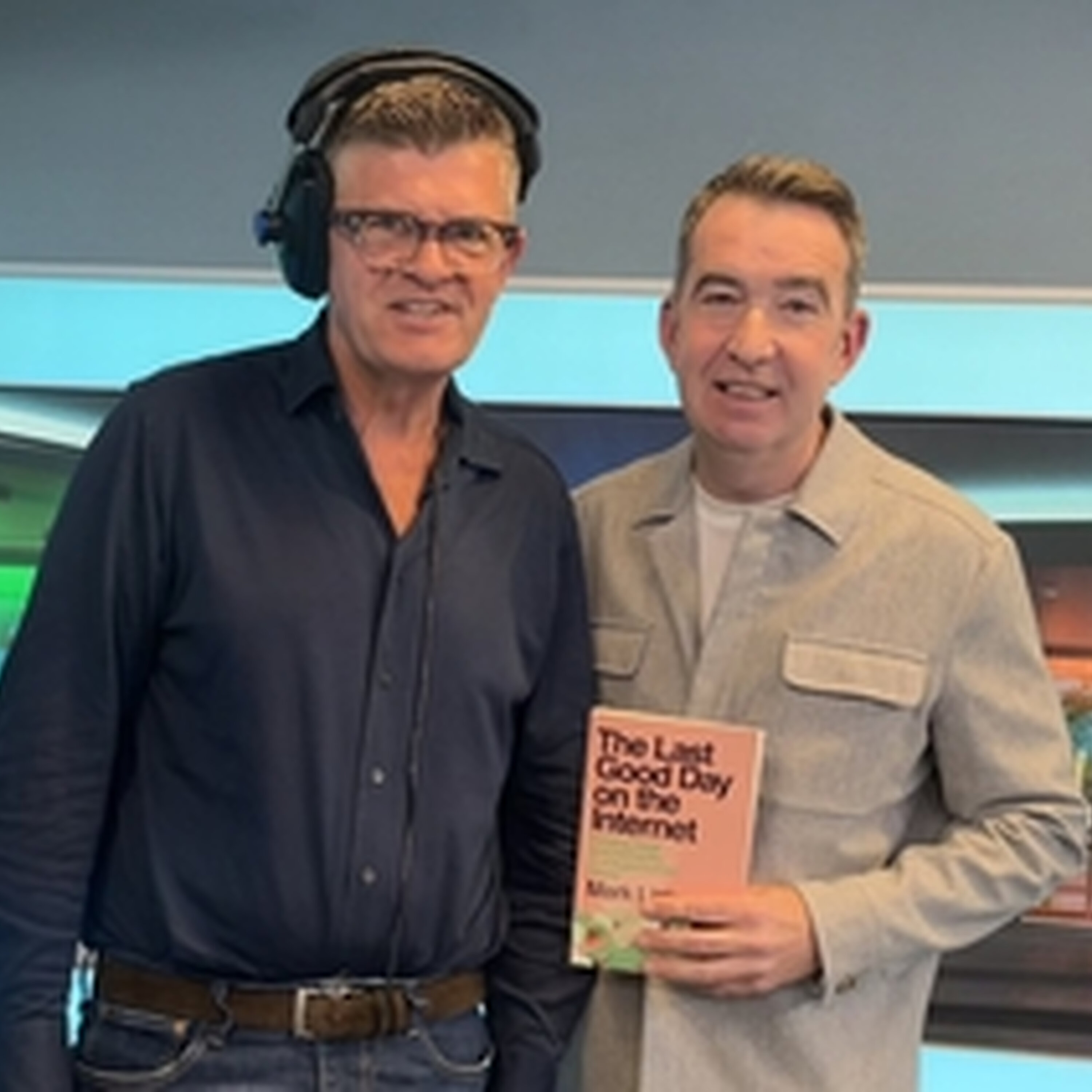
Mark Little, tech entrepreneur and journalist, has written a new book 'The Last Good Day on the Internet' in which he charts the initial innocence of the internet and its 'shared playground' feel to the rise of the algorithm to the AI age we're currently living in.
See omnystudio.com/listener for privacy information.
Get every episode summarized
Each time Brendan O'Connor publishes, we email you a written briefing from the transcript — the topics, who appeared, and any specific claims, with the ad reads skipped.
Email me new episodesFree for 3 shows. No card needed.
Know when Mark Little turns up
Follow Mark Little and once a week we email you every new episode they appeared on — including guest spots the show notes never mention, because we read the transcript.
Follow Mark LittleFree. Pick your own day and time.
Hosts & guests
Transcript ready
350 searchable segments. Every word is indexed and playable.
Full transcript
Brendan O'Connor — Mark Little - We can take back our power over AI. Machine-transcribed; use the interactive transcript above to jump the player to any line.
Mark Little, good afternoon. Good afternoon to you, Brandon. So Mark, your journey is to the heart. You take entrepreneur as well. But I think and our listeners know this. You've found yourself in a related space in the last few years of maybe trying to figure out what is broken about politics and the online world and of course the online world is the world now. And also you've been thinking about what the way forward might be. And to that end, you've written a book. It's called The Last Good Day on the Internet. And I would say it's like there's a bit of memoir. There's a kind of a history. There's also a manifest or there. So what was the last good day on the Internet, by the way, for you? Well, the actual last good day I talk about in the book is the 26th of February 2015. You might remember there was a dress. I really lost our absolute minds over whether it was blue or it was gold. And a lot of writers say that's the last good day on the Internet. Well, we had this burst of collective excitement. We all felt more human together and the algorithms weren't taken over. And I wrote the book because the
last good day on the Internet for me is the spirit we have when we go online and we feel more human. Like we stumble over a great idea or in our group chat, we have some connection with a family member that just makes us feel alive or we find a new community, a new idea we celebrate together. That was the way the Internet was supposed to be. And I just wanted to remind people that this hasn't gone away. And we live in this world now where, you know, to be quite honest, if you think about it, we will all, everyone listening, live through more technological change in our lifetimes than any previous generation in human history. And it'll happen faster than we think. We wake up every morning and there's no existential threat. And obviously that just overpowers us and makes us feel that we have no power at all in the face of approaching technology. And this book is for everybody I hope. It's the last good day on the Internet because I'm trying to remember, you know, remind people the power that they might feel they can feel and they should feel right now over the future. So that's the purpose of the book. As you say, a bit of a personal
journey because I've had experience, I think, irrelevant. But also I wanted to say to people that it's not just about empty optimism. There's real reasons for grounded hope that we can actually feel and take back our power. So the story is sort of what I think you call them, citing door moments, right? When history or the Internet could have gone either way. And we're asked one of those moments. Now I think everyone's very conscious with AI. But tell me about the 26 words that created the Internet. I did not know this. Yes. So there was basically an act in 1996. It's the Communications Decency Act. And it was part of what they attempted to do, regulate the Internet when it just hit the commercial explosion of 1995, 1996. And the American lawmakers were trying to regulate. And what they did a very good job of this particular 26 words gave platforms the power to essentially, you know, host people's conversation on their platforms without having liability what was said. They could moderate content if they wanted.
But they were basically given a free pass. They weren't publishers of content. They were just hosting conversations. So you can make all the money out of this, put the down side of it is not your responsibility. Yeah. And I think the thing is the actual, for me personally, those 26 words are a positive thing because they create this massive explosion in a collaborative Internet. But the problem was there was no regulations as part of this to stop these dominant corporations coming along. I mean, nobody in 1996 could have imagined an open AI or an Apple or a Google. And I think it was that failure to imagine what could go wrong is one of those sliding doors moments. It happens again and again. Yeah. You love social media initially. You love Twitter, didn't you? It made me a better journalist. I remember going into studios in prime time. And I would go online and I asked people to give me questions to ask ministers and the financial regulator. I suddenly realized I had a two A conversation, whereas before I was the man in the telly, nobody could talk to me. We presented the news. You had no involvement, whatever. And suddenly through social media,
I became a better journalist, a better listener. And that feeling of having people talking back to you became, for me, a revolutionary moment. And I still think looking back in it, it was a great moment in time. That's so quaint when you think of it. And how did dancing to Michael Jackson at a wedding lead you to your first start? So there were two triggers. One is a very serious one. There was a revolution in Iran where I remember thinking, oh my god, the Aza foreign correspondents year over. But the second was a cousin's wedding. And I was walking through to the bar and I saw a bunch of young people sitting around looking at their phones. Michael Jackson had just had a heart attack. And we started dancing to thriller at this wedding in the banks of the Shannon before the LA Times reported his death. And I remember thinking, I've suddenly now witnessed what happens when the whole world can talk at the same time, is telling the same story before the mainstream media is reporting it. And that was a holy crap moment when I realized nothing could ever be the same again. I was kind
of changed at that moment. And a few months later I set up a business that was trying to make sense of, well, let's just see what is worth listening to on the internet. So that was the idea. Okay. So to train filter all this content that was out there and verify and everything else. And that's a common theme for me in the book. It's all about those moments when something like that goes, oh my god, I've changed my mind about something. And those moments are still possible. Yeah. And like reading about your adventures and startups is no doubt that you'd want to be crazy to start a protect company. Would you make a distinction between a battle? And I think I do think we're seeing it again. Now all this is happening again. The right kind of crazy and the wrong kind of crazy. What's the right kind of crazy? And what's the wrong kind of crazy? I think there's a great moment you're in a startup where you realize that the secret of just getting up every day is to just face your worst fears and to understand your own frailty and you will fail, you will fall. And once you've come to that realization, you become stronger because you become more human. And the people around you start being able to speak their worst fears out loud. That's the kind of
right kind of crazy where you realize actually it's all about being frail, not superhuman. The wrong kind of crazy is when you have someone like Elon Musk who goes from being quite a modest guy when I first met him back in 2013 to being someone who is part of a cult in which the right kind of crazy is people and aware their frailty and the frailty people around them. The wrong kind is where they have to push forward. They're inspired by this cosmic vision that has nothing to do with real people. It's to do with their own ego, their own fears and sometimes their own cosmic vision. And that for me is one of the reasons we are where we are today because a small group, kind of a cult of entrepreneurs have decided that we need whatever they're selling us without them understanding our problem. And that's the wrong kind of crazy, I think, the strivingness. Looking for answers to a problem that we don't have. So people will have a version of the story of the story of the internet and their heads, right? But there are things here that people will not have realized. So you saw the story for
the wrong 2014 and you still saw the internet as a reasonably benign place then, right? Then you point out that that was roughly when the algorithms changed as well. Now the algorithms are the big bad guys now. The algorithms originally were serving us, correct? Yeah, they were and if you think about Google originally what it did was solve the major problem because suddenly the internet was there and we had this overwhelming amount of information we were drowning. So Google came along how to get an algorithm that helped us sort out what we really wanted based on our, you know, what we wrote into that cursor. But about 2014 these algorithms go through a revolution, the deep learning revolution, which is the basis of the AI we have today. And suddenly the big platform is realized, oh my god, we can make so much more money if we just keep dropping people in the content that makes them feel some sense of real deep emotion, you know, anger is good. Any emotion. And so the algorithms kick in to make us consume more and become more unconscious of work we're consuming. So the algorithm goes from a pretty useful piece of technology to
something that's trapping us in these unconscious experience. Now all not all algorithms are bad, right? We have Netflix and Spotify that over time just give us the kind of music or movies we want. But the particular type of algorithm built initially by Facebook and other social media platforms is turning us into users who don't have any conscious control of our environment. And that kicks in around 2014, 2015. And is it the case that unfortunately the things that are the most high octane for people and therefore that that it serves the algorithms to serve are generally kind of more on the ultra-agent anger end of things rather than like fluffy ponies, yeah? Yeah, they have to keep you looking more at the internet, but also serving of more advertising. And the only way they could do that was mining the really extreme emotions that we all feel and doing it again and again without you knowing it. Like at least now with the AI, right? You sit down at the chat box in front of you, but when you are using this recommendation systems, it was invisible sitting on your shoulder looking at what you're watching, predicting the next thing you
want to buy, you know, it's creepy because you weren't aware of it. And that's really for me, which is one of the things that turned us into this unconscious victim of technology rather than people who can actually take back control. And that's the age of attention, which we've talked about where basically the people that are all the power are the people who control the spectacle, whether it's in politics or in business. Okay, you talk a lot and again, it's the king's road or it's Gondor's potential of all this. You saw that, you went to work in Twitter. Yeah, and you basically went in there and realized this is broken, the solid thing. Yeah, I was like, it was weird going in the door because I mean, I was like literally fell in love with Twitter, I was head over heels with it. And at that stage, the algorithms hadn't kicked in. So Twitter, at that stage was still full of communities that really made a difference in the world. I never forget being in Twitter, listening to executives from India talking of the way Twitter was a public
utility in times of floods in Japan, when there was that big earthquake, if you remember, at the nuclear reactor incident, Twitter was being used to help people get to emergency services. And I saw Twitter as this great big piece of digital public infrastructure. And then little that I know at the people in Twitter didn't care about the world, the executives, a lot of great people working in the company here in Ireland, but in America, and I never forget this executive coming to Dublin, where I was ahead of this stage, the Irish international course. You were the colonial and voice right. I was the guy who was the man from Del Monte like going out there. And I said to this executive, I said, you know what, 79% of all the people who use Twitter are outside the United States. We should care more about the world. And she said, yeah, but 80% of our advertising revenues from the US. And it was left hanging. And I suddenly realized that they did not see the world as this glorious community that Twitter was. They saw it as a big business and my job was to go out and exploit these new markets, rather than try build up communities that might have a beneficial
impact in society. So another inflection point, 2016, when Donald Trump came on the world stage, you also say that is when our shared reality began to collapse. Was that all the internet's fault? No, I think what's happening after, let's say, 2008 and 2009, we start to see internet-enabled rebellions. If you remember the financial crash, really was legitimate grievance against the establishment, against the elite democracy that lost its way. Then on top of that, you had again and again a feeling that liberal democracy had lost its way. The internet took that legitimate grievance and turbocharged it. Okay. And so I think when we talk with the internet's to blame for democracy's, you know, fall, it's not. It accelerated what was an already legitimate criticism. And so I think you have to remember back in the early days of the rebellions and Arab uprisings and you had lefty rebellions again. I'll keep my wall street. And you also then had what we now see is kind of populist and right-wing rebellions. But they all came from the same real life grievance
that the establishment, the elite, was out of control, was not serving real people. So I think people should keep that in their minds. It's not just the internet. The internet reflects the best and worst in society and the strongest to the motions as well. But was there a point then at which the worst became more amplified by it? Was the worst more prone to be amplified by it like, you know, rage and poison and that? Yeah. No, a good example would be Twitter, for example, where we had like more than half and half men and women using Twitter. It wasn't before these algorithms kicked in in 2016, serving up and elevating the most angry voice, but it suddenly did when the algorithm was turned on. And then suddenly what happened was we all go into it and we think that all of the people out there are angry. But actually what the algorithm is doing is over representing the angry tiny minority, but giving them the loudest loudspeaker. And that's the thing that kind of Twitter has done. And I think other platforms is they have elevated the loudest
angry voice. And now all of us the rest of us think, well, that's the way the whole society is, but it's not. And I think that's one of the things about the book, the last good day in the internet is about going back and forgetting, remembering what it's like to be surrounded by real humans. And did the real humans see the internet, see Twitter and these spaces then, two doors crazy in the end? Then when it started to look like that, did people withdraw a bit from it, ordinary people? Yeah, I mean, there's a sense of censorship by noise. When people are shouting and screaming people who tend to have more moderate views, tend to not talk. And this happens again and again. And sometimes it's promoted by dictators who use social media to quash to send, to stop people speaking out, particularly women. And so it can be used again to suppress people's feeling that they have a freedom to talk openly. And that's what happened to large extent with the platforms. We gave it away to them. We did. And it's not surprising. Why would you want to do that? So so interesting. It happens then. We used to go for friends and family onto social media. It was a
place to connect with other people. Yeah, it stopped being that. And suddenly got taken over by influencers, creators and the loudest voices. And no, it's no longer social media. This is the irony we should no longer call it social media because it doesn't bring us to friends and family. It just shows us the people that are good at gaming the algorithm, whether or not that's influencers or that's people who are politically extreme to the pandemic. Acceleration. That is right. It did, but also because of a really natural sense of of listen, I'm stuck here. I don't know who to believe anymore. I feel I'm alienated, marginalized. We all had different experience of pandemic. And I think what happened was people with legitimate concerns about the official version. We're turning to people that made them feel stronger, better. And sometimes those people were serving them up conspiracy thinking. But it's again, back to this point that the internet can reflect the legitimate doubts of people who feel like they're disconnected from the mainstream society or disconnected from the establishment. So I think that's what happened with the pandemic.
It was a real sense that people who were lost a little bit, okay, found in these sort of gurus who would tell you, you know, that it's all a conspiracy and they will give you hidden knowledge. And one of the things people don't realize about misinformation and this kind of problem, it's not about the supply of lies or bad information. It's about people's demand for information that makes them feel empowered, connected. And I think that's why you're in the pandemic. So we leave those people down in the pandemic. There was a very much a thing of you, either with us or against us here. And if you're questioning things at all, you're almost banishing people off into conspiracy. Yeah, and I'll tell you right now that I admit this myself, you know, and part of the reason I wrote this book and the last good day in the internet is to say, listen, I used to push back on anybody that seemed to have a difference of opinion with the conventional scientific wisdom, but in retrospect, what I realized was we should have been standing up as we did against really violent, dangerous content that's designed to basically cause division,
but at the same time have a deep understanding of why some people feel that they feel closer to those people that are offering them at conspiracy theory. So I think that was one of the things we didn't do during pandemic, perhaps was understand that science is a process. It's not an established fact. It changes over time. And so what we have to be doing is thinking, how do we all together collaborate better on establishing some level of shared reality at a time of great insecurity? And I think possibly we didn't do that well enough during the pandemic. Now, is there background to all this then that they big tech companies and they kind of call to leaders who run them? We're seeing as kind of Silicon Valley hippies and liberals and then now we regard them all as kind of almost right wing edge Lords like, do they flip at some point? Did they and that didn't out? Yeah, it's funny. The whole, you know, the book is talking about a history on back to that. The hippies did actually create the internet believe it or not. They were the people who had the communists came in to work for the original big companies. Steve Jobs is a great
example. I mean, he pays homage to the hippies and he came along and he had this idea of technology as the bicycle of the mind. So he was part of this kind of alternative thinking. But he also then becomes turning that into a sort of a corporate revolution, recreates. So he makes the ads, you know, the 1984 ad for Apple is this great moment where he's technologies now, revolutionary force in society and things start to change. And suddenly it's not free thinking hippies and he poor. It's really ambitious. Capitalists with a cosmic ambition for this technology. So Silicon Valley is always being this kind of battle between two forces, you know, the libertarians and the communists. And I think part of that is it's always been that tension. But more recently now these last couple of years, a different type of almost cult like what I would call in the book, accelerationism. Yeah, no, you say that you say in the book, that's the most consequent ideology of our age. So tell people what acceleration is in this. So accelerationism is a theory that emerges actually
to the end of the late 60s, which believes that if you literally don't have any constraint on this kind of technological capitalism, we will basically solve all our problems. So there's not a problem in the world that cannot be solved by technology and sort of, oh, they also say, well, in the end of the day, democracy's all fine and good, but it always be in the leaf who should decide the way that we advance. And so therefore we have people like I say, Elon Musk broadly is part of that camp. There's a guy called Mark Andreessen who is one of the first people developing the commercial internet. He's the most explicit thinker around this accelerationism. And these people, and he's an incredibly powerful guy in terms of the people he has mentored and financed and everything else. And the people might know him as well as some of the others, but he's the background player. He is. He's also brought a lot of people with him to go from supporting liberal Democrats in the day to becoming people that are supporting Donald Trump. And the thing that defines these people is they all want some escape. They want to escape from democracy. They want to escape from the world. And these are the
people that are driving the most fantastical and sometimes scariest visions of technology. And they're all in charge right now. And they are part of the groups that are telling us about some apocalypse going to happen because of AI. For them, that's not necessarily a downside. But they are the other hand are driving us towards the the the apocalypse. Yeah. They're going to come up with the dynamic in AI is is extraordinary at the moment. Like these people pushing further and further and saying, this is really dangerous. We need to put a break on. And then others saying no, a break is only going to make it more dangerous. I mean, I think people can't understand anymore. Like what what the philosophy is for pushing this as far as we're pushing it because they seem to be saying if we push it far enough ultimately, yes, it will. But I think there's a distraction going on here. So we have these people have been saying this for years, by the way. Yeah. The AI will wipe out humanity. There's a 10% chance it might happen. They've been saying that for years. We actually sit down and ask them what do you mean? It doesn't really, you know, the evidence does not suggest that at
all. But for them, the more fantastical and scary this future becomes, the more people were thrown money at them. Okay. So if you're if you're leading one of these big AI companies right now, you know, it may seem strange that they're they're so negative about the future, but it is driving this insane amount of money that's going into essentially one form, very narrow form of AI development that just so happens to be owned by a handful of people who believe technology is the most important thing, not human problems to be solved. So the more people scared, the more people feel powerless, the more empowered they are. And that's part of the challenge here. Part of the reason I wrote this book is to make people feel they have some power as long as they can consider alternatives. Now when we start believing in, you know, the end of the world is more likely than we have power to change the course of AI, that's when we should be really alarmed. Not about, you know, apocalypse, but about the fact that these companies now are trying to make us feel absolutely victims. Okay. And it's interesting you talk about that approach of they are moving on this very, very
narrow version of what AI is and what the problems they seem to want to solve for it. And the big thing then in the race at the moment is, oh well, if we put a pause in the West, China will take us over. Now, that's about how China using AI. It sounds much more healthy and enlightened than what we're doing in the West. Apart from obviously you see your efforts. But broadly in Asia, what's really interesting is because they have been behind the American frontier labs. So if you're like an open AI or an anthropic, what you want to do is create chatbots, AI agents and this vast big commercial marketplace to make a lot of money. In Asia, because they've been slightly behind, they focused a lot about integrating AI into daily life. So for example, in certain parts of Asia, now public services are available on the internet using AI to make it more efficient to understand what your benefit is. In Japan, for example, a lot of focuses on using AI to help a society that is rapidly aging, which by the way we are as well.
So a lot more applications about real world dividends for people in Asia and areas like healthcare and public services. The promise of what AI we taught would be doing for us. I guess what? Yeah. People in opinion polls are much more positive about the path to AI that is changing people's lives now. Whereas in our part of the world in the US and Europe, we're much more negative because we're already paying the price for the vast computing power. These data centers that people are now really opposed to. We're seeing the, you know, not the benefits. We're seeing the harms before we see any benefit. Are we seeing the benefits as well? Like when you actually think about it, okay, we've chatbots, an elevated version of Google for most people, right? What else? Well, we're seeing, I think, the beginnings of a real revolution in many ways in medical research and terms of science, you know, I think back to it. It is actually all happening. That is happening. But part of the problem is that the application of it all is built on a tiny tower, which is controlled by these AI companies. So like governments will buy services from Anthropic
or Amazon and suddenly we're no longer independent because the technology we're using is sold by a tiny number of companies. There's an alternative to that. Open Source AI, which would allow us, for example, to, you know, a small little research team could use a model not controlled by the big companies, but basically optimize for their purposes. And they can build onto that, what they need for their, for their company and share that model on, you know, and share it around. And again, the reason the book is called Alaska Day and the Internet because this open source approach is a reflection of the original promise of the Internet way back when Tim Berners-Lee was around. That alternative vision of an AI that's used by people to solve real problems is real. And it's there. The problem is they all get indistracted by the handful of men as they are who control this sort of very, very specific narrow form of LLM. And that's where we have to get our head around. I think the alternative again, easier to, you know, think about the end of the world than it is
about some sort of positive form of AI, but it is there. And it's potentially in play at the moment. And you're, your idea around how we could maybe get back to that and get back to the human connection, you draw an Internet that makes us feel more human and everything is an age of intention, you know, and it's ambitious now, but you know, I mean, if you saw some seeds who know the network can grow, first off, you say we are not users and we are not addicts. No. Now again, obviously social media can create, you know, very attractive experiences that like start, you know, slot machines, you continually pull the lever to see what result you'll get, but we're not like addicted in that sense, like to say that we're the victims that we have some disease, like in addiction, again, makes us feel so powerless. What I'm saying is like, for example, if you get up in the morning, you walk into a supermarket or a library or a bookshop, you have an intention, you walk in there, you're conscious, you're going to go in, if you're buying food, for example, you might look at the food table, see what's in it, you want to compare that to something
else. But the opposite is our experience of technology. So what I'm saying is there's three levels here. There's a personal consciousness raising, I think, for all of us to walk in and realize every click, like share that we execute every day is shaping our environment. Now if we went in with more intention to try and shape our experience, we could do that if we start to look for the experiences that reward us. Okay. So you're very good at giving people one simple thing to do. I mean, even don't just saying, look, go in, get a, get a chopper two years ago, you told me and everyone, just mess around with AI so that you know what it is and what you, and I think a lot of people told me they did after that. So what would be one simple thing people could do with intention to try and start making an internet for them that works for them. You get three practical ways to do it. First, I'll sit down and say, I'm coming here to do something, planning a holiday, getting a recipe, just finding out about some subject I really want to know more
about it. And once you've done it, you go, you don't let the at chopper turn it. Okay. I like it. Come on. Do you want more information? No, yeah. Yeah. Okay. Yeah. Number two, if you want, I can do x, y, z, you just say no. Yeah. I'll come you with this. Second, this is a Patricia Scanlan, who is art and former A.M. Buster told me this a couple years ago, ask the AI about something you know a lot about. And then you'll see the flaws because you'll, you know about it, then you'll ask good about it and you'll see where it goes wrong. I loosen eights, things like that. And I think the third is to ask the internet, ask the AI, why am I wrong? Because most people go on and say, I have this idea, tell me why I'm right. I was doing this in the early parts of the research of my book. I was waiting for it to tell me how fantastically smart I was. Yeah. Because we know that from chat logs and open AI, for example, that the chat box 10 times more likely to say, yes, you are correct. But if you walk in and say, why am I wrong? It changes your relationship with AI immediately. Because now it helps you be more critical in thinking about how you think.
Okay. And we see, and we'll do that if you ask it. It'll override its willingness to kind of tell you you're great and that you should set up a company and write a book and all those things. Now I use Claude, so but my experience is it's quite happy to tell you. Okay. You're full of right. But what happens suddenly then is you're now thinking about how you're thinking, you're boosting your ability to think. The medical research says when you go in without intention, you will become cognitively weak. You will lose your mental fitness. Okay. So go in knowing exactly what you want to do, do it, stop, talk to it about things that you know a lot about already and see the flaws and then thirdly is ask it to tell you why you're wrong. Yeah. Okay. There's three good things people can take away from today. So listen, I know you're not an optimist, but you have hope. What is your proportion of hope to panic right now? So I start with panic. Like in my last start on myself, my co-founder, Oni Kair had this thing called pre-mortem. We were launching some
great product we loved and we ask ourselves, why will it fail? And if you sit down and work at your worst fear from all this technology, as soon as you do speak that I'd loud, it loses its power over you. And then it gives you the capacity to say, okay, I'm no longer optimistic in that I expect it'll, you know, won't rain tomorrow and I'm feeling lucky about it. But I've got grounded hope. I know all I plan is. And for me, when I think about the future, it's going to be in three parts. I think people will become more intentional as we've just discussed conscious. Then they'll realize when they start to try and fix the settings on their AI or on the social media, oh no, we're going to take some collective action. And we're starting to see that people coming together, for example, in protests against data centers. So the beginning of the resistance, okay, and then the resistance gets together. And before we know, we got a backlash against AI, where's the blueprint for a better use of AI? And so for me, the beginning of personal consciousness is not about us, we can't change on our own, the big tech companies. But when we start to realize we're actually part of a collective, we resist. And then we start asking for the blueprint, we put it on
the political agenda, we start asking politicians to tell us what they're going to do about inspection of AI. That's how we get something more than simply just us doing a couple of things to trick the AI. Okay, exciting. All right, the book is called The Last Good Day on the Internet Finding Hope in Humanity in a superhuman world. And it is terrific. And it's out no published story. Hashtag marked little as always. Thank you. Thank you, Brendan.
More episodes
More from Brendan O'Connor

The Newspaper Panel
Brendan O'Connor

Jennie Bond - "It's an absolute character assassination of King Charles"
Brendan O'Connor

The Watchlist
Brendan O'Connor

"Sitting with Manchán while his soul left his body was life-changing"
Brendan O'Connor