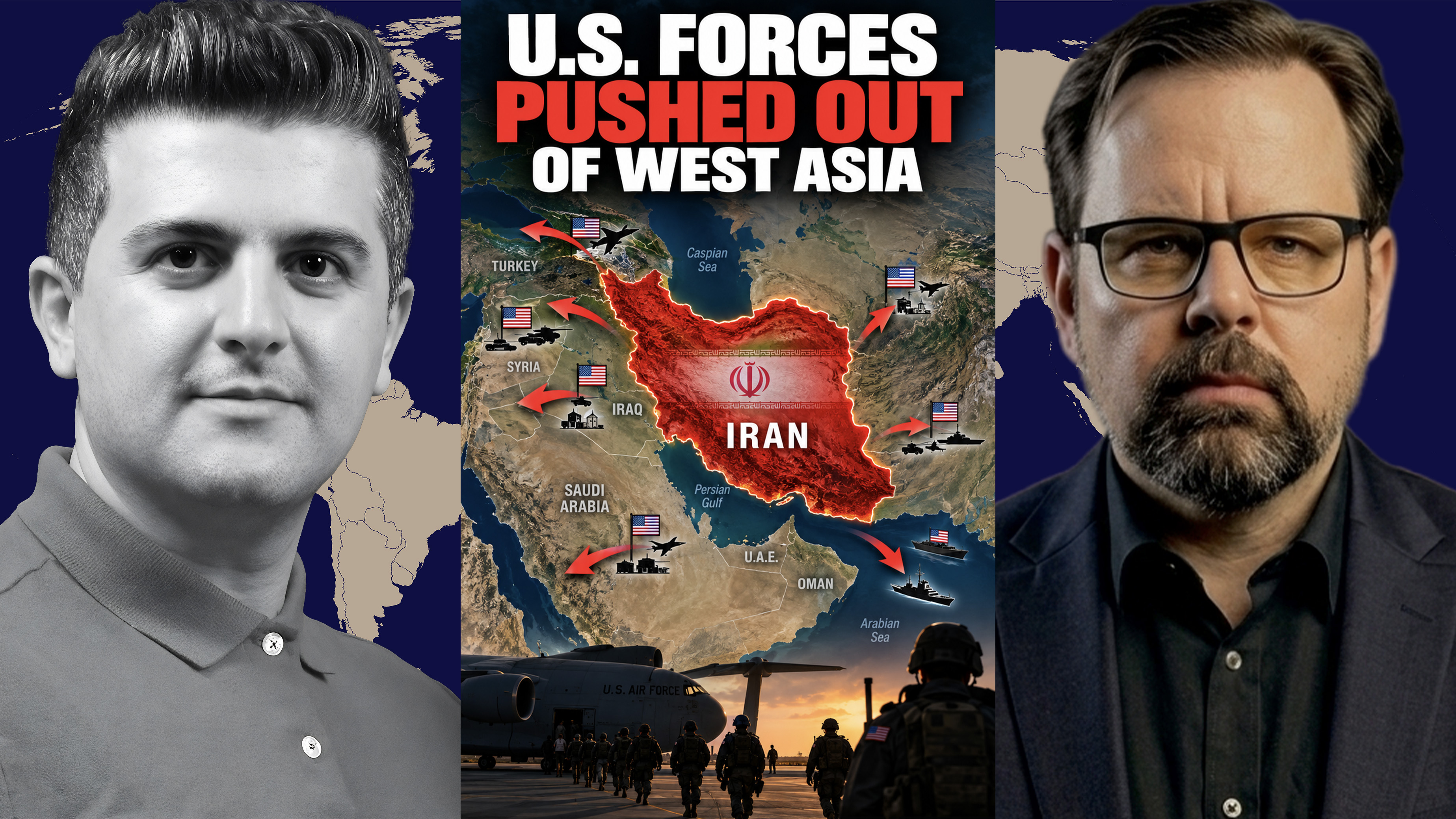
Mark Sleboda: U.S. Warships Under Fire by Iran – CENTCOM Confirms Strikes on 3 Iranian
About this episode
Deep dive into the escalating US-Iran conflict, focusing on kinetic strikes in the Strait of Hormuz and Gulf of Oman. We explore why US economic sanctions are failing given Iran’s strong oil ties with China, and how Iran maintains a strategic advantage through precision missile strikes, underground facilities, and advanced sea mine deployment.
The discussion also covers US munition shortages, Israel’s push for wider regional escalation, and the ongoing Russia-Ukraine war, where recent US diplomatic visits to Moscow yielded no ceasefire. Finally, we examine the shifting geopolitical landscape, analyzing how SCO and BRICS navigate US pressure while Eurasian nations pivot to overland trade routes to bypass sanctions and secure their economic futures.
Hosted on Acast. See acast.com/privacy for more information.
Get every episode summarized
Each time Dialogue Works publishes, we email you a written briefing from the transcript — the topics, who appeared, and any specific claims, with the ad reads skipped.
Email me new episodesFree for 3 shows. No card needed.
Hosts & guests
Transcript ready
622 searchable segments. Every word is indexed and playable.
Full transcript
Dialogue Works — Mark Sleboda: U.S. Warships Under Fire by Iran – CENTCOM Confirms Strikes on 3 Iranian. Machine-transcribed; use the interactive transcript above to jump the player to any line.
Hi, I'm ready today is Saturday, September 5th, 2026, and our dear friend, our brother, Mark, Slobodys, you're with us. Welcome, Mark. Thanks for having me, Neumann. It's always an honor and a pleasure to be on dialogue works. And I y'all. Great to have you back, Mark. Let me start with what has happened moments ago. We've learned that Iran is firing some sort of missiles. Iran is right now what's going on. They have fired missiles at US warships in the Gulf of Oman, in the Arabian Sea. And on the other hand, the central command, they said that they have hit three Iranian oil tankers. At least two of them were confirmed. So this is the fight, Mark, that is going on between
the two sides. On one hand, you see Donald Trump is talking about the Operation Economic Outcast together. And the fight because of the blockade, the fight is happening as you see. And the Iranian, the Iranian, the Hathamal, and Bia, central command, which is, you know, the organization in charge of the war. And every time, every time we learn something from the war, it comes from this organization. It says that they have warned if the US naval blockade remains and the US continues to target Iranian civilians ship. Iran will increase its, its targeting of US Navy vessels and expand the scope of naval warfare. Iran is boiling because of the blockade. Sooner or later, I think they're going to get back to war again. Where do you see the conflict? The two sides. One side is the economic warfare, as they call it, the Operation D-Day, whatever that would be. And on the other
hand, the shooting fight that war that is going on. Okay. So, I mean, first let's get this Operation Economic Outcast out of the way. Because I think that's almost a non-factor. Because the US Treasury Secretary Scott Bennett has obviously been put in charge of this. And he's once again bringing it up in the context of regime change in Iran even. He himself, you know, seemed to intimate that somehow might be how this process ends. But does anyone know exactly what his economic D-Day is in the last two weeks since he announced it? Because the reality is, there's not a whole lot of sanctions left that the US and Europe can really put on Iran, right? They've sanctioned
pretty much everything, everyone. You know, a lot like with Russia. I actually, I just checked the numbers. Russia has received 33,000 sanctions since 2014, right? And he runs in, you know, not far behind. But so what they're talking about is secondary sanctions, right? And they also made that explicit that they were going to force every country in the world with threats to stop trading with Iran, right? That is, you know, where they are secondary sanctions, right? That's what they're talking. The same thing that they have been trying to do for five years now with Russia, and that hasn't worked for them. Now, Iran is an important commodity supplier to the world like Russia, maybe not quite on the same scale, but significant. But when we look at the enforcement of that, it's extremely problematic for the United States,
because the, you know, Iran's biggest export is oil, and the biggest purchaser of oil is China, by far, right? China buys like 90% of Iran's oil. So is the US going to put secondary sanctions on China? I don't think so. They've been down this route in the current Trump administration of a trade war with China. It's been put on pause, but they backed off every tariff, every penalty, every restriction they had put on China, because China fired right back with rare earths and lithium batteries and everything else, which they, by the way, they still have levels of restriction on the US for, and it was the US who backed out. So they're not eager to renew that, particularly not before mid-term elections, right? Anything that could see the price of
oil rise dramatically or have a big effect on the US economy, because Trump's, you know, the effect he is going to have, right? He's not up for re-election, it's congressional elections, but, you know, the president always has an effect on mid-term elections, and right now, he's extremely unpopular in the country, right? Outside of his core base, and that is sure to have a knock-on effect on other Republicans, and that's going to lead to him losing likely control of the House, which means that Democrats are going to be lining right up to impeach him nonstop, you know, for the rest of his term, and he won't be able to get anything done because you'll have lost Congress, lost control of the purse strings of the US government. So, I mean, that's done right there. That doesn't necessarily mean that that's going to result in a change of
policy for Iran. However much the Democrats may be eager to jump on Trump when he fails. They're also not likely to want to go in opposition of the Israeli lobby in the United States, I-PAC, which is certainly in favor of all of this, and even of escalating it or returning to it. So, don't look to a Democrat-controlled Congress to change US policy, specifically with the conflict with Iran. They're just going to create a lot of other problems for Trump that will consume most of his time. And, you know, if we want to speak of Trump having mental energies, then consuming what mental energies the man might have. But, you know, other than China, you know, what has the US actually sanctioned in the last two weeks? By my count, they've sanctioned
one Egyptian bank and one Turkish bank. And that's like it. I mean, that's like calling something D-Day and D-Day consists of two little robots rolling towards the German coast, right? You know, in the German controlled coast of Europe. That's not really D-Day. So, you know, we can say that Trump has chickened out when we've got a serving of taco, but from Scott Besit on the economic war front. So, you know, while the Iranian economy is certainly under some strain, right? I don't think that there are anywhere near a point of collapse or anything like that. They're struggling with high inflation, you know, and they're certainly going to be suffering some problems with government revenue from the difficulties of getting as much
of their oil out as they like. But we've been through this geo-economic game of chicken before for an extended period. And it was Trump. It was the US that blinked last time, right, after two months of this. I don't see that we're in a position that the results of it this time around would be any different for the two of them, you know, in this this dueling blockade, this geo-economic game chicken. So, that's almost background noise at this point. But the latest round of conflict, of kinetics strikes if we want to use the military parliaments. It started because the US was once again trying to force the creation of a corridor through the state of foremost, the southern corridor,
hugging the Omani coast outside of a coordination and control of Iran, right? All of Trump's ludicrous claims that that he controls the state of foremost. And then even that even in his next breath, or his next post he's talking about, we don't really need the state of foremost because trucks traveling through Syria are going to transport so much oil, right? You know, and I'm like, why are you talking about that? Because I thought you controlled the state of foremost. We don't even needed anymore. But wait a minute, you control it. Why would people want to divert away from the state of foremost if you control it? So, I mean, the narrative, you know, an eighth grader, eighth grader could punch holes in Trump's narrative with the state of foremost. But they keep trying to sneak ships through at night with their transponders turned off. And there is some indication that over, you know, the past couple of months, they have done with occasional strikes some
damage to Iranian detection equipment, to radar, and to others along the straight-of-four moves that is, you know, might right now be making it hard for Iran to detect every ship passing through, you know, particularly in that far southern corridor. They've actually been sending out fastboats and spotting ships with search lights at night, you know, that seems to, you know, indicate that they don't have a total. Trump is claiming about ridiculous amounts of oil and ships passing through the straight. And he can claim that, but there's no evidence of it whatsoever. And he's claimed that before, and it was proven false. The independent traffic monitors, tanker traffic and capillary, and others, they don't seem to indicate any of this. But it does seem he's getting some through, right? And then we also had some indication there was
some reports this week about, at least from the Iranian side mentioning that in one of these latest ships that they had tried to force through, that the US had disembarked the crew and put their own people on, right? Now, I don't necessarily know that that means US Navy, personnel, it may simply be people that are specifically hired for that purpose. But there is the open question is what sane owner or captain of tankers would want to risk his ship going through the straight of four moves, knowing that they are being targeted by Iran, that they might, you know, that there are sea mines in the strait, whatever Trump may say. There is no evidence that any US Navy ship has entered the actual straight of four moves at any time since this conflict started,
right? Putting some birds in the air, some reaper drones that keep getting shot down, possibly some helicopters or aircraft on the outer fringes of the strait. Yeah, that, right? When they talk about escorting ships through, they mean a drone or a helicopter flying up there providing moral support, right? That's what their, that's what, what escort means escorting ships through. But they haven't done any demining. D mining is actually a really fairly difficult and involved process. It's not something that is done under conflict conditions and the US doesn't even have any dedicated mines sweeping ships, which makes it all the more difficult. So all this talk about, you know, no sea mines, that's complete nonsense. And we know it's complete nonsense because we had Western mainstream media Bloomberg last week had an article talking to anonymous US allies,
right? I'm sure, you know, some of those at least were Gulf state officials saying that they don't believe Trump's claims that there's no sea mines in that strait. But regardless, the US has proven that it does not have the military capability to stop Iran from reaching out and exerting control over the strait of four moves, right? It's, what, 2021 kilometers, 2021, 24 at its shortest point, right? It's 24 or 24. And they've got so many options, right, to do this with, right? They've got their, some remnants of their navy, no matter what Trump may say. They've got their fast attack boats. They've got thousands of them, right? They've, they've got aerial drones. They've got surface drones. They've used those. They've got underwater drones. There's reports they've used those. They've got cruise missiles. They've got anti-ship specific cruise missiles.
They've got anti-ship ballistic missiles. They've got some helicopters. They've got aircraft. They've, even artillery could be used. I mean, they were 24 kilometers, right? You know, that's not long. They've got rocket systems. And the cheapest option of the mall, of course, is just to lob sea mines in. And they've got a whole lot of ways to do that, right? They don't, they could drop them off their fast attack boats, right? They, we know they could do that. And they can and probably have. They could place them with their mini-subs. That they have a number up. They could do that. But they can even be dropped from drone or aircraft, right? That that has been done. But what Iran has evidenced in the past week to keep sea mines, you know, or at least to increase the concentration is to use a rocket
with sea mines from a multiple launch rocket system, right? Like a rocket launcher, like on the back of a truck, like a Russian tornado or the, or the old cutout shells, right? Or, you know, very similar to the US high marks, actually, right? It's the same kind of idea, a rocket system. And there's actually articles out last year talking about Iran is the first country to do this with sea mines. So it's been done before actually by Russia. Russia has a system, a type of rocket system that they call the Zemlodilia, the Agra culture. And it doesn't drop sea mines. It drops land mines, but it fires and it remotes lays mines like that. And then they've demonstrated that before. And then last year there are reports in the Western media,
right? You know, in like defense journals and so forth talking about Iran's ability to do this. And they're the first one to do with sea mines and how it was, you know, for them concerning. It kind of makes me wonder if Russia maybe didn't help that we know that there's continuing tech transfer back and forth. And it's certainly possible that if Russia already has a system that does this with land mines, they might have given, you know, Iran a few pointers, you know, some technical help in doing this with sea mines. Now, I don't know that that's pure speculation on my part, but, you know, it's a possibility. Iran is probably certainly capable of doing it on their own too, but you know, time constraints. Maybe I don't know. But anyway, they have this ability. And evidently, they were doing it last weekend from Lark Island, which is one of the islands, one of the smaller than Kishim, but it's at the narrowest point of the straight-of-form moves.
The Lark Island is ideally strategically located to exert control over the straight-of-form moves. And evidently, they had a few launchers there that were lobbying sea mines, right? You know, almost certainly towards the southern corridor, right? To increase the concentration there, to make it more difficult for the US to push tankers through there at night with their transponders turned off and so forth. And the US detected them. And what first of all tells us the US has pretty good reconnaissance because these are things that, you know, they're on the back of trucks and what they're doing is they would be able to do it quickly and scoot away. Is my point. So the US has fairly good reconnaissance drones satellite. Whatever they're using, they detected it quickly. And they sent in, I believe it was drones, although I've seen different
reports, but they hit these launchers. And Iran responded back. And Iran responded back in an entirely disproportionate way, right? They did not hit the equivalent of two rocket launchers, they attacked, they launched by some accounts up to 40 ballistic missiles, right? As other accounts less at US military bases in Jordan, but also there were reports of attacks on the UAE and Qatar as well. And they shot down another $30 million Reaper drone on top of it all. So there's a reason for that. Iran is ready to go back to war. They would prefer, they think that they
have better leverage in that position. They sense US weakness with their shortage of munitions, with the bad material state and logistical problems they're having with their naval forces, right? Because of Iran's strategy of debasification and hitting US headquarters, fifthly headquarters in Bahrain, forcing the US to use a long logistics chain from Diego Garcia in the Indian ocean in order to keep these ships supplied with food, with ammunition, with fuel, right? You know, all these things, really complicating this mission there. And there was an internal report last week that was leaked by the Pentagon, that is obviously crying for help. They're like, save us from this madman, but there have been multiple leaks about how bad the situation is for the US military.
And the chief of the naval operations on the mission of continuing the conflict against Iran and continuing the blockade, the chief of the Navy put a non-concur meaning that, well, they'll do it if we're, you know, being told to, but we don't agree with it, right? You know, that, and that's really interesting. So a very bad situation there for the naval forces. And we have, you know, headline, US newspapers, papers of record, The Washington Post, with quotes from US officials saying, we can't sustain this, right? The, from military, we can't sustain this. So Iran has every reason to push things, right? They will have leverage if they escalate against the United States right now, because in this conflict, right, in the straight-of-four moves with regards to,
you know, attacks on bases and, you know, the US's remaining bases in the Middle East that it hasn't retreated from, Iran there has the escalation dominance right now. So they have every reason to try to push the US back into a cycle of conflict, maybe tit for cat, maybe more intensive, right? You know, but that they're setting the pace for, that they're taking the initiative. So that's what this was. And the US of course responded back and they launched another round of attacks on the straight-of-four moves. And this resulted in them eating a wedding with a number of civilian casualties. And then, you know, it's really hard to understand this. And this has been acknowledged by the New York Times, right? It's not like something just the Iranians are saying, the New York Times take a look at the evidence. And yeah, one of our missiles
hit a wedding and killed a bunch of civilians. Now, I've heard some suggestion. This isn't the first time the US has hit a wedding. If it weddings in Afghanistan, they've hit them in Iraq. And you're like, what's up? Does Trump hate weddings? You know, what's up with this? I've heard this suggestion that when US is doing signals intelligence and they get a lot of mobile signals all together in one type place like that, that it can resemble a high-level meeting, you know, of military people. So maybe that's what it is. I mean, otherwise, you have to believe that they just targeted a wedding just to kill some Iranian people. I actually don't believe that simply because they don't have enough missiles to waste on things like that. But whatever, regardless, it's a war crime, right? Whether it was an accident or, you know, or intentional, that's that's almost a good point that you've mentioned. Sorry for interrupting you, but
how about Iranian attacks? You see a huge difference between Iranian attacks and American attacks. Much larger than that. Why is that? Is that the precision? Is that the problem with... What is that problem? Because if the United States is that sophisticated, they have to have a better precision with their missiles, with their targets. But you don't see that happening. But with the case of Iranian, you see less casualties, significantly less casualties. Yeah. Okay, so first of all, the Iranians are having incredible accuracy with their missiles, right? With their drone attacks, but particularly with their ballistic missiles. And they're by and large, of course, not being stopped by the Patriots because the Patriots actually sucks at intercepting ballistic missiles. That they fire off however many, you know, five, six, seven, eight, and they're lucky if they can intercept even then. And they're evidently, Iran does have some satellites. There's no question
there, but there seems to be an assessment from Western media, and supposedly this is coming from US intelligence, that the precision and the real time updating such that every time the US moves planes around or repairs a hanger or something like that is due to Russian providing it. And they're really upset at Russia for that. And as a Russian, I'm like, give it to them, feed Iran at all, right? I mean, they're doing the exact same thing to us in Ukraine. So, you know, paybacks of it makes me quite happy. But we've usually, you know, the US all, we shot everything down, nothing was hit, blah, blah, blah, you know, despite, you know, all the footage of misd inner steps and footage of impacts. And then towards, you know, usually it's not two or three
days, four or five days later, we often get the satellite images, right, from commercial satellites, which is what we saw after these hits on these bases in Jordan. And we know Iran was pinpoint hitting US hangers, right? Very pinpoint. So, extreme accuracy. So, you know, that's what's happening on the Iranian end. On the US end, there's a comments about them having a, first of all, we know they have shortage of standoff munitions, right, of Tomahawk's and jazels. So, as much as possible, they have been trying to switch to glide bombs, to J-gams, right? These old Cold War era bombs with smart glide kits, like the Russian Fabs. Now, here's the problem with that is they have, their aircraft have to get in a lot closer to use those glide bombs, then with the standoff munitions,
like the air-fired cruise missiles, like the Tomahawk's and the jazels. Also, glide bombs are by their nature less accurate, right, than a cruise missile. So, there's a degree less accuracy there. But it also means because they can only get so close before entering the danger zone that Iran still provides with their air defense. And we know that because they keep bringing down the predators every time they try to penetrate Iranian airspace, they can only hit targets right along the Hormuz, you know, as, because they're firing from out in the Gulf of Oman. So, they've got a certain amount of range inland, and that's the targets they can hit. And they would be putting themselves at risk if they went further. So, there's a limited amount that they can hit with those glide bombs on the Iranian coast. And there have been complaints voiced in the Western media before. Again,
these kind of leaked comments from the military in previous stages of kinetic conflict, or kinetic salvos. And they have a problem with a dearth of targets. There's not enough targets. And it's not enough that Iran doesn't have enough targets there. It doesn't have enough targets that they can easily hit. Because most of Iran's military, you know, launch facilities, you know, everything and their hardened shelters for hiding things, they're underground. They've been preparing for this conflict for a long time. The US, their bases, they don't have underground tunnels and hardened shelters underground for the most part. Iran does. That makes it very hard for the US to hit, to reach out and hit. And they've hit what they can. And they keep hitting some things. But that explains to some degree. Their attempt to switch to glide bombs
explains a lack of accuracy compared to the Iranians. And the certain amount of range, what limited targets they can hit, and the fact that the Iranian targets are just underground and much better protected in general, making it harder for the US to target them. And you know, we've seen that all through the conflict, right? Trump is still obsessed with pick act mountain, right? That's buried beneath the ground mountain. And Iran has like what? 26 of these things, something ridiculous like that of these hidden missile fortress cities where they can launch missiles and drones out of, and that many of them evidently have missile and drone production facilities deep underground as well. And the US can hit them with their, you know, with their big deeper penetrators. And they're barely going to make a dent. They'll knock out some tunnels that can be clear, you know, some launch tunnels that can be cleared out. They've had a problem with that, this whole war, right? That's why they keep talking about using
tactical nukes. But there's no guarantee that even a attack nuke would take one of these deeper missile, you know, underground missile fortress cities out of. And not everything has to be a missile fortress city. Everything else that Iran has also has, you know, tunnels, networks. I've seen the videos, they're fast attack boats. They're all shelved in tunnels and deep underground and then launched, you know, out into the sea. It makes it really hard for the US to hit them. So, what we've seen in the past week since that attack on the mine layers on Larach Island, the Iranian response, a US response, then we've seen an Iranian response and an Iranian response. And an Iranian response. Three salvos launched during this week without a US kinetic response. The US is really hesitant to get back into a tip for tat or an even escalated conflict. Why?
Because their military options are so limited at this point. In that last salvo, that first salvo at the bases in Jordan, there are reports that they blew through close to 100 patriot missiles interceptors to no real effect. And they had like 800 left, right? That's like 10% of their remaining stock trying to intercept one salvo of missiles from Iran. Obviously, that's unsustainable. So, they're very low. So, we've now seen three kinetic strikes on US bases by Iran this week with no reply from the United States. Now, Iran has also hit several tankers that the US was attempting to once again push through the straight of four moves. And we have to, I think we have to
assume that most of these tankers are under their control because no one is going to risk this. No one is going to risk their property unless it's underwritten and being directed by the United States at this point. So, they're trying to force it open. And Iran has hit a number of them. I've seen at least two of them ships did hit sea mines. Those are the reports. Others that Iran hit with anti-ship cruise missiles. And I did see one report of Iran fire hitting a tanker, a Saudi tanker, with an anti-ship ballistic missile, which I haven't seen before. Anyway, those are the reports. Right? It's not 100% guaranteed, but the Iranians have been pretty reliable. What they have said has happened in this conflict is a lot closer in retrospect to the way things have unfolded than the ridiculous claims coming out of Sencom or the United States. So, now just this week,
in the past three days, the US has evidently adopted a policy that they're calling a tanker for a tanker. And that's their new game that they're flailing around with this week. If Iran hits a tanker that they're trying to push through the straight-of-four moves, they're going to hit another Iranian tanker, presumably somewhere in the Gulf of Oman, or perhaps in even in one of their ports. And as you said in the beginning, there's now mention that they've hit three Iranian tankers, just in the past few days. So, obviously, this is an escalation. There are reports that Iran has fired anti-ship cruise missiles at US ships, presumably doing this or enforcing the blockade or both, right? Because there's only 20 some ships. There's only 20 US ships there.
We don't know whether any of those missiles hit or not. We haven't had any word yet. It would be something that would be difficult for the US to hide, but not impossible, right? So, you know, we're kind of waiting to hear about that. But obviously, the Iranians are not going to sit down and just let the US keep taking potshots. Again, it is in their interests now to take the preemptive and escalate and to force the US back into a cycle of escalation into the US is completely military exhausted and either just goes away, which is the more likely scenario, or returns to some version of the memorandum of misunderstanding or something like that. But I don't put any stock in that. I mean, the Russians are pretty clear now that there's no diplomacy
possible with the Americans, right? You know, they're diplomacy incompetent and incapable. And I think the Iranians recognize that as well. We've had comments from top Iranian officials that they consider diplomacy with the Trump administration impossible and they'll just wait out his turn. Whether that's true or not, you know, we'll discover in the fullness of time. But I think you're right. There is definitely going to be an escalation this week, right? Continuing escalations, escalations in the straight-of-formos on tankers and potentially in the Gulf of Oman as well. And again, Iran is going to keep taking strikes at US military bases until the US does something. And again, Iran wants to get them back into a cycle, a kinetic cycle in exchange of blows because they think that in terms of this war of attrition, right, which is basically counted
at this point by what is your potential of, you know, missiles, right? What do you have in terms of air of offensive missiles, right? You know, the Iranians ballistic missiles and drones and the US, you know, standoff munitions, JDMs, but also of air defenses. What air defense remnants do you have? And they're, you know, neither side looks great, but it seems that whatever the Iranians have is at least as effective if not more so than what the US has been able to put up, right? At least in response to Iranian ballistic missiles. So Iran feels in that exchange that attrition, right, you know, this long-range strike attrition, they have the advantage. They have escalation dominance and that they are endurance, that they can outlast the stocks of the US munitions in those
regards. And there's very good reasons to believe that. Trump is going off multiple times in the last week, screaming at anyone who has, you know, which is, I mean, everyone, I mean, the Washington Post, the Center for Strategic and International Studies, everyone has been admitting, you know, how low the US inventory of these munitions are. And Trump says anyone who does that is treasonous scum in big, screaming childish capital letters. So he's obviously really upset about all of this, of trying to deny it, but he denies it in vague words saying we have lots of munitions. Yeah, you do, but not the ones you need for this conflict, right? We have unlimited amounts of mid-to-high grade ammunition. Yes, you do, but not of standoff munitions or air defense interceptors, not the ones you need, right? In this situation, that's what you don't have. And also, it's also, you know, part of what you need in the conflict in Ukraine and you don't have it there either. So, you know, that's, that's all new. So Iran wants to put this. They feel that in a return to military
conflict at a level that they can dictate at this point, they feel. They have all the advantage and that further exchanges will increase their leverage via the United States, rather than sitting there and just letting this US blockade take effects over time, which is, you know, I, again, I don't think it's critical, but it's less certain. And there's very good indication that the factions in the Iranian government, the Iranian political elite, that the West likes to call the hardliners, right? The IRGC, the Supreme Leader, Munchtaba Hamaniy, that they have the help, right? That they, as a result of all the assassinations and everything that has happened and the fact that it is a crisis military situation that they have, you know, there are the final decision-makers
in this and they feel that the best options in this case is a return to some level of military conflict rather than trusting that the US will ever keep their word on whatever, you know, bullshit memorandum of misunderstanding, part two might come out. I know there certainly are people within the Iranian government that would like to go down that route, because Ashkin, but, you know, there, it's not to the level of, you know, dissension or anything like that. Any US government, any government, right, has disagreements within it. If anything, the Trump administration obviously has more disagreement about the way forward, right, on all of this than the Iranian government. So it's not any big thing to admit that there's disagreement within the Iranian government, right, there's disagreement within the Kremlin, right, there's disagreement within Beijing, right, you know, it happens. It's not always aired in public, you know, to a big degree,
but I mean, it's certainly just as bad if not worse in the United States. That's normal, right, that your governments have these things. So it's not a slight to say that there is disagreement. But there is also a recognition, you know, at least in, you know, the top analysts that are looking at the situation in Iran that, you know, the pro-military escalation faction within the Iranian government seems to have, you know, the helm at this point. And that seems to be the path that they're moving down. So I mean, that's where we are right now, right, where they're shooting at civilian tankers, both sides. And Iran has responded with ballistic missile launches and drones, three times unanswered this week. And the US is obviously shying away from a response. Now,
we're hearing contradictory things about where the US wants to move forward on this, which I think is very reflective that the Trump administration, you know, inside is divided. And they're all trying to bend Trump's ears. You know, when we know Trump, he changes his mind every 15 minutes depending on who he talks to. But we've had some options, right? Some just want to go the economic route and try to wade it out, right? Some people within the administration want to adopt the policy that, you know, the Israelis have used for a long time against Gaza and Lebanon that it's called Moindelon. That means normalize regular strikes to manage the problem rather than recognizing that there's no military solution to solve it. Basically, a kind of forever war, normalization of US air strikes and Iran moving forward. I think that's actually the most likely scenario out of all of them. There's other talk about a that the US will let the conflict
die off now and then renew it after the midterms are over, right? After, you know, to limit the political damage to Republican candidates. I'm not so sure that's actually a big effect, but anyway, you know, they're worried about it. So, you know, those are kind of the options. Meanwhile, those evil SOBs in Jerusalem, Tel Aviv, they're plotting. There was a peace out in the Jerusalem post this week. Very detailed, very open. But they want a US-ground invasion of Iran. And, you know, they're working out how to get it done. And they're talking, you know, not so much that they have a problem politically, getting, say, the current administration to do it. But that a problem that the US military just isn't big enough to do it without a draft that they're
saying openly they need, you know, a million, a million and a half troops in the US has less than 500,000 at the moment in the army, you know, and of course not all of those are combat troops. So, they're the Jerusalem post is pushing this fantasy plan. I don't think it's anything but this evil fantasy plan of they say the way to get people to enlist in the military is debt forgiveness. That they know that Americans are all neck deep in debt, including young people with college loans and car loans and mortgages and everything else. And so they're their idea of how to get large numbers of young American men and women to enlist, you know, as far as their concern to fight their war against Iran for them is by the US government passing a policy of debt forgiveness for whoever one who's willing to sign up and throw their wife's away for for
desionists like this. And they talk about this like it's perfectly normal and possible. And I have to admit I don't I don't actually think that the US is in that situation. Now it's true that the US political elite is by and large, you know, in Israel's back pocket, right? The the I pack the Israeli lobby has far too much malignant influence of the US. But there is a counter current popular opinion in the US is at a level critical of Israel that really has never been seen before. Now no one acts Joe voter before they go ahead and make a foreign policy decision. Foreign policy doesn't work that way. By and large Americans don't vote according to foreign policy, right? They have a party loyalty, culture wars and everything. And certainly it has limited impact. But if you were in the Iranian or sorry the Israeli government,
if you were in Tel Aviv Jerusalem and looking into the future, you're going to be very uncomfortable with the possibilities that eventually may be not till the next generation or so. But somewhere down the line, there's a possibility that US support for Israel not only will be less than it is now under the Trump administration, but less than other other presidents like Blinken and Sullivan or Obama or others, which you know is still support, but you know not as full-throated and not willing to say launch a ground invasion of Iran or any attack on Iran like the Trump administration has been. So they have every reason to try to push things. And they are continuing. They are slowly escalating the ethnic cleansing not only of Gaza but of the West Bank and the same thing in
South Lebanon. And in the past week, they've been after months of trying, they're pushing hard on a particular ridge in South Lebanon that the Iranians are very concerned about. And there are reports that Iran has issued warnings that if the Israelis continue with their attacks on this particular ridge in South Lebanon, that they will return to big strikes on Israel. Which Iran rejected those reports. Iran said they didn't issue that report. Yes, they did. They have. And we don't know whether it's true or not. Because they said there were two things marked. Not only said the Reuters reported that article that you mentioned. Because they said there are Iranian commanders with some high rank, you know, Hezbollah commanders in that ridge that they're trapped there and they're going to get them.
But they captured the ridge and nothing was there and nothing. There was no report of Iranian commander or any sort of, you know, huge. I assume that the reports of Iranian commanders or their special forces there were nonsense. I didn't believe that for a second. But obviously something is going on there. And there were reports last week out as well that the Iranians were considering launching strikes against Israel. We don't know. Is that Israel trying to provoke the Trump administration? Are there elements within the Iranian government that would like to return to strikes on Israel? Almost there. It's so serious, Mark. It's so serious. They're discussing every day about hitting some targets in Israel. So it's being discussed. There's no question. Right. They haven't done it. And also it must be said that since that one launch, they haven't done anything about the Israeli occupation and continuing conflict,
the continued airstrikes or artillery strikes in South Lebanon. They haven't done anything since the last airstrikes on Beirut. So they've threatened that they would and then they backed off of that. So obviously they are, you know, thinking strategically, they're prioritizing and what Israel is doing in South Lebanon is on a back burner at this point when they're still faced with this, you know, chess versus checkers game in the straight-of-four moves and the Gulf of Lebanon. And I think that's smart. I think that's, you know, they have to concentrate on that at the moment. Mark, there is a new report on Kahnu's Israeli media. He says the idea of his preparing for a significant reduction of its forces in southern Lebanon following the destruction of tunnels along the Alitoha race that you've just mentioned. Okay, I mean, I don't believe anything that the
Israeli forces say until it's happened and even then I won three levels of verification on it. There's been so much coming out and you know anything that Axio says it might as well, you know, you just Israeli intelligence said, right? There has been so much false information peddled through Axios and these sources that I take it all with a grain of salt. I note that it was said and I'm not likely to comment on it until I get multiple other levels of verification because there's just too much constant disinformation coming out of Israel. I mean, everyone does disinformation, but they do so much disinformation. I mean, not the kind of absurd over the top. I mean, Trump's disinformation isn't even necessarily disinformation. It's like, like Trump world fantasy propaganda, right? I mean, it's like like fan fiction of an alternate
reality, you know, that you don't even take that seriously. You read it more for entertainment value and to try to understand the twisted, disturbed psychology of that, that, you know, ego maniacal megalomaniac. But, you know, I know everything when it's said by Israel, the Israeli defense forces, Axios, whatever, but it doesn't mean that I take anything they say as granted. Certainly, what it's not about withdrawing troops. How many times have we said they're going to be withdrawing troops from Gaza and has that ever happened? Never. So, and I think as well, I mean, Netanyahu was just prancing around last week saying we're never going to pull any troops out of self-lebanon. So, some of that may be intended to, you know, manage the US to manage the Trump administration. Who knows? I don't believe that there's any, or has there ever been any real,
serious disagreement between the US and Israel? Certainly not any that would cause a rupture in their relations. It doesn't mean that Trump and Netanyahu always have to agree on every little issue. But, there it is structurally impossible in US politics to have a rupture that would change US support for its troops. That's structurally impossible. So, everything else is just background noise, entertainment, you know, if you will. I don't believe that is possible. But we can talk about levels of offensive support. And, you know, there's no question that Israel wants the US to continue the conflict and wants it to escalate. I mean, they would like a grounded region. I believe that's, that's, you know, that's Trump world level fantasy. I don't believe it's going to happen. But, you know, it's important to understand where where the Israeli mindset, what
they want, you know, even if they're never likely to get it as well. Mark and shifting the gear a little bit to what's going on in Russia. I see Wetkov and Jet Kushner are there. Our friend. Chuckle brothers. Larry Johnson called them. Laurel and Hardy. That's true. But, Putin just said, you know, in the meeting he had the footage is coming out and they're coming out and Putin said, Putin turned down Ukraine's push for a wider three day troops telling the US envoy's, you know, Wetkov and Kushner that Ukraine's authorities published their call for a broader three day ceasefire. But Putin says we never agreed to that. Oh, yeah, sure. With them. And what does Donald Trump want from, you know, with this new
Yeah, of these two guys. Well, what is going on in your opinion? He wants Russia to stop. Right. So Russia has escalated their long range strike blockade of Odessa and the Black Sea ports is crippling both the military logistics, you know, from NATO being provided to the Kyiv regime and for their economy, right, making impossible practically their export of grains of steel of sudden flour of everything, right, 80% of it went through those ports. And now nothing is getting in or out. Also, during the last week plus, Russia has been attacking Kiev 24, 7, day night, almost every hour, just continuous waves of drones. And at the same time, the logistical rape of Ukraine, of the Kyiv regime control of Ukraine, of warehouses, of cargo trucks, of gas stations, of locomotives against every warehouse in the country, right, you know, after
Ukraine, as the Kyiv regime, as Putin pointed out, opened the Pandora's box, they attacked these things first, and then Russia just responded in 10 times the level, right, TIT is much bigger than TAT. And Putin referred to it as opening Pandora's box. I disagree with that analogy because if you know your Greek mythology, there was something that Pandora found at the bottom of that box. Do you remember what that was? Hope. And there's no hope for the Kyiv regime at the bottom of that box. That's what I disagree with the analogy, right? So the Kyiv regime is in a really bad position. Their defenses are crumbling at multiple parts around the battle line. Russia has several cauldrons forming in the past week. And they're moving on this last defensive line and on boss. They're moving towards an encirclement of Arrehoff and Zaparroja. They've made crazy advances in Hattikov and the Sumi region.
And there's all this talk about a potential new offensive thrust in Chornigov region in the North coming as well. So everything is just going bad for the Kyiv regime, right? You remember all this absolute BS coming out of the Western media, you know, just a month or so ago. Oh, the tide has turned. You create his winning all of this nonsense, right? That's all evaporated up in the thin air. So first, last week, the CIA director, John Ratcliffe came to Moscow. And it's the first time a CIA director has been since the eve of the SMO in November 2021, where then the CIA director William Burns told Russia, don't, you know, attack our proxy in Ukraine or else, right? And that was it, right? It was a threat. And I think that's the same context we have to look at this here. It would have been you need to stop in Ukraine. You need to agree to a cease-fire,
you know, which Russia has always refused, right? Not going to give the regime time again for NATO to rearm it. And that's exactly what it's official. It's talk. We need a cease-fire to rearm and can script more people. They talk about it open. So Russia has been adamant. They're not giving a cease-fire. And almost certainly, Ratcliffe came, maybe with a few token carrots that Russia wasn't at all interested in. We can remove a few sanctions and we can talk about business opportunities in the future, not interested by the hell would we ever want to crawl back in the bed with you economically, right? And then sticks, right? Because the CIA director is always going to come bearing sticks. The question is, what are those sticks of escalation? And one of those sticks of escalation is almost certainly was announced by Zelensky just a couple of days later that the Kyrgyzm was going to begin attacking Russian civilian airports and airliners in a intense way.
We actually haven't seen that. Or if they've tried, they haven't gotten through the fortress that is Moscow air defense to be able to effectively do it. But that is an escalation, right? And the CIA director having failed, I guess Trump decided to fall back on his, you know, his A-team of his sleazy real estate buddy from New York and his twink son-in-law. You know, and Russia's like, hey, anytime Jared and Steve, want to stop by? You know, they can stop by. Oh, we don't think they're going to have anything to say interesting to us, but you know, they're free to drop by, you know, and they've said that all along and suddenly this was dropped a couple of days ago. And at the same time, Zelensky announced, and this came out just yesterday, that he was announcing a three-day ceasefire all across the border, a total ceasefire for these
diplomatic efforts by the United States to bring peace, right? And like, there's some kind of expectation that Russia would just agree to this because he's sending Whitkopf and Kushner, that Russia will just agree to something that they're otherwise refusing to do anyway. Well, he did. Whitkopf and Kushner came first to Moscow. They're there today. There's, I don't expect anything to have come out to it. There's absolutely nothing they can offer Russia at this point, that the US and Europe would accept, and that Russia would be interested in. They're winning, you know, why are they going to set it for anything else? And you could make threats and whatever you come up with, we'll endure it. And then deal twice as much, or 10 times, as much back on your proxy and just finish it faster. So, I mean, I don't expect anything come out of this. Now, Putin did announce a three-day cessation of attacks on Kiev,
so that Kushner and Whitkopf can then fly to Kiev and pedal the same line. And Zelensky wouldn't be any more interested, really, in what the US, you know, anything the US has to offer than Russia would, you know, toward, you know, Trump's idea of ending this conflict. They wouldn't, they'd very much like a ceasefire, as long as they could, you know, continue to get military supplies and then restart it, you know, when they want a Russia's not going to give them that. I, Whitkopf, you know, tried the, Whitkopf and Kushner, they tried to actually push on this, playing, I don't know, an emotive thing. It was put out in the Western press. Oh, Whitkopf is scared about going to Kiev when the Russians are bombing it. So, you know, we don't know if we're actually going to go. And I'm like, well, then don't meet in Kiev, meet in Lovov, or better yet meet in Poland, or Germany, or the US, or, you know, just the man up and, you know,
you know, take the risk of the bomb. I mean, there's millions of people in Kiev that, you know, live there and go to nightclubs and walk their dogs every day. Yeah, Russia is doing a little bit more collateral damage than they were, say, you know, half a year ago, there were rules of engagement of all, obviously, loose in the bit, but it's hardly like Russia is carpet bombing, right? You know, it's still very precision attacks, very specific industries and so forth. So, quite obviously, they wouldn't hit them, but this gives them an excuse. I don't agree with this, by the way. I think that that that Kiev is just being hammered, that, that, you know, they're, they're being put through the ringer, and I don't believe you give them a breathing room. So, I have to say that that even Putin's limited ceasefire just against Kiev for three days, I disagree with that, and I know a lot of other Russians in military and, and, and analysts and political
commentary who do as well, but you know, what are you going to do? So, but I don't expect anything to come of this. And at the same time, it must be said that there was probably also during rat cliffs, the CIA director's visit and probably followed up with week off in Kushner. Hey, could you stop helping Iran is creating a problem for us? And they're like, what did you say you were going to stop helping Ukraine? No? Oh, okay, then, never mind, right? You know, and there were reports out this week, again, take them for what they're worth. I think they were in the financial times, but elsewhere that Russia has provided has been providing. And they actually talk about the multi-year effort of providing high-tech cruise missile technology to Iran for RamScrew engines and the like, which is interesting, but it's not anything new. They specifically
mentioning multi-year effort. So, but that may be paying off in some of, you know, what Iran has been launching now. And if they're doing that, they're likely doing other things as well, right? You know, that we haven't heard about. So, I find that plausible. I find that more than plausible. I would say it's even likely. In fact, I'm sure there's more being done. And Iran has, you know, made statements thanking Russia. I saw there was even a Legos, one of Iran's Lego Infrawar pieces thanking Russia for their help and the support of the Russian people. And Lavrov, the Russian Foreign Minister, was even asked by a journalist on the sidelines of the Eastern Economic Forum in Vladivostok this week. You know, and he said, well, our allies now are North Korea and Iran. And Lavrov's like, yeah, what's wrong with North Korea and Iran?
They're the best company. So, I think Russia is all in with Iran at this point. I think that that they are helping them a lot more than is publicly known. And I'm sure that goes both ways as well. I mean, the Goran 5 is nothing like the Shahed 136. It must be, I mean, they don't even look or the wing bro. There's nothing alike. But obviously there has been cooperation, technology transfer, increased economic transfer back and forth and back and forth. And it has made the US's proxy war on Russia more difficult. And it has made the US's direct war on Iran more difficult. And, you know, what more can you ask for? Mark, look at the SEO summit, which was significant for the first time you see,
there are at least, you know, they're mentioning that the members are under tremendous pressure from the United States sanctions. I've mentioned the sanctions that the United States is putting on its members. Basically, they're talking about Iran and Russia. I don't know what their members under the, or China itself is under tariffs from the United States. But they're much reduced from what they were. Yeah, exactly. Yeah. But where do you see the SEO summit? And we know that the BRICS is coming as well. And one of the major issues is the American sanctions. And how to reduce the effects of the American sanctions. That's not expected. So the SEO summit, I mean, yeah, the SEOs, it was the 25th anniversary, it must be said, that's significant, right? 25 years around. That is, they are, you know, not as advanced,
obviously, as, you know, NATO or even ASEAN or something. But, you know, they're an established multilateral organization now. But the SEO has a problem. And one that is shared by BRICS plus, I think, that they expanded too quickly. And that reduced the geopolitical alignment. And thus, capability of action and decision within that, right? The only significant thing that I saw out of this Shanghai cooperation, you know, other than, you know, a standard multilateral organization, Photoshop, you know, which is what, you know, meet and greet networking, you know, was they did agree on a statement condemning the US position on Iran, which is not in sign language, because there's India and Pakistan in there, right? And both India and Pakistan have at various times and continue to be aligned with the US on certain things, including military
and otherwise. And the US can exert enormous amount of pressure. So that's no small thing, getting that type of statement. But we can't really expect any other action from the Shanghai cooperation organization. And even less from BRICS plus, because BRICS plus suffers, I feel, from the same, too quick expansion to include countries like, I forget Brazil and India, which are always on the fence in these things anyway. Now we've got Egypt, which is one of the single biggest recipients of US military aid going back decades. You have the United Arab Emirates, which is on the other side of this conflict, right? And Saudi sitting the fence, are we part of BRICS plus, are we not? Right? They've never even made a decision on that. And they're on the other side of this conflict. Therefore, you cannot expect anything to come out of BRICS plus on the Iran
conflict, nothing positive, right? It will continue to be paralyzed by this conflict, right? And even with the conflict in Russia, Russia wanted Brazil during the previous years that their their ownership of the BRICS for that year to pursue more actions towards formalization of alternatives to swift that Russia had all formulated. And Brazil was dragging their feet on it, almost certainly under pressure from the United States. So even with that conflict, don't expect anything to come out of BRICS plus on that. They expanded too quickly. And they've now, you know, have members and they rely on consensus. You know, that means they're paralyzed on these issues. So talking shop right now. But I think connecting the
the Eurasia, I'm talking about Central Asia going to Russia, Iran, China, if some countries in the GCC countries, they're suffering a lot, Mark, because of this war. I think they're seriously thinking of diversifying their economy, seriously thinking of that. Everyone, everyone is always thinking of diversifying their economies. And yes, that is a long-term effect of this and much else it has to be said. There's no question that countries are responding, right? All the Eurasian countries are interested in, you know, the possibilities of increased trade and benefits of investment in terms of the Belt and Road and that sort of thing. That's something that is going to be playing out over decades and it's not immediately relatable to this conflict. Sure, we can talk about increased
trade traffic through Pakistan to Iran and that sort of thing. But ultimately, that's at a level below the intensity and immediacy of this conflict. It's something that's going to play out over years and decades. So, yes, that's positive. I mean, who's going to say that it's not positive, right? And overland trade, you know, rail networks and the North South corridor through the gas being and all of that. It will, of course, be much harder, not impossible, but much harder for the U.S. to interrupt and interdict. And that's always good, right? When we're talking trade between Russia, China and Iran in particular, but, you know, other countries, you know, as well in the and others in that regard. So, you know, slow work, baby steps, you know, two steps forward,
one step backward, you know, that sort of thing. But yeah, over time, sure, it's positive. But again, a lot of that is not necessarily motivated out of geopolitical strategy as simply economic self-interest. But if that brings you to the same place, eventually, you know, does it really matter? Exactly. Thank you, Mark, for being with us today. Please go to the boosty.to slash the real politic, right? On the right side of Mark, you can see boosty.to slash the real politic. Mark is not on YouTube, he's on YouTube, he's on subside, but he's not active on those platforms because of their sanctions, again, coming to sanctions on the Russian economy. That's why the only way you can follow,
you can subscribe and help Mark, you can go to the boosty.to as of mentioned. Thank you. Thank you so much, Mark, for being with us today. Great pleasure, as always. Thanks for having me, Neumat. It's always fun talking with you. And I'm already looking forward to next time. Yeah, sure, sure. See you soon, Mark. Thank you. Bye-bye.
More episodes
More from Dialogue Works

Nima R. Alkhorshid: US Navy FLEES After Iran’s Hypersonic Missile Impact – New I...
Dialogue Works

Col. Larry Wilkerson: Missile Over Carrier: Iran's Bold Test Sends US Navy Runni...
Dialogue Works

Paul Craig Roberts: Iran and the U.S. Move Closer to a Major Confrontation
Dialogue Works

Col. Jacques Baud:BREAKING: Houthi Missiles Strike Saudi Aramco – Fire Erupts at...
Dialogue Works