Get every episode summarized
Each time The Journal. publishes, we email you a written briefing from the transcript — the topics, who appeared, and any specific claims, with the ad reads skipped.
Email me new episodesFree for 3 shows. No card needed.
About this episode
The Journal. is made possible by:
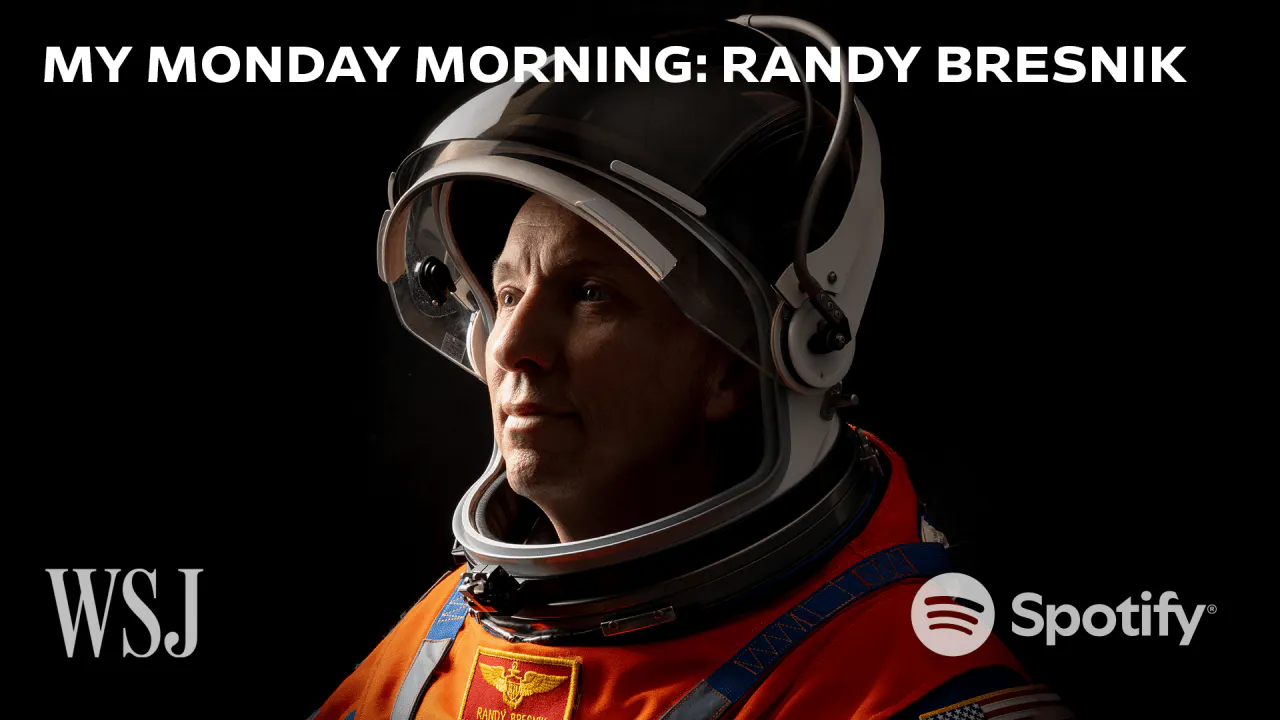
“I'm Randy Breznik and this is my Monday morning. Astronaut Randy Breznik is leading NASA's Artemis 3 mission into space next year. He's a retired marine colonel and has been to space two times before.”From the transcript
Get every episode summarized
Each time The Journal. publishes, we email you a written briefing from the transcript — the topics, who appeared, and any specific claims, with the ad reads skipped.
Email me new episodesFree for 3 shows. No card needed.
Hosts & guests

Transcript ready
285 searchable segments. Every word is indexed and playable.
Full transcript
The Journal. — My Monday Morning: Randy Bresnik. Machine-transcribed; use the interactive transcript above to jump the player to any line.
I'm Randy Breznik and this is my Monday morning. Astronaut Randy Breznik is leading NASA's Artemis 3 mission into space next year. He's a retired marine colonel and has been to space two times before. His daughter was born on the day he first walked in space in 2009. Artemis 3 will build off of the huge success of Artemis 2 earlier this year and Randy will lead a crew of astronauts, Andre Douglas, Luca Parmitano and Frank Rubio onboard the Orion spaceship next year. And NASA's ultimate goal with these missions is getting humans back on the moon. For his Monday morning, Randy told me what it's like to wake up in space and why it's the best sleep he's ever had. I'm Lane Florsche, and that's coming up after the break.
This episode is presented by Accenture. When your advertising operations fall out of sync, everything else follows. Spotify and Accenture are working together to reinvent the rhythm of ad sales, using automation, analytics and smarter workflows to simplify campaign delivery and access better data across the business. The result? Less time spent on operations, more time connecting brands with the moments and fandoms that matter most. Learn more at Accenture.com slash Spotify. This episode is supported by Anthropic, the public benefit corporation behind Claude. People have hard questions about AI. What happens to jobs, whether they're kids end up better off, and Thropic asked over 100,000 people their thoughts on AI and is tracking in public what it does about them, and where they might not have the answer just yet. There's hope in hard questions. Ask yours at Claude.ai slash the journal. I've interviewed a lot of people for this and never asked for not, so I can't wait to
hear about your routines and how you start the week. I'm happy to meet you Lane and looking forward to the conversation. We ask about routines in this show and I think that a lot of people are going to be really interested to hear about the routine of a NASA astronaut and how you start your week, especially as you're prepping for this big mission. I was wondering what does a Monday morning look like for you? Well, here on Earth, before the mission, my preparation starts a little bit Sunday, making sure I know what I'm doing on Monday. I guess I've got either the gear, the uniforms, food, whatever it is I need, where to go. Monday morning doing my five most important things, and this is my Monday morning, five must-haves. First is wake up and give my wife a kiss and say, good morning. Number two, get my daughter a hug when she comes downstairs and gets ready to go to school. Number three, pet my dog's guy. Number four feet, my dog's guy. And then sit and have a quiet moment as I have breakfast and thank God for another day.
Anything about this jobs and astronauts is it varies every single day, every single week. You know, training goes from being in a simulator that has computer screens and we're integrated with mission control to being in a simulator that's more of a mockup, where we're actually in our spacesuits and we're in the vehicle, we're actually on our backs as if we're taking off or landing. And even just yesterday, we were in our spacesuits doing an egress if we had to get out quickly on the ground over the water. Number four is actually taking a class on a particular guidance or navigation type of thing or learning about our science experiments or learning how to take my own blood samples. It is such a neat wide variety of stuff that you just never boring. It's always challenging. You're always learning something. Everybody feels a belonging. They feel that they are contributing and that's what drives us all. I mean, that sounds so special. To go back a little bit into the morning, do you have a go-to breakfast that you like to eat?
Are you a coffee drinker? I don't drink coffee or tea. So by morning breakfast is a breakfast shake. I've been doing that since literally since I was in high school. And then it's off to the work. Most days I try and get to the gym before I get to work so that way I can just have get the best part of the day. I started off at the beginning and then I see people leaving the gym and getting ready to head to the office and say, OK, the best part of the day is over now. But we go into the work and do all the exciting stuff that has to do with learning or making the space program work, supporting the people that are in space right now. Sometimes that can go later than normal hours. But we try to keep most work between the eight to five hours on Monday and Friday. How do these routines change when you're in space? How does going to sleep and waking up work in space do you set an alarm clock? We do. I mean, the first part is, is going to sleep. You're not pulling back the covers, laying down the bed, having gravity hold you there
and pull the covers back on top. Get comfortable with the pillow and get comfortable with the blankets. You don't push it on your toes. In space, you set up your sleeping bag and kind of tie the corners to where it will float. And then you float into the bag and zip it up. And then your body is just floating in the bag. And so to me, that is the most comfortable position I've ever been in sleeping and I sleep great. It is absolutely awesome because I have nothing touching or moving my body or making it uncomfortable. But the part of the edge is a little bit different. Is that you can put stuff down, you put your watch down, your glasses or drink of water next year, nightstand next to your bed. In space, you put something down and it floats off. So you've got to have stuff either with Velcro on it, you've got to have a little bag where you put everything and keep tracking everything. So the routine is a little different. The morning you wake up, I want to have my wife there to give a good morning kiss to with the start. So I'll be unfortunate. I think you've seen Luca and Frank and Dre great humans, but we won't be kissing them in
space. And so then it is float out of the sleeping bag. Go ahead and put the sleeping bag away. You've got to get changed into your work clothes for the day. Use the restroom that we have. And then somebody's got to get up and get the food going for breakfast because it takes time to fill up the dehydrated food or other things like that with water and then put them in the food warmer until we can eat a meal. And then it's going to a one time little area. Think of the size of a king size bed and four people living and working in that space with a little bit of overhead for days. You have to coordinate with your buddies to stay out of their way while they're trying to go use the facilities to get changed and all that. And so we're ready to start the day on time and then pull them up to the displays and we're right and see it checking the vehicle systems, making sure things working okay. Checking the timeline for what we have to do that day. Sitting up quick and forth, you know, maybe you guys do an interview with us while we're in space and we have to set up the cameras and the audio and the scene that we're
self-dressed for and get ready for it. So there's every day is different. Obviously they're both important days for this mission but the ones where we are able to look up on our system and see that we have a target vehicle and we have something to rendezvous with and we're going to watch a spec in the horizon be it closer, it becomes a shape and that shape becomes a spacecraft. And that spacecraft becomes something that we can see the docking hatch on and a docking hatch is something that few hours later we're actually docking our spacecraft to and joining putting the hooks out, putting the two vehicles together and then executing the joint operations. Wow, I mean that just sounds incredible. And I can't believe that this is the follow-up question that my brain is going to but you mentioned heating up breakfast and I was wondering and the dehydrated food and I was wondering what's the best breakfast in space? Ooh, we've had two of our four food tastings and your taste buds, your change over time and certainly change in space. When I came around this time kind of familiar and reminded me of taste that I liked and
things that stood out as those times, things that I want to take with me are certainly that the sausage patties were really good and flavorful and then there's like a kind of a breakfast granola cereal, kind of a cereal crunch. I was like I think I'm going to have that more than one day out of the spec because that came across as a really good taste and something that's strong enough to overcome the blandness that sometimes you get in your taste buds when you're in space. Coming up, Brandy talks about his leadership style. AI is moving fast across the enterprise. But without visibility, it's just chaos, different tools, different models, different teams using AI in completely different ways. Service now turns that chaos into control. With the AI control tower, you see all your AI across the business in one place. What it's doing, what it's done, and what it's about to do. So you stay in control.
To put AI to work for people, visit ServiceNow.com. People disagree about a lot in this country. Taxes, healthcare, education. But wherever you land politically, I think most of us agree on this. Better information leads to better decisions. That's the mission of USAFACs to make government data clear and accessible because public data should be easy to access trust and understand. So we can use it to make informed decisions. Read and sign our open letter to support public data at USAFACs.org. The mission is scheduled for next year ahead of the amazing success of Artemis 2 this year. I believe you'll be in space for about two weeks. And not to be too on the nose, but I was wondering, what is your North Star for this mission? What's your goal? Our North Star is at Daimling the Follow-On missions. Being successful in the mission elements and parts of the profile that allows the buy-down
risk so we can safely land humans on the room on the very next mission. How do you think about or define your leadership style? Like what's the most important consideration when you're leading people in space? Taking care of your people. It's that simple. I come from, you know, it was 25 years in the Marine Corps and you can't accomplish anything by yourself of this magnitude. And my definition of leadership is the art of getting things done through people. And so whether that is the crew members on my flight or through the lead flight director and the folks that are in mission control, manage the consoles of all the different systems or it's working with the programs that provide the vehicles and the hardware and the science that we're going to be doing on the mission, it all comes down to people working together and a unified effort towards accomplishing the mission. And so if you take care of the people, then the people take care of the mission. And in a high-risk job like this, how do you stay calm?
Fortunately, most of us have had backgrounds where we've had high-risk jobs or we just have life experiences that have taught us how to compartmentalize. And so, you know, there's the compartmentalization aspect and not worrying about things beyond your control. There's the trust factor that we all have working with the people that are building on rockets, designing on rockets, you know, operating on rockets, knowing that they are consumable professionals to the absolute best that they can and that they're going to put the best product for us to trust our lives to go to space. And then, you know, lastly, it's training. Being familiar with the tasks we're going to do, so that when we go to do them, we're just floating. You know, we look down and we see the earth instead of the floor of a training building and knowing that if we just execute what we train, then we're going to accomplish tasks that we have. And so, all those things put together really give you a sense of peace and calmness and the real emotions you get is this excitement of, wow, look down at the earth, you know,
seeing America as you come over the coastline from west to east, you know, seeing the Florida Keys as you exit the bottom corner on a descending node and seeing the beauty of them as you then head across the Atlantic. I mean, just all these things that add to the joy and allow you to just take in some moments of pleasure and mental joy as you execute the timeline of the mission. Well, kind of on that note. I know that NASA has been live streaming more of their recent missions and I was wondering how do you feel about doing your job on camera with a lot of people watching? Well, certainly, even when you're here training or anything like that, you always, somebody's always watching. And so, fortunately, by the time you get assigned to a space life, you've gone through training in a bunch of different areas and many different areas. And so, you become comfortable with it, you know, and so certainly, it was neat to see Artemis II be able to have the connectivity and the bandwidth of the comm systems to be able to send down, you know, a lot more continuous images and videos of what was going on, which
allowed the public to, you know, the public call it the world to be engaged. And you know, I used that as an ignition event for them to be, you know, really had their passions ignited and follow, follow the space flight. And so certainly, we're ready for that to continue that momentum to show people what, you know, humans can do in space, what the capabilities of these great American spacecraft are. And so, we hope to convey, you know, a mission that is successful that shows humans working together in harmony and shows us unified in the purpose of, you know, getting humans to the moon as soon as possible. What are some of the fun things that we can expect to see you doing space? For example, I saw this great photo of you on a previous mission eating personal pizzas with several other astronauts. We won't unfortunately have the pizza making, you know, opportunities in the small capsule ride. I mean, fun things. The first one is going to be, you know, Frank and Luke and I seeing Andre Douglas in space and his experience of that for the first time.
That is always one of those joyful things to see another human feel weightlessness. Look out the window and see the horizon. It's always been flat their whole life turning to horizon, the style curved. And you have them go around the earth and, you know, hour and a half and have them realize it, wow, I'm going tens of thousands of miles an hour. And I just ran over on the whole planet in under two hours. I mean, you can't even get, you know, in a cross-town traffic and most of our major cities in that amount of time. And so that's certainly number one. When we do an earth-option base, it's certainly being able to see a blue origin lander, you know, up in space and get close to it and dock with it. And enter that's going to be an amazing opportunity. The first time we've had humans inside of a lunar lander, you know, since 1972 and the Apollo 17. And for all of you to see, you know, the blue origin lander launch, you'll see that it's us launch. And then a few days later, see the SpaceX Starship launch. To be able to see all these launchers, all coordinate in space, get together.
That's what's going to buy down a lot of risk for the follow-on mission. And we're actually brought to be with lunar lander in lunar orbit to be able to take humans down to the surface. That is so cool. This being your third spaceflight, I was wondering, are there any rituals or habits that you've brought into all of your spaceflights? Certainly, I always have taken items with me that were personal items that meant a lot to me. Whether it was for my wife or for my kids. You know, one of them was something I took on a previous flight that was meant for my Southern return to 18. And to be able to give him that two and years later and him understand that, wow, they kind of put some thought in effort into this. This was like five, six years ago that they planned this and did this for me. I think it made it mean more to him. So, taking things that are memorable and important to me and my family are certainly wonderful things. But I think more importantly, all of us crew members will have those types of things.
But be able to go up and represent the country. That will be the part that really gives us a lot of satisfaction and knowing that we are contributing to the evolution of human spaceflight exploration. Thank you so much for joining us for my Monday morning. Happy Monday. My Monday morning is part of the journal, which is a co-production of Spotify Studios and the Wall Street Journal. I'm Lane Floreshime and we'll be back with another episode of my Monday morning next week. Follow us on Spotify or wherever you get your podcasts. And follow me on Instagram, at Lane Floreshime, for more behind the scenes stuff for my Monday morning and to let me know what you think of the show. This episode was produced by Jiva Kavarma and edited by Catherine Brewer and Sarah Platt. Video production by Nathan Singapak, original music by Nathan Singapak. Thanks so much for joining us.
This episode is brought to you by Born in Roma fragrances by Valentino Beauty, the iconic fragrance duo. Donna Born in Roma Ode to Parfume is a feminine fragrance featuring juicy black current, central jasmine, woody cashmurren, and warm vanilla. Its masculine counterpart, Womow Born in Roma Ode to Dualet, has notes of fresh violet leaf, aromatic sage, green vetiver, spicy ginger, and mineral salt. Shop at macy's.com.
More episodes
More from The Journal.

How Cocaine Is Flooding Into Europe
The Journal.
The Vigilante Taking Down Job Scammers
The Journal.
Our Reporter Tried Meta’s Viral AI Agent. Should You?
The Journal.
How China Swiped the Secret to American Blueberries
The Journal.