Get every episode summarized
Each time Backwoods Bigfoot Stories publishes, we email you a written briefing from the transcript — the topics, who appeared, and any specific claims, with the ad reads skipped.
Email me new episodesFree for 3 shows. No card needed.
About this episode
“If you like YouTube, you'll love YouTube Premium. Hi, I'm Sean Evans from Hot Ones and I want to tell you about YouTube Premium. It has offline downloads, so you can watch without Wi-Fi. Background play, so you can lock your phone and it still plays, baby.”From the transcript
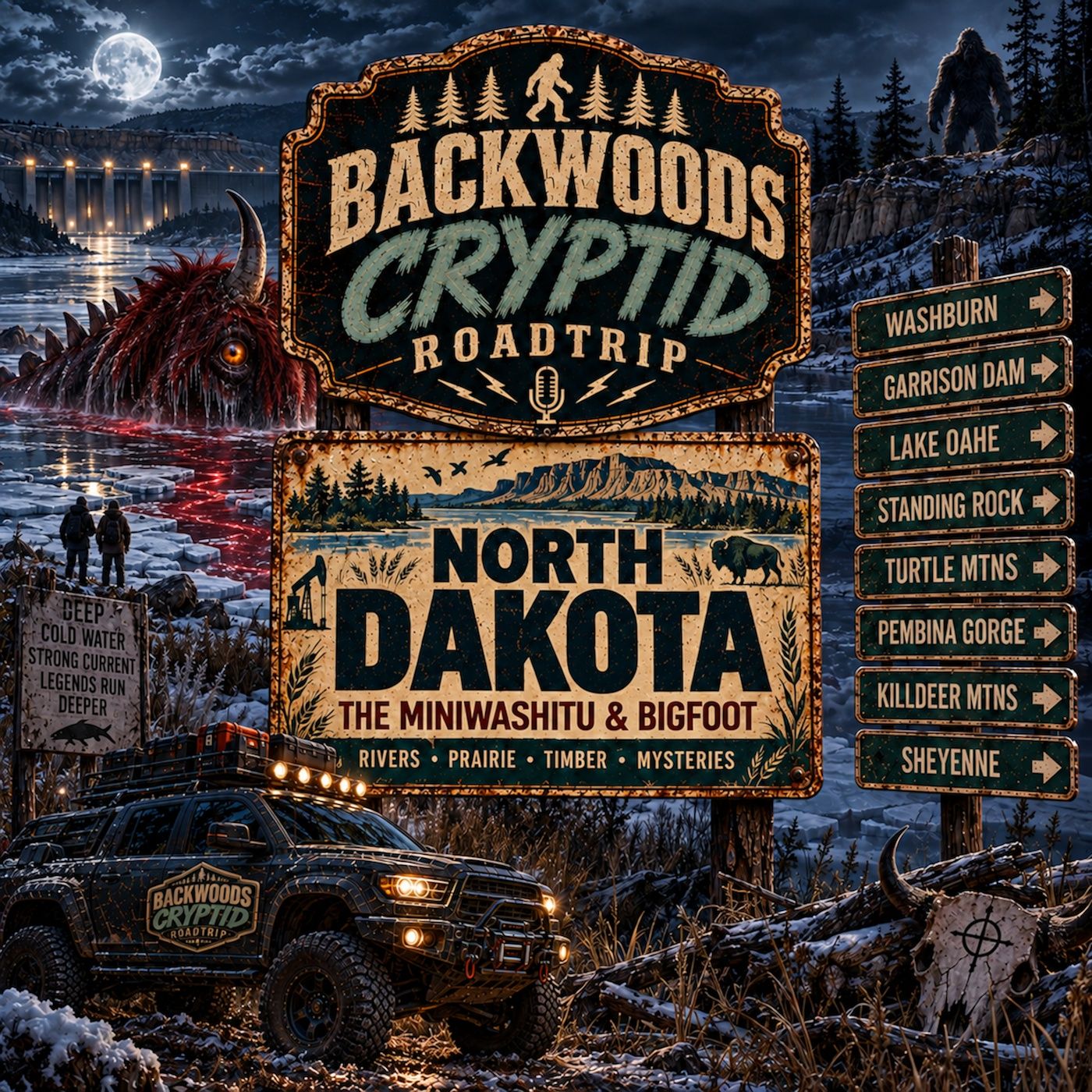
On this stop of the Backwoods Cryptid Road Trip, Brian heads into North Dakota and follows the Missouri River in search of one of the strangest creatures ever recorded in the folklore of the northern plains: the Miniwashitu.
More than a century ago, ethnologist Melvin Randolph Gilmore wrote of a mysterious being said to live beneath the Missouri. Covered in red hair like a buffalo, with a single eye, one horn, and a jagged backbone resembling the teeth of an enormous saw, the Miniwashitu was believed to swim upstream each spring as the river broke apart.
Witnesses were said to hear its terrible roar, see a strange redness trailing through the water, and know better than to look directly at it in daylight.According to the story Gilmore preserved, the last man who did was struck blind, lost his reason, and died soon afterward.
From that chilling piece of recorded folklore, Brian travels the Missouri and the reservoirs connected to it through five unsettling accounts involving something moving upstream beneath breaking ice. A nine-year-old girl watches a saw-toothed back rise from the river north of Washburn. A worker below Garrison Dam sees an enormous red-haired form tear through an ice jam. Teenagers on Standing Rock watch a red glow moving beneath frozen Lake Oahe. Kayakers encounter something impossibly large fighting the Missouri's current.
And an ice fisherman feels the frozen lake rise beneath his feet before hearing a roar coming through the ice.Then the episode leaves the water behind.North Dakota may be known for open prairie, but its river bottoms, wooded valleys, badlands, and scattered forests have produced another kind of report.
Brian heads into the Turtle Mountains, Pembina Gorge, Missouri River bottoms, Killdeer Mountains, and Sheyenne Valley for five accounts of enormous upright, hair-covered figures seen by hunters, riders, ranch hands, and families.
Along the way, Brian also reflects on the unexplained things he's encountered on his own property in the Appalachian woods—footprints, strange nighttime vocalizations, bent saplings, tree structures, and rock stacks—and why stories from people who encounter something impossible in familiar country hit differently once you've experienced something you can't easily explain yourself.
From something roaring beneath the Missouri River ice to massive figures watching from the timber, North Dakota may be one of the most unexpected—and unsettling—stops on the entire road trip.
Email Brian
Join Our FREE Newsletter
Get Brian's Books
Leave Us A Voicemail
Visit Our Website
Have you experienced a Bigfoot sighting, Sasquatch encounter, Dogman experience, UFO sighting, or any unexplained cryptid or paranormal event deep in the woods? We want to hear your story.
Email your encounter to [email protected] for a chance to be featured on a future episode of Backwoods Bigfoot Stories.
Backwoods Bigfoot Stories is a paranormal storytelling podcast featuring real Bigfoot encounters, Sasquatch sightings, Dogman reports, cryptid experiences, and true scary stories from the backwoods.
Follow the show and turn on automatic downloads so you never miss a chilling encounter from the forest. Listen with the lights off… if you dare.
Get every episode summarized
Each time Backwoods Bigfoot Stories publishes, we email you a written briefing from the transcript — the topics, who appeared, and any specific claims, with the ad reads skipped.
Email me new episodesFree for 3 shows. No card needed.
Hosts & guests
Transcript ready
898 searchable segments. Every word is indexed and playable.
Full transcript
Backwoods Bigfoot Stories — North Dakota: Miniwashitu & Bigfoot. Machine-transcribed; use the interactive transcript above to jump the player to any line.
If you like YouTube, you'll love YouTube Premium. Hi, I'm Sean Evans from Hot Ones and I want to tell you about YouTube Premium. It has offline downloads, so you can watch without Wi-Fi. Background play, so you can lock your phone and it still plays, baby. Oh, and it is completely ad-free. Yes, I said it, ad-free. Try YouTube Premium for two months free at youtube.com slash premium. Trial eligibility varies, terms apply, cancel anytime. McDonald's is putting value back on the menu. Whether you're craving a big mac, McNuggets or sausage egg and cheese McGrittle's, make it a meal and save. Your favorite is now your wallet's favorite too. Extra value meals are back. Sun rises, prices fall, get a sausage McMuthin with egg or sausage egg and cheese McGrittle's small hot coffee and hash frowns for just six dollars. Price and participation may vary, promotion pricing may be lower than meal pricing. For a limited time in McDonald's, get a big mac extra value meal for $8.
That means to all beef patty special sauce lettuce, cheese, pickles, onions on a sesame seed bun. And medium fries and a drink. We may need to change that jingle. Price and participation may vary. For decades, people have disappeared in the woods without a trace. Some blame wild animals. Others whisper of creatures the world refuses to believe in. But those who have survived, they know the truth. Welcome to Backwood's Bigfoot Stories, where we share real encounters with the things lurking in the darkness. Bigfoot, dogman, UFOs and creatures that defy explanation. Some make it out. Others aren't so lucky. Are you ready? Because once you hear these stories, you'll never walk in the woods alone again. So grab your flashlight, stay close, and remember, some things in the woods don't want to be found. Hit that follow or subscribe button, turn on auto downloads, and let's head off into the woods if you dare.
Every spring, the Missouri River in North Dakota tears itself apart. It starts with a sound. People who live along the water say you hear it before you see anything. A crack that runs for a mile, then a groan, then a boom like a shotgun, going off inside a barn. The ice that's held the river shut since December starts to move. Slabs the size of a house right up over each other and grind. The whole surface, three feet thick in places, six in others, breaks in heaves and starts downstream. And for a few days, the river sounds like something big, is loose in it. Along that river, in a book printed more than a hundred years ago, there's a story about what's doing the breaking. It swims upstream against the current, and it has a back like a saw. It's covered in red hair, and it roars. And the people who told that story to the man who wrote it down said one more thing. Don't look at it, not in daylight. Because the last man who did came home blind, and then he lost his mind, and then he died.
We've come up out of Nebraska on Highway 83, straight north through the sand hills, and across the South Dakota line, and the country's flattened and opened even more than it already had. This is the next stop on the road trip, and we're going to spend most of it on the water. Where I live, the ridges close in on you. Down home in Appalachia, deep in the woods, you can go a whole day and not see more than a hundred yards in any direction. You learn the country by sound. A rock kicked loose on a slope above you. A limb that cracks with nothing to crack it. A call from the next hollow over that doesn't belong to anything you can name. That's where this show gets made. In a studio at the end of a gravel road with timber on all four sides. North Dakota is the opposite of that, and the drive in makes you feel it. There's nothing here to stand in front of the sky. You cross the Missouri at Bismarck on a bridge that's longer than some towns I've lived in, and the river underneath it is wide and brown and slow.
And along both banks there's a line of cottonwoods that runs off in both directions until it's just a smudge. That line of trees is the only real timber for a long way. Everything else is wheat and pasture, and the occasional shelter belt somebody's grandfather planted to keep the wind off the house. So it's the river. Everything in this episode comes back to the river. The Missouri here isn't the river it was. In the 1950s the Army Corps of Engineers built Garrison Dam upstream of Bismarck, and it backed the water up into Lake Sacaca, near 200 miles of reservoir. Downstream they built a Y in South Dakota, and that lake reaches all the way back up into North Dakota. So the free running stretch of the Missouri and the state is really just the piece between the two dams. From Riverdale down past Bismarck and Mandin to somewhere around the cannonball, about 80 miles of open river, still wide, still brown, still cold, and still freezing solid every winter, and still breaking up every spring.
That breakup is where this starts. In 1921 a man named Melvin Randolph Gilmore published a small book called Prairie Smoke. Gilmore was a curator at the North Dakota State Historical Society for a few years, and before that he'd spent a long time working with the native nations of the Upper Missouri, writing down how they used the plants of the Prairie, how they lived on the river, what they told him. Prairie Smoke was his attempt to put some of what he'd been told into a book a regular person could read. It went through more than one edition. The one most people quote is from 1929. There's a short passage in it, not much more than a page, and it's where the many wash-a-toe comes from, as far as the written record goes. He wrote that in the long ago there was a mysterious being within the stream of the Missouri River. It was seldom seen by people, and it was dreadful to see. Sometimes it was seen in the water in the middle of the stream, and where it passed there was a redness in the water, shining like fire as it went upstream against the current, with a terrific roaring sound.
If anyone saw it in the daytime, that person soon went mad, and stayed restless and riving as if in pain, until death came and relieved them. Then Gilmore wrote that one time, not so many years before, a man had seen it, and had lived long enough to tell how it looked. The man said it was of strange form and covered all over with hair like a buffalo, but red. It had one eye in the middle of its forehead, and above the eye a single horn. Its backbone stood out, notched, and jagged like an enormous saw. As soon as the man saw it, everything went dark to him. He was just able to get home. He lost his reason, and soon after that he died. Gilmore closed the passage by writing that the miniwashi-tu was said to still live in the Missouri, and that in spring, as it moved upstream against the current, it broke up the ice of the river. That's it. That's the whole of the written source, and everything anybody's printed about the creature in the century since has been built on those few paragraphs.
Gilmore didn't name the person who told him the story, and he didn't name the nation the story came from in that passage. His work on the upper Missouri was mostly with the Dakota, the Mandin, the Hadatsa, and the Arakara, and the word itself is Dakota. Mini is water. Later writers have mostly called it a Dakota story, and a few have called it Mandin, and the book doesn't settle it. What the book does make plain is that this wasn't a monster in the way a lake monster in Nebraska is a monster. Something a newspaper man could invent for a slow week. It's a being with a place in the year. It belongs to the breakup. When the river opens in March and April and the ice starts moving, that's the miniwashi-tu going upstream, and the sound the ice makes is the sound it makes. The single eye and the single horn, and the red hair belong to a kind of being that shows up in the traditions of a lot of the river nations. Water beings with horns.
Powerful, dangerous to look at. Tied to specific rivers and lakes. They aren't one being, and the nations they belong to don't treat them as one. The miniwashi-tu is the Missouri's. That's as far as Gilmore takes it. The rule that matters most, or what follows, is the one about seeing it. Gilmore's informant didn't say it attacked anybody. Didn't say it took livestock or pulled a man under. What it did was be seen. And being seen was enough. Blindness. Then madness. Then death. The man in the story didn't run from it. He looked at it and went home. That rule and the roar and the red in the water and the timing. Break up. Spring. The ice going out. Those are the pieces. And for the last hundred years, often on, people along that river have described one or another of those pieces, without ever having heard of Melvin Gilmore or his book. We started in 1961.
Lorraine was nine, the year her father told her not to look at the river. Her family had a place on the east bank of the Missouri north of Washburn, a farm that ran down to the bottoms where the cottonwoods were. And her father cut his firewood down there every March when the ground was still frozen hard enough to get the wagon in an hour. In 1961, the ice went out early. She remembers that because they'd been down cutting wood the week before. And the river had been white and still all the way across. And when they went back on a Saturday morning, it was moving. Her father heard it first. She said they'd just gotten the team stopped at the wood pile. And he put his hand up. And they both stood there. And from downstream came a sound she'd never heard before. It was low and it went on a long time. She said it was like a bull bellowing but stretched out. And under it there was the ice, cracking and grinding. And the two sounds were coming together. So she couldn't have told you which was which. Her father told her to get up on the wagon seat and turn around and look at the horses.
She asked him why. He said because he said so. She got up on the seat and then she did what any nine-year-old does when they're told not to look at something. She turned her head and looked. The river was about 200 yards from where the wagon stood. And the ice was in pieces. Big flat slabs of it riding down on the current and piling up against the band. In the middle of the channel, going the wrong way, going upstream, there was a line of broken water. The ice was coming apart ahead of it, splitting and lifting the way a board splits ahead of an axe. And the thing that was splitting it was under the surface. She could see a back, a long hump of it, dark, wet. And along the top of the hump there was a ridge that stuck up out of the water and points. She said it looked like a row of teeth on a saw blade. But each tooth was as tall as a fence post. And they were moving, going by, one after another. The sun was low behind them and it was shining on the water. And where the light hit the back she said it was red.
A dull red, like rust on a piece of iron. She watched it go by. She watched the teeth go past for as long as it would take to count to 20. And then the last one went by, and the water closed, and the ice slid back together over the place. The roaring stopped. The ice kept grinding. Her father was standing between her and the river with his back to her. And when it was quiet, he turned around and saw where she was looking. He didn't say anything. He got up on the wagon and turned the team and drove them back up out of the bottoms without cutting a stick of wood. And the wood they'd already stacked stayed down there until May. That night at supper he told her mother that the river had gone out. Her mother asked if he'd got the wood and he said no. And that was the end of it at the table. Lorraine wrote the rest of it herself, years later. That spring her father's eyes started giving him trouble. He'd always had good eyes. By summer he couldn't read the paper without holding it at arm's length. And by fall he'd quit driving at night.
The doctor in Bismarck said it was cataracts and he was young for it. But it happened. He had the surgery in 1964 and it helped some. She said that when she was grown and he was old, she asked him once whether he'd looked at the river that day. And he said he'd seen enough of it. And he changed the subject. He never told her what he'd heard about it or from whom. She said he was the kind of man who'd have heard a lot of things working the river bottoms his whole life. But he wouldn't have passed a one of them onto anyone. She's 74 now. She lives in mind it. She said she's never once in her life put a boat on the Missouri and her husband fished it for 40 years and could never get her to go. The breakup on the free running stretch below Garrison Dam isn't what it used to be. Because the dam holds the water steady and the ice doesn't get the chance to build the way it did when the river ran wild. But below the dam in the tail race and the first miles downstream toward Washburn and Stanton, it's still freezes and it still goes out and in 1974, Gene was there when it did.
He worked for the Corps at Garrison. He'd been there about 10 years on the maintenance side. And part of the spring routine was checking the shoreline below the powerhouse for ice damage after the breakup, walking the rip wrap along the bank and noting anything that had shifted or washed out. It was late March. He was alone. The crew had split up to cover more ground and he'd drawn the stretch on the West Bank about a mile down from the dam, where the river's still narrow and fast before it spreads out. The ice had gone the night before and there was a jam at a bend below him. A pile of slabs shoved up against a sand bar, maybe 20 feet high at the top of the pile, and the water was backing up behind it and running over it in sheets. He heard it from the jam. He was standing on the rip wrap with his clipboard and the sound came up out of the pile of ice and it wasn't the ice. He'd been listening to ice all morning. He said this was an animal. It was a roar, one long roar, and it had a vibration in it he felt through his boots.
And it went on long enough that he had time to set the clipboard down on a rock and straighten up and look. The jam moved. The middle of it lifted. A section of the pile as big as a garage rising straight up like something underneath had stood up. And the slabs slid off it on both sides and went into the water. And in the gap where the ice had been there was a back. It was broad, wider than the dump truck the crew drove. And the water was pouring off it and it was covered in something that wasn't scales and wasn't skin. He said it was hair, long, matted. The color of a red cow that's been out in the weather all winter and it lay flat where the water was running through it and stood up in clumps where it wasn't. Down the middle of the back there was a ridge. He said the ridge was bone or looked like bone. And it came up through the hair and a row of points. And the points were jagged and uneven the way a saw gets when it's old and half the teeth are broke. He guessed the tallest of them at three feet. He didn't see the head.
The front of it was upstream pointed into the current. And the back was rising and the head must have been under. He didn't see the tail either. What he saw was about 30 feet of back and spine rising out of an ice jam in the tail race of Garrison Dam. And then it went forward. It drove into the rest of the jam and the whole pile came apart. The sound of that was bigger than the roar. Slabs the size of cars going over and splitting. And the thing went through the middle of it going upstream toward the dam. And the water where it went was red. He was clear that the water was red. He said it wasn't the animal's color reflected. He said it was the water, a cloud of it. The way water goes brown when you kick up the bottom. Except this was red and it hung in the current behind the thing for a hundred yards. Then it went under. The back went down. The spine went down last, tooth by tooth. And the river closed and the jam was gone and the water started running clean through where it had been.
Stay tuned for more Backwood's Bigfoot Stories. We'll be back after these messages. For a limited time in McDonald's, get a Big Mac extra value meal for $8. That means to all beef patty special sauce lettuce cheese pickles onions on a sesame seed bun. And medium fries and a drink. We may need to change that jingle. Price and with the Swiss Yumei Vary. Your sausage Mcbuffin with egg didn't change. Your receipt did. The sausage Mcbuffin with egg extra value meal includes a hash brown and a small coffee for just $5. Only at McDonald's for limited time. Price and with the Swiss Yumei Vary. For a limited time in McDonald's, get a Big Mac extra value meal for $8. That means to all beef patty special sauce lettuce cheese pickles onions on a sesame seed bun. And medium fries and a drink. We may need to change that jingle. Price and with the Swiss Yumei Vary. He stood there a while. He picked up the clipboard and it was wet. And he couldn't remember setting it in the water. He walked back up to the truck.
The next morning he went back down to the same stretch with two other men from the crew. Because the jam letting go had to be logged. And the bend was clear and the sand bar was scoured down to gravel. One of the other men, an older hand who'd been on the river since before the dam was finished, stood at the edge of the water and looked upstream for a while. And then asked Jean if he'd been down here when it went. Jean said yes. The man asked if he'd seen anything. Jean said no. The man nodded and said good. And went back to the truck. And Jean said he's never known to this day what the man meant by it. He didn't write it up. There was a line on the form for unusual conditions and he wrote that the jam below the bend had let go on its own. Which it had. That summer his eyes went. It started as a blur at the edges. And by August he was seeing double. And by the next spring he couldn't pass the physical for the job. The doctors in Bismarck and then in Minneapolis called it a degeneration and said it wasn't the kind you usually see in a man of 45.
He took a disability retirement in 1976. He's been legally blind since the 80s. Marcus grew up on the Standing Rock Reservation, on the North Dakota side, and the river was the edge of everything. His grandmother raised him. She'd been born on the river before the dam, before O'aw filled up the bottoms and drowned the old towns in the timber. And she had rules about the water. There were a lot of them. And most of them were the kind of thing a grandmother says. Don't swim after you eat. Don't go down there alone after dark. But one of them was different. And she gave it to him every year at the same time in March, when the ice started to go. She said, don't look at the river when it's breaking up. He asked her why when he was little and she said, because something's going up it. And it's not for us to see. He asked what it was. She said it was old. And it had a name. She said it broke the ice for the river every spring, and that was its job. And if a person saw it doing its job, that person would be sorry.
That's how she said it. Sorry. And then she'd tell him again the next year. In 1988, he was 15. The reservoir doesn't break up the way the river used to, because it's a lake now. And the ice goes out slow and rotten, instead of all at once. But that year there'd been a warm week and then a hard freeze and then warm again. And the ice on a y below fort Yates was cracked and shifting. And one night in the middle of March, he and two friends drove down to the shore to drink beer where nobody would find them. The moon was up. The ice was making noise out on the lake, popping and groaning. And they sat on the tailgate and listened to it. And it was fine. It was just the ice. Then one of the other boys said, what's that? Out on the lake, maybe a quarter mile off, there was a light under the ice. He said it was red. It was a red glow, the size of a truck moving under the surface. And the ice over it was lit from beneath so the cracks in it showed dark against the glow. And it was going north.
Going up the lake, going upstream toward where the river came in. The two boys he was with stood up and watched it. He turned around and looked at the truck. He sat on the tailgate with his back to the lake and looked at the cab of his friends pick up. And the two of them stood behind him and narrated it. And he listened. They said it was getting closer to shore. They said the ice was breaking up over it, heaving up in slabs and falling back. One of them said he could see it now. That it wasn't a light. It was a thing. And it was red. And it had a back like a saw. The other one said there was a horn. He said one horn, sticking up out of the water ahead of the back. And it was long and curved. And it was white against the red. Then there was a roar. And he heard that with his back turned. And it went right through him. And he got down off the tailgate and got into the truck and shut the door. The other two got in a minute later and they drove home. The one who'd seen the horn. The one who'd watched it longest and described the most was a boy named Andy.
Andy joined the army that fall. And in 1991 in the Gulf, he was in a truck that rolled. And he came home with a head injury. And he was never right after. And he went through his mother in Fort Yates for 20 years and mostly didn't talk. He died in 2012. Marcus didn't say that one thing caused the other. He said Andy looked at it and he didn't. And Andy's dead and he isn't. And his grandmother would have said that was the whole story. He's 53. He still lives on Standing Rock. He said he tells his own grandchildren the same thing every March. And they roll their eyes at him the way he rolled his at her. In April of 2007, Cheryl and her husband Rick and a friend of theirs named Paul put two kayaks and a canoe in the Missouri at the boat ramp below Fort Abraham Lincoln State Park. South of Mandant for the first float of the season. The ice had been out for two weeks. The water was high and cold and fast. Snow melt off the whole upper basin coming through. And they'd all paddled that stretch enough times to know it.
They were going to go down past the mouth of the heart and take out at a landing eight or nine miles south. And easy afternoon. It was a Sunday. There wasn't anybody else on the river. About four miles down where the channel swings east around a big island of cottonwood and willow. Paul was in the lead in his kayak and he stopped paddling. Cheryl said he held his paddle up crossways over his head, which was the signal they used for a log or a snag ahead. And she and Rick and the canoe back paddled to hold position. And then she heard what Paul had heard. It came from around the island from the channel on the far side where they couldn't see. She said it was a bellow. Deep, rolling, going on for 10 or 15 seconds and then stopping and then starting again. She said the closest thing she could compare it to was a bull elk in the fall except it was lower and bigger. And it wasn't an elk because there aren't any on the Missouri south of Mandan and because the sound had water in it. She said it sounded like the bellow was coming up through water.
Paul started to paddle again toward it. Rick called to him and he didn't stop. They followed him around the point of the island because there wasn't anything else to do. And the far channel opened up ahead of them wide and brown and running hard. And in the middle of it something was going upstream. Her first thought was that it was a tree. A whole cottonwood roots an all that had come down in the high water. Except it was going the wrong way. It was moving up the river against a current that was running at least four miles an hour. And it was leaving a wake behind it. A big V of disturbed water. And in the middle of the V, sticking up, there were points. She said a row of points, dark, jagged, sticking up out of the water two or three feet and running back along the length of it. And the length of it was longer than their three boats and to end. She said the points were moving up and down a little as it went. The way a swimming animal's back rises and falls. She didn't see the front of it. It was too far ahead and there was too much spray.
The water around it looked wrong. In the sun, the wake behind it had a color in it. A red, like somebody had poured a bucket of paint into the river. And it was washing out downstream. Paul was ahead of them and closer. He'd stopped paddling and was drifting. And he was leaning forward in the kayak, looking. Rick called to him again. And this time Paul turned his kayak and came back toward them and said, we're getting off the river. They put in on the island. They pulled the boats up into the willows and stood there. And the thing went on upstream and out of sight around the next band. And the bellowing went with it and got fainter and quit. Cheryl said the three of them stood on that island for an hour before anybody would get back in a boat. Paul wouldn't say what he'd seen. She said Rick asked him twice on the island and again at the takeout. And Paul said he'd seen the same thing they had. And Rick said, no, you were closer. And Paul said, drop it. Six weeks later in June, Paul had a stroke.
He was 52 and in good shape. And there was nothing in his history to point to it. It took his speech and most of the use of his right side. He lived another four years in a care home in Bismarck. Cheryl said she visited him and he'd hold her hand. And he couldn't talk. And she never asked him again. She said she doesn't connect the two things. And then she said she'd be lying if she said she didn't. She and Rick still paddle. They go to Minnesota. Delbert ran a hardware store in Linton for 30 years. And in the winter of 1995, he was ice fishing Lake O'ah. Near the Beaver Bay area on the east shore in February. When the lake was still hard and it was well before any breakup. It was a Friday night. He'd set up a shanty out about 300 yards from shore over a point where he'd caught walleye before. And he had a lantern going and a heater and a couple of lines down. He was alone. The wind was up out of the northwest. And the ice was talking the way it does in the cold.
Cracks running off across the lake with a sound like a rifle shot. He'd been out about two hours when the ice under the shanty moved. It wasn't a crack. He'd felt cracks. The floor of the shanty tilted. The hole sheet under him lifting on one side and inch or two and settling back. And the lantern swung on its hook. And his lines went slack in the holes. And then it did it again. He got the shanty door open and looked out. The lake was dark except for the moon. And out toward the main channel. Half a mile off. The ice was lit up from underneath. There was a red glow under it. Long, longer than the shanty by ten times. And it was moving north, up the lake, slowly. And the ice over it was heaving. He watched a slab tilt up on edge. A slab he guessed at 40 feet across and slide back down into the water with a crash. He heard a second after he saw it. Then it roared. He'd been a farm kid and he'd heard every animal that lives in that country.
And this was a bull. It was the sound a bull makes when it's worked up. When it's pawing and blowing. And it was that sound turned up until it came through the ice into the souls of his boots. It roared twice with a gap between. And then the glow kept moving north and the ice kept breaking over it. And after a few minutes it was too far up the lake to see. And the sound of the ice breaking faded out. He stood in the door of that shanty with the lantern behind him. And he said the last thing he saw was the horn. It was a long way off. He said the ice had broken open and something came up through and held there a second. It was standing up maybe six feet above the water and then it went down. He said it looked like a horn on a bull turned upright. One horn in the middle. He said he was too far to see anything else and he's glad of that. He pulled his lines. He left the shanty and the heater and the lantern and walked to shore in the dark and drove home to Linton. And he went back for the gear on Sunday in daylight with his son-in-law.
And the shanty was where he'd left it. And the ice out toward the channel was broken and re-frosen in a jumble for a half mile in a line running north. His son-in-law asked him what had done that. He said a pressure ridge. His son-in-law, who'd fished that lake his whole life, said he'd never seen a pressure ridge that looked like a plowed field. Dilbert sold the store in 2001 and moved to Fargo to be near his daughter. He never fished a while again and he never told his wife why. And she passed in 2009 not knowing. He told his son-in-law the whole thing at her funeral in the church basement over ham sandwiches. His son-in-law listened to it and said I figured as much. And then went back for more potato salad. None of them got a photograph and there's no such thing as a track and a river. What runs through all five accounts is the same handful of details Gilmore's informant gave him a hundred years ago. The upstream direction, the breakup, the roar, the sawtoothed back, and the red and the water.
And the rule about looking, which not one of them had read in a book and which most of them broke. Now we get out of the water and into the trees. And in North Dakota that takes some doing. I've said before on this show that I live deep in the Appalachian woods and I'll say again what that means in practice. It means I found footprints on our property that I couldn't put to any animal I know. And I've been around every animal that lives in those hills for most of my life. It means I've heard vocalizations at night from the ridge above the house that weren't coyote and weren't owl and weren't a person. It means I've walked up on tree structures back in the timber. Saplings bent over and locked together and ways the wind doesn't do. And I found rock stacks along the creek that nobody in my family built. I don't know what all of that adds up to. But it's there. And when I read an account from somebody who saw one of these things in the open. I read it as a man who's heard them in the dark.
North Dakota doesn't have my kind of woods. What it has are the river valleys and a few high places where the timber grows. The Missouri bottoms, cottonwood and willow. Thick as a jungle in July. The Cheyenne winding down through the eastern half of the state in a valley with oak and bass wood on the slopes. The Pembina, up against the Canadian line cutting a gorge through the escarpment that's the only real forest in that corner. The Turtle Mountains, which aren't mountains, just a hump of glacial hills covered in aspen and oak and dotted with a few hundred small lakes, straddling the border north of Botanow. And out west, the badlands along the little Missouri and the Kildir Mountains, which are buttes with juniper and ash on the slopes and box elder in the draws. Stay tuned for more backwoods big foot stories. We'll be back after these messages. Your sausage McBuffin with egg didn't change. You're receded. The sausage McBuffin with egg extra value meal includes a hash brown and a small coffee for just $5.
Only at McDonald's for limited time. Price and British Swishy Mayberry. Have you heard that McDonald's spicy chicken McNuggets made with spicy tempura and a blend of aged cayenne are back? Remember to grab a few extra napkins. Ba da ba ba ba for limited time and for disparaging McDonald's. Right now at Subway, try the 499 Sub of the day. Get a different 6 inch sub every day for just 499 each, like meatball marinara on Mondays, tuna on Tuesdays, and the BMT on Saturdays. It's a different 6 inch sub every day, packed with protein and your choice of chopped veggies for just 499 each. Or make it a meal with chips and a drink for just $2 more. But hurry, it's only for a limited time and only at Subway. At participating restaurants, prices higher in Washington, Alaska, and Hawaii and on third party delivery, add on taxes and fees for delivery additional. That's where the reports come from. They come from those lines and pockets of timber and from nowhere else because there is nowhere else.
Wayne had a deer tag for the Turtle Mountains in November of 1979. And he was hunting a piece of state land near Lake Metagosh that his brother-in-law had told him about. The Turtle Mountains in November are gray. The Aspen's Bayer, the oaks holding onto its brown leaves, and the ground between the trees is a mat of leaf litter and dead fall. And there's usually a little snow in the low spots that never melts once it's down. Wayne had walked in from a section road at first light and set up on a stand he'd built the day before. A plank nailed between two oaks on a rise above a slew. And he'd been sitting about an hour when he heard something walking on the far side of the water. It was walking on two feet. He'd been hunting deer for 20 years and he knew what four feet sounded like and leaves. And this was two. A heavy step and then another and a pause. Coming along the far shore of the slew through the cat-tails. And he put his rifle up and looked through the scope and waited for a man to come out into the open.
What came out was seven and a half feet tall. He said he was sure of the height because it walked past a dead Aspen that he'd sighted in on the day before. A snag he'd used to range distance. And he'd guest the snag at eight feet and the things head was just under the top of it. It was dark brown, almost black, and the hair on it was long, five or six inches, hanging off the arms and the back of the legs, and shorter on the chest. It was walking along the edge of the slew with its head down, watching where it stepped in the mud. Its arms were hanging loose and swinging and he said the hands came down past the knees. He said it was built like a man who'd spent his whole life carrying a barrel. Wide through the shoulders and thick through the middle with no waste to it. He watched it through the scope for a long time. He said a minute at least. It went along the far shore, about 90 yards from him. And at the end of the slew where the cat-tails gave out, it stopped and stood up straight and turned its head and looked across the water at his rise.
The face was flat and dark. The eyes were set deep under a brow that stuck out. The nose was wide and pushed in, and there wasn't any neck. The head sat on the shoulders like a stump on a block. It looked at his stand, right at it. And he had the cross hairs on its chest, and he took his finger off the trigger and laid it along the guard. And it turned and went into the aspen on the far side. And he heard it walking for a while. And then he didn't. He sat on the plank until noon. Then he climbed down and walked around the slew to where it had stood. The mud at the end of the cat-tails was soft and there were two prints in it, side by side, where it had stopped and stood. And he said they were 16 inches long if they were an inch. He'd brought a tape measure for the antlers of the deer he didn't get. He measured them. 16 and a half and 16 and a quarter. And seven inches across at the ball. And five toes. The mud was pressed down so hard and smooth at the bottom that the outline of the toes was clean.
He didn't have a camera. He cut a stick to the length of the print and carried it out. He told his brother-in-law that night. His brother-in-law said, so you saw him too. And Wayne said, what do you mean too? And his brother-in-law said he'd seen it at that same slew two years before, walking the same shoreline. And he hadn't said anything because who would he say it to? Wayne hunted the turtle mountains for 30 more years. He never saw it again. He said the stick is in his garage and mine it, on a nail over the workbench. And his kids think it's for measuring something else. Kristen was riding a four wheeler on the trails in the Pimbena Gorge in September of 2012, on a Saturday, with two friends. And she was the last one in the line. The gorge is steep. The river has cut down through the escarpment about 400 feet. And the slopes are covered in oak and elm and aspen. And the trail system runs along the sides and dips down to the river in a few places and back up.
It's the biggest stretch of unbroken timber in the state. And people who've never been to North Dakota don't believe it's there. They'd come down one of the trails to a crossing where the rivers shallow and gravel bottomed and you can forward it on a machine. And the two friends had gone across and up the far bank. And Kristen had stopped at the water because her four wheeler had stalled. She got it started again. She was sitting on it in the shallows with the engine running, looking up the trail on the far side where the other two had gone. And she happened to look downstream. There was something standing in the river about 100 yards down. At a bend where the water's deeper and the banks undercut. It was standing in the water up to its thighs, facing away from her, bent over. And it was doing something with its hands under the surface. She said it was the same color as the bank behind it, a grey brown like river mud. And that's why she hadn't seen it right off. And it was big. She said she was on a four wheeler and her head was a good five feet off the water.
And the thing bent over at the waist had its back higher than her head. She sat there with the engine running and it didn't turn around. It stayed bent over and its arms were moving under the water. And then it straightened up and it had something in one hand. And it looked at it. She said it held its hand up near its face and looked at whatever it had. And then it put its hand to its mouth. Then it bent over and went back to feeling around on the bottom. She got a good look at the back of the head and the shoulders while it was standing straight. She said the hair on the head was longer than on the body. And it came down onto the shoulders. And the shoulders were wider than a doorway. And the arms were hanging down at the sides. And the elbows were below where a person's hips would be. She said the head was pointed on top. Not sharp. But there was a ridge running front to back over the crown. And the hair lay along it. It never turned around. She watched it for close to two minutes. And it fished the bottom of the pembina the whole time.
And twice more it brought something up and ate it. And then her friend on the far bank hollered down for her to come on. And it heard that. It stood straight up and turned its head toward the sound. And she saw the side of the face for a second. The jaw came forward and the brow stuck out. And the whole profile was flatter than a person's. Then it walked out of the water. It went up the far bank, the undercut side, in two steps. And into the arms. And it didn't hurry. She drove across the Ford and up the trail and caught up with her friends and didn't say anything. She said she couldn't have made her mouth work. They rode another hour and went home. And she told them in the parking lot at the trail head. And one of them laughed and one of them didn't. The one who didn't drove back down there with her the next weekend. They walked to the band. The gravel bar on the inside of the band had been turned over. Rocks flipped and piled the way they'd be. Something had been picking through them for crawfish. In a strip about 10 feet long.
There were no tracks on the gravel. On the bank above were the Elm start. The friend found a place where the leaves were pressed flat. And the grass was laid over in a line going up the slope. A path, she said, about two feet wide. They didn't follow it. Kristen still rides the gorge. She doesn't stop at the Ford. She said her four wheelers never stalled again. And she wishes it hadn't that day. Tom was bow-hunting the Missouri bottom south of Bismarck in October of 1996. On private land near Huff that his family had leased for deer for a long time. The bottoms down there are a maze. Old channels and slews and cottonwood stands that were islands once. With willow thickets between them so dense you crawl through them. And the deer live in there and move at dawn and dusk between the timber and the beans up on the bench. Tom had a stand in a cottonwood at the edge of a slew where a deer trail came out of the willows, 15 feet up. And he'd climbed into it in the dark and was sitting there at first light waiting for the doves to come through.
He heard the deer come before he saw them. They were three, coming along the trail from the willows at a walk. And they came out into the open and stopped. And they weren't looking at them. They were looking back the way they'd come. They bolted. All three, straight across the slew, splashing and up the far bank and gone. And Tom stayed still because he thought a coyote was pushing them. What came out of the willows on the deer trail was walking upright. It was black and it was covered in hair. And it was tall enough that when it passed under the limb of a cottonwood that he'd guessed at seven feet off the ground, it ducked. It ducked its head under the limb the way a tall man does going through a door he's been through before, without looking. And straightened back up on the other side. It was twenty yards from him. He was fifteen feet up in a tree and it walked under him. And he could smell it. He said it smelled like a wet dog that had been rolling in something dead. And it was strong enough that he breathed through his mouth.
He looked down on the top of its head. He said the hair on the crown was parted in the middle. And lay down both sides like a man's hair that's grown out. And he could see a line of skin in the part, dark gray. The shoulders were rounded and heavy in the arms swung. And he could see the hands. And the hands were open with the fingers slightly curled. And the palms were lighter than the backs. He said the thumbs were where thumbs go. It walked along the edge of the slew where the deer had crossed and stopped where they'd gone into the water. It stood there. It looked across at the far bank where the deer had gone. And then it squatted down at the water's edge and put one hand in the water and held it there. And then took it out and shook it and stood back up. Then it looked up. It looked straight up into the cottonwood atom. And he was looking straight down at it. And the face was dark. And the eyes were the color of the rest of the face. So dark he couldn't see where the pupil stopped. And the mouth was closed and wide.
He said it looked at him the way you'd look at a bird's nest. Then it turned and walked back along the trail into the willows the way it had come. And he heard the branches moving for about a minute and then it was quiet. He climbed down at full light. The trail out of the willows was deer packed and hard and there wasn't much on it. But at the water's edge where it had squatted, there was one print in the mud, a right foot. He measured it against his own boot and it was twice as long and twice as wide. He hunted that stand two more years. He said he never saw it again but that the deer stopped using that trail. And that in the second year he found a place in the willows about 200 yards from the stand, where six or eight saplings had been bent over and woven into each other at head height, and arch of them. And he walked under it and stood on the other side and looked back at it for a while. Tom 61. He wrote that he still hunts the bottoms and he still climbs into that cottonwood some mornings. And it's the only stand where he leaves the bow in the case and just sits.
Ray was working cattle on a ranch below the Kildir Mountains in June of 2003. And it was the middle of the day when he saw it, which he said is what makes it hard for people to swallow. The Kildirs rise up out of the prairie and Duncownie. Two flat-topped buttes with a saddle between them and they're covered in juniper and green ash and box elder in the draws. And there's water in them, springs, which is why the ranches around them have grass when the country around is burned off. Ray was 30 and he'd been on that ranch for four years. He was moving a bunch of pears from one pasture to another along the base of the south butte on horseback, alone. And it was two in the afternoon and hot. The cattle wouldn't go. He'd pushed them up a draw toward a gate and they'd stopped at the mouth of the draw and bunched and wouldn't take another step. And the cows were bawling and the calves were tucked in under them and he rode around to the front to see what was in the draw. It was standing in the ash trees about 80 yards up the draw in the shade and it was watching the cattle.
It was standing sideways to him, looking down at the cows and it was reddish brown, the color of a red angus. And the sun was coming through the ash leaves and dappling it so it was hard to see the outline. What he could see was that it was standing on two legs and it was taller than he was sitting on a horse. The horse's ears went flat and the horse started backing up on its own and he let it. The thing turned its head and looked at him. He said the face was lighter than the body, a tan and bear. And the eyes were big and dark and set wide and there was a heavy ridge over them. It had a mouth like a person's but much wider. Then it opened its mouth and it made a sound. He said it was a bark, one short bark, deep, like a big dog but lower. And every cow in the bunch behind him turned and ran back down the draw the way they'd come. Caves and all. And he sat on a backing horse and watched it. It didn't come toward him.
It took one step out of the ash into the sun and he saw all of it for a second. The chest was wide and flat and the hair on it was thinner so we could see the shape of the muscle. The belly stuck out some. The legs were thick, thicker than a man's and the feet were flat and wide and the toes spread on the rock. Then it turned around and went up the draw at a walk, up toward the base of the butte and he watched it go until the junipers took it. The horse wouldn't go up that draw. He got off and let it and it said its feet and wouldn't be led so he tied it to a fence post and walked up alone, which he said was stupid. And about where the thing had been standing he found the ground under the ash trees torn up. Not tracks. Torn up. Like something had been sitting there and shifting around for a long time. And there was hair on the bark of one of the ash trees. About six feet up, reddish. A tough of it caught in a crack in the bark. He pulled it off and put it in a shirt pocket and then he thought about it and put it back on the bark where he'd found it.
He said he didn't want it. He got the cattle through the gate the next day by going around the long way. He told the owner of the ranch that night. The owner was in his seventies and had been on that place his whole life and he listened. And then he said that the old people had a name for that and that the killdeers had always had things in them and that the ranch had lost a calf or two a year for as long as he could remember to something that wasn't coyotes and that he'd never wanted to know what. Stay tuned for more Backwood's Big Foot Stories. We'll be back after these messages. McDonald's is putting value back on the menu. Whether you're craving a Big Mac, McNuggets or sausage egg and cheese, MacGriddles, make it a meal and save. Your favorite is now your wallet's favorite too. Extra value meals are back. Sun rises, prices fall, get a sausage McMuffin with egg or sausage egg and cheese MacGriddles, small hot coffee and hash frowns for just six dollars. Price and participation may vary, promotion pricing may be lower than meal pricing.
Bada bada bada. Some days you just want to amplify your everyday look. Like when you want the look of false lashes without the extra effort, reach for thrive cosmetics, liquid lash, volume eyes, or mascara. Or when you want all eyes on your smile, keep empowered gloss ultra glossy lip serum in your bag. It's a burst of 24 hour hydration that smooths like a serum, shines like a gloss, and can be worn sheer or layered. You'll always look and feel your best with thrive cosmetics. Plus, every product is 100% vegan, cruelty free, and made with clean skin loving ingredients that work with your skin, not against it. Amplify your everyday. Go to thrivecosmetics.com slash shine26 for an exclusive offer of 20% off your first order. That's thrive cosmetics. C-A-U-S-E-M-E-T-I-C-S dot com slash shine26. McDonald's is putting value back on the menu. Whether you're craving a big Mac, McNuggets or sausage egg and cheese MacGriddles, make it a meal and save. Your favorite is now your wallet's favorite too.
Extra value meals are back. Sun rises, prices fall. Get a sausage McMuffin with egg or sausage egg and cheese MacGriddles, small hot coffee and hash frowns for just $6. Price and participation may vary. Promotion pricing may be lower than meal pricing. Ray said the owner never brought it up again and neither did he. He left that ranch in 2006. He's cowboyed all over the western half of the state since. He said he won't take a job in Dunn County. And he's turned down too. And the people hiring don't know why. And he doesn't tell them. Dorothy's is the oldest of these and she was 79 when she wrote it out. Her family farmed on the Cheyenne River near Fort Ransom in the southeast part of the state. And the farm ran down to the river bottoms, which on the Cheyenne are oak and bass wood and elm. Hardwoods. Some of the only hardwood timber in that part of the country. In August of 1968, she was 21 and home for the summer.
And her folks had gone to a wedding in Lisbon and she was alone in the house. She had the porch light on and the windows open. It was about 10 at night. She was reading in the front room and the dog started barking. And the dog was a farm collie that barked at everything so she didn't get up. Then the dog stopped barking. The dog came in through the screen door, which it never did. And went under the kitchen table and lay down and shook. She got up and went to the door. The yard light was on. A big mercury light on a pole by the machine shed. And it lit the yard in the edge of the garden and the first row of the shelter belt. And standing at the edge of the shelter belt in the light was something upright. It was standing beside a cottonwood in the belt that she'd climbed as a girl. And she knew the lowest limb on that tree came to her father's shoulder. And the thing's shoulder was above the limb by a foot. It was dark brown. It was covered in hair, long on the arms and shoulders, shorter on the chest and face.
And it was standing with its weight on one leg. Easy. The way a man stands leaning on a fence. And it was looking at the house. She could see its face. The light was good and it was maybe 40 yards off. The face was dark and flat and the mouth was wide and the eyes reflected the yard light. A dull green, the way a deer's due. And they were far apart and they were on her. She stood behind the screen door in her nightgown and it stood by the cottonwood and they looked at each other. It moved its head. She said it tilted its head to one side. The way a dog does when it hears something it doesn't understand. And held it there. And then straightened it. Then it lifted one arm and put its hand on the cottonwood, flat, palm on the bark, at the height of the low limb. And stood like that for a while with its hand on her tree. Then it took the hand down and turned and walked into the shelter belt. And she heard it going through the caragonna on the far side and out into the wheat.
She didn't call anybody. There wasn't anybody to call. And the phone was a party line. And she wasn't going to say it on a party line. She locked the door, which they never did. And sat up in the front room with the light on and the collie under the table. And her folks came home at one in the morning and she told them. And her father got the flashlight and went out to the cottonwood. He came back in and set the flashlight on the table and said there was mud on the tree. There was a mud print on the bark of that cottonwood. A hand at the height of the low limb with the fingers spread. And the fingers were as long as his hand. He'd measured it with his own. He'd get a ladder and cut the bark off in the morning and keep it. In the morning it had rained and the mud was washed off. And there was nothing on the tree. Her mother, when she heard it, asked whether it had come toward the house. And Dorothy said no. It had stood at the belt and looked and gone. Her mother said then it wasn't interested in the house. It was interested in her and went to bed.
Dorothy said that was the only thing her mother ever said about it. Then or after. Her father took the collie out to the belt and the collie wouldn't go in. He walked the far side along the wheat and found where the wheat was knocked down and a line going west toward the river. And he followed it to the bottoms and lost it in the oak. She married in 1970 and moved to Valley City and she's lived there since. The farm's been out of the family for 30 years. She drove past it a few summers ago and the shelter belts still there. And the cottonwood still there. And she pulled over and looked at it from the road for a while. We'll end where we started. The Missouri is low and brown and quiet. The way it is in September. There isn't much of anything on it but a couple of pelicans and a man and a John boat working the far shore. The ice is four months off. It'll come. And it'll lock the river up from bank to bank. And sometime in March it'll go out. And it'll make the sound that Lorraine's father heard and Jean heard and Delbert felt through his boots.
Whatever's under it going upstream or whatever isn't, the sound will be the same. Melvin Gilmore wrote down what he was told and what he was told was that the thing in the river has a job. And the job is to break the ice. And it's been doing it since before anybody was here to hear it. The people who told him that had a rule about it and the rule was simple. And the last man who broke it made it home and no further. Lorraine's still in mind it. Jean's in Bismarck and can't see well enough to read this. Marcus tells his grandkids every March. The river doesn't care about any of that. It'll freeze and it'll break and it'll roar. If you've got a siding, a story, or a stop you want me to add to the map, reach me via email at Brian at ParanormalWorldProductions.com. Until the next stop, watch the water and when it breaks in the spring. Maybe don't watch too close. There comes a point when a little extra support can create a lot more freedom.
At Kingsley Manor, residents receive personalized assistance while continuing to enjoy an active, connected lifestyle surrounded by friends, opportunities and the energy of Los Angeles. It's a community designed to help you focus less on daily challenges and more on living each day with purpose. Learn more at KingsleyManner.org. That's KingsleyManner.org.
More episodes
More from Backwoods Bigfoot Stories

North Carolina: Bigfoot & The Beast
Backwoods Bigfoot Stories

Bigfoot & The Wild Tales of Appalachia
Backwoods Bigfoot Stories

New York: Champ Meets Bigfoot
Backwoods Bigfoot Stories

Bigfoot Mailbag
Backwoods Bigfoot Stories