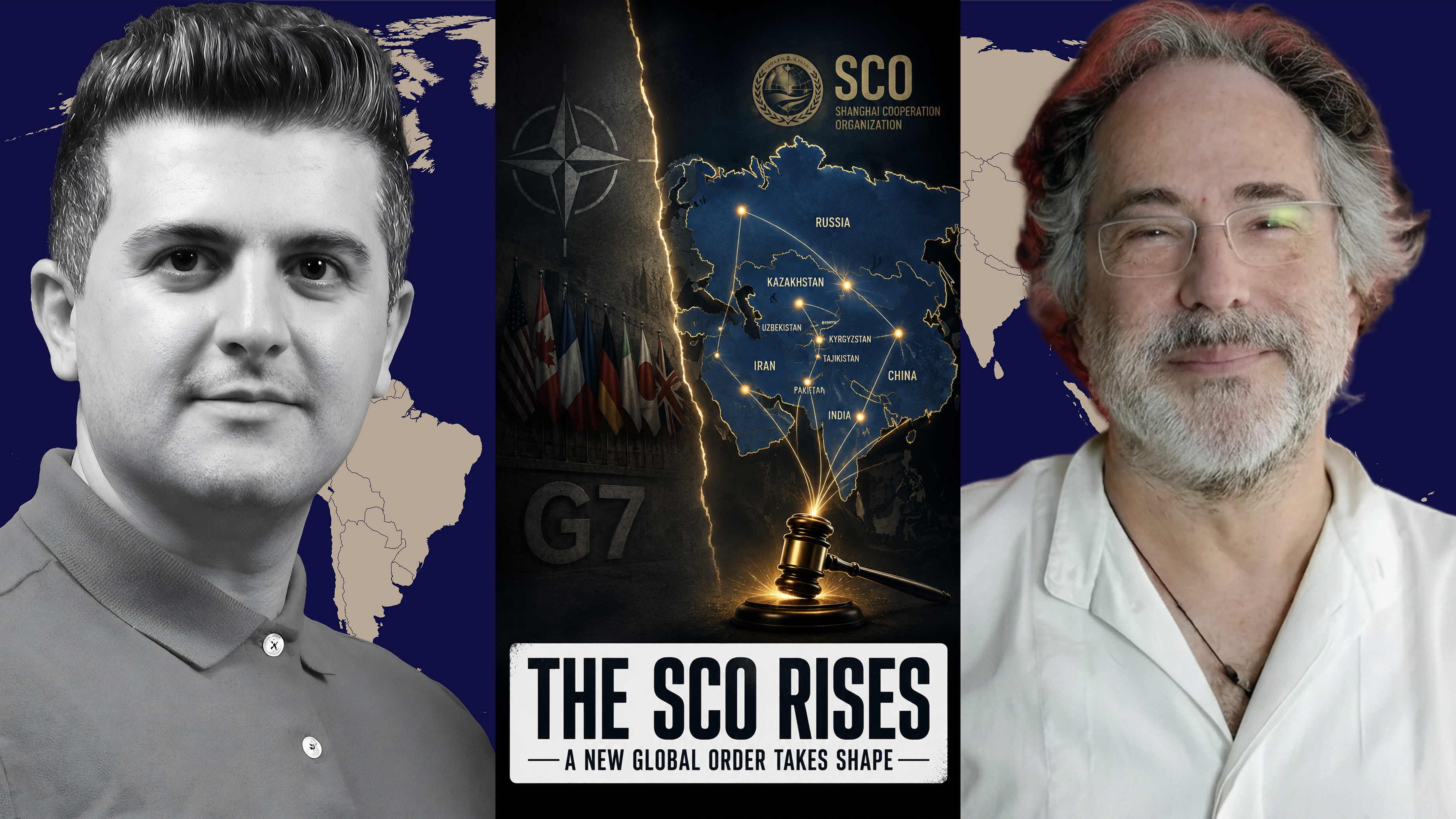
Pepe Escobar: The SCO Just Hammered Home a New Reality: What the Summit Really Decided
About this episode
Hosted on Acast. See acast.com/privacy for more information.
Get every episode summarized
Each time Dialogue Works publishes, we email you a written briefing from the transcript — the topics, who appeared, and any specific claims, with the ad reads skipped.
Email me new episodesFree for 3 shows. No card needed.
Hosts & guests
Transcript ready
462 searchable segments. Every word is indexed and playable.
Full transcript
Dialogue Works — Pepe Escobar: The SCO Just Hammered Home a New Reality: What the Summit Really Decided. Machine-transcribed; use the interactive transcript above to jump the player to any line.
I already today's Thursday September 30th, 2026 and our dear friend, a rather peppy scobo, I'll see you with us. Welcome back, peppy. Well, now I'm okay because I'm with you. Before that I wasn't hell. Not to do bay. The Brazilian way of greeting each other. To the bay. So now we know that Nima is whoops, piercing cool. Peppy, let's start with the SEO summit in Bishkek, Kyrgyzstan. Which was totally ignored in the mainstream media in the West. Nobody basically mentioned nothing, nothing about what has happened there.
What is your understanding of that and how did you find the way that there were meetings by lateral meetings, talks between Iran and Russia, between Russia and China. India was there. Later on we've seen Turkey was there. They had a joint statement altogether. And what is your understanding of what has happened and the importance of that for the ongoing sanctions on Russia and Iran and basically for these two wars? Well, I wrote a long column about it but the Russians can be sometimes. They haven't published it yet. And I sent them yesterday afternoon. Well, so I'm going to try to summarize the start of my column. Because then you have an idea of how important this summit was. And in connection to the Vladivostok summit, which is, well, until a few minutes ago,
it was the Putin Q&A in Vladivostok. It probably ended a little while ago or is ending now. It's eight times in Russia, as we speak. Well, last year, the SEO summit was in Tianjin. So last year I followed them back to back, which almost brought me to tears this year because I could not go because of private, you know, other commitments. And I'm going to South Korea tomorrow. So I could not go to Kyrgyzstan and then Vladivostok. Unfortunately, but I was buried into both until today, for the whole week, starting on Monday. So last year, and I was, of course, comparing to what happened last year where there were very, very important summits back to back once again. First in Tianjin hosted by China and then in Vladivostok.
So Tianjin was the summit where the SEO came to life, really. It was probably the most important SEO summit of them all last year, under the Chinese as hosts. After all, they started this organization, which in the beginning was called Shanghai Five. And the Shanghai Five were Russia, China, and three Central Asian stands, Uzbekistan came later. And this was very, very important. And I never ceased to stress that to all of you. Founded three months before 9.11 in June 2001. I was following very closely because at the time I was in Hong Kong, and I was getting ready to go to Central Asia. I was preparing myself for a long trip in Pakistan and Afghanistan. Little did I know that after that there will be 9.11.
But this was the situation in June 2001. And as many of you may remember, or if you are too young, you won't. China and Russia were not superpowers at the time. China was not even a member of the WTO, the enter the WTO, later in 2001. And Russia, of course, Putin was on his second year in power. He was elected on March 2000. I covered the election in Moscow in March 2000. And so I was getting familiarized with Russia again, after spending one month following the election that turned out to be putting elected for the first time. So this was putting in power for one year, three months, not much. And starting to put the Russian empty ducty back together, which had been completely destroyed during the Yeltsin years.
So this is the context at the time. And why would Russia, China, and three Central Asians start an organization? The first brief of the SEO, very important. And this is important for all of you to understand how today the SEO is a completely different organization, so much, much broader organization. Their first brief was we have to fight terrorism, separatism, and religious extremism. If we put this all together, what did that tell you in 2001? Al Qaeda. And obviously, both already had direct experience of Al Qaeda, Salafi Jihadis, Crazy Wahhabis, Takhfeiris, any way you want to name it, and any way you want to name the organization.
The Russians in Chechnya, and they decimated the Arab and pre-Arab preacher supported international of Salafi Jihadis and Takhfeiris in Chechnya. And the Chinese in Xinjiang, obviously, would help from MI6 and CIA. There was already a substantial brainwashed Uigur terrorist cell network around Xinjiang. And the Chinese started to go against a big, big time. And that started in 1999, two years before, when China launched the fish market. Just mentioning Peppy, these are the years that Russia was involved in some sort of internal war with Chechnya since 2000. You're absolutely right. That's why I mentioned Chechnya.
So, our audience, you can make the connection between Chechnya at the end of the millennium, beginning of the new millennium, and Xinjiang, the same thing. There were very similar problems because they were both fighting Al Qaeda-style terrorist networks. And then, later on, I had direct confirmation. When I was in the Pamir Valley, sorry, sorry, when I was in the Hindu Kush waiting for to interview a commander bassoon, they took the demoja heading, took me to their prisons. And guess what I found in Masood's prisons? Chechens, Uigurs, and Central Asians. All of them, Salafi Jihadis, Al Qaeda members, former Al Qaeda, crypto-al Qaeda, TAK-Feedis, you name it. And they were fighting against Masood, side by side with the Taliban and Al Qaeda.
And I even managed to interview some of these people at the time. So, this helped me to put together, because I was trying to put together the whole terrorist situation from Xinjiang to Afghanistan and Pakistan and then Russia. So, for us foreigners, it takes quite a while to do that. And there's no other way for you to do it except going there. So, this is exactly how I was doing. I was going everywhere to try to put the jigsaw puzzle together. Okay, so, SEO, three months before 9-11, they already knew that they had to fight all that. So, when 9-11 happened, it confirmed that they were right on top of it. Regardless of what Al Qaeda involved in 9-11 or not, that's another question for, nobody has solved this problem yet.
There's no definitive answers about it. But, for instance, it was I was hearing from Masood himself. This was his last interview. And he told me Al Qaeda, side by side with the Taliban, they're going to come up with something. So, he already knew there was something in the air. And of course, Masood had good Russian intel. And Masood had good Iranian intel as well. So, the Russians and Iranians knew that something, but nobody knew exactly what was really, really weird. And then, when I arrived in Peshawar, capital of the tribal areas in Pakistan, I was handed the information on a plate like this. Why? Because it was not America. And I had made a network of connections from Islamabad to Peshawar. And they told me, look, the Americans are going to send a commando inside Afghanistan to
snatch Osama bin Laden and take him to the United States. This was just mentioning Pepe, sorry for interrupting you. Masood, you mean Ahmad Shah Masood? Of course, Ahmad Shah Masood, the Lion of the Pangeer, who was by the way assassinated. I'm sure many of you will remember the story. Masood was assassinated on September 9. I got a first text on my phone from one of my connections in Afghanistan. And he didn't say that. The text read, the commander has been shot. And that was it. So I tried, I still had my sad phone. I tried to talk to them. Absolutely impossible. We only learned two days later that in fact, he was killed. He was assassinated. And two days later, guess what? It was the day of 9.
Which was a tragedy for the whole region, to be honest. You're absolutely right, Nima. It was a tragedy for the planet, but especially for the whole, for this part of Eurasia as my whole. If everyone, from the Arab world to the Pashtuns, to the tribal areas, to South Asia, everywhere, to Xinjiang, to Western China, everywhere. But okay, the SGOs are already on the game. So they started to perfect their intel and exchange the intel on the moves of this, let's say, Al Qaeda style network all across the region. So this is basically what they did in the years 2000. In the years 2000 and then, they started to upgrade as a regional organization. They had more members.
Soon they had India and Pakistan being admitted as member, full members at the same time. So they started to grow. And of course, they started to think about doing business. And this is something I remember very well. If you went to a NCO round table, 10 years ago, 12 years ago, more or less, I remember very well, in St. Petersburg, for instance, at the St. Petersburg Forum. They were discussing business. They were discussing trade. They were discussing mutual investment and development, much more than terrorism and religious extremism. And you know that by that time, Al Qaeda was slowly fading or had disappeared almost completely. And now, in the third decade, after COVID, in fact, it was the big SGO push. And this push was basically formulated and concluded last year
in this big, big summit in Tianjin with China presiding. And China introducing several very, very important developments. The notion of global governance, which is something very Chinese, it's a way of governing the planet but based on the real principles in trying the new way, the new way in charter, giving a voice to everybody. And everybody is equal, end of unipolarity, productive investment, which is essentially the rationale of the Belt and Road initiative, the new Silk Road. And two ideas that are now, they were discussed earlier this week in Kyrgyzstan. And they are already rolling and we can have them established by next year. Number one, very important, and development bank.
So the SGO is going to have its own development bank, something that Putin said yesterday in his own words. He has to be totally independent from, you guess, the usual suspects. This means the dollar system. You run totally subscribes to it. You run in when Pezashkin spoke in Kyrgyzstan, not only he emphasized the creation of the development bank, but the other project, which is very ambitious, but suits all the participants. An energy consortium. Why? Because you have many very important energy producers, not only Russian, Iran, as we know, but also Kazakhstan, oil, and Turkmenistan, gas. So they should have a consortium that benefits all members and the partners as well. And many of the partners, the one who want to jump in, they need energy badly. For instance, just to give an idea, among the partners, we find Afghanistan and Turkey.
So there was a representative of Afghanistan in Kyrgyzstan, and Erdogan himself went to Kyrgyzstan because he wanted to talk to everybody. And he did. He actually talked to everybody. There were by-lattros between Turkey and everybody else. Turkey, as we know, is a partner. They want to become members, but there are serious problems because essentially, okay, cut to the chase. Nobody trusts Erdogan. There's no other way of putting it because he had just all the time. And don't forget, Turkey's NATO member. Turkey is the eastern arm of NATO implanted in Eurasia. Don't forget that Anatolia is in Eurasia. There's nothing to do with European part of Turkey. So for many of the neighbors, this poses an enormous problem. Can we get this guy in our club? So this is, of course, no decisions.
Turkey, once again, Erdogan once again said that they are dying to become full members. It's what he says about bricks as well. And he has still not been admitted as a full bricks member. So because of all these, and then we can discuss this to eternity, what are the real objectives of nail Ottomanism? What are the real objectives of the organization of Turkey states, apart being a vehicle from Turkish construction companies to build whole towns in Kazakhstan, with something that I saw by myself, not more than that. You know, so all that is very, very up in the air. But the fact that Turkey is trying to be very close to the SEO is a good sign. And just to summarize, the most important points of the Bishkek Declaration, which is basically the main points discussed in Kilgistan.
The number one point, Nima, is, I would say this is the most important one, because it was also signed by India. And it's the first time that we hear directly from Modi and from the Indian government. All SEO members, and that's unanimous, condemned the American war on Iran. This is in the Declaration. It's immensely important. This is basically the whole of the Oratia telling Trump, okay, filled in the blanks, it's up to you. Okay, other important points. They support the reform of the international financial system, which, you know, the shorthand for that is, we are going to create our own development bank for our productive development projects. And forget about the IMF and the World Bank.
They want to propel the SEO to a key role-debating global questions, means, if the UN, of course, we all know that the UN is dead. But what remains of the UN, the UN, the presence of SEO members is going to be much more forceful. And in every other multilateral organization. Another point, they refute double standards on terrorism. Well, that's more than obvious. Just look at the way Syria is being treated by the West now. Until yesterday, the guy who was the president of Syria was an al-Qaeda and ISIS throat, slitter, and had chopper. Now he puts an Hugo Boss suit and he has dinners with American generals. Talk about double standards. That's one for you. They oppose interference on sovereignty of states. I don't even need to comment. It's more than obvious. And very, very important.
They reaffirmed the indivisibility of security, which is what the Russian were trying to explain to the Americans before the start of the special military operation. The letters that the Russians sent to NATO and to the White House in December 2021, talking about indivisibility of security, basically saying, let's really go shade everything. Let's have a security pact that is convenient for Western Europe, Eastern Europe, the post-Soviet space, and all of us across the region. We all know that there was no response from the Americans. And they obviously were prodding the Europeans and NATO especially to go for a blitzkrieg against Donbas. And this was two months later. And this was the main reason that the Russians had to do something to prevent Donbas from being eviscerated. So the SEO has been on top of all of these
themes. And now it's essentially a due economic organization. So basically, let's do more and more business all among ourselves. It's fully supported by the top two powers as much as they are the drivers of bricks. Russia and China are also the drivers of the SEO. And what they presented in Kyrgyzstan, Arizona, sort of concise roadmap for the development of an integrated Eurasian. And very important, defending one of their members completely for an attack by a foreign power. Basically, in the United States, you won't be able to do this again. Forget it. Maybe this was the last time you managed to do something like this. And if you do this next time, that will be consequences. You are already paying the consequences by Iran itself and by the help that Iran gets from other SEO partners, for instance, just to cite three of them. Russia, China, and Pakistan,
which are directly helping Iran in each and every way possible. So if the Americas try another regime change operation with the SEO member, these things are going to get much, much hotter. So this is essentially why this summit was so important, even if it was not as flashy as in Tianjin last year. And complementing what's been happening in Vladivostok, especially this past today. And today with a plenary session where we had the vice president of China. We had the president of Mongolia. We had the president of Myanmar. And the president in Indonesia is a guest of honor and Vladimir Putin. So this is integration of the Oratia in different aspects, but overall is the same picture. Let's integrate east, west, north, and south of our own
mega, super, super continent with our own system, with our different system of international relations, with our own geoeconomic system of relations. And of course, defending every member from reputious for actors. So that's it. And more or less the resume and how these two summits in the same week interconnect. And I hope they are an auspicious preview to a fruitful bricks summit, which is going to be at the end of next week. So literally around the corner. For the moment as we know, bricks this year has been a total disaster. Nothing. Nothing. The engines are the management of the bricks summit this year by India is doesn't even qualify as a joke. But let's hope at the last last minute there is some turn around. And once again, Russia and
China go there and make things work. Happy the other point that was mentioned in the joint statement of the SCO was the sanctions. Continuing the sanctions against the members. Members basically they're talking about Russia and Iran. No other members if I'm and China, China is under the US tariffs. I'm under some sanctions. Absolutely. So basically they're all facing the same sort of strategy on the part of the Trump administration. But Pepe, when it comes to the operation, economic outcasts together with these new round of attacks on Iran, what is your understanding of this? Well, we don't know what they discussed in detail, Nima. Because one of one of the responses that Putin gave to a Russian journalist question, in fact, was, wow, straight to the point, he was asked
what kind of military help Russia was providing to Iran. And Putin said, military secret. And that's what it is. We have all sorts of speculation in Iran, in Russia across Eurasia, but no details. No, it's military secret. Same thing with the Chinese. For instance, we, Larry and I knew via our Pakistani mediators that China was supplying state of the art upgrades to Iran via water, via the port of water. So from Xinjiang, they will travel all the way to Guadar. And from Guadar, trucks would take it across the border. It's gabbed the border across the border point, between Iran and Pakistan, 80 kilometers from Guadar. And then
by truck, they will go whatever they needed to go in Iran. We had confirmation from that, but you can never get this kind of confirmation from the Chinese government. For them, it's their response if we ask them, will be the same thing, some military secret. But we know different sources, of course, not confirmed officially that Russia and China are helping Iran in so many different ways. And some of them up up there. So obviously, they, I'm sure they discussed that in the bilaterals. Did you see, are actually discussing with one guy, for instance, you know, and there was a direct meeting, putting Pesashkin as well. Of course, this is part, but these for both for the Russia-China strategic partnership, which by the way is the Russia-China Iran strategic partnership, because they're interlocked. These are military secrets.
Pepe, what is the understanding of the attack? Is that something they have decided because of the mines? Because Donald Trump is talking about Iran is putting the mines back into the strait. We have removed all those mines and they're getting back. We know it's bullshit. We know that everything that is on through social is bullshit by definition, not to mention when it's totally unhinged. Some opposed have, I would say, a 5% link with something real, 10%, but somewhere totally unhinged. One of them this week was, Iran is a failed state. That was something like that. How can a president of a superpower post something like this? It's not even childish. It's off the charts in terms of imbecilating stupidity, but this is what we get. So obviously, nobody pays attention to the vociferations on through social.
And this is what passes for an American executive order is a social network opposed. It's the debasement of the functions of government and of the seriousness of being ahead of state. This guy even destroyed even that. Check in here, Pepe, he said, failed nation. Very good. I prefer to pay attention to what the motion rezae is saying. This is the guy you have to pay attention to. He published something along the lines that the Americans will be plunged into the infernal deaths of hell. I love them. If this is
translated from Farsi directly, it's a brilliant image. And of course, the vice president of Iran saying, oh yeah, okay. So now our response is going to be asymmetrical and you're going to suffer much, much, much more. Your economy, American economy is going to suffer much, much more. So we are back once again to that absolutely horrible escalation ladder. And this can go worse and worse and worse in the next few days and two months, in fact. September, October before the midterms in November. And now, Neemons, even he gets even worse after the midterms. It's doing the rounds in Washington already and being discussed in think tanks. And I think it was already, it already hits something. I'm not sure if it was writers or CNN.
One of the usual suspects that Trump is considering to rent up the war between the results of the midterms and the new Senate and Congress taking power in January. So he will have a window between November and mid-January to go for an all-out war against Iran. Well, if this is being discussed in Washington, everybody in a position of power in Tehran already knows about it. So Iran is also preparing a scenario for November, January. And that tells us that this war simply will not end anytime soon. I think this is something that we can't affirm by now. Would you agree, Deema? Yeah, I do agree because Iran is preparing, what I see in Iran is that they're preparing to, to the end of the Trump administration. They're basically they don't care what Donald
Trump is talking about. And because the only way that they can get to talks or negotiation, whatever they have in their mind, it's going to be getting back to the MOU. Yes, there is no other way to get back. That's why they're preparing themselves, economically, militarily, and the tensions are somehow boiling last night we've seen Iran in attack on Kuwait and UAE. And Donald Trump says that none of our bases in the region were hit by Iran in missiles. Not even stupid people in any latitude believe in it anymore. So it's just for internal absorption of some MAGA followers. That's about it. But it's very, very worrying. It's very, very worrying in terms of the mediation channels,
they are being blown up by the Americans over and over again. Something that we learned this week, once again, Larry and I, a simmuneer, Field Marshal, who until a few days ago was the number one mediator between the Iranian leadership and Trump. He's not even answering Trump's phone calls anymore. He's fed up because he finally understood that he was being used. He was basically saying via his office to the White House, look, you begged for me to talk to Iran, get him back on the table, it's that I broke my back trying to do what you asked me. And then you blew up our channels of communication. So I'm not doing anything anymore. That's it. So the Trump administration once again, they blew up the only remaining diplomatic channel. Was the most important one by Pakistan. Qatar basically is the follow the money channel.
It's essentially those six billion dollars in Qataribags. And Oman basically is what they are discussing with, Oman doesn't have the stature to be the super mediator. They were basically discussing with the random modalities of navigation in the straightover news. They have a draft deal. Let's put it this way, which the Americans, even if they got this deal and published this, the America's wouldn't respect it. So blowing up all the diplomatic channels, what's left? Escalation ladder. And apparently Trump thinks that he can get away with an escalation ladder, not to absurd until the midterms. And he actually believes that he can win the midterms, or at least buy the midterms, or distort the midterms, or subvert the midterms. Because he's already thinking according to this Washington, or rumor mill, of going back to Total War between November and January.
So all the signs that couldn't be darker than that. But once again, Iran is prepared. Right, Nima. Give us a quick summary of the mood among the Supreme National Security Council. It's peppy. I think if the United States decides right now what we've learned that the United States is trying to attack Iran in a manner that they don't want to escalate that much to influence the global market when it comes to oil market and death. But after all, they're trying to somehow once in a while attack in Iran to see the Iranian response. The problem is peppy, the sooner or later I think with the blockade, US blockade, and Iranian ports, Iran can attack them. It's not just about the depends on... This is obvious. Whoever follows the Iranian media, the talks,
you see how the things are changing inside Iran. They say it doesn't matter if the United States attack or doesn't attack. We're going to attack them. We're going to remove the blockade by force. There is popular consensus, right Nima? There is popular consensus. Total support. You're going to be amazed. I am amazed by what's going on in Iran. You see the government, those people who are basically before the war starts. These are the far right, the more radical people you see, the people are getting more radical than the people who are in power. Absolutely. The nation is asking for escalation. The nation is like, just end it. Put an end to it by force. You have to do it. This is the reality of... The whole... Pepe, it has changed a lot inside Iran because they didn't want to start the war,
but the started the war and put pressure on Iranian people, on Iranian economy. And Donald Trump coming out saying that the last thing he said is that 100,000 people were killed in the protests and all this sort of... It's absurd what's going on with Donald Trump. Because this doesn't work anymore. People are seeing what's going on with the Trump and the enemy is Donald Trump. The blockade is Donald Trump. And the only way Pepe to get rid of that is the military. And there is no other way, at least, from what's going on. You know what's going on with the talks, messages going back and forth. Basically nothing is coming out of that. And you don't know that. Nothing. Nothing. So the mediators, they were working very, very hard. And until the last minute, they actually believed that, okay, we are resuscitating the MOU that cat. They actually
believed that. And of course, there were some encouraging signs from the Americas. Obviously, they are not talking to the usual Tweedledi, Tweedledum, Wittkov, a coach that those bloody idiots, they were talking to other people, closer to vents. And obviously, these people are slightly more rational. So they were encouraged. And there was some dialogue. They were passing information back to the Iranians. Look, the Americas might consider... So there was some sort of diplomacy going on. Suddenly, the whole thing collapses. In a matter of a day, in one day, everything collapsed. So obviously, everybody now is fed up. And this means that these players are going to start working on their own security arrangement for West Asia and South Asia as well, apart from
the Americas. And that's where the MACA defense alliance comes in. Because now it's... And some people, some leaders are looking at it. Oh, maybe this is not a bad idea. So the fact that now we have a secretariat in Saudi Arabia. And the Secretary General for the first three years, going to be a Pakistan he's going to have to be a super diplomat because he's going to link all these three with Turkey and link with... There's already a mini queue of countries who are seriously interested. Or at least, you know, examining the terrain. And if you have this fact, expanding, this is by any way you want to look at it. An alternative as security umbrella arrangement for West Asia, South Asia at
least could even include North... North and Africa if we have Egypt coming on board. So things are changing now despite the imperial dementia. This is a new element in the chess board. It's already changing the chess board. And of course, everybody is fed up with the psycho killer in in Washington. Everybody is fed up. A part of course from the desktops because they think that they can still use him for something. They had to change. Can you imagine when you see Erdogan courting everybody in Kyrgyzstan, Erdogan was practically begging everybody to listen to me. Let's stop. It's NATO. It's the most important army in NATO apart from Ukraine, which is essentially a NATO army. So, you know, we see changes. Yes, go ahead, please.
Erdogan is going to learn it the hard way in my opinion. The way that he learned from Europe, he wanted to be part of Europe for such a long time, but it's not part of Europe. And he's going to have 35. Pepe, I really believe that the F-35s are going to end up the same way. He's saying it's all about the talks. Israel would not let the United States to give them anything. Especially now that Israel already announced that Turkey is next. Exactly. There. The reason they're attacking Turkey in the Northern part of Syria is because of bringing up the tensions to show that Turkey is the enemy. So, are you going to assault those F-35s to Turkey to attack us? To do so? Turkey is so cautious in that. They have their own calculation to be honest. I'm talking about Turkey. And they are masters at hedging. They hedge everywhere. This is what they do
best. In fact, this is something that they got from the Ottomans. The Ottomans were masters at hedging as well. But, do you see, Pepe, they had the first meeting of the name, the official name of the of the Mecca is the Mecca defensive alliance. Mecca defense alliance. Yeah, the official name. Mecca defense alliance. Yeah, exactly. You see the official name they came out with in Istanbul. They had the first meeting in Istanbul before the SCO. True. Where what is happening in the eyes of Pakistan? Let's put it this way. What is the importance of that? And how does Pakistan see the future of that in the West Asia? This is what I want to ask our mediator friends next week. I didn't have the time. This week I was buried into
SCO and Vladimir So next week I want to ask them directly. Give us a briefing on how the Pakistani government is seeing their new role. And now it's a much more solid, sorry, geopolitical role. As you know, Secretary-General of Defense Alliance and as a nuclear power. And with lots of nations manifesting their interest on top of it. For them this is very, very impressive. And you could see the way they were treated in Kyrgyzstan. You could see that there are statuses much higher than before. Very, very impressive. Everybody wanted to talk to Shalif. Very, very impressive. So if they play it well, in geopolitical terms they're going to have a new
stature and they can capitalize on that because closer relations Pakistan and Turkey, which historically at least this past few decades have been very close, Saudi Arabia may be you know, may rest a little bit. As long as somebody tells them they will have to be the Pakistan is solve your problem with Yemen. If this is not solved, nothing is solved. And of course if there are other nations want to become members of the alliance, then we have serial moves in the chess board in terms of a new security arrangement. And of course, assuming that this alliance keeps very, very good close relations with Iran. That's very, very important. So far there are no bad words coming from the run about the alliance. But let's see. It depends on their moves. And of course,
Iran was according to the Pakistanis. And according to Hakkan Fidan from Turkey, they all told Iran in advance that this was going to be signed. So it was not no surprise for Iran. So this means that they are, in the case of Pakistan, they are the mediators between Iran and the US. They could possibly do this behind Iran's back out of the question. But we still don't know the long term repercussions. And of course, considering the death cult over there, they're going to try to find something to subvert these new arrangements. And let's, if they do, what's going to be the response? Especially if they do something against Turkey. Is there going to be a defense alliance response? But the Pakistanis will be the first to say yes. Saudi Arabia not so much because there's a lot
of Zionism among the Wahhabis over there in power. So it gets more complicated by the data, the whole thing. Exactly. Thank you so much, Pepe. Muito obrigado. Muito obrigado, querido. All the best. You on the road. Next week, I have no idea where from, but I'll let you know before, probably from Russia, but then probably near the end of the week, from Russia. Okay. No, no. It's okay. Obrigado, Pepe. Grande, Brasil. Grande abraço. Muito obrigado. Grande abraço. Ablação. Ciao.
More episodes
More from Dialogue Works

Nima R. Alkhorshid: US Navy FLEES After Iran’s Hypersonic Missile Impact – New I...
Dialogue Works

Col. Larry Wilkerson: Missile Over Carrier: Iran's Bold Test Sends US Navy Runni...
Dialogue Works

Paul Craig Roberts: Iran and the U.S. Move Closer to a Major Confrontation
Dialogue Works

Col. Jacques Baud:BREAKING: Houthi Missiles Strike Saudi Aramco – Fire Erupts at...
Dialogue Works