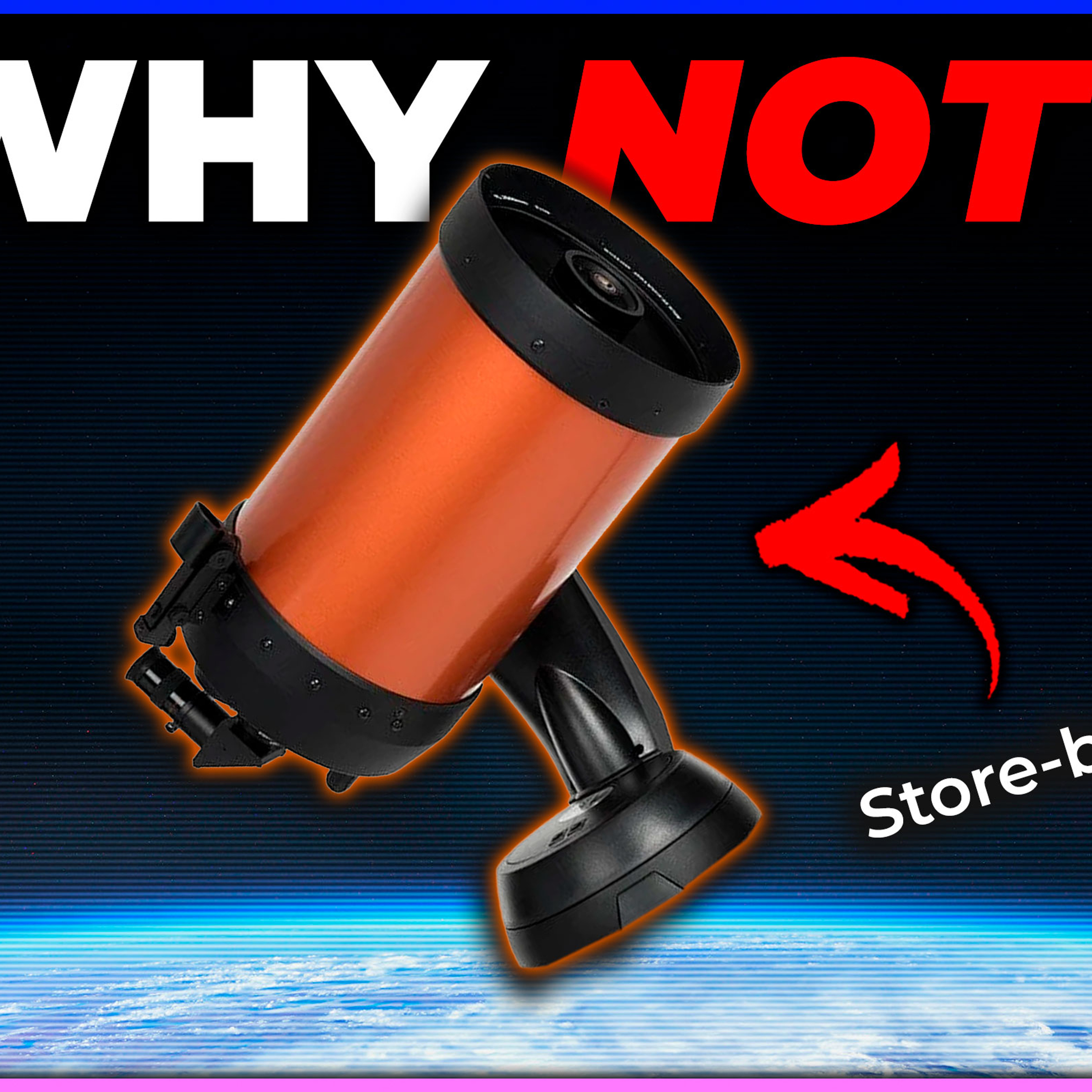
[Q&A+] Can You Put An Consumer-Grade Telescope In Space?
Get every episode summarized
Each time Universe Today Podcast publishes, we email you a written briefing from the transcript — the topics, who appeared, and any specific claims, with the ad reads skipped.
Email me new episodesFree for 3 shows. No card needed.
About this episode
“Can someone launch a regular small telescope into space? Are Mooncafe stable enough for a permanent base? What happened to the Swift Rescue Mission? And Akuni Plus was the asked for a built-up planet at some point? All this and more, this week's Question Show.”From the transcript
BONUS QUESTION STARTS AT 15:01
Watch the video here (with no ads) or on YouTube: https://youtu.be/UjOkLC6N9cY
Can someone launch a regular small telescope into space? Are Moon caves stable enough for a permanent base? What happened to the Swift rescue mission? And in Q&A+, was the asteroid belt a planet at some point?
00:00 Intro
00:41 [@Noonyuh] Could affordable consumer smart telescopes be easily retrofitted to survive in space?
05:06 [@user-kx2fc2mw5v] Are Moon caves stable enough to build in them?
08:47 [@surrender_monkey] What happened to the Swift rescue mission?
15:01 [@EdSceptic-y2e] Is the asteroid belt a destroyed planet or is it forming into a planet or neither?
18:15 Final thoughts
Get every episode summarized
Each time Universe Today Podcast publishes, we email you a written briefing from the transcript — the topics, who appeared, and any specific claims, with the ad reads skipped.
Email me new episodesFree for 3 shows. No card needed.
Know when Ed Sceptic turns up
Follow Ed Sceptic and once a week we email you every new episode they appeared on — including guest spots the show notes never mention, because we read the transcript.
Follow Ed ScepticFree. Pick your own day and time.
Hosts & guests
Transcript ready
322 searchable segments. Every word is indexed and playable.
Full transcript
Universe Today Podcast — [Q&A+] Can You Put An Consumer-Grade Telescope In Space?. Machine-transcribed; use the interactive transcript above to jump the player to any line.
Can someone launch a regular small telescope into space? Are Mooncafe stable enough for a permanent base? What happened to the Swift Rescue Mission? And Akuni Plus was the asked for a built-up planet at some point? All this and more, this week's Question Show. It's time for the question show. Your questions, my answers, as always, wherever you are across my channel of the question pop to your brain, just write it down, and I'll gather them up and I will answer them here. I'm now in Epsom, England. We're just about to begin our hike through England starting in a couple of days, but I will continue to sort of find internet and keep recording the news as we go. So hopefully you'll still get tons of content coming from me, even though I am on the road. All right, let's get to the questions. Noona, could affordable consumers smart telescopes be easily retrofitted to survive in space? Let's force Musk to mount them to Starlink so they can give us access. So could consumer smart telescopes survive in space, theoretically yes, but they're not hardened for space, and that when you try to take off the shelf consumer technology
like an iPhone and you put it into space, you've got this device that has incredibly fine precision electronics inside of it. What are they down to? Two nanometers? Three nanometers? The size of the pads on the transistors inside the chips are very, very close. And so you hit that with a cosmic ray and you're going to get bit flips and memory, you're going to get corruption in what's happening on the processor. And so you've got yourself a problem. Now low or thorebit isn't that much of a problem. You're still protected by the magnetosphere. And so you're going to experience less cosmic radiation than you would if you say went to the moon. And so I think that there, you know, if one of the smart telescope makers wanted to build and a version of their telescope that was space hardy, they could probably pull that off. You know, instead of it being having a plastic chassis, they would use a stainless steel
or an aluminum chassis. They would have to make sure that you don't have excess gas that's going to build up inside when you're out in the vacuum of space. You need to make sure that it, you know, all the gas can escape out of it. And you're going to just have to take a certain level of corruption and damage to the spacecraft or to the telescopes that's going to happen in space. And they would be amazing, right? You take like the Hubble Space Telescope is a 2.6 meter telescope. That's tiny compared to various ground-based observatories. You know, if I named all of the telescopes from the biggest to the smallest, it would take me, you know, I would be 30 observatories down before I got to the 2.6 meter territory. You can just buy it off the shelf one meter telescope. And so that's not a very big telescope. And yet it's in space. And once it's in space, without any atmosphere, it is a completely different game. And so just like a regular smart telescope, even something very small would do an incredible
job out in space. I don't know if putting them onto star links is the way to go, although that might be cool, right? That every star link is equipped with a dwarf mini on the back of it that is able to be directed by amateur astronomers, 10,000 telescopes that you can buy time on. You know, I suspect that SpaceX would see this as another revenue stream. And then they would charge you or maybe you get this as a free service for being a star link customer. But it is certainly doable. And if not with the existing, like you wouldn't just take an existing smart telescope and throw it in space, but you could adapt a smart telescope or have the smart telescopes be partnered with the satellite mega constellations and go that route. The other option of course is to use like a CubeSat and you would just launch a smart telescope into space. I kind of like the star link version better because then that handles the data transmission.
And that is actually one of the biggest challenges of launching your own satellite is communicating with your satellite. You can build all the technology into your satellite so that it has its little telescope and it's able to do its work and all of that. But it's getting the data home is the challenge. And so if you bolt this onto a star link or you have a way for it to communicate with the star links to be able to to send its data home, then that's the big challenge that needs to be overcome. And so yeah, I think SpaceX, if you're watching this and you want to get a little bit of good will, put telescopes on the backs of every single star link and make those available to schools and children and people being able to who want to be able to learn more about the universe. Don't just take away the night sky and give nothing back. User KX2, our moon caves stable enough to build in them. Probably, you know, we don't exactly know the precise geology of what's going on inside
the moon caves. So what these are are ancient latitudes. So you've got, at some point billions of years ago, there was plenty of eruptions happening on the surface of the moon and you would get lava flowing in these streams, these rivers. And then because the moon goes into darkness, you would be having these lava flows while the moon was very cold. And so you get this crust forming on top of the lava while the lava is still flowing like a river underneath. And when the eruption ceases, when it ends, the lava just keeps flowing and it just goes out the end of the tube and spreads out onto the landscape and you've got this natural cave. And because the gravity on the moon is one sixth the gravity that you have on earth, these caves can be huge. People have suggested they could be a kilometer tall, which would be amazing. And so these are the kinds of places that you would want to be able to build on the moon. You could set up right at the mouth of a cave so that you are protected by the roof of
the cave, but there's still an entrance out into the landscape. You could build a road and you could come and go from your cave. And so this is eventually going to be the natural place that humanity is going to want to build some of their lunar bases. If you build out on the surface, you are exposed to micro meteorites. You are exposed to larger objects crashing to the surface and you're exposed to the cosmic radiation. You have to deal with the hot cold, hot cold that goes from you being in the day side, you being in the night side. And a lot of those problems go away. The downside as you are suggesting is that your roof could collapse. And it's almost like if you went into one of these ancient lava tubes, you would see blocks of material sitting on the ground all around from various collapses that had happened over billions of years. But that's billions of years. And so the chances of it actually collapsing on top of you is very, very low. But it's not zero because there are still moonquakes.
We know thanks to the Apollo missions, even, that there are these small earthquakes that are happening on the moon all the time. And they generally don't get bigger than three, four magnitude. But still, it can shake cracks loose. You've got the heating cooling cycle that goes on that can help weaken and cause more erosion. And this is a thing that we just don't know. And so the only way to find out is for us to go and put a spacecraft into one of these tubes to examine rocks, try to figure out piece together the collapsed history of the rocks in the lava tubes. But you can find the place where you want to build. You can build a shell over top of your stuff. You can go and examine the roof and try to see if it's a potential collapse risk. So I think it would suck if you had the roof collapse on your brand new base. But considering all the various risks, it would suck if an asteroid came out of nowhere, even like a meter across and blew up your base.
And we look at the surface of the moon and we see the damage that is happening to that place. It's time to share all the new $5 patrons that above. Marcus Wombie, Mark Long, Charles Baker, Lisa Rittenhouse, Alex Pelleig, Raf Faye Sunshine, Duncan Nuns, D Harrison, and D orbital mechanic. Join the club at Patreon and ComSUSH, universe today. Surrender Monkey. Can you comment on the Swift satellite rescue mission that failed to push it back into geostable orbit? Sure. So the Swift telescope, this is an X-ray observatory that was launched like 20 years ago or so. And it has been one of the most productive space telescopes that has ever been launched. The challenges that X-rays are blocked by the Earth's atmosphere. So if you want to be able to view X-rays, you want to go to space. And what Swift does is it has the ability to monitor a huge swath of the sky. And it's watching for a Gamma Reburst. And if a Gamma Reburst goes off, it is able to then very quickly turn and observe where
that Gamma Reburst happened. And deliver additional information to the rest of the astronomy community. But because you want to see the first few moments of a Gamma Reburst, that's when the really cool stuff is happening. And so Swift has been just this really productive satellite space telescope. It was there when the Kilinova event was detected that you had two neutron stars colliding with each other, produced a Gamma Reburst. It was detected in space by Swift and it was detected on the ground by LIGO. So you got the gravitational waves and you got the electromagnetic spectrum. This allowed astronomers to determine the speed of gravity. That the speed of gravity is the speed of light. The two are the same, which was absolutely incredible. And Swift has just gone on to give us some of our best understanding of not just Gamma Rebursts, but it's able to look at the X-rays coming from supermassive black holes and serving other interesting objects that are out there. It's kind of like a very ruby in space. It's finding new, weird things that are happening the moment they happen.
A very exciting telescope. But it is in lower orbit and any telescope that's in lower orbit is interacting with the atmosphere of the planet. And so it is being brought down year after year after year. And now it's at the point where it's just about a year away from it re-entering the Earth's atmosphere. And to try and prevent this, NASA partnered with a company called Catalyst and they launched a spacecraft called Link. And Link was going to fly the space, dock with the Swift satellite, and then raise its orbit. And shortly after the Catalyst mission launched, its reaction wheels failed. And this has been my bugbear for my entire space journalism career. Gyros and reaction wheels breaking. And the classic, the worst example of this is the Kepler's mission. Kepler was going to be the mission that was going to find Earth 2.0.
It was going to stare at a spot in the sky and just scan it and watch it and watch it and look for transiting planets. And after three years, you would get a population of Earth-sized worlds orbiting around some like stars. Because you're beginning these transits of Earth. You only get one every 365 days. You have to wait a long time. And unfortunately, Kepler's reaction wheels failed. And so they had to switch up the mission to do something different, which is a whole of the story. And it's one of the most incredible spacecraft rescue stories ever told. And if one of you asks me to tell the question, I will. But so reaction wheels. And of course, like very spinning wheel that can be tens of kilograms heavier, they're moving at thousands of RPM. They are going very, very fast. And that is just like hard to make them completely robust. And so they break. Unfortunately, the link mission had its reaction wheels fail.
And so the engineers were still able to communicate with the spacecraft. It was tumbling. But it was still getting enough sunlight into its solar panels that it was able to keep its communication system going, keep its computer going. And so they were able to communicate with it and be able to give it new commands. They were able to use its ion engine to sort of change the direction of the thrusters and counteract the spin that was going on on the spacecraft. They essentially do abandon the reaction wheels and go with purely. Let's just use the thrusters to try and control the spin of this spacecraft. So they're able to do that. But they ended up having to use way too much of its fuel on board to the point that it was able to get under control again, but it was no longer able to provide its job to Swift. And so where we're at today is that in fact, like I think it was like today or yesterday, we got new images of the Swift satellite taken by the link spacecraft. So it was able to rendezvous with Swift, but it just doesn't have the fuel in the can
anymore to be able to actually raise the orbit of the Swift satellite. So NASA is still deciding what to do and who knows what's going to happen. But because Swift is doomed, I think the right move is to still dock, like still perform the maneuver, dock with the Swift satellite and try to at least find out if you can boost it just like a tiny little whatever's left in the can and find out if you can actually dock these satellites together. So this theoretically work because if it will, there's a lot of satellites that are on these degrading orbits that could use a buddy to boost them back up. So it's not a complete loss. You're going to get a lot of science, you're going to get really nice observations of the Swift satellite. That will allow astronomers to see how much damage happens from space debris to a space telescope that's been alive for that long. You're going to be able to like visually inspect it very carefully. That's great. You're going to be able to test out sort of orbital maneuvering with another target,
which is going to be really useful for say orbital refueling. So there's a lot like if you were to like list off all the things you'd wanted to get out of this mission, it would be a mission worth flying. Even if it didn't perform, they let's boost the Swift satellite. So this is like you're watching lemonade kit made out of all these lemons. Ed Skeptic is the asteroid belt a destroyed planet or is it forming into a planet or neither. So the asteroid belt contains material that is essentially left over from the formation of the solar system. And because of the gravitational interactions of Jupiter, it's constantly being stirred and mixed. And so it can never form gravitationally into a single object. If you could remove Jupiter and probably Saturn, then the asteroid belt would have less perturbances and would start to coalesce into a single object. But that single object is very tiny. If you added up all of the mass of all of the objects in the asteroid belt, you would
end up with something that's like 5% the mass of the moon. So you take our moon, make something that's 5% of its mass and put that in the out as the new asteroid belt planet. And it would be classified as a dwarf planet because it would include series, but it would not qualify as a full-blown planet, although what's the definition of a planet. So you can decide if you think that 5% of the mass of the moon is a planet, but it will not happen. And in fact, that sort of the jiggling that comes from Jupiter, the gravitational jiggling, is the cause of near-Earth objects. So you have these three body interactions with Jupiter and the various objects in the asteroid belt. And this is slowly picking objects out of the asteroid belt and sending it into orbits that bring it closer and closer to the Earth. And so if we didn't have Jupiter, we wouldn't have near-Earth objects as much.
It's really due to Jupiter. Jupiter, they always talk about how Jupiter is our great protector, that it is absorbing a lot of the asteroids. And it's true. It is jiggling asteroid so that asteroids are both going closer to the Sun and farther from the Sun. And the ones that go farther from the Sun, they fall into Jupiter and they are destroyed. But the ones that go closer to the Sun, they crash into the Earth. And so it is at best a frenemy. Thanks for watching this week's episode here on Patreon. Really appreciate it. And just like thanks for allowing me to be able to do this kind of an adventure and not have to be worrying about ads and search engine optimization and AI and any of that. I just, I can work on my news and I can report and also be out and about. All right, those are all the questions that we had this episode. Thank you everyone who put your questions into the YouTube comments. Everybody who joined me for the live show. I'm going to chat about some of the TV shows that I'm watching. But first, I look to think of Patrons. Thanks to Abe Kingston and Dre Petretty. Boltz is our galactic invader, Brian Bowdoch, Karen Witton, Tchaikovsky, and Skim Interbey.
David Guilson and David Mats, Evan.Pro, James Clark, Jerry Madden, Jim Burke, Marcel Sments, Mike Purcell, NASA Ocean Guy, Norrispace, once you're friend of us.org, whale it out travel. Please follow mine if you had V-Brick, 6994, Rynk Kydu, Richard Williams, Sean Sargent, Team 49, Tillsubs, Canada, Flagship, and Wolfgang Klutz, Zelda, Baldazard. I knew this day would come. Who's support us? At the master of the universe level and all our patrons, all you support means the universe to us. So even though I am on the road, my wife and I have been watching a bunch of TV shows recently and I was wanting to share what we have been watching and what we have been enjoying. So we've been watching lanterns. And I don't know if I have ever said this, but my absolute favorite comic book franchise are the Green Lanterns. Specifically, it was when Alan Moore was writing for the Green Lantern Corps. You know, like I did Watchman, but he just wrote an incredible series for the Green Lantern. I just absolutely was gripped. And now there is a TV show about the Green Lanterns. It's kind of true detective meets the Green Lanterns.
And I was skeptical, right? Like they're going to take your precious baby and they're going to make a television show out of it. And it's really good. I'm really, really enjoying it. And it sort of gets to the heart of this idea. The Green Lanterns, the gist is that they have no fear. Like that is the question you get asked is, do you have any fear? And what kind of person has no fear, right? What kind of weirdo has no fear? What does it take to be the kind of person that has no fear? And is that even a good thing? So they sort of go in at that question. And it's really good. I really, I'm really enjoying it. The other show that we've been watching is Silo and that's on Apple TV. And like the first two seasons were great. The third season started out and I was kind of frustrated and angry and you will probably feel the same way. But if you stick with it, it gets better throughout the show until the end. So there you go. Lanterns and Silo. All right. We'll see you next time.
More episodes
More from Universe Today Podcast

[Space Bites+] Moon Cities Are Not Happening. Here's Why
Universe Today Podcast

[Q&A+] Why Didn't NASA Just Build Another Kepler When It Failed?
Universe Today Podcast

[Interview+] This Crazy Robot Could Explore the CAVES of Titan | NIAC 2026
Universe Today Podcast

[Space Bites+] This Supernova Candidate Turned Out To Be Something Completely Di...
Universe Today Podcast