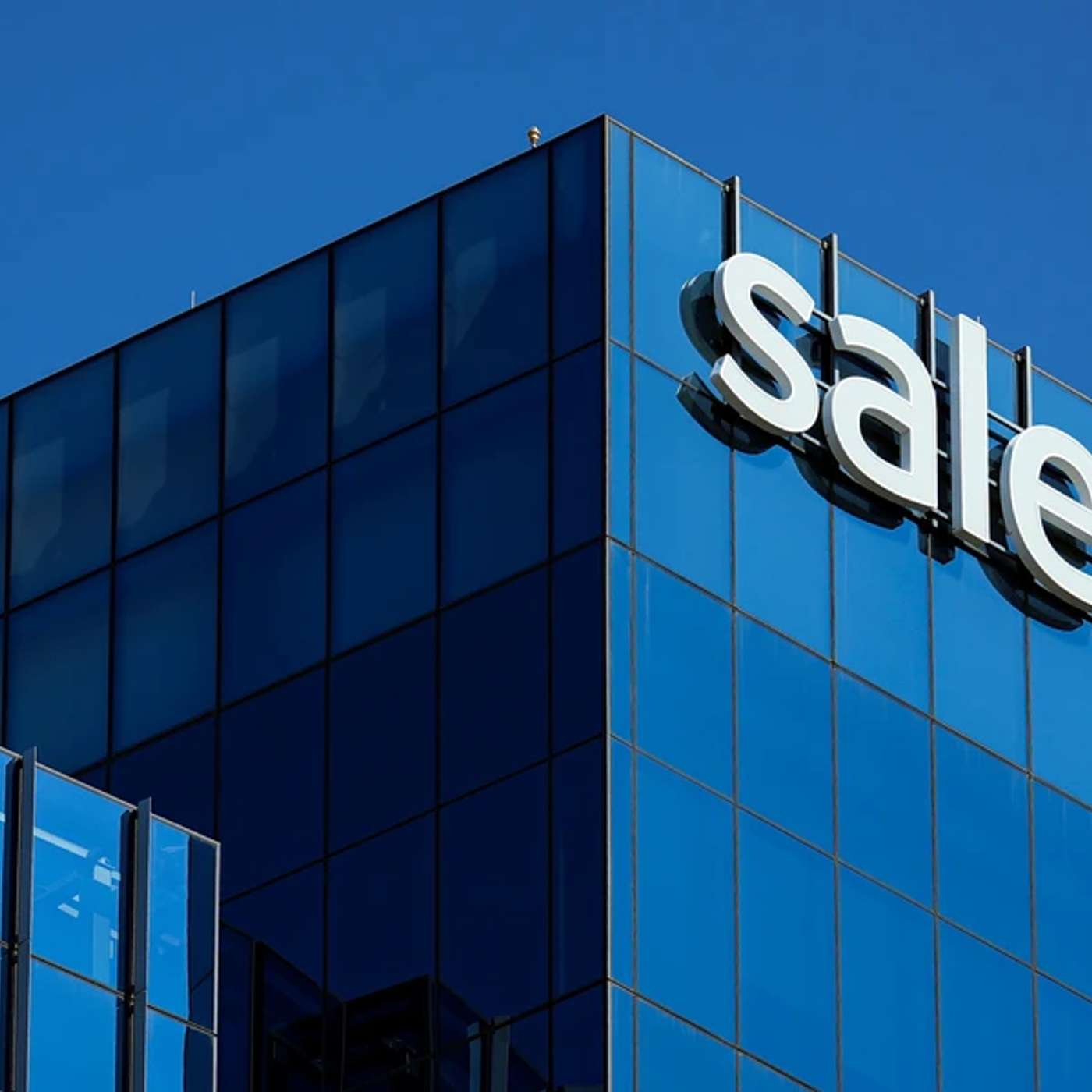
Salesforce Data Breach Case Advances, Temporal Cloud Grows Ambitiously, OpenAI Funds AI Cancer Vaccines, Tech Giants Slash Jobs Amid AI Restructuring, and more...
Get every episode summarized
Each time Tech News Daily publishes, we email you a written briefing from the transcript — the topics, who appeared, and any specific claims, with the ad reads skipped.
Email me new episodesFree for 3 shows. No card needed.
About this episode
Tech News Daily is made possible by:
“It's September 16th and this is your daily brief in tech. A federal judge in California largely denied Salesforce's bid to dismiss a proposed class action over a 2025 data breach, allowing most claims to move forward.”From the transcript
(1:32): Temporal Cloud's Revenue Soars; Serves 4,300 Clients Including OpenAI and Netflix Amid AI Expansion
(4:08): OpenAI Unveils $40M Data-Grant Program to Revolutionize AI in Cancer Vaccine Development
(6:32): Tech Giants Slash Jobs amid AI Restructuring: 2026 Layoffs Top 45,000 by March
(8:38): Amazon Unveils 2026 Kindle Overhaul with AI Features, User-Replaceable Batteries
To subscribe visit https://www.brief.news.
For more updates in your inbox each morning visit www.brief.news.
Image credit: Bloomberg Law
Get every episode summarized
Each time Tech News Daily publishes, we email you a written briefing from the transcript — the topics, who appeared, and any specific claims, with the ad reads skipped.
Email me new episodesFree for 3 shows. No card needed.
Hosts & guests
Transcript ready
133 searchable segments. Every word is indexed and playable.
Full transcript
Tech News Daily — Salesforce Data Breach Case Advances, Temporal Cloud Grows Ambitiously, OpenAI Funds AI Cancer Vaccines, Tech Giants Slash Jobs Amid AI Restructuring, and more.... Machine-transcribed; use the interactive transcript above to jump the player to any line.
Good morning. It's September 16th and this is your daily brief in tech. Here's everything you need to know. A federal judge in California largely denied Salesforce's bid to dismiss a proposed class action over a 2025 data breach, allowing most claims to move forward. Plaintiffs say Salesforce's cloud infrastructure had systemic security flaws that let unauthorized parties access personal information, tied to customers and employees connected to Allions, Farmers Group and TransUnion. The ruling clears the path to discovery and extended litigation focused on Salesforce's security practices. The court accepted that the plaintiffs have standing, finding injury in fact from the breach. It also found the negligence claim and several state consumer protection and privacy laws, including the California Consumer Privacy Act, Illinois Consumer Fraud Act, and Washington Consumer Protection Act, sufficiently pleaded.
Uptcoming proceedings will center on the adequacy of Salesforce's security protocols, the scope of the breach, and potential damages or remedies. The suit names 18 Salesforce clients affected by the breach, though client identities aren't disclosed in the available materials. The ruling preserves ongoing scrutiny of Salesforce's data security practices as the case moves toward discovery. That issue is the data exposure of individuals tied to the clients, underscoring alleged failures in Salesforce's security controls. Temporal cloud now serves more than 4,300 customers, including open AI, SNAP, Nvidia, Netflix, and JP Morgan Chase, with an annualized revenue run rate above $250 million, more than triple year over year. Both metrics show an annualized revenue run rate up over 200% year over year, with net dollar retention above 200% since February, 2026, 1.9 trillion billable actions processed
in August, up over 350% year over year, and open source installs surpassing 43 million, up 134% since December 2025. Salesforce Temporal installs surpassed 43 million in August, signaling strong developer and enterprise adoption for AI agents and autonomous systems. Co-founder and CEO Samar Abbas frames durable execution as a standard for reliable applications and says the round strengthens Temporal's capital base to pursue broader enterprise adoption and global reach, with AI agents taking on more critical work. Abbas emphasizes reliability as essential for AI era software, arguing the funding provides a foundation for widespread AI-enabled development. Industry context includes a geek wire note on Microsoft drafting AI guardrails amid discussions of an industry slowdown. Temporal hosted its fifth replay conference at Moscow Center in 2026 and partnered with
Crystal Palace as front of shirt sponsor, with plans for deeper enterprise investment, further global expansion, another replay, and ongoing platform work. The public facing content largely consists of social metadata, links and comments, with limited standalone narrative. Recent integrations include OpenAI agents SDKGA, March 2026, and Versal AI SDK for TypeScript. Leadership promotions within engineering, sales, and people, and the addition of high-end fan as VP of product marketing. Temporal founded in 2019 in Seattle with about 570 employees intends to use the round to fund global expansion and platform R&D. The round underscores a strong Pacific Northwest venture capital surge, reinforcing Temporal's role as foundational software for next-generation AI-powered systems. Demand for Temporal grows as AI agents run longer and interact with multiple tools, increasing
potential failure points per task. OpenAI Foundation unveils a $40 million data grant program aimed at accelerating AI and medicine, starting with novel cancer vaccines and open admit, a drug-effect prediction platform. The effort run through data for public health seeks high-quality, de-identified data sets to improve tumor-antigen selection and vaccine formulations, with trials in triple-negative breast cancer as a starting point. Researchers Benjamin Vincent and Alex Rubenstein will collect and analyze tumor and immune cell data from three bio-banks to train AI models that identify better tumor targets and guide vaccine design. The program highlights a competitive push to secure proprietary data, with one-day-suner securing data sets from two disclosures and pursuing more through bankruptcy data access. A core strategy is to obtain common technical documents from bankrupt entities, including regulatory correspondence and manufacturing and safety data to give AI deep, real-world
insights into drug development and regulation. OpenAD-MET aims to cut drug development failure rates by using data to predict pharmacokinetics, drawing on precedents like alpha-fold tooth use of PDB data in CASP. CTD Commons seeks to reduce duplication and cost in clinical research by providing open access to comprehensive drug development records, including toxicology, manufacturing, and FDA correspondence. Roxandra Teslow proposes using bankruptcy filings from failed biotech firms as a biotech's lost archive to train AI for navigating the drug approval process, with a half-million-dollar grant from one-day-suner backing this approach. Teslow argues the drug regulatory process is a black box, and more data is needed to turn AI from theory into practical breakthroughs in curing disease. Scientific data are framed as essential for research, with emphasis on large-scale observations and breakthroughs when models access broad, high-quality data sets.
The program invites ongoing collaboration and outlines next steps, including updates as science progresses and opportunities to contribute via science at OpenA Foundation.org, with data access principles calling for broadly available data sets, privacy safeguards, and open publication of analyses as preprints, plus four open roles in life sciences and curing diseases. Tech layoffs are accelerating in 2026 as AI-driven restructuring, economic uncertainty, inflation, higher interest rates, chip shortages, and rising energy costs push firms to cut costs. By March 2026, total layoffs exceed 45,000 globally, with the United States accounting for a majority despite strong revenue growth at many firms. Context from 2025 shows a sustained downturn with tech layoffs totaling more than 244,000 worldwide across 269 companies. In the first half of 2026, major players announced bold restructuring moves, Oracle signaled
up to 30,000 global cuts, at Lassie and Trimmed about 1,600 roles tied to AI and enterprise focus, and Salesforce reduced around 1,000 positions in a February to 2026 window. July 2026 brought a 20% workforce reduction at Monday.com as it shifts toward an AI-driven, flatter organizational structure. In July, Microsoft announced about 4,800 layoffs, concentrating on sales and Xbox teams while accelerating investment in AI infrastructure and embedded engineering. January 2026 also saw notable planned cuts at Ericsson, about 1,600 in Sweden, and Metta's reality labs around 10% reflecting broader downsizing beyond the headline tech giants. By May 2026, Cisco cut nearly 4,000 jobs in Cloudflare about 1,100 amid AI-focused restructuring. Metta later announced an 8,000 job reduction in May 2026, targeting engineering and product
teams to push AI-driven efficiency. Oracle scaled up restructuring costs and began a new layoff wave in September 2026, signaling a substantial financial impact on its workforce. A continuously updated layoffs roster tracks these events with links to primary reporting for each. Amazon is gearing up to refresh its eReader lineup later in 2026 with new models that boost processors and RAM to enable AI-driven features beyond what current Kindles offer. The plan aligns with an EU battery law taking effect in early 2027, prompting design changes across devices. With a number of 126, Amazon's Sunnyvale hardware R&D unit remains responsible for Kindle, Fire Tablets, and Fire TV, and is working on next-generation products like the Kindle Scribe ColorSoft. A notable change in the Kindle lineup will be user-replaceable batteries with backpanel screws, moving away from glue-backed batteries.
This shift comes as Amazon invites young influencers to lab 126 for tours with executives and researchers to learn about industrial design and product development. The goal is to provide a behind-the-scenes look at how hardware and software teams approach coast-to-coast product development. Lab 126's role continues to center on hardware innovation for Amazon's Kindle family and related devices. The latest hardware refresh is positioned to support AI-driven features that go beyond existing Kindle capabilities. These are considering how to balance battery life, repairability, and new legal requirements in battery design. Analysts will watch how these changes affect the Kindle ecosystem, including potential impacts on third-party accessories and service plans. This has been your daily brief in tech. To read more about these stories, follow the links in the episode bio. You can also subscribe to these updates via email at www.brief.News.
For more daily podcasts about the topics you love, visit brief.News-forward slash podcasts. Tune in tomorrow. We'll be back with everything you need to know.
More episodes
More from Tech News Daily

Adobe Warns of Critical Flaws, AI Transforms Coding Yet Humans Remain Essential,...
Tech News Daily

AWS Secures NATO Clearance, AstroForge Launches AI Mine Mission, Deterministic S...
Tech News Daily

EU Kids Act Tightens Safety, Rust Project Warns of Social Engineering, Hermes Tr...
Tech News Daily

Nvidia CEO Dismisses AI Extinction Fears, Apple Music Boosts Artist Pages, DavMa...
Tech News Daily