Get every episode summarized
Each time The Jeremy Ryan Slate Show publishes, we email you a written briefing from the transcript — the topics, who appeared, and any specific claims, with the ad reads skipped.
Email me new episodesFree for 3 shows. No card needed.
About this episode
“As if one man's ambition killed a 500-year-old system. They die when the architecture built to contain power is broken from the inside. Rome spent 400 years building constraints to stop a king.”From the transcript
Caesar didn't break Rome. 50 years before Caesar ever mattered, Sulla did — and he did it while trying to save the Republic.
Rome spent 400 years building constraints to stop a king. Two consuls, not one. One-year terms. Ten tribunes with veto power. No army inside the sacred boundary of the city. No office without a term limit. It worked because everyone agreed to lose — you lost an election, you waited your turn.
Sulla broke every one of those constraints in five years. Legions camped inside the pomerium where no army had legally stood for four centuries. The first proscription list nailed to the forum wall — turning murder into law and confiscation into budget policy. The dictator's chair, empty for 120 years, dragged back out with no expiration date.
Then he walked away. He resigned the dictatorship, served an ordinary consulship the next year, and retired to his villa in Puteoli as a private citizen. He thought the precedents wouldn't matter because he hadn't kept power.
He was wrong.
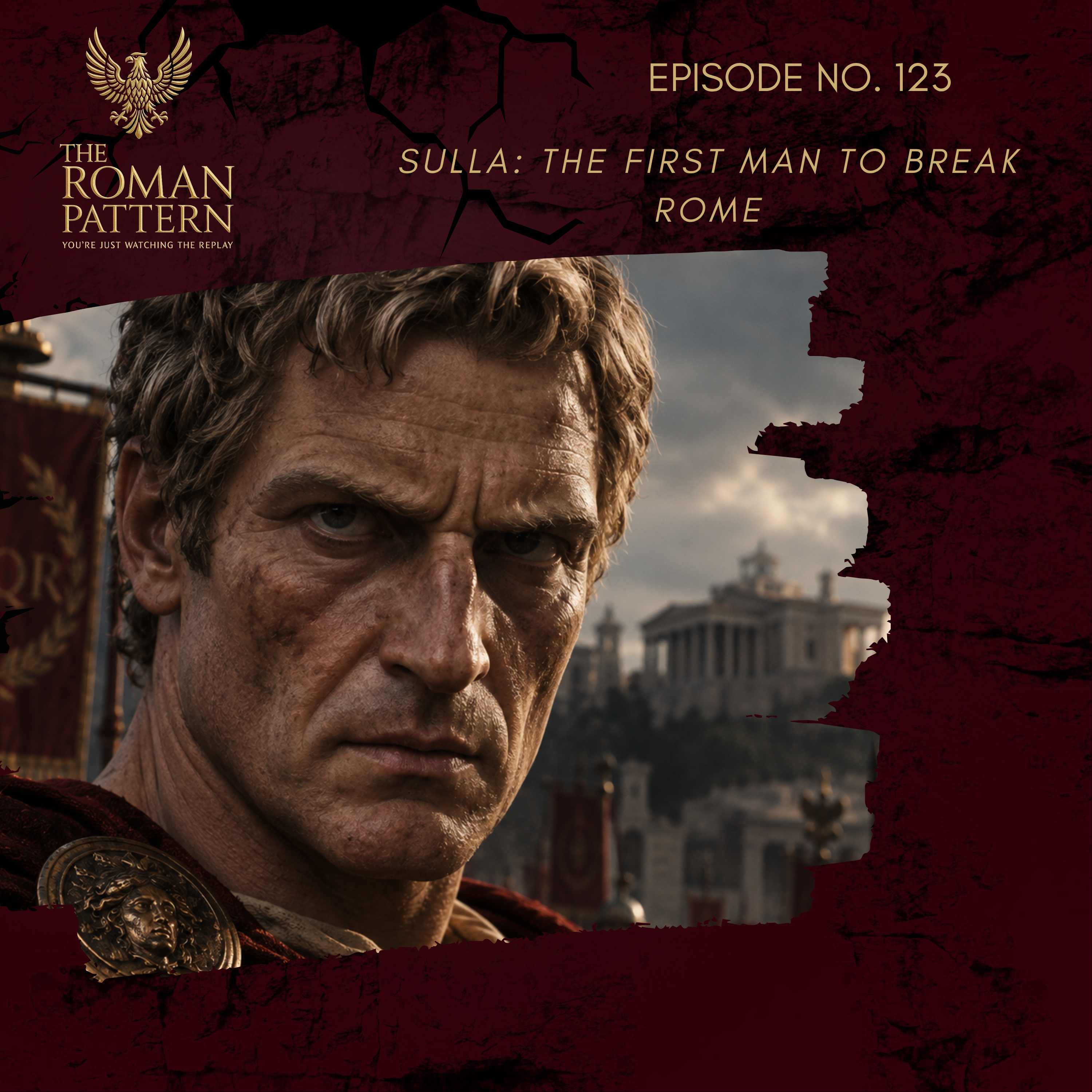
This is Episode 123 of The Fall of the Republic series on The Roman Pattern — the story of how Sulla set every precedent Caesar, Antony, and Augustus would use to destroy the Republic, while genuinely believing he was saving it. He is not a villain who destroyed the Republic because he hated it. He is worse. He is the repairman who used dynamite to fix the plumbing.
Chapters:
00:00 Caesar didn't break Rome
01:30 What the Republic actually was
02:47 Sulla's origin — patrician without money
03:51 Jugurtha and the signet ring
05:26 The Marian reforms and shifting loyalties
06:12 The Social War
07:55 Consul at 50
08:44 The Sulpician crisis
09:36 The march on Rome
11:22 East to fight Mithridates
11:48 Marius and Cinna purge Rome
13:09 Return with five legions
13:59 The Colline Gate
15:07 Dictator with no time limit
16:00 The proscription lists
17:15 Fiscal policy through murder
18:08 The constitutional reforms
19:42 The young officers watching — Pompey, Crassus, Caesar
20:09 Sulla walks away
20:56 The settlement dismantled
21:26 The Second Triumvirate copies the machinery
22:47 Precedents don't die
Sources referenced:
— Plutarch, Life of Sulla
— Appian, The Civil Wars, Book 1
— Sallust, Bellum Jugurthinum
— Cicero (contemporary references)
— Cassius Dio, Books 30-35
— Arthur Keaveney, Sulla: The Last Republican
— Ronald Syme, The Roman Revolution (1939)
— Mary Beard, SPQR
— Erich Gruen, The Last Generation of the Roman Republic
The Fall of the Republic series continues next Monday with Spartacus — the slave revolt that set up Rome's collapse.
Get every episode summarized
Each time The Jeremy Ryan Slate Show publishes, we email you a written briefing from the transcript — the topics, who appeared, and any specific claims, with the ad reads skipped.
Email me new episodesFree for 3 shows. No card needed.
Hosts & guests
Transcript ready
521 searchable segments. Every word is indexed and playable.
Full transcript
The Jeremy Ryan Slate Show — Sulla: The First Man to Break Rome. Machine-transcribed; use the interactive transcript above to jump the player to any line.
Caesar didn't break Rome. Solided. 50 years before Caesar ever mattered. You've been sold the myth. The genius dictator. The daggers on the Iads of March. As if one man's ambition killed a 500-year-old system. It didn't. Systems don't die like that. They die when the architecture built to contain power is broken from the inside. Rome spent 400 years building constraints to stop a king. Sulla broke everyone in five years. Legion's camped inside the Pom area, where no army had legally stood for four centuries. Names nailed to the forum wall. The first prescription list. Turning murder into law and confiscation into budget policy. And a dictator's chair, empty for 120 years, dragged back out with no expiration date. In this video, we'll trace how solace that every precedent Caesar, Antony, and Augustus would later use. Even as he tried to save the Republic.
Because precedents don't die when their author does. They wait for the next man willing to use them. And we're watching that same pattern replay right now. Welcome back to the Roman pattern. I'm your host, Jeremy Ryan Slate, CEO of Commanger Brand. Check us out over at Commangerbrand.com. And now, our story. Sulla walked away. And that's the part everyone forgets. He broke every rule that held Rome together, then he quit. And that is why Rome still died. To understand what Sulla broke, you have to see what the Republic actually was. It was not a democracy. It was a containment system. For 400 years, Roman nobles were obsessed with one fear,
a king coming back. So they built a Republic designed to stop any one man from holding onto too much power for too long. Two consoles, not one. One year in office, then you step down. Ten tribunes who could veto anything. No army inside the sacred boundary of the city. No office without a term limit. No command without the Senate's permission to end. It worked because everyone agreed to lose. You lost an election. You waited your term. You lost a command. You went home. The system depended on restraint. And restraint depended on no one proving that it could be ignored. This is power. This is the fault line Sulla will detonate. But power does not break alone. Money and borders broke first. Usius Cornelius Sulla was born in 138 BC. He was a patrician. That meant his name was old. It did not mean his family was rich. His branch of the Cornelie had faded. No console ships in generations. No money.
He grew up in rented rooms. He drank with actors. He kept company with a noble woman named Nacopolis, a courtesan with money of her own, who left him everything that she had. He learned to perform. Plutarch is our main source for these early years. And he never misses a chance to moralize about them. Cheap lodgings. Night spent with actors and dancers. A young or risk to crack with an ancient name and no cash. This matters because Rome's politics ran on money. He needed wealth to run for office. He needed wealth to fund games. He needed wealth to lend to voters. Sulla had none. So he needed war. War was the only way a broker-rister crack could get rich fast and get famous faster. In 107 BC he got his chance. He was appointed quite star to Gaius Marius. Marius was the greatest general in Rome. He was also a novice homo, a new man without ancient ancestors. He despised men like Sulla. Sulla despised him right back.
Marius was fighting King Jigertha in New Media. The war was dragging. Sulla did something Marius could not. He talked to Gertha's father-in-law, King Bocus of Martania, into betrayal. Bocus handed Jigertha over in chains. The war ended. Sulla's throat the whole Jigertha war as a story about Roman corruption eating the Republic from the inside. And he ends the thing right here with the King handed over in chains and two Romans about to spend 30 years arguing over who did it. Marius got the triumph. Sulla got the story and had a signet ring made. It showed Bocus handing Jigertha to him. He wore it every day. He stamped letters with it. It was a message. I ended the war. This was not just vanity. In Rome, credit was currency. The one the war determined who won the next election. Marius knew it. Sulla knew it. The rivalry started here. It will burn Rome to the ground.
But this is still just personal ambition. Rome had survived ambitious men before. What it had not survived was what happened to its borders and its money. Rome's army had changed. The same year Sulla showed up as his quistor. Marius did something necessary and fatal. He made it normal to fill the legions with the poor. The property qualifications had been sliding for decades. Marius stopped pretending it mattered. Landless men flooded in. They had no farm to return to. Their legion was their home. Their general was their patron. He promised them land when the war ended. He promised them loot when cities fell. The senate had to approve that land. When the senate said no, the soldiers didn't blame the senate. They blamed the system. This is borders and money colliding. Rome kept expanding its borders. But it never solved how to pay the men who bled for those same borders. So loyalty shifted from the republic to the general who promised to care for his men.
The shift had no law to stop it. Then in 91 BC the border walked into Rome. The Italian allies revolted. This was the social war. Rome's closest allies had fought Rome's wars for 200 years. They had no citizenship. No vote. No legal protection. They demanded to be Romans. Rome said no. So hundreds of thousands of Italians took up arms. Rome nearly lost. Sulla proved himself here. He fought as a legged, then as an independent commander in Campagna and Somnium. He was brutal and brilliant. He recaptured towns that had massacred Romans. The senate noticed. The soldiers noticed more. Rome survived by doing what it had refused to do before the war. It started handing out citizenship while the fighting was still going on. One law in 90 BC to reward the allies who stayed loyal. Another in 89 to widen it. Hundreds of thousands of new citizens. The question became where to enroll them.
In which voting tribes? If you spread them evenly, they dominate elections. If you pack them into a few tribes, their vote is worthless. Romanian gives us the fullest surviving narrative of this mess. He's clear that the fight was never really about citizenship. It was about the tribes. The grant was the easy part. The enrollment poisoned Roman politics for the next 10 years. The city was flooded with new voters who owned nothing in Rome. And wanted everything from Rome. This is borders again. Rome expanded who counted as Roman without fixing how Rome counted votes. Money, borders and power. No three now under strain. And Sulla was sitting at the center of it. In 88 BC, Sulla was elected consul. At 50 years old, finally at the top. His prize was a command. King Mithridates VI of Pontus had invaded the Roman East. He'd orchestrated the murder of as many as 80,000 Romans in one day.
The Asiatic Vespers. The East was rich. The command meant unimaginable loot and the land for his veterans. It was the payoff for a lifetime of being broke. And Sulla got it by lot, legally assigned. Then a tribute named Polius Salpickius Rufus broke the system to take it away. Salpickius had his own debts. He had his own street gangs. He proposed a law to distribute the new Italians and citizens evenly across all 35 tribes. It would give him their votes overnight to pass it he needed muscle. So he allied with a 69-year-old Gaius Marius. Marius wanted one last command. He wanted Sulla's war. The deal was simple. So Pickius gets Marius's veterans to intimidate in the forum. Marius gets the Mithridate command from the assembly. They pushed the law through with violence. Sulla's son-in-law was killed in the street riots. Sulla was pelted with stones. He fled the city he was consul of. He ran to his army, camped at Nola.
The power completely inverted. A Tribune using new voters as a weapon. An assembly voting to strip a sitting console of a legal command. A general humiliated in his own city. The Republic had no answer for this. The laws had been used to break the laws. And Sulla had to choose. Accept it and he was finished politically. He would lose his army, his money, his future. Or he could do what no Roman had ever done. Sulla stood in front of his six legions. He told them what had happened. He told them the assembly had stolen their war, their loot, their promised land. He asked if they would follow him. The officers refused. Almost every senior officer walked away. Except one, Lucullus. The soldiers did not. The poor, landless, Marius eras soldiers chose their general over their country. Sulla marched on Rome. In 400 years, the Republic, no army had ever crossed the Palmarium in arms.
It was not illegal. It was unthinkable, which is worse. Laws you can rewrite. Tabus, you cannot unbreak. As Marybeard points out, the rules Sulla broke that day, where the ones nobody had ever bothered to write down. Because until that morning, nobody ever needed to. The city had no walls to stop him. It never needed them against its own consoles. So Piquius and Marius tried to defend the streets with half-armed mobs. Sulla's veterans cut them down. Rome burned in places. For the first time, legionaries fought inside the cities. So Piquius was betrayed by a slave and killed. Marius escaped through the marshes. Sulla declared them public enemies, post-astes. Outside the law. Anyone could kill them and be rewarded. He annulled Sulla Piquius's laws. He passed his own reforms. Then he did something even stranger. He left. He thought the precedent would not matter, because he had not kept power.
He was wrong. Sulla sailed east to fight Mithridades in 87 BC. He took his legions. His own concert colleague had already been murdered by another general soldiers. So Sulla left Rome to the incoming consoles. He made Kina swear an oath to leave his settlement alone. The oath was the only garrison he had. The moment he was gone, everything he did was undone. Lucius Cornelius Kina, the new console, revives Sulla Piquius' distribution of the new citizens. He allied with old Marius returned from exile. He landed in a trueria with his own private army. He joined Kina and besieged Rome. Rome starved. The senate surrendered. What followed taught Sulla his most dangerous lesson. Sulla's son Kina purged the city. No law. No trial. Soldiers went door to door. Senators were beheaded in the streets. Heads displayed in the forum. Sulla's friends were murdered. His house was raised.
His laws were annulled. His property was confiscated. He was declared a public enemy. His family fled. This was not vengeance. This was a message from the system. If you leave, we will erase you. Sulla was in Greece learning that Rome only respects force. He besieged Athens. He cut down the academy's groves to build siege engines. He took the city in March 86, BC. He led his men's socket. Then he beat Mithradati's generals at Kironia and Orcomenthas. Brilliant cold battles. In 85 BC, Mithradati sued for peace at Dardanos. Sulla gave him shockingly lenient terms. He needed to get home. He needed to teach Rome that his precedent beat theirs. Kina ruled Rome for three years. Then he was killed by his own mutinous soldiers. The Republic was now run by men who held power only because their armies let them. Same pattern, different names.
Sulla watched it all. And he learned that lists could be legal. In spring 83 BC, Sulla landed at Brendizium with five legions and about 30,000 men. The Senate sent armies against him. One by one, they defected. Pompey was 23 years old and held no office at all. He raised three private legions out of his father's clients at Pakenum and marched them to Sulla. Crassus joined him. Rome's wealthiest wanted order at any price. This was not a foreign war. This was Romans killing Romans for two years. Towns taken. Armies broken. Promises made and debts recorded. It ended on November 1st, 82 BC at the Coaline Gate. The northern gate of Rome itself. Sulla's army exhausted faced a Sam Knight and Papalare's army that badly outnumbered it. The Sam Knights who hated Rome for centuries. They fought to burn the city rather than let Sulla have it. The battle lasted all day and into the night.
Sulla commanded the left wing. The left wing collapsed. He was out in front of it himself, riding the line. Trying to hold the men who were being driven back against the walls of his own city. Crassus held the right. Then Crassus rolled around the enemy and broke them. The man who saved Rome for Sulla that night was the man Sulla would go on to make the richest human being in the world. By the morning the field was covered with bodies. Survivors were slaughtered where they stood. The prisoners were heard together and massacred why Sulla addressed the Senate next door. Appian, writing later, but working from sources close to the men who were there, puts the number at 6,000. Senators heard screams. Sulla did not pause. He told them not to worry. He was punishing some scoundrels. Power now spoke without apology. The republic's capital had become a battlefield. The precedent was now complete. A Roman army could march on Rome and win. Twice. The Senate was terrified.
So they did what frightened oligarchs always do. They made the strong man legal. They appointed Sulla dictator. Rome had not had a dictator for 120 years. The old dictatorship was limited. Six months maximum. One emergency. Then you resigned. Sulla's dictatorship was different. Dictator for writing laws and restoring the republic. No time limit. No veto. No appeal. He could make laws, condemn citizens and remake the state alone. He thought he was repairing the containment system by holding absolute power to fix it. This is the logic of every emergency declaration that outlives the emergency. First, he fixed the money. But not how you think. Sulla posted the first prescription list in the forum. A white board. Names written in order. 80 of them. Then 220 more. Then 200. And 20 after that. The rule was simple. If your name was on the list, you were not a citizen. Anyone could kill you. Your killer got a reward.
Two talents ahead. Call it 48,000 Sistercies. Decades of soldiers pay for one afternoon's work. Your informer got a share. Your children lost everything. Your property was auctioned in the forum. Cheap. To Sulla's men. He published a second list. Then a third. The formal count is disputed. The ancient numbers run from a few hundred to several thousand. And thousands more were murdered privately. Then added to the list afterward to make it legal. One man, Quintissa Realius, read his own name. He said, quote, whoa is me. My album farm has informed against me. End quote. That line comes straight out of Plutarch. And it's the most useful sentence in the whole episode. A man reading a government document and instantly understanding. It isn't about politics at all. His farm was worth having, so he died for it. This was not just revenge. This was fiscal policy. The treasury was empty.
Wars and purges and bribes had drained it. Salapade 23 legions by murdering rich men and selling their houses. He settled 120,000 veterans on confiscated land in Italy. Itchuria was empty. Samnium was emptied. Their farms were given to his soldiers. His soldiers now owned the countryside. They owed everything to one man. Tell me you did not see the pattern. Enemies posted lists publicly. Properties confiscation as budget. Loyalty bought with stolen land. Legal murder called reform. Salah did not invent cruelty. He invented bureaucratized cruelty. He made it administrative. He proved it worked. After the killing, Salah tried to save the Republic. This is the tragedy of him. He believed in the old system. He tried to put every crack he had opened, back together, with law. He doubled the Senate. From 300 to 600, he packed it with his own officers and equates. He gave the Senate control of the courts.
He stripped the tribunes of power. Tribunes could no longer oppose laws freely. They could not stand for higher office after. He made the office a dead end. He wanted to end the populist Tribune as a weapon. He created strict term limits. No office twice without ten years between. No consultship without a pre-tourship first. A cursus onorum in stone. He strengthened the governor's law. Stay in your province until your successor arrives. No army leaves without Senate permission. On paper, it was perfect. Every abuse he exploited was now forbidden. It lasted ten years because it answered the wrong question. Salah fixed the laws. He did not fix the precedent. He proved a general with an army could march on Rome and become king in all but name. He proved property could be taken by list. He proved the Senate would legalize anything if frightened enough. He proved you could kill your enemies right of constitution and be called a savior.
Laws do not survive their first successful violation. Men remember what worked. The young officer is watching him, memorized it. Pompey was there. He was 24. Cassius was there. Caesar was there. 18 years old. Hiding in the countryside. Shripped of his priesthood. His wife's dowry. His inheritance. It took the Vestal Virgins and two consular relatives to talk Salah into sparing Caesar. He watched his father-in-law kin as system. He replaced by Salah's system. He learned the same lesson Salah had taught. Power waits for the man willing to use it. Salah's constitution was brilliant. It was also irrelevant. There's no peace of parchment can stop a precedent that pays. Then Salah did the most shocking thing of all. He laid down the dictatorship. He served an ordinary consulship the next year, like any other Roman. In 79 BC, he walked away entirely, dismissed his lictors, and walked into the forum as a private citizen.
He offered to answer for his actions to anyone. No one dared. He retired to his villa at Potoli. He wrote his memoirs. He drank. He died in 78 BC, sick, rotting, and still feared. His constitutional settlement was dismantled piece by piece within a decade. Pompey and Crasus restored the Tribune's power in 70 BC. They needed the tribunes to get commands of their own. The law as Salah wrote were undone by the men Salah made, but his precedence were never undone. Leopard has tried to march on Rome in 77 BC. Statorius ran a Branco way Roman state in Spain with his own army for eight years. Caesar crossed the Rubicon in 49 BC. He said he was defending his dignity. He was following Salah's road. The triumpheers prescribed again in 43 BC. They did not copy Salah's names. They copied his machinery. The posted lists. The rewards. The auctions. And then they went further than he had.
Leopardus put his own brother on the list. Anthony put his uncle on it. Octavian gave them Cicero. Anthony, Octavian, and Leopardus auctioned the property of 2000 more men. They learned the budget trick. They learned the terror trick. Salah had been dead for 35 years. His paperwork had not survived. His playbook had. This was not just Rome. This is what happens when a system breaks its own restraints and calls it an emergency. The law returns. The violation remains. So Salah is not a villain who destroyed the Republic because he hated it. He is worse. He is the repairman who used dynamite to fix the plumbing. He believed he was saving Rome from Marius, from Kina, from Chaos. He told himself every illegal act was necessary. Marching on Rome was necessary. Dictatorship was necessary. The lists were necessary. Every man who followed him told himself the same thing. Caesar called his civil wars a necessity.
Augustus called his prescriptions a necessity. Systems do not die from one bad man. They die from necessary exception. Repeated until the exception becomes the system. Rome spent 400 years proving constraint could contain ambition. Salah spent five years proving it could not if ambition refused to be contained. Presidents do not die when their author does. They wait. For the next man willing to use them. And we are watching that pattern replay right now. This has been the Roman pattern. I'm Jeremy Ryan Sleeve. Please like this video. Leave us a comment. And smash that subscribe button if you want more of the Roman pattern.
More episodes
More from The Jeremy Ryan Slate Show

Spartacus: The Slave Revolt That Set Up Rome's Collapse
The Jeremy Ryan Slate Show

The War Rome Almost Lost to Its Own Allies
The Jeremy Ryan Slate Show

What If Aurelian Never Died? The Rome That Never Fell
The Jeremy Ryan Slate Show

Marius: The Reform That Accidentally Destroyed Rome
The Jeremy Ryan Slate Show