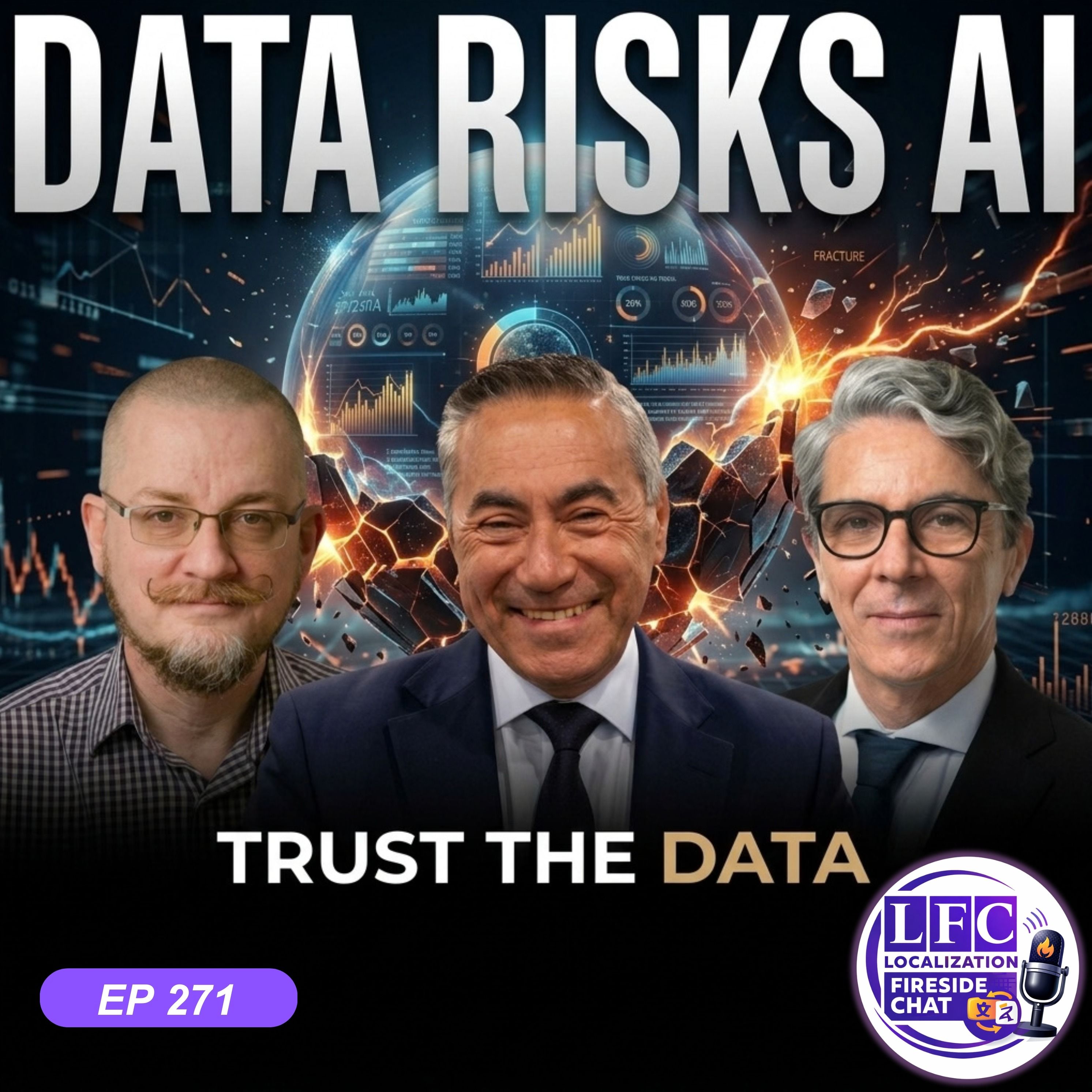
Tahar Bouhafs + Arle Lommel: The Data Quietly Killing Good Decisions
Get every episode summarized
Each time Localization Fireside Chat publishes, we email you a written briefing from the transcript — the topics, who appeared, and any specific claims, with the ad reads skipped.
Email me new episodesFree for 3 shows. No card needed.
About this episode
“This bomber has one pound of a pound of hot. And for only 599, even regular Jews can afford it. He holds Angus Maximus, only 599 is cold senior. A bill for a limited time of participating restaurants.”From the transcript
The problem isn't the data that gets caught. It's the data that passes through unquestioned — and the decisions that follow.
In this episode:
• Why two-thirds of language service providers didn't grow last year — and what the K-shaped economy actually looks like when you plot it
• How 'good enough' market data creates more damage than outright fake data, and how to spot the difference before it drives a bad decision
• What the Global Revenue Forecaster revealed: why CFOs literally don't believe the ROI of localization until they see the methodology
• Why AI is accelerating the data quality crisis, not solving it — and what CSA Research does differently because of that
Tahar Bouhafs has been building and leading research organizations since 1992, from Forrester Research to Management Ventures Worldwide to CSA Research, where he serves as CEO. Arle Lommel came into the industry through LISA, helped build the Multidimensional Quality Metrics framework at the German Research Center for Artificial Intelligence, and has spent his career at CSA Research doing what most analysts won't: clearly separating what the data says from what we wish it said. Together they make the case that trust is the scarcest asset in the industry right now — and that the methodology behind any data point is the only thing worth arguing about.
Connect with Tahar Bouhafs + Arle Lommel:
LinkedIn: https://www.linkedin.com/in/taharbouhafs
LinkedIn: https://www.linkedin.com/in/arlelommel
Website: https://csa-research.com
Subscribe: https://localization-fireside-chat.simplecast.com/
Credits
Host: Robin Ayoub, Founder, Localization Fireside Chat
Connect and watch more
Website: www.L10NFiresideChat.com
Spotify: https://open.spotify.com/show/5OoURgc29R31XPGzOWL9iX
Be a guest: https://calendly.com/robin-ayoub/localization-fireside-chat-podcast-recording
LinkedIn: https://www.linkedin.com/in/robinayoub/
Support the show
Share the episode with a friend. Subscribe on YouTube and Spotify. Leave a short review.
Disclaimer
Views are for education and discussion. Apply judgment in your own context.
Tags
#L10NFiresideChat #localization #hiring #recruiting #leadership #ai
Hosted by Simplecast, an AdsWizz company. See pcm.adswizz.com for information about our collection and use of personal data for advertising.
Get every episode summarized
Each time Localization Fireside Chat publishes, we email you a written briefing from the transcript — the topics, who appeared, and any specific claims, with the ad reads skipped.
Email me new episodesFree for 3 shows. No card needed.
Hosts & guests
Transcript ready
440 searchable segments. Every word is indexed and playable.
Full transcript
Localization Fireside Chat — Tahar Bouhafs + Arle Lommel: The Data Quietly Killing Good Decisions. Machine-transcribed; use the interactive transcript above to jump the player to any line.
This is Angus Maximus. This bomber has one pound of a pound of hot. Suzy cooked to honor Angus Speed. It's more face than a quarter pounder. The battle is closed! And for only 599, even regular Jews can afford it. Like that guy! You can get that big old burger. Yeah! He holds Angus Maximus, only 599 is cold senior. A bill for a limited time of participating restaurants. Tax not included. Not valid for use within a combo or in combination with any other offer or discount. Good afternoon everybody. Robin, you've been here from the localization fireside chat. I want to welcome you to another recording, another conversation. Today with this recording, we are recording episode 271. So welcome to episode 271. I hope you guys join us for the journey and you find this conversation very informative. We talk a lot about on this show about technology, how technology is changing the industry, the AI, the machine translation, the automation. But there is a choir crisis going on underneath all of it.
Is the nobody is talking about loudly enough. The quality of the data we're making decision on, not obviously bad data, not fake data that gets caught. The data that we're just talking about, not talking about enough about, is the pass through the unquestioned data. And there is a question about that because there is the decision that follows from these types of data. And that perhaps we need to pay attention to my two guests the day they don't need introduction, well, I'll introduce them and I'll let them introduce themselves in the second. To Harbohafis and Arley Lamel from CSA research. And I want to welcome you both to the conversation. It's an honor to have you both. It's rare. But it's an honor to have you both on the channel. I really appreciate you time. Thank you. Thank you. To Har has been building and leading research organizations since 1992 from Forrest to research to management venture worldwide and now steering CSA research as a CEO.
And he has he brings a rare combination of the academic rigor and I've worked with the with the market research industry for many years as a vendor to the market research industry. I'm very familiar with many companies in that in that industry and I admire the researchers in that industry and I admire the research rigor that you bring into the industry to Harbohafis will continue to talk about here in the recording of this episode. And also there is a real MNA experience you bring in as well to a field that desperately need all three academic rigor, science and training computer science and training and MNA. And Arley come from into the industry from Lisa helped build a multi dimensional quality metrics framework at a German research center for artificial intelligence. He has spent his career at CSA research doing something most balanced won't do clearly separating what the data actually says from what we wish to say or we wish the data would say.
What I'm personally curious about from both of you today, if you don't mind and 30 years of watching this industry, make decisions. How much of the damage you've seen was really a technology problem versus how much it was data driven problem that did not get addressed and something we need to talk about. So before we get started, I want to welcome you again and let's get this conversation. First, we'll start with the story question and I know the audience love this question because they're always interested in the human behind the conversation. So Har, why don't we start with you? What is your story? What got you here? Okay, I want to say first good afternoon. Bonjour. Assalamu alikum.
Sarah, and Azul, those are the five languages that are part of who I am and that I think there's something about me or not a linguist. The other thing that I want to say is I am the CEO of CSO research in my background, etiquettes of importance where I, my life in my life, I studied, I have a master in business, I have a master in computer science, but what's important is before that, my love was philosophy and literature. And that's very important and that's stayed with me. So if I had to present here, probably I would not do it here, I would read the poem for you. So my mission when I joined, so I come from, when I joined CSA from Forester. So 15 years at Forester Research, top company in terms of market research.
And Don, who is, Don actually what he did, right, he was, he started CSA research, okay, he said 20 or 21 years ago, and he was an analyst for a start. So when he talked to me to join, the first thing that we did is commitment that we bring to this industry data, quality of data, market research that is in part with what the other industry industries are, again, and that has been challenged a little bit, but every, every research that we produce, every data that we produce goes through that process of that you can trust. I think the work trust is at the basis of this. I think what is that enough for the, whatever you want to share, I'm good with that. If that's all you want to share, I'm sure I'm sure some of it will come out throughout the conversation, more will come out.
I just want to get it for me and art is that at the base of what we do is trust. Because as I said for any company today, in particular with AI is the trust and will go over what that means for market. Absolutely. It's the world what it is, not what we wish to be. I really appreciate your introduction to her and thanks for sharing a personal journey. Arlene, back to you. What's your personal journey and what got you here? Well, if you'd ask me when I was a teenager what I'd be doing today, I'd tell you I would have been a marine biologist. When I went to university, I just abruptly, and I still can't explain it, switched to linguistics, did my bachelors and linguistics. Because I was the overachiever sort, I actually did all the master's course work while I was doing my bachelors. And then I was stuck. I couldn't get the masters without repeating things because I didn't have courses I could keep taking.
So at that point, I actually switched to folklore studies, which everybody hears also you go out and collect folktales or something. But no, it was really about this deep analytic perspective on culture. And while I was doing that, I was working for the localization industry standards association. I'd gotten involved with that because of my association with a professor named Alan Melby, who's one of the unsung heroes of this field. Because Alan is arguably the inventor of translation memory. He created the first modern terminology management system. But he was also one of these guys who didn't monetize it. And if anybody used the ideas, he was just happy to see it happen. But I got involved because he had been one of my professors. And from there, I kept working in the field while I was doing my studies. And then Lisa shut down in 2011 and I was at loose ends.
And at that point, I was approached by the DFKI, the German Research Center for Artificial Intelligence, to go work for them in building what became multi-dimensional quality metrics, which has really become the de facto standard for evaluating translation quality and is actually soon to be standardized in ASTM and parts of it are included in ISO 5060. So it's become quite influential. It may be the one thing that ends up on my gravestone. So if I can add you where you knew about AI before us in general, is that correct? Yeah, I've been working with machine translation since really about 1999 in one capacity or another. I wrote with Mike Dillinger, an early study on the localization use of translation memory,
that would, or sorry, machine translation, that would have been circa 2002 or 2003. So yeah, I'd been doing that. And then when I was at DFKI, that's a major artificial intelligence research center. And I worked on AI related projects there in addition to the quality projects. And then in 2015, it became necessary for some personal reasons to return to the states. And at that point, I'd known Don DePaul-Muffer years. And I talked to Tahr and CSA hired me. So I came back and a couple months later started working for CSA research. And at CSA, I continued many of the strains that I'd been working on and really got to do deep dives into some of the analytic areas.
Both around AI, but then also around the economic value of language, is there a way to put a number to the value of language to estimate how much it will affect a company's bottom line. And all these things that are tend to be very Lucy Goosey and dominated by anecdotal evidence and the paths other people have taken. And we've tried to put some rigorous data behind that so that people aren't just saying, well, so and so went to French German and Spanish. So I'm going to go to French German and Spanish, even if that's the wrong, you know, decision for them. So that's kind of how I ended up here. You also have a PhD in ethnographic. So am I correct? Well, yeah, I describe it the folklore one is as ethnography that's it's really the same thing. And ethnography, I use because that means something to people that folklore, they may dismiss because they don't understand what it actually is.
Is that like some sort of a sleeper detail that shaped how you think about quality and the human behavior? Absolutely. So in all this, I came from a perspective of what's called Percy and semiotics, which great American philosopher. And it was all about how do you constitute meaning within a context? And there's a lot of research going on in the localization space that wants to treat it as a mathematical problem or a computational problem. But it really is always first and foremost a cultural issue that has these results that are in language in computation. But you ignore that cultural, that communicative aspect at your peril. And so we see a lot of, you know, claims made about machine translation are now LLMs that are completely unmoored from the reality of what they need to be addressing.
So thanks are appreciated now moving to the heart, you were teaching at universities in 1992, but then you walked into the market research or the research industry. Why? So why that I can't tell the story that's a third single one I was leaving in a building in Cambridge, Massachusetts. And my neighbor was a landlord. And so I had very good relationship with her. I'm a cook, I cook a lot and she will smell the food and I would share with her we became friends. And one day a guy came and said, excuse me, you do parties until two o'clock in the morning, three o'clock nobody shuts you off. That's a story. And I said, I don't know why. And I was telling that she was doing it only for me. So he said, OK, why don't we do party? You can invite five people and we'll say that it's yours, which I did. It happens. This guy was working for four so research.
And I was teaching. And after a while, he said, I think we need to evaluate Europe and the fresh market. Could you comment to it? And so I came on Thursdays. And after that, the story is very simple. When I was living in September, the CEO said, we want you to say I said, no, I'm living. And then he put piece of paper on the table says, this is how much you'd be making. And I said, yes. And he said, he said, maybe you should ask your wife and said, no need. It's a yes. It's a it's a it's said, but teaching was not paying enough. But that's how it's a I call it destiny or the Arabic word is back to things that we don't really know. It's written that way. Yes. So, yeah. Take out of it. Yeah, get out of it. Take out of it. Take out of it. For us, yeah. We can speak Arabic if you want to, but I don't know how the audience would feel about this. No, there we go. We said, we, I said, Salamu alaikum at the beginning. So they would pick you up. Absolutely. And for the Arabic listeners, we appreciate you as well.
I've got a lot of listeners that comes from the Arabic Gulf. I thank you so much for listening and being part of this. Now, you both. Well, if I can continue for the head for for the listener, I am, I am from North Africa. I'm from Nigeria. And the language in Nigeria is the mixture of Arabic, French and so on. And we call it Derrija. It's a local language. And there is another language for one third of the population that is called Amazon. This is the first, the original people of North Africa. And my, and I've talked a lot with Arab, about this. It's what will happen to these languages that are not the top 15 or 20 languages. Absolutely. Will they be taking it to our card in the future when with the technology actually English is looking more, more prominent. And so that's the worry. And that's what we interested in. You know, we have similar, you and I, we have similar, similar interesting background. I come from Lebanon where French language and Arabic language are, you know, mix.
Yeah, mix together. And I remember, you know, even today I meet some of my colleagues, I say, you know, they want to say thank you. They would say, merci, Pierre. Sort of like, thank you very much. They say, merci in French and Pierre is an Arabic. So this is so funny. I was, I was having a coffee with my friend from the same region in Nigeria. And we were speaking at the moment turns and says, which language are you speaking? And she said, I'm a linguist. And she said, I couldn't tell. And we are missing mixing English, French, Arabic. And we did the same verbs and so on. You relate to it probably. She could pick up the language. She picked up some of it, but not the full language. No, this is very, this is very good. And I know are they probably speak two, three different languages as well, right? Yeah, I speak Hungarian and I lived there in the 90s, learned it. And I actually did research on Hungary and in my graduate studies.
And then speak German as well. And I was a serial dabbler in other languages, none of which I, can I claim to speak? But which were all interesting. So I've written papers in my academic career on Welsh, on my own languages, on Hungarian as well. But the hard brings a very good valid point where those languages that they are not spoken by many people or many demographics, we call, I tend to call them minority languages from a data perspective. We're hosting a webinar on the topic, I guess on the 29th, the effect of AI on my nor indigenous and minority languages. And I've got a, and I've got a PhD person who is specialized in indigenous languages, I'm moderating and he's the guest speaker on that webinar for the audience if you're interested, head over to Luma and or hit me up and I'll send you the registration link and feel free to register.
We've got a few other people already registered. It's a very interesting topic. Yes, yes. Will send you a few slides about this with data, I think you should have it in front of you. Yeah, I really appreciate that. Yeah, thank you. And the risk for those languages right now because English, are we have the data of some more than 50, one percent of the elements are in English, right? Is that correct or? Yeah, the majority of data is in English and the rest is, you know, you get to 90% with something like six more languages and then there's tons where the data might be one page in the training data. I want to ask, if you don't mind a question for both of you and I love you take on each of you on this particular topic now, what you know today about where technology is in the language industry. And what you've started with, does any of it today surprise you or what you what what you what you take on that?
I can take this one and then he will look at I look at it from business point of view, right? So in the past with technology, we knew that you will wait. A little bit and you can understand it companies will acquire it, benefit from it. And so the cycle for technology was clear today, what's happening is way too fast. That is I think the many elements, the changes are happening so so quickly that compared to technology in the past. So our big question right now, if you will client asks us what will happen in a year. I mean, we have to be very careful to tell them what will happen in the year for in terms of technology. So I think speed speed of change, not just following this everywhere is the key question and it's the danger. It's happening so fast that in the past, if you missed it, right, you could catch up right now. If you miss it, you cannot catch up. So are you what you take on that?
Well, I think one of the interesting things looking at the language sector with technology is it's been really on the cutting edge of a lot. And yet it's also strangely, uh, reticent to accept other things. A good example is, you know, uh, translation memory was stated the art AI when it was first introduced in the 70s. People often don't realize it goes back that far, but it was late 70s. It extends, you know, in the 90s, it started really gaining traction. Okay. But we're still kind of using the same version of it. There's been some incremental improvements. Or you look at some of the standards people know in the space like translation memory exchange or TMX was developed in the late 90s and it reflects constraints for processing and storage and hardware from that period. We're still using it, even though it's now really manifestly unsuited for the demands that's going on.
And yet trying to get rid of it is very difficult. So it's this strange. Let's charge ahead and be on the cutting edge and yet also this conservatism. And I think it's actually putting the language sector in a bit of a bind because it's keeping it from embracing some things that I think would be beneficial. And so I feel like I was just doing a podcast just recorded just finished recording about an hour ago and I think, you know, the market who the language industry serves. I think they're going to have and I still do and I had them before as you were saying, Arley, like, this is nothing new here. They had the options of market has the option of using either fully autonomous or automated way of converting languages to semi automated to perhaps I want to call it the human or the professional way of doing translational quality, the artisan way of doing translation. And that formula will always exist. Now we may disagree on percentages, lay, which way the market chooses versus the market could choose.
For instance, I want to go 30% of fully automated, etc. Those percentages will move, but the option of selecting those three are always going to be around your take. If you don't mind, we'll start with you to hard. What do you think of that? Yeah, I think we did what's new is the fear of technology. I think in the past, when we saw technology, you have early adopters, but then people will go and try to acquire it. And right now there is this fear, honestly, this fear of is it taking my job? Is it taking my task? What would happen to more, even if I get this technology, will it be good to remote from now? And I think that fear factor, I don't really agree with me, is the main question what we were talking about technology. Only what you think. Can you repeat the question? Sorry. So the choice from a market perspective always existed. Okay, thanks for the reminder. I was following to Harren and drifted a bit. We had changed it a little bit, but I was trying to make the case that making choices on technology is more risky today because of how those technologies are changing and people have a fear.
Well, before I just go, that's why I said, I'm happy. I wait three months or four months and I'm saying, this is great. I know about it. I'm just three months right now. Maybe that's gone and you have another new version of it. So what I would observe is that this question of the technology choice is actually very profound for the overall fortunes of the language sector. So we up through about 2019, the industry grew consistently on the basis of human translation as a transactional service. You have a price per word. You said, okay, I need 100,000 words. It's going to cost me X amount and you'd send it off. And there was a human somewhere who was building this translation for you. The top and since then is the mix has shifted decidedly in favor of machine first or machine only approaches to the three you talked about.
And those are much lower margin, much lower cost, great for companies that want to get the word out. I put an asterisk on that in just a moment. You know, they look at it and say, hey, I can do this for pennies on the dollar. And so we've seen this explosion of international content. But at the same time, those artisans, as you called them, who've been doing this, they've been seeing things evaporating. And we're actually seeing a lot of freelancers leaving the sector. And overall revenues. I know there's some debate about this, but I look at the data and we've seen that human only part of the industry cut to about half of what it was in 2019. And other services have risen, but they haven't quite made up for it. So if you're in multimedia services or interpreting services or the, you know, those hybrid translation approaches, those have all been going gangbusters.
But they haven't offset this huge decline in human only translation. I was going to get to that point, I down the road of the conversation here, but since you brought it up, I'm going to ask the question. There is a two saw, I think there would be, I don't know, maybe I'm an observer from the outside looking in you guys are in the research. You can validate this for me. There are two stories going on or two narratives going on. One narrative says the industry is growing on a 20% scale per year. And I look at it from what I've experienced. I mean, I've been, you guys know my story, I've been in the industry. I'm still in the industry. I just left my corporate job in November. And from what I'm seeing from inside the industry, I'm not seeing the 20% scale up. I'm seeing it on a downward. Now I, it just from what you're mentioning from since 2019 and the correction told today. I'm sure the pendulum swing, you know, the pendulum of the truth is being swing left and right and somewhere in the middle. What is your take on where we are right now, gross?
I, I, so I know there's some data out there, but the data that we have with a representative sample has shown that the size of the market was decreasing for the last two years at least. That is clear. When you take inflation into account, it becomes worse. So the, I think nobody today, nobody, by the way, if we talk about real life data that you can trust, nobody today believes that the industry is growing. The latest data shows that to turn off the, of the providers didn't go. So I have a difficulty bringing it because I know we have to bring maybe competitors in this. But what I will say is, is please check the data check if there is a representative sample check how it's done.
First is costly and we spent a lot of time doing this. So go back and verify how it was done. That's all. But I can tell you, I would stand in front of anybody. The industry is not going. Already anything to add? Well, there's been a lot of talk lately about this idea of the K-shaped economy. It's, you know, everywhere now. I wish I could show you this image. But when I actually plotted the growth versus decline of companies and put it by absolute value and ranked them, it actually makes a literal K-shaped in the data. By data. Yes. We have seen some companies that have had their best ever growth, you know, going up by, you know, doubling in size in the last couple of years. And we've seen other ones that have just been hemorrhaging revenue. And we saw, for instance, a lot just get picked up by RWS where it had a debt overhang. It just couldn't address.
And so it got bought up. And it's an example of one that had been despite valiant effort actually on the downward leg. And so what we're seeing is the industry as it was defined prior to about 2019. That's on the downward leg. But on the upward leg are the services that are responsive to the needs of the clients. And aren't just translation, but they're addressing the business need that translation is in. And I like to tell people there is nobody in the business world who wakes up in the morning and says, man, I want to buy me some translation. It just doesn't happen. What they're wanting to buy is engagement, revenue, their freedom from regulatory risk and all these other things. And the providers that can focus on that and articulate their value in terms of that are doing better than the ones that are just putting up a shingle.
That says, hey, we can translate for, well, it used to be 10 cents a word, but because a competition, five cents a word, four cents and so on. That's a race to the bottom. Yeah, but in terms of when you do all the cash in just business, the gap between those companies, let's call them going into the global contact. And doing the ones doing traditional translation, the gap is still to be right now. So I hope in the future, these keeps growing and this is this will go will shrink more and more, you know, that the traditional services. So is it shrinking? Yes. I can confirm it's true. So the companies in the last. Yeah, it's once you adjust for inflation, it's about two thirds of our sample. And I have to to. Yeah, yes, but that's not on it because there's a lot of companies now that aren't disclosing their data. That's true.
They don't want to share a bad year. So maybe even worse. Yes. So in the sample this year, we have former companies that didn't share the data because they thought. They're over new shrank and they didn't want to show it, which doesn't make sense. We know everybody is losing some kind of business. Now, speaking of case shaped economy and companies who are, you know, and early mentioned earlier, the acquisition or the. The selling of a collad, etc. No, to her, I understand CSA runs a confidential MNA practice inside of a research firm. Can you talk a little bit about that? What is it like? What is it for? Who engages on those transactions? Well, the MNA, what we wanted to do in the MNA is not mixing companies and sending emails and say, you are up. You can settle, you can buy what we did is and I need to go back to what we call the matrix is how you progress from being another speed to bring becoming a global content.
So we take a, we take, we don't find where you are, what you want to become. And then we find the profile of the best company that you should partner or do MNA. And so our approach to MNA is complicated. It is based on research, not not just a. You're not a broker, basically what you're saying. We are not a broker, absolutely. We are not a broker or scientific. So the advantage of this is when we do it right and we do the evaluation of the two companies, we end up having one plus one is equal to two. When most of the deals in the last years, one plus one will be less than two. And this goes to the conversation for the audience just to elaborate a little bit. This conversation goes broke when we talk a lot about selling, growing, finding new markets. There's two ways you can grow. You can either or three more than one way you can grow. Actually one is organic growth. You got to find new customers.
And we all know the complexity is that's faces this and we have a conversation coming up on that one in March. Very detailed. And the second way is by perhaps acquiring companies. You bring in more revenue or you bring in complimentary services to what you want to offer. And the third one is perhaps finding a new services that you can offer that the market that you're noticing in the marketplace that maybe need those services that you don't have right now. And Arlie, you mentioned something. Sorry, go ahead to hurry. You want something? What he said new services. I just want just to add. It's new solutions, because of AI, new solutions. We did different functions with the companies or with new companies in order what you are not going to the localization department and trying to sell translation. You have to go to other departments and try to grow your business by selling to them the global content.
And I think those two are by the way on the K shape graphic. The growth will come from this global content business that. I think maybe are you get me from wrong here maybe right now 15 companies are doing it. I've become a close to global content solution providers. Yeah. So the rest are moving up a little bit. This is Angus Maximus. This partner has one part of a pound of hot. She'll see cooked to water and just speak. It's more face than a quarter pounder. The battle is closed. And for only 599 even regular Jews can afford it. Like that guy. Give me that big old man. Yeah. He holds Angus Maximus. Only 599 is cold senior. A bill for a limited time of participating restaurants tax on included not valid for use within a combo or in combination with any other offer or discount. That matrix to point to but really it's where. If you stay with the same.
Pond if you want the same point where you used to get business that will have to go somewhere else bring new solutions. I'm trying to if you go to market it guy you will set to them something different that is not translation but that includes. And thanks for the addition here appreciated to her. And now are you talked a little bit about well I'd love to explore a little bit further with you talking about the. And you just mentioned which I love your line nobody wakes up in the morning says you got to buy me some translation. Your research tracks the economic value of language services and you've mentioned it earlier the ROI to the customer loyalty supports risk reduction. Is there like if somebody one of our CFOs is listening to this conversation and they're looking at this and thinking okay how do I put that on a spreadsheet. Is there any metrics that you can add to this. Yeah so we've conducted over the years a series of research called camp read won't buy we're gearing up hopefully to be running a new version that will be even better.
But this looked at Internet consumers and business decision makers in I think we're up to 33 countries. And how does language affect their buying decisions and what we found is in a lot of countries if. You aren't translating you're probably ignoring 80 plus percent of your market. And think about it if somebody's going to come and purchase from you they need to there's a discovery phase they have to find something in their language. I you know somebody in Vietnam is going to be typing in Vietnamese what they're looking for and if you don't have Vietnamese content it's never going to be picked up by the search engine for that Vietnamese person they will never be aware of of you. If it if you speak English right yeah. Yeah even if they speak English they're probably going to be looking in Vietnamese. And then even if they do become aware of you and now they want to read product information if it's not localized their English isn't going to be perfect they may be missing things and all these things accumulate in a way that really means if you aren't localizing you're just cutting off a huge portion of your market.
And from the CFO's perspective they ought to be looking what's the cost to to localize for market it's peanuts it's it's a rounding error on what they spend on perks for the you know for the call their recreation rooms for their employees or whatever it's it's nothing and yet it has this profound impact. You know if a company is doing more than half of its business internationally and they're looking at a you know localization budget of a million and a half and say let's slash that. You know they're cutting off this tremendous source of revenue and you know what already just reminded me of a conversation back in the days when I was working for for that large corporation. I had a conversation one time with a customer big customer a large corporation and I was going through the cost of translation etc. And somebody told me and it was in the meeting told me and it divulged to me that they spend more on grand and toy that staples for our for those who are not familiar with what grand and toy is not for its Canadian brand.
On they spend more on office supplies than they would spend on translation and here they are talking about reducing the cost of translation. I don't know what it is since we are talking about the cost I think the industry has made in that's my opinions as they won I started an industry the biggest error that this industry made it's at its foundational error by pricing things on a unit basis which is the perward rate. And I think that draw draw us down as an industry to compete on how much can you reduce perward versus what is the value of this I mean you just mentioned it all right if you you can't read you can't buy I mean there must be a metric to this. So if I can I'll go back to tool that we call the global revenue for cash and I tell story that is that will explain what you are saying. So we give you we give you get some information you tell us I want to add this language and we come back and tell you what will be the revenue by adding let's say German in fast okay so that's right forward so one day I had a call from the CF of company and he told me you are lying what we gave them the data is that you are lying I'm like.
He said so we explain to him we did show him how we do it so on and he said this which is very important I have never seen an ROI that is so because his job was to cut to select only some value so you will spend half a million and get it is case 10 million or something he didn't believe it I think that is that is really the story of everybody going by with the price perward. You know a CFO who's bonus on cost cutting I don't know how they would understand revenue increase I don't think it's in their dictionary with all my with all my due respect to all the CFOs this is to sorry and this global for cash is good to a lot people I love you to show the revenue for cash or I think for our audience you guys should look it up yeah I can explain a global revenue for cash is an econometric model we built that's based on an analysis of what are the language preferences in country.
So if you offer English and French what percentage of it is going to be used in English versus French and so we can look at things like substitution effects like yeah yeah now you offer French and you only had English what percentage of the people are going to move to that and thereby become more secure as consumers because you're speaking their language what percentage of people are going to come in who wouldn't have come in and so we we have this model for all the countries in the world that allows us to basically say based on your past performance what is your likely future performance to be now this assumes you do everything else you need to of course it's not like a translate magically it's there but without that you do all those other things and they don't matter. Sorry, sorry, Tahr, you want to add something? Yeah, something we have other tools and it's the CX calculator so of course if you are the language we show you that people will come more often and that increase the CX for your products and company.
I think they're excellent tools and but you cannot use them with the localization department and that's what I was talking about other functions you need to go to the marketing people to strategy people to the functions that make decisions and then look at the future then they see every time we meet with those people this are you know but we are not talking to us. And we've noticed over the years I mean you guys can agree with I'm not sure I'm sure you guys have statistics on this one we've noticed through the throughout the years that the decision making process from the customer perspective has moved to the business units from the localization units if you will so now the marketing can make a decision the business development people can make decision research can make a decision product development can make decisions and all the localization now has been vertically integrated throughout the entire process it is not going to be a lot of things. Not necessarily at the obviously i'm generalizing it's not necessarily at the end of the process or i'm done with the website go translated it's being integrated at the initials onset of a whatever the process whatever the product is or the services being created am I correct that's correct but.
They are also bypassed in a lot of companies are completely bypassed so you can go sway to those and sell to them the translation to. Are do we have an example of department localization department without naming them that was gone because the other department the other functions were going. So I just want to get the translation. Yeah I can think of one major tech company again without naming it that had a very mature localization function and then just absolutely slashed it partially because. Of the belief that I would would solve the problems and also because a lot of these teams that saw the localization group as a bottleneck rather than a neighbor and so they were pushing to you go out and do things themselves now of course the problem with doing that is then you know you fire everybody who knew how to get stuff out the door six months later you are I can't ship my international product.
What do I do and you you've reset everything to level zero in a maturity model now I want to ask you this because we've talked about it before in the prep call to our when we were planning for this podcast recording. You mentioned something that I think it's under appreciated the the problem is not fake data that causes most of the damage is the data that we call qualify as good enough data and we pass it through and it doesn't really withhold a lot of security so when people are not really careful they could look at it. Would you mind unpacking the difference between fake data good enough data and the decision that is associated with this is probably causing some damages. Well fake data because of AI is becoming dangerous right now because you can you can package isn't such a way that it looks as good data and so I go back to the source you cannot tell unless you identify the source and the methodology behind it.
Now no data I can tell you that no data is better than bad data forget about fake data no data you can work with it because you can make decisions now on the i'm trying to see what I have to take your question from from which angle the for example you will have forget about fake data you will have polling yeah so my on this website that people will come and. And then we say the industry is growing that is not just fake data it's bad data that is going to impact people making decisions same thing if you don't have the representative sample right and use statistical method then you put data out there that is that is really dangerous for for the people who are consuming that data did I respond to your question no no you did also are only good enough data. It's affecting how I currently models being trained on the language side right so it's affecting you know if we're if we're feeding these models good enough data versus what should be done is culturally sensitive data and all that stuff so is that is that an impact on the models to what do you say.
Yeah so I realize now that there's there was an ambiguity ambiguity in what we're talking about with data because I was thinking of market research data but then there's a lot to form the market research data obviously it's the one that is really I'm interested in today but there's also the data how it treating our technology with it so can we separate the two if we can picture the growing risk of of good enough data or good enough knowledge right of good enough advice. It's really big because people have this tendency to trust is costly first so it's very you do you do we do the annual survey right and it takes us six months with the validation with the verification to come out with that data where we we could go with some data right. And say we will be happier with it I think then then waiting six months for that data so good enough data is I think a big big danger for the industry and I'm going to tell you how we're trying to solve it we're trying to solve it actually with AI.
We have this tool called CSA where it's chatted it basically that comes only from our research that's also it fits it we feed it with our research. Is that but even that right if you compare it to chat deputy right there's some data that looks really good I go to chat deputy I run it and I have a response I'm happy. So I think it's really the biggest danger for us and for the for whatever is good enough but also what is bad bad data. Just to make it closer to the people's mind as they listen to us talking about the trust in the data and the research that CSA provides i'm going to use the example of the industry top 100 company list as an example now you know we all know the process I mean we've been around the industry a little bit. So these companies will submit their data to you through some sort of a form or submission of sort that you guys collect that information on the CSA side and then you crunch the data and then you end up with the results of publishing 100 top 100 companies in the company in the country in sorry in the industry now companies know that and it's a good business tools for them from marketing perspective to be on the top 100 list and some of those companies on the top 100 list I know them intimately.
And some of those numbers that I see on the 100 list in some cases I question maybe I'm wrong I have no idea I'm not sitting on the inside of this organization I don't see the financials so is there a way what is your method of scrutiny to make sure that the data you're receiving is okay and the day that you're making decision on publishing just using the 100 list as an example so I. I'll start hard if you don't mind this is what we call our global market survey and your survey right where the goal is really to know what's happening in the industry to come with the sizing I think one by product of this is ranking okay that's it companies give us information we do two things we have a process to validate the data so we can take it and say the data is valid and we send you back the data to verify and to. To tell us yes so if that that is not there we will not publish the data if you do not confirm now your question I think has to do what if they give us wrong data for private company there's no way no way we can verify except that most of them will not do it because they'll be too afraid because they'll be caught by the market the market will call them on.
I do want to add something I'm going to give it to part answer one is that you have to be very careful in doing market research obviously to get you know good inputs without saying anything I'll just say that I saw one industry list that included a company and it's top 10 where the revenue was magnified by 40 fold so we start just my imagination good no no this and the. And I kind of understand why it happened but it was one word the company hadn't actually supplied its own data and so somebody had misinterpreted something. So that's that's one source of problems and then the other is yeah there are companies that are going to try and manipulate. But that it's more they may go to smaller side I believe that yeah smaller ones you want to over inflate themselves and every year we catch somewhere we look at it and say.
So this number is just that there's no way that you grew from you know two million last year to 30 million this year come on or all the cut it out ice we verify so we look for outliers and very often you know because we're asking about a lot of data that isn't just the size. We're able to spot things that just don't add up you know companies that claim to do X but they have one office and three employees. Or you know this and then that encourages us courage us to dig deeper and say can we verify this is there something that would tell us that this is real or not real and every year we end up excluding some companies for weeks come on. We do really I think I think that's our strength and buyers trust our list and actually this piece of data is important our most red piece of research is the top one and most success we see people coming right so that means buyers are checking it and maybe others but you got the question of trust that's right.
Trust me so and I tell you this story we were we were showing we were fed up we were showing at the event how small event with four CEOs what we call the leadership council we're showing our methodology and one of the CEOs got upset said I know so why are we seeing time on this. What do you know and he said I trust you and said but do you know how we make how we do how we work the data and he said no I don't care I trust you and I think that's a big problem for us because when that's see if that CEO is gone. The person is going to replace them would not have the same. You have to rebuild that whole trust again so to be honest I think I think it's it's it's more of for this industry for this industry where I am really surprised that I have even so sophisticated that CEO asking me what is our data versus someone else and the only response we have is his my methodology look at it from a to Z and how we put the data so I'm not sure I never had this this type of questions.
When I was at four is ever the data was there they trusted the company if they wanted to look at the methodology they will go to the middle so it it I think we are it's going to get worse and worse because instead of you companies doing this we have anybody with the I putting data out and how do you fight this and I think really the trust is at the phone is our most important asset I think is trust and so I think it's. I think it's a very important thing for the companies and go ahead can I toss in here I think one of the issues with trust if you want to know who can you trust. Look at who's giving you a simplistic narrative versus who's telling you it's complex and we don't know I had a teacher in high school who told me that everybody thought he was an idiot when he was growing up because he'd make stuff up and the day he decided I'm not going to tell anybody.
I don't know anything unless I know it's true and I don't know I will tell them I don't know he said within a year he went from being the butt of the class to the one everybody thought was the smartest guy because they knew when he said something they could trust it that's good and we see a lot of narratives about the industry that want to simplify it in one way or the other either it's all sunshine and butterflies and growing or it's all gloom and do when the reality is that these things are never that simple. And so if somebody's exposing uncertainty exposing complexity that's a sign that they're actually doing the hard work to figure out what's going on whereas if it's just a simple narrative what are they trying to sell you. Oh yeah, it's right go ahead. So what I want to add is we have a lot of data that we do not share if we do not have the representative sample and I think that's what's important so if I need 100 and I have only 60 we keep it we can share it and the video with client but we never produce that data and I think that is statistical results right that's what brings the trust that's what we're trying to do.
To tell client this is to trust how I collect the data how I make sure that the information is safe even on M and you brought M and probably not a lot of people know that we do M and A compared to others because we don't advertise it and one way we have people talking to us. Confisional confidentiality is number one so and we never say anything about the deals that we did for in terms of M and I'll even see internally to her I think. Probably 90% of the M and A deals you've done I don't even know about I am eternally we don't put them in our human in our Sierra we don't I am the only one with one person getting the data so I think that's part goes with the trust that you can trust me because when you think about it it's not just the data that is it you give me they give us a lot of data I mean we don't do ranking with revenue they give us a lot of data and you need to trust me. You need to trust me that that data is safe number one and two that I'm not going to go to your competitor and show you show them that data that is really this is where an analysis important they can take that knowledge share it with never bring you data to someone else.
Now I know we're coming up on the hour and I love to continue talking to you guys for a couple of hours not just one hour but we only booked one hour for this call and I hope to bring you back in another day and do another part two of this conversation it's very intriguing very interesting you know I grew up around the you know the fact that I've sold to the market research industry all my life almost in the language industry with my primary target of selling to I sold to the names that you probably more familiar with. It's so sweet and the rest of these rest of these organizations and I love the fact that a market research or a research company in our industry brings the cadence of forest or for instance to the to the industry this is no longer and that's what I'm sensing here and in to our correct me from wrong no longer thumb in the air kind of research was a gun of rain today. We're going to get a storm this is more validated by data and you know you don't have to and I and I 100% understand where you're coming from you don't have to really open the hood and see what's inside of the inside of the engine here but we we can see it I can see it when I log into your site that you put a lot of and I used to and I still receive the well I used to receive the reports from from
CSA and a very detailed very well thought out and the research Mr methodology really don't have to tell it but you can see it in the output of what that is so I'm you know I'm 100% in on this is valid and the next time I hear somebody talking about you know how rosy things are we have to really take it with the grain of salt because people speak from their perspective if that's what they're seeing that's fine. And it's if it's data it's not opinions correct we bring the time the only correction I want to make we collect our data will search we do the whole process except for one for consumers consumer data we go with the capital group because they have partners in different countries so that one we outsource the data to them. Okay, so you have like data collection companies working with you only for the consumers because you need to have fun. Yes. Yeah, yeah, absolutely. Now as I come into the end and I have like a ton of other question I wanted to ask but this is so enjoyable.
So what do you guys think of this conversation I know it's your first podcast so what do you what do you ask to give the conversation? It's super interesting I think next time if we do it I want to be in a more comfortable in the place where this is more discussion than an interview and I think that's what's for me after it's a bit yes. So it's a conversation I did not really come at it as an interview. Oh, no, I sure yeah, yeah, yeah, that's cool. Cool. So what do you think? Well, I really like these sorts of discussions because there's so many things that connect and it's they never go the way you expect because things really it's in conversation that meaning emerges and inside emerges and that's the value of something like this is you you ask the right question and it sparks something in the person who says I never thought about that but I know this that's about that's relevant and I think that's how you discover things and I think what you you may just comfortable.
I was not expecting I ask just like half an hour before what is it and he said just let's go right and we'll see but you may just come for it's almost that I'm glad I did really I forgot we could have been in room I would have been the same in the same room and I think that's that thing I hope to do this face to face. At some point, we sit down in one office and do the interview or do the conversation. I really appreciate your time now before we leave for those who are listening out there one last comment for our LSB or our localization industry colleagues out there. If you want to leave them with one advice to her starting with you and our next what do you tell them for providers you're talking about the buyers for providers. Anybody in the industry who's working in industry today what would you tell for providers that we said this open your mind reset and start developing the new business model because that all the one for translation is gone will be gone so that's my piece of advice that's very highly.
Or what do you tell them. I would say that we're in a period where a long established way of doing things is giving way to something we don't fully see and your job whether you're a freelancer company or an enterprise is not to defend the way things were done. It's to find the way to embrace what's coming because the good old days they ain't coming back but I think the good new days are yet to emerge. I want to thank you both for joining me today and for the audience hopefully you've enjoyed this conversation as much as I did I was having fun with this conversation to be honest it was one of the best conversation I've had for a while. I want to thank Tahal Buhafs and Arley Gamel for joining me today I really appreciate it from the essay research if anybody's interested in getting a hold of Tahar or Arle if you're not connected with them obviously you can find them on LinkedIn if you're not connected and you like an introduction please let me know happy to facilitate an intro that's my job that's what I do.
And for the audience as well if you're watching us on YouTube thanks for watching if you're listening to us on our podcast channels thanks for listening in and thanks for looking up the blog post where I summarize these conversations and I hope to see you guys at the next episode thank you all thank you very much thank you thank you.
More episodes
More from Localization Fireside Chat

Marc Tyler Nobleman: The Nine-Year Fight to Credit Batman's Co-Creator
Localization Fireside Chat

Vidar Hokstad | The Lethal Trifecta Killing AI Adoption
Localization Fireside Chat

Andre Alexander: When the Founder Is Still the Operating System
Localization Fireside Chat

Brian Samson: Nearshoring Is a Control Strategy, Not a Cost Play
Localization Fireside Chat