Loading...
societyculturenews
The Data: Was Racism Stoked By Corpos To Distract from Occupy Wall Street?
About this Episode
Malcolm & Simone Collins break down Asmongold’s viral “American History Conspiracy Timeline” — the theory that identity politics and racial tensions were deliberately amplified after Occupy Wall Street to distract the public from corporate and elite power.
They examine explosive evidence: skyrocketing funding for the SPLC, NAACP, HRC, and GLAAD right after Occupy Wall Street, massive corporate donors (JP Morgan, Bank of America, Coca-Cola, George Soros, etc.), changes in FBI hate crime training and reporting guidelines, polling shifts on race relations, Google Trends/Ngram data, and more.
Is modern identity politics organic cultural evolution or an astroturfed wedge issue? They also discuss antisemitism’s resurgence, Russia’s role in BLM, corporate vs. industrialist interests, and why class conflict was redirected into identity warfare.
A data-heavy, no-holds-barred episode that connects the dots between Occupy Wall Street, the explosion of “woke” terminology, and today’s cultural divisions.
Show Notes
Asmongold’s Thesis
On a YouTube clip of Asmongold’s stream titled Alex Jones was right, in which Asmongold went over the Southern Poverty Law Center’s support of racist groups, he presented his conspiracy timeline regarding racism in the USA.
He drew up a timeline (the “asmongold American history conspiracy timeline”)
* 2005: “racism basically defeated everyone is getting along generally”
* 2011: “lives improve but what about all these corpos? Occupy Wall Street
* 2014: “look at that black person, they took your future”
* 2025: “omg the jews”
I hadn’t heard this before but… it sounds credible? How credible is it?
I checked to see how Asmongold’s theory tracks with key word search volume, changes in police training programs, ngram word volume in books, reported hate crime data, polling data, and fundraising data for top identity politics orgs versus Occupy Wall Street.
I was surprised by what I found. For example: While most nonprofit fundraising curves I looked at appeared to go up mostly linearly over time, the fundraising for identity-politics-related (e.g. NAACP, SPLC) skyrocketed after Occupy Wall Street. I’ve got graphs and numbers.
Checking Asmongold’s Argument
Asmongold lays out a simple four‑step “conspiracy timeline” where elites redirect public anger from class issues to identity conflicts, moving from “racism basically defeated” in 2005 to renewed racism and surging antisemitism by the mid‑2020s.
2005: Racism “basically defeated”
* He describes mid‑2000s America as a time when most people of different races got along and pop culture normalized multiracial friendship and cooperation (e.g., movies like Rush Hour 3 with a Black and Chinese lead that everyone was excited to see). He frames this as racism being “basically defeated” and society getting more progressive each year on race and sexuality, with growing acceptance of gay people and gay marriage and then the election of Barack Obama as a symbol that things were going right.
* He emphasizes that everyday social life felt edgy but unserious: people said offensive things (like racial slurs in online games) but “everyone knew it wasn’t real,” and the overall vibe was that people joked harshly yet still generally got along instead of seeing each other as mortal enemies.
Checking in on hate crime
In 2005, in the US, did various measures (e.g. racially-motivated violence, racial hate crimes, revelations of serious discrimination) indicate low relative measures of racism vis a vis the rest of American history?
TL:DR: Yes. 2005 marked one of the lowest points for racism in U.S. history relative to prior eras (slavery through the Jim Crow and Civil Rights periods). Overt, lethal racial violence had plummeted from its peaks in the late 19th/early 20th centuries and even from mid-20th-century levels, with no comparable mass events or systemic terror campaigns.
* FBI Uniform Crime Reporting (UCR) hate crime data, which began in 1991, shows 2005 with 7,163 reported hate crime incidents (involving 8,380 offenses and 8,804 victims). This was explicitly noted by the FBI as the lowest total in more than a decade. Racial bias motivated about 54.7% of single-bias incidents.
* Overt racism (legal segregation, mass lynchings, race riots as tools of social control) had been declining since the mid-20th century. Studies of discrimination trends (e.g., in employment/housing) show persistence but also overall reductions post-1960s civil rights reforms
Did police departments get trained to report more hate crimes?
After 2012, were there any known training programs that took place among police departments that might have increased the percentage of crimes reported as being racially motivated hate crimes?
YES.
After 2012, multiple federal and state-level initiatives provided or promoted training programs for police departments specifically aimed at improving the identification, investigation, classification, and reporting of hate crimes—including racially motivated ones.
Here are some sources of these changes:
FBI Hate Crime Data Collection Guidelines and Training Manual (updated multiple times post-2012):
* Version 1.0 (December 2012): Merged prior guidelines and training guides; included learning modules on bias-motivated crime definitions, a two-tier review process (responding officer flags “suspected” bias → expert review), case study exercises, and model procedures for agencies to build their own training. Explicitly intended to help departments establish/refresh hate crime training programs.
* Version 2.0 (February 2015): Added new bias categories (e.g., anti-Arab, expanded religious biases) and corresponding training scenarios.
* 2021–2022 major revision: Updated for the full transition to the National Incident-Based Reporting System (NIBRS) (phased in ~2016–2021, mandatory by 2021). Removed Summary Reporting System references, added federal/tribal offenses, new anti-Asian scenarios, non-binary gender identity guidance, and tips for victim interviews. NIBRS’s detailed incident-based structure made it easier to flag and code bias motivations (including racial) at the offense level.
NIBRS Transition Support (2016–2025): DOJ/BJS and FBI provided targeted grants, technical assistance, and training to thousands of agencies on properly coding/reporting hate crimes in NIBRS. Examples include the FY2023 Law Enforcement Transition to NIBRS grant (explicitly to “improve hate crime reporting”) and FBI training of ~19,500 participants from 9,500+ agencies (2016–2022). This shift alone is associated with better capture of bias indicators.
DOJ/COPS Office and BJA programs: Ongoing grants and resources (such as the Matthew Shepard and James Byrd Jr. Hate Crimes Training & Technical Assistance Program) funded specialized training, resource centers, and outreach for identifying/investigating bias crimes. COPS released recognizing/reporting hate crime training in 2022 (with later updates). Post-2020 awards emphasized investigation and community collaboration.
THIS IS IN ADDITION TO STATE-LEVEL CHANGES
* California (2017 onward): Commission on Peace Officer Standards and Training (POST) developed and mandated the video course “Hate Crimes: Identification and Investigation” (November 2017). AB 57 (enacted ~2017–2019) required its inclusion in basic academy training, made it available online, and mandated periodic in-service training for all officers (every 6 years).
* Other states passed similar mandates or funded programs (e.g., Illinois proposals, local collaborations with groups like the Matthew Shepard Foundation)
Checking in on general perceptions of racism racism
Gallup (satisfaction with race relations / “very/somewhat good”):
* Early 2000s–2014: High (often 60%+ “good”; peaked near 70–80% post-Obama election).
* 2015 onward: Sharp drop to ~30% “good” (lowest in decades amid Ferguson-era protests). Hovering 22–36% since; 2022 reading ~28% satisfied.
* 2025: 64% say racism against Black people is “widespread” (tied for highest since 2008 tracking; up from 51% in 2009). Civil rights progress views also down from 89% (2011) to lower levels post-2020.
Pew Research:
* 2019: 58% called race relations “bad”; 53% said worsening.
* Post-2020: BLM support peaked (67% in 2020) then fell (~51% by 2023). Discrimination perceptions peaked ~2021 (60% saw high levels against Blacks) but declined to 45% by 2025.
* Recent (2025–2026): Diversity viewed positively (~75% “good thing”), but partisan divides widened; some softening on specific discrimination claims, yet overall pessimism on relations persists vs. early 2000s.
2011–2012: Occupy and class conflict
* In his view, the real break comes with the 2011–2012 Occupy Wall Street moment, when people start focusing on economic power rather than identity, asking whether their problems come from the ultra‑rich and corporate “leadership class” who own capital and keep wages low in the post‑2008 crash recovery.
* He argues this terrified the elite, because public attention was turning away from blaming minorities or women and toward questioning the people who own everything, so there was a strong incentive to deflect anger away from class and back onto identity categories.
How did American sentiment change about wealth disparity and class conflict when the occupy wall street movement gained momentum in the USA?
The most direct and widely cited data comes from Pew Research Center surveys:
* Perceptions of class conflict: In a December 6–19, 2011, Pew survey of 2,048 adults, 66% of Americans said there were “very strong” or “strong” conflicts between rich and poor people—an increase of 19 percentage points from 47% in a 2009 survey. The share saying “very strong” conflicts doubled from 15% to 30%—the highest level since Pew first asked the question in 1987.
* Class conflict was now seen as a bigger source of tension than conflicts between immigrants and the native-born, Blacks and whites, or young and old.
* These increases occurred across most demographics (e.g., +22 points among whites, +23 points among independents, +24 points among those earning $40k–$75k), though they were especially pronounced among younger adults, women, and liberals/independents.
* Views on economic fairness and power: In a separate December 2011 Pew poll, 77% agreed there was “too much power in the hands of a few rich people and large corporations.” 61% said the economic system “unfairly favors the wealthy” (up from earlier baselines in related polling), while only 36% called it generally fair.
* Broader inequality concerns: A CBS/New York Times poll at the end of 2011 found that two-thirds of Americans agreed the nation had “too much inequality”—a level of agreement that analysts credited to OWS for moving the issue from academic discussions into mainstream public consciousness.
Earlier 2011 polls (pre-momentum or early October) showed lower awareness and more uncertainty about OWS goals, underscoring that the change coincided with the protests’ peak visibility.
Important: OWS and an actual increase in disparity were at play: Pew researchers noted that the short timeframe of the attitude shift “may reflect the income and wealth inequality message conveyed by Occupy Wall Street protesters…that led to a spike in media attention to the topic,” alongside growing public awareness of actual wealth concentration (e.g., Census data showing the top 10%’s share of wealth rising sharply).
2010s: Identity politics as a diversion
* Asmongold’s core claim is that, in response, big institutions cultivated a new wave of identity politics as a “wedge issue” to keep people fighting each other instead of looking up the class ladder.
* In his Paint diagram this is the phase where the rich guy takes nine slices of a ten‑piece pie, then cuts the last slice in half and says “the Black guy got your half,” redirecting resentment toward other ordinary people instead of the elite.
* He says he does agree with some specific identity‑politics claims but thinks the overall structure is a misdirection: arguments over bathrooms, trans inclusion, and similar topics become a constant culture‑war distraction that fractures solidarity and makes people forget about shared material problems.
The measurable rise in identity politics—defined here as politics organized around identity-based interest groups (e.g., race, gender, sexual orientation, etc.)—occurred primarily in the mid-2010s, with a sharp acceleration around 2013–2016 according to the specified metrics. This was not the invention of the concept (the term dates to the 1977 Combahee River Collective statement, with earlier roots in civil rights and feminist movements), but a clear inflection point where it became a dominant framing in public discourse, media, and politics.
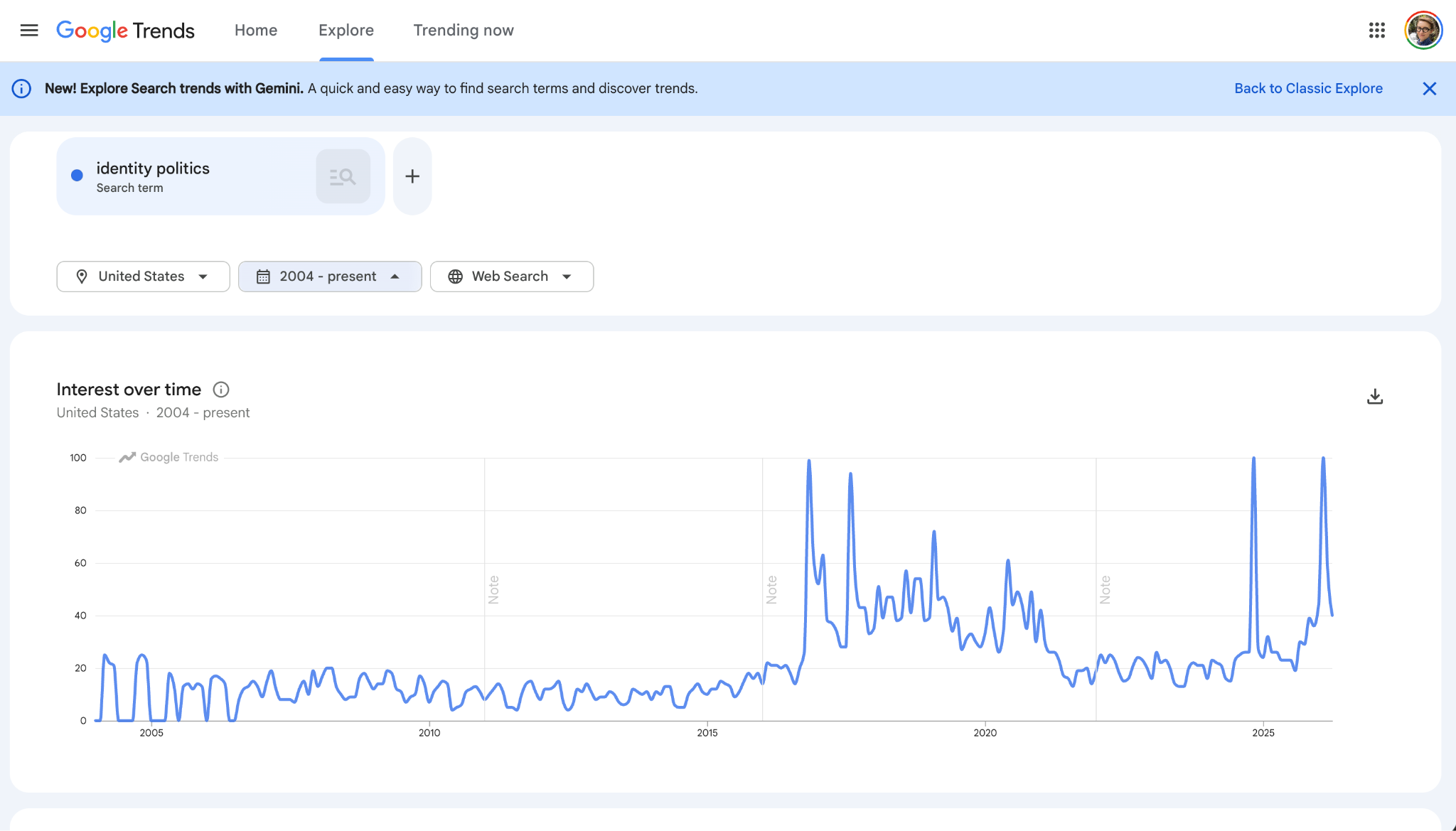
See Google Trends for Identity Politics (spike in 2016) - 2005 to 2025
* Public interest in the phrase “identity politics” itself was low and stable for decades, then spiked dramatically.
* Searches reached more than twice their previous all-time high in November 2016 (post-Trump election) and again in August 2017 (Charlottesville).
* These were not coastal-only phenomena; Rust Belt states showed strong interest. Earlier data (pre-2016) show no comparable surges, confirming the mid-2010s as the breakout period
Word frequency and media mentions
* Quantitative content analyses of major U.S. publications show a clear surge in the phrase “identity politics” beginning in 2016. One study of major outlets found it tied more often to the political left but with significant right-wing linkage as well; aggregate trends confirm the spike through 2019
* Google NGram Viewer
* identity politics,intersectionality,black feminism,nonbinary,lived experience 2000 to present
* NYT word-frequency analyses of “woke”-adjacent terminology (including identity-focused language) also show rapid rises starting ~2013–2014
2016–2020s: Manufactured extremism and the “return” to antisemitism
* He then layers in the SPLC/FBI storyline he’s reacting to: that anti‑hate nonprofits and elements of the security state allegedly paid or supported extremists to keep visible “racism” and “right‑wing extremism” alive.
* In his narrative, these groups have a financial and institutional incentive to produce hate so they can fundraise by promising to fight it, which requires keeping social tensions high instead of allowing them to cool off.
* Within that frame, he says identity politics eventually “runs its course,” and elites fall back on the oldest scapegoating pattern: overt antisemitism and conspiracy about “the Jews” as the master explanation, which he characterizes as “old reliable” used to absorb and misdirect frustration away from structural issues.
Funding of Identity Politics
The top identity politics orgs:
* NAACP (National Association for the Advancement of Colored People)
* Southern Poverty Law Center (SPLC)
* Black Lives Matter Global Network Foundation
* Human Rights Campaign (HRC)
* GLAAD
* Transgender Law Center, National Center for Transgender Equality, Lambda Legal
* ACLU (American Civil Liberties Union)
SPLC Fundraising Over Time
TL:DR Seemed to go DOWN a bit after OWS, then blasted up after Trump was elected
* 2000–2015: Relatively stable and modest, generally in the $35M–$62M total revenue range (contributions ~$30M–$55M). Slow, steady growth with minor fluctuations.
* 2016–2017: Dramatic surge (post-2016 election and heightened visibility), with total revenue jumping to ~$136M and contributions to ~$132M.
* 2018–2024: Elevated plateau with volatility — peaking at $170M total revenue in 2023, then declining to ~$129M in 2024. Contributions remained high (~$97M–$132M range).
High-Profile SPLC Donors
Asmongold’s Theory might have more weight if donors to the SPLC would be uniquely uncomfortable with OWS-related sentiment. Who are high-profile SPLC donors?
* George Clooney and Amal Clooney (via the Clooney Foundation for Justice): Donated $1 million in 2017 to support SPLC efforts against hate groups.
* George Soros (via Open Society Foundations): Multiple grants over the years, including support for anti-hate initiatives (e.g., a $75,000 pledge in 2016 for convening anti-bias groups; broader involvement in related funding).
* Tim Cook (then-Apple CEO, on behalf of Apple): Pledged $1 million to the SPLC in 2017 (part of Apple’s $2 million total to anti-hate groups, split with the ADL). Apple also encouraged employee and customer donations.
* JPMorgan Chase: Longtime donor; gave an additional $500,000 in 2017 for “disaster relief” and other support.
* Other notable mentions:
* OpenAI, Chick-fil-A, and MGM Resorts (corporate contributions in recent years).
* Various donor-advised funds, foundations, and high-net-worth individuals (SPLC’s revenue is primarily from private contributions, with an endowment/net assets nearing or exceeding $780M–$800M).
NAACP Fundraising Over Time
* Sharp growth in the late 2010s–early 2020s aligns with heightened national attention to racial justice issues.
* Pre-2011 data is limited in digitized Form 990s; overall NAACP-related activity was smaller-scale historically (you don’t have to report as much when your nonprofit revenues are super low)
* Contributions
* 2024: Total Revenue $60.6M / Contributions $49.9M (82%)
* 2023: $43.6M / $25.7M (59%)
* 2022: $51.2M / $40.0M (78%)
* 2021: $103.7M / $94.2M (91%) — major surge (post-2020)
* 2020: $86.8M / high contributions
High-Profile NAACP Donors
Corporations have provided some of the largest recent gifts:
* Wells Fargo: $50 million grant in 2023 — the single largest corporate donation in NAACP history. Funds supported grassroots branches, a new national headquarters, financial literacy, and racial equity programs. Wells Fargo has been a long-term partner (20+ years).
* AT&T: Multi-million dollar contributions (in the $1M+ category in some reports).
* Others in the $200K–$1M+ range: Bank of America, JPMorgan Chase, McDonald’s, Walmart, Hyundai, UPS, FedEx, Coca-Cola, and Eli Lilly.
Foundations who donated:
* Ford Foundation
* W.K. Kellogg Foundation
* Robert Wood Johnson Foundation
* Open Society Foundations (linked to George Soros)
* The Atlantic Philanthropies and others.
HRC Funding
* Early 2000s (~2000–2005): ~$20M–$25M range — smaller scale during earlier advocacy phases.
* ~2010: ~$27M.
* 2012: ~$33M.
* 2015: ~$37M.
* 2017–2018: ~$42M–$46M.
* 2020: ~$46M.
* 2023: ~$50M.
* 2024: ~$46M.
* 2025 (FYE March 2025): $50.1M (peak recent year; contributions $46.1M).
GLAAD Funding Over Time
* Early 2000s–2010: ~$3M–$5M — smaller scale focused on media advocacy.
* 2015: $5.1M
* 2016: ~$5.4M
* 2017: ~$7.7M
* 2018: ~$19M+ (major donor spike, e.g., Ariadne Getty Foundation)
* 2020–2021: ~$20M–$24.9M (post-2020 visibility surge)
* 2022: $18.6M
* 2023: $25.3M (recent peak)
* 2024: $13.6M (notable decline, with expenses at ~$22.5M)
Versus Funding of Occupy Wall Street
* It didn’t survive beyond 2012
* The trackable fundraising data effectively ends in 2012, as the movement’s organizational structure fragmented after the encampment’s removal, making consistent financial tracking impossible.
Major OWS Donors
Occupy Wall Street (OWS, 2011) was a decentralized, grassroots protest movement with no central nonprofit structure, so it did not have traditional “high-profile donors” in the style of established organizations like the SPLC or NAACP. Funding came primarily from thousands of small individual donations (often under $100), in-kind contributions (food, supplies, tents), and online platforms like Kickstarter and WePay. Total cash raised in New York alone reached roughly $500,000–$600,000 by late 2011, with much of it processed through the Alliance for Global Justice (AFGJ) as a fiscal sponsor (taking a ~7% fee)
A few prominent left-leaning individuals and business figures stepped in with larger support, especially after the initial Zuccotti Park phase:
* Ben Cohen and Jerry Greenfield (founders of Ben & Jerry’s Ice Cream): Led the Movement Resource Group (with other business leaders) to raise funds for a national Occupy office and grants to local groups. They personally contributed significantly; the group raised ~$300,000 by early 2012 (with plans for $1.8 million), and more than two-thirds came from the Ben & Jerry’s Foundation.
* Danny Goldberg (former Nirvana manager and music executive).
* Norman Lear (television producer, founder of People for the American Way).
* Terri Gardner (millionaire businesswoman).
Celebrities
* Susan Sarandon, Michael Moore, Kanye West, Russell Simmons, Cornel West, Pete Seeger, and others.
* Brad Pitt commented positively on the movement internationally.
Versus Leading Environmental Orgs
It might make sense to look to environmental orgs as the next best anti-corporate proxy.
The TL:DR is (1) their funding is bigger overall than identity-based org funding and it’s more linear (which could be an argument in favor of the identity politics orgs being a bit more astroturfed).
The top US-based environmental nonprofits are:
* The Nature Conservancy
* World Wildlife fund (WWF) Inc (US Affiliate)
* Environmental Defense Fund (EDF)
* Natural Resources Defense Council
* Sierra Club
The Nature Conservancy
* Early 2000s (~2000–2005): ~$400M–$500M range — steady but lower scale.
* Mid-2010s (~2010–2016): ~$700M–$1B — gradual growth with increased conservation focus.
* 2017–2020: ~$1.0B–$1.2B.
* 2021–2022: ~$1.3B.
* FY2023 (ended June 2023): ~$1.17B.
FY2024 (ended June 2024): $1.48B (with some reports citing ~$1.5B–$1.83B in total support/revenue including certain gains)
The Environmental Defense Fund
* Early 2000s (~2000–2005): ~$80M–$120M — smaller scale.
* Mid-2010s (~2010–2016): ~$138M–$200M — steady growth.
* 2017–2020: ~$210M–$300M+.
* 2021: ~$365M (notable peak, partly due to pledge timing).
* 2022: ~$285M.
* 2023: ~$247M.
2024: $299M (with contributions making up ~97%)
The Sierra Club
Early 2000s (~2000–2005): ~$80M–$90M — more modest scale focused on traditional advocacy and membership.
~2010: ~$100M.
2015: $109M.
2020: $152M.
2021: $152M.
2022: $167.5M.
2023: $173M (peak in recent filings).
2024: $169M (Form 990) / ~$183M (audited consolidated revenues, including net assets released from restrictions)
COVID and the internet as accelerant
* Finally, he argues that COVID is the “killshot” for normal Western social life because it forces every “idiot” online all day, massively amplifying outrage dynamics and fringe narratives. With everyone stuck on the internet and algorithms favoring extremity, manufactured divides and identity conflicts scale up far faster and feel more real and dangerous than in the mid‑2000s offline world he remembers.
* In his completed “American History Conspiracy Timeline,” the through‑line is that 2005’s relatively relaxed, optimistic, and materially focused environment is systematically replaced by a top‑down, incentive‑driven system that constantly re‑inflames racial tensions and revives antisemitism, not because grassroots hatred suddenly surged on its own, but because powerful institutions needed visible bigotry to justify their budgets and keep people from uniting around class and power.
If It’s Not a Conspiracy, What Is It?
This could be caused by a couple of things:
The Urban Monoculture Reaching Critical Mass
* And the urban monoculture is more predisposed to identity politics
Trump Derangement Syndrome
* Funding for these identity politics orgs—and some environmental nonprofits—spiked after Trump’s election
* SPLC funding skyrocketed with Trump’s election
Maybe it’s also just COVID driving people into their heads
* NAAPC funding skyrocketed with COVID
Episode Transcript
Simone Collins: [00:00:00] Asmangold, presented his conspiracy timeline starting with 2005, racism basically defeated.-. But what about all these CoreOS occupy Wall Street? Then 2014, look at that black person
If you look for example at,
Malcolm Collins: oh my God,
Simone Collins: terms like identity politics, intersectionality, black feminism, non-binary lived experience it’s like,
Malcolm Collins: it’s like exact.
Simone Collins: Mm-hmm. It’s a little uncanny. It’s a little weird.
I made a graph of the Southern Poverty Law Center.
Malcolm Collins: What
Simone Collins: Here we have the HRC funding graph. Again, something, you know, you, you see the normal, like steady,
Malcolm Collins: oh my God, it’s so obvious here.
Yeah, let’s look at Glad.
Simone Collins: What happens? They’re
Malcolm Collins: not in on the conspiracy.
Simone Collins: Surely nothing happens. Suddenly, oh
Malcolm Collins: my God. Gladys said what?
Simone Collins: And this is all from their, their tax filing. This isn’t just like conjecture.
At and t. Others? Bank of America, JP Morgan. Chase, McDonald’s, Walmart. Hyundai, UPS. Oh my God. FedEx, Coca-Cola, [00:01:00] Eli Lilly. The Ford Foundation, the Kellogg Foundation, the Robert Word, Johnson Foundation
Speaker 5: I wonder if it affects the behavior of the children. Hmm. Curious.
would you like to know more?
Simone Collins: Hello, Malcolm. I’m excited to be speaking with you today because I heard a new conspiracy theory that I really like, and I wanted to see if there’s good evidence behind it. So let’s go on a YouTube clip of Aspen Gold Stream titled, I
Malcolm Collins: brought this to you, by the way. I, I brought, I brought it like, I actually think there could be something to this.
Simone Collins: Yeah. This, this was, again, Alex Jones was right. He. He Asman Gold, went over the Southern Poverty Law Center’s, support of racist groups, and then presented his conspiracy timeline regarding racism in the USA. And it basically goes like this. He, he titled that the Asman Gold American History Conspiracy Timeline, starting with 2005, racism basically defeated.
Everyone is getting along generally then 2011 lives improve. But what about all these [00:02:00] CoreOS occupy Wall Street? Then 2014, look at that black person they took your future. And then 2025 OMG, the Jews, and I hadn’t heard about it before, but it sounds credible like that. Basically the racism and identity politics of our recent era.
Are the product of some AstroTurf work done by Cor Bros because they don’t like the idea of people really being against them.
Malcolm Collins: Yeah, so basically and I’ll, I’ll, I’ll, I’ll try you to frame it a bit more tightly.
Simone Collins: Yeah.
Malcolm Collins: Is Asma Gold thesis is we solved most of the issues of social discord was in American society.
Mm-hmm. As a result, people then begin to look with suspicion at the pose. And here I’m not talking about generic capitalism or something like that. I’m talking about the entrenched bureaucratic corporate interests that riggs the system in their favor in a very non-capitalist socialist, high barrier to entryway, which is demonstrably a part of [00:03:00] American.
Culture at this point. Mm-hmm. And because the social harmony that we achieved allowed for that these people who had a lot of institutional power. And keep in mind the Corpo here isn’t just Wall Street. It is the deep state that profits from Wall Street. Right. Like the deep, straight corpo revolving door is very, very tight.
Right?
Simone Collins: Yeah.
Malcolm Collins: Especially within the Democratic Party, and it used to be within the Republican party. And so they say, uhoh, uhoh how do we get people to stop looking at us now? And they’re like, what if we invent racism? And as we saw with the Southern Poverty Law Center, because Asmo Gold said this southern poverty loss interest thing, he’s like, I bet.
But if you don’t know, this is the number one anti-racism group in the United States. Turned out to likely be the major the, because the amount that they gave out was over $3 million to the various orgs, and it was orgs like the Nazi org and the KKK, which are not getting a lot of money from [00:04:00] other sources.
It is hard to stay employed and make millions of dollars if you’re. Publicly donating to one of these institutions. So they, they could have been their primary funder with funding. And, and why do I believe that they were their primary funder? Potentially. Yeah. If you look at before occupy Wall Street, if you look at videos of clan rallies from that time or neo-Nazi rallies in the United States, it would be like three sad people walking with a bunch of people yelling at them.
Yeah. Now you get like full on tiki torch parades and stuff like that. Like there, there has been a demonstrable change in the size of these.
Simone Collins: Yeah. Who’s gonna pay for the tiki torches? Who’s gonna pay for the, the matching khaki pants.
Malcolm Collins: Yeah. They’re nice. The change in the size of these operations since the Southern Poverty Law Center started funding them.
Mm-hmm. And so, but the question is, is who else is funding them? How much else are they funding them? And Simone came back to me and she goes, Malcolm. I think I found some smoking guns here. So I want you to go further. I want you to expand the genius Asma gold theory on all of this.
Simone Collins: [00:05:00] Oh, yeah, yeah.
I, I, I went and I checked to see how the theory tracks with keyword search volume and changes in police training programs and gram word volume and books and reported hate crime data and polling data and fundraising data for the top identity politics orgs and versus pol or, or occupy Wall Street and versus just general like environmental orgs and.
It’s so suspicious. Okay. While most nonprofit fundraising curves just to like, give a little teaser that I looked at, appear to just go up mostly linearly over time. Like when you look at most of the environmental orgs, it goes up linearly. That makes sense. And then yet fundraising for identity politics orgs, like the N-A-A-C-P and the Southern Poverty Law Center skyrocketed after occupy Wall Street. Like there’s a very weird, like, yangyang. So it, it, mm, it’s just one of many things. So first, let’s just look at, at his, his argument point by point, and see how well supported each of his arguments are. Because I don’t know, like, you know, my memory, [00:06:00] my memory’s shot, I don’t know where things actually were.
So in, in, again, this four step conspiracy timeline,
Malcolm Collins: actually just No.
Simone Collins: Before you
Malcolm Collins: go further,
Simone Collins: Uhhuh,
Malcolm Collins: when did all of the antisemitism begin to rise in America? The antisemitism began to rise right as black fatigue was setting in. Mm-hmm. They’re like, oh, oh, we need a new outgroup.
Simone Collins: Yeah. Yeah. Well, I mean, we also have to eventually do a podcast on black Americans being supplanted for Muslims, because that’s another interesting, like flipper route that happened around the time of the
Malcolm Collins: Oh yeah.
Left is really done playing with black people. Like yeah, you guys are.
Simone Collins: I’m tired. I’m done.
Malcolm Collins: Toy story where like the, the drops Its toy at new toy.
Speaker: Oh, I forgot you’re broken. I don’t wanna play with you anymore.
Malcolm Collins: He’s got the new, the new toy. Right. But hopefully we can use this on the right to un brainwashed some [00:07:00] black people and bring ‘em over to our side, which means stop being performatively racist to be edgy guys, that’s not, it’s not useful.
Okay. Yeah. It, it, it, it, it really only hurts us. There are obviously some black immigrant communities that need to that, that have externalities associated with them, like the Somalian refugees and stuff like that. Yeah. But don’t d you know, one thing to be like. These black immigrant populations have negative externalities and we need to find a way to deal with it.
Then to just be like performatively racist or something like that, which is really only to masturbate your own ego, not to help the party because it hurts some. Yeah.
Simone Collins: Anyway, Osmond Gold describes the mid two thousands as basically this time when most people of different races got along and pop culture just normalized, multiracial friendship and cooperation.
And he,
Malcolm Collins: yeah,
Simone Collins: he uses rush hour three. With, you know, Jackie Chan and it was Chris Rock, right. Being like, oh, everyone’s like excited to see that. And like people, a joke about people of being of different cultural and, and ethnic [00:08:00] backgrounds, but like, they were comfortable with it. It wasn’t this tension.
It was rush hour three. Wasn’t a story about multiculturalism. It was like funny. And they would, you know, people enjoyed that. And also society was just getting more progressive each year on race and sexuality. There was growing acceptance of gay people. We elected Barack Obama, like it was a thing. And he emphasized that everyday social life did feel edgy, but unserious that people would say offensive things like they would use racial slurs in video games, but everyone knew it wasn’t real.
Like it was just teasing and trolling and basically in locker room talk. The overall vibe was that people just joked harshly, but got along. And I
Malcolm Collins: checked, there was not meaningful ethnic tension outside of ghettos. And I really mean this in, in my school for example, like we had kids of different s ethnic, you had kids of different ethnicities in your school.
Did anyone care?
Simone Collins: Yeah, nobody cared. We would talk about stereotypes, but that’s because they were real. So.
Malcolm Collins: The, we had, we had a group that we called the Korean Mafia because there were a bunch of [00:09:00] Korean kids at our school
Simone Collins: mm-hmm.
Malcolm Collins: Due to some sort of scholarship that let them come. And then there was a bunch of Chinese kids who hung out together.
But other than those two groups and those two groups, you know, literally came from other countries.
Simone Collins: Well, I literally remember the first time I heard someone say something racist that like surprised me because I just never heard anything racist before. And it was, I was a friend in school. I can’t remember what level of school I was in, but her name was Yesenia and she came from like a Spanish speaking household.
And she was telling me how like her parents were really concerned about brown people. And I was just so, like, I was like, what do you mean what is this about? But like that I have a memory of someone talking with me about that and like, being surprised must show that. Like, we really didn’t care at that era, you know?
Just didn’t matter. But yes, when you check in on hate crime in 2005 in the us the, it was one of the lowest points for racism in US history relative to prior eras. And lethal racial violence had plummeted from its peak in the late 19th, early 20th century.
Malcolm Collins: Yeah, we had gone to a point where [00:10:00] blacks were mostly just killing other blacks.
Yeah. Sorry. I’ve had to, I know that’s horrible. There, there is a difference in homicide rates, but they, that is true that blacks mostly kill other blacks while they do have an increased homicide rate.
Simone Collins: Yeah.
Malcolm Collins: Virginia.
Simone Collins: So studies of discrimination trends, which, you know, have been active since we’ve been, like for, you know, decades and decades, show persistence.
Like there’s still discrimination, but they were overall reductions. Post 1960s things had only gotten better. And in 2005 there were 7,163 hate crime offenses. And this was noted by the FBI as the lowest total in more than a decade racial bias motivated about 54.7% of single bias incidents. So this was by
Malcolm Collins: the way,
Simone Collins: yeah.
Malcolm Collins: Continue, continue. I, I’ll, I’ll, I went to get end of your thought.
Simone Collins: Importantly, and this is really interesting, right? So we’re looking at, at all of this crime. I started wondering if perhaps part of what made hate [00:11:00] crime levels seem to go up, had to do with police training. And, okay.
Malcolm Collins: Okay. Before you get into that, I wanted to go into a, f Funny, I saw this on Asma Gold or Nino and this, it looked like official data. I’m gonna double check because this sounds so crazy if this is actually official data. Okay. But it was tracking interracial grapes.
Simone Collins: Oh God. You mentioned this to me. Yes.
Malcolm Collins: And it was, black on white was something like 12,000.
Mm-hmm. Which, I mean, if you’re considering the whole country isn’t a ton, but it’s still like a lot. Right? Like I’m, I’m sure that we get way more from immigrants, but I, I know that that’s the particularly prejudiced statement against immigrants. But I mean, I’m, I’m pretty sure I would expect more than 12,000.
But the funny number was, was white on blacks, which was literally over the official datasets entire recording period for that year. Zero. Oh God.
Simone Collins: Ugh.
Malcolm Collins: Which actually track,
Simone Collins: yeah, fact track that. But like, oh, that’s
Malcolm Collins: our video on perceived attractiveness between groups. White people [00:12:00] uniquely see black people as unattractive.
And this is actually really hard for black
Simone Collins: people. Oh, that’s even more insult. You’re just saying like, well, they wouldn’t. Because they don’t want to. That’s horrible.
Malcolm Collins: Yeah. Well, I mean, it’s when we point out how bad it is for blacks in the United States we have this episode on like, it being so hard for black women that if you look at the old ok OkCupid da dating stuff that.
You know how bad it is for white men in online dating.
It is literally harder for black women in online dating than it is for white men. That is how nerfed the black community is within dating pools in like black pill communities. Not named the black, but like they go full like, like in sell whatever.
People are like, bro, like. Be white, be tall. Like if you’re not those two things, you are nerfed, right? Like so do keep in mind that there are some areas where white men still have privilege when it comes to being thirsted over.
Simone Collins: Yeah,
Malcolm Collins: if you’re in the top 1%
Simone Collins: anyway [00:13:00] and so things hit this nadir in terms of hate crime and everything in, in 2005.
And I started to wonder like, okay, if, if this is, this conspiracy is real and if interests, you know, with, with deep pockets and we didn’t want corporations to be scrutinized, wanted. To begin to foment this feeling that racism was real and that racial tensions were a big thing in the United States. It had to be addressed.
That we all have to obsess over that and not look at corporations and rich people. That one thing you might do is just train or encourage training and police departments that would lead to a higher rate of reported hate crimes. So then you, with some other nonprofit, you, you could point them. To look at the data and report a spike in it and then be like, this is a big problem.
Ooh,
Malcolm Collins: very clever.
Simone Collins: And it, so it actually does turn out that multiple times after 2012, the FBI crime data collection guidelines and training manual were [00:14:00] updated. Starting in December, 2012, the tail end of Occupy Wall Street, they merged major guidelines and training guides to include learning modules on bias motivated crime definitions.
There was this two-tier review process, so you respond to Officer Flags. They have like for suspected bias, and then you have expert review of whether it actually is bias. The training included case study exercises and model procedures for agencies to build their own training, and they, it was explicitly intended to help departments establish and refresh hate crime training programs.
Right at the end of Occupy Wall Street. And then in 2015 there were new bias categories. So, they added anti-Arab, they expanded religious biases. And they added more training scenarios for those. And then they, they also updated in 20 21, 20 22. This for this full transition to the National Incident Based Reporting system that that removed.
I’m not, okay. I’m not gonna get into it. But basically, yeah, they did train, they did train [00:15:00] differently after Occupy Wall Street in a way that would’ve led to probably more reporting, even if things remain unchanged otherwise. And
Malcolm Collins: then they could utilize the higher reporting to create movements like BLM.
Simone Collins: Yes. And then also this is, this is just, this is just the FBI. Then there’s the, the the N-I-B-R-S. Basically the department adjustment sorry, department of Justice and the BJS, what is the BJS? I didn’t look that up. Sorry. And the FBI, they provided targeted grants and technical assistance and training to thousands of agencies to properly code and report hate crimes mm-hmm.
In this database. So they’re also like, we’ll give you money to make sure that you do this correctly. Which is. Notable, I don’t know where the grants came from, but I could totally see like this is a very subtle and hidden way for someone who, like, for example, made a lot of political donations who made sure that an appointee is leading a certain agency to, yeah, to, to, to put something like this in without anybody like, Hey, just putting this policy and what you’re not gonna look bad for [00:16:00] doing it.
You know, we need to, Hey, crimes are a big, serious issue, you know, we just need more accurate reporting. But you know how measurement works, you know, like if you encourage and incentivize and give people grant money to measure something, they’re gonna measure it more, you know? Mm-hmm. And then there were also very specific targeted grants.
Like there’s the Matthew Shepherd and James Bird Jr. Hate Crimes and Training technical Assistant program grants. They funded specialized training resource centers and outreach for identifying. Crimes and, and bias. So just keep in mind that like even specific people created grants to,
Malcolm Collins: and it’s very interesting that there’s a flurry of this right at the end of Occupy Wall Street because.
There was not a flurry of attention on interracial violence right at the end of Occupy Wall Street.
Simone Collins: No, no, no, no, no, no. The, the, I think the wheels started turning the donations started the, the, the, the training shifted. And, and also just to be clear, this is in addition to state level changes. So for example, in 2017 [00:17:00] onwards, so this is a bit after Occupy Wall Street there was the California Commission on Peace Officer Standards and Training.
Releasing a new video called Hate Crimes Identification and Investigation. And then also AB 57 required its inclusion and basic academy training. Made it available online, mandated periodic in-service training other states. Cast similar mandates. So basically now there’s just basic like propaganda videos that, that is another way to put it being like, here’s how to report bias.
And then also I just wanted to check in on polling, right? So because polling is another way for us to see how Americans felt about bias. So when you look at a Gallup satisfaction with Reese relations question for like, oh, is it, are you very satisfied? Are you somewhat satisfied? In the early two thousands to 2014?
People were very satisfied. They high, basically 60% plus marked good. And this p peaked near 70 to 80% post the Obama election. [00:18:00] Then 2015 onward, you know, after the gears had started turning, there was this sharp drop to 30% marking it as good. Sharp drop. This is the lowest in decades. And this was amid the, the Ferguson era protests.
And then ever since it’s hovered from like 22 to 36% from its high at 60%. So Aspen Gold is totally right, that like people in 2005 were feeling pretty fine about race relations. And now as of well last year, as of 20 25, 50, 60 4% say racism against black people is widespread. And this is tied for the highest since 2008, tracking up from 51% in 2009 and civil rights progress views are also down from 89% in 2011.
So preoccupy Wall Street to lower levels post to 2020. Then also Pew Research as well. In 20 19, 50 8% called race relations bad. And 53% worsening post [00:19:00] 2020 BLM support peaked and then fell and discrimination perceptions peaked around that time too. It, it’s, it’s bad basically like peer research reports now that people also see racism as a very, very bad issue in the United States.
So let’s go back to what Aspen Gold observed about the 2011 to 2012 occupy Wall Street conflict. He, he, he said the real break came with OWS when people started focusing on economic power rather than identity. And they were wondering whether their problems came from the ultra rich and this corporate leadership class.
Because I think a lot of the sentiment back then, I’m very like, it’s, it seems like a lifetime ago, it seems so long ago, but people felt like after the 2008 crash when a lot of really wealthy people got bailed out, we just never really seemed to recover from that.
Malcolm Collins: Society didn’t Yeah,
Simone Collins: yeah. Like pe pe like the, the rich just kept getting richer, but no one else like really saw the same level of steady improvement that they were used to.
And he argued that [00:20:00] Asman gold argues that this is, this is the point at which the elite get terrified. So what I wanted to know is how American sentiment changed about wealth disparity in class conflict when the Occupy Wall Street movement gained momentum in the USA, Ooh. And this one Pew survey of 2048 adults done in.
20 end of 2011. So Occupy Wall Street was like, this is picking up now. Mm-hmm. 66% of Americans said they were very strong or strong conflicts between rich and poor people. An increase of 19 percentage points from 47% in a 2009 survey right after the 2008 financial crisis. The share saying very strong conflicts doubled from 15 to 30%.
The highest level since Pew first asked the question in 1987. So this was a definitely this flashpoint peak. Yeah, he’s absolutely right that people saw it. Class conflict was now seen as a bigger source of tension. Then conflicts between [00:21:00] immigrants and the native born blacks and whites, or young and old per pew polling.
So he is spot on with this. Also views on economic fairness and power. Were, were totally also off it in a separate 20 th 2011 poll. 77% argued there was too much power in the hands of the, a few rich people and large corporations. 77% of people. I mean, I, I could see large corporations and really wealthy people kind of being like, Hey guys, we should probably divert their attention
Malcolm Collins: 77%.
Yeah. We need to get people pissed at something else.
Simone Collins: And this is, it has
Malcolm Collins: felt, I’m gonna be honest, like on the ground, when I learned about the, that, that the
Simone Collins: 2008 financial crisis, like all
Malcolm Collins: the, the Civil Property law center had been funding the KKK and the neo-Nazis.
Simone Collins: Yeah, yeah, yeah,
Malcolm Collins: yeah. And that Nick Fuentes was heavily AstroTurf.
I sort of had this moment of like pulling back and I think a lot of influencers on the right have been trying to cater to both sides to some extent. To try to be like, yeah, well I don’t wanna [00:22:00] isolate. That audience by being like, yes, unmitigated, obviously this word’s a good thing for America’s long term interests and stuff like that.
Mm-hmm. And I sort of come to this realization of, oh. The people who I thought I was arguing with may just not even really exist in meaningful numbers. They’re just sort of, shell accounts online and a heavy sort of force that have been converted for by those shell accounts, but they’re not like a meaningful contingent of the conservative movement.
Yeah.
Simone Collins: Mm-hmm.
Malcolm Collins: And it’s changed the way that I address it where I just don’t. One, I don’t care about them as much as, as like players to like ideologically take seriously. But two, I see them as more of a threat than I did historically as well. Yeah. Which is to say that a lot of this stuff could just be funded by bad actors, right.
And, and like the pro Russia part of the Right, which is just comical because we pointed out that Russia is what was behind [00:23:00] BLM. If you go to our episode on that, we go with plenty of receipts showing that. If you were ever worried about Russia interfering with the election on behalf of Trump at a nine to one level.
So they literally nine times more than that, they spent on trying to make BLMA thing.
Simone Collins: Yeah.
Malcolm Collins: They are the source of BLM in America, so the
Simone Collins: Russian helped. It’s clearly, it wasn’t only. Plausibly conspiratorially, allegedly corporations and wealthy Americans. You know, it was Russians.
Malcolm Collins: Well, I mean, I think these groups work together.
Simone Collins: Well, I don’t think they coordinated. I just think that when you get, you know, enough people with aligned incentives doing the same thing, it’s gonna be more effective.
Malcolm Collins: No, no, no, no, no, no. I think they literally work together. So by this, what I mean is if you, this was period where a portion of the American Right began to act like Russia was our friend.
Simone Collins: Oh my God. That’s right. Yeah. Like, wow. Russia’s actually, you know, a. Worthy of
Malcolm Collins: a very good right wing country. Yeah. And I remember when I first started seeing this and I was like, I’m sorry, I’m sorry. The right wing hates Russia. Like we have always hated [00:24:00] Russia. They are a communist country who transformed into a kleptocracy like this is antagonistic.
Simone Collins: Oh god. This was, yeah, this was even like when on the left people had a lot of memes about like Putin being sexy. Do you remember? Yes. Was Putin yes.
Malcolm Collins: I think, I think, oh.
Simone Collins: What was that? That song? I mean obviously it was a Rasputin song, but like
Malcolm Collins: Yeah, that’s when the RAs
Simone Collins: song got
Malcolm Collins: popular and everything
Simone Collins: like that.
Yeah. There
Malcolm Collins: was a push during a certain time period on both the left and the right to make the extreme and captured parts of them. The parts that seemed disingenuous. More pro-Russia.
Simone Collins: Well, look, okay, I just, I just wanna emphasize. The, the, the wealthy poses had a reason why, like another stat, 61% said the economic of Americans said the economic system unfairly favors the wealthy.
And this was up from earlier baselines in related polling, and only 36% called it generally fair. And it, it should also be noted though, that Oh, O Occupy, occupy Wall Street presented this threat and there was also this [00:25:00] actual increase in disparity at play. That yeah,
Malcolm Collins: I think, I think we have moved into the United States.
It’s having a system. We talk about this in our video of economically, who is actually more communist, the United States or the CCP in China, and the answer is the United States by threefold. Mm-hmm. Significantly more communist.
Simone Collins: Yeah,
Malcolm Collins: totally. Totally. And if you look at the structure of the government of the United States, which you might even go so far as to argue, is.
This is as much to distract us from the communist capitalist battle as it is because what has functionally happened is the communists of Russia had a plan to take over the American governing system, and potentially they have. They took over our academic institutions. They just called themselves something else.
They called themselves socialists. They, and, and, and Wokes and SJWs. And then they used that to take over our companies and they used that to create an alliance with these, and if somebody’s like. [00:26:00] Malcolm, how can you think that like SJW is aligned with Russia and you know, the Putin hates like the gays or whatever.
It’s like anybody who understands s JW really is, understands it’s a disease that you unleash on your enemy. It’s the effect the zombies
Simone Collins: for sure. Yeah.
Malcolm Collins: Like put, do you think Putinism agrees with Black Lives Matter? No. Then why is he funding it so much? Because he understands how to promote the disease and people who are infected with the disease don’t really care where they get money.
Simone Collins: Yeah, well, few people care where they get money, but so back to Aspen Gold’s core claim. It’s, it’s that in response to these growing concerns, big institutions cultivated a new wave of identity politics as a wedge issue to keep people fighting each other instead of looking up the class ladder and then in Ms.
Paint or whatever it is he uses, and he’s such a fast drawer. What is up with that? It’s inhuman. This this is the phase he sort of was describing where the rich guy takes nine slices of a 10 piece pie and then cuts the last. [00:27:00] Slice in half and says that black guy got your half redirecting resentment toward the other ordinary people instead of the elite.
And he, he does agree with some specific,
Malcolm Collins: and I wanna point out that these people, like, we need to like be clear about who the bad actors are in this, right?
Simone Collins: Yeah.
Malcolm Collins: Corporals are not industrialists and they’re not capitalists. Industrialists and capitalists is what make America a wealthy and successful country.
These are people like Elon Musk. Yeah. Or Jeff Bezos or mark Zuckerberg, or these are people who build things that make money. Okay. Compos are very different. These are people who use institutional bureaucracies and legal structures to make money in ways that the average person can’t. These are the people who run Enron.
These are the people who run Exxon Mobil. These are the people who run the major weapons manufacturers. These are the people who run Lockheed Boeing. The people who run the types of institutions that do not succeed. And these [00:28:00] make up a huge chunk of the American economy because they’re draining a huge chunk of the American economy.
They are in an endless cycle to siphon tax dollars from the average citizen in America, in the industrialists in America. And I think that what we need to do is build a better system for. A shared class identity for true Americans, which is the industrialists and the middle class against the parasites.
Who is the corpus and the people who live off of the system
Simone Collins: Well, and I think we need to recognize the wedge effectiveness per Aspen Gold’s point of identity politics, which absolutely did spike after. Around 2016 and certainly after Occupy Wall Street. So I just sent you Google Trends and Google Ngram viewer screenshots.
And I’m gonna link to all this in the show notes. If you look for example at,
Malcolm Collins: oh my God,
Simone Collins: terms like identity politics, intersectionality, black feminism, non-binary lived experience from [00:29:00] 2000 to present in Google Ngram viewer, it’s like,
Malcolm Collins: it’s like exact.
Simone Collins: Mm-hmm. It’s a little uncanny. It’s a little weird.
And also if you look at mi,
Malcolm Collins: okay. Plausible
Simone Collins: I know
Malcolm Collins: as, no,
Simone Collins: no, no. I’m getting more. No, there’s more. There’s more. Don’t, you know, let me keep going.
Also, New York Times word frequency analysis of woke adjacent terminology, including identity focused language showed also rapid rises, but not starting in 2016.
We’re talking starting in 20 13, 20 14. So. You know this, it’s, yeah, it’s, it’s real. And then, so keep in mind that next, in his argument, Aspen Gold layers in.
Malcolm Collins: Don’t forget to send me that graphic way, the New York Times one.
Simone Collins: I don’t have a graph for that one. That was just research done. Oh, okay. Yeah, but I, I’ll send you all the graphs that I have and I will get, again, put everything in the show notes and links and everything.
Aspen Gold then layers in how you get this SPLC. Involvement right in, in, and all these anti hate nonprofits suddenly [00:30:00] getting super active.
Malcolm Collins: Well, the, the coin goes as leaflet calls them.
Simone Collins: Yes.
Malcolm Collins: And it sounds like a ethnic slur. So she used the term coin goes, which means like. Quasi autonomous non-government entities, I think, or something like that.
Simone Collins: Yeah, yeah. And then basically at that point, the identity politics run their course and Elite fall back on basically like the old scapegoating pattern, just overt antisemitism and conspiracy about the Jews and, and the master explanation, which he characterizes as all reliable. And it just. Absorbs and redirects all the frustration from the structural issues that they were like,
Malcolm Collins: somebody’s like, well, the people are getting over black people.
They’re just done with them at this point. Right? Like, we sort of exhausted them as a resource that people,
Simone Collins: but there’s the, there’s old faithful, you know, it’s
Malcolm Collins: like, who’s next? Jews brilliant. Right? Like,
Simone Collins: yeah.
Malcolm Collins: How do we, how do we convince people to hate the Jews? Well, well, I mean, if it, if it looks like, it looks like you just bought the accounts of people who are already antisemitic to try to.[00:31:00]
Simone Collins: But here’s the, the really crazy thing. This is what really started changing my mind. Look at the fundraising over time. I made a graph of the Southern Poverty Law Center.
Malcolm Collins: What
Simone Collins: it actually seemed to go down a little bit after Occupy Wall Street and then it blow down. No,
Malcolm Collins: we down during Occupy Wall Street.
Yeah. So this, this is the period during Occupy Wall Street. 2015, it explodes to like five times the rate. It used to be.
Simone Collins: Yeah, because, so from like 2000 to 2015, it made between 30,000,050 5 million
Malcolm Collins: Theos.
Simone Collins: And then in 20 16, 20 17, especially by the time momentum was built, it was making 136 million, 132 million.
Then 2018 to 2024, it peaked at 170 million in 2023. And this is just around the time that they’re doing things like, you know, donating 3 million to their sources, right, their sources. And then I was like. Also like, okay, well then who are the donors to these organizations? You know? Yeah. [00:32:00] Might have more weight.
The donors would be uniquely uncomfortable with Occupy Wall Street related sentiments. So who are some high profile Southern Poverty Law Center donors? Well, there’s George Clooney and Amal Clooney via the Clooney Foundation for Justice. They donated a million in 2017. There’s George Soros via the Open Society Foundation, Tim Cook.
Then Apple, CEO, on behalf of Apple, pledged a million. JP Morgan Chase, a large American bank. OpenAI has also donated to SPLC, Chick-fil-A
Malcolm Collins: OpenAI
Simone Collins: mgm,
Malcolm Collins: by the way, do not use OpenAI models. Like if, if they’re donating to organizations like this one, they’re not very good. And two evil, evil, evil, evil.
You know what? I might even charge a premium. Well, hold on. We had somebody who’s gonna give us open AI tokens to test. No, you don’t. So they give us open AI tokens. I won’t charge a premium on open AI
Simone Collins: model. Look, people should have freedom to use AI as they want, but look at the next graph. ‘cause it isn’t just the Southern Poverty Law Center.[00:33:00]
This next one is the N-A-A-C-P. What?
Malcolm Collins: Oh
Simone Collins: my
Malcolm Collins: god. So
Simone Collins: Simone, they also saw a massive, massive spike. And this is all from their, their tax filing. This isn’t just like conjecture. We, nonprofits in the United States have to make pretty public disclosures of the amount of money that they got. Also, who’s donating to the N-A-A-C-P Wells Fargo 50 million grant in 2023.
At and t. Large corporation, others? Bank of America, JP Morgan. Chase, McDonald’s, Walmart. Hyundai, UPS. Oh my God. FedEx, Coca-Cola, Eli Lilly. The Ford Foundation, the Kellogg Foundation, the Robert Word, Johnson Foundation the Open Society Foundation, that’s George Soros again. The Atlantic Drops the company
Malcolm Collins: you should buy from.
Oh, no. Did Coca-Cola donate to them?
Simone Collins: Yeah. Sorry. Malcolm. Oh
Malcolm Collins: no. Oh,
Simone Collins: no. Sorry. Malcolm. All. Let’s go to another identity politics [00:34:00] nonprofit. Here we have the HRC funding graph. Again, something, you know, you, you see the normal, like steady,
Malcolm Collins: oh my God, it’s so obvious here.
Simone Collins: It, it just, it just spikes up. You wanna see another one?
What’s, what’s another one? Glad. How about glad you wanna look at glad. Let’s look at glad.
Malcolm Collins: Yeah, let’s look at Glad.
Simone Collins: What happens? They’re
Malcolm Collins: not in on the conspiracy.
Simone Collins: Surely nothing happens. Suddenly, oh
Malcolm Collins: my God. Gladys said what?
Simone Collins: Yeah. Yeah. So, you know, they were, they were, they were so, they were so modest,
you know, 20 15, 5 0.1 million, 20 16, 5 0.4 20 17, 7 0.7 2018, 19 million, 20, 20 20 million, 24 million.
2022. Oh, it, it’s just like, it’s, it’s insane. It’s insane. Let’s look at, let’s look at Occupy Wall Street. Our owner of
Malcolm Collins: glad’s, one of the funders of the KKK as well. I wouldn’t
Simone Collins: be surprised. God. Well, I mean, it would, it wouldn’t hurt. So, just so you know, occupy Wall Street, it, it didn’t survive beyond 2012.
They, they were evicted. Like you remember, they just took out the [00:35:00] camp, the, the trackable fundraising data for Occupy Wall Street. Effectively ends in 2012 as the movement’s organizational structure fragmented when the encampment got removed. And
Malcolm Collins: infiltrated by socialists, by the way.
Simone Collins: Yeah. So let’s, let’s just take a look at their, their fundraising.
Surely, you know, some huge, you know, calm interests were involved, but no, the, it, it peaked out at 800 k.
Malcolm Collins: 800 K.
Simone Collins: 800 k. And okay, well
Malcolm Collins: maybe companies don’t want Occupy Wall Street because they took over our institutions.
Simone Collins: Yeah, they
Malcolm Collins: took over our large
Simone Collins: companies. Yeah. They, yeah, they, they were too busy taking over.
And also I was like, well, maybe, maybe I was going too far with being like, oh, all these banks and like rich people donating to like the Southern Poverty Law Center and the N-A-A-C-P. Like, maybe that’s just kind of how it is. Right. You know, rich people donate to things ‘cause it’s like a, some kind of tax thing and they have to, you know, donate a certain amount of their trusts.
Otherwise they can’t maintain trust status or something. Right. Like, I know [00:36:00] there’s all these weird tax rules, so they have to make donations. Maybe they donated to occupy Wall Street too. But the people who donated, and there were very few obviously ‘cause they like raised nothing. The most prominent corporate founders are the most anti-corporate corporate founders you could possibly imagine.
Ben and Jerry of Ben and Jerry’s ice cream. They, they led to remember what Donators
Malcolm Collins: through Occupy Wall Street?
Simone Collins: Yeah, yeah. They, they, they wanted to be super supportive. And then there’s also just like Danny Goldberg, a former Nirvana manager and music executive. Norman Lee or a television producer, like, no, no one we would know, aside from Ben and Jerry oh wait, actually, no.
Susan Sarandon and Kanye West, Michael Moore, Russell Simmons, Cornell West. P Seeger and others. Brad Pitt commented positively. He didn’t donate money,
Malcolm Collins: commented
Simone Collins: positively. No wishes. No wishes.
Malcolm Collins: I love that. That counts as a donation these days. People are like, oh, Elon, he must have donated to your prenatal list movement.
I’m like, no.
Simone Collins: He
Malcolm Collins: commented positively.
Simone Collins: So he
Malcolm Collins: gets footnote,
Simone Collins: yeah, [00:37:00] thoughts and prayers. So I thought maybe like there was just some weird, spike. And, and there kind of was with some organizations I used. And I’ll, I’ll have all the numbers in the show notes, a bunch of environmental nonprofits as my control to kind of see like, well, is this just something that happened like after 2016, like when Trump got elected?
Did people just like put all of their Trump derangement syndrome into donations? And there were modest spikes, but nothing like with these. Really big spikes with the identity politics related organizations. And what’s notable to me is when you look at the, the, the amounts of money that the environmental nonprofits have raised is just orders of magnitude more, and this is actually what makes me the most suspicious.
Okay. So the Natures of Conservancy just, just insane to me. They’re raising like 400 million, 500 million in the early two thousands. Already In the early two thousands.
Malcolm Collins: [00:38:00] Yeah.
Simone Collins: Like keep, keep in mind the, the Southern Poverty Law Center. Do you remember how much they were raising in the early two thousands?
It was
Malcolm Collins: like 11 million, right?
Simone Collins: It was like 35 million.
So we’re just talking huge orders of magnitude more for environmental nonprofits. And that makes me feel like a small number of wealthy people. Throwing a little bit of money toward those organizations and encouraging outsized like sort of propaganda results is, is something that just, I don’t know, it gives me pause.
That basically just environmental nonprofits had slightly more steady increases, like more what I would expect from a nonprofit. And also they just, they clearly had much more broad based support, whereas these more niche, more out there, more radicalized, identity politics based nonprofits just kind of got very significant changes in donation patterns after a very specific event.
Aspen Gold also argued that COVID and the internet were this perfect storm, accelerating [00:39:00] the, the identity politic. I can’t use bad words.
Malcolm Collins: Oh yeah. Perfect storm. Not an engineered storm. It’s not like, it’s not like, they
Simone Collins: were, that’s good pointing out though, like it forced every idiot online all day, which massively amplified outrage dynamics and fringe narratives because just people were just sitting online.
Online. It
Malcolm Collins: made my life so much better. COVID has been like the turning point in my existence where the world, I, it really reminds me of this anime Zam 100, where the world, yeah. It is overrun by zombies and he’s like, loving it. He’s like, this is so much better than having a day job. Yeah. And post COVID so many people that come to me, they go, everything’s been terrible since COVID.
Speaker 2: Starting today, I don’t have to go to work anymore.
Speaker 3: I am.[00:40:00]
Speaker 2: Until yesterday, I saw the world in monochrome, shrouded in a black cloud of despair in hopelessness, loose skies, green trees. I Red Blood. I’ve been zoned out for so long, I’ve forgotten. The world was so beautiful. Oh of so many beautiful colors. Who cares if there’s zombies chasing me?
Malcolm Collins: Like, now Trump’s in power and look at all the crazy stuff that’s happening in politics and look at all the, and I’m like, bro, it has just been a blast for me. It was,
Simone Collins: yeah. I, that, that one song that we kept listening to during the pandemic with the, like, I’m just gonna. Be inside the
Malcolm Collins: [00:41:00] Caer song like I’m
Simone Collins: song Yeah, that just like captured everything that I felt.
I do wanna point out though, and I’m gonna bring back the same graph that I showed for my argument about male female speciation. I don’t know, that episode may not have run yet, but that the, the male female political divide, which is very much associated with this identity politics, insanity.
Really it does.
Malcolm Collins: Oh, you found this, that it all started with Tinder.
Simone Collins: It started with Tinder, but it accelerated after COVID. And I think that really feeds, it plays into Aspen Gold’s argument that COVID was an accelerant for extremism by forcing all these people online.
Malcolm Collins: Tinder plus COVID is what? COVID.
Simone Collins: Tinder Plus COVID. But okay. Like I, I, I’ve presented all of this, right? So we had differences in, like, changes in the way that police were trained. There was a, a very clear and measured. Nadir in hate crime and in perceptions of racism before occupy Wall Street and then suddenly, somehow inexplicably and for [00:42:00] no apparent reason.
It started to get bad and, and I really can’t understand aside, like I don’t have any alternate, here’s, here’s my three theories as to what this could have been. If it wasn’t the Corpo saying, oh my gosh, we have to engineer. Okay, go for division, that’s not concerned about us. One is. It could just be the urban monoculture reaching critical mass.
Okay? And the urban monoculture is more predisposed toward identity politics. So this was just a separate cultural mimetic virus running out of control. And of course, all these things could be happening at the same time. Two, it could be just Trump derangement symptom. Because funding for many of these identity politics orgs and some of the environmental nonprofits as well spiked after Trump Trump’s election.
It was 2016. That was one of the periods. Now this doesn’t explain, for example, the shift in the New York Times language toward woke. Stuff well before Trump was elected. But, [00:43:00] but the Southern Poverty Law Centers funding did skyrocket with Trump’s election. Now, that could just be when their team really got product market fit and found out how to like tap into really good veins because of that.
And they had already picked up momentum before, but still.
Malcolm Collins: I have another thesis,
Simone Collins: Uhhuh,
Malcolm Collins: is that you’re looking at it wrong.
Simone Collins: Okay.
Malcolm Collins: That it was explicitly the death of Occupy Wall Street that caused the explosion in identity politics. Let me explain. Okay. In our book, the Pragmatist Guided of Crafting Religion, I actually explicitly go over this.
I say. That the urban monoculture is not a parasite, it’s this parasitoid. It has to kill its post.
Simone Collins: Yeah.
Malcolm Collins: The way that it spreads, that takes control of a company or a movement, and it then begins to look for any node within the movement or company that is unaffected in an in uninfected. And it attempts to flip them or infect them.
And if they appear to be un infect or immune to it, it then expels them so that it’s [00:44:00] easy to affect the nodes that are effect just harder to affect. Right? And so it, it goes throughout an organizational movement until it can capture as many nodes as possible. The problem with this mecca and how does it do this?
It does this with HR training. It does this with, you know, group struggle sessions. It does this with, you know, the few woke people, they, they use words that they know that you don’t know, and then you’ve gotta learn more and more of their lingo to not accidentally offend them, and then you get kicked out, right?
Like, this is how they maintain the purity. But once an organization is fully infected there’s a problem from the perspective of the mimetic evolution of the urban monoculture. Mm-hmm. All the infected nodes are stuck inside the infected organization
Simone Collins: and have to disperse
Malcolm Collins: and it has to disperse.
That is part of its lifecycle. And so it has to kill the host through angry infighting is what it typically looks like. Yeah. The captured nodes to be released into the atmosphere and begin to infect new companies. [00:45:00] What we might have seen with Occupy Wall Street is the first large infected entity dying and spreading all of the infected nodes to the wind where they infected tons of bureaucratic positions within companies.
Ah,
Simone Collins: because they, they were extremely woke. Like I remember. Yeah, I remember thinking of them as being pretty freaking intolerable. And it’s not because. Like I, I, I don’t think that there’re really serious things to question about, like the bailouts that took place after well, and especially the lack of justice.
After the 2008 financial
Malcolm Collins: crisis. What gives to me a belief that this is what’s happening Yeah. Is if you look at a lot of your graphs, the funding. Two, this stuff started about two and a half years after W Occupy Wall Street. That’s
Simone Collins: true there, there was a pause, things retooled for a while.
Malcolm Collins: Just enough time for them to begin to build influence within other companies.
Simone Collins: But this is also just enough time for theoretically, you know, wealthy people’s donations to start kicking in too, for the [00:46:00] change to start enacting, for the trainings to start leading to different numbers for the reporting to come through. All of this stuff takes time to build.
Malcolm Collins: True, true,
Simone Collins: true. And again, all of these things can be true at the same time.
Like absolutely. It could be that, you know, the Occupy Wall Street movement then exploded into these other things. So
Malcolm Collins: my question is to the comments, whose theory is right? Malcolm Siri or Asma Gold Theory, who’s the. More clever cultural commentator on this particular issue. I like asthma Gold, Siri. I like it because the narrative that it paints is Occupy Wall Street was actually noticing a real problem and attempting to solve it in a meaningful way.
Yeah. And and that, that makes it seem like, oh, and then they crushed it and then turned us against each other. My theory is more just like a cultural evolution theory. Like, well you had Occupy Wall Street died and then you have all these infected nodes that mm-hmm. You know, come out of college recently ‘cause that’s who a lot of Occupy Wall Street was filtering into major companies in college campus.
Yeah. But taking over the HR departments, once [00:47:00] you take over the HR department, it’s very easy to decide who gets hired next. And this was the problem that a lot of these companies had that we’ve talked about before, is they were like, oh God, we’ve gotta hire like minorities, like trans, gay, black people.
Okay. Well, we don’t wanna risk that on like our engineering team, right? ‘cause we need them to actually be competent. So I guess put them in hr, right? Like, no, that’s not gonna hurt anything. But now they’re in control of who’s hired.
Simone Collins: Yeah, for real. Oh, Mr. Woke up. Yeah, I mean, I think maybe the other issue is that the growing class divide and all these just like the, the, the, the lack of accountability that, that various people who caused the 2008 crash had and, and on the bailout and everything like this is just stuff that like individual people maybe just couldn’t feel like they could do anything about.
Whereas there were many different, there were many easier ways to virtue signal identity, politics related things. Like putting your pronouns in your bio and all these other
Malcolm Collins: [00:48:00] words. It also could be here’s the final hypothesis.
Simone Collins: Yeah.
Malcolm Collins: Is a lot of this is in opposition to the new right. Beginning to gain more power.
And the left not knowing how to react.
Simone Collins: Hmm. And then Right. Really didn’t come until after.
Malcolm Collins: Yeah. I suppose you’re right. Yeah, they came later. Alright. Could it, could it all be downstream of Tumblr? Did Tumblr destroy society? I think that could be a fun video.
Simone Collins: BLR, I mean,
Malcolm Collins: Tumblr
Simone Collins: society. It was
Malcolm Collins: great, kinda.
Anyway I love you Simone. I love you. So for tonight, I want something easy.
Simone Collins: Okay.
Malcolm Collins: So what’s easy? Mac and cheese, I guess.
Simone Collins: Prob probably
Malcolm Collins: pizza if you’re doing pizza.
Simone Collins: Yeah. Okay. I’ll do either pizza or mac and cheese or grilled cheeses. I guess. Any one of those works for you.
Malcolm Collins: Yeah, the grilled cheeses you make are fantastic.
I’ll
Simone Collins: see with kids support,
Malcolm Collins: but the mac and cheese is really good too. And I learned [00:49:00] about pep black pepper in mac and cheese, but the pieces you make allow me to put Indian spice on top, which as is a little.
Simone Collins: Some razzle dazzle.
Malcolm Collins: Some razzle dazzle. That’s what I’m all about, Simone, the razzle dazzle. Okay. You honestly, this week’s videos are just like a string of absolute bangs in terms of like. Unique research. I cannot believe that you took this theory that asthma gold had, that all of these sort of anger that we’re seeing over increased racial anxiety in the United States.
Well,
Simone Collins: I just didn’t know, like I wanted to gaslight myself like, oh no, like racism was. It can’t have been like everything was fine then, right? Like,
Malcolm Collins: and then Occupy Wall Street happened. The court post freaked out and Admiral posts the theory, and then Simone here, the theorist comes in with like a hundred graphs and funding charts and being like, no, no, no, no, no.
So don’t understand like [00:50:00] every one of these orgs funding increased like. 13 fold near the end of Occupy Wall Street, and we know who the donors were, and it was all the Corpo. And we can also see how they changed training in police stations. As a result that caused a spike in the number of, and I was like, whoa, Simone, too much, too much cooking in there.
Simone Collins: A lot interesting stuff going on. But yeah, I, I love, I love getting a good conspiracy theory that I haven’t heard before. May we get many more in the days to come? Well,
Malcolm Collins: I mean, mine with the crash out that the assassin had about the freaking,
Simone Collins: I cannot, that, that is so hilarious. It’s, I just, I love that we live in a timeline where like, you know, assassins after they manifest us have like ps oh my God, the security, this
Malcolm Collins: is terrible
Simone Collins: here.
It’s just like, it’s like a comic book joke, you know, like of like also kind of, it’s like the thing that they put in to like lampshade the fact that like. Clearly no president would have such bad, you know, so we’ll just, [00:51:00] we’ll just lampshade by having the villain talk about how ridiculously bad it is and then that will kind of hand wave away.
You
Malcolm Collins: might might as well edit a ps. You should really probably go ahead with that new ballroom.
Simone Collins: I know. You really should have. Yeah. People gotta get better with their their manifesto trolling, but,
Malcolm Collins: Right, right.
Simone Collins: Good stuff. I love it.
Malcolm Collins: Anyway, I love you too, Simone. I have a spectacular day. The, by the way, the website’s getting better and better.
I’ve added vibe coding features to it. Right now. What I’ve really been focused on is reducing the cost of the agent feature and improving the card game.
Simone Collins: You guys check out our Fab AI for
Malcolm Collins: really cool. You wanna try like magic the gathering, but like. Played by ai. So like the, the effects, like fire doesn’t do like five points of damage.
It like modifies a card by being lit on fire.
Simone Collins: It’s fun. It’s fun. And any just AI adventures, AI companions, AI agents, it can make phone calls, all the cool stuff. Definitely check it out. Phone
Malcolm Collins: call feature is hard to do and it confuses people. So
Simone Collins: I was, I dunno, I found it like, you know how I just always [00:52:00] find bugs
and
Malcolm Collins: stuff.
You found it easy to use. Have you used it?
Simone Collins: Yeah. And it called me and I was like, oh. That’s really crazy. You
Malcolm Collins: have to whitelist the phone number by the way. You have to go, you have to click, have it call you while you’re looking at your phone. Whitelist it.
Simone Collins: Yeah, I
Malcolm Collins: did. Long government reason as to why this is the case that I can’t do anything about without having you pay like a hundred dollars for a phone number.
I love you, Simone. You are amazing. I think that you are beautiful and I am really glad we’re gonna be at DC for most of this week doing meetings. So, but we have a good backlog, so don’t worry about it guys.
Simone Collins: Love you.
All right.
Speaker 4: What do you, you gotta, you gotta wear this on the channel more often. If it’s sunny and I’m going outside, I’m gonna put it on you. Look Adorkable and I love it. This is, this is what our fans are in this for Toasty. You are gonna get, we.[00:53:00]
What are you doing, girl?
Speaker 5: She just saw somebody to hug. Yeah, I just attack dogs all the time.
Speaker 4: Oh my.
Are you building a bridge? Toasty. Testy. Build a bridge. I mean, can I have that? I wanna throw the French. So under there, what it’s like under there? Yeah.
This is a public episode. If you'd like to discuss this with other subscribers or get access to bonus episodes, visit basedcamppodcast.substack.com/subscribe
No transcript available for this episode.
More from Based Camp | Simone & Malcolm Collins
View all episodes →
Everyone Is Wrong About Pragmata (The Pronatalist Game)
Based Camp | Simone & Malcolm Collins
May 1, 20261:13:26failed

Did Tinder Cause BLM & Me Too? Could it Lead to Males & Females Speciating?
Based Camp | Simone & Malcolm Collins
Apr 29, 20261:03:04failed